How to Load a Truck Camper by Yourself: The Nose-High Rule, Wind Limits, and When to Abort
The first time I loaded my truck camper alone, I stood behind the truck with my hands on my knees and just breathed. Nobody tells you about that part. Every how-to video makes it look like a tidy five-minute operation: crank the jacks, back under, drop it in the bed, done. But learning how to load truck camper by yourself for real means learning the fear between those steps — the moment the camper sways a half-inch on its jacks and your brain does the math on four thousand pounds deciding which way to fall.
This is the mentorship version: why campers tip, the nose-high rule that stops it, real near-disaster stories, and the hardest skill of all — knowing when to stop and wait for help.
Why a Truck Camper Wants to Tip Over
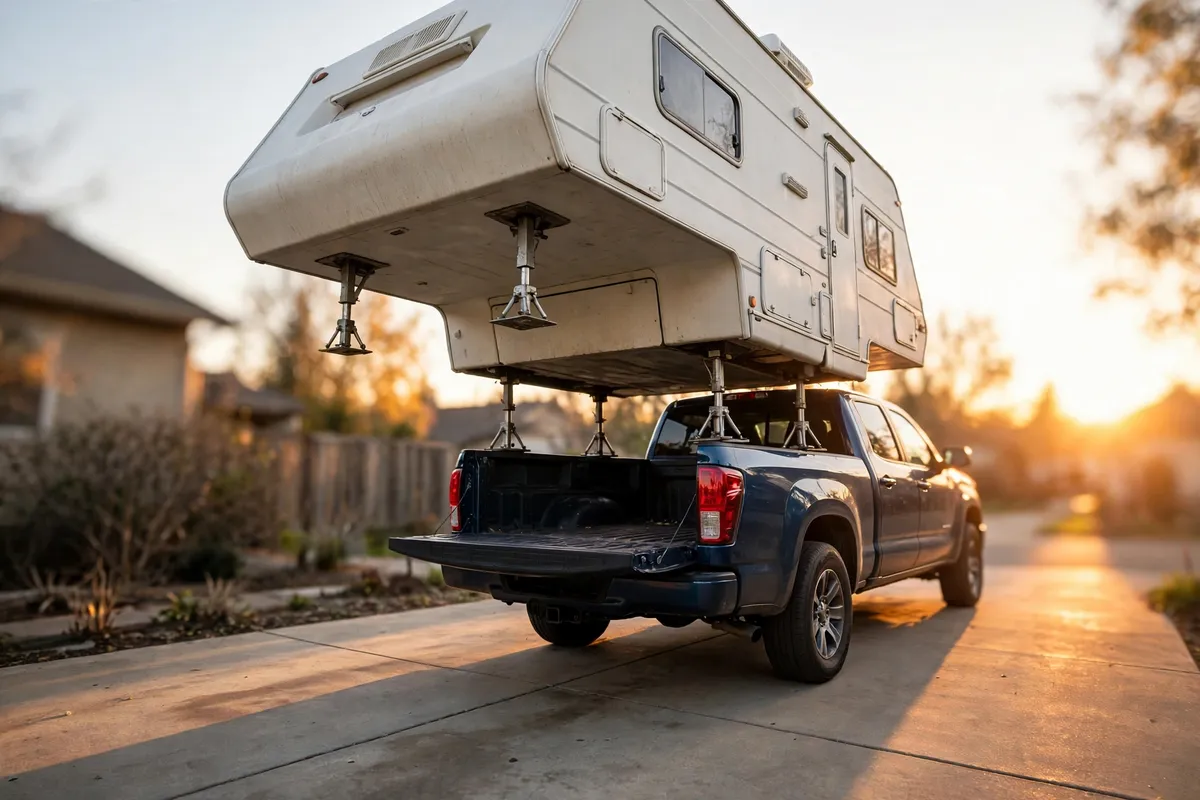
A truck camper off the truck is a tall box with a high center of gravity standing on four (sometimes three) spindly legs barely wider than the truck bed. Your camper might weigh 2,000 to 4,500 pounds — find your real loaded number with our truck camper payload calculator guide — and every pound of it is balanced on jack feet totaling maybe eight square feet of contact.
The Happijac owners manual puts it bluntly: you are moving a dynamic load weighing thousands of pounds, and as you change levels you shift hundreds of pounds from corner to corner.
Here’s the insight most generic loading guides skip: camper jacks are designed for vertical load, not shear. Truck Camper Magazine lists Happijac and Rieco-Titan corner jacks at roughly 1,500 to 2,800 pounds of vertical capacity per jack — plenty for a straight lift. But an owner on the WanderTheWest forum, describing a near tip-over during a dolly-to-truckbed switchover on a slightly sloped driveway, put it in words I never forgot: the jacks are not meant for any shear stress. Any sideways push — a fender bump, a gust, the camper walking on slick pads — loads those thin legs in a direction they were never built to handle.
The Nose-High Rule (And Why It Is Not Optional)
Every major jack manufacturer’s manual agrees on one thing, and it’s the single most important sentence in this article: keep the front of the camper four to six inches higher than the rear, throughout the entire loading and unloading process, and never let the rear get higher than the front.
The official Happijac owners manual spells out the sequence: raise the front four to six inches higher than the rear, keep that differential until the camper rests on the bed, get the camper floor at least three inches above the bed rails, back under slowly, and lower it so the rear contacts the bed first. Unloading runs the same rule in reverse: front up four to six inches, lift clear of the bed by three to four inches, drive out.
Why does it matter so much? Gravity. A nose-high camper, once it touches the bed, wants to settle gently backward into the truck. A rear-high camper wants to walk forward toward your cab, or pivot and twist the jack plates.
The Story Every Solo Loader Should Read First
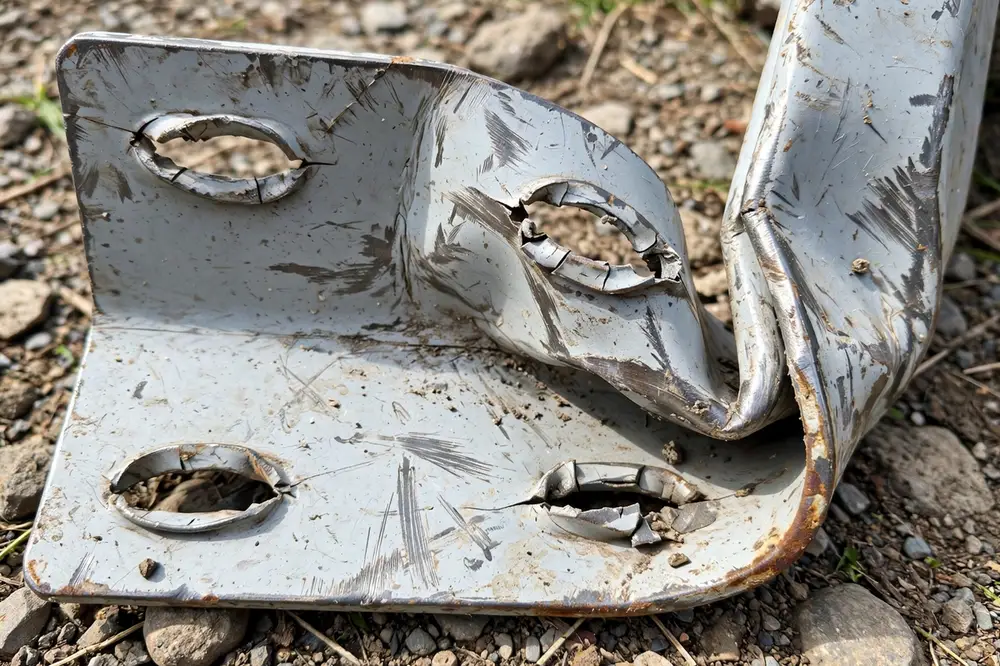
On the WanderTheWest forum, in a thread called “Rules for loading a camper,” a member named Kevin shared what happened when he loaded his camper on his own and barely touched the side of it while backing in. The camper started falling backward, away from the truck. It twisted all three of his jack plates and ended up teetering half on, half off the bed — he described himself as a hair’s breadth away from dumping it on its roof.
He recovered the only way you can: he braced the rear with a farm jack (a Hi-Lift), straightened the jack plates with brute force, and backed under a second time with the farm jack staged behind the camper as a backstop. Then he rewrote his own rules: level concrete, always have someone guide you, handle everything with kid gloves, and add a fourth jack on the corners.
The part of Kevin’s story that stays with me isn’t the twisted metal. It’s the trigger. He didn’t ram the camper. He just touched it. A sideways nudge at truck-bed height on a top-heavy box is all it takes — remember the shear-stress problem. That is why the experienced owners in that thread converge on the same three commandments: level ground, preferably concrete; always have a spotter; and treat the whole operation like it’s made of glass.
How to Load a Truck Camper by Yourself
So yes — you can do this alone. Owners report loading solo in about twenty minutes once they’ve done it a few times. But solo means you are both driver and spotter, so build the spotter’s job into your process.
Pick your ground like it matters, because it does
Find the flattest, hardest surface you can — level concrete is the gold standard. The Happijac manual says to load on basically level ground and to put 12-inch square, 3/4-inch plywood pads under each jack foot so they can’t sink into soft ground, sand, or hot asphalt. A jack foot that sinks an inch on one corner is the same as cranking that corner down an inch — you’ve just shifted hundreds of pounds of load sideways onto the other legs.
Raise it nose-high, and mark your height
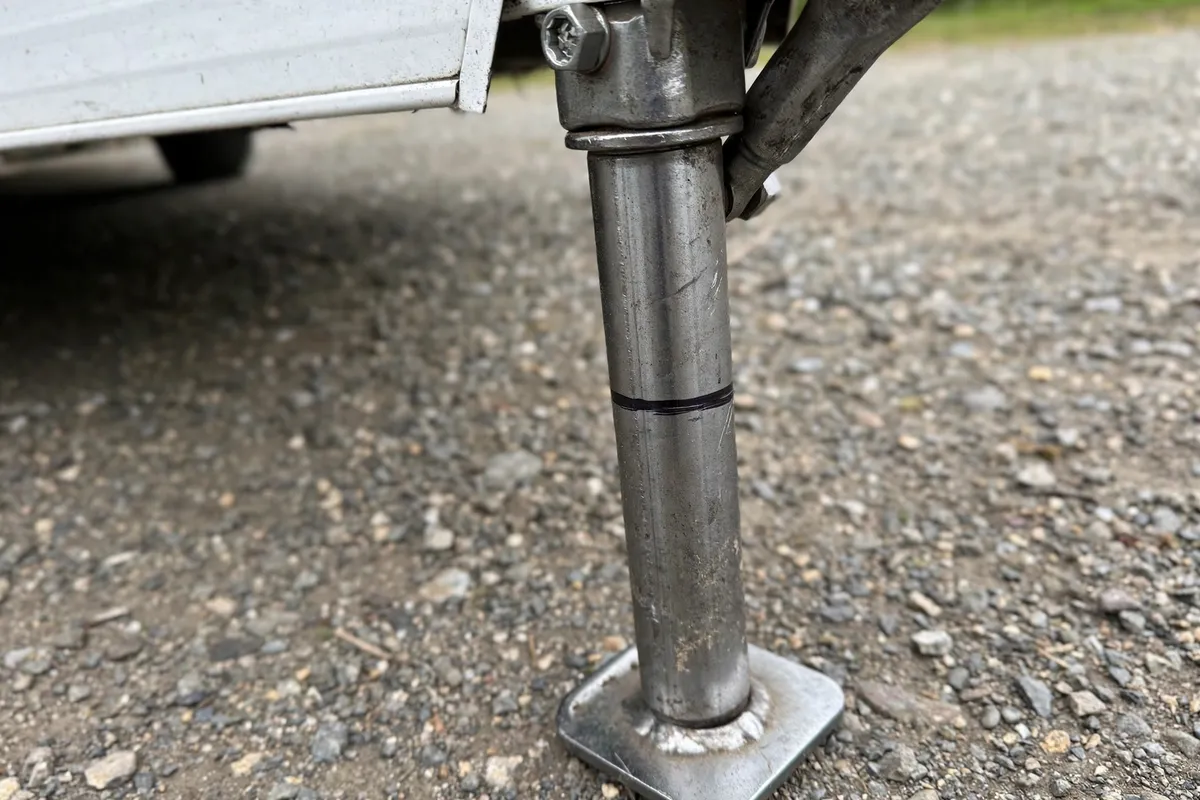
Run all four jacks down to the ground first, then raise the front four to six inches higher than the rear, working front to back in small increments and checking that the camper stays level side to side. Here’s a trick from the WanderTheWest forums I wish I’d learned on day one: once the camper is at the right loading height, mark the jack legs with a permanent marker. Next time you skip all the eyeballing about whether you’ll clear the bed rails.
If you’re new to this and the whole rig feels intimidating, there is no shame in starting lighter. Our roundup of the best lightweight truck campers for 2026 includes pop-ups and hardsides that are far easier to load solo than a 4,000-pound slide model.
Line up the truck before you move
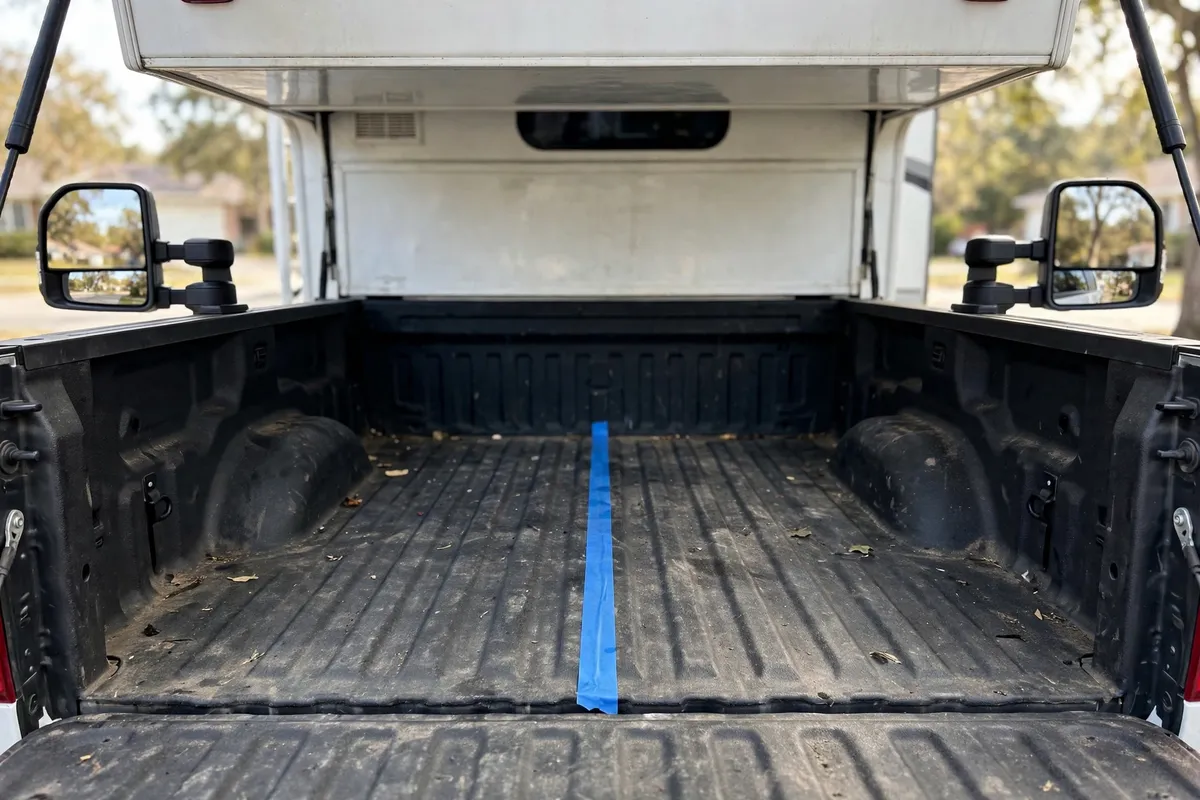
This is where solo loading differs from loading with a spotter. You can’t see the camper from the driver’s seat, so give your future self reference marks. Owners on the forums swear by a strip of blue painter’s tape down the centerline of the truck bed and another on the center of the camper’s front wall — line them up in the mirror and you’re centered. One owner adds: when you’re lined up correctly, you should not be able to see the rear jacks, because the front jacks block your view of them. Start your approach from farther back than feels necessary; it gives you room for small steering corrections.
Tuck the wiring harness out of the way before you start backing — a snagged harness stops a load cold — and get out and walk around when you’re about two-thirds of the way under, before the wider rear section. Check your left-right clearance (a couple of inches per side), then duck down at the back and confirm the rear of the camper clears the bed rails too. As the forum veterans say: do. Not. Be. In. A. Hurry.
Lower it rear-first, then walk away from the jacks
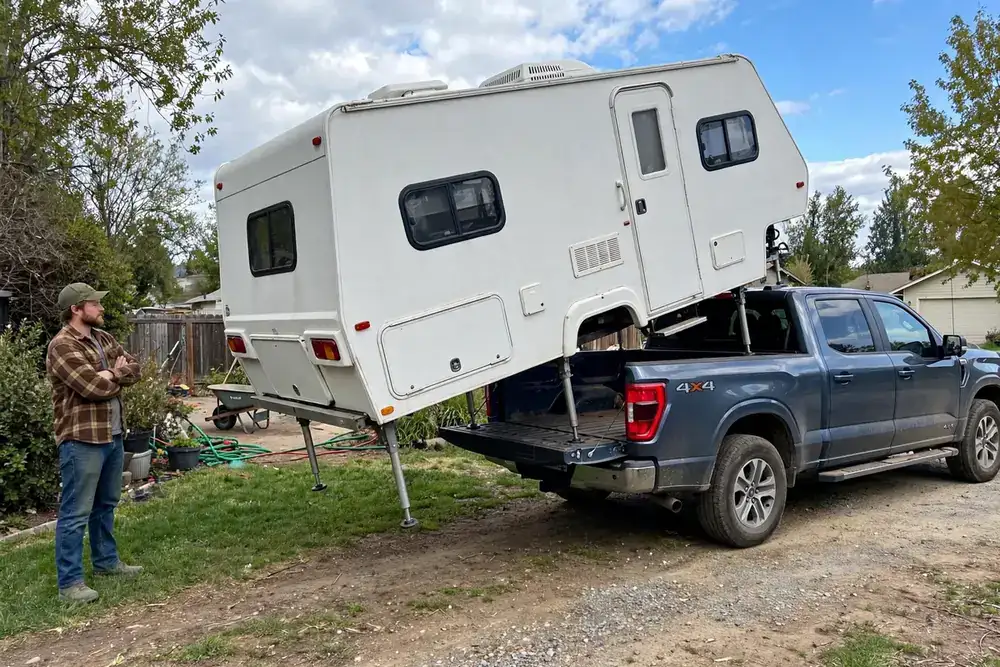
Once the truck is fully under, lower the camper in small increments, keeping that nose-high attitude until the rear of the floor touches the bed first — rear-first contact keeps the cabover from kissing your truck’s cab. Then retract all four jacks fully. As you lower it onto the bed, expect the truck’s suspension to settle a bit; if your rig squats noticeably, our comparison of airbags vs Timbren vs SumoSprings will help you sort out the right support setup.
One more solo-loader hack from YouTube: a creator known as the Wrenching Realtor demonstrates a DIY centering setup using inexpensive boards as guides, so the camper funnels itself into alignment as you back under.
Unloading Solo: Same Rules, Reversed
Unloading is loading played backward, and the nose-high rule still governs. Disconnect the tie-downs and the electrical connection first, run all four jacks to the ground, then raise the front four to six inches higher than the rear. Lift the camper clear of the bed by three to four inches, drive the truck forward slowly, and lower in small increments, keeping everything level side to side.
Two unloading mistakes I see constantly: cranking one jack way up before touching the others (no single jack can take a shifted load — work corner to corner in small increments), and leaving the camper sitting high on its jacks for weeks. When the camper is on the jacks alone and you’re not actively loading or unloading, store it as close to the ground as possible for maximum lateral stability — or lower the floor onto cribbing, sawhorses, or heavy pallets and let the jacks just touch for insurance.
And here is a hard rule, not a suggestion: do not go inside the camper while it’s sitting on its jacks alone. An iRV2 veteran says he has seen all four jacks torn clean out of a camper’s framework by people who ignored this. The floor of a truck camper is designed to be supported by the truck bed, not to hang between four legs. If you’re just getting started with the whole truck camping thing, our beginner’s guide to truck camping covers the full setup sequence so unloading day isn’t your first surprise.
Wind: The Invisible Hand on the Camper
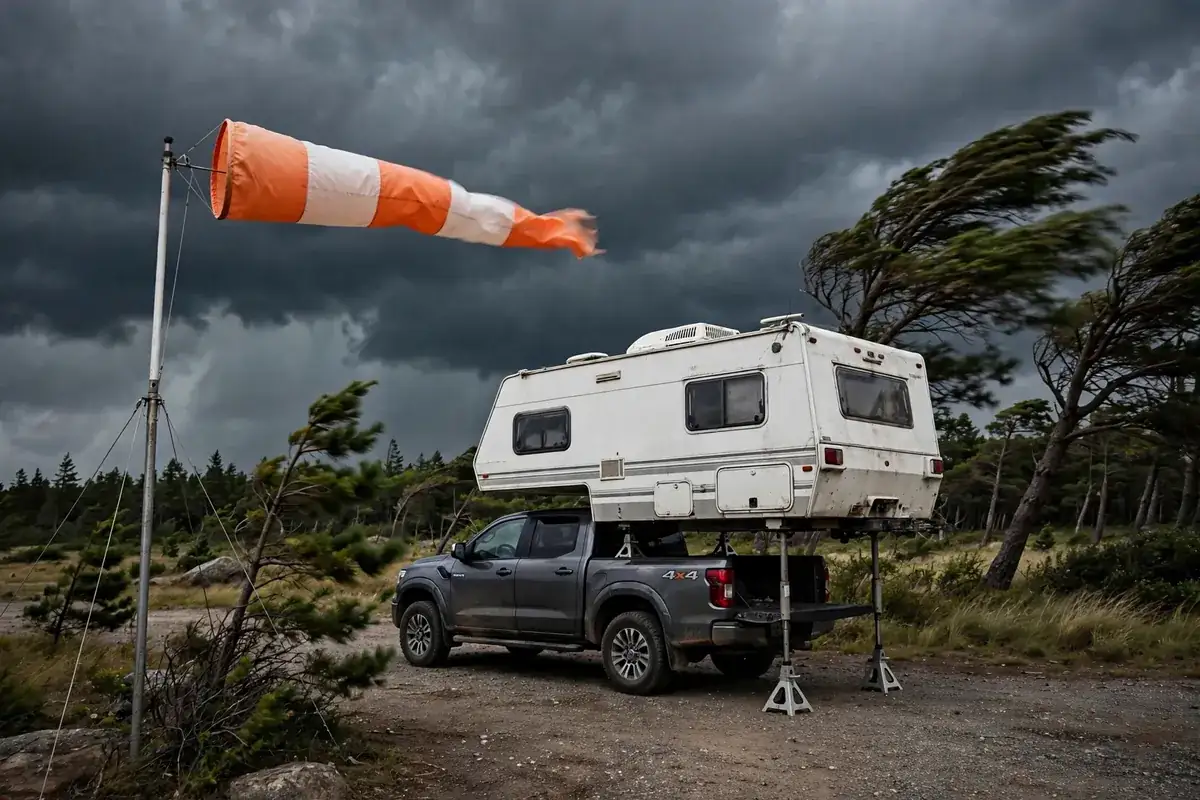
Wind is the one loading hazard you can’t see coming in the mirrors. A truck camper at jack height is a giant sail, and the numbers are sobering.
An owner on the WanderTheWest forum did the back-of-the-envelope physics on his Northern Lite: two 200-pound people sleeping in the cabover used only about twenty percent of the tipping moment — comfortable margin. But adding the wind load of an 80 mph gust hitting the rear wall with the camper at truck height put him right at the tipping point. His conclusion: lower the camper as far as possible whenever high wind is around. That was one owner’s calculation from published weight and center-of-gravity figures, not an engineering stamp — but the direction of the answer is what matters.
The manufacturers are blunter. Torklift’s blog warns that a camper in storage can be hit with 60 mph winds — without proper support you risk jack or frame damage, or the camper tipping over completely. The Happijac manual says to use extreme caution when the wind is blowing and to avoid storing the camper in windy, unsheltered areas.
My personal rule, built from those sources and a couple of white-knuckle afternoons: if gusts are hitting 25 to 30 mph, I do not load. I wait. A camper that weighs two tons still dances on its jacks in a real gust, and no schedule is worth a tipped camper.
When to Abort and Wait for Help
This is the section the generic guides never write, and it’s the most important one. Abort — lower the camper back down, chock everything, walk away — if any of these show up:
The camper moves on its own. If a jack foot slides, a jack plate twists, or the whole box walks sideways on its pads, stop cranking immediately. Do not try to chase it with the jacks. Lower it back to the lowest stable height and reassess. If jack plates are already twisted like Kevin’s were, straighten them before the next attempt.
The ground is lying to you. Soft asphalt on a hot day, a gravel pad that slopes more than it looked, a crowned driveway — any of these turn a vertical lift into a slow sideways slide. If a jack foot is sinking, stop and get pads under it before continuing.
You can’t see what’s happening. Solo loading lives or dies on visibility. If the sun is in your mirrors, it’s getting dark, or you cannot confirm your alignment, that’s not a cue to go faster and hope. Pull forward, get out, look — and if you still can’t verify it, wait for daylight or a second set of eyes.
The wind picks up mid-load. Lower the camper back down. Partially loaded is the most vulnerable state — the truck isn’t fully under it yet, so there’s nothing to catch it.
You’re tired, rushed, or frustrated. Almost every loading disaster story starts with somebody rushing. If you’ve already had one scare today, your judgment is compromised. Come back tomorrow.
And the absolute non-negotiables: never stand under a raised camper, never put any part of your body where the camper would land if a jack folded, and never try to catch a falling camper. Get clear, let it fall, and deal with the aftermath from a safe distance. A camper can be repaired. You can’t.
If much of your camping is solo, our truck camper security guide covers keeping the rig safe when you are on your own.
After It’s On: Clearance, Tie-Downs, and Storage
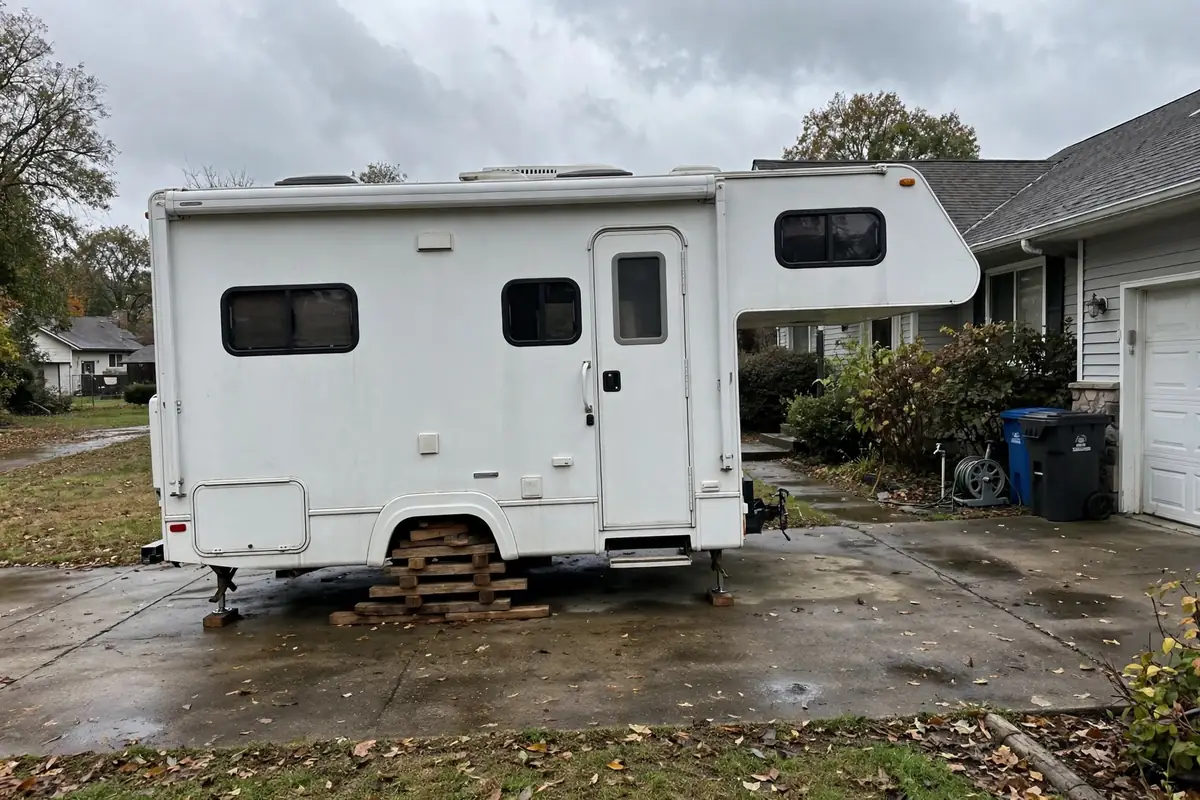
Before you celebrate, check clearance between your jacks and your tie-downs. A YouTube creator’s video titled “Disaster Loading Our Truck Camper with Brophy Tie-Downs” documents a three-hour ordeal getting the camper to fit between the jacks because of aftermarket tie-down interference. Every time you change tie-down hardware, verify the camper clears it before you back under.
For storage between trips, remember the golden rule from the Happijac manual: never leave the camper elevated on jacks. Lower it to the ground or onto fixed platforms like sawhorses. Torklift’s guide to supporting an off-loaded camper echoes it — they call out 60 mph winds as a storage tipping risk and recommend proper structural support over DIY cribbing.
If you do use the camper off the truck for short stretches at camp, Torklift’s FastGun Wobble Stopper braces connect the front jack legs to the camper body to cut sway and jack stress. And if the whole four-corner-jack dance is the part you dread most, the integrated Stable-Lift jack and tie-down system replaces corner jacks with a powered lift frame.
Loading a truck camper by yourself isn’t really about strength or technique. It’s about respect for the physics, patience with the process, and the humility to stop. The owners who’ve been doing this for decades all say the same thing: level ground, nose-high, kid gloves, no hurry, hard line on wind. Learn it from them now, and you’ll never learn it from a twisted jack plate.
Frequently Asked Questions
Can you really load a truck camper completely by yourself?
Yes — owners do it solo regularly, and experienced solo loaders report the whole process taking about twenty minutes. The Happijac manual does recommend a spotter when possible, and solo loading means building the spotter’s checks into your routine: verify alignment at least once mid-approach, use tape reference marks, and never rush a step you can’t see from the driver’s seat.
Why does the front of the camper need to be higher than the rear?
The Happijac owners manual requires the front to stay four to six inches higher than the rear throughout loading and unloading — never rear higher than front. A nose-high camper settles backward into the truck bed under gravity when lowered. A rear-high camper wants to walk forward toward the cab or twist the jack plates, which is how tip-overs start.
What wind speed is too much for loading a truck camper?
No manufacturer publishes a hard wind limit for loading, but the guidance converges: Happijac says to use extreme caution when the wind is blowing, and Torklift warns that 60 mph winds can tip a camper sitting on its jacks. One owner’s calculation put an 80 mph gust at truck height near the tipping point. Practical rule: don’t load in gusts above roughly 25 to 30 mph — and if wind picks up mid-load, lower the camper and wait.
What should I do if the camper starts tipping on the jacks?
Get clear immediately — never try to catch a falling camper or put your body under it. Once you’re safe, lower the camper to its most stable height if you can do so without going under it, assess damaged hardware from a distance, and call for help rather than improvising a rescue lift alone.
Can I go inside the camper while it’s sitting on the jacks?
No. Camper floors are designed to be supported by the truck bed, not suspended between four jack legs. Experienced owners on iRV2 report seeing all four jacks torn out of camper frameworks by people who camped in campers supported on jacks alone. Lower the floor onto solid cribbing or platforms and keep the camper as low as possible.