Truck Camper Jacks Electric vs Manual Maintenance and What to Do When One Fails
I learned to respect truck camper jacks the day I watched a camper lean just enough to make my stomach drop. Nothing had broken yet. One foot had found soft ground, one leg was carrying more than its share, and the whole box was quietly telling me I had rushed the setup. Truck camper jacks look simple — four legs, a motor or a crank, up and down — until one stops, bends, or sinks. Then they become the most important gear on your rig.
This guide covers choosing, maintaining, and rescuing those jacks. It is not another loading walkthrough. For the solo loading sequence itself, read our guide to loading and unloading a truck camper solo. What follows covers which system suits your camper, how much it can lift, how to keep it working, and what to do when it does not.
Safety first: a camper on truck camper jacks is not a building
A camper on its jacks is tall, heavy, and balanced on four narrow points. Never get under a camper supported only by its jacks, never work underneath it, and never let anyone else do so while it is up in the air. If work underneath is needed, the camper belongs back on the truck, or properly supported on solid blocking at ground level by someone qualified.
Never sleep in a camper left high on fully extended jacks if you can avoid it. Lower it as close to the ground as you safely can, keep the front very slightly higher than the rear while lifting or lowering, and stop immediately if anything binds, leans, or moves unevenly. A jack problem rarely improves if you push through it.
Disclaimer: This is general owner guidance, not a substitute for your jack manufacturer’s manual. Follow the manual for your exact model, especially for weight limits, extension limits, and electrical work. If you are unsure, stop and get a qualified RV technician involved.
What truck camper jacks do — and do not do
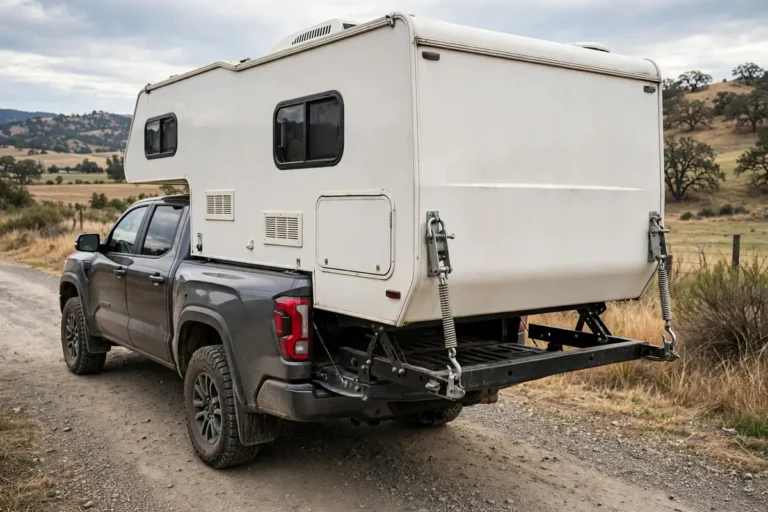
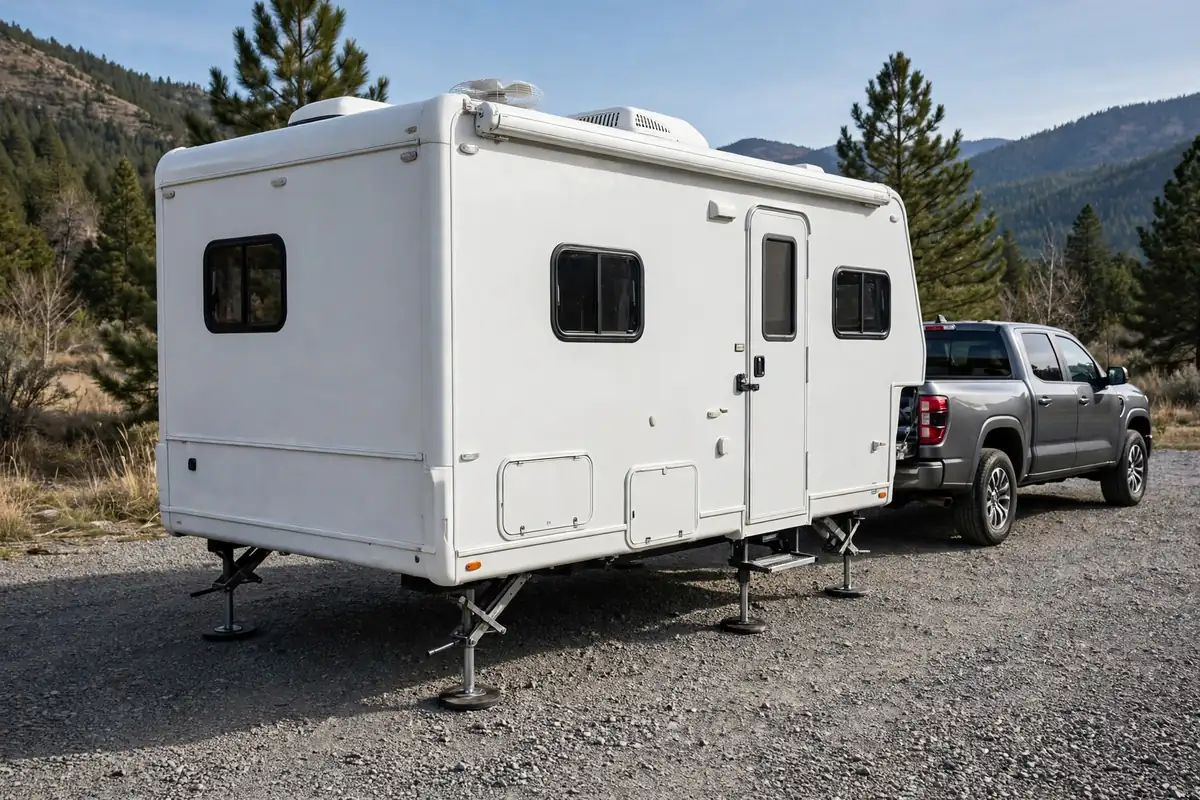
Truck camper jacks lift the camper clear of the truck bed so you can drive out from under it, hold it while it is off the truck, and let you fine-tune its level. They are not a foundation, and they are not meant to lift your truck. Trying to jack the truck up with camper jacks, or forcing a badly out-of-level camper level with them, is how legs bend and brackets tear.
Manual vs electric vs hydraulic jacks
Manual jacks are cranked by hand, usually with a handle or a drill attachment. Their virtue is simplicity: no motor to burn out, no control board to fail, and no remote battery to die at the worst moment. The downside is time and effort. Four corners, one at a time, in small increments, is real work on a heavy camper. Manual jacks suit lighter campers and owners who rarely take the camper off.
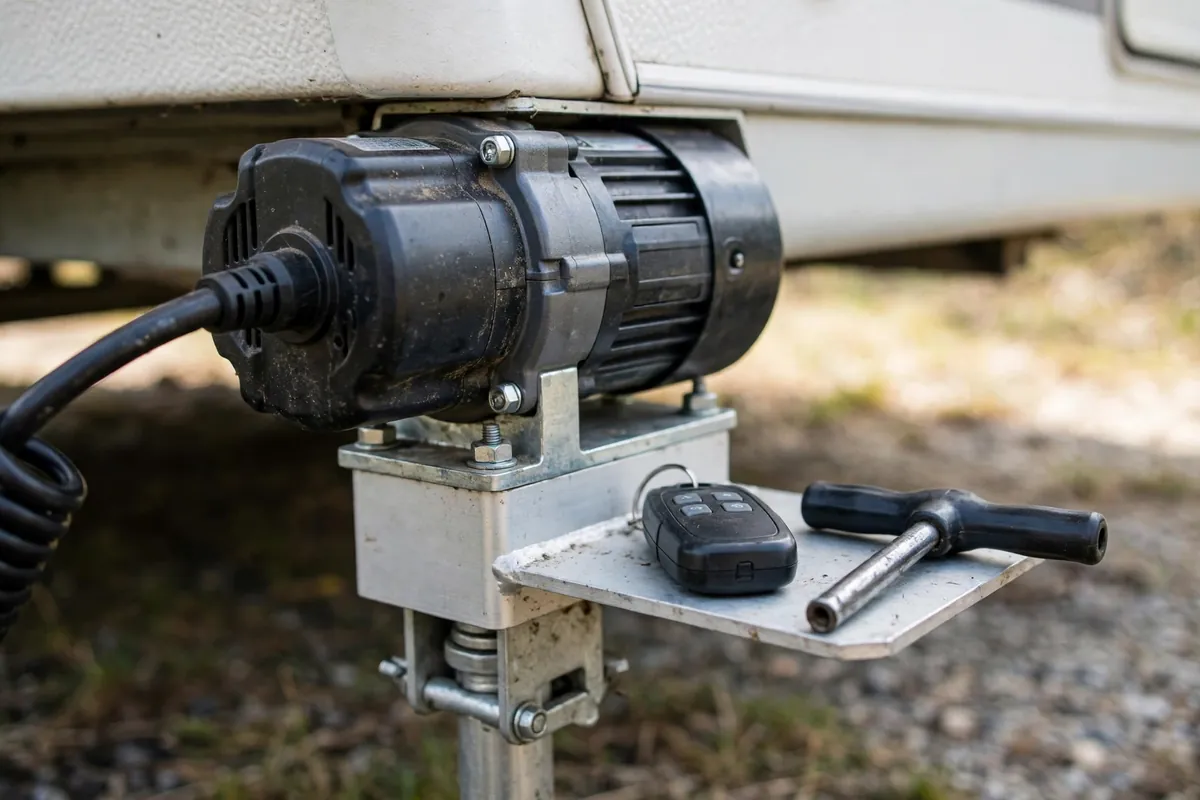
Electric jacks use a motor on each leg, run from the camper or truck battery, and operated by switches or a wireless remote. You can run all four together or one at a time, which makes levelling far less tedious. For a heavy camper, or for anyone who takes the camper off often, this changes how often you bother to free up the truck. The trade-off is electrical complexity: a weak battery, corroded connection, or long, thin wire run can make a healthy jack look dead. HappiJac and Rieco-Titan both offer manual-to-electric conversion kits for their own mechanical systems, but check compatibility by exact series. Keep the battery charged and a manual override plan ready.
Hydraulic jacks lift with fluid pressure rather than a screw. The motion is smooth and powerful, and some integrated systems can load a camper in a couple of minutes. Stable-Lift is the best-known example: a frame-based system that also replaces conventional tie-downs and turnbuckles on compatible campers. Hydraulics bring different worries — seals, hoses, fluid level, and leaks — and are less of a driveway DIY job than swapping a screw leg.
HappiJac vs Rieco-Titan, and the Torklift confusion
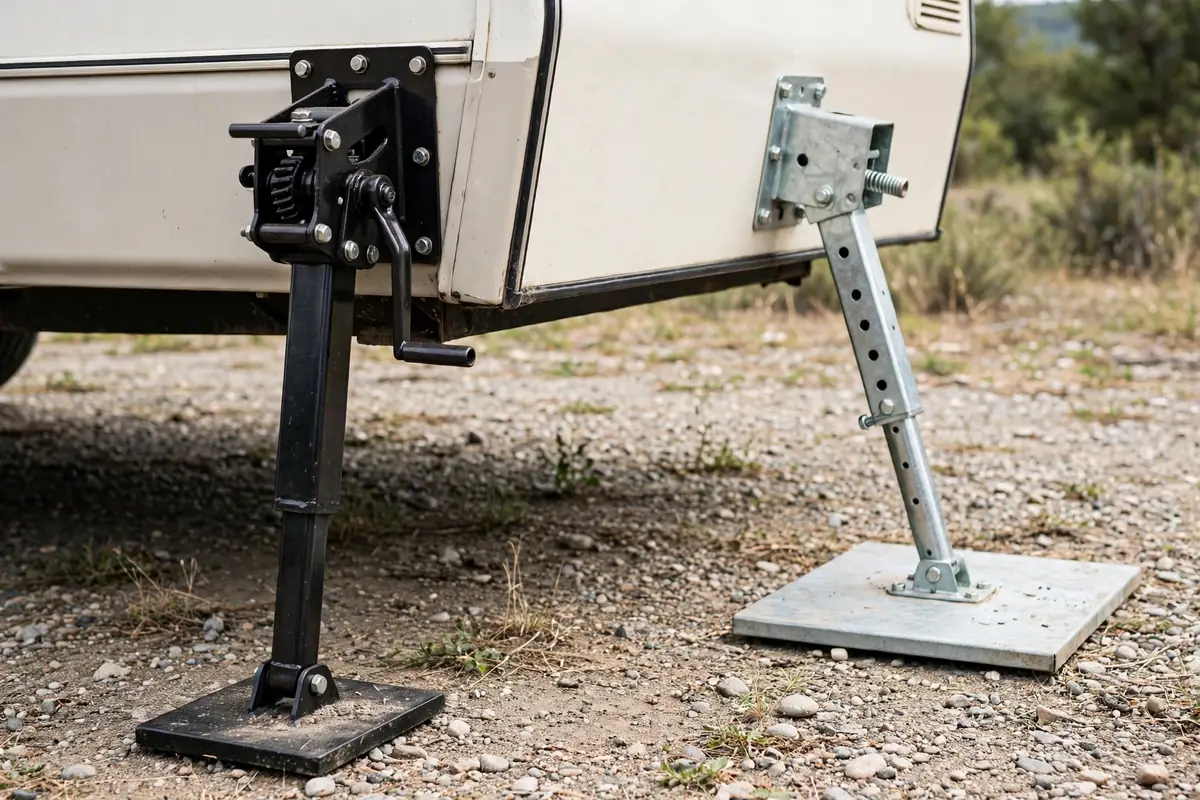
HappiJac, now a Lippert brand, is the most common name on factory campers. Its jacks use 2-inch square tubing, powder-coated inside and out for corrosion resistance. HappiJac makes both acme screw and ball screw jacks; the acme design uses a polished steel screw and a self-lubricating nut, plus a redundant safety nut meant to catch the load if the main nut fails. See the manufacturer’s overview on the Lippert HappiJac page.
HappiJac’s range is generally described as 1,500 to 2,800 pounds per jack. Two common legs show the spread: the 4220 series leg is rated around 2,200 pounds with about 34.5 inches of lift, while the heavier 4820 series leg is rated around 2,800 pounds with about 36.5 inches of lift, extending to around 51 inches. A four-leg set built around the heavier legs is therefore rated in the region of 11,200 pounds as a system, but load is rarely shared perfectly, so per-leg rating and bracket condition matter as much as the total.
Rieco-Titan is the other giant, and many experienced owners regard its jacks as the toughest in the category. Its electric system is rated at 2,500 pounds per jack, with a net camper weight rating of 6,000 pounds for a four-jack set, and about 36 inches of lift, according to the company’s own Rieco-Titan electric jack instructions. Its manual any-corner jacks are commonly rated at 2,000 pounds per jack. Rieco-Titan brackets also share a bolt pattern with discontinued Atwood jacks, so a single failed Atwood leg can sometimes be replaced without re-drilling, though you must confirm compatibility for your exact Atwood control setup. Truck Camper Magazine’s overview of Rieco-Titan, HappiJac, and Stable-Lift jack systems puts both brands in the same 1,500 to 2,800 pounds per jack range.
One correction many articles get wrong: Torklift does not make camper jacks. It makes frame-mounted tie-downs and FastGun turnbuckles that hold the camper to the truck while you drive. That system still matters to jack health, because a camper that shifts on loose turnbuckles puts repeated stress on jack brackets. Our comparison of tie-downs and turnbuckles explains how it works. Buy by loaded weight with margin, lift height to suit your truck bed plus clearance, and bracket fit — not by brand reputation alone.
Weight ratings and lift height: three mistakes owners make
First, adding up four per-leg ratings and treating that total as the safe camper weight. It is a ceiling, not a working load. If one leg is on soft ground or the camper is out of level, one leg can briefly carry far more than its quarter share. Leave margin and keep the camper as level as you can while lifting.
Second, ignoring lift height. Measure from the ground to the underside of the camper on the truck, add bed side height and any bed mat, and add clearance for wheel wells and tailgate hardware. A jack lifting 36 inches sounds generous until a tall truck needs nearly all of it, and maximum extension is also maximum wobble. Shorter extension is more stable extension.
Maintenance that actually prevents failures
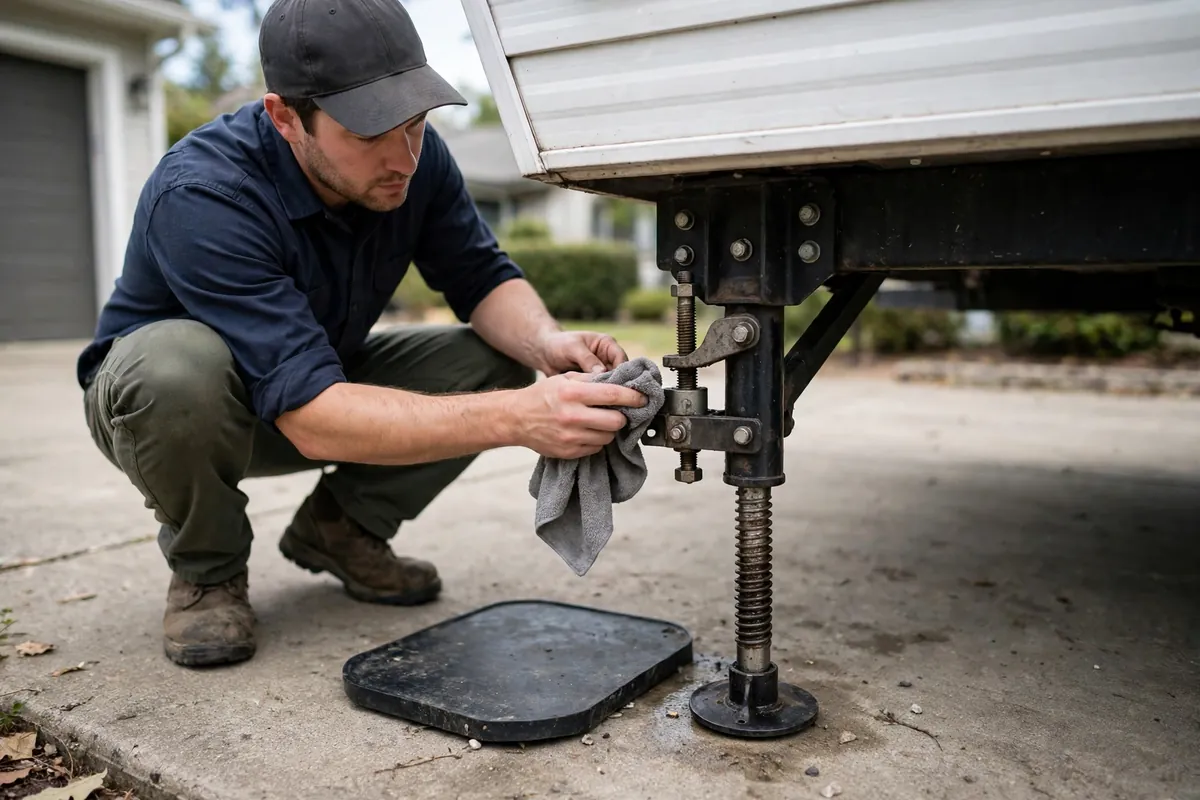
Most jack failures are slow problems that were easy to see months earlier. A good routine takes less than an hour a season. Inspect all four legs, footpads, brackets, and bolts for bends, dents, rust, and cracked paint. A cupped HappiJac foot or a wide Rieco-Titan foot spreads load better than a small, bent, or missing pad. A bracket that flexes is telling you the load path is wrong, and tightening the bolt harder will not fix a cracked mount.
Clean the exposed screw and tube before you lubricate it. Greasing over grit just makes grinding paste. Use the lubricant your manufacturer recommends. HappiJac’s acme nut is described as self-lubricating, which does not mean never inspect it.
For electric jacks, maintenance is mostly electrical. Clean battery terminals and jack connectors, look for green corrosion, chafed wires, and loose grounds. Find the manual override in the driveway, in daylight — not in a dark campground. For hydraulic systems, check fluid level, look for weeps at fittings and seals, and wipe shafts clean before retracting them. Fold this into our broader truck camper maintenance schedule each season. Dirt dragged past a seal on retraction is how seals fail early.
Owners on forums report a habit worth copying: for a longer off-truck stay, they lower the camper onto solid blocking under the base rather than trusting the jacks alone for days, and several say they started doing it after a jack failed or sank on them once.
Common failures, and what each one tells you
If the motor hums or clicks but the leg stays put, suspect a stripped gear, jammed screw, broken shear pin where fitted, or a leg bent just enough to bind. If the leg retracts but will not extend, or the reverse, owners on forums report that the control board or polarity-reversing circuit is a common culprit, especially when two jacks fail in the same direction at the same time. The field fix owners describe, which can get you moving in an emergency, is to bypass the control board and power the motor directly from a 12-volt source with jumper wires, reversing the wires to reverse direction. Only do this if you understand the wiring and can avoid a short, and stop the moment the leg binds. This is a get-home measure, not a repair.
Slow and noisy usually means low voltage, a tired motor, dry or dirty threads, or a leg carrying more than its share because the camper is out of level. Check battery voltage under load and clean connections first. A motor that repeatedly overheats and cuts out is protecting itself — let it cool, reduce the load, and do not keep hammering the button.
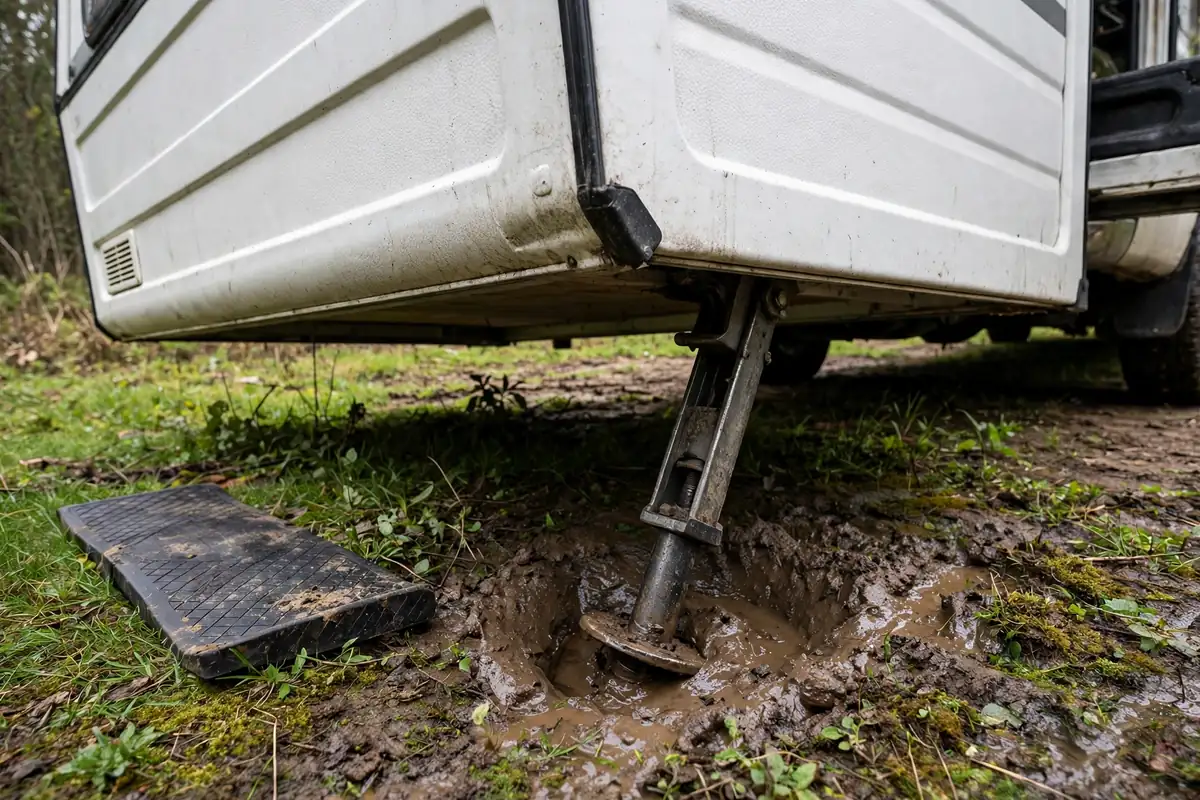
A bent leg is a retired leg. Do not straighten a bent screw jack tube and put it back into service. The same applies to a leg bent by driving off with a jack still down — a mistake owners on forums admit to more often than you would think, usually with sheared bracket bolts as the calling card. Replace the leg and inspect the bracket and camper wall. If the camper leans but no leg looks bent, check the ground first: a foot sunk an inch on one corner looks exactly like a failing jack from inside. Lower, move to firmer ground or add wide pads, and re-lift in small, even increments.
Over-retraction is a known HappiJac headache in owner reports: power or crank past the limit and the inner leg can drop or jam, leaving a leg that feels loose and will not drive either way. Stop, disconnect power, and do not force it with a drill. Damaged threads mean replacement. A jack that will not retract the last inch is often simpler — dirt on the shaft, a bent foot, or debris at the pad. Clean it, clear it, and try again. Do not drive with a jack hanging low.
When one jack fails with the camper off the truck
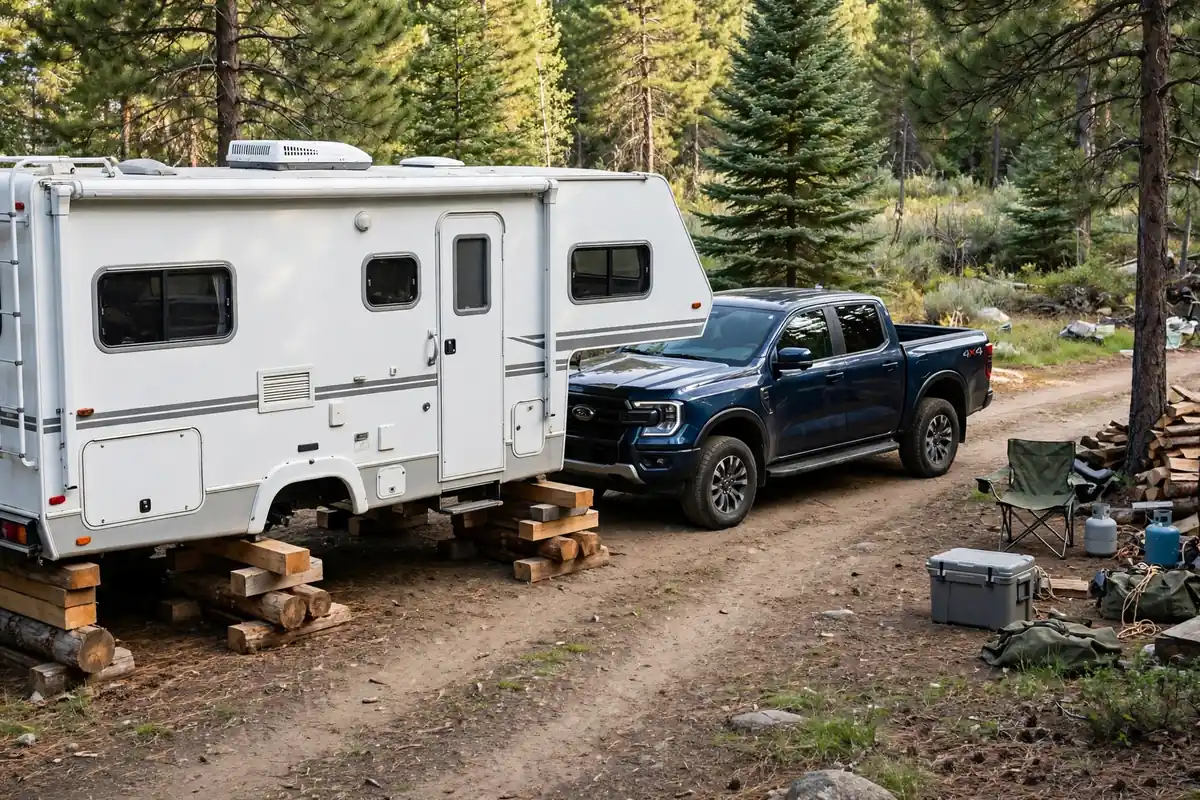
Stop. Do not keep lifting the other three legs to compensate — that increases twist and load on the failed corner. Get everyone out of the camper and clear of the fall zone. Do not go under the camper to look.
If you can lower safely, lower in small, even steps. A bottle jack and solid cribbing can temporarily support a corner, but only on firm ground, with the load spread, and never with anyone under the camper. If the camper is stuck off the truck and cannot be lowered safely, the safest move is often to bring the truck back under it, raising the good legs just enough, in small increments, to clear the bed. If you cannot do that without dangerous lean, stop and call a mobile RV technician or a tow service with camper experience. Do not drive with a failed jack hanging, dragging, or tied up with rope.
Extensions, blocks, and soft ground
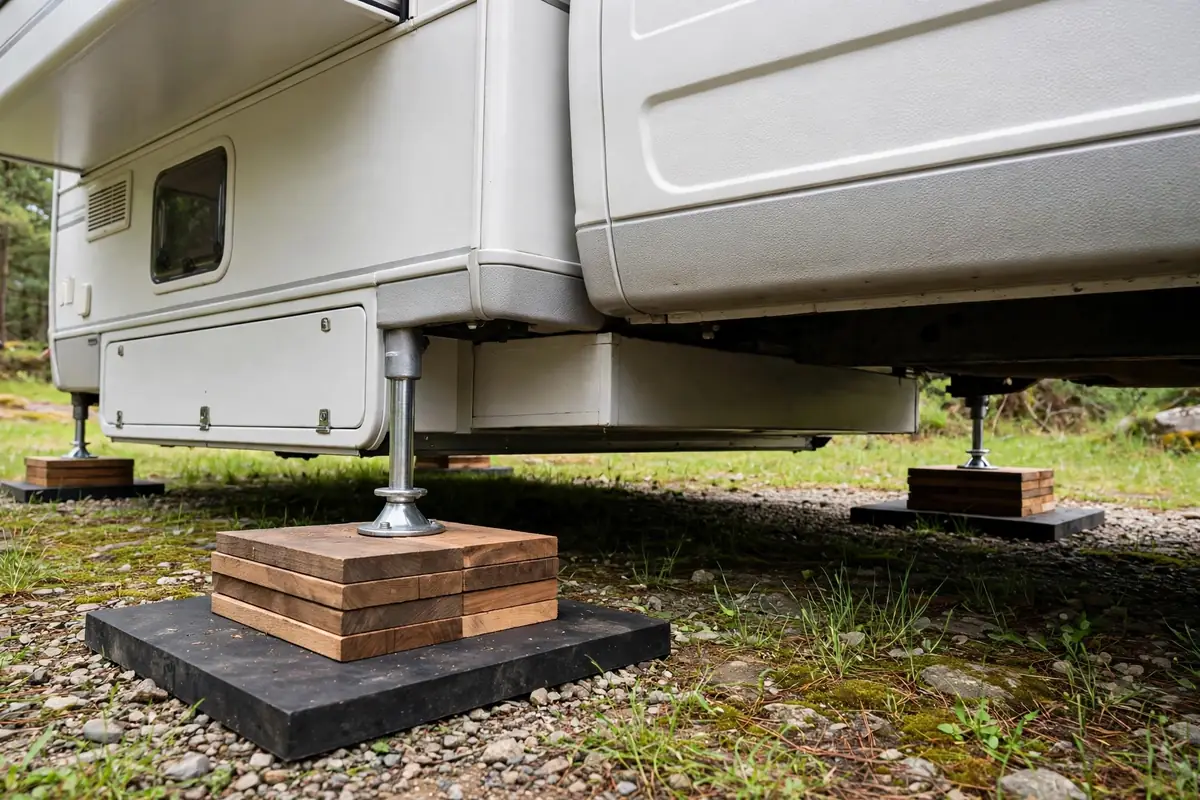
Rieco-Titan’s own electric jack instructions warn not to place blocks under jacks for additional lift or clearance. That warning is about height. Stacking blocks to gain lift makes a tall, narrow, unstable tower on a surface that can shift or crush. Manufacturer extensions, swing-out brackets, and longer legs exist for height problems. Tall cribbing is not a substitute for the right leg length.
Wide pads for soft ground are a different job. A broad footpad, a purpose-made jack pad, or flat plywood or hardwood spreads the load so the foot does not punch into mud, sand, or soft grass. Keep the pad flat, wide, and centred under the foot. Owners on forums report the same lesson repeatedly: a foot that sinks drags dirt into seals and threads on retraction, and a leg that sinks unevenly twists the whole camper.
Use blocks under the truck tyres or camper base to get close to level before leaning on the jacks, rather than extending one jack to its limit for a slope. Our guide to levelling on uneven ground covers that approach. On a slope, owners on WanderTheWest report another risk: jacks can slowly walk downhill, especially on loose gravel or wet grass. Keep the camper low, on wide pads, and braced where possible.
Replacement cost and effort: the honest picture
A single replacement screw jack leg from HappiJac or Rieco-Titan is commonly several hundred dollars from a retailer, before shipping and brackets. A full four-leg manual set costs less than a full electric set, and a manual-to-electric conversion kit sits between them — retailer and guide ranges I checked put electric kits broadly in the low four figures, with more advanced systems higher. Stable-Lift and other integrated systems are the premium end: guide ranges put them broadly around $3,600 to $4,000 before installation and shipping, while an older manufacturer-linked report put a three-jack system around $2,895 plus installation. Treat these as planning ranges, not quotes, because prices move and fit changes the price.
Swapping one corner leg on a camper safely on the truck, with the bracket intact and bolts accessible, is a manageable DIY job: support the corner, unbolt the old leg, bolt on the new one, check wiring, and test unloaded before trusting it loaded. Replacing a whole system, rewiring a control box, or fitting an integrated frame is a bigger job, often a full day or a shop visit.
FAQ: truck camper jacks
What do I do if one electric jack stops working?
Stop lifting, get everyone clear, and check battery charge, fuses, connectors, and whether the other legs work. If the motor runs one way only, the control board or wiring is a likely suspect. A direct 12-volt jumper to the motor can be an emergency get-home measure for owners who understand the wiring, but it does not fix the fault. If the leg is bent or the camper is leaning dangerously, lower it safely if you can, get the truck back under it if you can do so safely, and call a mobile technician if you cannot.
How much weight should my truck camper jacks handle?
Size for loaded weight with margin, per-leg rating first. HappiJac legs run about 2,200 to 2,800 pounds each; Rieco-Titan electric legs are rated at 2,500 pounds each, with a 6,000-pound net camper weight for a four-jack set.
Can I use blocks under my jacks on soft ground?
Use wide, flat pads to spread the load on soft ground. Never stack blocks to gain extra lift height.
The bottom line
Good truck camper jacks are boring in the best way: they go up evenly, they hold steady, and they come down without drama. That reliability comes from buying enough capacity and lift, doing the seasonal checks, and stopping the moment something feels wrong. Keep them clean, level, and low off the truck, and never trust them with your body underneath.