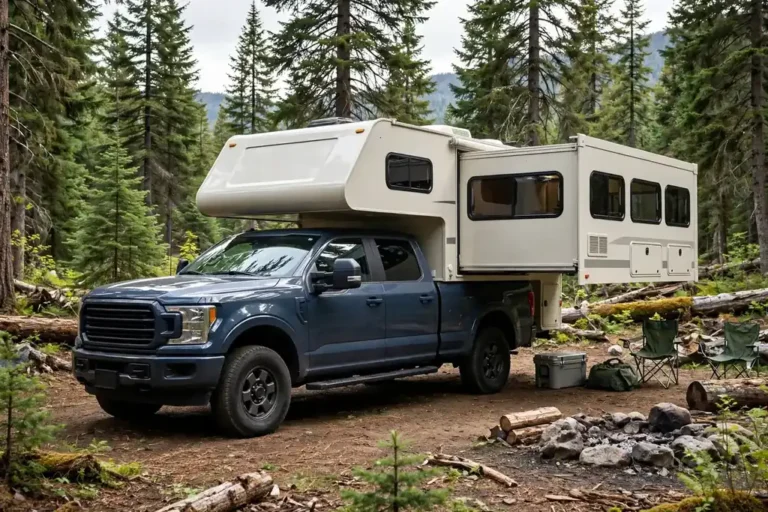
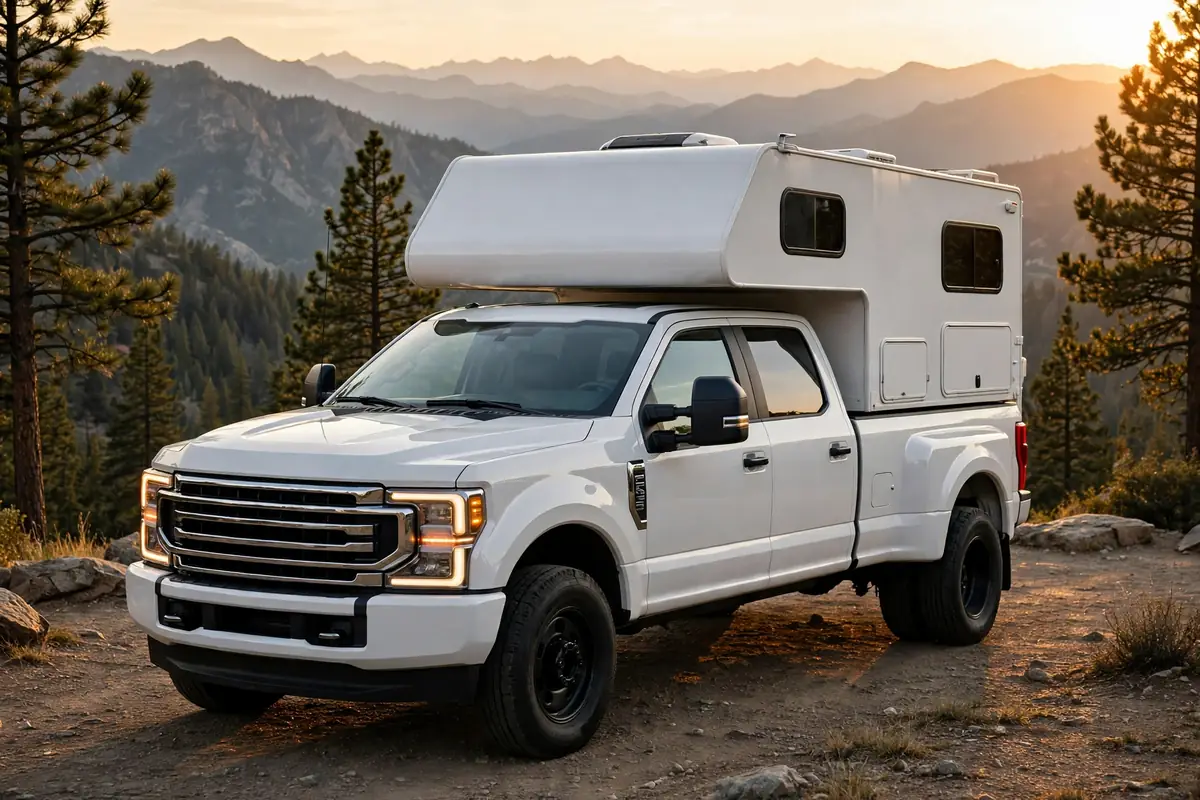
Best Truck Camper for Ford F-350: Fitment Guide That Keeps You Legal
The best truck camper for Ford F-350 owners is not the biggest camper you can afford. It is the biggest camper your exact truck can carry once you count the water, the propane, your family, and everything you toss in the back — and still stay under the number on your door sticker. I learned that standing at a CAT scale with a rig I was sure was fine, watching the rear axle number climb past where I wanted it to be. An F-350 is a genuine one-ton that carries campers a half-ton cannot. But “one-ton” is a nickname, not a promise: two F-350s on the same lot can have payload stickers more than 2,000 pounds apart, depending on the engine, the cab, and whether there are four tires or six at the back.
This guide answers the question that matters: which truck campers actually fit an F-350 without overloading it, and what do you fix first?
The Best Truck Camper for Ford F-350 Starts With Your Sticker, Not a Brochure
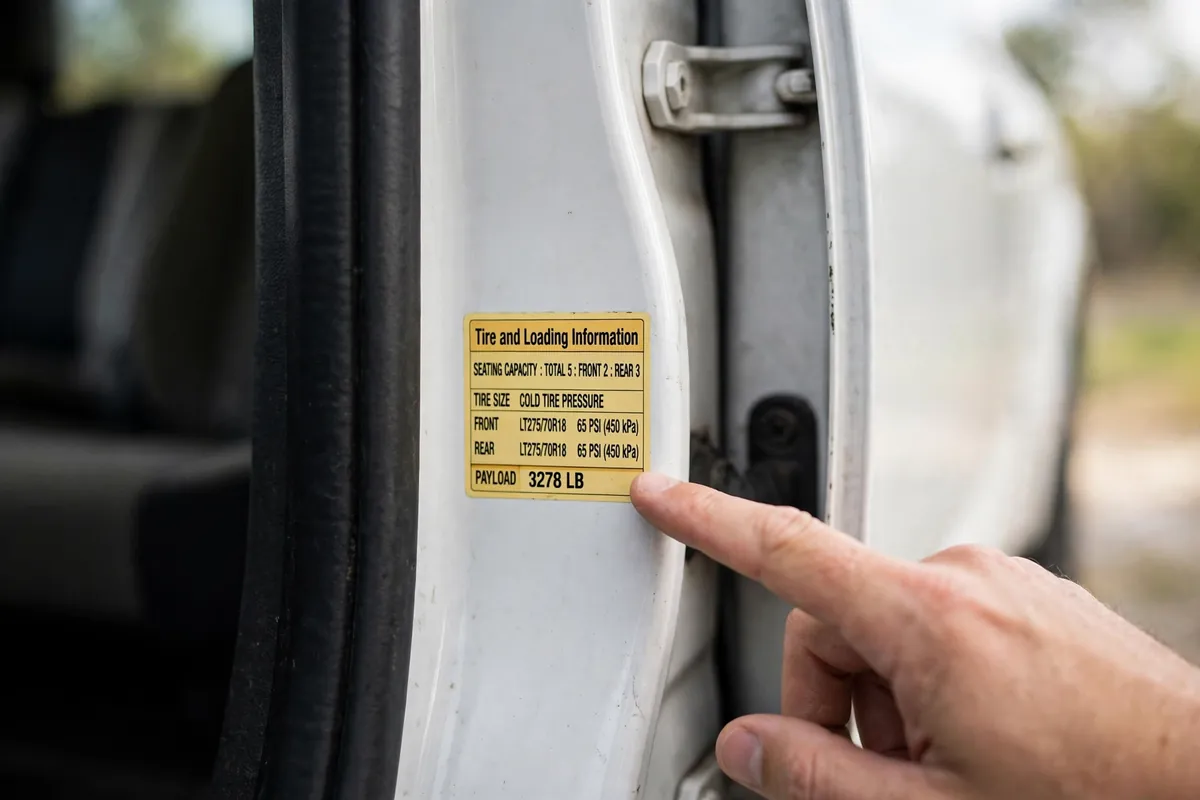
Ford’s 2026 RV and Trailer Towing Guide lists maximum F-350 payloads that look enormous: up to 8,000 pounds for a 6.8L gas V8 dually, 7,635 pounds for the 7.3L gas V8 dually, 6,952 pounds for the standard 6.7L Power Stroke diesel, and 6,935 pounds for the high-output diesel. Those are maximums for the lightest possible build — a regular cab, two-wheel drive, stripped work truck. Your truck is almost certainly not that truck.
Open the driver’s door and read the yellow “Tire and Loading Information” sticker. That number is your payload. It already accounts for your cab, your engine, your four-wheel drive, and every option Ford bolted on before delivery. Everything you add after that — the camper, the water, the batteries, the tie-downs, your passengers, the dog, the cooler — comes out of that one number. Run your own numbers through our truck camper payload calculator guide.
Here is the math that catches most people. A camper’s dry weight is the weight of an empty shell as it left the factory, usually without options, water, propane, or batteries. Real life adds roughly 800 to 1,500 pounds: 30 gallons of fresh water alone weighs about 250 pounds, a propane tank and a battery add another 80 or so, plus food, clothes, tools, and gear. Truck Camper Magazine’s loaded-weight calculations make the same point — a Lance 865 that starts at 2,012 pounds dry ends up near 2,870 pounds once wet and loaded. So add at least 1,000 pounds to every dry weight, then compare that loaded number to your sticker. If it is bigger, the camper does not fit.
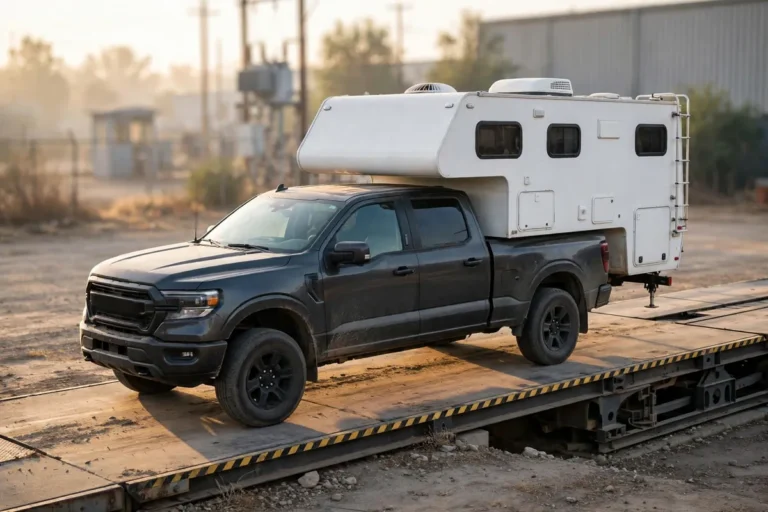
Then weigh the finished rig on a CAT scale. Owners on the RV Forum report finding themselves hundreds of pounds over this way — one F-350 dually owner with a Lance 1191 worked out his total payload at 6,457 pounds against a 5,899-pound maximum, over by 558 pounds when towing. The scale told the truth.
Gas vs Diesel: Why the 7.3L Godzilla Often Carries More Camper
This is the surprise that stings diesel owners. Diesel is the stronger towing engine. It is not the stronger carrying engine.
Ford’s 2026 Super Duty lineup gives you four engines: the 6.8L gas V8 (405 hp, 445 lb-ft), the 7.3L gas V8 — the Godzilla — (430 hp, 485 lb-ft), the 6.7L Power Stroke diesel (475 hp, 1,050 lb-ft), and the high-output 6.7L (500 hp, 1,200 lb-ft). The diesel’s torque is magnificent on a mountain pass, and its exhaust brake is a genuine comfort coming back down. But the diesel engine itself weighs several hundred pounds more than a gas V8, and at a fixed GVWR, every pound of engine is a pound you cannot put in the bed.
Look at the maximums again: the gas trucks top out at 8,000 and 7,635 pounds of payload, the diesels at 6,952 and 6,935. That gap of roughly 700 pounds is a whole extra battery bank and a full water tank. The same trap shows up on other brands — see our piece on the Ram 2500 diesel payload trap.
Buy the diesel for the right reason. If you tow a heavy boat or trailer behind the camper, cross mountain passes every trip, or live at altitude, the Power Stroke earns its keep. If the camper is the main load and you rarely tow anything heavy, the 7.3L gas truck will carry more camper, cost less to buy and maintain, and never ask for DEF. Owners on Ford Truck Enthusiasts who end up happy picked the engine for the load they actually carry: a 2025 F-350 Tremor owner with the high-output diesel reported a payload sticker just over 4,000 pounds on his crew cab, while a comparable gas truck would have carried several hundred more.
One honest note: some dealer summaries quote a 7,900-pound maximum for a 7.3L F-350 with the Heavy-Duty Payload Package. Ford’s own 2026 towing guide lists 7,635 pounds, and I am using Ford’s conservative figure. Trust your sticker over any salesman’s number.
SRW vs Dually: Stability Is the Real Difference
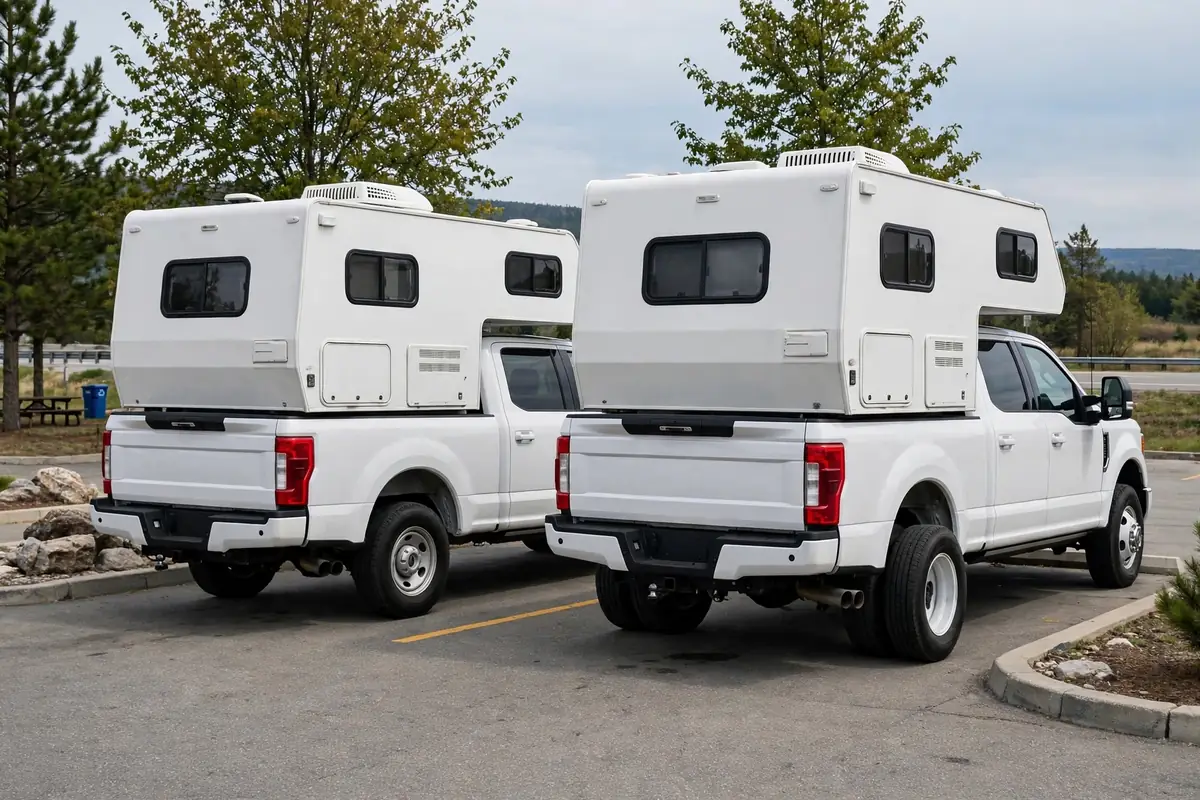
The F-350 is the only Super Duty that gives you a real choice here. The F-250 is single-rear-wheel only; the F-350 comes as SRW or DRW, a dually. If you own the lighter sibling, our best truck camper for Ford F-250 guide covers that truck’s tighter limits.
On payload, the gap is large. Ford’s best SRW payload is 5,137 pounds (a light 6.8L gas build), while the best DRW payload is 8,000 pounds. A typical crew cab 4×4 diesel SRW will sticker in the high 3,000s to low 4,000s — one owner on iRV2 reported about 4,100 pounds on a 2024 F-350 SRW crew cab long bed diesel — while a comparable dually can sticker above 6,000 pounds.
On stability, the gap is just as real. On iRV2, one owner who carried the same 4,000-pound camper first on a SRW one-ton and then on a dually wrote that the difference was huge — less bouncing and sway in every way. Another, who had run a Bigfoot on two SRW trucks before moving it to a dually, called the change dramatic. Four rear tires spread the load wider and share the work of resisting roll. A tall camper raises the center of gravity, and in a crosswind or when a semi passes, that tall box acts like a sail — the dually gives the truck a much wider stance to fight it with.
None of that makes the SRW a bad truck. An SRW F-350 is narrower, fits in a garage, parks like a normal truck, and is far better in snow and on soft ground, where a dually’s four rear tires spread the weight so thin they can skate. If the camper lives on the truck most of the time, the dually makes sense; if the truck is your daily driver and the camper comes off for months at a time, the SRW is the easier truck to live with. My rule: if your loaded camper weighs more than about 4,000 pounds, or you plan to tow behind it, buy the dually. If it weighs less, the SRW will serve you well — with the suspension fixes below.
Bed Lengths: 6.75 ft vs 8 ft
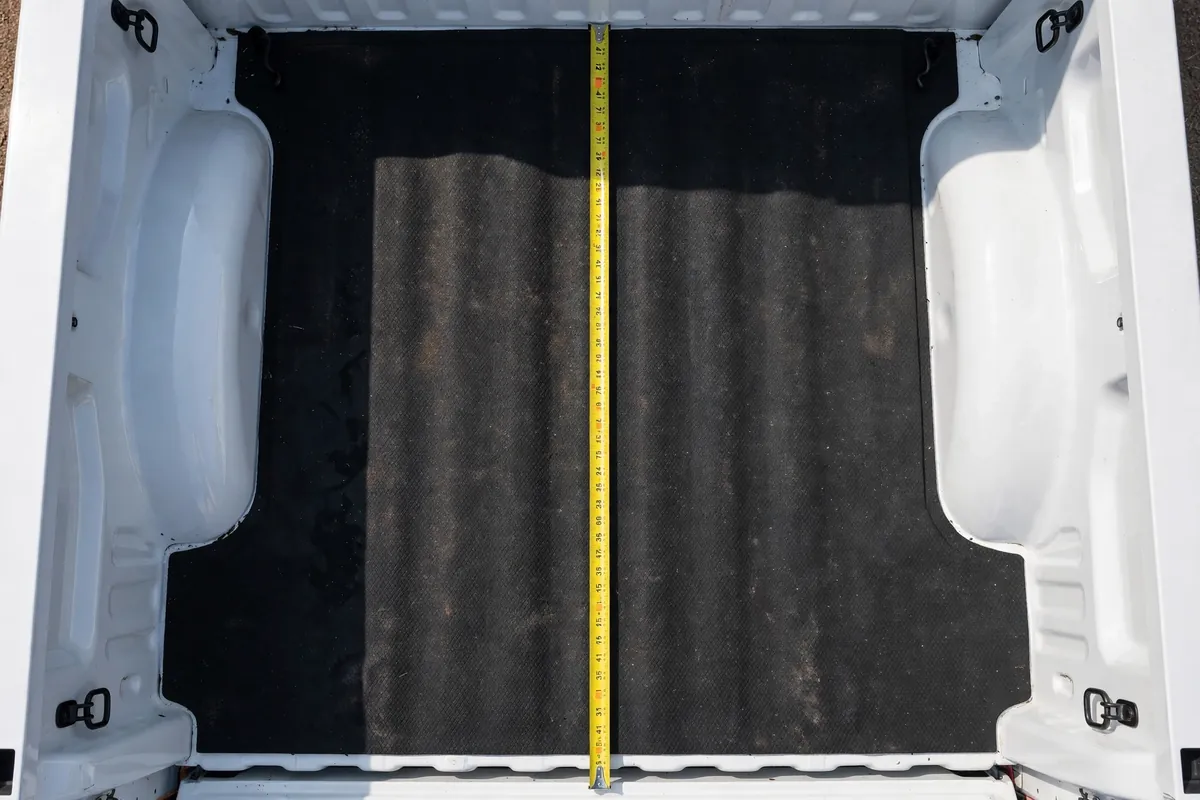
Ford builds the Super Duty with two beds: a 6.75-foot box (81.9 inches at the floor) and an 8-foot box (98.1 inches). The regular cab comes only with the long bed; SuperCab and Crew Cab buyers can choose either. That 16-inch difference decides which campers you can consider. Our full comparison is in the short bed vs long bed truck camper guide.
Short-bed campers are built for the 6.75-foot box: the Lance 650 and 825, the Arctic Fox 865, the Northstar Laredo SC, the Four Wheel Hawk, and the Scout Olympic. A long-bed camper on a short bed overhangs the tailgate and slides the center of gravity rearward. Long-bed campers belong on the 8-foot box: the Lance 865 and 1172, the Arctic Fox 990 and 1140, the Bigfoot 25C10.6, the Host Mammoth, and the Four Wheel Grandby. A few models, like the Lance 865 and the Arctic Fox 865, work on either bed — check the manufacturer’s fitment chart for your exact year.
Campers That Fit — and the Ones That Don’t
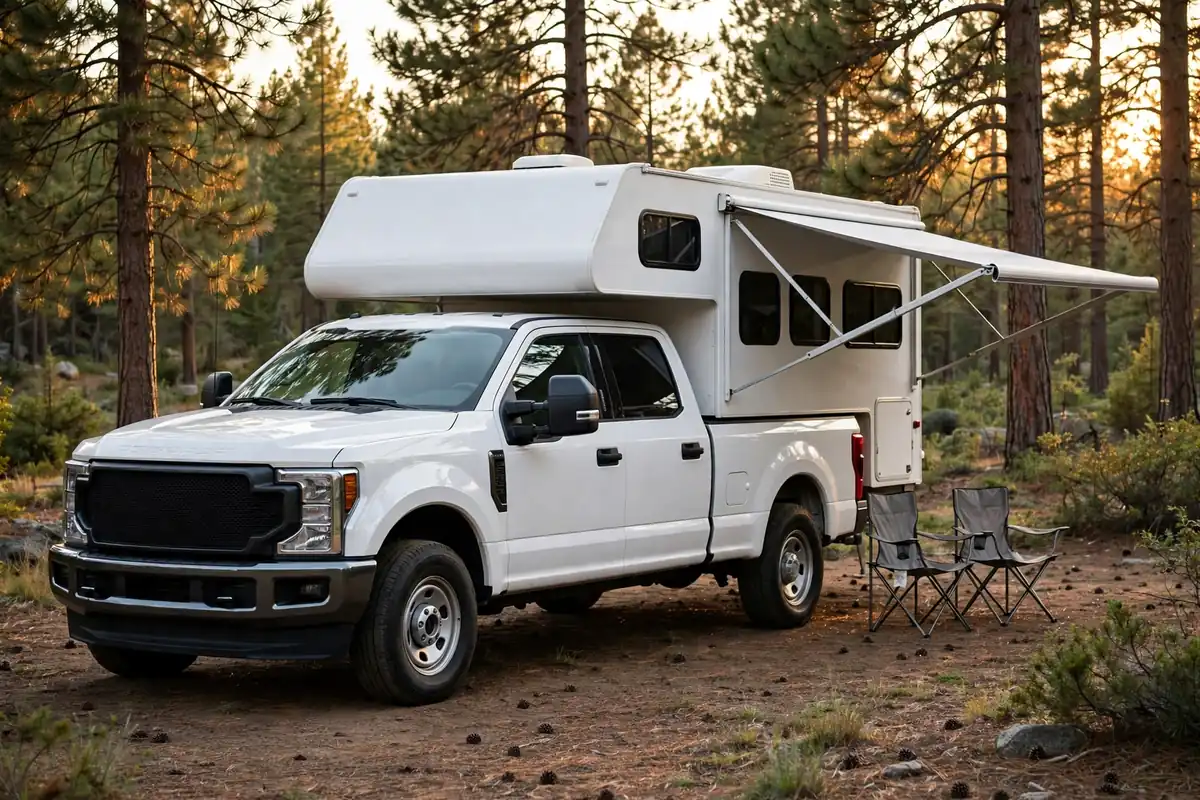
The table uses manufacturer-published dry weights. Add at least 1,000 pounds to every dry weight for water, propane, batteries, options, and gear, and compare the loaded number to your door sticker.
| Camper | Dry weight | Bed | Best F-350 match |
|---|---|---|---|
| Four Wheel Hawk | 1,200 lb | Short | Any SRW |
| Lance 650 | 1,694 lb | Short | Any SRW |
| Lance 825 | 1,867 lb | Short | Any SRW |
| Lance 865 | 2,012 lb | Either | SRW sweet spot |
| Northstar Laredo SC | 2,090 lb | Either | SRW sweet spot |
| Arctic Fox 865 | 2,641 lb | Either | SRW with margin, or dually |
| Arctic Fox 990 | 3,010 lb | Long | Gas SRW or dually |
| Bigfoot 25C10.6 | 3,180 lb | Long | Dually for most |
| Host Mammoth | 3,955 lb | Long | Dually only |
The Lance 865 is the sweet spot for a lot of SRW owners: a real hard-side with a wet bath that loads out near 2,900 pounds. The Arctic Fox 865 needs a warning, though — owners warn that Arctic Fox campers run heavier than their stickers once the factory value package and options are added, and one iRV2 thread recommends treating the 865 as a dually camper unless your SRW sticker has real margin. The Bigfoot 25C10.6 loads out past 4,300 pounds — a dually camper for most people. The Host Mammoth loads out near 5,000 pounds and is dually-only.
Owners on iRV2 and Ford Truck Enthusiasts repeat the same story: a buyer matches the dry weight to the brochure payload, drives home happy, weighs the rig, and finds the rear axle or the GVWR already over. One owner put it plainly — truck campers are always heavier than advertised, and by the time you add propane, water, and batteries you can easily add 1,000 to 2,000 pounds. Believe him. He has the scale ticket.
Suspension Fixes: What to Fix First, in Order
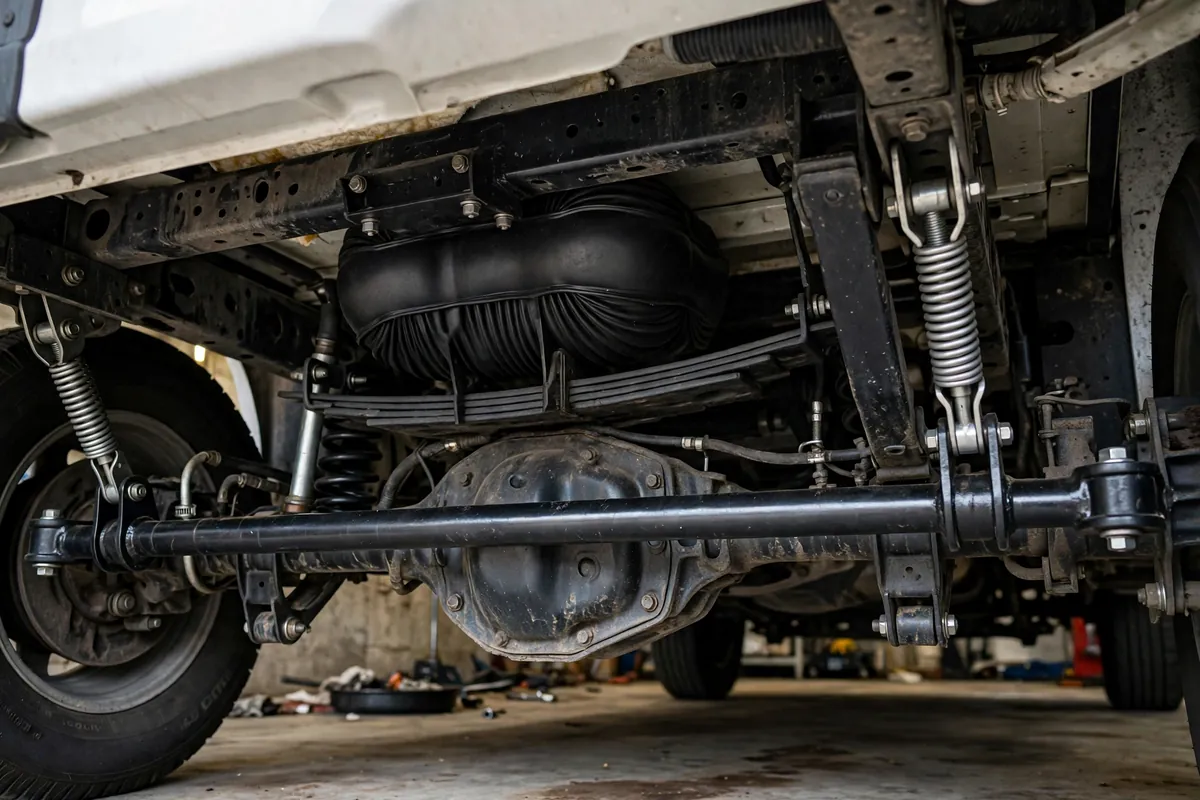
Suspension upgrades do not increase your payload. Airbags, Timbrens, SumoSprings, and sway bars do not change the number on your door sticker, and they do not make an overloaded truck legal or safe. They make a truck that is within its ratings ride level and handle predictably. Fix the weight first. Then fix the ride, in this order.
First, tires. Your rear tires are the real limit on a lot of SRW trucks, because the axle and tire ratings cap out before the springs do. Check the load rating stamped on your tire sidewalls. Owners who moved to higher-rated tires — one went to a tire rated at 4,080 pounds per tire — report it as the single most effective change for a heavy camper.
Second, a rear sway bar. A tall camper leans in every corner and every gust, and the factory bar on many Super Dutys is, in one owner’s words, anemic. A heavier aftermarket bar from Hellwig or Roadmaster is the most-reported fix for that white-knuckle lean — several owners say a big rear bar plus good shocks made their SRW handle a camper nearly as well as their old dually.
Third, load support: airbags or Timbrens. Airbags — Firestone Ride-Rite or Air Lift — are adjustable, so you can level the truck with the camper on and soften it when the camper comes off. A common fix truck campers share on YouTube is running the bags on separate valves, never teed together, so air cannot slosh side to side in a corner. Timbrens and SumoSprings are the set-and-forget answer: hollow rubber springs that only engage under load, so the empty ride stays stock. Owners on WanderTheWest report that Timbrens kill the sway and stop nearly all of the bounce. Our full comparison is in airbags vs Timbren vs SumoSprings. If you want adjustability, buy airbags. If you want zero maintenance, buy Timbrens.
Fourth, Torklift StableLoads. These engage your factory overload springs earlier, so the springs Ford already gave you actually do their job. Owners on Good Sam report running StableLoads with airbags or Timbrens and finding the combination better than either one alone.
Fifth, shocks. Factory shocks, especially on FX4 trucks, are tuned for off-road comfort, not for damping a 4,000-pound box. Swap to heavy-duty shocks when the bounce is still there after the sway bar and load support.
Tie-Downs and What I Would Buy
A camper that is not tied down properly will move. Frame-mounted tie-downs — Torklift is the name you will hear most — bolt to the truck’s frame and give the turnbuckles a solid anchor. Bed-mounted tie-downs are cheaper, but they anchor to sheet metal, and owners who have used both say the frame-mounted setup is the one that stays put. Spring-loaded turnbuckles are worth the money: they keep tension as the camper flexes on rough roads. Check them at every fuel stop on the first trip, and again after the first hundred miles. Our detailed comparison is in truck camper tie-downs and turnbuckles compared.
If I were buying an F-350 for a truck camper today, I would buy a gas 7.3L Crew Cab long bed — SRW if it is also my daily driver, dually if the camper stays on most of the year. The gas engine gives me the most payload and the long bed gives me the whole camper catalog. I would order the Camper Package and the Heavy-Duty Payload Package, and skip the Tremor (no Camper Package offered).
For the camper, my pick for most F-350 SRW owners is the Lance 865. At 2,012 pounds dry and roughly 2,900 pounds loaded, it fits a crew cab diesel SRW with margin to spare, it has a real wet bath and a north-south bed, and any dealer can service it. If I owned a dually, I would step up to the Arctic Fox 990 for the slide-out space, or the Bigfoot 25C10.6 for four-season camping. If I wanted to go light and go far, I would take the Four Wheel Grandby on a long bed and spend the payload I saved on water, fuel, and freedom.
Whatever you buy, do the steps in order: read the sticker, add 1,000 pounds to the dry weight, weigh the rig on a scale, fix the tires and the sway bar first, and tie the camper down like you mean it. The F-350 is the right truck for this job. It just asks you to do the math first.
Payload figures are Ford’s 2026 maximums from the 2026 Ford RV & Trailer Towing Guide and the 2026 Ford Super Duty page; your door-jamb sticker is the final word.
FAQ
Can an F-350 carry any truck camper? No. Even a dually has a limit, and a crew cab 4×4 diesel SRW can sticker under 4,000 pounds. The Host Mammoth and other triple-slide campers load out near 5,000 pounds and need a dually with a strong sticker. Compare the loaded weight — dry weight plus at least 1,000 pounds — to your door sticker.
Is gas or diesel better for a truck camper on an F-350? For carrying a camper, gas usually wins on payload: Ford’s 2026 maximums are 8,000 pounds for the 6.8L gas dually and 7,635 for the 7.3L, against 6,952 and 6,935 for the diesels. For towing heavy trailers behind the camper or crossing mountain passes, the diesel’s torque and exhaust brake are worth the sacrifice.
SRW or dually for a truck camper? Buy the dually if your loaded camper weighs more than about 4,000 pounds, if you tow behind the camper, or if crosswind stability matters most — owners who switched report a dramatic improvement. Buy the SRW if the truck is your daily driver and your loaded camper is under 4,000 pounds.
What size truck camper fits a 6.75 ft bed F-350? Short-bed models only: the Lance 650 and 825, Arctic Fox 865, Northstar Laredo SC, Four Wheel Hawk, and Scout Olympic. Long-bed campers need the 8-foot box — a long-bed camper on a short bed puts the center of gravity too far rearward.
Do airbags increase my F-350’s payload? No. Airbags, Timbrens, SumoSprings, sway bars, and StableLoads improve ride and handling, but they do not change your GVWR, your axle ratings, or the number on your door sticker. Fix the weight first, then fix the ride.