Best Truck Camper Road Trips in the USA for 2026
I have driven a lot of miles with a camper on my truck, and I have learned this the slow way: the best truck camper road trips are not always the prettiest roads on a map. They are the roads where a truck camper actually works — where you can turn around, park for the night without a fight, fill water without a queue, and wake up somewhere worth waking up.
That is the test I used for this list. I picked six routes across the country, so you can choose by season instead of forcing a desert trip in July or a mountain pass in January. Each one has rough mileage and days, the best season, named places to camp that I verified, and one honest truck-camper tip for that road.
How I picked these routes
I wanted routes that suit a truck camper specifically: short driving days, campgrounds that fit a truck and camper, places to dump and fill water at sensible intervals, and roads where being narrow and short is an advantage. A truck camper shines on the Million Dollar Highway and Scenic Byway 12, where a big Class A would be white-knuckling every hairpin.
If you are still deciding, read our rent before you buy guide and try a shorter route below first. For free-camping detail, see our boondocking guide. This article is about where to go, not how to park for free.
1. Utah Mighty 5: Zion, Bryce, Capitol Reef, Arches and Canyonlands
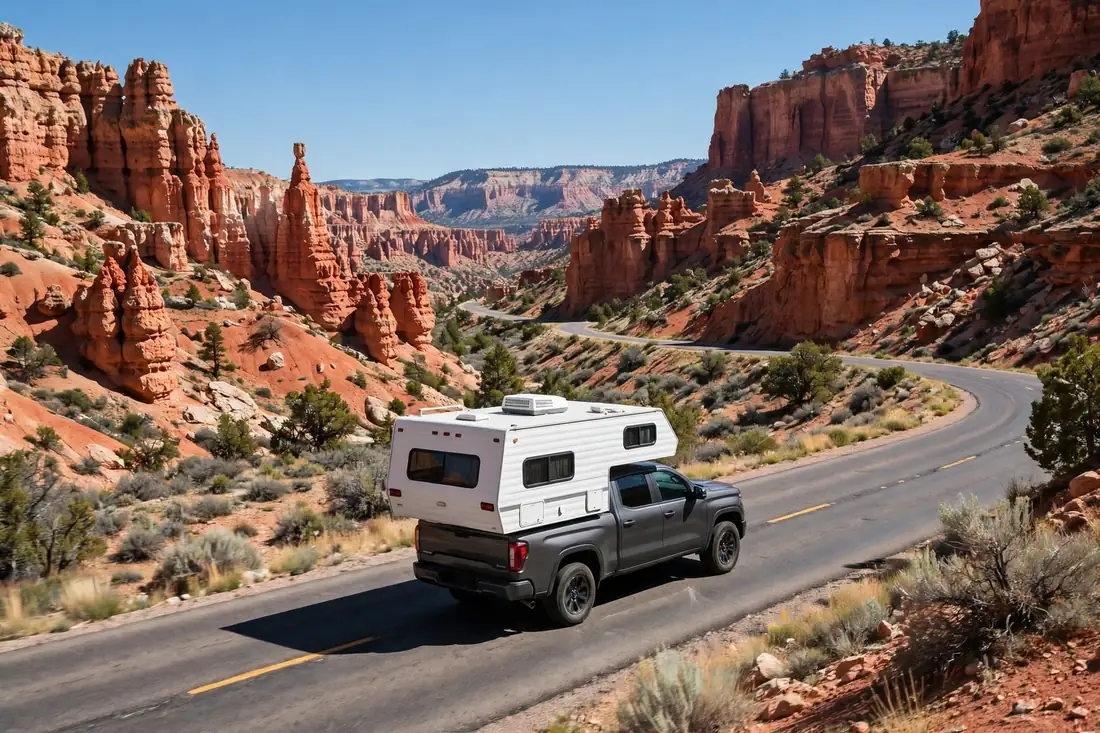
Route: Las Vegas or Salt Lake City to Zion, Bryce Canyon, Scenic Byway 12, Capitol Reef, then Moab for Arches and Canyonlands. About 1,040 miles, 7 to 10 days. Best season: April to May and September to October.
This is the classic for a reason. Visit Utah lays out a 10-day, roughly 1,040-mile version starting in Moab and ending in Zion. The parks sit about two to two and a half hours apart, except Arches and Canyonlands, which share Moab as a base.
What makes it great for a truck camper is the driving in between. Scenic Byway 12 from Bryce to Capitol Reef is one of the best drives in the West, and the roads into Canyonlands and Capitol Reef suit a rig you can park in a normal-sized space and walk away from.
Where to camp: Watchman Campground in Zion, open year-round, reservations six months ahead on Recreation.gov — aim for its electric A and B loop sites. In Arches, Devils Garden is the only campground inside the park, reservable March 1 to October 31 and first-come, first-served in winter. It is usually full in season, so book the day your window opens and keep a Moab backup. Torrey is the base for Capitol Reef.
Truck-camper tip: Do not cut through Zion on the Zion-Mount Carmel Highway without checking your size. From June 7, 2026, vehicles over 35 feet 9 inches long, 7 feet 10 inches wide, or 11 feet 4 inches tall are not allowed between Canyon Junction and the East Entrance. Most truck campers are well under that, but measure yours loaded and enter through Springdale if you are close. Moab and Zion regularly top 100 degrees in summer, so hike early and do not start a long desert drive with a half-empty fresh tank. Our fresh water guide explains how to stretch a small tank between fills.
2. Pacific Coast Highway: San Francisco to San Diego
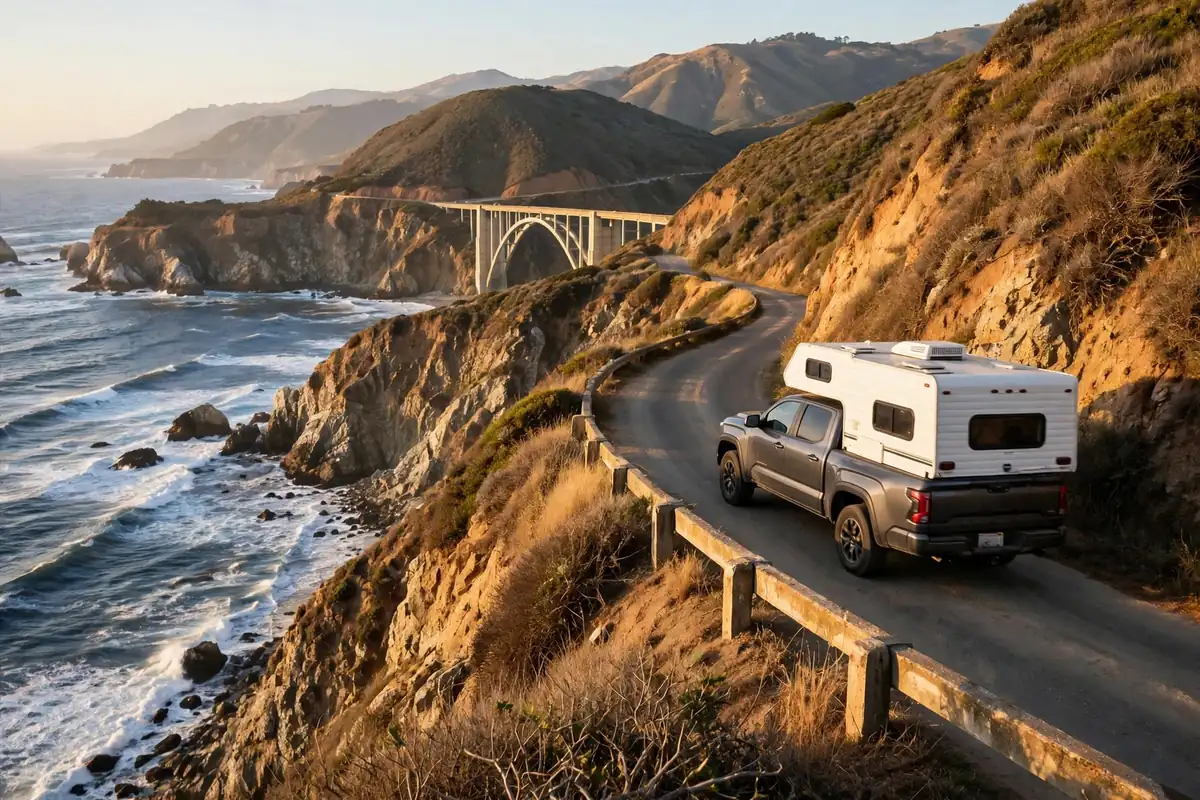
Route: San Francisco down Highway 1 through Santa Cruz, Monterey, Big Sur, Cambria, Santa Barbara and Los Angeles to San Diego. About 550 miles on the coastal routing, 7 days at a relaxed pace. Best season: late September to October, and spring.
Drive this one southbound, so your passenger gets the ocean side and you get the pullouts on your right. The direct drive is under nine hours, but Big Sur alone deserves a full day, and the stretch from Carmel through Big Sur to Cambria is only about 90 to 100 miles and still takes four to five hours with stops.
A truck camper fits the campgrounds here in a way a long trailer often does not. The trade-off is parking: sleeping overnight in a vehicle is not allowed along Highway 1, and pullouts are for short stops, not camping. Owners in Big Sur guides report the same lesson: book a real campground, arrive before dark, and do not assume you can pull off somewhere pretty for the night.
Where to camp: Pfeiffer Big Sur State Park, with 189 sites along the Big Sur River, is the most practical base — book well ahead. Further south, Kirk Creek Campground sits on a bluff above the ocean, with no water on site and sites that owners report are not level, so bring levelling gear. Plaskett Creek, across from Sand Dollar Beach, has flush toilets and water.
Truck-camper tip: Check Caltrans Highway 1 conditions the morning you leave Carmel, and again before you leave Big Sur. This coast closes for landslides, rockfall and fire — in late August 2026 part of Big Sur was closed because of wildfire. Have the inland detour via US-101 in mind, fill fuel in Monterey or Cambria, and drive in daylight only. A common fix owners share on YouTube is simple: use the turnouts early when traffic stacks up behind you, and never back a camper into a cliff-side viewpoint after dark.
3. San Juan Skyway and the Million Dollar Highway, Colorado
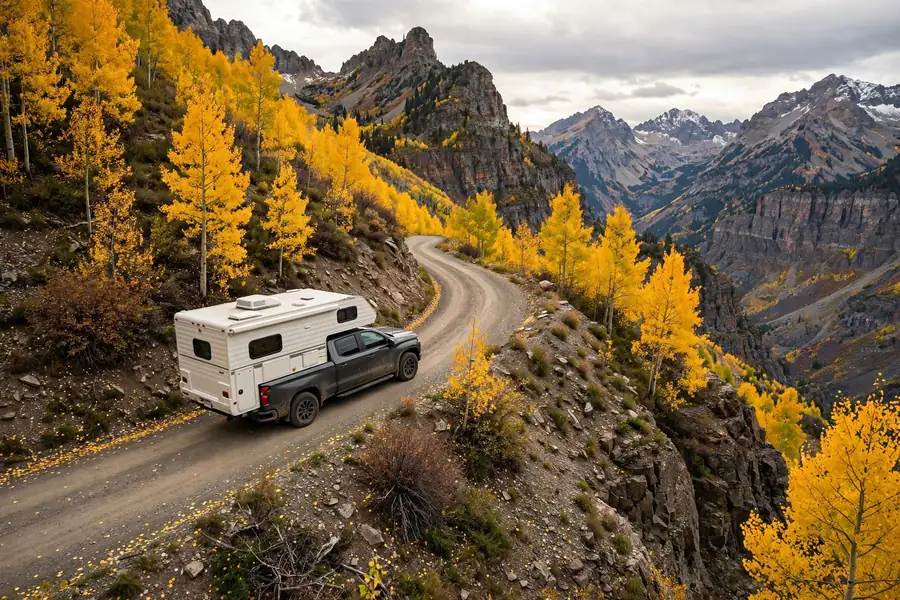
Route: A loop from Durango to Cortez, Telluride, Ridgway, Ouray, Silverton and back to Durango. 236 miles, 3 to 5 days. Best season: late June to early October, with late September for aspen colour.
This is the shortest loop here and the most dramatic per mile. The San Juan Skyway is a 236-mile All-American Road, and its famous middle — the Million Dollar Highway, the roughly 23- to 25-mile stretch of US-550 between Ouray and Silverton — climbs to 11,018 feet at Red Mountain Pass, with grades up to 8 percent, hairpins and almost no guardrails in places.
That is why it belongs here. A truck camper is one of the best fits for this road: short, narrow, no trailer to swing wide on a hairpin. Owners on iRV2 who have driven US-550 report the same split — some say they would never take an RV over it, others have taken a motorhome or fifth wheel over it many times by going slow downhill — and the consensus is that a truck camper with a confident mountain driver, good brakes and no trailer is the sweet spot. The escape route is Highway 145 from Cortez, via Telluride.
Where to camp: Ridgway State Park is the base I would pick, with nearly 300 sites across Elk Ridge, Dakota Terraces and Pa-Co-Chu-Puk, electric sites, a dump station, showers and full-hookup sites at Pa-Co-Chu-Puk, reservations up to six months ahead. Ouray is about 25 minutes south and Silverton is a day trip over the pass. Near Silverton, owners on iRV2 also mention dispersed camping on South Mineral Creek — check current Forest Service rules first.
Truck-camper tip: Drive Ouray to Silverton in the morning, in daylight, with full fuel and empty waste tanks if you can. Go slow downhill in a low gear and let your engine do the braking — this is the road our driving guide was written for. There is no easy fuel stop on the pass itself, so fill up in Durango, Ridgway or Ouray. Snow has been reported on these passes in July, and the highway can close for avalanche control in winter.
4. Blue Ridge Parkway: Virginia to North Carolina
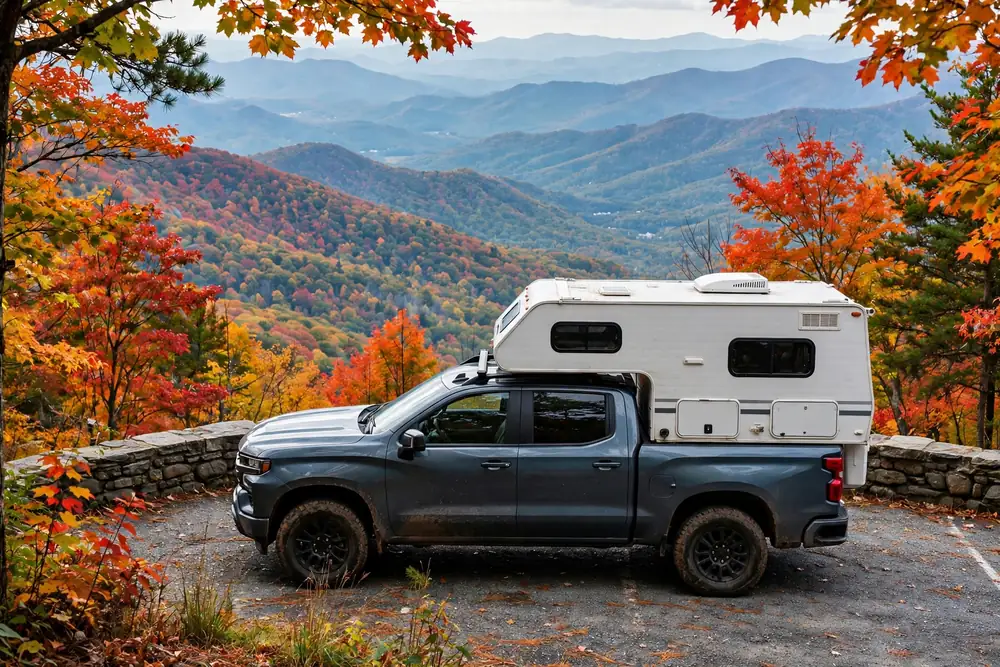
Route: Shenandoah National Park at Rockfish Gap, Virginia, to Great Smoky Mountains National Park near Cherokee, North Carolina. 469 miles, 5 to 7 days for the full parkway, or 3 to 4 days for one half. Best season: May to October, with early to mid-October for fall colour.
This is the slow road. The speed limit is mostly 45 mph, there is no commercial traffic, and the parkway was built in the 1930s for leisurely driving. Plan 100 miles a day, not 300.
What makes it great for a truck camper is that the parkway campgrounds were not built for big rigs either. The typical maximum is around 30 feet at most campgrounds, and a truck camper fits comfortably where a long fifth wheel would be checking every site length. The campgrounds are dry camping — no hookups at individual sites — with potable water, flush toilets and a dump station at each one, and showers at Julian Price and Mount Pisgah.
Where to camp: The National Park Service lists eight developed campgrounds, open May through late October, at $30 a night, reservations up to six months ahead on Recreation.gov. See the official Blue Ridge Parkway camping page. Peaks of Otter (Milepost 85.9, Virginia) is a good first stop. Julian Price Park (Milepost 297, North Carolina), the largest campground, sits on Price Lake. Mount Pisgah (Milepost 408.8), at nearly 5,000 feet, is the highest and coolest in summer. Check first: Linville Falls and Crabtree Falls were closed for the whole 2026 season, and as of October 2026 Mileposts 344 to 355 were still closed for Hurricane Helene repairs.
Truck-camper tip: Measure your actual height, including the roof air conditioner, and check it against the official NPS tunnel-height table before the North Carolina section. The parkway has 26 tunnels, and the NPS warns it is illegal and dangerous to cross the centre line to gain clearance. Most tunnels clear 13 feet or more at the edge line, but the three lowest near Cherokee are much tighter: Big Witch at 11 feet 7 inches, Lickstone Ridge at 11 feet 8 inches, and Bunches Bald at 12 feet 3 inches. A tall camper with a roof rack may not clear — exit before that stretch and take US-19 around it. The Virginia half has just one tunnel, Bluff Mountain at Milepost 53.1, at 13 feet 1 inch.
5. Yellowstone and Grand Teton, Wyoming
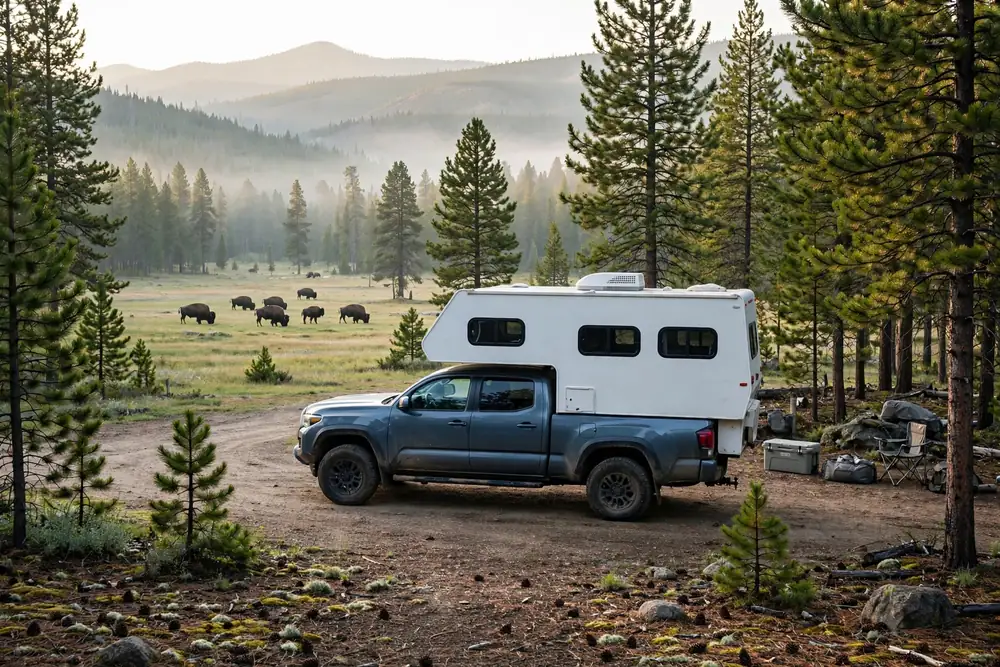
Route: Enter Yellowstone from the north at Gardiner, Montana, loop through Mammoth, Canyon, Lake and Old Faithful, then drive south through Grand Teton to Jackson. About 300 to 400 miles inside the parks, plus your approach drive, 5 to 7 days. Best season: late June to September.
This trip rewards a truck camper: you can park in a normal pullout for a bison jam, fit campgrounds that turn away long trailers, and move camp every couple of days. Yellowstone has no single length limit — each campground publishes its own combined truck-plus-camper length, so check the site you book. Sources disagree on some numbers, so confirm on Recreation.gov or the NPS page before you pay.
Where to camp: Madison Campground is a good central base, and owners on iRV2 report filling water at the dump station across from check-in there, and topping up from bathroom sinks with jugs on longer stays. Fishing Bridge RV Park is the only campground inside Yellowstone with full hookups, and it takes hard-sided rigs only. Mammoth is the only campground open year-round. In Grand Teton, Colter Bay RV Park has full hookups, Gros Ventre takes rigs up to 45 feet total, and Signal Mountain is smaller and tighter. Overnight camping outside designated campgrounds is not allowed inside Yellowstone.
Truck-camper tip: Water is the real planning job here, not fuel. Owners on iRV2 and Wander The West report the same problem: the potable tap is often at the dump station, and the hose by the sewer drain is for flushing a black tank, not filling a fresh tank. The fix owners share is to carry your own white potable hose and an inline filter, sanitise the spigot before you connect, never use the hose left at the dump, and carry a few gallons in jugs as backup. There is almost no cell coverage in much of Yellowstone, including at Madison, so download offline maps before you enter the park.
6. Florida Keys: Overseas Highway to Key West
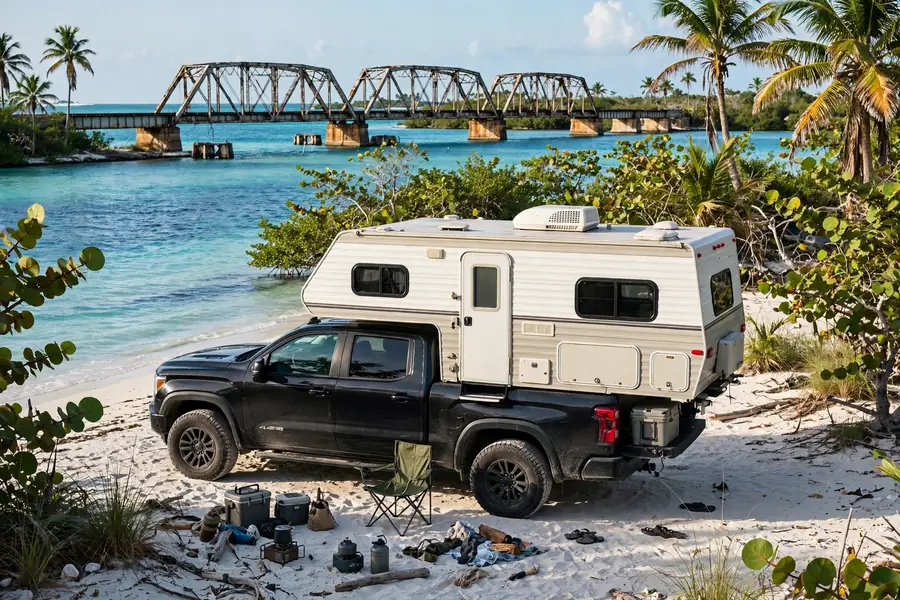
Route: Miami to Key Largo, Islamorada, Marathon and Key West on US-1, the Overseas Highway. About 113 miles, 3 to 5 days, or a week if you linger. Best season: December to April for dry weather, or November and May for easier bookings.
This is the easiest drive here and the hardest booking. The road is flat and slow, with 42 bridges and water on both sides, and a truck camper is the perfect size for it — small enough for the tight state-park loops. The catch is supply: only about 1,200 RV sites across the whole 113-mile chain, and demand in winter is extreme.
Where to camp: Bahia Honda State Park, at Mile Marker 37 on Big Pine Key, is the one to try for first. It has about 80 sites across three loops and a white-sand beach that is rare in the Keys. The loops are not interchangeable — Sandspur is limited to about 23 feet, while Buttonwood takes larger rigs — so check the loop and site length before you book, as early as the window allows, up to 11 months ahead. If Bahia Honda is full, Curry Hammock State Park near Marathon is the central backup, and John Pennekamp Coral Reef State Park in Key Largo is the reef base at the top of the chain.
Truck-camper tip: Book Bahia Honda the minute your window opens, have a backup park ready, and do not arrive hoping for a walk-up site in season — owners report peak-season sites selling out within minutes. Watch the limits for the loop you book, not just the park as a whole, and check hurricane season dates (June 1 to November 30) before a summer trip: an evacuation order closes campgrounds and the highway, and there is no alternate route off the Keys. Fill water and fuel on the mainland or in Marathon before you push south, and plan a proper dump stop rather than hoping one appears. If you are new to levelling on soft, sandy pads, our leveling guide will save you a wobbly first night.
How to choose the best truck camper road trips for you
If you have a week, do Utah in spring or fall. If you have a long weekend, do the San Juan Skyway or the Florida Keys. If you want the coast, do the Pacific Coast Highway in late September, when the fog lifts and the crowds thin. If you want fall colour, do the Blue Ridge Parkway in October — and check the Helene closures first.
Whichever you pick, keep the driving days short, book the popular campgrounds the day the window opens, and leave a spare day in the plan. The best trips are the ones where you stop, stay a second night somewhere good, and drive home wishing you had stayed a third.
Frequently asked questions
What is the best truck camper road trip for a first-timer?
The San Juan Skyway or the Florida Keys. Both are short, with driving days under three hours and towns nearby for fuel and water. Save Utah and Yellowstone for your second trip.
How far should I drive each day in a truck camper?
Aim for 100 to 150 miles on scenic routes, and up to 200 miles on easier interstate approaches. Scenic roads are slow by design.
Do I need reservations for these routes?
For the popular campgrounds, yes. Watchman, Devils Garden, the Blue Ridge Parkway campgrounds and Bahia Honda book through Recreation.gov or the state system, usually six months ahead for federal sites and up to 11 months ahead for Florida state parks. Have a backup for every night.
Can a truck camper drive the Million Dollar Highway?
Yes, in most cases — it is short and narrow with no trailer. Drive it in daylight, in a low gear downhill, with good brakes, and only if you are comfortable with steep grades and drop-offs. If you are not, take Highway 145 via Telluride instead.
Can a truck camper fit on the Blue Ridge Parkway?
Most can, but measure first. The lowest edge-line clearances near Cherokee are 11 feet 7 inches at Big Witch, 11 feet 8 inches at Lickstone Ridge, and 12 feet 3 inches at Bunches Bald. Check your loaded height against the official NPS tunnel table and detour around any section you do not clear.
When is the best season for a truck camper road trip in the USA?
Spring and fall for Utah, late June to early October for Colorado and Yellowstone, late September to October for the Pacific Coast Highway, May to October for the Blue Ridge Parkway, and December to April for the Florida Keys. Pick the season first, then the route.