Best Truck Camper Tie Downs Compared – Torklift vs Happijac vs Brophy
If you are shopping for the best truck camper tie downs, here is what product pages will not tell you: the turnbuckles almost never fail first. What fails is whatever they are attached to. The bed sheet metal flexes. The plywood under the camper mount tears out. A bumper folds like a paperclip. The system is only as strong as its weakest link, and that is usually not the shiny hardware in the photo.
I learned this the way most owners do — standing in a parking lot, staring at something that was not right. I went through the forum threads, owner reports, and current product lineups to build the comparison that did not exist: Torklift vs Happijac vs Brophy, plus the turnbuckle question that matters most — spring-loaded or not.
Frame-Mounted vs Bed-Mounted Tie Downs: The Anchor Location Matters More Than the Brand

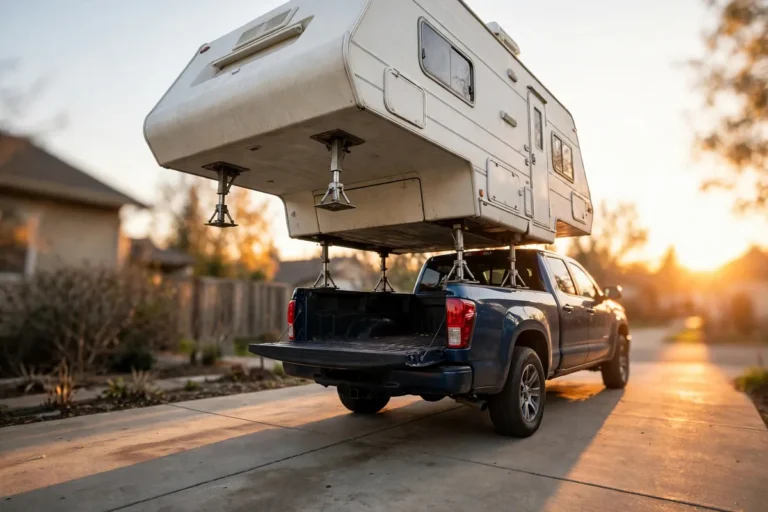
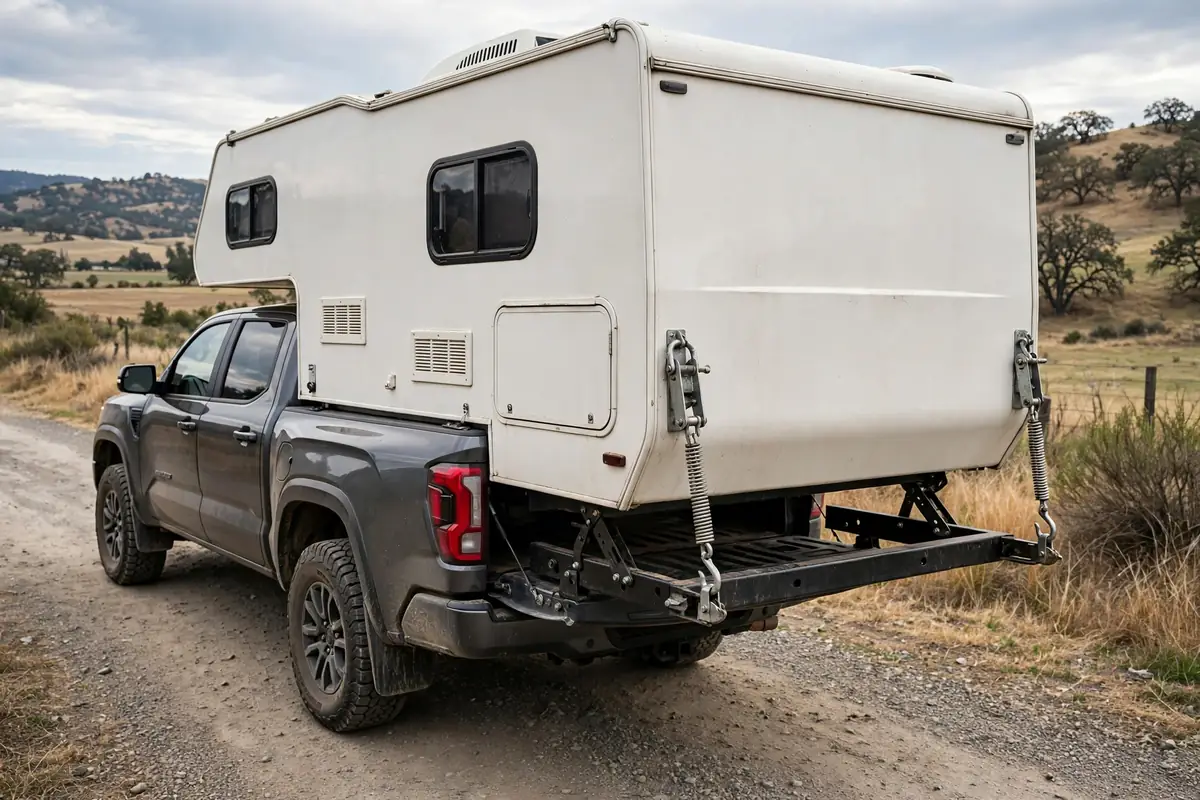
Tie downs attach the camper to the truck at four points that bolt either to the frame or to the bed and bumper. That choice decides almost everything about how your rig handles.
Frame-mounted systems (Torklift, ApexAnchors) bolt to the structural frame rails under the truck. The frame does not flex like a bed, and nothing about the camper’s movement can tear sheet metal or crack bed paint. The trade-off: vehicle-specific, costs more, and fishing hardware through a frame rail is a real afternoon of work.
Bed-mounted systems (Happijac, Brophy) attach to the bed and the rear bumper. Cheaper, simpler to install, anchors sit where the camper’s anchor points already are — but the load path runs through sheet metal and bumpers never designed to hold a four-thousand-pound camper steady at highway speed.
Owner forums are blunt about the split. On iRV2, owners who moved from bed-mounted to frame-mounted report noticeably less sway — the camper stops riding on a flexing bed. The bed-mounted loyalists say Happijac’s front geometry pulls the camper against the front of the bed at a better angle, and several run a hybrid — Happijac fronts, frame-mounted rears — because modern bumpers keep getting thinner.
One thing manufacturers bury: your camper’s anchor points are the weakest link either way. Makers commonly recommend limiting anchor-point loads to around 300 pounds, and those points fail long before either brand’s brackets do. Keep that number in mind for the tension section.
Torklift Tie Downs: The Frame-Mounted Favorite
Torklift’s steel frame-mounted tie downs are the ones you will see recommended most often in owner forums, and for a boring reason: they bolt to the frame, full stop. Four independent tie-down points, no belly bar or crossbar, each bracket designed for a specific truck make and model. When you are not hauling, you pull the inserts out and the system is nearly invisible under the truck, with no loss of ground clearance.
Torklift lists its steel tie downs starting at $313.99 per pair on its own site; a full truck needs a front pair and a rear pair, and owners who bought the complete system report it landing in the $800 range. The hardware weight counts too: our Ram 2500 diesel payload trap breakdown shows tie-downs and turnbuckles alone eating about 80 pounds of the payload Cummins owners are always short on.
Two other Torklift systems. Talon is the aluminum and stainless version — rust-free for life, no-drill install, no loss of ground clearance. ApexAnchors is the newer inboard system for campers with anchor points inside the truck bed (Four Wheel Campers, Scout, Cirrus): brackets bolt to the frame below the bed, anchor points retract flush when the camper is off. Each anchor is rated for 2,000 pounds — but the camper anchor point warranty requires Torklift’s own spring-loaded turnbuckles on all four corners, or the camper-side warranty is void.
Install is mostly straightforward. One Forest River Forums owner who did it himself said it went fine except the driver-side front mount, where you fish a bolt through the frame and the tie down. A pain, then done, no problems since.
Happijac Tie Downs: The Bed-Mounted Veteran
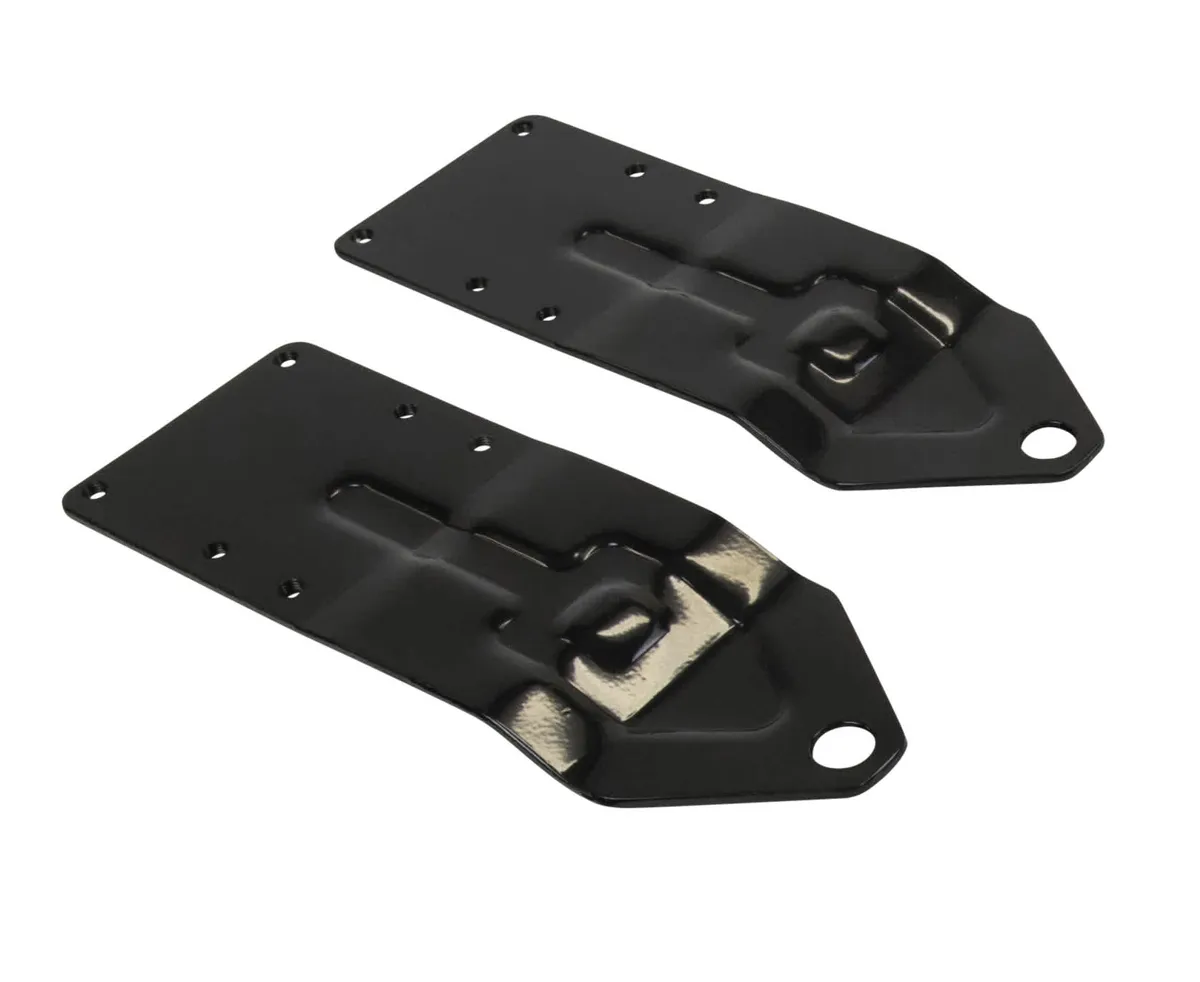
Happijac — now a Lippert brand, around since 1967 — built the classic bed-mounted system, and it is the system most used campers you will go look at already have installed. The design uses an I-beam truss structure: front anchor plates bolt through the front of the bed at the cab wall, rear anchors mount to the back bumper, and the geometry is meant to counteract side-to-side, front-to-back, and up-and-down camper movement.
Price is the big draw. Torklift’s own comparison page lists HappiJac tie downs starting at $284.80 — the full anchor system, not a single corner. The other draw is that angle: several experienced owners prefer Happijac for the front mounts, because the anchor position pulls the camper snug against the front of the bed, and the turnbuckles can be adjusted while the hooks are still connected. The warranty gap is part of the price difference: one year on Happijac, lifetime on Torklift.
The honest concerns, straight from owner discussions: the rear bumper anchors. Bumpers on modern trucks are thinner than they used to be, and owners who could flex their rear bumpers by hand decided not to trust them. Aluminum-body trucks complicate bed-mounted anchors further, and drilling into a new truck’s bed and bumper is a commitment.
Happijac pairs its mounts with Quik-Load turnbuckles — stainless bodies with reinforced half-inch steel round hooks, a detachable cushioned handle, locking pins — sold as a set of four (182895), typically $430 to $530. The kit mixes spring-loaded fronts with shorter hooks and stress-guard rears with longer ones for the bed-mounted geometry.
Brophy Tie Downs: The Budget Stake-Pocket Option

Brophy’s stake-pocket tie downs (the TDSF set of four) are the entry price of the market — roughly $145 to $175 for all four — and they install in minutes: they drop into the stake pockets on your bed rails, with three removable spacer tabs to fit different trucks and a tab lock that resists lifting and twisting. No drilling, no afternoon under the truck.
The catch is fitment. Brophy says the TDSF fits full-size pickups with campers up to 8 feet — but not 1988-and-newer Chevrolet and GMC trucks, and not 2011-and-newer pickups at all. One retailer calls them temporary-use only and not for pickups newer than the 1990s, because stake-pocket stress can twist the bed. On a modern truck with a heavy camper, that is a red flag, not a recommendation.
One more practical gotcha: a YouTube creator documented a three-hour ordeal getting their camper to fit between the jacks because aftermarket tie-down hardware blocked the camper’s path into the bed. Whenever you change tie-down hardware — any brand — verify the camper clears it before you back under. Our solo loading guide covers the checklist for the day you discover a clearance problem like that.
So: cheap and fast for a small camper on an older truck. For a heavy modern camper, not the answer — the fitment warnings say so themselves.
Turnbuckles: Spring-Loaded vs Rigid, and Why Tension Is Everything
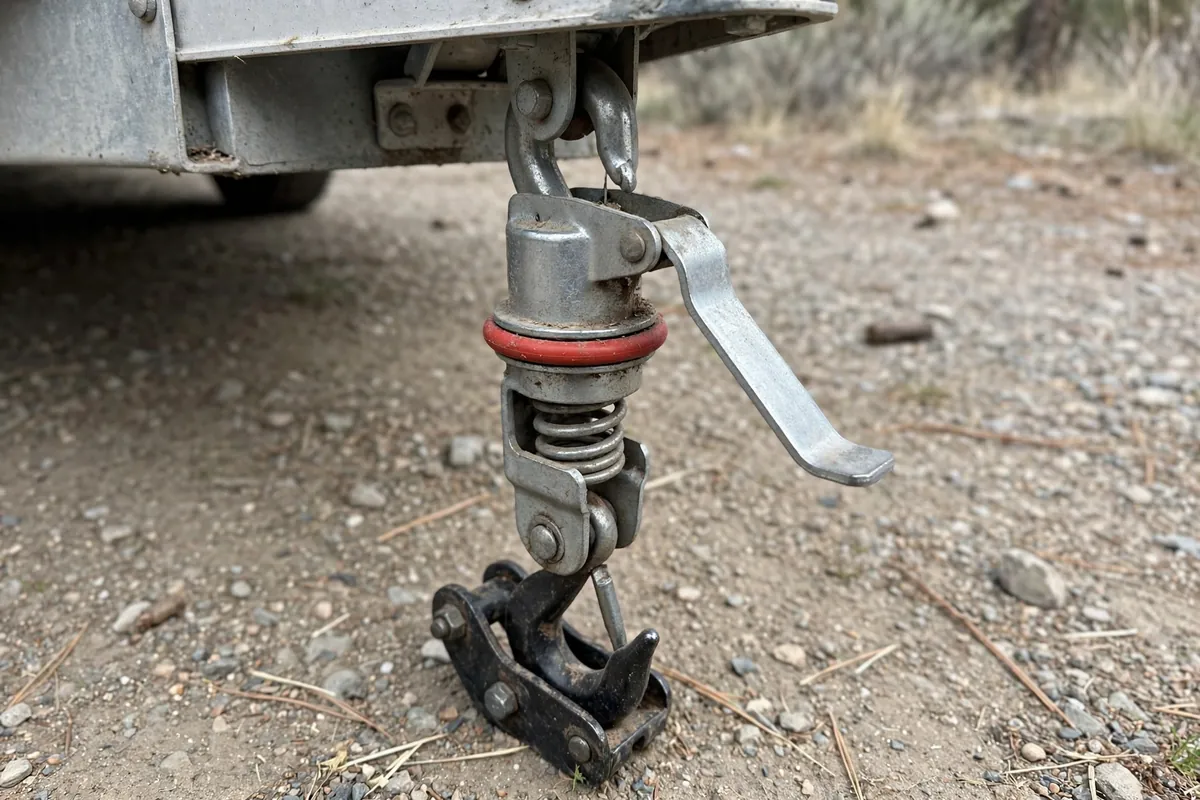
The turnbuckles connect the tie downs to the camper’s anchor points, and this is where owners make the most mistakes. The truck flexes over uneven surfaces; the camper does not. With a rigid connection, that flex goes somewhere — the mounts, the anchor points, or the camper’s structure. Spring-loaded turnbuckles absorb it.
That is why Torklift conditions its camper-anchor warranty on spring-loaded turnbuckles at all four corners, and why makers like Northern Lite recommend frame-mounted tie downs plus spring-loaded turnbuckles with regular checks. iRV2 owners who have run springs for years on gravel backroads say it plainly: the springs let the truck and camper move together instead of fighting.
Tension matters more than brand. Too loose and the camper bounces on the mounts — owners on the WanderTheWest forums learned that bouncing stresses anchor points until they break. Too tight and you slowly deform the structure under the camper’s anchor points. The sweet spot for FastGuns: adjust until the tension indicator’s O-ring sits about a quarter inch below the body with the handle closed — most camper makers specify spring-loaded turnbuckles around 300 ft-lbs, roughly 200 pounds per corner. One Forest River Forums owner puts it practically: about an eighth-inch clearance between the eyebolt and the anchor point. By hand plus the lever, never a cheater bar.
The products, side by side:
- Torklift FastGuns — the number-one selling quick-disconnect turnbuckle in the RV world: stainless, spring-loaded, tension indicators, handles that connect and disconnect in seconds, lockable (locks sold separately; turnbuckle theft is real — our theft-prevention guide covers the rest of the rig). Torklift lists them starting at $323.99 per pair; retailers typically list pairs around $440, so four runs real money. Owners consistently call them the easiest turnbuckles to live with. Forum note: on some trucks the front FastGun blocks the fuel door — unhook and rehook when you fuel up, twenty seconds.
- Torklift Springload XL (S9050A) — cleaner step up from the basic springload: internal springs, tension indicators, 35 to 45 inches of reach, about $230 to $325 per pair. The basic Springload (S9000) runs around $147 per pair. The plain eye-to-eye (S9011) at about $22 each is the rigid, non-spring hardware the old hands warn against.
- Happijac Quik-Loads — adjust tension after installation without removing them, which fine-tuners like. Set of four runs $430 to $530; stainless, reinforced half-inch steel hooks, removable handles, one-year warranty. (etrailer’s flatbed Quik-Load listing shows the lever design, 11-inch threaded hooks, and spring-action construction.)
- Derringer handles (S9528) — convert ordinary half-inch-thread turnbuckles into quick-disconnect lever-action units, about $244 for four. The popular middle path.
Safety note: never rig a camper with open hooks you do not trust. An old Diesel Page thread documenting a turnbuckle stress failure landed on a fix owners still repeat — replace wimpy hooks with forged eye ends and proper shackles or quick links. And respect a spring-loaded handle: that lever stores real energy. Keep face and hands out of the release path, and never put your body between the turnbuckle and anything that can move.
So What Are the Best Truck Camper Tie Downs?
The honest ranking depends on your truck more than your budget:
- Torklift frame-mounted (steel or Talon) with spring-loaded turnbuckles — the best truck camper tie downs for most owners. Only system that puts the load path through the frame; anchors disappear when the camper is off; lifetime warranty; the combination camper makers recommend. Costs the most, install has its moments. Buy once, buy this.
- Happijac — best if your used camper already has it, or you want the front pull angle. Good front-mount geometry, turnbuckles adjust on the fly. Eyes open about bumper-mounted rears on modern trucks — many owners end up running Happijac fronts with frame-mounted rears.
- Torklift ApexAnchors — best for inboard-anchor campers (Four Wheel Campers, Scout, Cirrus). Retractable, flush, frame-mounted. Remember the warranty strings on the turnbuckles.
- Brophy — best for a small camper on an older truck on a tight budget. Respect the fitment limits; not a 2011-or-newer truck or heavy-camper answer.
Pair whatever you choose with a rubber bed mat — it keeps the camper from walking in the bed, which reduces how hard the tie-downs work. And budget the hardware weight: 50 to 80-plus pounds against payload, so run the payload calculator with real numbers.
The Failures Owners Actually Report (And How to Avoid Them)

Product pages skip this section; it matters most, because almost every tie-down failure in owner forums was preventable.
Problem: over-tensioning tears the camper’s anchor mounts out. On the WanderTheWest forums, an owner brought home a new-to-him Four Wheel Camper and found the front passenger turnbuckle lying loose in the bed after the first shakedown — the mount loop had torn clean out of the wood, never attached to the camper’s frame, likely over-tightened by a previous owner. The thread’s fix: back the torn mount with a large steel plate to spread the load, and stop treating turnbuckles like lug nuts.
Problem: turnbuckles loosen and vanish on washboard roads. A WanderTheWest owner checked everything at trip start, then found a turnbuckle had vibrated clean off mid-trip — later found under the camper — and a hardware-store replacement hook had straightened 90 degrees on the bed eyebolt. Cheap fixes: jam nuts, thread locker, forged eye-bolts with backing plates instead of hooks, and a nightly flashlight walk-around on washboard days.
Problem: rigid connections break things when the truck flexes. In the iRV2 spring-loaded-versus-rigid debate, the winning argument is mechanical: the truck flexes while the camper does not, so a rigid connection forces the mounts or the camper’s structure to absorb every twist. Owners of heavy campers on rough roads are most insistent — this turns a rough road into a cracked camper wing or a torn anchor.
Problem: turnbuckles too loose let the camper hammer its own mounts. The flip side: slack turnbuckles let the camper bounce, and every bounce hammers the mounts. Too loose breaks things, too tight deforms things — the springs exist so you never choose between the two. Check tension regularly and re-check after the first hundred miles.
Two smaller surprises. Happijac rears attach to the bumper — on a 2017-or-newer Super Duty or any bumper you can flex by hand, owners do not trust them; it is the most common reason people switch to frame-mounted rears. And tension is not set-and-forget: re-tension after the camper settles into the bed.
Shopping used? Study the anchor points before buying. Our used-camper inspection checklist has you look for tight mounts with no wallowed holes, twisted jack plates, or cracks around tie-down areas — a torn anchor mount is a repair, a negotiation, or a walk-away, and you want to know which before money changes hands.
Safety disclaimer: I am an owner, not an engineer. Follow your camper maker’s securement instructions and your truck’s payload ratings — tie-downs hold the camper down, they do not increase what the truck can legally carry. If a mount is torn or a turnbuckle will not hold tension, stop driving and fix it before the next trip. Suspension helpers improve how a legal load rides (our comparison) but change nothing about the payload sticker.
FAQs
Can I use the tie-down points that came on my used camper?
Usually — inspect them first. Each anchor should be tight, the holes not wallowed out, and the structure behind them solid with no cracking or rot. Questionable anchor points are a repair or a negotiation point; no turnbuckle fixes bad structure.
Are spring-loaded turnbuckles really necessary?
For a heavy camper, effectively yes. The truck flexes, the camper does not, and the springs absorb it so the mounts and anchor points do not have to. Makers recommend them; Torklift’s camper-anchor warranty requires them. Rigid hardware suits a light pop-up on a light truck — the heavier the rig and rougher the roads, the more the springs matter.
How tight should truck camper turnbuckles be?
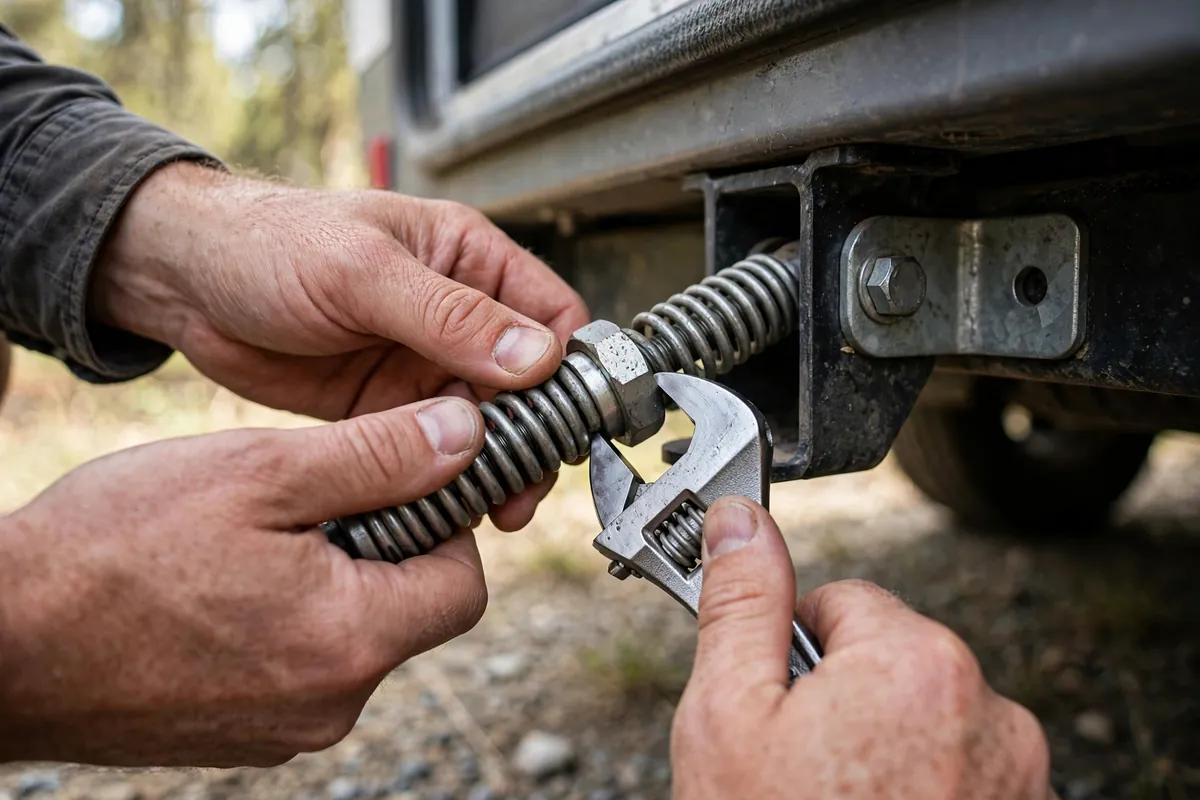
Tight enough that the camper cannot bounce, loose enough that you are not deforming the camper’s structure. On FastGuns, the tension indicator’s O-ring should sit about a quarter inch below the body with the handle closed; most camper makers specify around 300 ft-lbs, roughly 200 pounds per corner. Never use a cheater bar. Re-check after the first hundred miles.
Why do my turnbuckles keep loosening?
Vibration, especially washboard and rough roads. The fixes that work: jam nuts against the turnbuckle body after setting tension, thread locker, and forged eye-bolt ends with backing plates instead of plain hooks. Then a nightly flashlight walk-around on rough-road trips.
Can I mix brands — Torklift turnbuckles with Happijac tie downs?
Yes; owners do it constantly. The brackets and the connectors are separate parts of the system. A popular combo is Happijac front mounts (for the pull angle) with frame-mounted rears and FastGuns as connectors. Keep the springs in the system, and respect the weakest link — the camper’s anchor points.
Do tie-downs affect my truck’s payload?
The hardware weighs 50 to 80-plus pounds and counts against payload like any cargo. But no tie-down system increases legal payload — that number comes from the door-jamb sticker. Tie-downs keep a legal load attached; they never make an overloaded truck legal.