Truck Camper vs Travel Trailer for Couples: The Space Fight Settled
Every spec sheet answers the wrong question. They will tell you dry weight, tank sizes, and floor length, but nobody asks the thing that actually decides whether you will love your rig or sell it in eighteen months: what is it like to live in a box this size with the person you married, when neither of you can go anywhere?

That is the real truck camper vs travel trailer debate for couples. The 6 a.m. bathroom queue. The wet-bath everything’s-soaked dance. Your partner snoring two feet away. And the one-person-cooks-while-the-other… does what, exactly? Stands there?
Quick Verdict: Truck Camper vs Travel Trailer for Couples
The truck camper wins if: you move constantly, you boondock, and your default setting is “we are basically one person with two sets of boots.” One vehicle, near-zero setup, fine with touching each other a lot.
The travel trailer wins if: you stay put for days, one of you needs alone time, either of you is tall or creaky, and you want a real bathroom with a door that closes. Unhitching and having the truck free changes everything.
The Space Reality: 100 Square Feet Changes Your Relationship
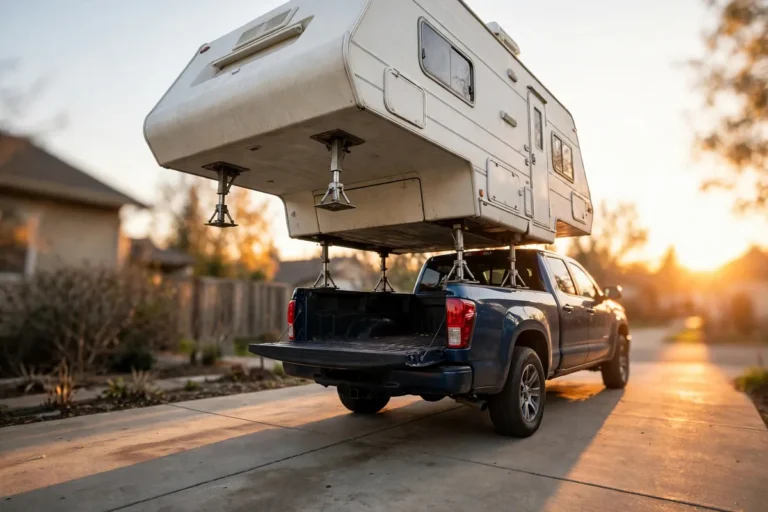
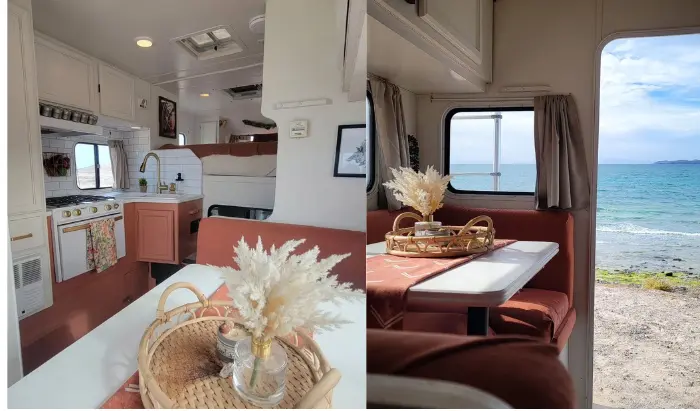
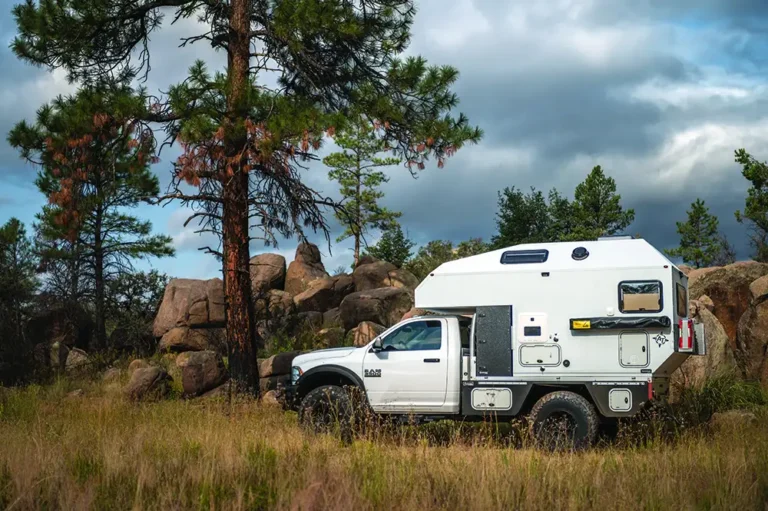
The math is absurd. A hard-side truck camper gives you roughly the footprint of your truck bed — an 8-foot floor with the bed hanging over the cab. Owners routinely describe about 100 square feet. A small travel trailer with a slide easily gives you double that, with zones: a dinette here, a bed there, a bathroom that is its own room.
One owner who went from a 30-foot travel trailer with a slide to a slide-less truck camper put it perfectly: he feels like he is living in a walk-in closet that includes a bed, a shower, a kitchen, a fridge, a table, and a couch. He loves it. But he also admits he cannot sit up on the cabover bed without tilting his head, his shower is 27 inches wide (“functional, but so is a bucket of water”), and anything not locked behind a cabinet will be found on the floor at the next stop.
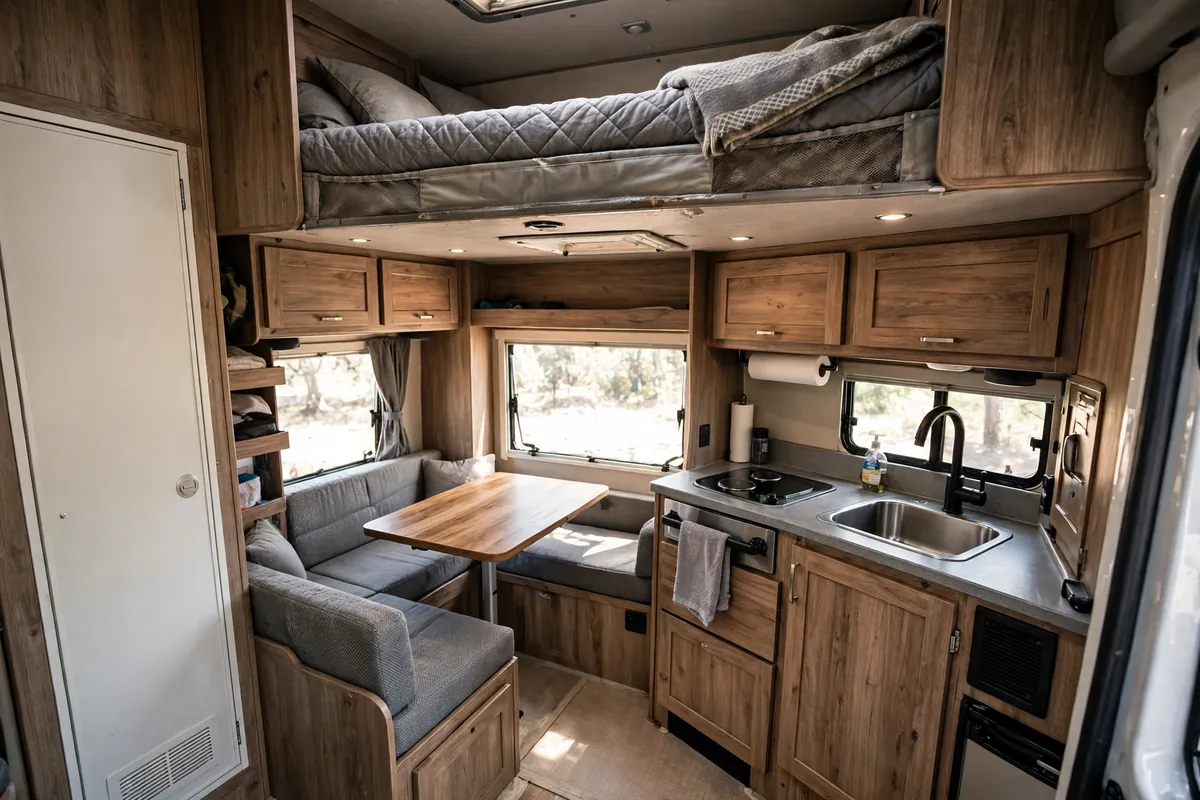
That last detail sounds trivial until it is your life. In a travel trailer, you can leave the coffee pot on the counter. In a truck camper, every drive is a tiny earthquake: everything gets an assigned home, and it goes there immediately. Couples who run this well are the hyper-organized, tidy-as-you-go type. If you and your partner are both the “I’ll get to it later” type, a truck camper becomes a junk drawer on wheels by week two — not a moral failing, just a rig mismatch.
The Bathroom Situation: Where Most Couples’ Fights Start
Here is a typical truck camper morning: one of us uses the wet bath, showers in the wet bath (it is the same room — wet is doing a lot of work in that name), dries everything, and then the other one gets a turn. There is no “you shower while I make coffee.” Coffee waits.
In a travel trailer, the bathroom is a separate room. Your partner brushes their teeth while you cook eggs. A husband-and-wife duo on the RV-Dreams forums, who road-tested floorplans for full-timing, put “as much as we love each other we do need our own private space once in a while” on their needs list, right next to “two bathrooms a must,” because they discovered they were, and I quote, “synchronized for doing number one and number 2.” Travel does this to you.
The wet bath is the biggest adjustment for couples moving out of a house. Toilet, sink, and shower share one tiny sealed room. When one person showers, everything inside gets damp — which is why veteran owners install a covered toilet paper holder to keep the roll dry. A couple who ran a truck camper for six years with their dog on the racing circuit summed it up: the wet bath is a PITA, and they would recommend a dry bath if you can find one. In a truck camper that is still a big ask — most compact models use a wet bath, with dry baths reserved for larger slide-equipped units.
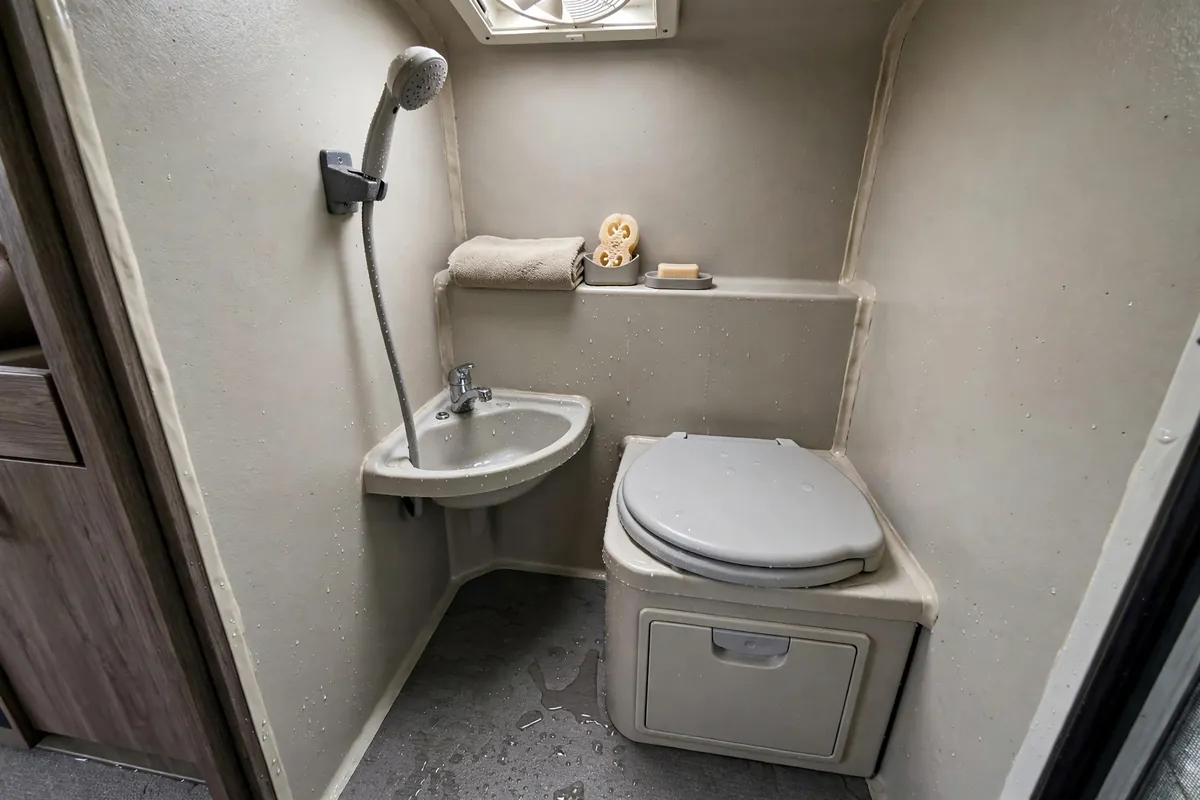
The toilet itself is the other couples’ decision. Many truck campers run a cassette toilet rather than a full black tank, which means someone physically carries the cartridge to the dump station. Have the conversation about who now, while you are both smiling. (Our cassette toilet guide covers the full boondocking reality.) A travel trailer with a standard black tank and a latching bathroom door removes this entire category of negotiation from your marriage.
Privacy, Noise, and the “Hearing Everything” Tax
In a truck camper, you can hear everything. Every zipper. Every snore. Every middle-of-the-night thought that would have been private at home. One couple, in Truck Camper Magazine’s “boomerang” stories of owners who left truck campers and came back, said they originally moved away partly because their pop-up had no bathroom “with enough privacy for the shy one of us.” The shy one of us. That is a gentle, real sentence that describes a lot of marriages.
A travel trailer does not give you a soundproof apartment either, but it gives you distance — a few extra feet, a door, a dinette that is not also the bedroom. In a truck camper, there is one room, and whatever one person is doing is what the room is doing.
This is not just about modesty. It is about alone time, and two kinds of couples exist. Some couples process their days out loud, together, and genuinely do not need separate space. Those couples can thrive in a truck camper indefinitely. Other couples need a door — not because anything is wrong, but because one of them recharges in silence. If that is your partner, do not talk them out of it. Get the trailer.
The Cabover Crawl: Beds and the Getting-Older Tax
Every truck camper puts the bed over the cab. It is brilliant engineering and a genuine couples’ stress test. To get into bed, you climb up — usually on short steps — and then you crawl in. The person against the wall forces the other to climb over for every midnight bathroom trip.
Young, limber couples laugh at this. Then a retired owner on the iRV2 forums, 67, put it bluntly: climbing over his girlfriend and down off the overhead bunk was no longer funny, and the 3.5-foot drop from the camper door worried him daily. He sold the truck camper and started shopping for a travel trailer — where the bed is a normal bed you walk up to, and the door has steps like a porch.
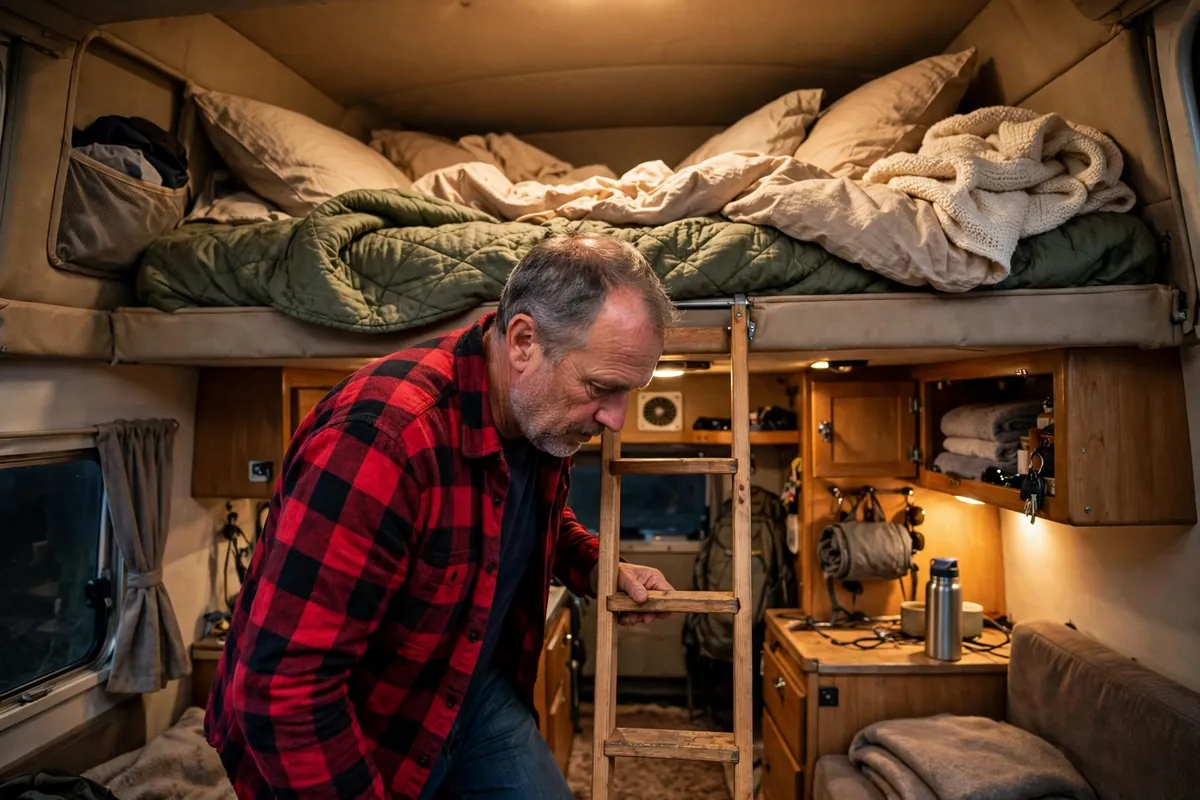
Truck camper floors sit high in the bed, and pop-up models add a ladder into a canvas loft. If either of you has bad knees, a bad back, or is past the age of laughing at a 3 a.m. clamber, that alone can settle the truck camper vs travel trailer question. A travel trailer’s floor is lower, its steps are steps, and most have a real queen bed you can sit on the edge of.
And when you do sleep up top, the mattress matters more than in any other RV, because a bad night in a cabover feels like sleeping on a shelf. Our truck camper mattress upgrade guide covers what actually fixes the cabover sleep problem.
The Choreography: One Cooks While the Other…
This is the part of the debate I wish someone had explained to us before we bought. In a travel trailer, two people can be in the kitchen at the same time — one chopping, one stirring. In most truck campers, the kitchen is a galley along one wall, roughly one human wide. When one person cooks, the other is outside. That is not a complaint; it becomes the rhythm. But it has to be a rhythm you like.
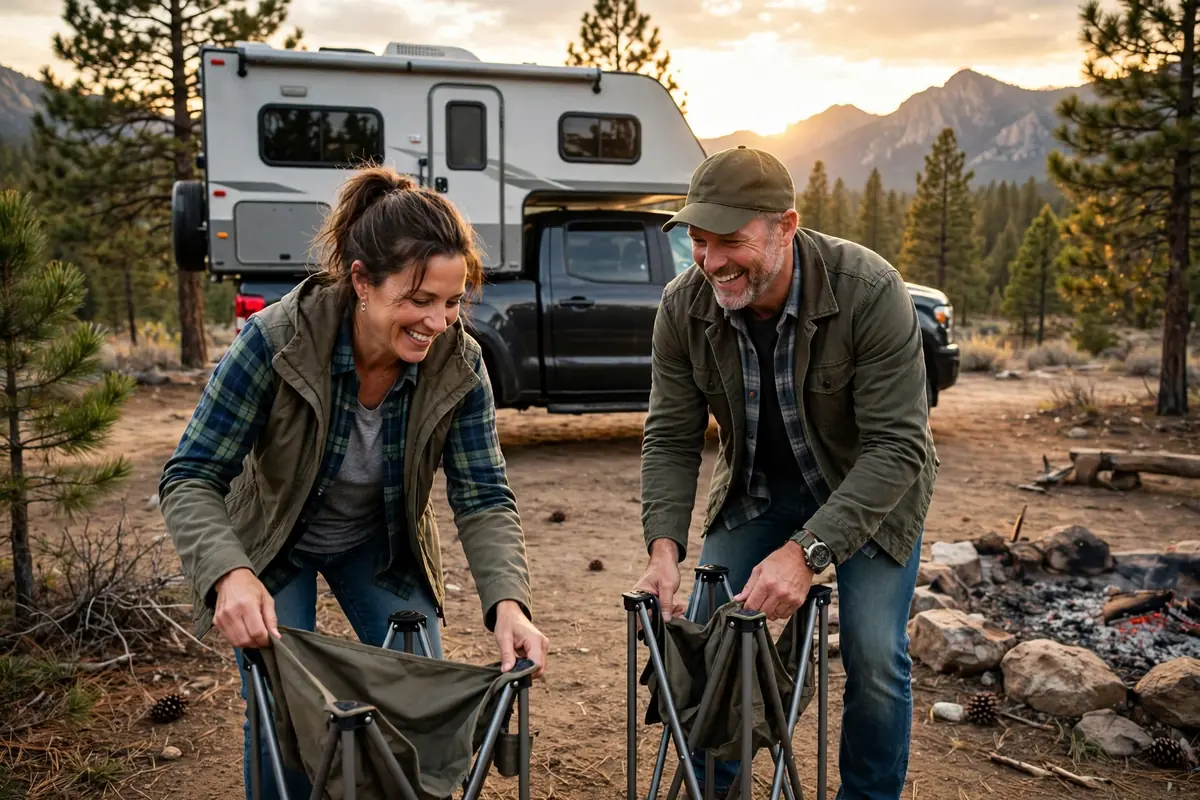
Truck camper morning: one person gets up first and goes straight outside — coffee on the picnic table, chairs out, dog walked — while the other dresses inside. The early riser volunteers as the outdoor shift. If you both love mornings outdoors, this is the dream. If one of you likes shuffling to the kitchen in pajamas and sitting for an hour, it is less of a dream.
Travel trailer morning: someone makes coffee at the actual kitchen, the other sits at the dinette, nobody relocates. Rainy days are not a logistical exercise.
Owners who love truck campers for couples almost always say the same thing in different words: we live outside anyway. The camper is the bedroom, the rainy-day kitchen, the bathroom. The actual living room is the campsite. Couples who thrive are the ones who would rather be outside — hiking, fishing, grilling, sitting by the fire. If your idea of a camping evening is the two of you inside with a show on, the trailer’s separate living space will save your sanity by day four.
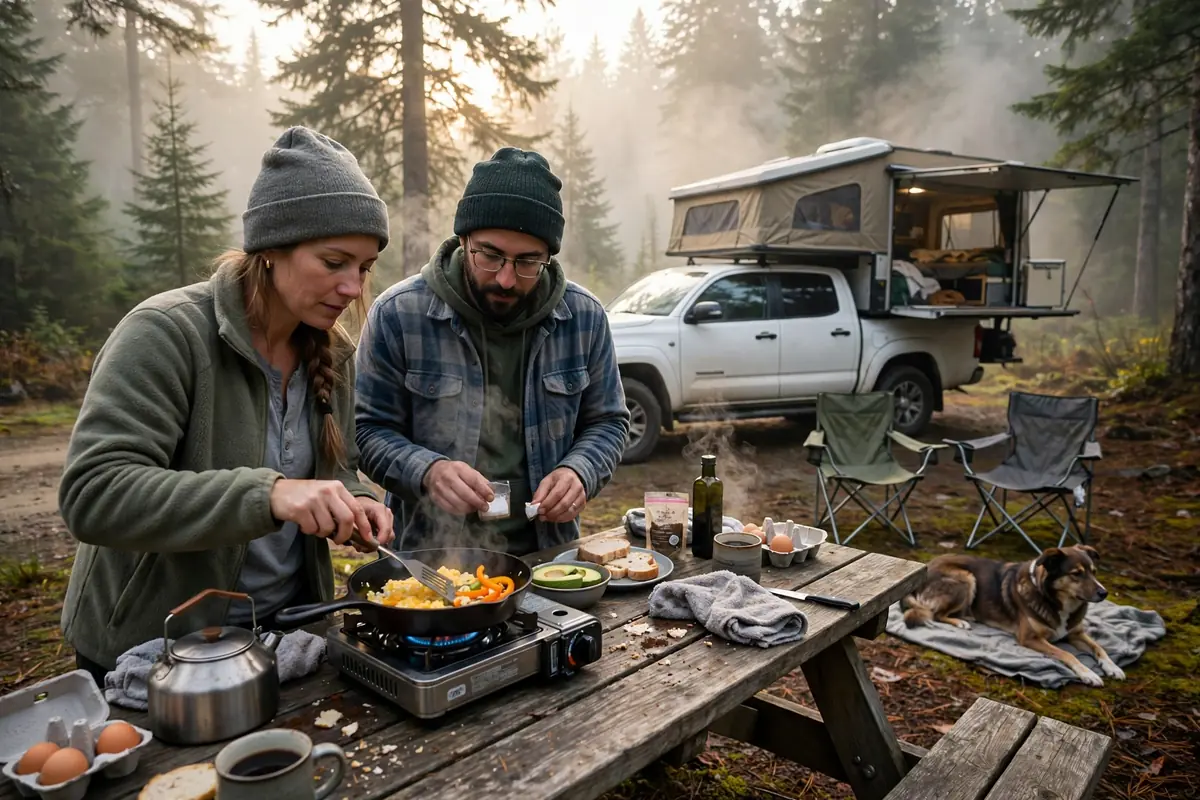
And the dog owners: yes, bring the dog. But in a truck camper, the dog’s “spot” is your spot too. Our truck camping with dogs guide covers where they ride, where they sleep, and the big-breed hacks that work in 100 square feet.
Mobility vs. Comfort: The Real Trade Nobody Can Win
Here is the part where the truck camper genuinely earns its keep, and why so many couples pick it anyway despite everything above.
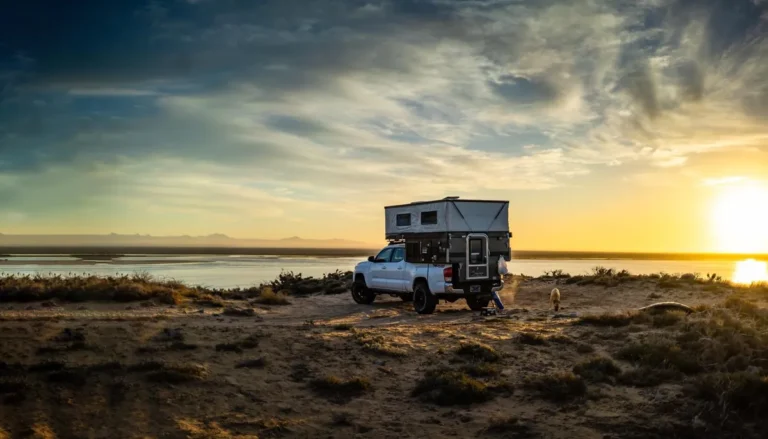
A truck camper goes anywhere your truck goes. No trailer to back up, no sway in crosswinds, no second set of wheels to watch on a forest service road. You pull into a single parking space, turn around on a dirt road that a trailer would have made you back out of, and setup is measured in minutes: park, level, done. A 28-foot trailer needs room to maneuver, a patient driver, and a proper hitch ritual every time you move.
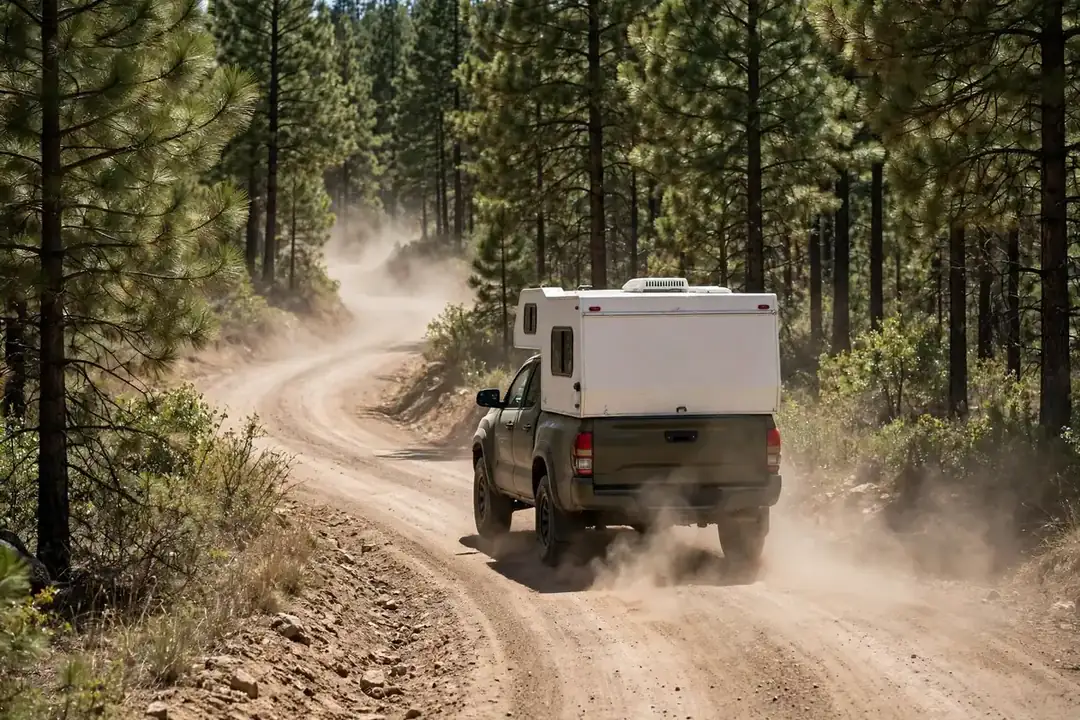
The flip side is what the trailer does to your days. Unhitch, and your truck is free — groceries, trailheads, sightseeing, all without breaking camp. Truck camper owners can drop the camper on its jacks, but most couples just leave it on, so every errand is a full-camp relocation. One retired owner on the iRV2 forums, who switched from a truck camper to a trailer, said the single biggest win was “being able to land and set up the trailer and then use the truck for various excursions.”
So the real question is how you travel. Couples who move every day or two — chasing weather, bouncing between boondocking spots — live the truck camper’s best life. Every campsite is a ten-minute decision, not an hour of backing and unhitching. Couples who pick a spot and stay for a week get more out of a trailer: it turns camp into a home base with a car attached.
The Money Surprise: Truck Campers Are Not the Budget Option
This is the myth that needs a stake through its heart. People assume the smaller rig is the cheaper rig. It is not.
Owners on the Good Sam forums have run the comparison with real numbers: a new 28-foot travel trailer can sell for around $18,000, pulled by a half-ton truck that doubles as your daily driver — total package in the $50,000s. The truck camper version needs a heavier truck (most models realistically want a 3/4-ton or 1-ton loaded for travel) plus the camper itself. One owner put it at $60,000 for the truck plus $40,000 for a modest camper — roughly Class B motorhome money. Another dealer’s verdict: the cheapest new travel trailers start below the cheapest new truck campers.
Then there is the truck itself. Your existing half-ton might happily pull a couples-sized travel trailer while being overloaded by a hard-side truck camper. A popular example like the Lance 650 currently lists at a 1,813-pound dry weight with a 6’10” floor (per Lance’s own specs), and the bigger 865 at 2,012 pounds — both need real payload, not the brochure fantasy. Run your actual numbers before you fall in love with anything: our truck camper payload calculator guide walks through how to know if your truck can carry the camper you want, and the Lance 650 vs 825 vs 865 real-weight breakdown shows what brochure weights hide.
For the record, it is possible to go light: the Kimbo 8 starts at $47,990 with a 1,125-pound base dry weight, a standard dedicated wet bath, and a queen cabover (per Kimbo’s own specs) — designed explicitly for couples on full-size trucks. But light is still not cheap.
Insurance is a small win for the camper: it usually rides on your truck’s policy, while a travel trailer needs its own. Our true cost of ownership breakdown lays out what a year of camper life really costs, and full-timers should read the ugly truth about full-time truck camper living — several of the couple-specific problems above get worse at full-time scale.
Truck Camper vs Travel Trailer for Couples: The Honest Verdict
After all the choreography and math, here is the couples’ verdict:
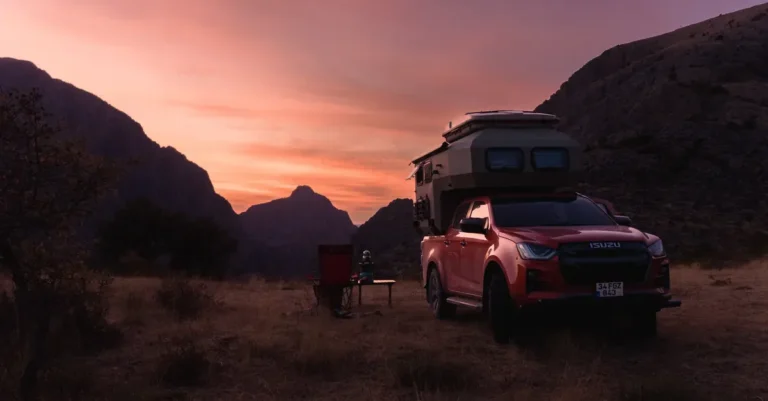
Choose the truck camper if: you move constantly, you boondock, your camping life happens mostly outdoors, neither of you needs alone time, you are both mobile enough to climb and crawl, and 100 square feet sounds romantic rather than claustrophobic. The couples who love truck campers are active, adaptable, low-maintenance-in-the-best-way pairs — the ones laughing in the rain on the picnic bench instead of inside watching it.
Choose the travel trailer if: you stay put for days, someone needs a door and quiet, either of you is tall or getting creaky, you want to cook side by side, the dog is big and opinionated, or the phrase “wet bath” made your partner’s face do something. A travel trailer is more comfortable for two people, full stop. A couple who admits that and buys the trailer will have a better decade than one who buys the camper to prove they are tough.
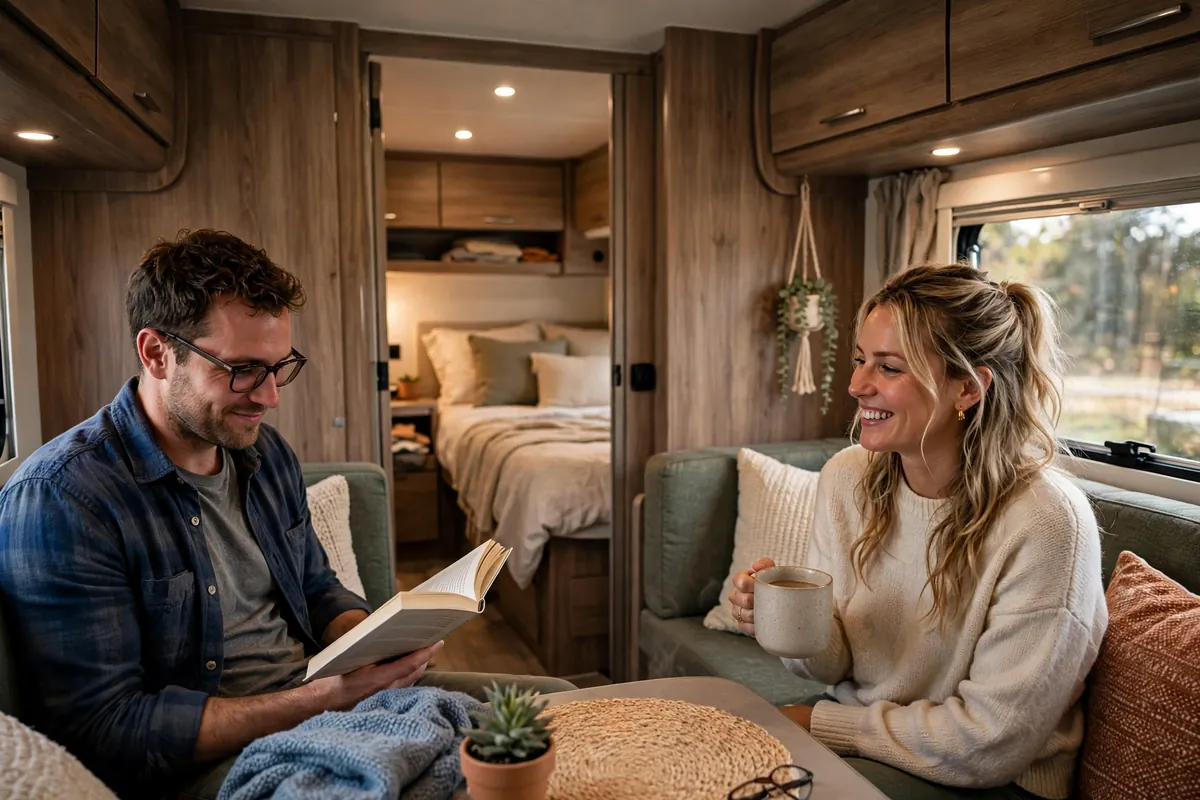
And if you are still torn, do what several couples on the forums wish they had done: rent each one for a long weekend and simulate a rainy day. Make coffee at 6 a.m. Use the bathroom. Cook dinner together. The rig that survives a wet Sunday will tell you everything.
Frequently Asked Questions
Is a truck camper big enough for two people full-time?
Yes, but only for a certain kind of couple. Owners who full-time as a pair say it works when both people are outdoor-oriented and comfortable touching each other constantly. But if one partner needs private space, 100 square feet will not manufacture it. For full-time couples, slide-outs and a dry bath make a meaningful difference.
Which is cheaper for a couple, a truck camper or a travel trailer?
Usually the travel trailer setup. New travel trailers start below new truck campers, and a couples-sized trailer can be towed by a half-ton truck that doubles as your daily driver. A truck camper often demands a 3/4-ton or 1-ton truck plus the camper, pushing the total toward Class B motorhome money. The smaller rig is not the budget play.
Can two people cook in a truck camper?
Not at the same time, in most floorplans. The galley is typically one person wide, so couples develop a rhythm: one cooks while the other is outside or at the dinette. Travel trailers let two people work side by side.
How do couples handle the bathroom in a truck camper?
You take turns, and you plan. Most compact truck campers have a wet bath (toilet, sink, and shower in one small room) rather than a separate bathroom, so one person uses it at a time and everything inside gets damp. Couples either get comfortable with this or upgrade to a larger model with a dry bath — or choose a travel trailer with a dedicated bathroom. Decide who empties the cassette toilet before you buy.
Is a truck camper or travel trailer better for boondocking as a couple?
The truck camper, by a wide margin. It needs no trailer-sized site, turns around on forest roads, parks in a single space, and handles off-road use. Couples who boondock as a lifestyle — moving between dispersed sites every few days — are the truck camper’s core audience.
Will we kill each other in a truck camper?
Probably not — but owners joke about it because the risk is real. One wrote that a two-week-plus road trip in his truck camper meant making sure he “was the beneficiary in everyone’s will.” The couples who thrive treat the outdoors as their living room and genuinely like each other at close range.