Towing With a Truck Camper: Hitch Extensions, Weights, Sway, and Legality
I learned quickly that towing with a truck camper is not the same as towing with an empty truck. Once the camper is in the bed — tall, heavy, and usually sticking out past the bumper — the hitch point moves back, the rear axle carries more, and stopping distances grow whether you feel it or not.
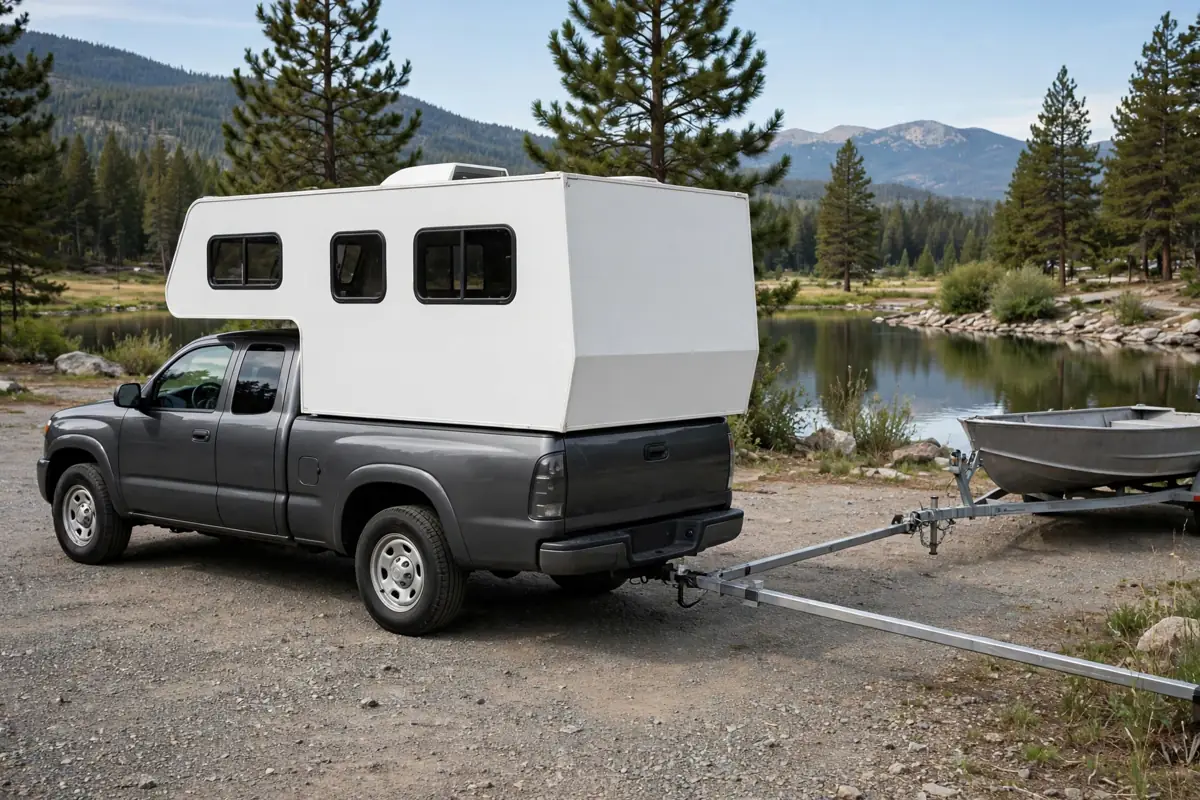
I mean the setup a lot of us actually want: camper in the bed, boat or utility trailer behind it. It can be great — and it can quietly put you over a rating you never checked. This guide covers clearance, hitch, weights, sway, braking, seeing, and law, in the order problems show up.
Why towing with a truck camper is a different job
Empty, the ball sits close to the rear axle and payload is plentiful. Loaded, three things change. First, payload is mostly spoken for: camper, water, propane, food, people, and gear are already on the truck, and tongue weight lands on that same axle and budget. Second, the camper usually overhangs the rear, burying the receiver or leaving so little room that the jack or boat bow hits the camper on a turn. Third, you lose your rear view and gain a wind sail: you cannot see the trailer, and camper plus trailer give crosswinds two things to push.
So stop thinking, “My truck tows 12,000 pounds, so this 6,000-pound boat is fine.” Think about the whole rig, loaded as you travel.
Measure the overhang before you buy anything
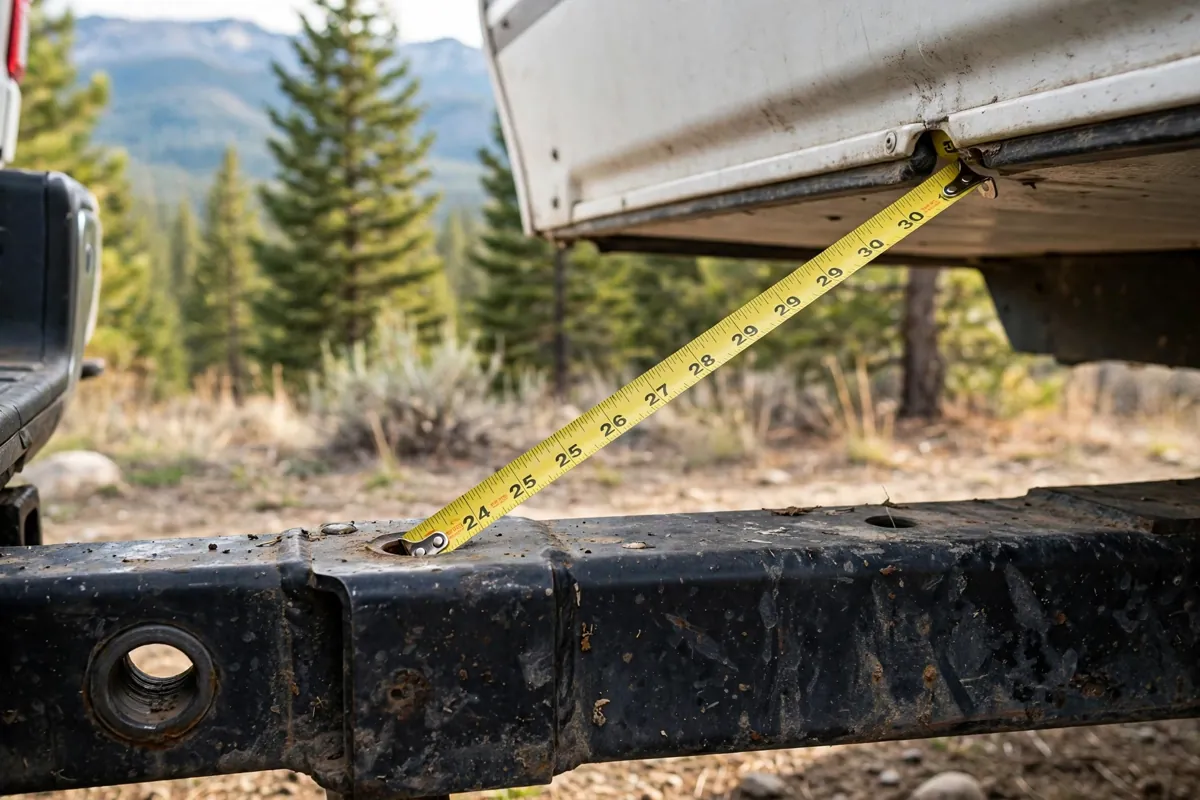
Before you shop, measure from the receiver pin hole to the rearmost point of the camper, including steps or ladders, then check coupler and jack swing. You need clearance straight, turning, backing, and over a dip where the tongue rises toward the camper.
Bed length matters: a long-bed truck often needs little or no extension for the same camper that needs a long one on a short bed — see my short-bed vs. long-bed truck camper guide. A short extension to clear a bumper is one thing. A three- or four-foot extension to clear a big camper is a different engineering problem.
Hitch extensions: the cheap fix and the proper fix
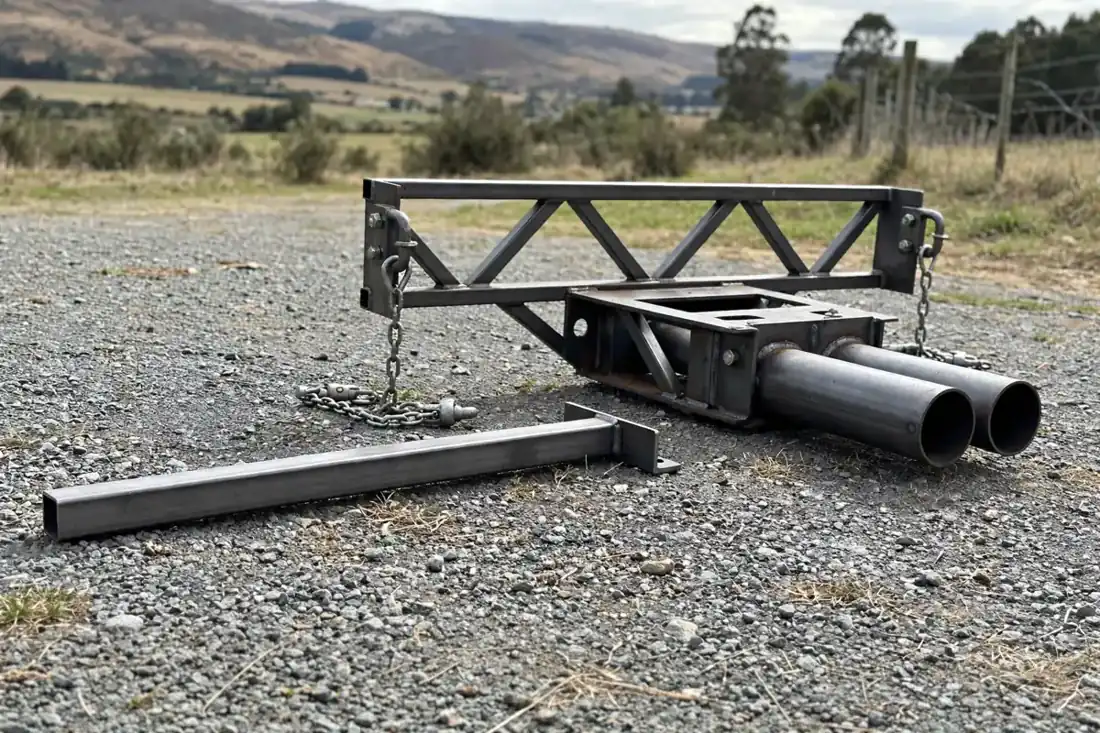
There are two kinds of “extension,” and confusing them is how people get into trouble.
The first is a simple single-tube receiver extension: a bar that slides into your factory receiver and gives you a second receiver farther back. Cheap and useful for light clearance problems, but costly in capacity. As a general industry guideline, an extension under 12 inches typically cuts receiver capacity by about 25%, and one 12 inches or longer by about 50%. That is a conservative rule of thumb, not a calculation for your exact truck, and your extender’s own stamped rating still governs. The rule that never changes: your limit is the lowest-rated part in the chain — truck, receiver, extension, ball mount, and ball.
So a receiver rated for 1,000 pounds of tongue weight, fitted with a long single-tube extension under that common 50% derating, may effectively be down to around 500 pounds. Plenty of boat and utility trailers eat that up fast. Owners on forums report exactly this surprise: nothing broke, but the rig felt loose, the rear squatted more, and the trailer had far more leverage over the truck than before.
The second kind is a purpose-built camper system, best known as Torklift’s SuperHitch with its SuperTruss extension. Instead of one unsupported tube, it uses a dual receiver and, on longer extensions, a truss with chains and turnbuckles to brace side loads. Lengths run 21 to 60 inches, and ratings fall as length grows: with weight distribution, a 60-inch SuperTruss is rated around 10,000 pounds pull / 1,000 pounds tongue weight, versus around 14,000 / 1,400 for a 21- or 24-inch version; without weight distribution, the long version drops to roughly 5,000 / 500. The extension sets the real limit.
That is why owners on iRV2 and Expedition Portal steer people away from a long, cheap extension for a heavy trailer. One often-repeated fix is to extend the trailer’s tongue instead, where practical: a longer tongue moves the pivot back without the same unsupported lever on the receiver, and owners report steadier towing. Check the trailer maker first — do not just weld one on.
One iRV2 story stuck with me. An owner towing behind an 11.5-foot camper said his three-foot extension multiplied hitch weight so much that bouncing on the hitched trailer made the truck frame visibly flex. Years later the frame broke just ahead of the rear spring hangers. He could not prove the extension caused it — but he stopped towing that big enclosed trailer behind the camper. I retell it not as proof, but because it matches the physics: leverage bends frames and receivers, not just sticker numbers.
The weight math, in plain terms
Forget the brochure tow rating for a minute. Four numbers decide whether your rig is inside its limits:
- GVWR: the most your truck alone can weigh, fully loaded — truck, people, fuel, camper, gear, plus tongue weight pressing on the hitch.
- GCWR: the most truck and trailer together can weigh, fully loaded. This is the number people blow past first, because the published tow rating usually assumes a nearly empty truck. Weigh-Safe’s GCWR explainer puts it plainly: if truck plus trailer plus everything in both exceeds GCWR, you are overloaded even if the trailer alone is under the tow rating.
- GAWR: the most each axle can carry. You can be under GVWR and still overload the rear axle.
- Payload: GVWR minus what the truck actually weighs. Your camper already used most of it; tongue weight uses more.
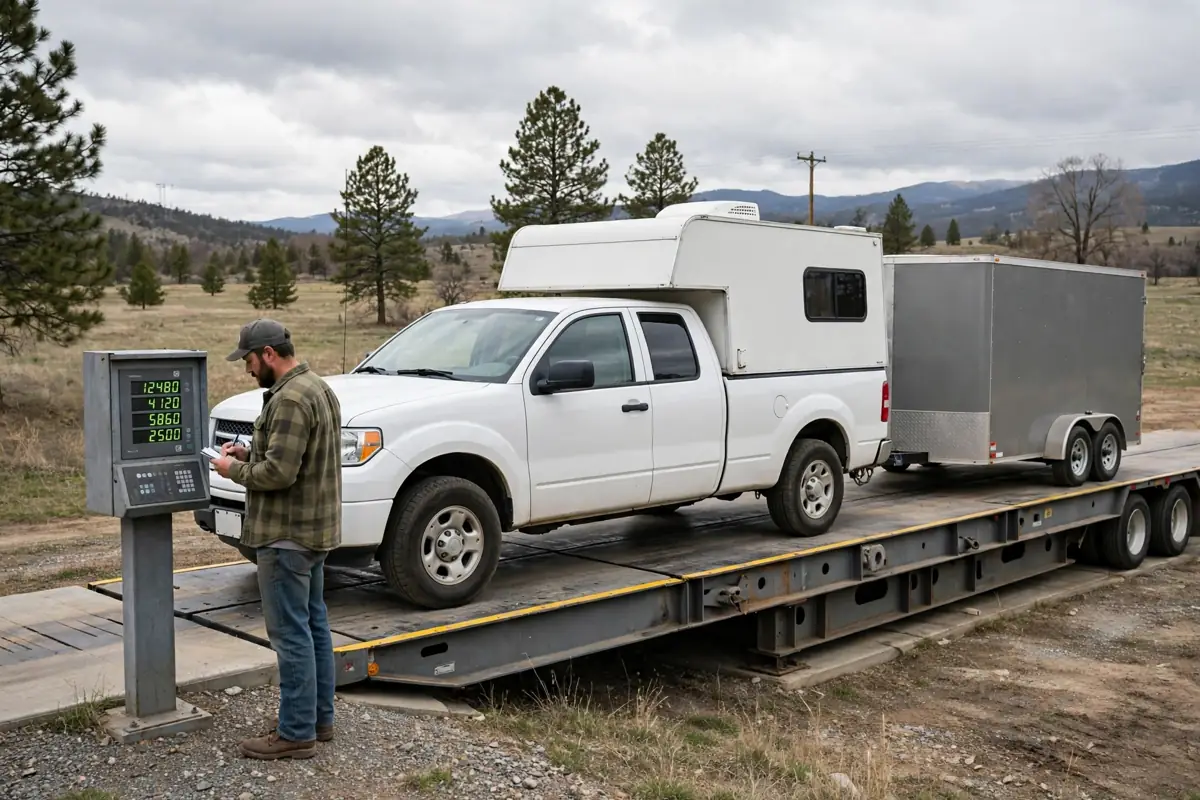
Do the math at home first: loaded truck against GVWR and rear GAWR; then loaded truck plus loaded trailer against GCWR. If any comparison fails, you are over — even if the trailer alone is under the advertised tow rating. A heavy camper is exactly how that happens.
See my truck camper payload calculator guide and truck camper tires and load ratings guide for deeper traps. Once paper math looks close, weigh the rig loaded the way you travel — a scale, not a brochure, is the verdict.
Tongue weight and sway: the 10–15% rule, and the boat exception
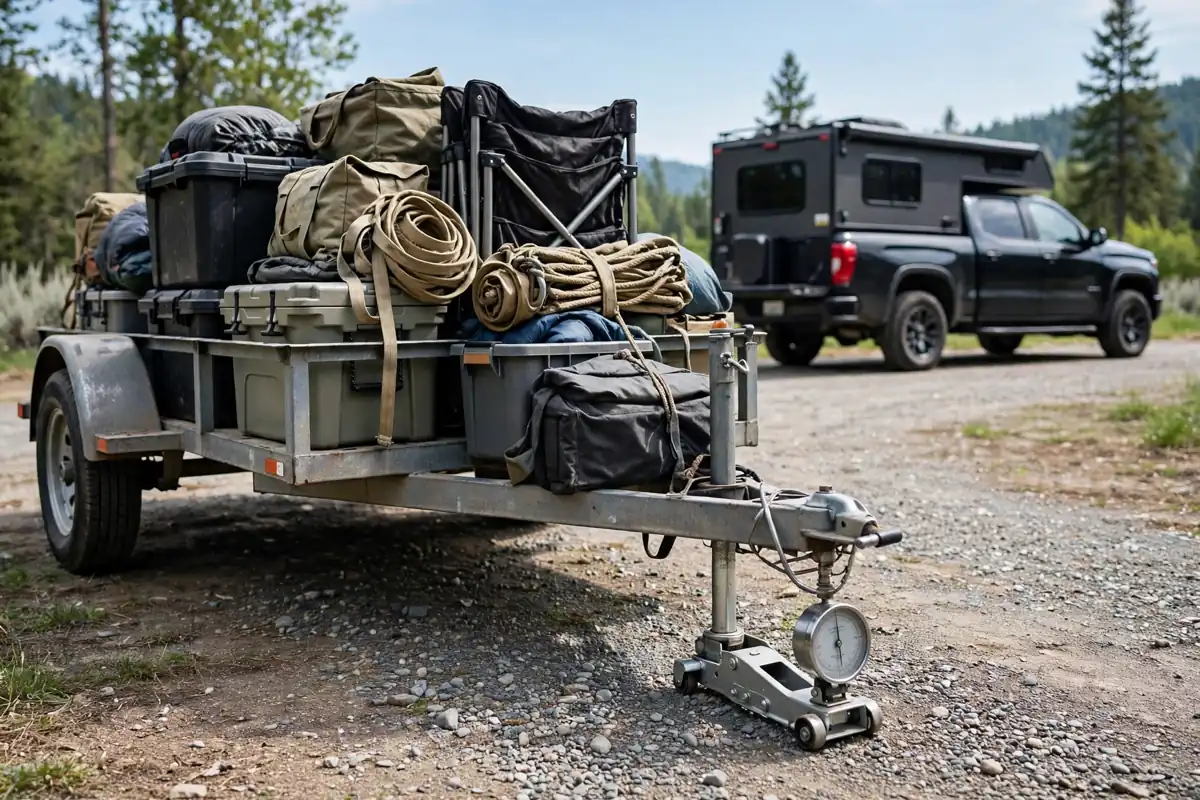
For most utility, cargo, and car trailers, aim for tongue weight around 10–15% of the loaded trailer’s weight — roughly 500 to 750 pounds on a 5,000-pound trailer. Below about 10%, weight sits too far behind the axles and the trailer becomes a pendulum. Above about 15%, you squat the truck, unload the front tires, and lose steering feel.
Boat trailers muddy this rule: some makers publish roughly 5–7% of loaded boat-and-trailer weight, because a boat’s weight distribution differs from a box trailer’s. Follow your boat trailer maker’s guidance, measure actual tongue weight loaded as you tow — fuel, gear, motor, and all — and watch behavior. A boat fine empty can sway badly once fuel and gear shift weight rearward.
Sway worsens behind a camper because the pivot sits farther behind the rear axle: the longer the extension, the longer the lever pushing the truck sideways. Hence a trailer stable behind an empty truck can wag behind a camper in crosswinds, past a semi, or downhill.
If sway starts, do not steer harder or brake hard. Ease off, keep the wheel steady, and let the rig slow. A brief manual application of just the trailer brakes can help pull it back in line. Then stop somewhere safe and fix the cause: reload forward of the axles, check pressures and tongue weight, and slow down.
Weight-distribution hitches with an extension: read the fine print twice
A weight-distribution (WD) hitch uses spring bars to push tongue weight onto the front axle and back onto the trailer axles. With a camper extension, three traps apply.
First, not every receiver or extension is rated for weight distribution; some are weight-carrying only, and WD bars do not raise that rating. Check the stamp for both uses separately — the SuperTruss table shows why, with the same extension rated for roughly double the pull weight with weight distribution, yet still dropping sharply as length grows.
Second, many boat trailers use surge brakes, and many WD hitches do not work with them: forward pressure can keep a surge coupler partially engaged, dragging the brakes. Some WD systems are made for surge brakes, and some owners convert to electric-over-hydraulic brakes, but that is a deliberate conversion. Andersen Hitches states plainly that its WD hitch cannot be used with surge brakes — confirm compatibility in writing before buying.
Third, WD redistributes load; it does not raise GVWR, GCWR, or axle ratings.
Braking: the trailer has to stop itself
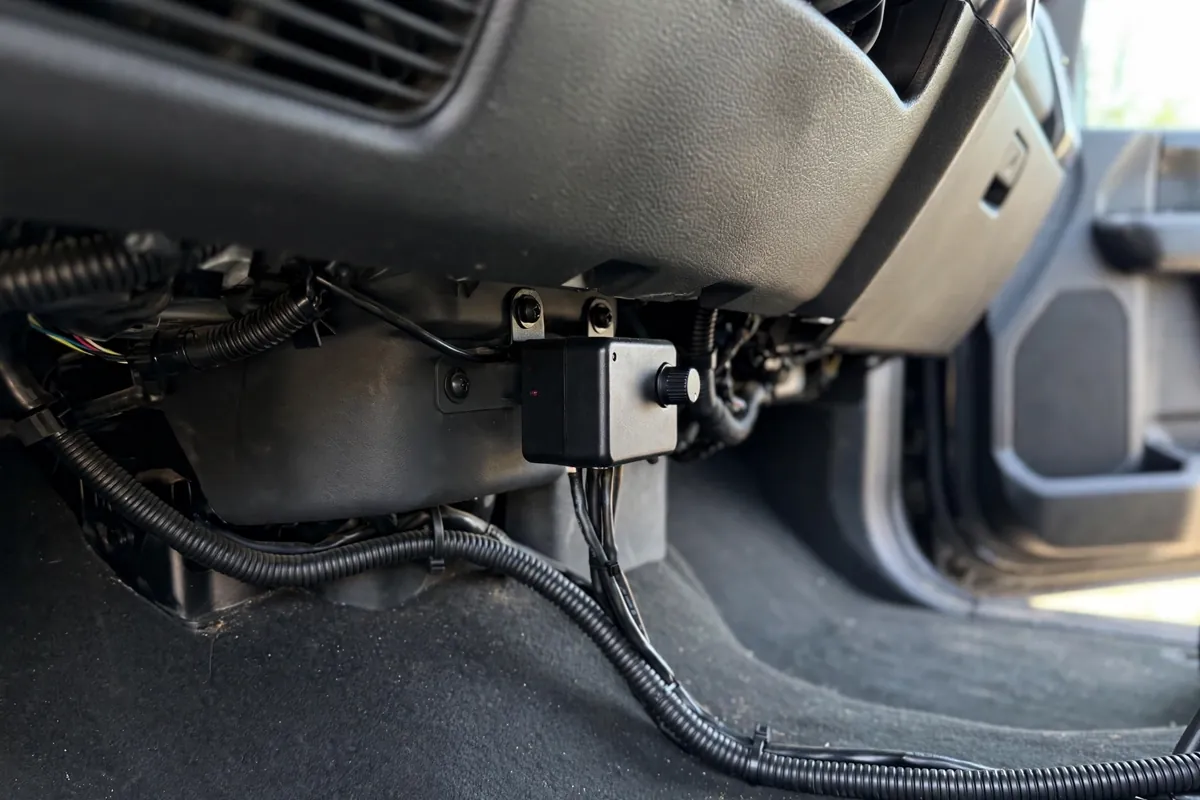
A camper-loaded truck already needs more distance to stop. Add a trailer with no working brakes, or brakes out of adjustment, and a long stop becomes a push.
As a rough national pattern, many states require independent trailer brakes once gross trailer weight reaches about 3,000 pounds, but thresholds vary. I am deliberately not publishing a state-by-state brake table: tables go stale, and “most states” is no defense in the one state that differs. Check the current statute for every state on your route, and treat 3,000 pounds as a planning line, not a legal promise. Near it, fit and maintain working brakes: controller, wired 7-way plug, and breakaway where required.
Boat owners have an extra job: surge actuators, discs, and drums live in water, and forum owners report brakes that passed a controller check but barely worked after seasons of dunking. Flush, inspect, and test before the season’s first tow. Cross rated safety chains under the tongue.
Seeing behind you: mirrors, cameras, and the boat ramp
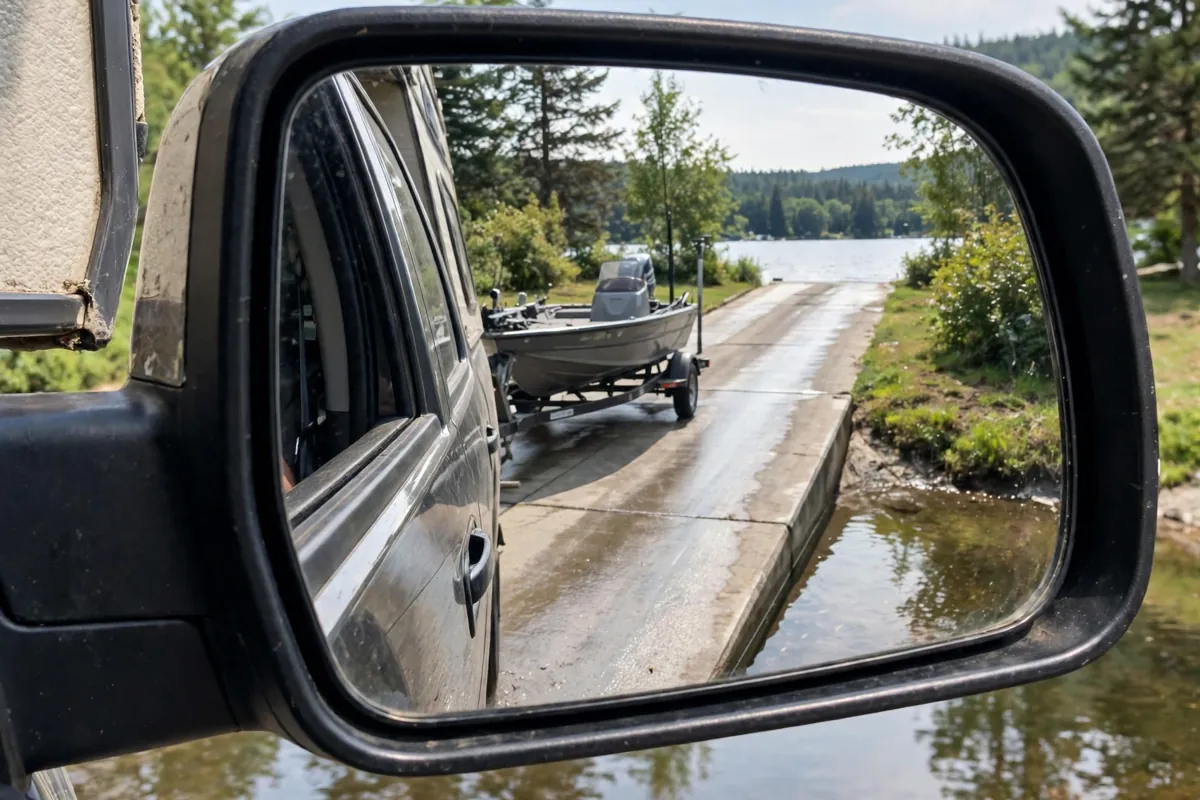
With a camper on, you cannot see the trailer through the rear window — your mirrors are your rear view. Owners towing boats behind campers say the same thing in Truck Camper Magazine’s reader reports on launching with a camper: use the mirrors, get straight at the top of the ramp, go slow, and do not chase the trailer with big corrections.
In practice: line up straight before backing, pick a reference — ramp edge, dock edge, or a concrete seam — and follow it in the mirrors with small corrections. The faster you go, the faster the trailer swings, and the more you overcorrect. One owner summed it up as “extended mirrors and the grace of God.” Another, a 20-year Sea-Doo dealer, said patience and mirror use will get you there, and sometimes you just have to get out and look.
Getting out and looking is not failure; it is how you avoid jackknifing a trailer you cannot see on a busy ramp. A spotter with agreed hand signals helps. If backing with the camper on feels hopeless, owners use two honest options: demount the camper and launch with the bare truck, or fit a front hitch and push the trailer down driving forward — one reader with a small sailboat did exactly that and solved it.
A rear camera helps for hitching up, but do not rely on a factory truck camera alone at a ramp: the angle changes as the truck tips onto the incline, and a low trailer can vanish from view until it is already swinging. Mirrors, a spotter, and slow speed are still the system.
Legality: one trailer is not the same as two, and states disagree
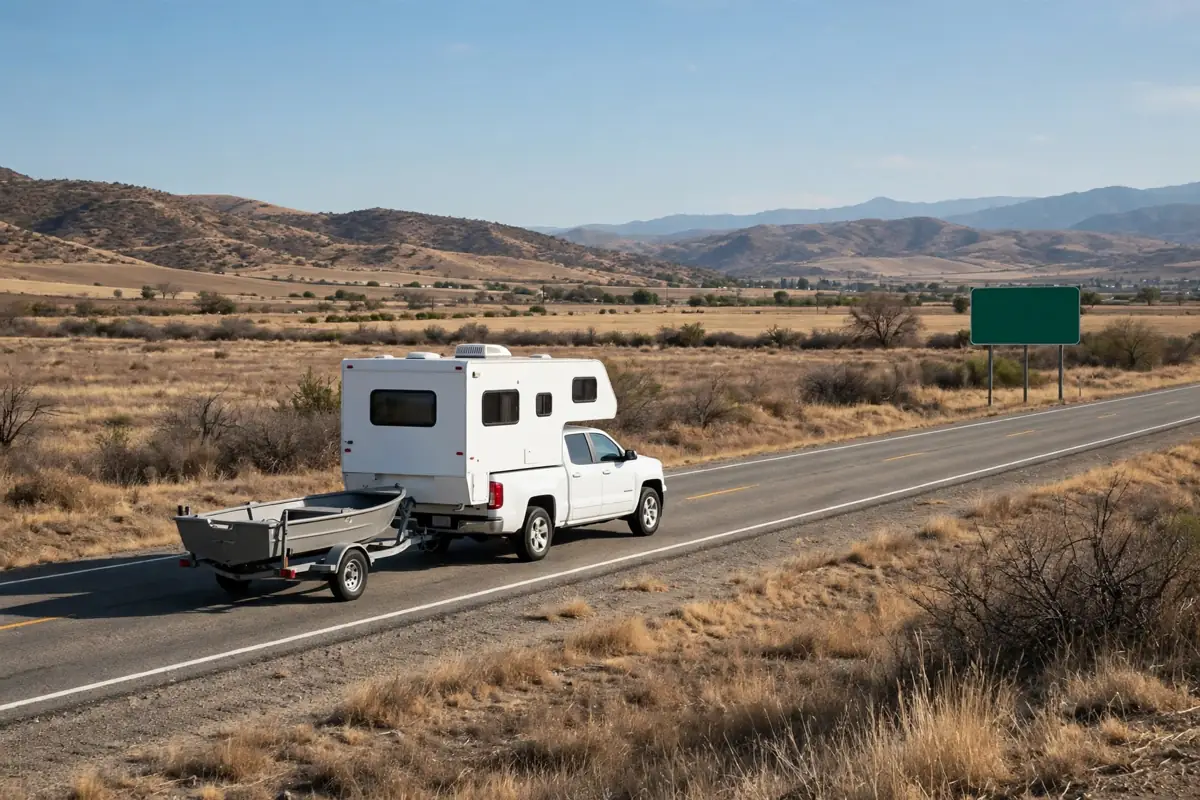
Be careful here, because confident state lists on the internet disagree with each other.
The key distinction: a truck camper is cargo in the bed, not a trailer. Towing one trailer behind it is, in most states, ordinary single-trailer towing, governed by your ratings, brakes, lights, and length limits.
Towing a second trailer behind the first — a boat behind a travel trailer, or a utility trailer behind a fifth wheel — is different, usually called double or triple towing, and state law splits sharply there. Secondary summaries generally describe the West and Midwest as more permissive and much of the East Coast as prohibiting it, with length caps commonly reported at 60 to 75 feet. But those summaries disagree on individual states — I found sources listing the same state as allowed, conditional, and prohibited — so I am not republishing a state list as fact. If your trip involves two trailers, check current statute or DOT/DMV guidance for every state on your route and route around states where your combination is not allowed. Legal at home does not mean legal across the state line.
For single-trailer towing, checks are simpler but still state-specific: overall length, brakes and breakaway rules, chains, lighting, mirrors, and any lower towing speed limit. License classes can turn on GCWR and trailer GVWR — federally, the familiar line is 26,001 pounds combined with a trailer rated over 10,000 pounds — but recreational exemptions vary, so check near those weights. Also check insurance and roadside cover: some plans tow the truck but not an attached trailer or camper.
Before you hook up: my pre-trip checklist
Fifteen minutes once it is habit: measure overhang, extension, and total length; read every stamp (GVWR/GCWR/GAWR, receiver, extension weight-carrying and weight-distributing ratings, ball); weigh tongue weight and the full rig if near a limit; load roughly 60% of cargo weight ahead of the axles, heaviest low and centered; test controller, breakaway, surge actuator, and lights; check chains, pins, and turnbuckles by hand; set mirrors, brief the spotter; and check brake, length, and license rules for every state on the route. Fix failures in the driveway, not at 65 mph.
What I would do if I were starting from scratch
Start with the lightest trailer that does the job. Owners on Good Sam’s forums make this point well: one owner towing a travel trailer behind a truck camper found the heavy trailer pushed the rig over its weight limit, and concluded the answer was a smaller, simpler trailer — not a bigger truck. Then match the hitch to the extension length, not the price, and budget mirrors, a brake controller, and a scale visit as part of the purchase. Torklift’s weight-distribution and sway FAQ notes a rear sway bar helps cornering load when towing heavy — helpful, but no substitute for tongue weight and ratings.
Done right, this is one of the best parts of the lifestyle: camper for sleeping, boat or toys for the daytime, one truck doing both jobs.
Frequently Asked Questions
Can you tow a trailer behind a truck camper?
Yes, in most cases. A camper is bed cargo, so this is ordinary single-trailer towing, subject to GVWR, GCWR, axle, receiver, and extension ratings, plus state brake, lighting, and length rules.
How much does a hitch extension reduce towing capacity?
As a common guideline, a simple extension under 12 inches typically cuts capacity by about 25%, and one 12 inches or longer by about 50% — but follow your extension’s stamped rating, and always use the lowest-rated component.
What is a safe tongue weight when towing with a truck camper?
For most utility and cargo trailers, 10–15% of loaded trailer weight. Some boat-trailer makers publish roughly 5–7% — follow your maker’s specification and measure loaded tongue weight. Too little causes sway; too much squats the truck.
Can I use a weight-distribution hitch with a hitch extension?
Only if receiver and extension are both rated for weight distribution, and only with a WD system compatible with your trailer’s brakes — many are incompatible with surge brakes. WD redistributes load; it does not raise ratings.
Is double towing legal?
It depends entirely on the state, and summaries disagree on individual states — do not rely on one list. It is generally described as more permissive in parts of the West and Midwest and prohibited across much of the East Coast, with caps commonly reported at 60 to 75 feet. Check current statute or DOT/DMV guidance for every state on your route.
Do I need trailer brakes when towing behind a truck camper?
Plan on yes for anything heavy. Many states require independent trailer brakes around 3,000 pounds gross trailer weight, but thresholds vary — check current law for your route.
How do you back a boat down a ramp with a camper blocking your view?
Use extended tow mirrors, get straight at the top of the ramp, follow a fixed reference in the mirrors, and go slow. Use a spotter you can see in a mirror, and get out and look when unsure. Some owners demount the camper to launch; others fit a front hitch to push the trailer down.