Truck Camping With Kids: Sleeping, Safety, and Routines That Actually Work
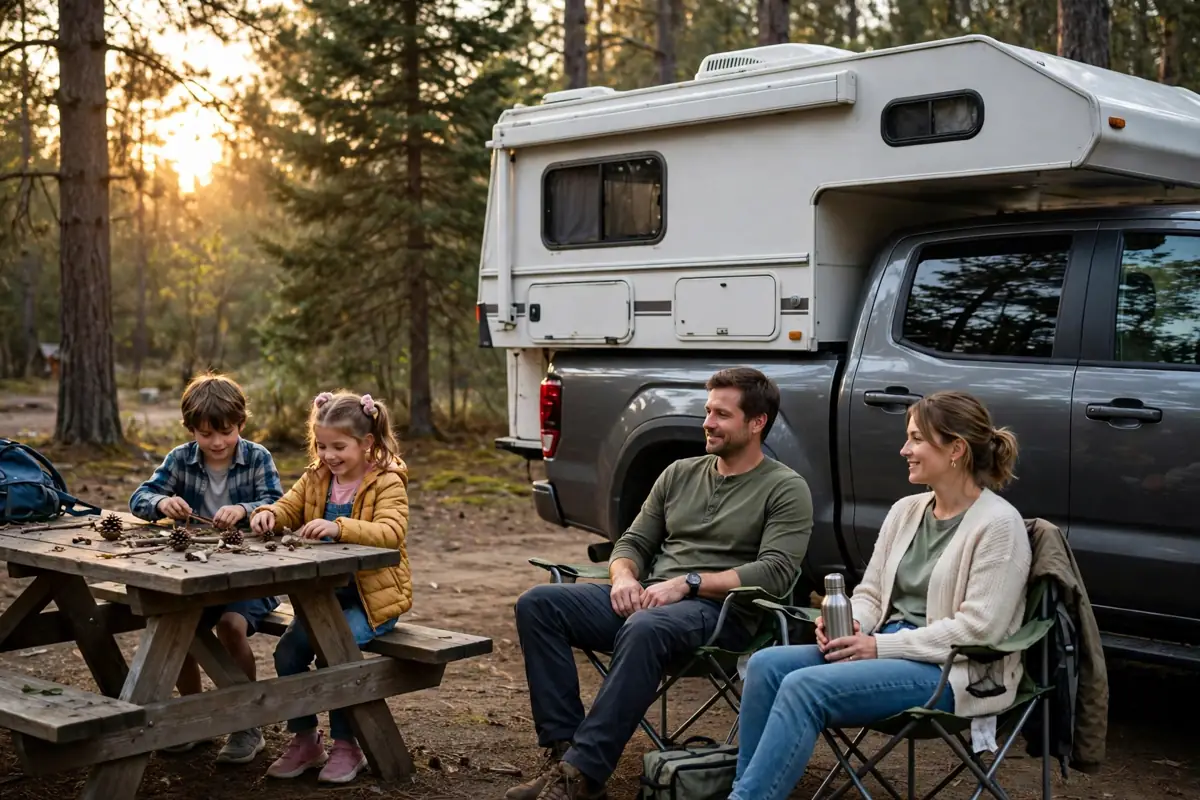
Truck camping with kids is not a smaller version of camping alone. It is a different trip altogether, and that is why it can be so good. The camper is tiny, the kids are close, and every little routine matters more than it does at home. Get the beds right, agree on a few safety rules before you leave the driveway, and keep the days simple, and a truck camper stops feeling cramped and starts feeling like a base camp your family actually likes coming back to.
Our first family trips were not smooth. We overpacked, drove too far on day one, and tried to convert the dinette at 10 p.m. while a tired toddler asked for a snack. The trips that worked were planned around how kids really sleep, eat, and melt down — and around having very little room to fix a bad plan at midnight.
Truck Camping With Kids Starts Before You Leave Home
Do a driveway camp first. Sleep in the camper one night at home and let the kids try every bed, ladder, and light switch. You will learn who rolls toward the edge, who needs a night-light, and whether your heater is too loud for a light sleeper.
Keep the first real trip short: one night, within an hour of home, with flush toilets and a playground. If something fails, you can go home without ruining the idea for your kids.
Pack by person, not by pile. Give each child one bag or bin they help fill: their own sleeping bag or blanket, headlamp, book, stuffed animal, and a change of clothes they can reach themselves. When everything belongs to someone, you stop digging through a shared mountain of gear every time someone asks for socks. If your basic setup still needs sorting, our beginner walkthrough on how to start truck camping covers the packing and first-trip basics that make this easier.
Plan the drive around kids, not the map: two to three hours, then a real stop to run, eat, and use a bathroom. Families on owner forums report the same lesson: stop about every two hours, keep snacks within reach, and build extra time into the plan.
Sleeping Arrangements That Actually Work in a Small Camper
There is no single right bed. It depends on your kids’ ages and how much they climb, wriggle, and wander at night. What works is safe, quick to make up, and leaves a clear path to the door.
The cabover bed
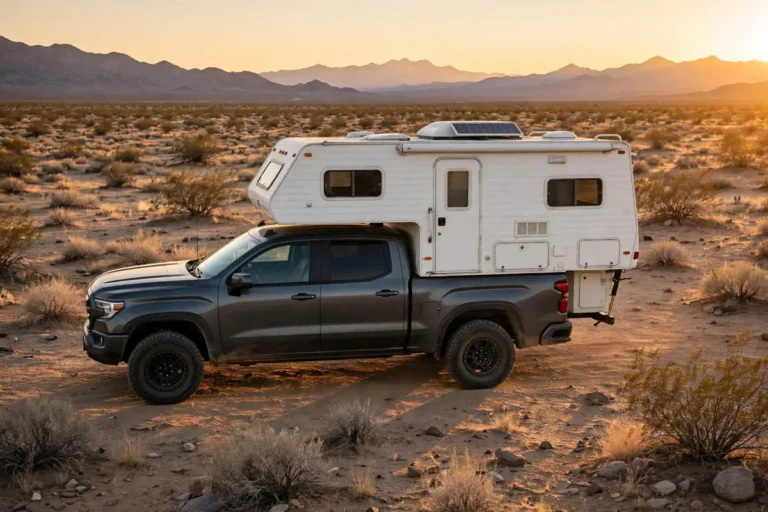
In most hard-side truck campers, the cabover is the biggest, flattest bed, and most families give it to the adults. It stays made up and keeps the main living space free during the day. If you have one small child who still wakes at night, some families do the opposite: the kids take the cabover together, and one parent sleeps on the dinette bed below, close enough to hear everything.
Measure before you promise it: cabover mattresses run shorter and narrower than a home bed. A good topper helps more than a thick new mattress, because it adds comfort without eating headroom. Our guide to a truck camper mattress upgrade covers toppers and that headroom trade-off.
If a child sleeps in the cabover, add a rail or barrier you trust. Parents on owner forums describe factory bunk nets and simple plywood frames fastened around the mattress each night. I am not recommending one specific homemade build — whatever you use must be sturdy, free of sharp edges, unable to collapse onto the child, and easy to lift the child out of.
The dinette bed
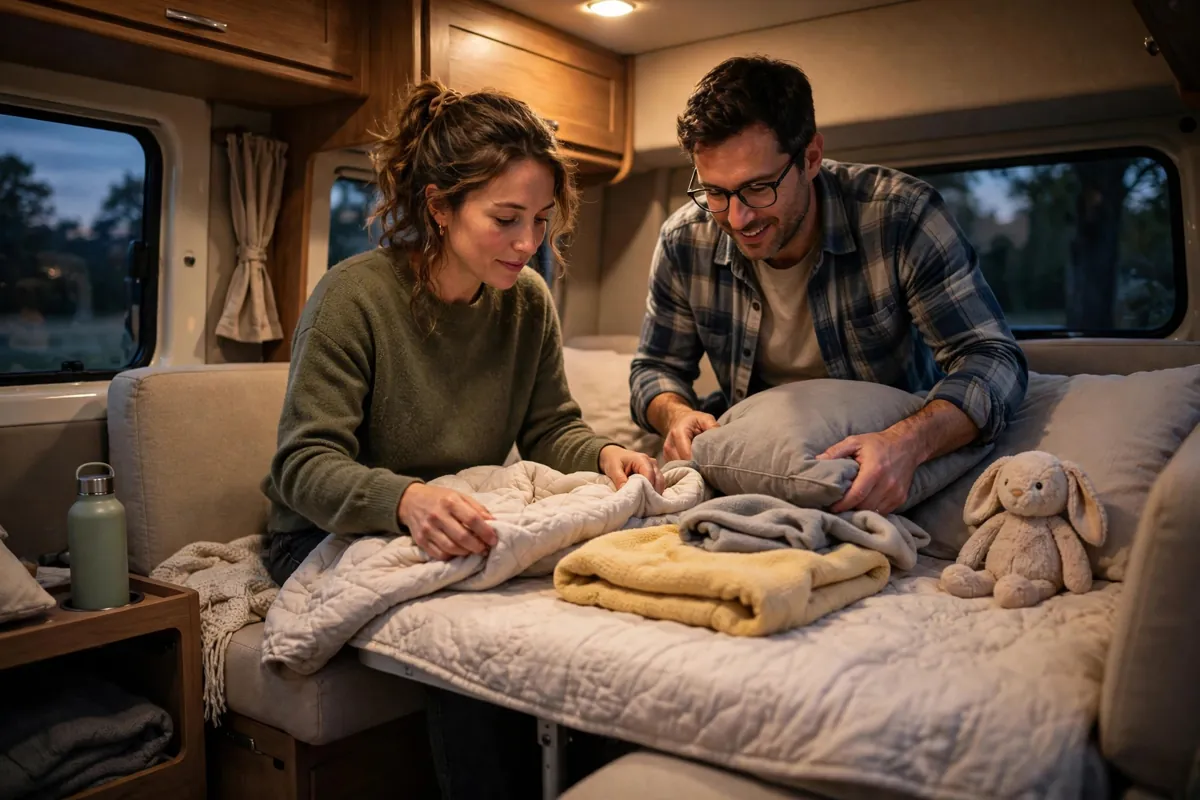
The converted dinette is the most common kid bed in a truck camper, and it is common for a reason. It is low, so a fall is short. It is near the adults. And by day it turns back into a table for breakfast, colouring, and card games. The downside is the nightly conversion. If you have to clear the table, find the cushions, hunt for bedding, and rebuild the bed every night, you will dread bedtime by night three.
Fix that before you leave home. Keep each child’s bedding in its own stuff sack, stored exactly where the bed gets made, and practise the conversion until you can do it in under five minutes with the lights low. Give the dinette bed to the earliest sleeper, so the rest of you can still sit at the other end with a book while they fall asleep behind a curtain.
For toddlers, a small travel crib can work on the dinette platform or floor, but only if it fits with the door closed and leaves a safe exit path. Never wedge a crib so tightly that you cannot get a child out fast, and never block the camper door with a bed.
The tent and the overflow plan
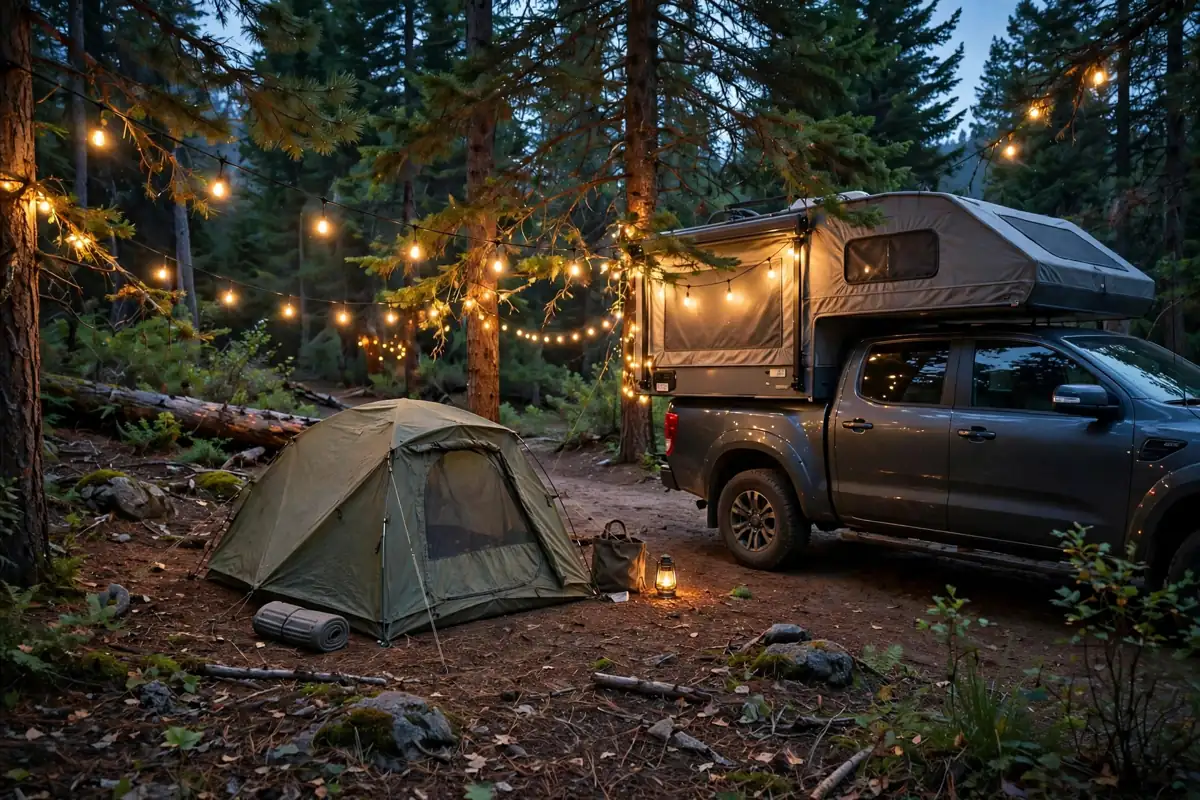
Older kids often want their own space. Parents on forums report the same pattern: once kids can be trusted with a zipper and headlamp, their own tent — close to the truck, within earshot, with a clear rule about coming back inside — gives everyone breathing room.
This is also your overflow plan. A tent, screened awning room, or canopy gives you a dry place for muddy shoes and a second table — it just has to be up before dark.
Parents on Expedition Portal describe a setup worth stealing: a hard-side camper with good window coverings, a reliable heater, a queen cabover for adults, and a twin converted dinette for the child. They chose the hard shell partly for darkness — it helped their little one sleep past sunrise, something a thin tent wall rarely does. Blackout covers can buy early risers an extra hour.
Owners on WanderTheWest report a low-tech trick for a rollover couch bed: leave one bench cushion in place when you fold the couch out, so the backrest forms a low rail, with rolled blankets filling the gap to the cabinets. Not a substitute for a guard on a high bunk, but on a low bed it shows the right thinking — use what is already there and keep the walkway usable.
Safety Rules to Agree On Before the First Night
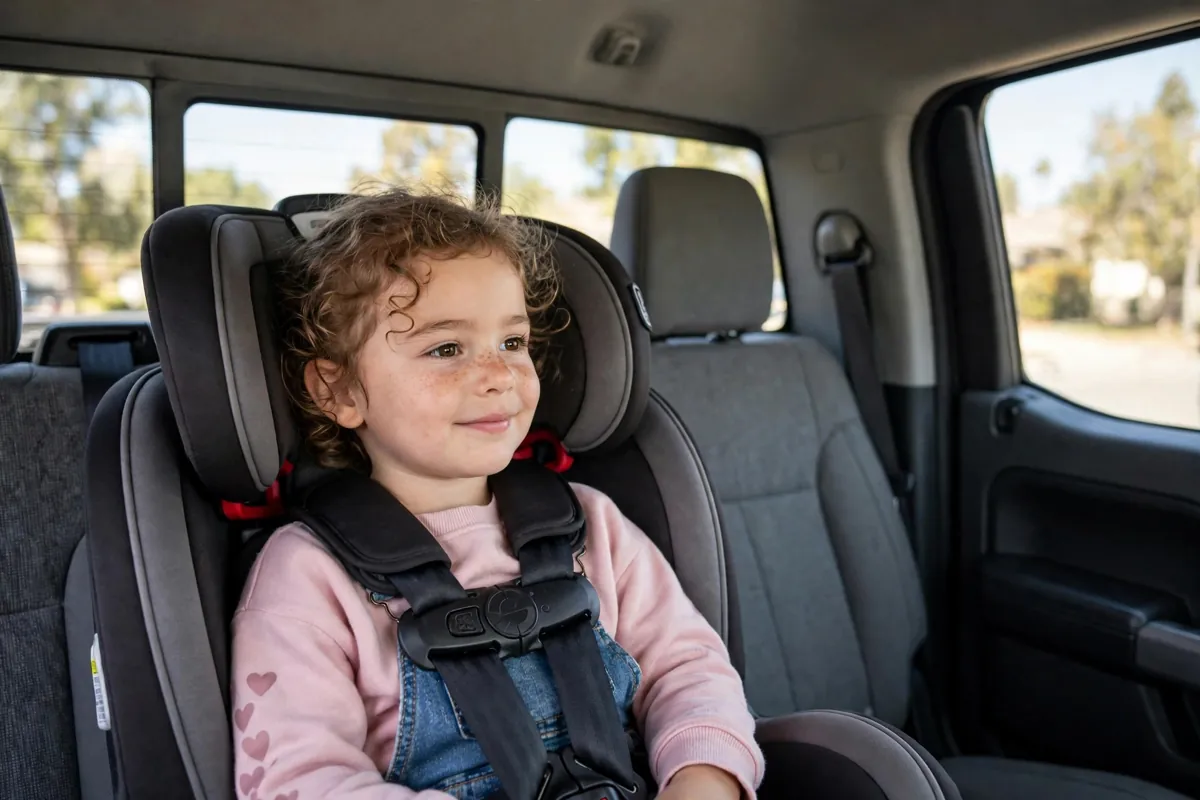
Kids do not need a long lecture. They need five or six clear rules, repeated the same way every trip, until the rules feel as normal as buckling a seat belt.
First, nobody rides in the camper while the truck is moving. In most states, riding in the living area is illegal or heavily restricted, and a camper interior is not built to protect a child in a crash the way a cab is. Every child rides in the cab, in the right seat or booster, every time. If your cab lacks proper seating for everyone, solve that before you leave.
I am not listing car-seat rules state by state here. Laws change, and a blog post is no place for legal advice. Check your own state’s rules, and the rules for states you will drive through, before you leave. Our breakdown of state laws on riding in a truck camper is background reading, not a substitute for that check. For the seat itself, American Academy of Pediatrics guidance via HealthyChildren.org is clear: rear-facing as long as possible, then a forward-facing harness seat, then a booster until the belt fits properly. Read their full car seat safety checkup before you buy or reinstall a seat.
Second, agree on the campsite boundary. On arrival, walk it together: this far and no farther without an adult. The fire ring, the road, the water, and the neighbour’s site are all outside the boundary until you say otherwise. Give younger kids a visual marker — a row of camp chairs, a bright towel on a line — because “stay near the camper” means nothing to a four-year-old, while “stay inside the chairs” is a rule they can follow.
Third, practise getting in and out safely. Steps are steep and the floor is high, so teach kids to face the steps, use the handrail, and never jump from the doorway. Keep a small step stool by the door and the entry clear. Families on Forest River Forums report a habit that stuck with me: during setup and pack-up, one adult is always the designated watcher, and kids stay in the cab, on the picnic table, or in a defined spot — never wandering around a reversing truck or a half-latched camper.
Fourth, sort out fire, water, and getting lost before they come up. Fire: a marked circle nobody crosses without an adult. Water: no child near a lake or stream without an adult in arm’s reach, even if they swim at home. Getting lost: stay put, make noise, blow a whistle. A whistle, a bright shirt, and a card with a parent’s phone number cost almost nothing.
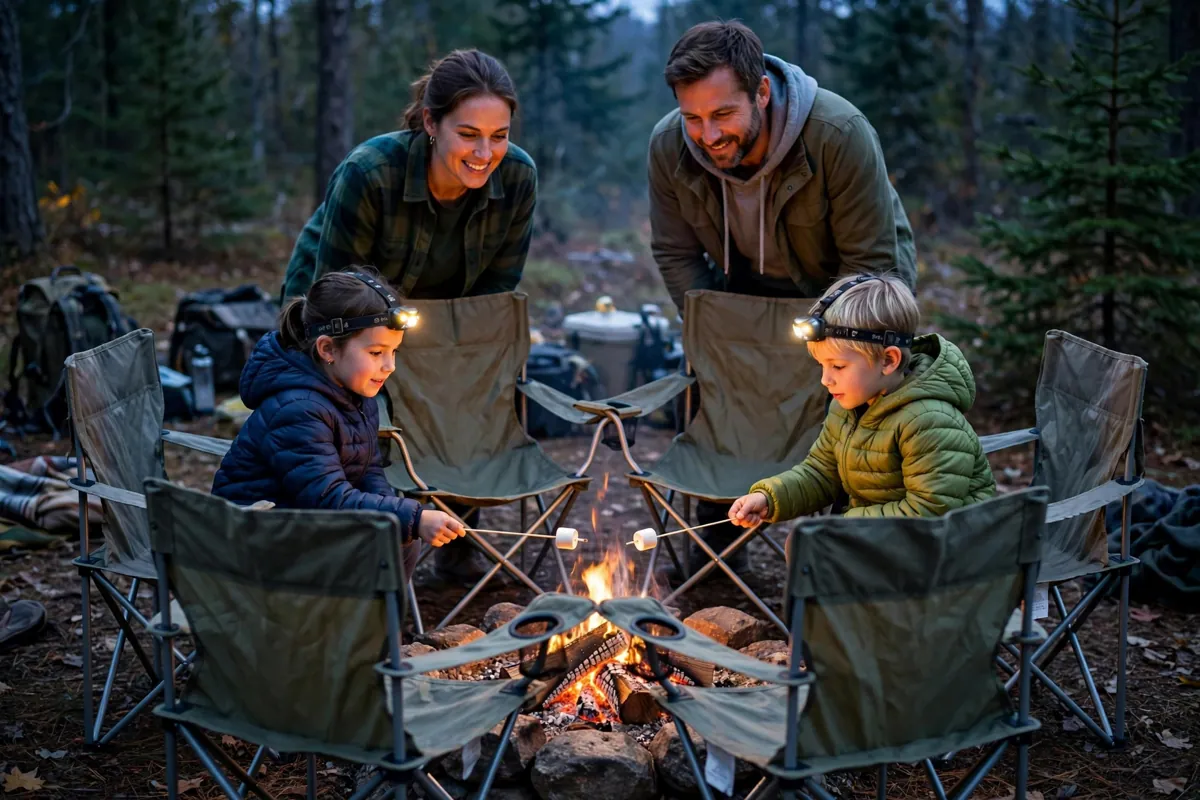
Fifth, lock the door from inside at night and teach older kids how to unlock it. The screen door is not a wall, either — parents on forums mention a clear panel on its lower half so a toddler cannot push through the mesh. Keep a headlamp by each bed.
Routines That Actually Work: Mornings, Meals, and Bedtime
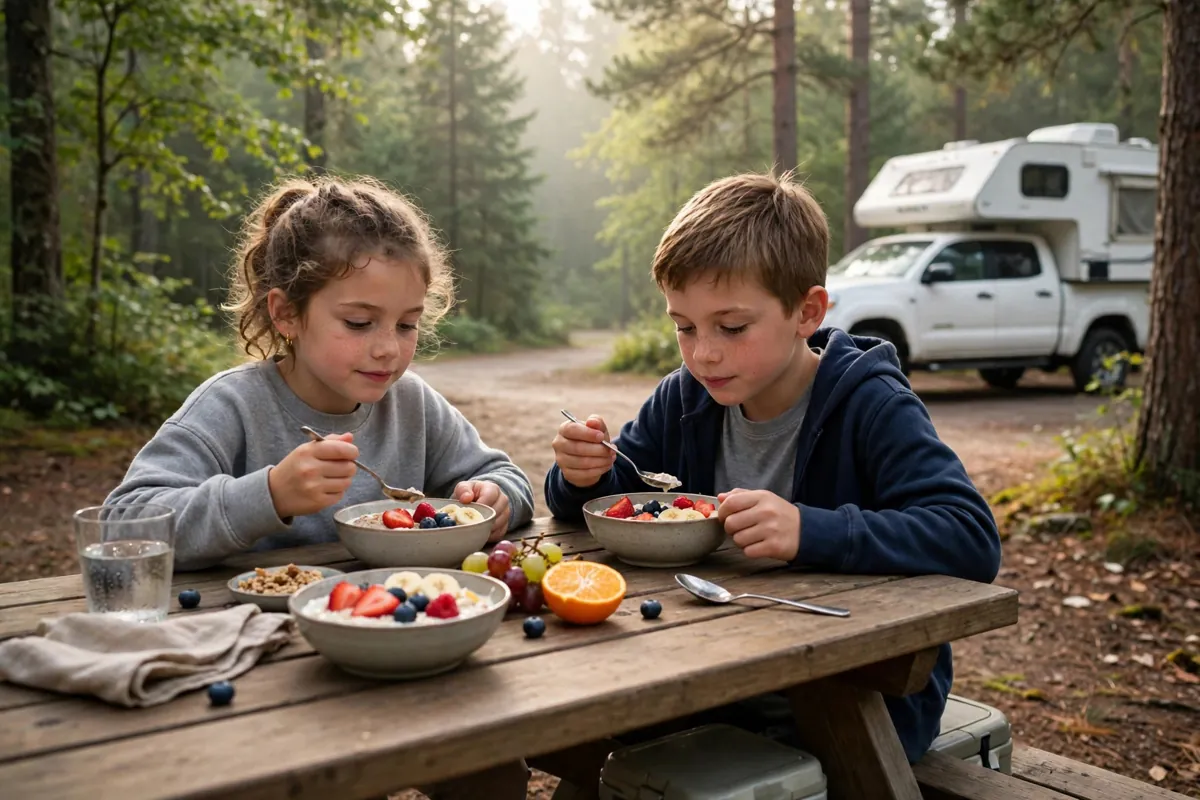
A truck camper does not reward improvisation with kids. It rewards a routine so familiar that everyone knows what happens next. When kids can predict the next step, they argue less, dawdle less, and sleep better.
Mornings work best outside. Shoes on, jackets on, out to the picnic table — do not try to get four people dressed and fed inside a camper at once. Breakfast outside, even just cereal and fruit, keeps the camper tidy and burns off the kids’ first burst of energy. Keep breakfasts simple: oatmeal with toppings they choose, wraps made the night before, or pancakes from pre-mixed batter. Save the big cooked breakfast for one morning. For meals that survive a small kitchen, our list of camping food ideas leans toward food you prep at home and finish at camp.
Pick one main activity a day, not five. A short hike with a payoff — a waterfall, a viewpoint, a stream for throwing rocks — beats a long forced march. Give each child the same job every day: one fills water bottles, one sets the table, one is in charge of headlamps. Jobs are how kids feel like part of the trip instead of luggage you brought along.
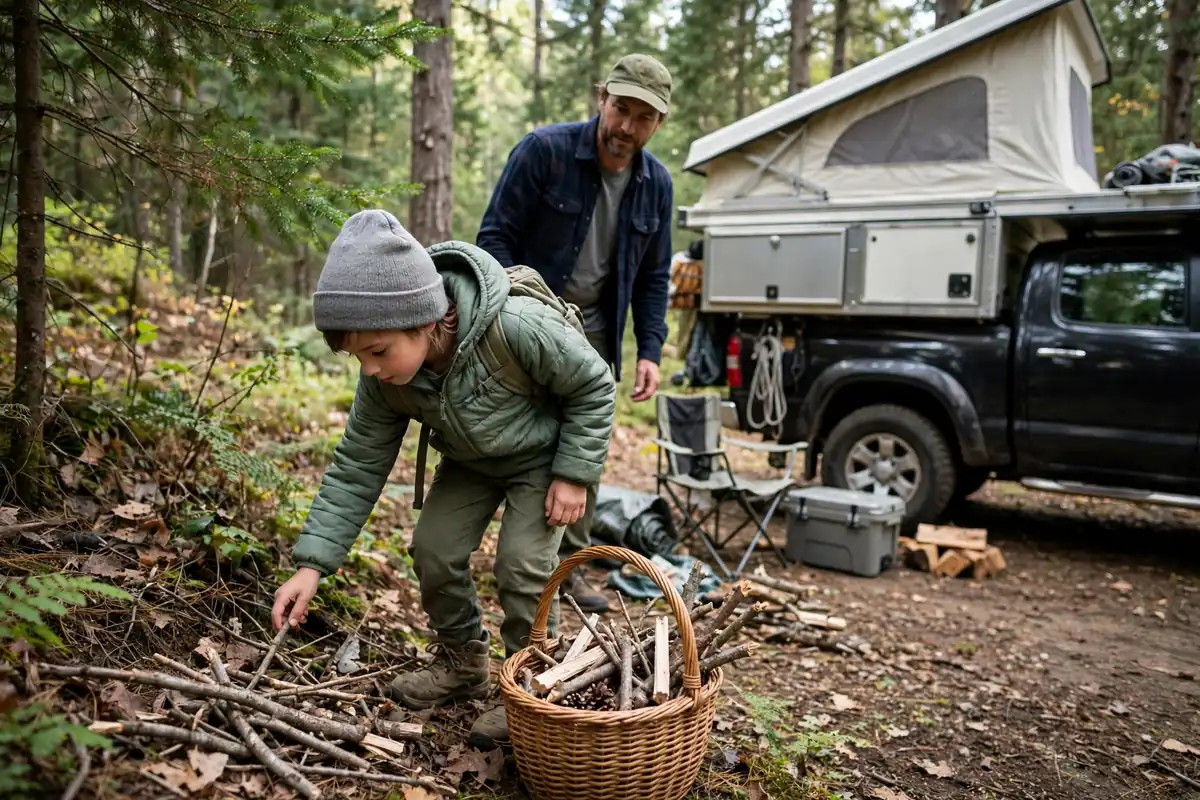
Build in quiet time after lunch: an hour of reading, drawing, or resting, with a physical cue — curtains drawn, shoes off, books out. It is what makes the evening campfire possible instead of a meltdown.
Bedtime is where most family trips fall apart, because summer evenings stay light late. Keep the home routine, shrunk to fit: same pyjamas, teeth, book, and order, at roughly the same time. Keep a night kit by each bed — water, headlamp, spare layer — so small problems do not become wake-ups. Ventilate, too: crack a vent and do not dry wet towels inside overnight, or damp bedding will make for restless kids. If condensation keeps recurring, our guide to stopping condensation in a truck camper covers venting and mattress moisture.
Packing, Weather, and Choosing a Family Site
Pack less than you think, then add back only what prevents a crisis: extra socks and underwear, yes; three extra outfits per child, no; spare dinette sheets, yes. Skip the toy box — a small bag of favourites, cards, a ball, and a nature kit will outlast a suitcase of toys.
Kids do not mind rain if they have a plan for it — a canopy, games, and rain gear that fits. On hot days, shade and a midday break beat another activity. On cold nights, a properly rated sleeping bag plus a warm hat beats blankets sliding off a narrow bed.
Weight and space are real limits, and kids add both faster than adults do. Weigh your loaded rig if you can. If you are heading off pavement, that matters twice as much. Our guide to boondocking and dispersed camping covers water, power, and site selection away from hookups.
Not every beautiful site is a good family site. A level pad matters more with kids, because a tilted camper means rolling beds and a door that swings shut on small fingers. Pick a site near the bathroom, with flat ground for bikes and some shade, over a dramatic cliff-edge pullout. Book early: popular campgrounds on Recreation.gov can fill months ahead in peak season. Check people-per-site, tent, quiet-hour, and generator rules before booking — quiet hours are your bedtime ally.
Teach Leave No Trace as a game, not a lecture. Kids who get to be the pack-up inspector will pick up trash and leave rocks where they found them. The National Park Service summary of the Leave No Trace Seven Principles is a good one to read together before a trip.
When It Goes Wrong (Because It Will)
Someone will get carsick. Someone will wet the bed. Someone will lose a shoe in a stream. Someone will announce, loudly, in front of the neighbours, that they hate camping and want to go home. None of that means the trip failed. It means you have kids.
Have a plan for common failures. Carsickness: bags, wipes, a spare shirt, a stop. Bedwetting: a waterproof layer, spare bedding within reach, no fuss. A lost shoe: camp shoes plus a spare pair. Homesickness: the familiar bedtime routine and a job for the next morning.
Know when to cut a trip short. Pushing through a second night of rain or misery to prove a point teaches kids camping is something to endure. Going home early, with a plan to try again, teaches them it is flexible and their comfort matters.
A Simple First-Trip Checklist
Driveway camp first. One night, close to home, with real bathrooms. Beds tested, rails checked, bedding in labelled bags. Every child in the cab in the right seat, every time, state rules checked first. Boundary walked together on arrival, a watcher during setup, a whistle for wanderers. One activity a day, breakfast outside, the same bedtime routine as home, a quiet hour after lunch. A tent or canopy for overflow, a night kit by every bed, spare bedding within reach. That is truck camping with kids, stripped down to what works.
The camper will still feel small, and the kids will still argue over the top bunk. But if the beds are safe, the rules are clear, and the days have a rhythm they can predict, the smallness stops being the story. The story becomes the campfire, the hike, and the morning they asked, before your coffee was finished, when you are going again.
Frequently Asked Questions About Truck Camping With Kids
Can a family of four really fit in a truck camper?
Yes, for weekends and shorter trips, if you are honest about the layout: adults in the cabover, one or two kids on the dinette, older kids in a tent when ready. An awning room helps on rainy weeks. Test the split in a driveway camp first.
Where should kids sleep in a truck camper?
Younger kids do best low and near adults: the dinette bed or a travel crib that fits without blocking the door. Older kids often prefer the cabover or their own tent. Any high bed needs a trusted rail and a clear path to lift the child out.
Can kids ride in the back of a truck camper while driving?
No, not as a routine plan. In most states it is illegal or heavily restricted, and a camper interior is not crash protection like a cab. Every child rides in the cab in the correct seat or booster. Check current state rules before you leave — this is not legal advice.
How do you keep a bedtime routine in a truck camper?
Keep the home routine, shrunk to fit: same pyjamas, teeth, book, and order, at roughly the same time. Darken the sleeping area, keep water and a headlamp by each bed, and keep the after-lunch quiet hour. Predictability beats perfection.
What is the best age to start truck camping with kids?
There is no single best age, only a best first trip for the age you have. Babies need warmth and frequent stops; toddlers need a boundary and spare everything; school-age kids need jobs and one main activity; teenagers need independence and a say. Start short and close to home.