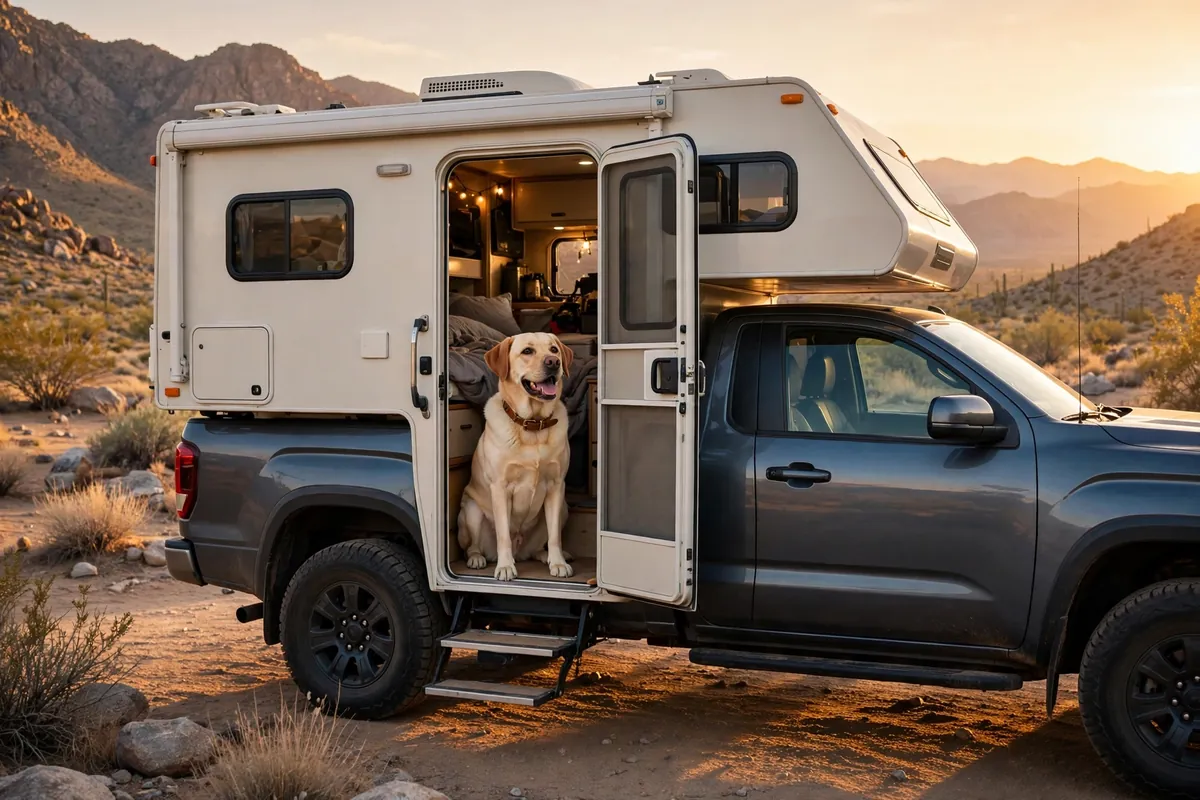
Truck Camper With Dogs: Where They Ride, Where They Sleep, and Big-Breed Hacks
A truck camper with dogs is a wonderful idea right up until a wet 80-pound Lab shakes off inside sixty square feet of living space. Then it becomes a logistics problem — and a solvable one. The dog does not need a bigger camper. You need a system: where the dog rides on travel day, where the dog sleeps at camp, how you handle heat, mud, and the simple fact that a dog makes a small space smaller. That is the whole article — what actually matters when you are truck camping with a large dog or a small one.
Where Your Dog Rides on a Travel Day
The dog rides in the cab. Not in the camper — a moving truck camper is a swaying box with an unsecured load, no seatbelts, and wild temperature swings. Owners on RV forums tell the same story: they tried letting animals ride in the carried unit once, found it rough and frightening for the animal, and never did it again. The blunt forum wisdom says it best: if you love it and it is alive, keep it out of the box when the wheels are turning. The same safety logic behind our state-by-state guide to riding in a truck camper applies to your dog, with even less margin for error.
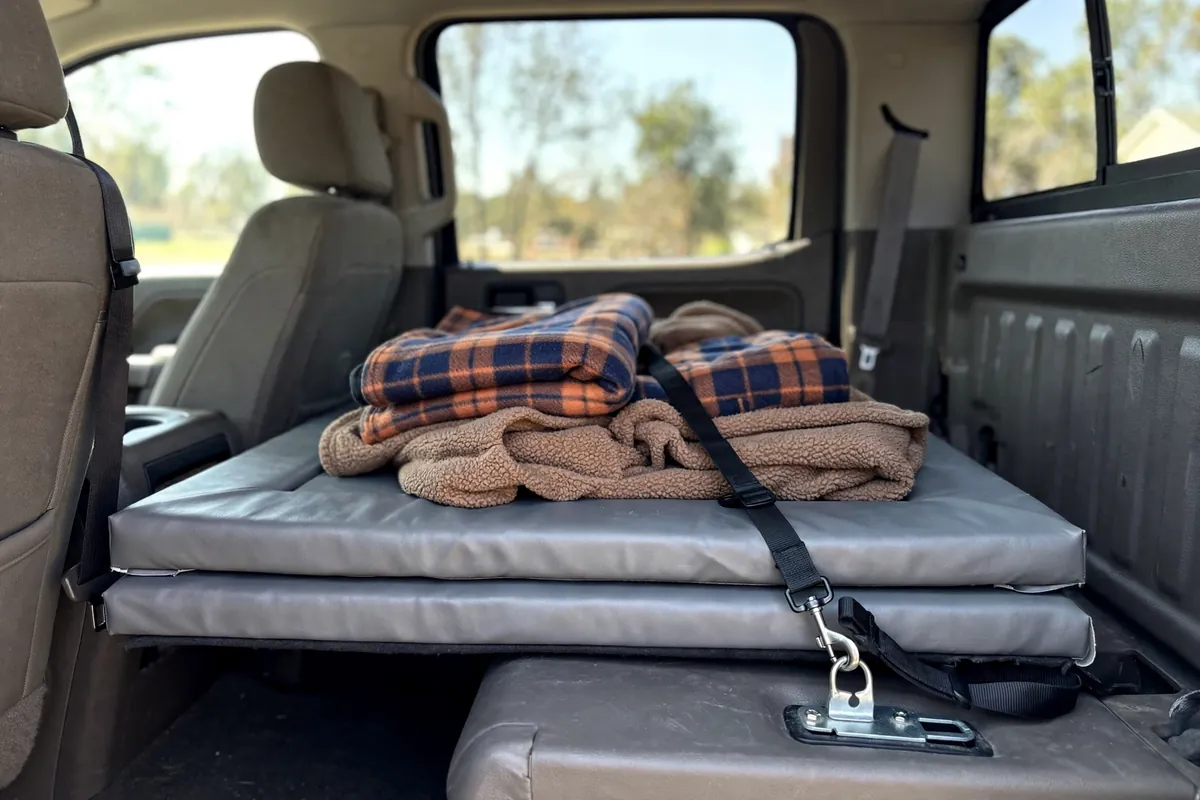
The best cab setup I have seen from long-term owners is almost embarrassingly simple. Fold the rear bench flat, lay a four-inch piece of foam on it, cover the foam in vinyl so mud and drool wipe off, and throw the dog’s blankets on top. One full-timing couple with dogs described exactly this on the RV forums years ago and it is still the gold standard: cheap, flat, washable, one big dog bed across the whole back of a crew cab. Add a netting barrier so the dogs cannot launch into the front seats — driver-distraction insurance.
The other proven option is a hammock-style seat cover stretched between the front and rear headrests, bridging the footwell gap and keeping hair off the upholstery. One overlanding truck owner runs a hammock cover for his 75-pound Lab and clips the dog’s harness to a LATCH child-seat mount, because in a hard stop he does not want 75 pounds of enthusiastic Lab arriving in the dashboard. Copy that mindset. A short tether across the back seat attached to a harness works the same way — the dog can shift and lie down but cannot be thrown forward.
Loose is what most people do, and it is the least safe option. A secured crate is safest for most dogs, and big dogs genuinely travel better crated — not because they like small spaces, but because they do not spend the whole drive scrambling to keep their balance on every turn and brake. If you crate, the crate goes in the cab if it fits, or in a spot with confirmed airflow — never just tossed in the back. One overlanding owner put a wireless thermometer in his truck’s camper shell and found that on a day in the 80s, the shell regularly topped 100 degrees even while moving. Any enclosed space behind the cab is a heat trap until proven otherwise.
Where Dogs Sleep in a Truck Camper
Here is the part nobody tells you before the first night: the sleeping plan you carefully designed at home lasts about ten minutes after lights-out. The dog will sleep where the dog sleeps, and your job is to make that spot workable.
Small dogs mostly solve themselves — they want to be on you. One family camping with four pugs described their setup in a truck camper magazine reader survey: husband in the cabover, wife and granddaughter on the sofa widened with plywood on an ice chest, and the pugs wherever they find an open flat spot. Another owner with five rescue dachshunds reported all five sleep in the cabover — and any dachshund owner is already nodding, because good luck keeping them out of the bed. Medium dogs do well with a floor crate or a bed tucked against the dinette. Give them a defined spot with their own blanket from night one and defend it, or the spot becomes your sleeping bag.
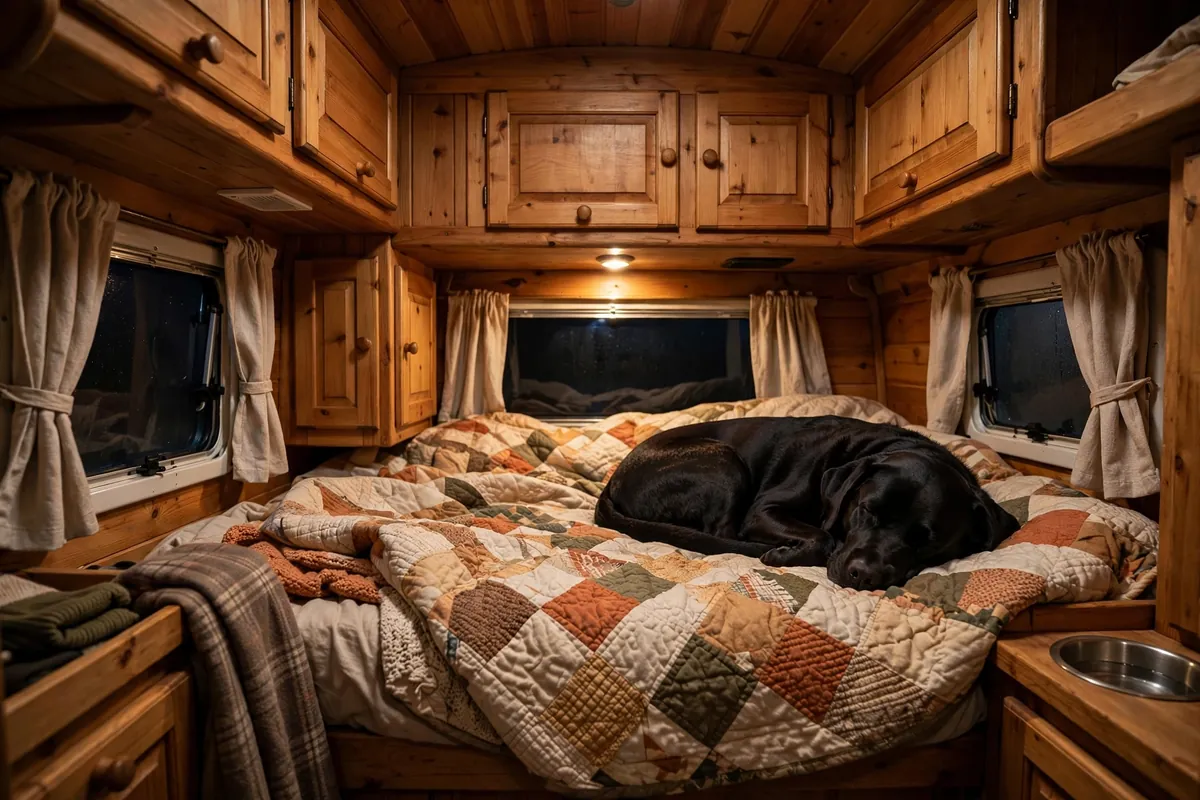
Big dogs are where it gets real. A large dog’s bed eats roughly ten square feet, and a truck camper’s open floor might only be twenty-some square feet once the furniture is in. That is your evening choreography: stepping over a sleeping Lab to reach the bathroom, in the dark, every night. Owners of giant breeds on the forums call it the doggy obstacle course and treat it as the price of admission. The best-case outcome is the one many owners report — the big dog simply jumps onto the cabover bed, the only bed big enough to share with an 80-pounder.
The cleverest space hack I have seen: use the camper’s pass-through or sliding rear window to the truck cab as the dog’s annex. One couple camping with two German Shepherds uses that slider as the dogs’ extra room.
Truck Camper With Dogs: Heat, Safety, and Temperature Monitors
Never leave your dog in a hot vehicle or a hot camper without active monitoring and a way to cool the space. Not for a quick grocery run. Not with the windows cracked. The ASPCA’s numbers are the ones to memorize: on an 80-degree day, the inside of a parked car can hit 114 degrees in under 30 minutes; on an 85-degree day it reaches 102 in ten minutes and 120 in half an hour. The ASPCA notes that thousands of animals succumb to heatstroke in unattended vehicles every year. Dogs cool themselves by panting — they do not sweat — and flat-faced breeds, seniors, puppies, overweight dogs, and dark-coated dogs are at highest risk. Heatstroke can kill in minutes, and cracking a window barely helps. A truck camper is an aluminum box with big windows. In direct sun it is not meaningfully safer than the truck.
So the rule in our rig is absolute: the dog comes with us, someone stays with the dog, or the camper has active cooling plus a monitor with alerts — and even then, only briefly, in mild conditions. The ASPCA’s hot weather safety tips are worth a read before your first summer trip.
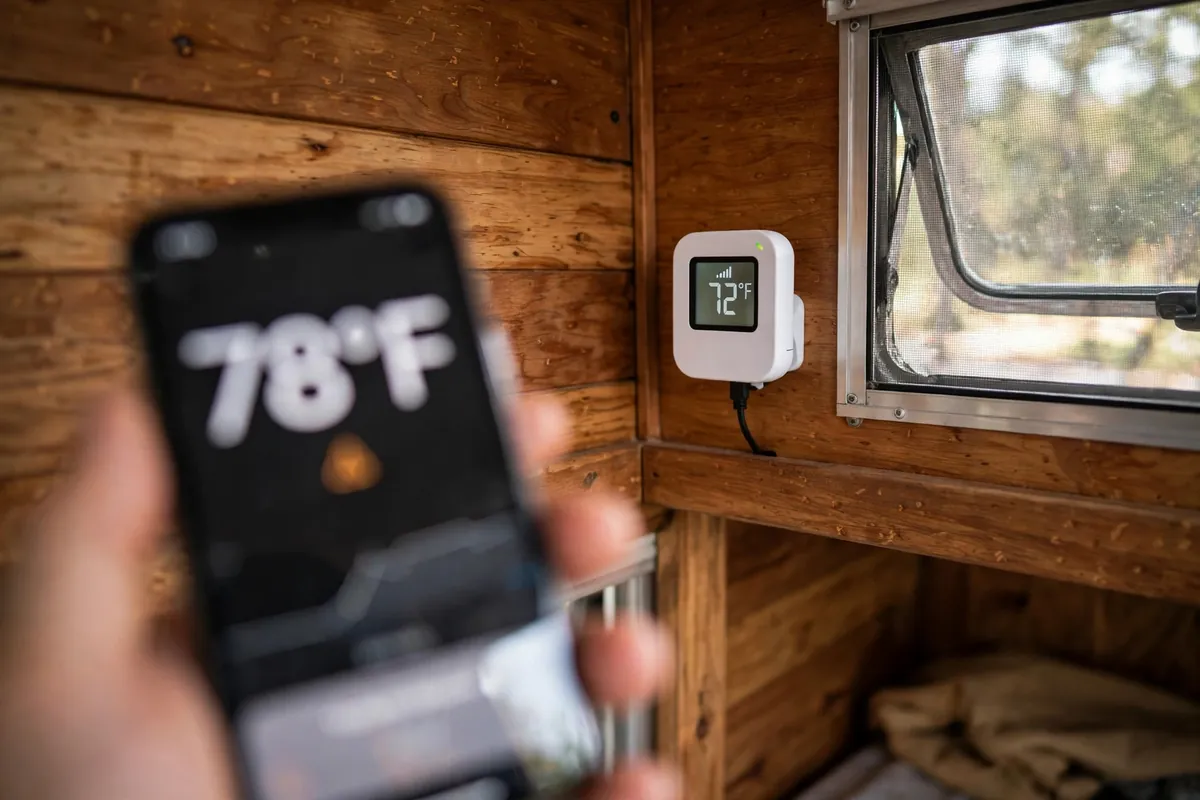
The device most full-timers use is a cellular temperature monitor — the well-known one is Waggle, and similar 4G monitors exist from other brands. Mount a small unit inside the camper, it connects over its own built-in cellular connection (no campground WiFi needed), and it texts and emails you when the temperature crosses a threshold you set, when humidity spikes, or — critically — when it loses shore power, because power loss is usually the first domino before the heat climbs. It keeps alerting on a backup battery during outages.
Owner feedback skews positive, but it is not magic. The most common complaint is false power-loss alerts when a generator or shore connection cycles — the company’s own FAQ covers the fix. Expect a couple hundred dollars for the device plus a monthly subscription roughly in the low teens to twenty dollars, pausable in the off-season; see current pricing on Waggle’s official product page.
Two things a monitor does not do: it does not cool anything, and it does not replace you. Think smoke detector, not fire extinguisher — the alert buys you time to get back or ask a neighboring camper for help. Build the two-hour rhythm into travel days: stop every couple of hours for water, shade, and a walk. You both need it.
The Dogs Make the Small Space Smaller Problem
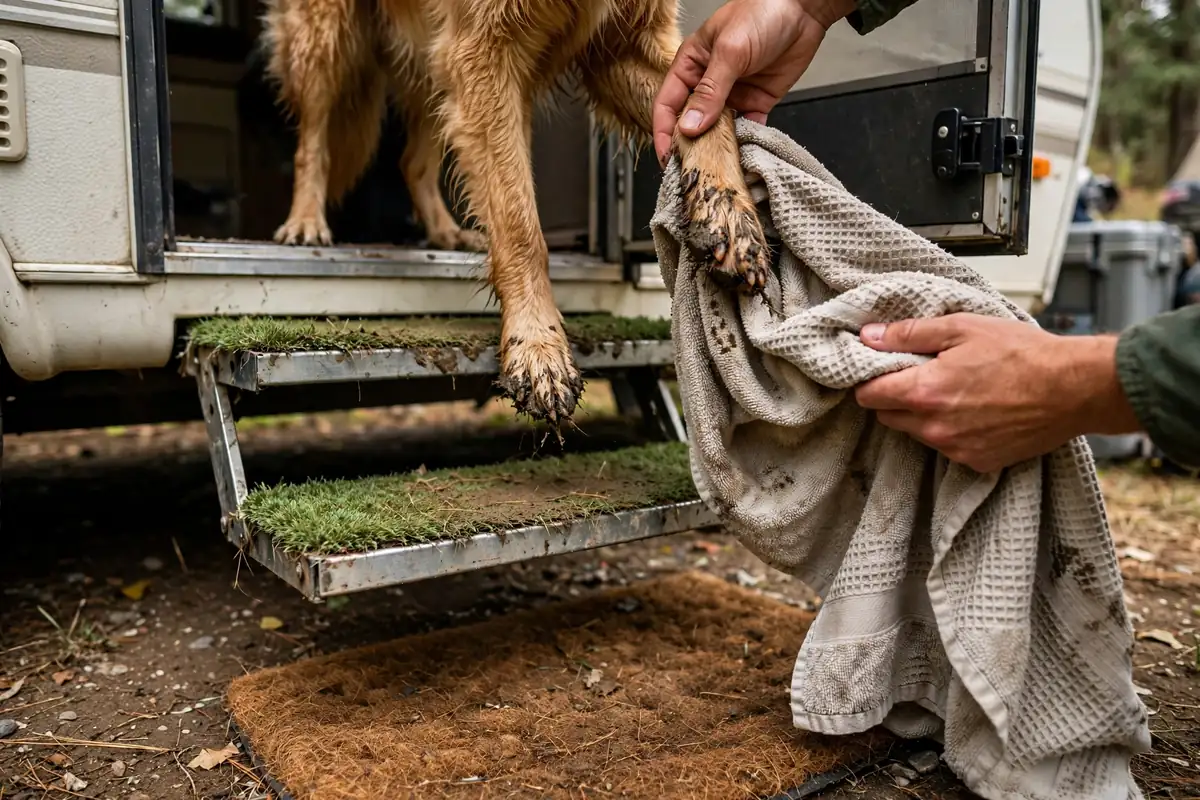
This is the section that separates the dreamers from the lifers. Full-time truck camper living is already an exercise in choreography, and a dog removes about a third of your maneuvering room while adding mud, hair, and a 2 a.m. bathroom schedule.
Mud management is the daily war. The best trick I found came from a truck camper owner traveling with a beagle: he made his camper steps deeper and covered them with astroturf, which gives the dog traction and — his words — collects an amazing amount of dirt before it ever reaches the floor. Pair that with a washable entry mat, a dedicated dog towel that lives by the steps, and the old tailgate bath: the tailgate is the perfect height for hosing muddy paws. A towel is about the most massively useful thing a dog owner can take camping. Bring more than you think you need.
Hair is the other tax, and here is a confession worth hearing: one owner on a camper forum admitted he packed his dog’s bed on trip after trip, and the dog never once chose it — the dog wanted the human bed, so the owner started putting a beach towel on his own bedding. Bring the dog’s bed anyway. It gives you something to point at when you say off.
Night bathroom breaks need a system, because you will be half asleep and the dog will not wait. Leash by the door, shoes by the door, headlamp by the door. Same spot, every night.
And one thing almost nobody budgets for: moisture. A dog is a warm, panting, wet-nosed humidifier sleeping in your tiny box, and truck campers already fight condensation on cold nights. That makes our guide to stopping condensation in a truck camper twice as relevant — ventilate like the dog is a second person, because for moisture purposes, it is.
Big-Breed Hacks: Great Danes, Labs, and Other 80-Pounders
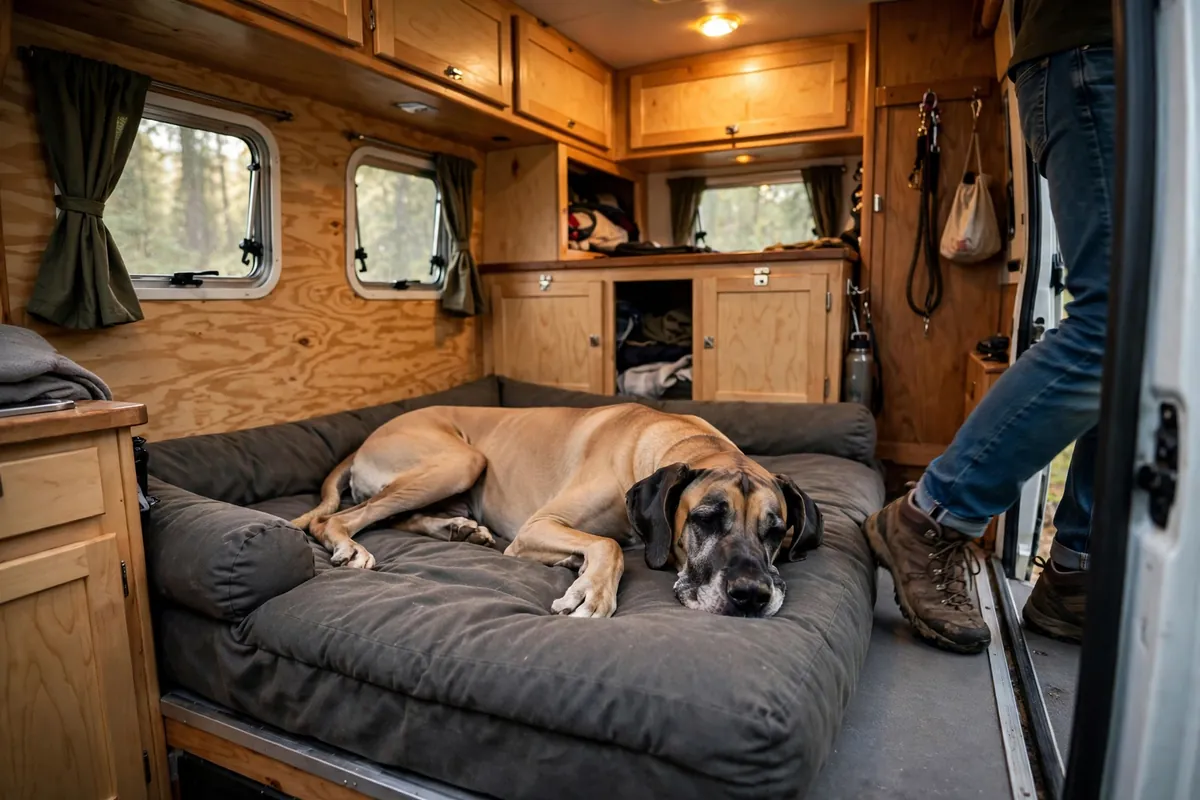
Truck camping with a large dog is a different sport. Everything below assumes the dog is 70-plus pounds.
First, cabover access. A young Lab will launch itself up the cabover ladder like it is nothing. A nine-year-old Dane with stiff hips will not, and you will end up lifting 120 pounds of dog at 10 p.m. in the rain. Plan for the dog your breed becomes: a ramp, a sturdy step, or a floor-level sleeping spot the dog can reach without climbing. Giant-breed owners on the forums note that big dogs also run cold on hard floors — one couple with two Great Danes found their dogs noticeably colder on the floor than the humans were up top, and eventually converted their sofa into a dedicated dog bed. Warmth, not just space, is part of the floor equation.
Second, restraint scales up. A loose 90-pound dog in a panic stop is a projectile; the hammock-cover-plus-LATCH-clip setup from the riding section exists because one owner did not want 75 pounds of Lab arriving in the front seat. Crates help big dogs brace against turns instead of scrambling, and several large-breed owners report their dogs settle faster crated.
Third, and this is the one people resist: a giant breed can change which camper you should buy. A Dane’s bed is ten square feet. In a pop-up with a narrow floor, that bed is the hallway and the tripping hazard. Shopping with a giant breed in mind means prioritizing open floor over a big cabover and looking hard at how the entry steps work for a heavy dog. For everything else that goes into the rig — and a dog adds a surprising amount — our truck camping gear guide is the packing list to start from, then add the dog’s kit on top.
Water dogs deserve their own warning: a Lab that swims brings the entire shoreline into the camper. Rinse with fresh water after swimming, towel thoroughly outside before entry, and accept that the beach towel on the bed is now a permanent fixture.
Reactive dogs at crowded campgrounds are the last big-breed issue, and it is a people problem. A nervous 100-pounder lunging at the end of a leash gets you remembered by every neighbor in the loop. Many owners set up linked metal exercise pens around their site — one couple ties theirs to their EZ-up canopy legs and wraps pipe insulation where the pens meet the camper. But many campgrounds require dogs leashed even inside a pen, pens eat real storage space, and some owners say no portable fence they can haul would hold a determined large dog. A tired dog is a calm dog — exercise hard before the campground happy hour, every time.
Campground Rules, Barking Etiquette, and the Dog First-Aid Kit
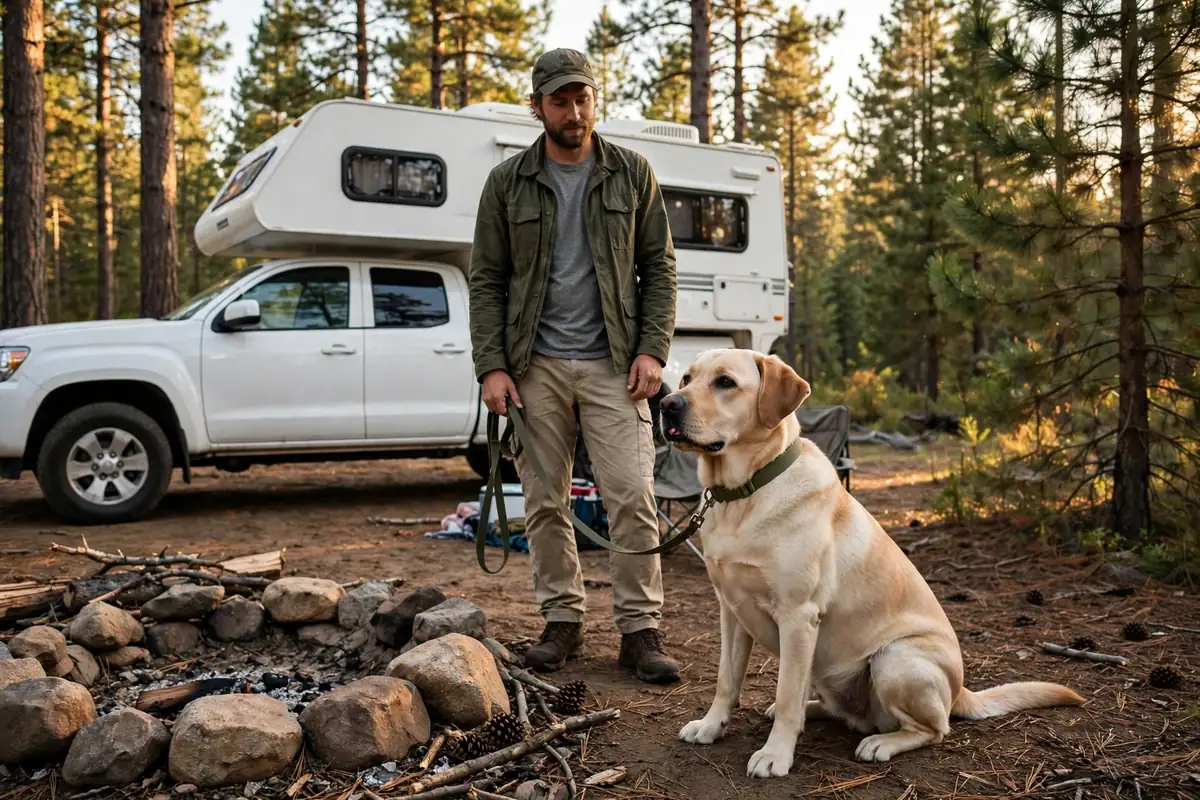
Campground rules are simple, strict, and enforced. The National Park Service’s B.A.R.K. rules are the template most parks follow: bag your pet’s waste, keep your dog on a leash no longer than six feet, respect wildlife, and know where you can go — because in most national parks, dogs are not allowed on trails, in the backcountry, or in buildings, period. The Park Service’s visiting with pets page lays it out. The key nuance: national forests and BLM land are usually far more dog-friendly than national parks, which is one more reason boondocking and dispersed camping pairs so well with dogs.
Breed restrictions are the uncomfortable footnote. Some private campgrounds and RV parks enforce breed lists, usually aimed at pit-bull-type breeds, and they can and do turn people away at check-in. Check the park’s pet policy before you book, not when you arrive.
Barking etiquette is where dog owners lose the goodwill of entire campgrounds. A dog that barks at every passerby, squirrel, and neighboring screen door becomes the site everyone complains about. Never leave a dog alone in the camper to bark — sound carries through those thin walls far better than you think. Train a settle command before the first trip, exercise the dog hard before quiet hours, and if your dog is a barker, own it: pick end-of-loop sites and apologize in advance to your neighbors. It costs nothing and buys everything.
Wildlife rules protect your dog, not just the wildlife. In desert parks, rangers warn that coyotes and mountain lions go after pets and cactus spines ruin afternoons. Keep the leash short where dogs are allowed, and store pet food like human food in bear country — Leave No Trace principles treat pet waste and food exactly like yours: pack it out, secure it, leave the place clean.
The dog first-aid kit is non-negotiable and small enough to have no excuse. The AKC’s camping guidance covers the core: tweezers for ticks, styptic powder for a torn nail, bandages, and hydrogen peroxide — plus vaccination records, medications, a flashlight, and waste bags. Their complete guide to traveling with your dog is the pre-trip vet-check reminder most people need. Add flea and tick prevention before you leave and save the nearest emergency vet’s number at each stop. You will probably never need it. That is the point.
Frequently Asked Questions
Can my dog ride in the truck camper while we are driving?
No — the dog rides in the cab. A moving truck camper is an unsecured, swaying space with no restraints and wild temperature swings. Set up the back seat with a folded bench, foam pad, or hammock cover, and secure the dog with a harness tether or crate.
Where do large dogs sleep in a truck camper?
Wherever fits — usually the cabover bed with you, a floor crate, or a dedicated bed in the largest open floor area. Many big-dog owners report the dog simply claims the cabover. For giant breeds, a floor spot near the entry avoids midnight lifting up the cabover ladder, and a sofa or dinette conversion can become a permanent dog bed.
Can I leave my dog in the camper while I go hiking?
Only with active cooling and a cellular temperature monitor alerting your phone — and even then, briefly, in mild conditions. On an 80-degree day the interior can hit 114 degrees in under 30 minutes. In most national parks dogs are not allowed on trails anyway, so plan around the dog: trade off with your travel partner, choose dog-friendly forest and BLM land, or find a day-kennel.
Are truck campers too small for two large dogs?
Small but workable if you commit to the systems: a cab riding setup, defined sleeping spots, serious mud control, and most of your living happening outside under the awning. Owners do it — including full-timers with multiple large dogs — but two big dogs plus two adults is the practical ceiling for most floor plans, and giant breeds shrink that ceiling fast.
Do campgrounds have breed restrictions for dogs?
Some private campgrounds and RV parks enforce breed lists, most commonly aimed at pit-bull-type breeds. Public lands generally do not, but they enforce leash, waste, and trail rules strictly. Always check the specific park’s pet policy before booking.