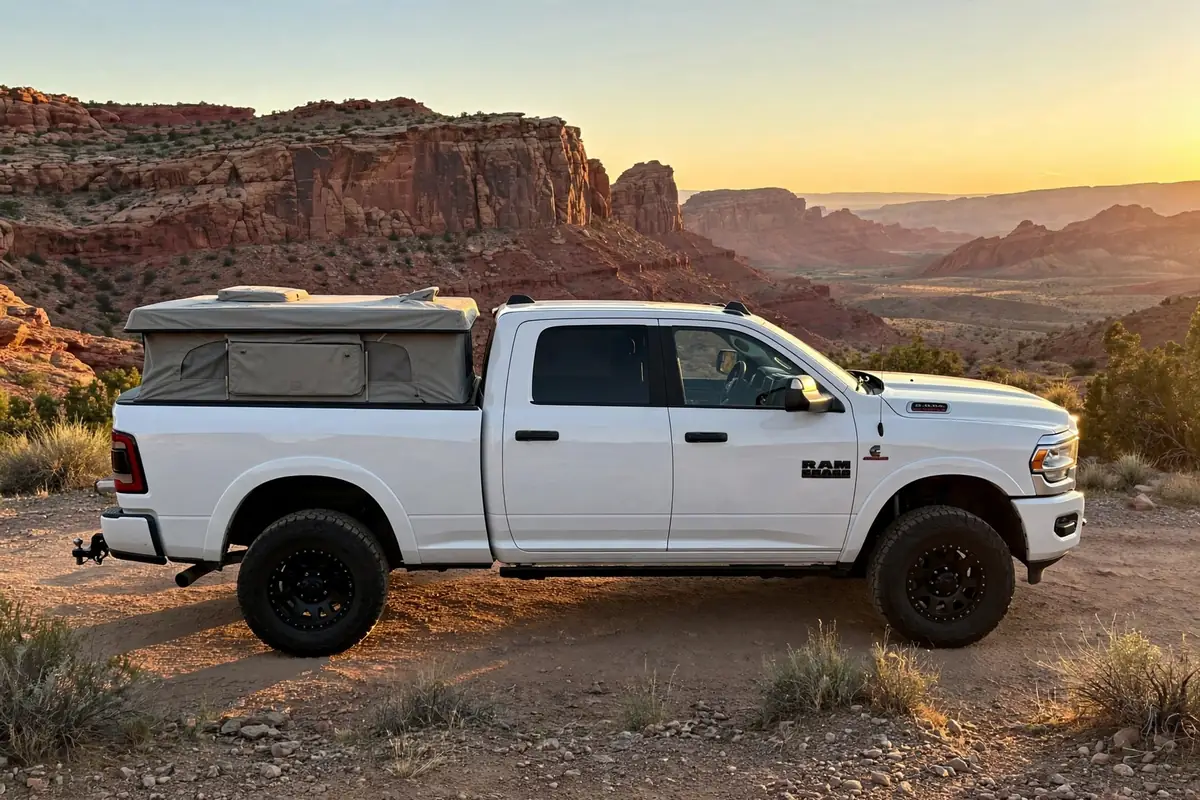
Ram 2500 Truck Camper Payload: Why the Diesel Carries Less Than You Think
My neighbor pulled into his driveway last spring with a Ram 2500 Cummins and a grin I recognized. It was the same grin I had when I bought my first slide-in camper, the one that says I just made the best decision of my life. He had also just put a deposit on a double-slide hard-side camper, and he asked me to look at the numbers. I did. That is the Ram 2500 truck camper payload trap: I had to tell him the truck he just bought could not legally carry the camper he just paid a deposit on, and it catches smart people every single month.
Here is the short version. A Ram 2500 with the 6.7L Cummins can tow up to 20,000 pounds, which sounds like it can do anything. But towing is not carrying. The diesel engine, emissions equipment, and heavy transmission eat roughly 800 to 900 pounds of the truck’s gross vehicle weight rating before you load a single sock, so a crew-cab 4×4 Cummins on a dealer lot often shows a door-jamb payload of just 1,900 to 2,380 pounds, numbers Ram Forum owners report off their stickers again and again. The gas 6.4L Hemi version of the very same truck can carry nearly 900 pounds more. And the campers people pair with these trucks keep getting heavier. The math fails, sometimes by a literal ton.
I have carried a slide-in on three trucks over the last decade, weighed every one on a CAT scale, and watched friends blow past their ratings without knowing it. This is the conversation I wish somebody had sat me down for before my first purchase: why the Cummins gives up so much payload, how both brochure numbers lie to you, the real-world disaster of a Ram 2500 carrying a camper 2,300 pounds over its limit, and what owners who got it right do instead.
Where Your Ram 2500 Truck Camper Payload Goes
Payload is the weight your truck can carry, on its back, in its bed and cab, without exceeding its gross vehicle weight rating, or GVWR. The Ram 2500 is capped at 10,000 pounds GVWR by class, no matter which engine you pick. Everything bolted to the truck subtracts from that 10,000. Fuel, the engine, the transmission, the crew cab, the 4×4 hardware, the leather seats, the sunroof, the bed liner, all of it. What is left is your payload, and it is printed on the Tire and Loading Information sticker on your driver door jamb. Not the brochure. The sticker.
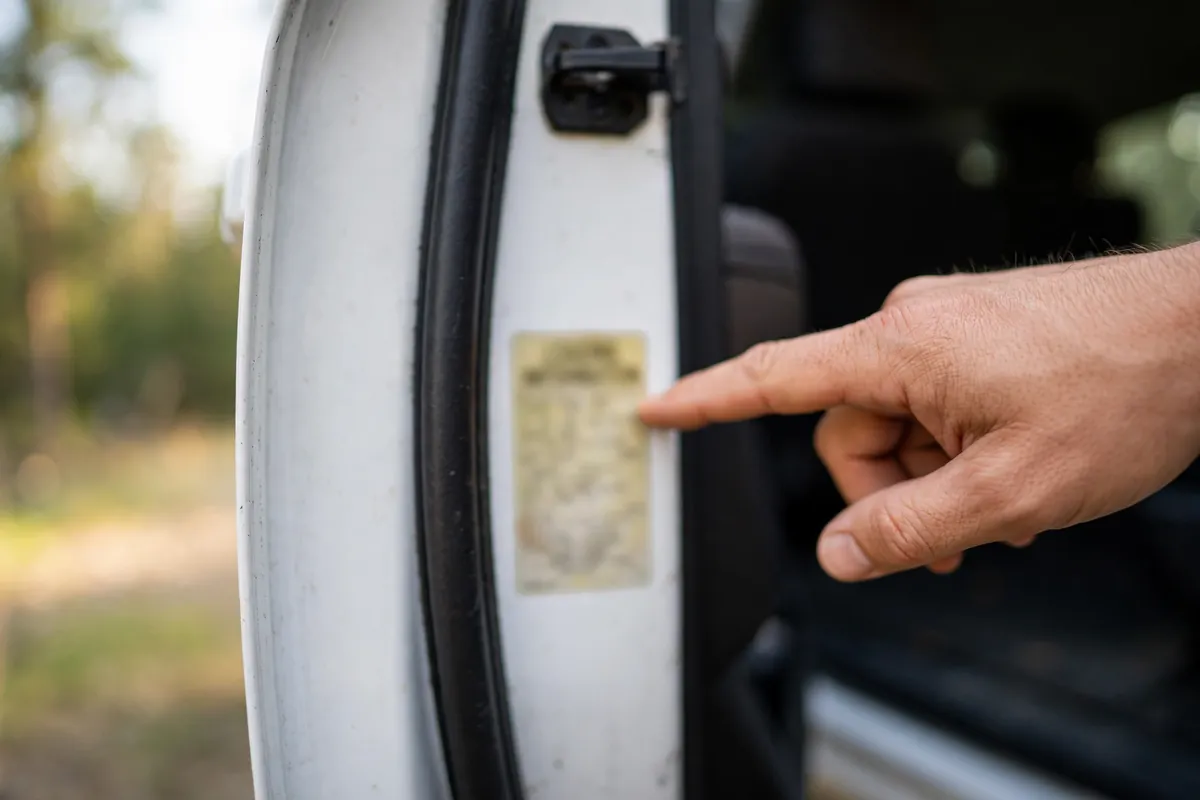
Ram’s official site lists 2026 maximum payload at 3,930 pounds for the 6.4L Hemi and 3,600 for the Cummins diesel. Those are best-case unicorns; your truck is not one. A loaded crew cab 4×4 Cummins on a dealer lot typically shows 2,100 to 2,400 pounds on the sticker. Owners on the Good Sam community compared identical 4×4 crew-cab trucks and found 3,280 pounds of payload on the Hemi against 2,360 on the Cummins, an 880-pound gap on the same truck shape. Ram Forum threads peg real-world diesel 2500 stickers at 1,900 to 2,100 pounds, with gas trucks at 2,900 to 3,200.
So why does the diesel give up so much? The 6.7L Cummins is an iron-block inline-six that weighs well over 1,000 pounds with fluids, roughly double the Hemi, and the heavier transmission, bigger cooling stack, diesel exhaust fluid system, and particulate filter all pile on. Every one of those pounds comes straight out of your payload because the 10,000-pound GVWR ceiling does not move. As one Ram owner put it, 2500 diesels are an oddball: they can pull a house but they cannot carry much. I have never heard it said better.
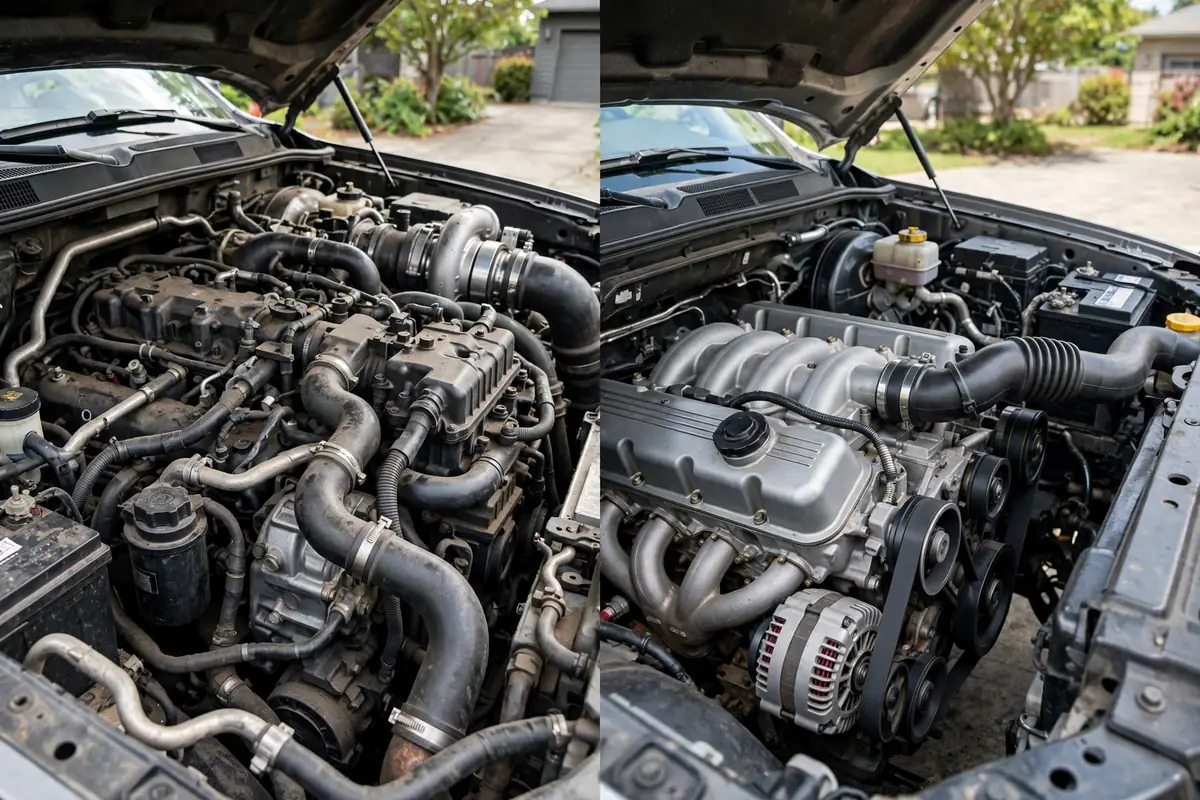
That same dynamic is why Ram can advertise 20,000 pounds of towing on the diesel. Towing is about the powertrain pulling weight behind the truck. Carrying is about the chassis, springs, tires, and brakes holding weight above the axles. The Cummins dominates the first and handicaps the second. If you want a fuller walkthrough of how payload math actually works on any truck, our truck camper payload calculator guide walks through the whole formula with examples.
Brochure Weights Lie on Both Sides of the Deal
Now for the camper side, which is where the trap really snaps shut. The weight printed in a camper brochure is not the weight of the camper you take camping. Experienced owners on an ar15.com thread about Ram 2500 truck bed campers spelled this out with unusual clarity: published and plated weights on slide-in campers are stripped to the bone and empty. Batteries, tanks, options, and awnings add hundreds of pounds before you fill a single tank or put any food in the cabinets. A camper that plates at 2,200 pounds dry can be a completely different number by the time it leaves the dealer lot with your options on it.
I learned this the embarrassing way. My second camper brochured at 1,890 pounds. With two batteries, a full propane fill, the dealer-added air conditioner, awning, solar panel, a full water tank, and our gear, the CAT scale showed it had gained more than 1,100 pounds over the brochure figure. Another owner in that same ar15.com discussion gave a rule of thumb I now repeat to everybody: take the dry weight, add 1,000 pounds, and that is the payload your truck will actually carry. Not scientific. Just about right.
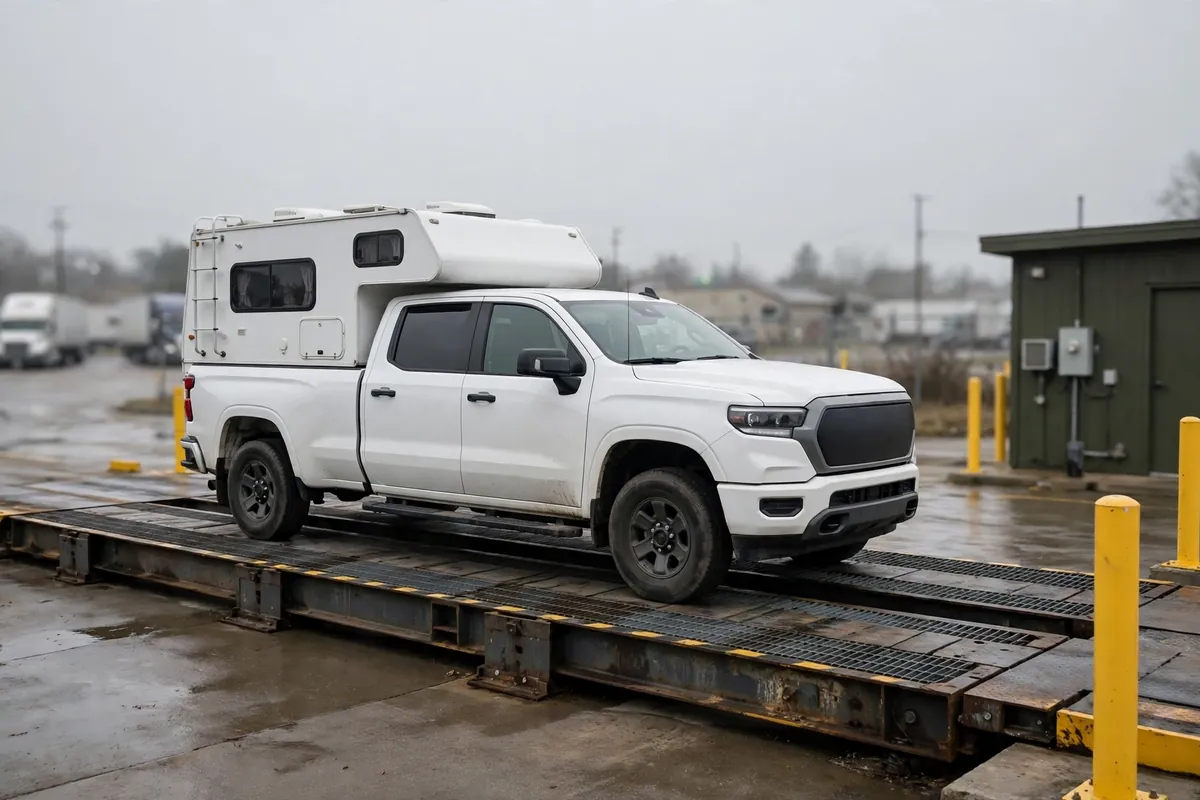
So both numbers flatter the deal: the truck brochure shows the max payload of the lightest configuration, the camper brochure shows the dry weight of the barest one, and the salesman is happy to match the biggest truck number against the smallest camper number. The door jamb sticker and the CAT scale are the only honest witnesses. Weigh the truck full of fuel with everyone aboard, subtract from GVWR, and that is your real payload. Weigh the loaded camper, and that is your real camper. Everything else is marketing.
The Payload Fail That Should Scare Every Diesel Owner
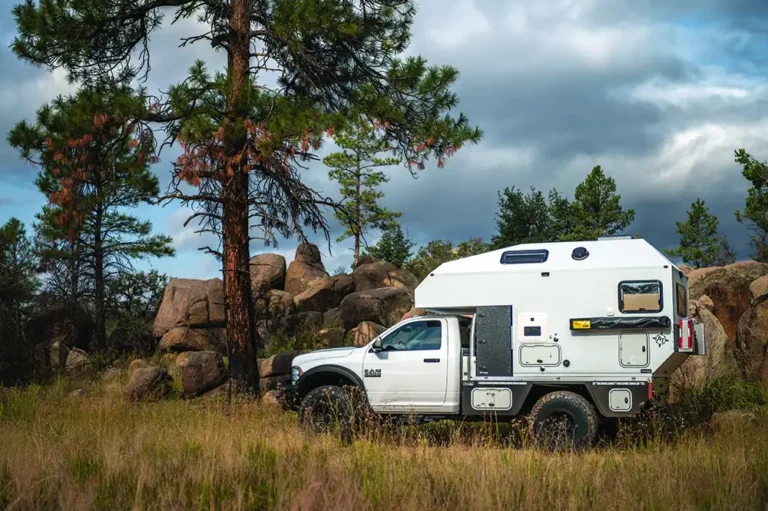
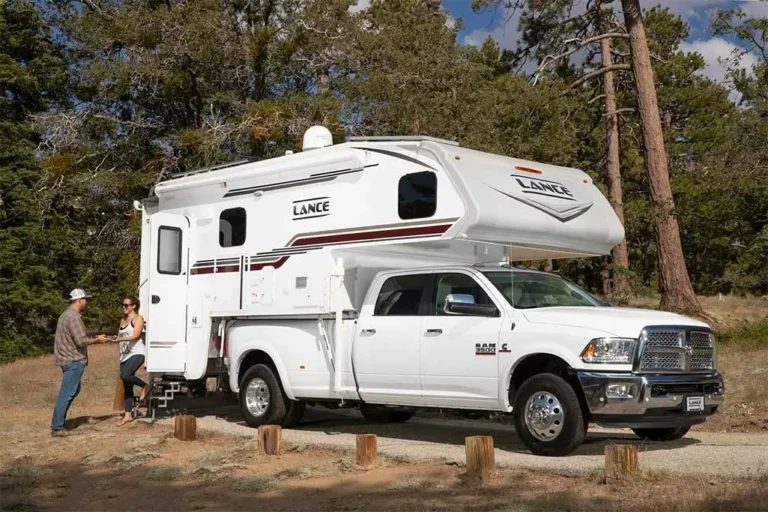
If you want to see what happens when nobody does that math, there is a famous cautionary tale. Truck Camper Adventure published a story called Truck Camper Payload Fail, about a reader’s photograph of a 2016 Ram 2500 carrying a 2016 Lance 1172. The Lance 1172 is Lance’s flagship dual-slide camper, and even in 2016 its wet weight was 4,300 pounds. Add roughly 1,000 pounds for batteries, options, water, propane, and gear, and that rig was carrying about 5,300 pounds of camper on a truck rated for 3,160, in its highest-payload regular-cab long-bed configuration. Roughly 2,300 pounds over. More than a full ton.
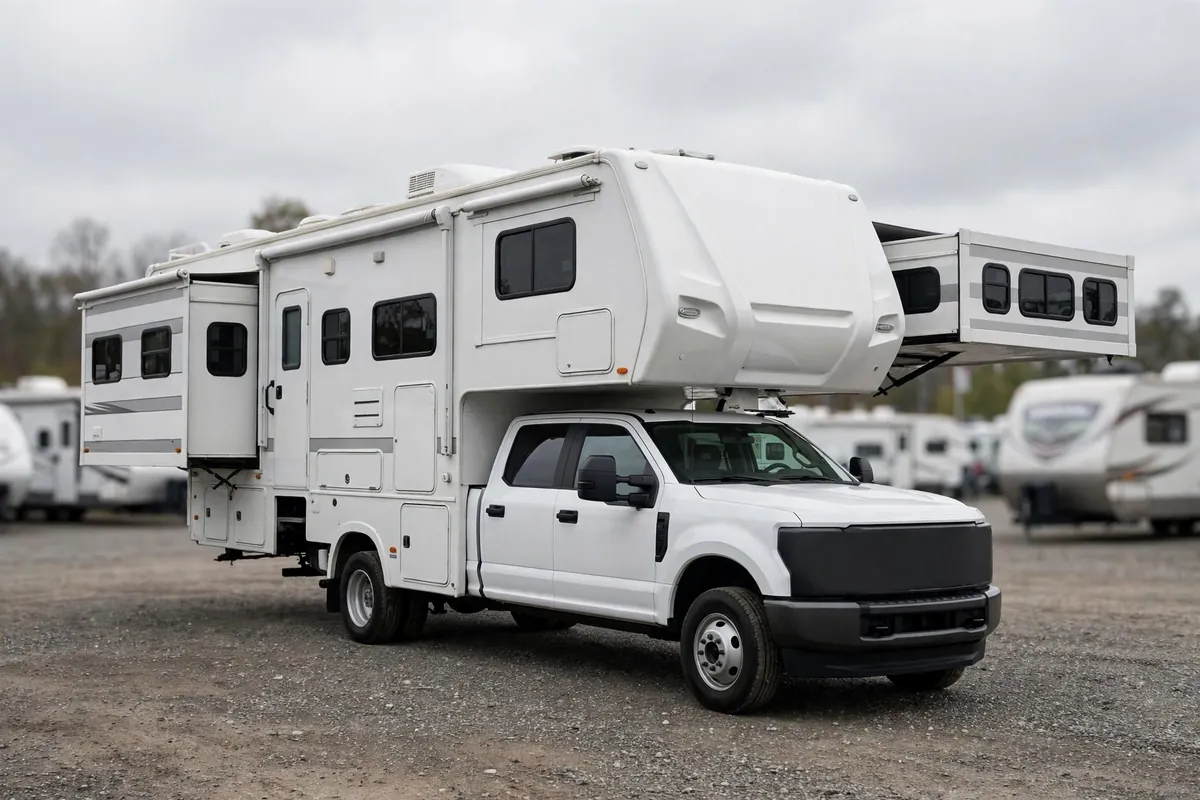
What made the story sting was that a dealer had a hand in it. The article’s whole point was that RV dealerships do not always have your best interests at heart. Somebody sold that pairing and somebody drove it home, and from the outside it probably looked fine. The problem is invisible until it is not: overheated tires, fading brakes on a grade, a bent frame, a voided warranty, or an insurance adjuster who walks away from your claim after an accident because you were knowingly overloaded. Our truck camper insurance guide covers how overloading can complicate a claim, and it is worth reading before you sign anything.
For context, the current 2026 Lance 1172 is even heavier, with dealer listings showing 4,063 pounds dry and 4,517 wet. That camper needs a one-ton dually, full stop. But the trap is that the same arithmetic quietly fails on much smaller campers too, which brings us to the math nobody does at the dealership.
The Math Nobody Does at the Dealership
Let us run honest numbers on a truck a lot of people actually own: a crew-cab 4×4 Ram 2500 Cummins with a door-jamb payload of 2,200 pounds, right in the range Ram Forum owners report.
Subtract two adults at 340 pounds combined. Subtract the dog, 60. Subtract the toolbox, recovery gear, and camp chairs, call it 250. Subtract the bed mat, tie-downs, and turnbuckles, 80. You have used 730 pounds and have not touched the camper yet. Remaining payload for the camper, wet and loaded: 1,470 pounds.
Now look at what that buys. A well-equipped pop-up in the 1,100 to 1,400 pound dry range can work if you pack light. A hard-side camper that brochures at 1,800 pounds dry will scale at 2,600 to 2,800 loaded, and you are over by a thousand before you leave the driveway. An owner in the Ram Forum truck camper thread gave almost exactly this advice: on a 2500 Cummins with around 2,100 pounds of payload, you are realistically looking at a max camper weight of about 1,500 to 1,800 pounds once passengers and gear are counted. He also flagged the 2500’s rear coil springs, which ride beautifully but squat fast under a tall, heavy load.
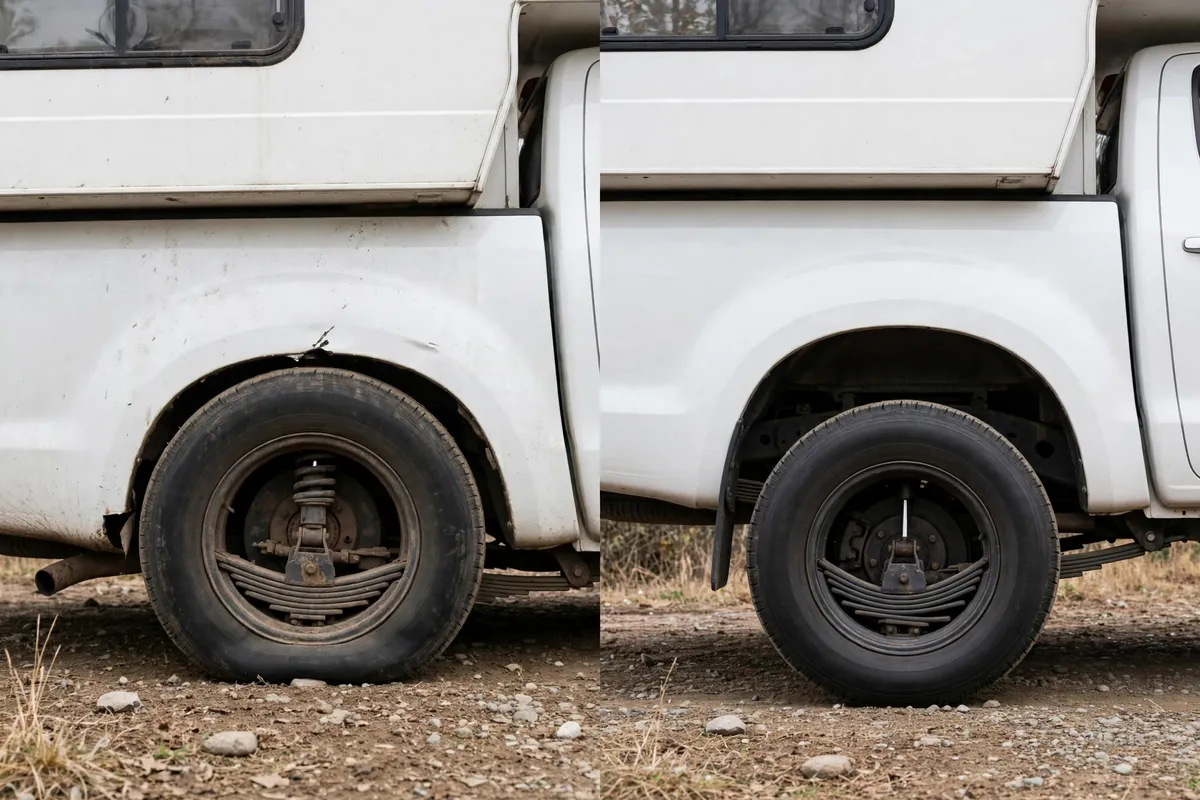
Run the same math on the gas Hemi version with its 3,280-pound sticker, and the picture changes completely. After the same 730 pounds, you have 2,550 pounds left for the camper, and suddenly a 2,000-pound-dry hard side with a bathroom is on the table. Same truck, same badge, wildly different camping life. That is the entire trap in one paragraph: people buy the diesel for the towing number they will rarely use, and give up the carrying number they need every single trip.
The Airbag Myth, and What Actually Helps
When owners realize they are over, the first thing most of them buy is airbags. I get it, I did it too. Airbags, Timbrens, SumoSprings, and helper springs all do something real: they level the truck, reduce sway, and make an overloaded rig feel more composed. What they do not do is add a single pound of legal payload. The door jamb number is the door jamb number, and in an accident or warranty fight, the rating is what counts.
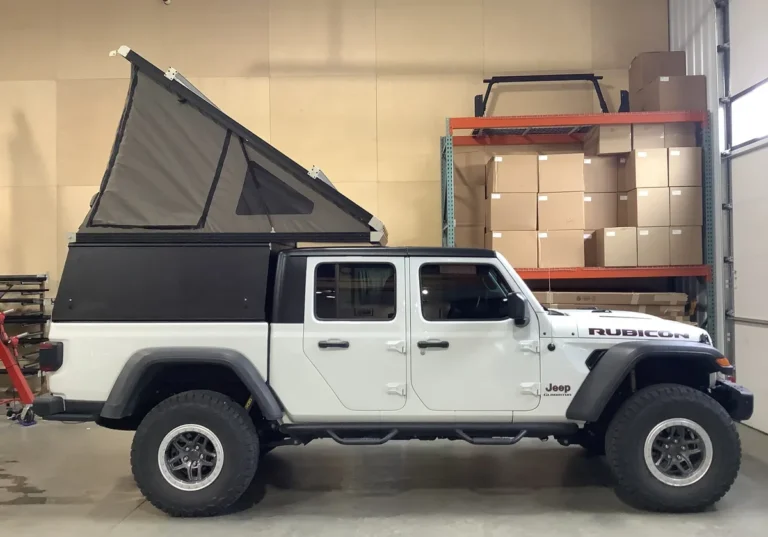
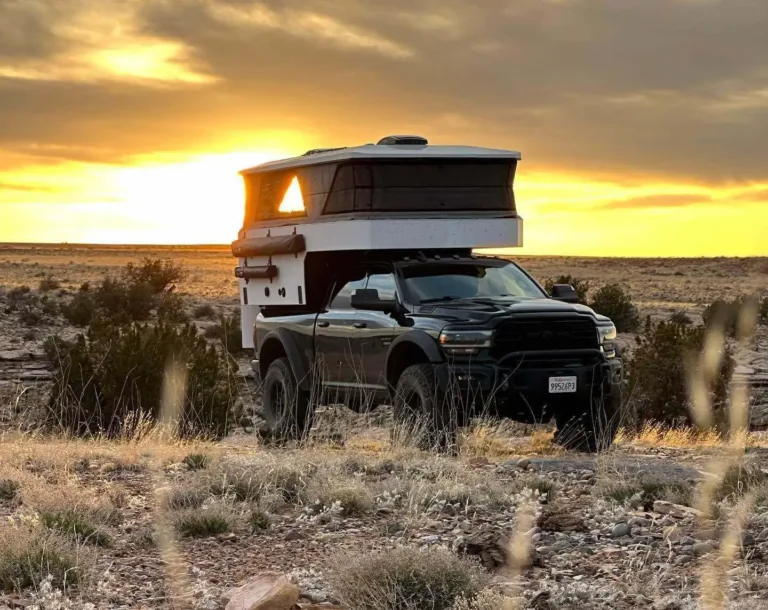
So what do owners who get it right actually do? From years of forum threads and campground conversations, the playbook has a few recurring moves. First, buy the camper to the sticker, not the brochure, and budget dry weight plus 1,000 pounds as your planning number. Second, if you already own the Cummins 2500, shop the light end on purpose. Pop-up campers are the classic answer for exactly this truck: a Four Wheel Camper Hawk or Grandby weighs roughly a third of a big hard side, keeps the center of gravity low, and leaves real payload for water, food, and gear. Check Four Wheel Campers’ truck compatibility guide to confirm fitment for your exact truck, and our comparison of the Four Wheel Camper Fleet, Swift, and Hawk breaks down which pop-up fits which truck. Third, step up to a 3500, which several Ram Forum regulars recommend outright: the 2500 is for pulling, the 3500 is for carrying. And fourth, weigh the rig on a CAT scale in the first month and adjust from reality instead of guessing for three years.
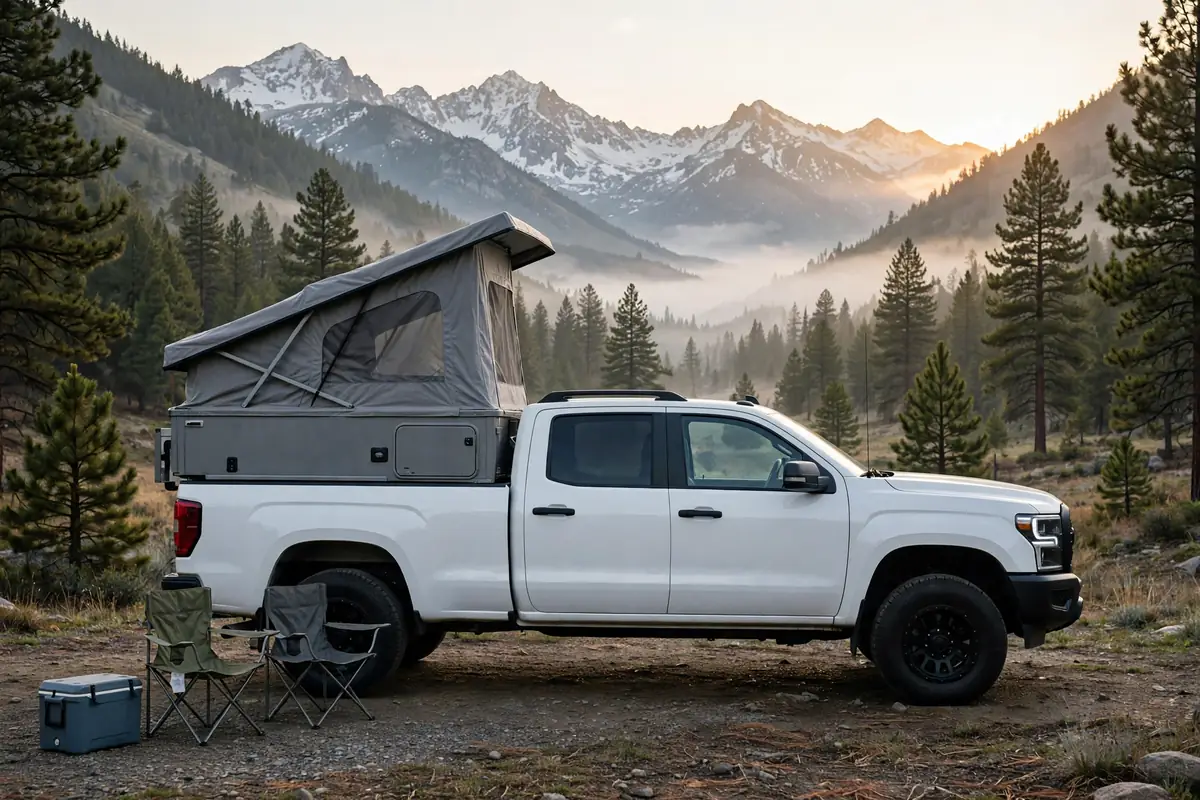
Then there is the option more owners are choosing: skip the diesel entirely. If your plans never approach that 20,000-pound tow rating, the Hemi 2500 gives you back nearly 900 pounds of payload, simpler maintenance, no diesel exhaust fluid, and a lower purchase price. One Good Sam poster working through this exact choice realized his camping plans would never use the diesel’s towing advantage. He is not alone. For a truck camper, payload is the whole game, and the gas truck plays it better.
If you do stay in the diesel camp, the lightweight hard-side market is your friend. There are genuinely good campers in the 1,400 to 2,200 pound dry range with real bathrooms and four-season insulation, and our roundup of the best lightweight truck campers for 2026 focuses on models that will not overload a three-quarter-ton truck. Wedge and canopy-style campers are lighter still, and our 2026 wedge camper guide lists real weights and prices for the simplest way to stay legal on a diesel 2500.
How to Buy Without Falling In
If you are shopping right now, here is the order of operations that keeps you out of trouble. First, open the driver door of the actual truck you will buy and photograph the Tire and Loading Information sticker. That number, not the website, is your payload. Second, subtract every human, pet, and piece of gear that rides along on a normal trip, and be honest about the toolbox. Third, take what is left and judge your camper shortlist by it, using wet weight plus options plus a thousand pounds of life, not the brochure dry weight. Fourth, before money changes hands, ask the dealer for the actual unit’s yellow weight label and add dealer-installed accessories. Fifth, within the first month, run the whole rig across a CAT scale, full fuel, full water, everybody aboard. It costs about fifteen dollars and it ends every argument.
One more story, because it is what finally convinced me scales matter more than stickers. A widely shared account from a few years back showed a Ram 3500 dually with its frame cracked in half on a Baja roadside under an Eagle Cap camper. The owner had done his research, the dealer had blessed the pairing, and the camper’s loaded weight still landed far above what that specific truck configuration could carry. The warranty claim was denied. If it can happen on a dually with dealer approval, it can absolutely happen on your 2500 with a salesman’s handshake. Verify everything yourself.
The Cummins is a magnificent engine, and I would take one in a heartbeat for towing a big fifth wheel across the Rockies. But a truck camper lives in the bed, not on the hitch, and in the bed the diesel’s weight is a tax you pay on every trip. Know the tax, do the math, buy the camper that fits the sticker, and you will never be the cautionary tale in somebody else’s article.
A Quick Disclaimer
Payload and weight guidance in this article is general information from an owner’s perspective, not engineering or legal advice. Ratings, laws, and insurance terms vary, and only your truck’s door-jamb sticker and a certified scale can tell you what your specific rig weighs. When in doubt, weigh it, and talk to a qualified professional before making towing or hauling decisions.
Frequently Asked Questions
How much payload does a Ram 2500 Cummins actually have for a truck camper?
It depends entirely on trim and configuration, which is why the door-jamb sticker is the only number that matters. Ram’s official 2026 maximums are 3,600 pounds for the Cummins diesel and 3,930 for the 6.4L Hemi, but those apply to stripped base configurations. Owners report real-world stickers of 1,900 to 2,380 pounds on typical crew-cab 4×4 Cummins trucks, and 2,900 to 3,280 on comparable gas trucks. After passengers, pets, and gear, a diesel 2500 often has just 1,400 to 1,800 pounds left for the loaded camper.
Why does the diesel Ram 2500 have less payload than the gas version?
The 2500’s GVWR is capped at 10,000 pounds regardless of engine. The 6.7L Cummins iron-block diesel, its heavier transmission, cooling system, diesel exhaust fluid equipment, and particulate filter weigh roughly 800 to 900 pounds more than the gas powertrain. Since GVWR minus curb weight equals payload, every extra pound of engine is a pound you cannot put in the bed, and owner comparisons of identically configured trucks confirm a gap of about 880 pounds.
Can I just add airbags to carry a heavier camper on my Ram 2500?
Airbags, Timbrens, and helper springs improve ride quality and calm sway, but they do not increase your truck’s legal payload rating. The door-jamb number and axle ratings are what matter for safety, warranty, and insurance. Suspension upgrades help a properly matched rig, but they cannot legalize an overloaded truck.
What is the heaviest truck camper a Ram 2500 diesel can carry?
Take your door-jamb payload, subtract all passengers, pets, and gear, and shop campers whose loaded wet weight fits what remains. For a typical crew-cab 4×4 Cummins with a 2,200-pound sticker, that usually means a camper scaling at 1,400 to 1,800 pounds loaded, which points to pop-ups or the lightest hard-side models. Use dry weight plus 1,000 pounds as your planning figure, and confirm with a CAT scale.
Should I buy the gas or diesel Ram 2500 for truck camping?
If the camper lives in the bed and you do not regularly tow near 20,000 pounds, the gas 6.4L Hemi is the stronger choice for most truck campers: roughly 900 pounds more payload, lower purchase price, and simpler maintenance. Choose the Cummins if you tow heavy often enough to use its torque and exhaust brake, and accept lighter campers or a 3500.