Truck Camper Fresh Water System Guide That Actually Works
I learned about a truck camper fresh water system the embarrassing way: standing in a campground in socks, pump buzzing, faucet spitting air, and no water coming out. The tank was full. The battery was fine. I just did not understand how the pieces fit together yet.
Once you do, the system gets boring in the best way. Fill it, use it, sanitize it twice a year, and stop thinking about it. This guide covers fresh water only — tank, pump, city-water hookup, filters, taste, and smell. Waste-side problems are a different job, and our guide to fixing black tank smell in a truck camper covers that side.
How a truck camper fresh water system works
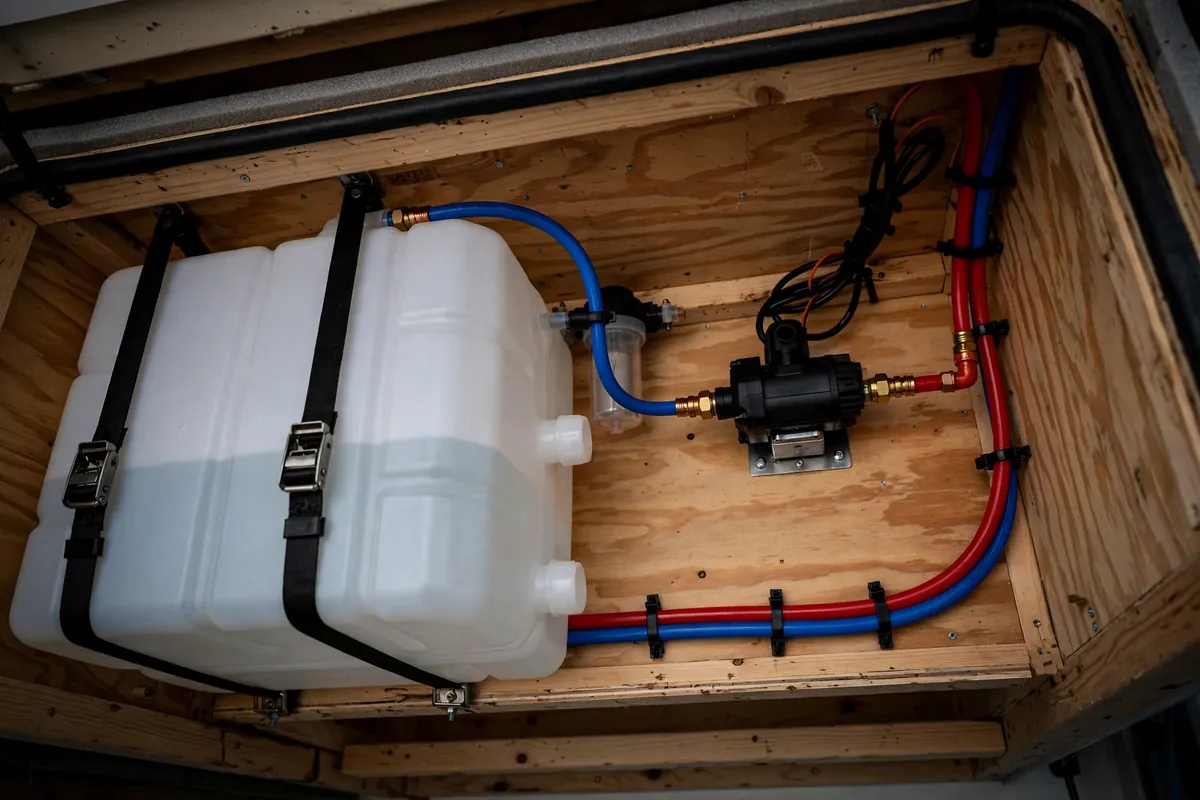
Your truck camper fresh water system is simpler than it looks under the sink: a tank, usually 15 to 30 gallons in a slide-in camper, a 12-volt diaphragm pump, PEX lines, and your faucets, shower, and toilet feed. Many campers also have a city-water inlet on the outside wall.
Off the hookup, the pump does the work. Open a faucet, pressure drops, the pump switches on and pushes tank water to the faucet. Close the faucet, pressure builds, the pump switches off. A common pump, the SHURFLO Revolution 4008, is rated at 3 gallons per minute with shutoff around 55 PSI — a steady kitchen stream, not a fire hose. Its spec sheet also lists 6 feet of dry-prime lift, which matters for troubleshooting.
On city water, campground pressure pushes water straight to your faucets and bypasses the tank and pump. Your pump should be off. Remember that: city water in, tank out of the loop. Pump on, tank in use.
One warning: your tank gauge lies. A quarter-tank reading can mean nearly empty. When in doubt, top the tank off.
City water vs tank: which should you use?
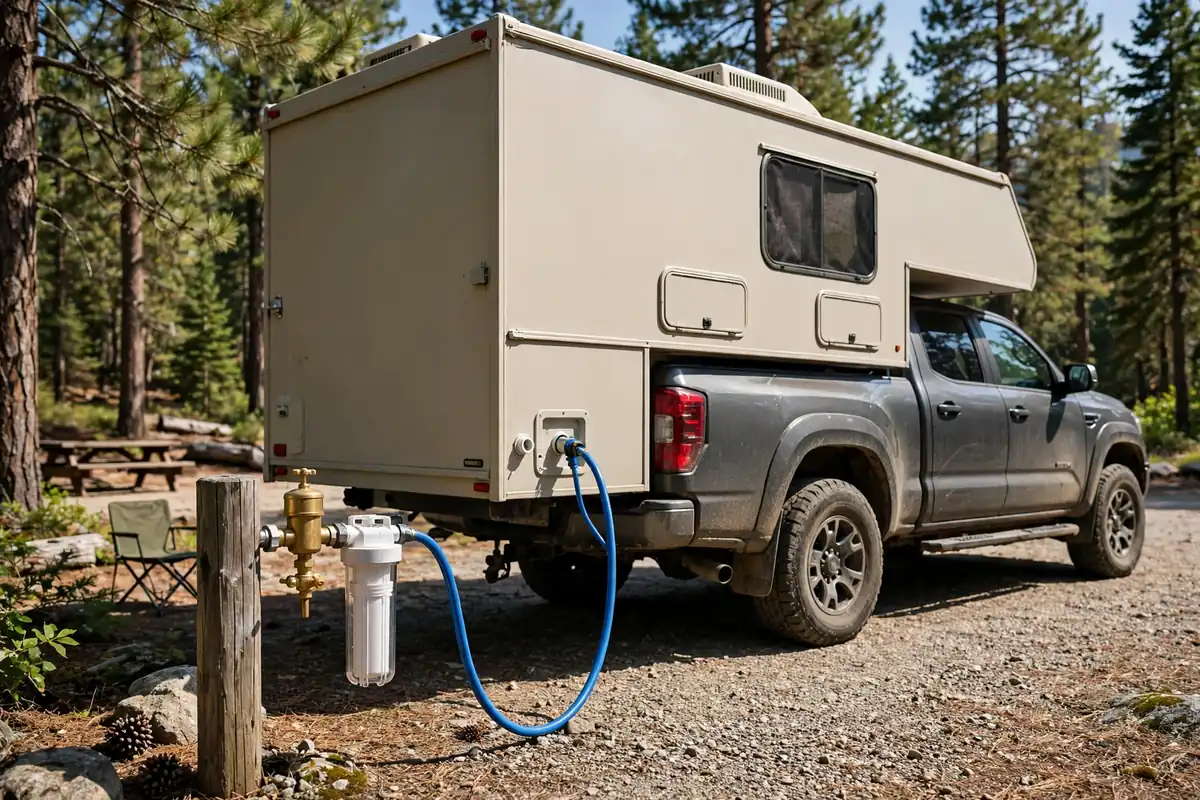
Use city water for a longer stay with a hookup, when you want unlimited showers and dishes and you are around to watch things. Pressure varies wildly between campgrounds, so always use a regulator on the city inlet. I keep mine at 45 to 55 PSI at the spigot end, so it protects the hose too, then run a drinking-water hose and inline filter in.
Use the tank and pump for boondocking, one-night stops, freezing weather, or sketchy pressure. The pump gives consistent pressure, and a leak while hiking is limited to tank contents instead of an open tap running all day. That is why I turn water off — pump or spigot — whenever I leave for hours and every night.
Many owners keep the tank about half full even on city water, so a midnight supply failure just means flipping the pump on. Our boondocking and dispersed camping guide pairs well with this one.
Filling the tank without ruining the taste
Start with the hose, where many taste problems begin. Owners on forums report blaming a new tank for foul water, then discovering the culprit was a new hose — or worse, an old garden hose, which is not made for drinking water and leaves a taste no flushing will fix until you change it.
Use a drinking-water-rated hose, cap its ends when packed away, drain it before storage, and do not leave it full of warm water in the sun. Before your first fill of the season, run water through the hose alone into a bucket and taste it. If hose water tastes bad and spigot water does not, you found the problem in thirty seconds.
At the spigot, my order is: spigot, pressure regulator for a city hookup, inline carbon filter, then hose into the camper. Flush a new filter for a few seconds first so you are not drinking loose carbon dust.
Fill patiently. A kinked tank vent makes filling slow and gluggy because air cannot get out. If the tank burps water back, check the vent before blaming the pump. Water has no fixed shelf life: municipal chlorinated water holds up better than untreated well water, and heat makes everything stale faster. If it sat more than a couple of weeks, drain and refill before drinking. Owners on WanderTheWest report keeping a separate gallon or two of known-good water for coffee on a questionable fill.
How to sanitize a truck camper fresh water tank
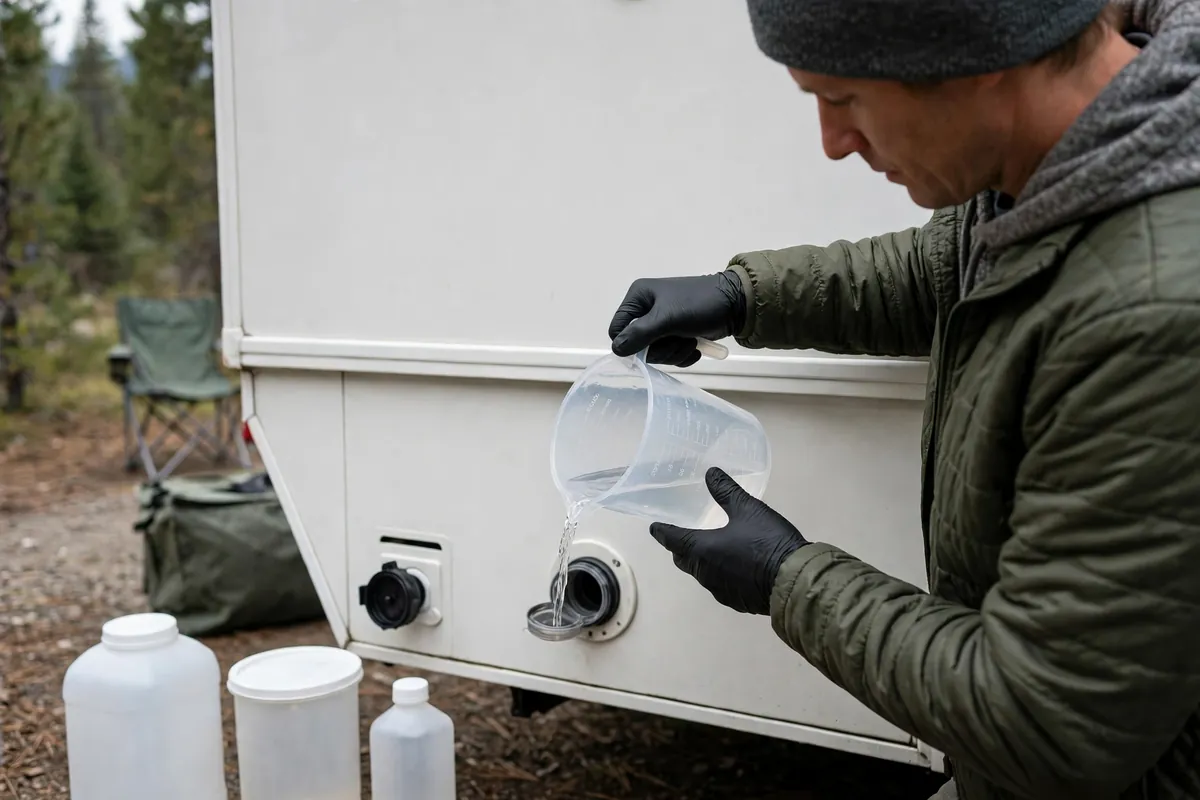
Sanitize at the start of the season, after the camper sat unused for a month or more, after a fill from a source you did not trust, and any time water tastes or smells off. Pull carbon filter cartridges out first and fit a fresh one afterward, or bleach will chew through the carbon.
The dose owners and manuals keep coming back to is 1/4 cup of plain, unscented household bleach per 15 gallons of tank capacity — roughly 1/3 cup for a 20-gallon tank, 1/2 cup for 30 gallons. Check the label first, because concentrated bleach is stronger than old standard strength, so use a little less if yours is concentrated. Never pour straight bleach into the tank. Dilute it in a gallon or two of water first, because straight bleach can damage seals and is brutally hard to rinse out.
The sequence: drain tank and lines, heater off and cool, bypass set as your manual directs. Get the diluted mix in via gravity fill, poured into the fill hose, or drawn in through the pump winterizing hose. Fill to the top, run the pump, and open each faucet one at a time, cold then hot, plus shower and toilet, until you smell chlorine at each. Top off again and let it sit at least 4 hours, ideally overnight up to 12 hours. Drain, then flush with fresh water until no bleach smell remains — usually two fresh fills. Owners on iRV2 report overdoing bleach turns a one-afternoon job into three or four flush cycles, so measure it.
Never mix bleach with vinegar or acid cleaner in the same step, as that can make chlorine gas. Any taste rinse comes only after bleach is fully flushed. Use plain, unscented bleach only.
If you are dewinterizing too, flush first, then sanitize, then fill fresh. Our truck camper winterizing guide covers freeze protection. Leftover pink antifreeze taste is almost always incomplete flushing, and this sequence clears it.
When the pump runs but no water comes out
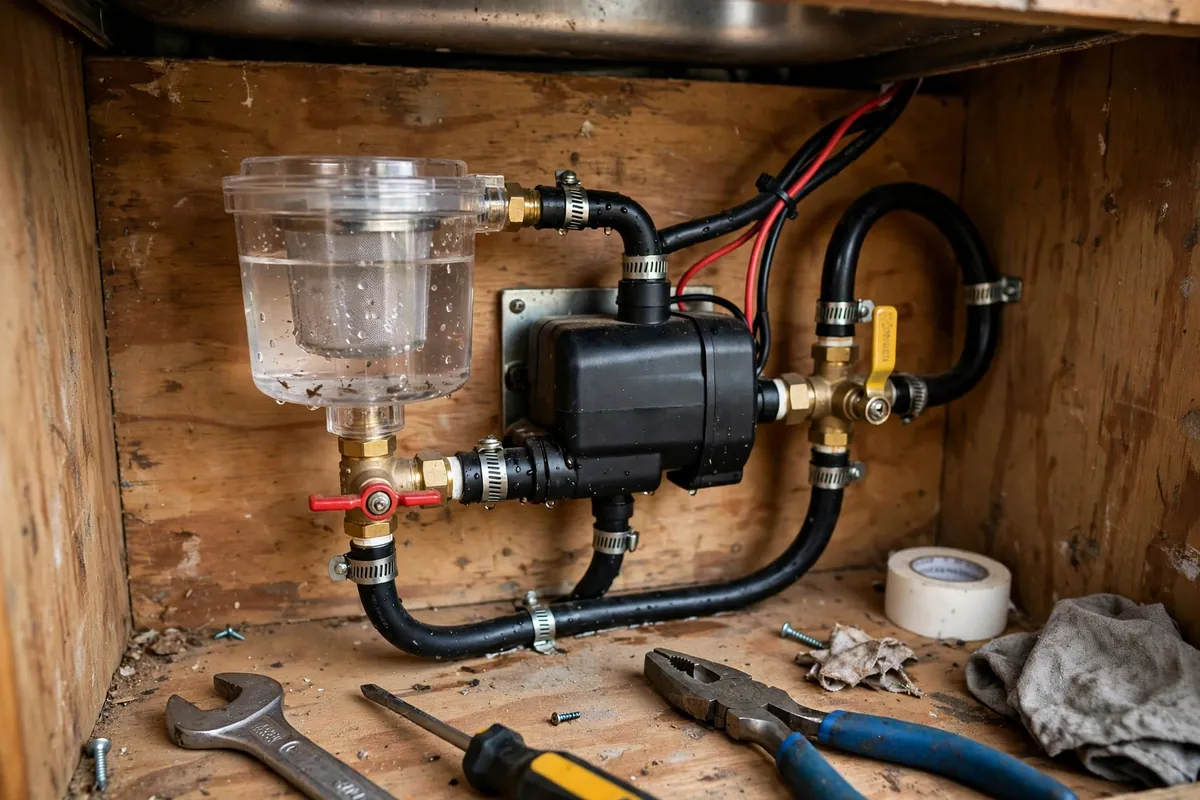
Work through this list in order, and stop when you find it. This problem sends people to buy a new pump they do not need.
Power first. Is the battery charged, is the master 12-volt kill switch on, and does the pump switch light up? The Four Wheel Campers water pumping guide stresses this because on-demand pumps will not even try to run with every faucet closed — so open a cold faucet before declaring the pump dead.
Water second. Top the tank off regardless of the gauge. A pump cannot pump air, and a tank reading a quarter full can suck air on a slope.
Valves third, and this is the big one. Check every fill/use selector, city-water/tank-fill valve, and winterizing valve at the pump. Owners on forums report the same story repeatedly: the valve was left in fill position, so the pump pushed water in a circle back into the tank and nothing reached the faucets. The same happens with a winterizing valve left open to a suction hose sucking air. Put every valve back to normal use, close low-point drains, and close the outside shower valves — an open outside shower is a classic hidden air leak.
Strainer fourth. Most pumps have a small clear bowl with a mesh screen at the inlet. Unscrew it, rinse it, and check for debris, a cracked bowl, or a loose seal. Owners on iRV2 report that a strainer bowl a quarter-turn looser than it should be was enough to let air in and stop priming. The suction side is where air gets in, so a tiny looseness has an outsized effect, and a freeze-cracked bowl does the same without ever showing a water leak.
Prime fifth. Open one faucet, turn the pump on, and give it time. Filling an empty heater and lines can take a minute or two, and chattering is usually pressurizing, not dying. Diaphragm pumps can generally run dry for a while without damage, so do not panic, but do not let it run for an hour. If it still will not catch, push-prime with city water: hook up, run water through, then switch to tank and pump with a faucet open. Owners on forums also report priming through the winterizing hose — drop it in a jug of clean water, flip the valve to it, let the pump grab water with almost no lift, then flip back to the tank.
If the motor still runs but moves nothing, check the pump fuse first — a blown fuse feels exactly like a dead pump — before assuming a failed pump or seized check valve.
Why your pump cycles at 2 a.m.
A healthy system holds pressure with every faucet closed. If the pump kicks on for a second every few minutes all night, it is losing pressure somewhere. Water is not compressible, so even a tiny loss is enough to wake it.
Check visible drips first: faucets, shower head, toilet valve, outside shower, and city-water inlet. A weeping toilet valve or dripping city inlet will cycle a pump all night without leaving a puddle you notice. Owners on forums report that gently seating a stuck plunger inside the city inlet stopped both the drip and the cycling.
Next, suspect the pump check valve. Inside the pump head, a one-way valve stops pressurized water flowing back into the tank. If grit or scale holds it open slightly, water bleeds back and the pump cycles to top pressure up. Cycling a faucet open and closed rapidly a few times sometimes flushes the debris and reseats it. Another test: hook up to city water and watch whether the tank level slowly rises. If it does, water is leaking backward through the pump valve. A separate inline check valve at the pump inlet can confirm and sometimes fix it, but a worn valve on an old pump means replacement.
Then recheck the suction side for air. The discharge side leaks water out, but the suction side — tank to pump, strainer, winterizing valve, and fittings before the pump — leaks air in, showing up as sputtering with no wet spot. Tighten suction fittings and cap the winterizing hose. An accumulator tank can cushion cycling, but it is not a fix for a real leak. Until fixed, turn the pump off at night and whenever you leave.
Taste and odor fixes, by symptom
Plastic or new-hose taste: flush, sanitize once, and test the hose alone. If the hose is the source, replace it and the problem often vanishes at once. A baking-soda rinse after sanitizing — about 1/2 cup dissolved in a bucket of water, run through and flushed well — is the fix owners report most for a lingering plastic note.
Chlorine taste: usually over-sanitizing or a fresh municipal fill. Flush again. A carbon filter will pull most chlorine taste out. Do not keep adding chemicals to chase it.
Rotten-egg or sulfur smell: often the water heater, not the tank. Bacteria can grow in a warm, stagnant heater. Owners on iRV2 report that a full chlorine shock of tank, lines, and heater together, then thorough draining and flushing — sometimes more than once — clears it. If only hot water smells, that points at the heater. Some well water also smells sulfurous at the spigot; a carbon filter helps taste, but the source is the story.
Stale or musty taste: water sat too long, usually in heat. Drain, sanitize, and refill from a trusted source.
Sweet, chemical, or pink taste after winter: leftover antifreeze. Flush tank, lines, heater, and every fixture including the outside shower, then sanitize. Do not drink until a cold glass tastes like plain water. Coffee will not hide it — it will amplify it.
One boundary: a taste filter does not make unsafe water safe. If the source was not potable, or the water looks dirty, drain, clean, and use bottled or known-good water until you trust the system again.
Filters: what they do, and what they do not do
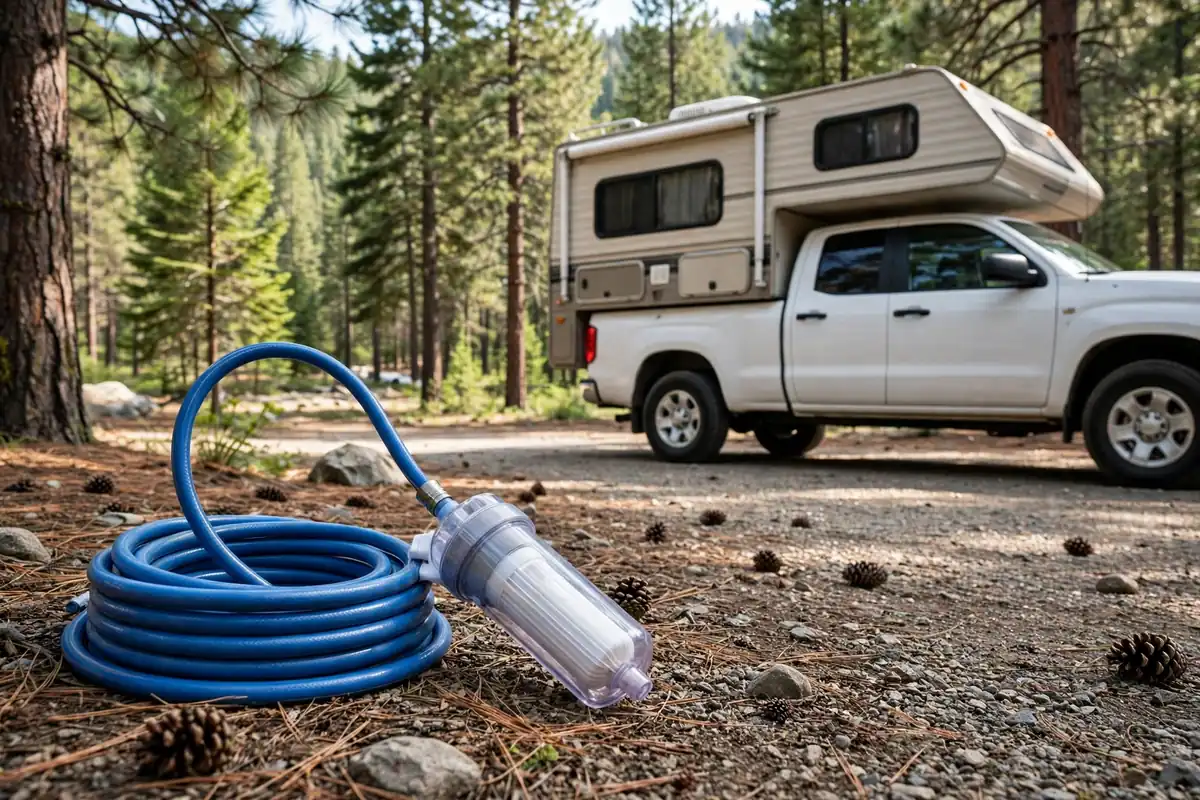
An inline hose filter is your first line. A common type, like Camco TastePURE, uses activated carbon and KDF media to reduce chlorine, bad taste and odor, and sediment, with a 20-micron screen. Its maker documentation says to use a regulator at 60 PSI or less and replace it each camping season, or sooner if taste, odor, or flow worsens. That is a taste and sediment filter, not a purifier, and it will not make microbiologically unsafe water safe.
The pump strainer is not a drinking filter at all — just a coarse screen keeping grit out of the pump. Clean it when flow drops or priming gets fussy.
An under-sink or dedicated drinking-tap filter is the upgrade for daily drinkers. It filters only what you drink, so cartridges last longer. Owners on WanderTheWest report running this exact setup — inline filter plus a finer filter inside — and preferring road water to home filtered water. Pull carbon cartridges before sanitizing, and never run bleach through them. A clogging filter first shows as a weak shower, easily misdiagnosed as a pump problem. Read the Camco TastePURE filter instructions and the SHURFLO 4008 spec sheet before buying.
Living with a small tank
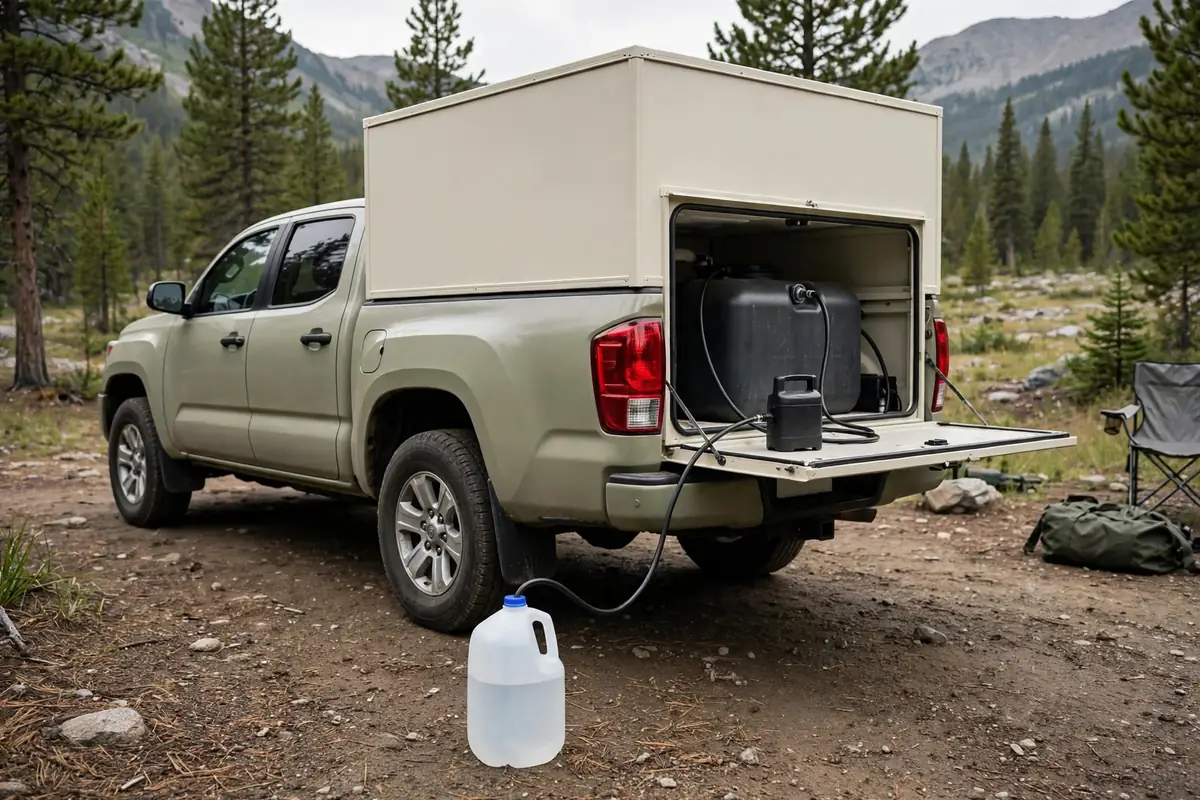
Plan on roughly 5 to 8 gallons per person per day for careful use — quick navy showers, dishes in a basin, no running tap while brushing teeth — and still carry extra. Water weighs about 8.3 pounds per gallon, so a full 20-gallon tank is roughly 166 pounds before the tank itself.
On the road, owners on WanderTheWest report finding water at potable dump-station spigots (not the wash-down tap), ranger stations, truck stops, gas stations if you ask, and grocery bulk-water dispensers. A folding bucket plus a small 12-volt transfer pump lets you fill from a source you cannot park next to. I keep a 5-gallon reserve jug and a 1-gallon jug for coffee.
At home, do not park it wet. Drain the tank, run the pump briefly to clear lines, and leave the system as dry as you can. Put that habit on your regular truck camper maintenance schedule.
FAQ
How often should I sanitize my truck camper fresh water tank?
At least twice a year — start of season and mid-season — plus after a month unused, an untrusted fill, or any off taste or smell. Full-timers filling from municipal sources commonly manage on once or twice a year with good flushing between.
Can I drink water from my truck camper fresh water tank?
Yes, if the system is clean, the source was potable, and you filled through a drinking-water hose and filter. If unsure, use a separate jug for drinking and cooking until you have sanitized, flushed, and a cold glass tastes clean. Never drink from a tank filled with non-potable water, whatever filter you own.
Why does my water pump keep running after I close the faucet?
Brief running is just pressure building back up. Running for a minute or more, never shutting off, or cycling with everything closed usually means a small leak, a suction-side air leak, or a check valve bleeding water back to the tank.
Should I leave my water pump on all the time?
No, not asleep or away. Leave it on while actively using water, and switch it off at night and whenever you leave. That prevents 2 a.m. wake-ups and limits any leak to a small mess instead of a flood.
Is city water or tank water better for a truck camper?
City water suits long stays and unlimited showers, but needs a regulator and the spigot off when you leave. Tank water gives consistent pressure anywhere and limits flood risk, but needs refilling. Most experienced owners use both, keeping the tank at least half full as backup.
Why does my new camper water taste like plastic?
Usually the new tank, lines, or more often a new hose. Flush and sanitize once, taste the hose water alone, and switch to a drinking-water-rated hose if the hose is the source. A baking-soda rinse after sanitizing helps a lingering note, and it normally fades with use.
Keep the hose clean, the filter fresh, sanitize on schedule, learn your valves before midnight, and turn the pump off when you walk away. If you are setting up a first rig, our how to start truck camping guide puts this system in context.