Truck Camper Tires: Load Ratings, Pressure, and Blowout Prevention
I learned about truck camper tires on a hot shoulder, staring at a shredded rear tire with the camper still on the truck and nowhere good to put a jack. The tire had plenty of tread. It was just carrying more weight, at lower pressure, than it should have been for a long time — and I had never weighed the truck with the camper on it. That afternoon changed how I buy, inflate, and check tires. Truck camper tires are the only thing between a top-heavy load and the road, and that load changes every time you fill the water tank or add a generator.
Why truck camper tires fail differently
An empty pickup is a different vehicle from the same pickup with a camper in the bed. The camper adds weight high up, mostly over or behind the rear axle, and it stays there for hours at highway speed in summer heat. The placard pressure for an empty truck is almost never the right answer for a loaded camper.
The main killer is not a nail. It is heat from flex. An underinflated tire flexes far more with every rotation, builds heat, and can come apart even if the tread looks fine. A retired tire design engineer writing for RV travelers put it plainly: blowouts are primarily the result of overload and underinflation, and the best defense he recommends is a properly programmed tire pressure monitoring system, tested each year, plus real scale weights. See his full explanation in this RV Travel blowout analysis.
Owners on Wander The West tell the same story from the other direction. One Tundra owner with a pop-up camper found his factory passenger tires always looked underinflated loaded, then had two flats on one remote desert trip — one a complete blowout, the other a long tread gash. He switched to load-range E tires, accepted a harder ride, and felt much safer, partly because he could air down off-road. The tire that feels fine empty can be marginal loaded, and you usually find out far from a tire shop.
People also buy a stronger tire and run it at the old pressure. That alone gains nothing: capacity comes from air pressure as much as construction.
Reading the sidewall: load range, load index, and LT vs P
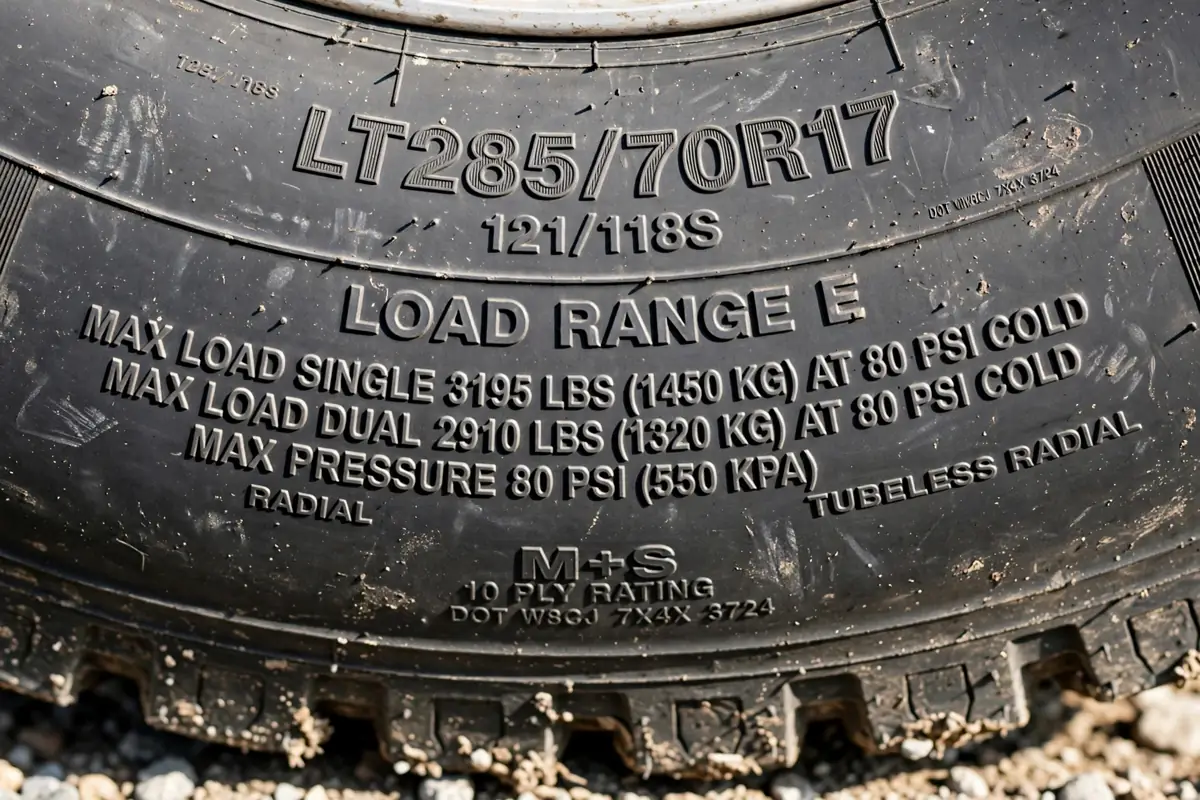
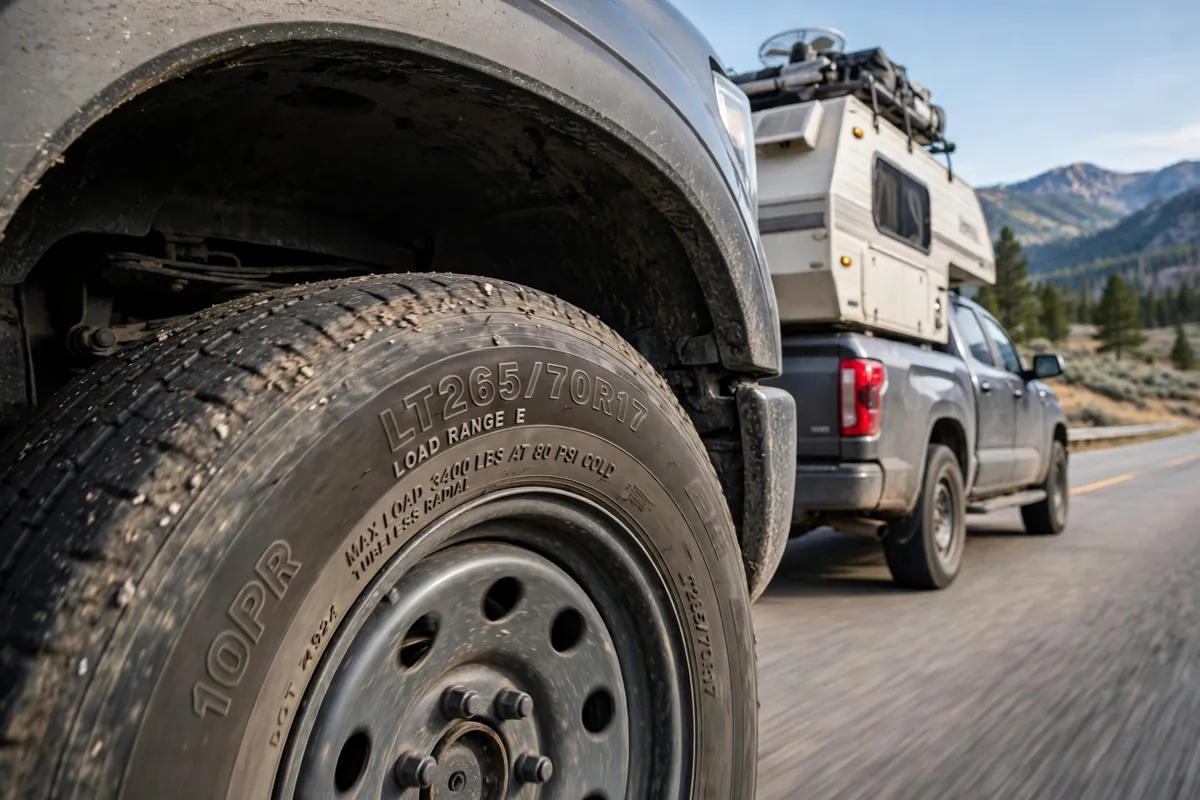
Read one tire properly before you buy anything: size, the letters before it, the load index and speed symbol after it, and the load range letter.
LT means light truck. P means passenger. A P-metric tire fitted to a light truck has its load capacity reduced — tire-maker guidance based on federal standards applies a factor of 1.10, so a P tire rated for a certain load on a car is allowed less on a truck. That derating alone can eat your margin. For a loaded camper, I want LT tires unless a scale-and-table check proves otherwise.
Load range is the letter: C, D, E, F, and beyond on heavier rigs. In the same size, a higher letter generally allows higher pressure and therefore higher capacity, but the letter alone is not a weight number. Load index is the number, and it is more precise. Owners on Expedition Portal found that a bigger tire in a lower load range can sometimes carry more per tire than a smaller tire in a higher load range. Focus on load index and actual pounds per tire, not just the letter.
The sidewall maximum cold pressure is the pressure needed to carry the tire’s maximum load, not a recommendation for your truck at your weight. Your door-jamb placard gives the pressure for the original size at the truck’s rated loads. If you change size or type, the tire maker’s load and inflation table for your exact size becomes the authority. Never inflate below the placard pressure for the original size unless a qualified tire professional has worked through the replacement-size table with you.
Weigh the rig, then use the inflation table
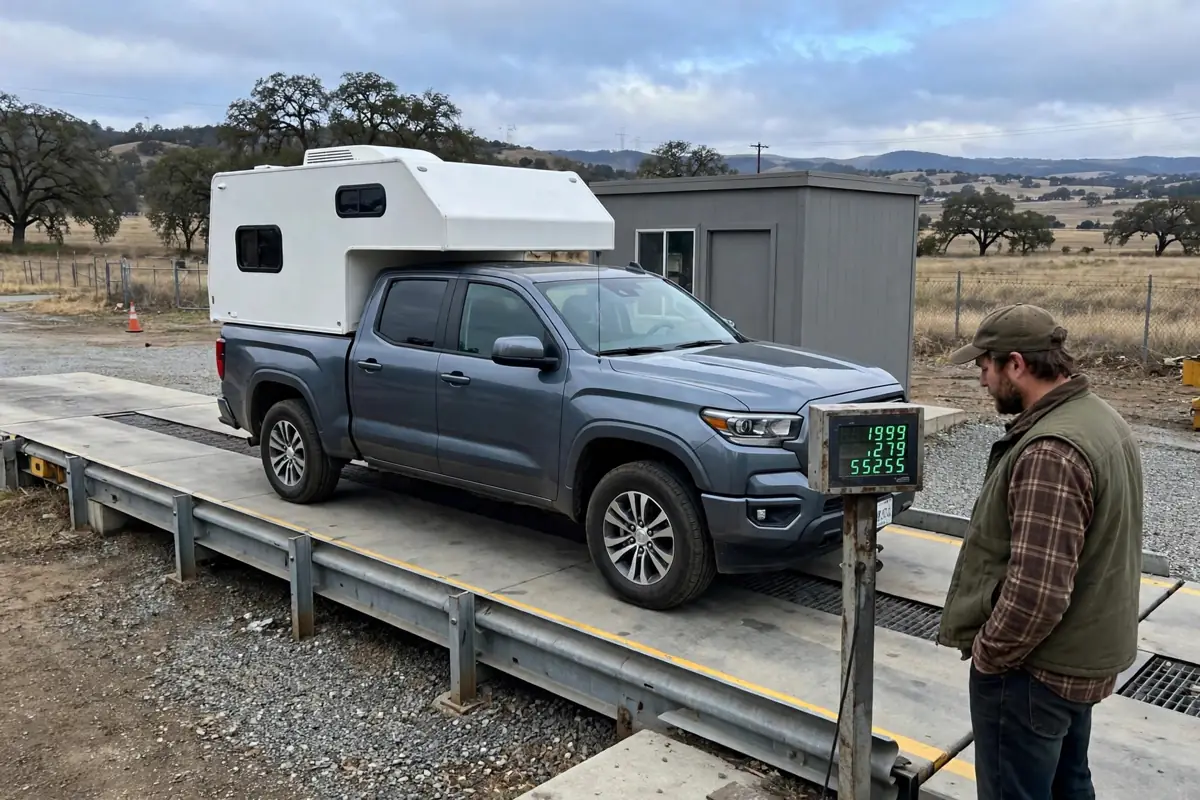
Drive to a truck scale with the camper loaded as you actually travel: full water if you travel with water, full fuel, food, people, dogs, and gear. Get front and rear axle weights separately. If you can get individual corners, even better, because campers are rarely balanced side to side.
Divide front axle weight by two per front tire, and rear axle weight by two on a single-rear-wheel truck. On a dually, divide by four and use the dual-load column, lower per tire because duals share load unevenly.
Open the load and inflation table for your exact size from your tire maker. Find your per-tire weight, then read across to the lowest cold pressure carrying at least that weight, with margin. That is your loaded pressure. Write it down — door jamb, phone, glovebox — because the next tire shop will reset you to the placard.
Here is a real example from a published table. For an LT265/70R17 tire, the Toyo load and inflation tables list 3,195 pounds single at 80 psi at the top of its E range, 2,910 pounds at 65 psi, and 2,255 pounds at 45 psi. That does not mean your truck needs 80 psi, or that 80 psi fits a different size. It means pressure and capacity move together, and the only honest pressure for your rig is the one covering your scaled weight for your exact size.
Wheels have ratings too. Owners on iRV2 repeatedly point out that a wheel rated for a certain pressure caps what you can do, no matter what the tire says. Check the stamping inside the wheel before chasing a higher number. For the whole loaded setup, not just tires, see our truck camper payload calculator guide before trusting any brochure weight. Brochure weights are almost always light, and tires are where that optimism shows up first.
Loaded pressure vs unloaded pressure: two numbers, not one
With the camper on, you need loaded pressure. With it off, the same pressure rides harsh, wears the tread center, and feels skittish on wet roads. Owners on iRV2 describe exactly this: a dually owner running high pressure loaded, then airing down when unhooked after a dealer warned him he was wearing the center out of his tires.
So keep two pressures. Loaded pressure comes from the scale and table. Unloaded pressure comes from the door placard for the original size, or a second scale run with the camper off. Do not guess it by halving the loaded number.
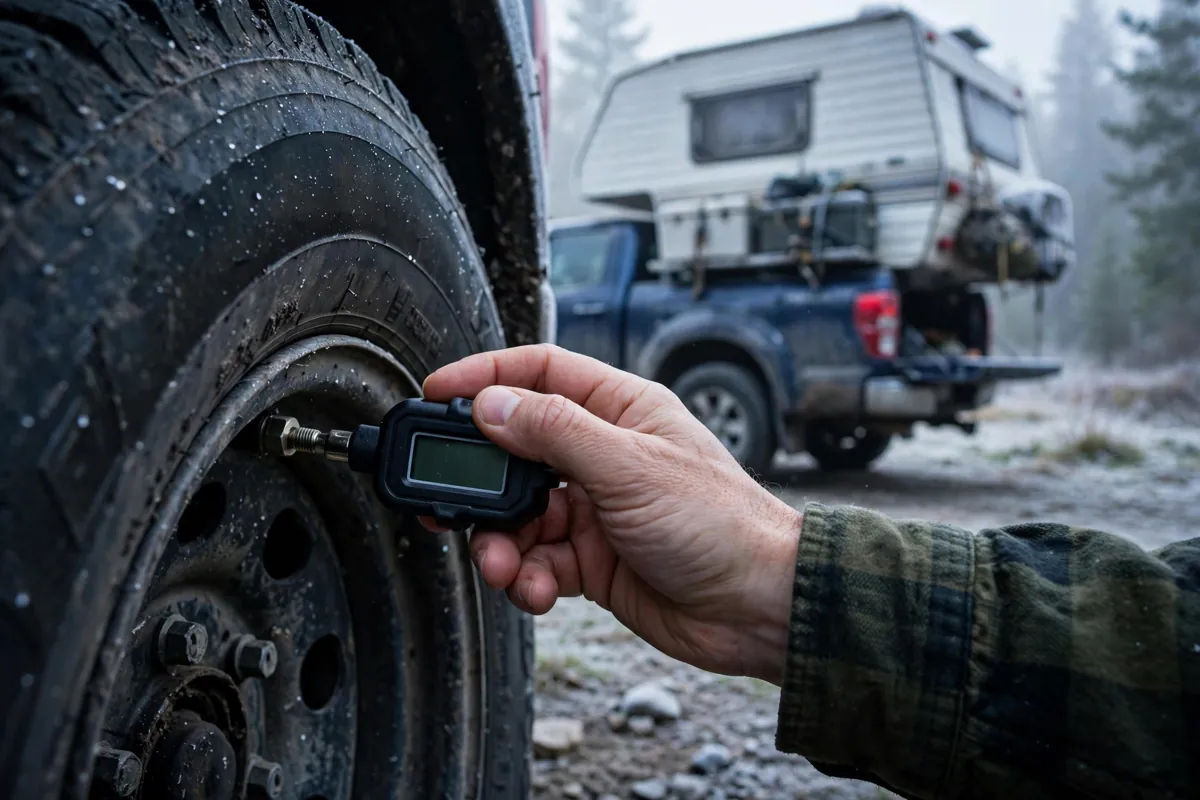
Change pressure cold, before driving, and never bleed a hot tire to hit your cold number. I check pressure the morning of every travel day, not the night before. The tire that failed on me had been slowly losing air for weeks, and I had not looked.
Owners on Wander The West use the chalk test as a sanity check, not a replacement for the table: loaded as you travel, chalk across the tread, drive straight, and check wear. Center only suggests too much pressure; edges only, too little.
TPMS: the warning you actually need
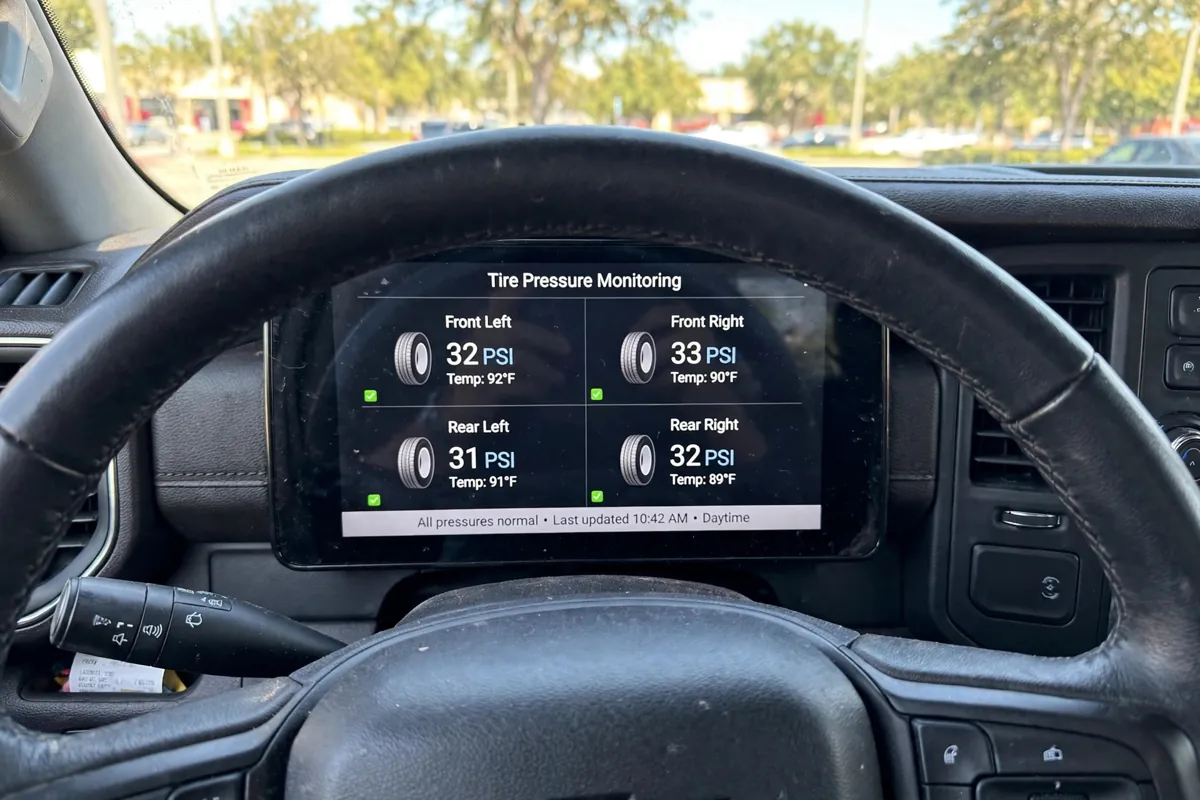
A factory TPMS usually warns only when pressure drops a long way — commonly around a quarter below recommended — and by then a heavily loaded tire has already been running hot. It also rarely watches a spare. An aftermarket TPMS showing actual pressure and temperature per tire, with alarms you set yourself, is the best tire-safety money I have spent.
Owners on iRV2 keep coming back to two points. Temperature matters as much as pressure: a tire heating up while pressure looks normal can mean a dragging brake or failing bearing. And a slow leak will not trip a factory warning for a long time, but a low-pressure alarm near your loaded pressure will catch it on the first morning.
Get sensors for every tire on the ground, plus the spare if supported. Check the pressure range covers your loaded pressure, and whether a long truck needs a repeater. Use metal valve stems if the maker recommends them. Set the low alarm just below your loaded pressure, test it, and cross-check against a handheld gauge monthly.
A TPMS does not replace a gauge or a walk-around. NHTSA’s tire-safety guidance still says to check pressure monthly when cold, including the spare. Our truck camper maintenance schedule puts those checks in context with seals, jacks, and tie-downs. Never ignore an alarm because a tire “looks fine.”
Blowout prevention: age, damage, and a ten-minute inspection
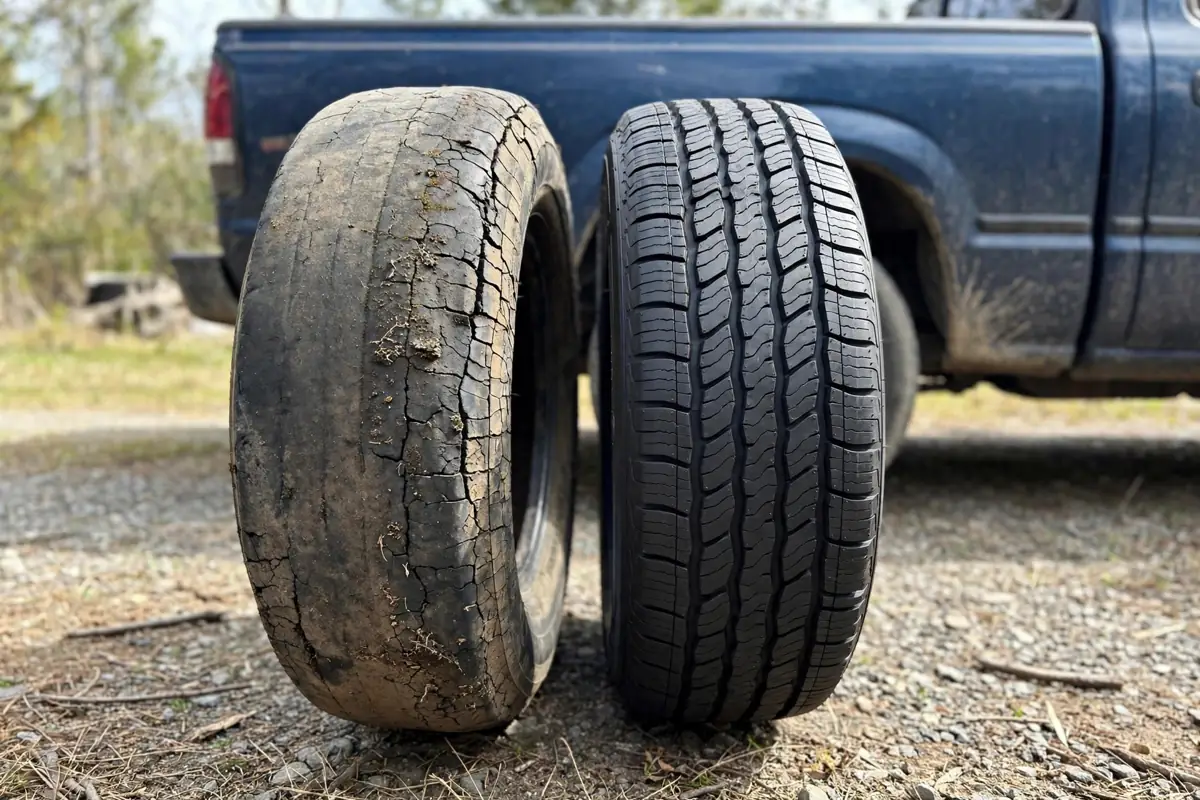
Most blowouts are the end of a chain: overload, underinflation, age, damage, or heat. Break two or three links and failure gets much less likely.
Start with age. The DOT code’s last four digits are the week and year of manufacture — 2324 means the 23rd week of 2024. Some makers mold the full code only on one sidewall, so check the inside face if needed. A tire that sits, bakes in sun, and rarely rolls can age out before it wears out. My rule is to plan replacement around six years from manufacture, sooner if cracking shows.
Do a ten-minute walk-around before every travel day: cuts, bulges, objects in the tread, sidewall cracking, uneven wear, valve stems, and the spare. When tread wears level with the raised wear bars between grooves, the tire is done.
Uneven wear is a diagnostic: center wear, too much pressure; edge wear, too little; one-sided wear, alignment or unbalanced load. Fix the cause, not just the tire. If the truck sways more, check the whole setup — our comparison of airbags vs Timbren vs SumoSprings helps, because owners often chase a tire symptom that is really a suspension problem.
On long hot days, plan stops so tires cool, and after a hard pothole hit, pull over when safe and check pressure.
The spare-tire reality nobody wants to hear
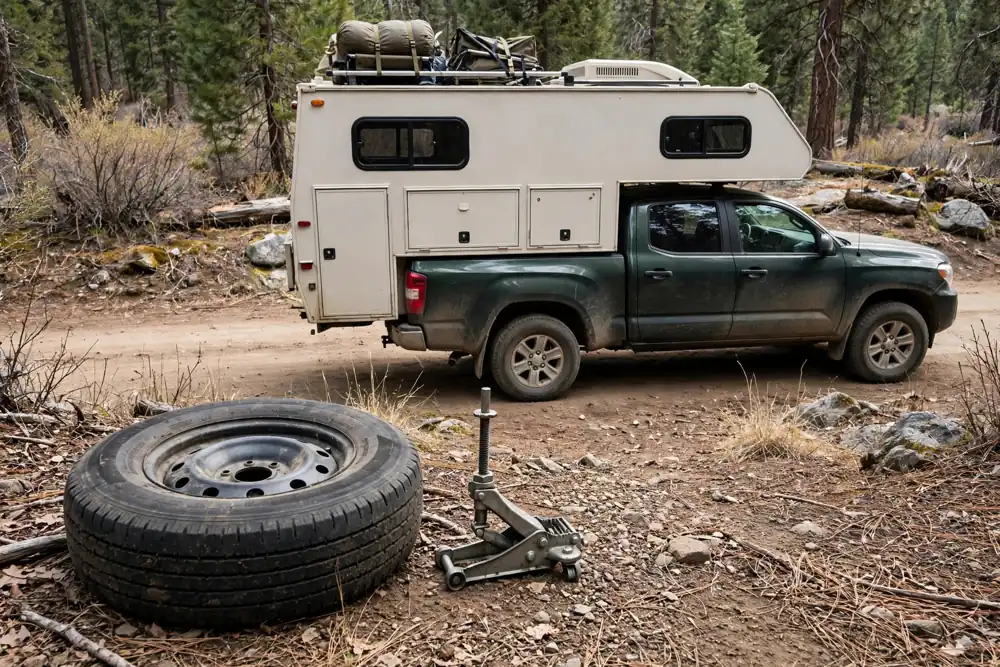
Many modern trucks do not carry a full-size, matching spare, or they carry one that does not match your upgraded tires. A compact temporary spare is not a camper tire. It is a short, slow trip to a shop, and with a loaded camper it may not be rated for that load at all. Check your manual’s limits before you need it, not on the shoulder.
A spare ages with the rest of the rig. Replacing four tires while leaving a much older spare leaves you with a spare you should not trust. Budget for it with the set, check its pressure and DOT code on the same schedule, and if you upgraded size, check that it fits its carrier and the jack can lift the loaded truck.
My preference is a matching full-size spare on a matching wheel, reachable without unloading the camper. Carrying an unmounted tire and calling road service to mount it is a reasonable remote-travel compromise, if you know it fits and your plan covers where you travel. What does not work is no spare and a hope that the next town stocks your size.
Practice once at home, in daylight, with the camper on: jack the truck, swap a wheel, and put it back. Check the tie-downs while you are down there — our tie-down and turnbuckle comparison explains what to look for. If the shoulder is soft or sloping, call road service. If a tire has been run flat, do not just reinflate it; it needs inspection off the wheel.
Airing down, and airing back up
Off-road, lower pressure helps: a bigger contact patch floats better on sand and snow and grips better on rough rock. Owners on Wander The West who run heavy camper trucks air down for trails, then air back up before road driving, usually with a portable compressor carried for that job.
Two warnings. Do not air down a heavily loaded camper as far as an empty truck: going too low risks debeading a tire or damaging a sidewall. Never drive highway distance on off-road pressure — air back up to loaded pressure before pavement, checked with a gauge. A plug kit is a temporary fix to reach a shop, and a sidewall puncture is not pluggable at all.
Tires do not increase payload or axle capacity. If the scale says you are over, the fix is less weight, a bigger truck, or a lighter camper. Our Ram 2500 diesel payload trap guide shows how easily a heavy diesel eats the payload a camper needs.
What to buy when it is time
Buy for scaled weight and real use, not for a look. Start with LT construction in a size that fits without rubbing at full load and steering lock, with a load index giving margin above your heaviest per-tire scaled weight. Margin matters because loads shift and one side is almost always heavier.
Match the tire to your roads. A highway tire is quieter and longer-lived on pavement. An all-terrain tire makes sense if gravel, forest roads, and winter driving are a real part of your year. Buy all four — plus the spare plan — together if you can, so wear and handling stay matched.
Ask the shop three questions: what table pressure covers my scaled weight, what is my wheel rating, and will you set my loaded numbers and note them? Owners on Wander The West report some shops will only inflate to the door placard, so find a truck tire shop that will work to your table pressure. Get the new DOT codes on the invoice.
I will not quote prices here, because they move by size, region, and season. Get quotes for the same size and load index from two or three truck tire shops and compare the total, including mounting and balancing. Owners on iRV2 who switched from bargain tires to a well-rated set and stopped having yearly failures make the value point well.
Take this routine: weigh loaded once and write down your pressures; check cold every travel morning; walk around and look; test TPMS alarms on schedule; inspect for age and cracking twice a year; check the spare too; and carry a compressor, gauge, plug kit, a jack that works with the camper on, and a road-service number.
Safety note: this guide is general information, not a substitute for your truck maker’s manual, your tire maker’s load and inflation table, or a qualified tire professional. Check advice against your door placard, wheel ratings, and the table for your exact size. If they disagree, follow the most conservative guidance. If a tire shows damage or has been run flat, have it inspected off the wheel before driving on it again.
Frequently asked questions about truck camper tires
What load rating do I need for truck camper tires?
A rating covering your scaled per-tire weight with margin, not a letter recommended online. Weigh loaded, divide axle weights by tires per axle, then use your tire maker’s table for your exact size. LT construction is the usual starting point, and load index matters more than the letter alone.
What pressure should I run with a camper loaded?
The pressure from your scaled weight and your tire maker’s table for your exact size, checked cold. The empty-truck placard fits an unloaded truck, not a loaded camper. Keep two numbers — loaded and unloaded — and switch when you load or unload.
Do I really need a TPMS if I check pressure every morning?
A morning check catches problems before you leave, not a leak an hour into a highway drive. A TPMS showing pressure and temperature per tire, with alarms near your loaded pressure, catches those while you can still pull over safely.
Can I use my factory spare with a loaded camper?
Only if it matches your current size and load capacity, is in good condition, and has correct pressure and a recent DOT date. A compact temporary spare is a short, slow trip to a shop, not a camper tire. Check the manual limits and practice a wheel change with the camper on before you need one on a shoulder.
How often should I replace truck camper tires?
On tread, damage, and age — whichever comes first. Replace at the wear indicators, inspect for cuts, bulges, and cracking, and plan age-based replacement before a tire looks worn out if it carries a camper and sits for long periods. Check the DOT date on every tire, including the spare.
Is it safe to air down a loaded truck camper off-road?
Yes, modestly and temporarily, if you air back up before highway driving. Lower pressure improves float and grip, but a heavily loaded camper still needs sidewall support, so do not drop to lightweight-rig pressures. Carry a compressor that reaches your loaded pressure and recheck with a gauge.