Truck Camper Entry Steps: How to Choose Steps That Don’t Wobble
I learned to take truck camper entry steps seriously the night I came back to camp in the rain, hands full of groceries, and found my bottom step had sunk two inches into soft ground. The step above it was suddenly a lot higher than my knee expected. I caught the door frame. The groceries did not.
A truck camper door sits high, higher still once you level the truck or park on a slope. You climb those steps every time you go in or out, in the dark, in the rain, with a dog on a leash or a kid on your hip. A step that wobbles or sinks is the most-used piece of gear on the camper, and the one most likely to put you on the ground.
What makes truck camper steps different
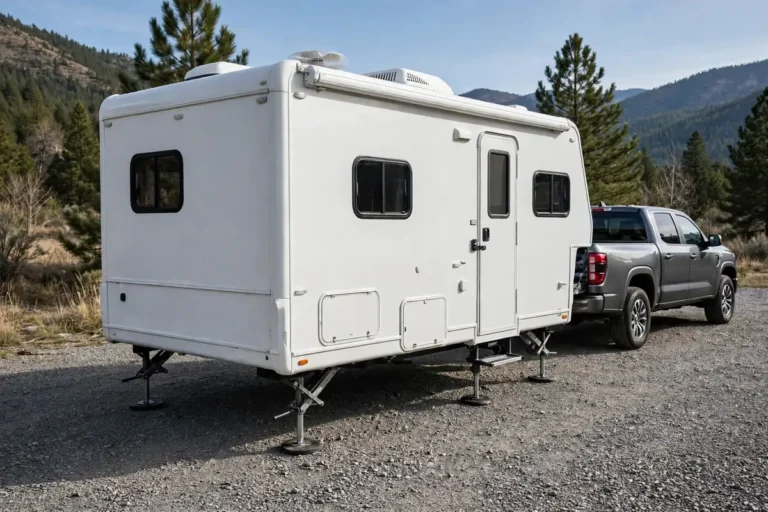
A truck camper is not a trailer. The floor is up on a pickup bed, the door is usually at the rear, and the ground under that door changes every time you move. Your steps have to cope with all of that, then fold away small enough to travel without dragging or blocking your tailgate.
Factory steps are built to a price, not to your knees. Most are a simple folding or scissor design hung from the doorway, with no contact with the ground. Step on them and they flex. Lippert, which makes many factory steps, calls that bounce the “diving board effect” in its replacement guide, and lists it as owners’ most common complaint.
That floating design is also why the first step is often the worst. The gap from the ground to the bottom tread can be a foot or more. A comfortable stair rise at home is about 7 to 7.5 inches. A truck camper owner in Truck Camper Magazine measured his factory setup at about a 14-inch rise and built wooden stairs to get back to a 7-inch rise. His wife, at 5 foot 3, had needed a hand getting in and out before that.
Measure before you buy anything
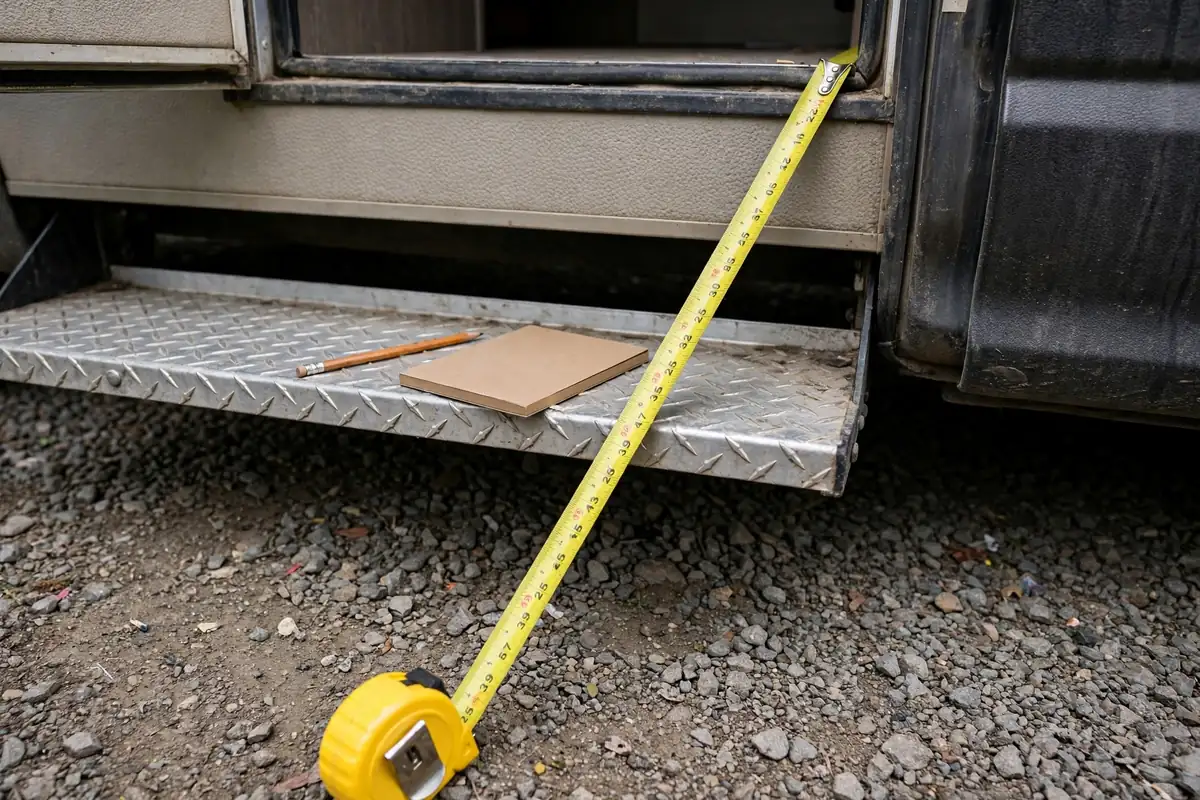
Do this on level ground, at tow height, before you order. Measure the height from the ground to the bottom of your door threshold — that decides how many steps you need. Then measure the width inside your door frame, edge to edge, and round up to the nearest even number.
Then measure the awkward stuff: room behind the camper when the steps are deployed, whether the door still opens fully, whether the folded steps clear your tailgate, and where a loose set will live inside the camper. A set one step too short leaves a big last gap. A set one step too long will not let the door close on a high curb or a sloping site.
The main types of truck camper entry steps
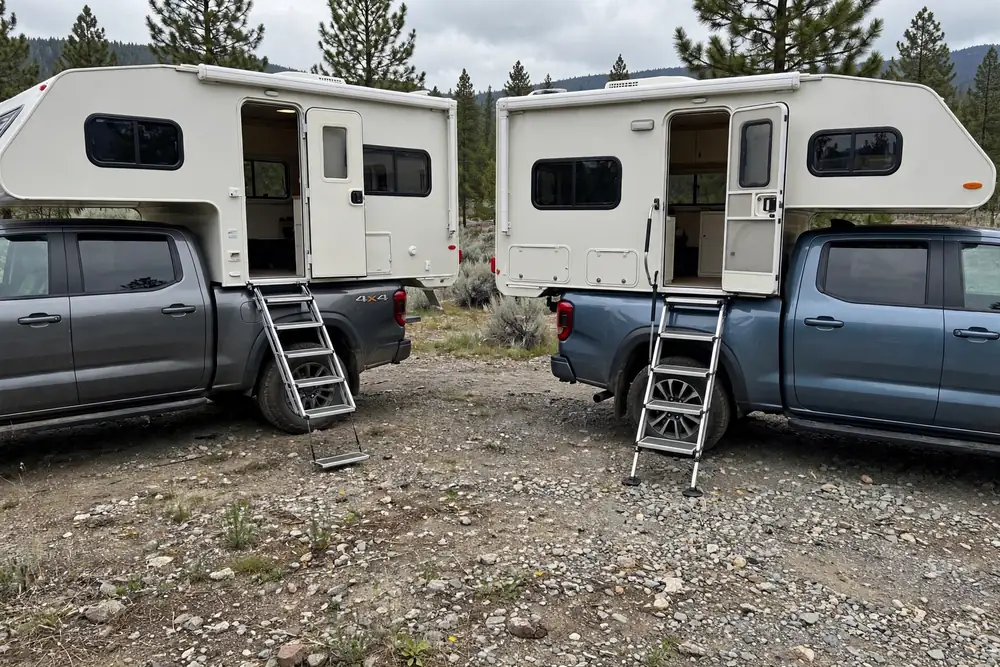
Factory scissor steps
The folding, accordion-style steps most campers arrive with. They hang from the doorway, fold up underneath it, and are fine on flat concrete. Their weakness is stability: they do not touch the ground, so your weight goes into the doorway mount and the assembly flexes. Owners on RV forums report the same wear — pivots loosen, bracket screws back out, and the steps get wobbly. One owner on the Good Sam forum says her husband slipped coming down scissor steps in their driveway and twisted his ankle, and she has wobbled down them herself many times. Check the pivots and bolts every season.
Ground-supported scissor steps: GlowStep and Stow N’ Go
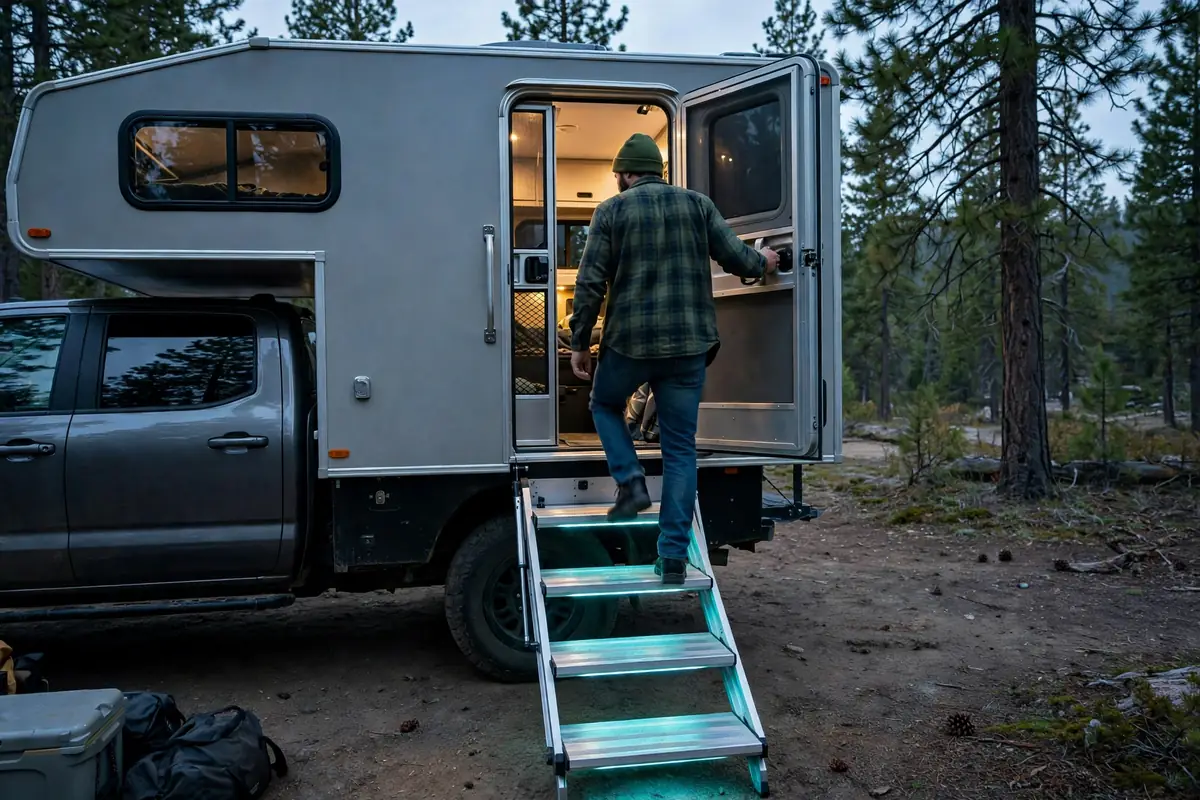
The upgrade most long-term owners end up with. The Torklift GlowStep is still a scissor step, but its feet reach the ground, removing the diving-board flex. The truck-camper version, the Stow N’ Go, bolts below the door or to the bumper; pull a handle, unfold the steps, and they snap back into the outside bracket when you leave, so mud stays outside. Torklift describes how the Stow N’ Go solves the common truck camper step problems on its blog. Specs: 7.5-inch rise, 15 inches of vertical adjustment, glow-in-the-dark treads for up to 10 hours, and 375 lbs capacity for 3- and 4-step versions with the handrail. See Torklift’s GlowStep Revolution Uprising page for the fit chart. Not cheap, but solid under a heavy person with gear.
Fold-in solid steps: Lippert Solid Step and MORryde StepAbove
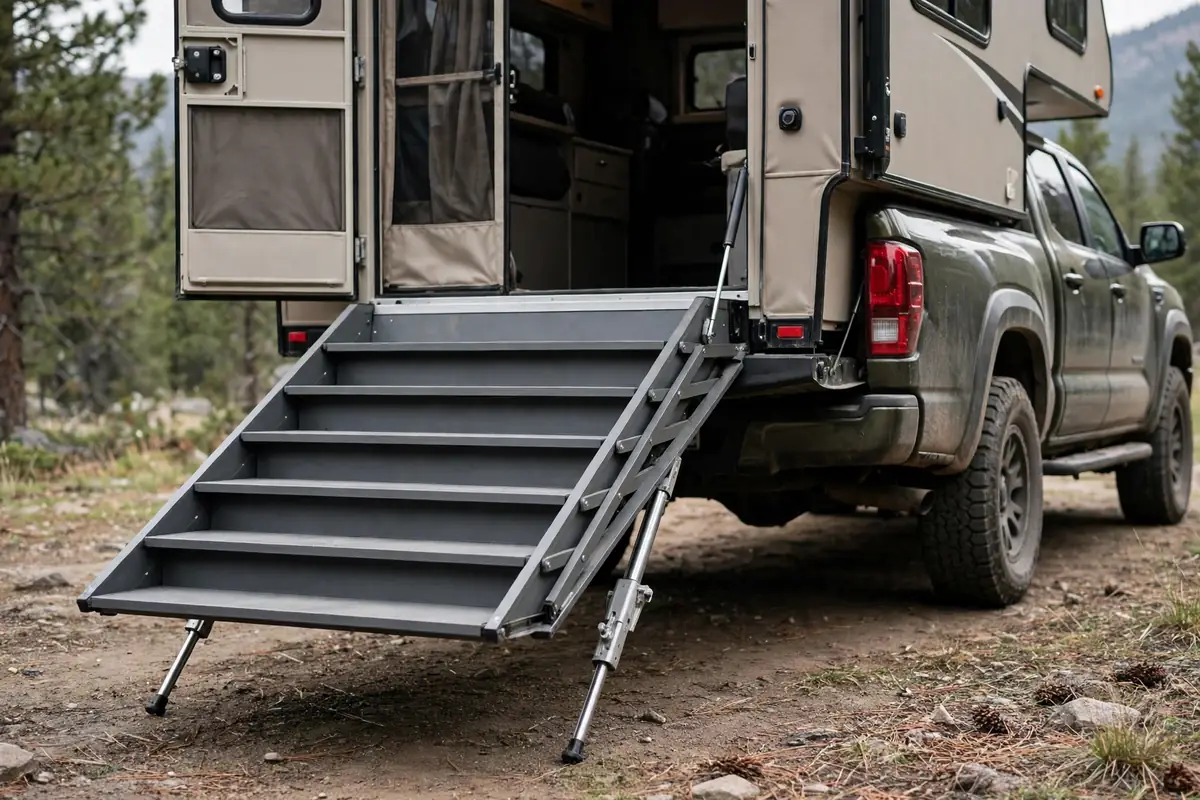
Big, rigid steps that fold up into the doorway like a drawbridge, with legs reaching the ground. Lippert’s Solid Step has a 13-inch-deep top step and is rated at 400 lbs, or 500 lbs for the Solid Step 4.0. MORryde’s StepAbove is rated at 500 lbs. Owners love the stability and hate two things: they swing out several feet, so you may not be able to deploy them in a tight rest stop or storage yard, and they store inside the doorway, so mud and water drip inside in wet weather. One iRV2 owner removed his MORryde steps and went back to fold-out steps plus a Lippert stabiliser for under $50.
Portable folding steps and platform stools
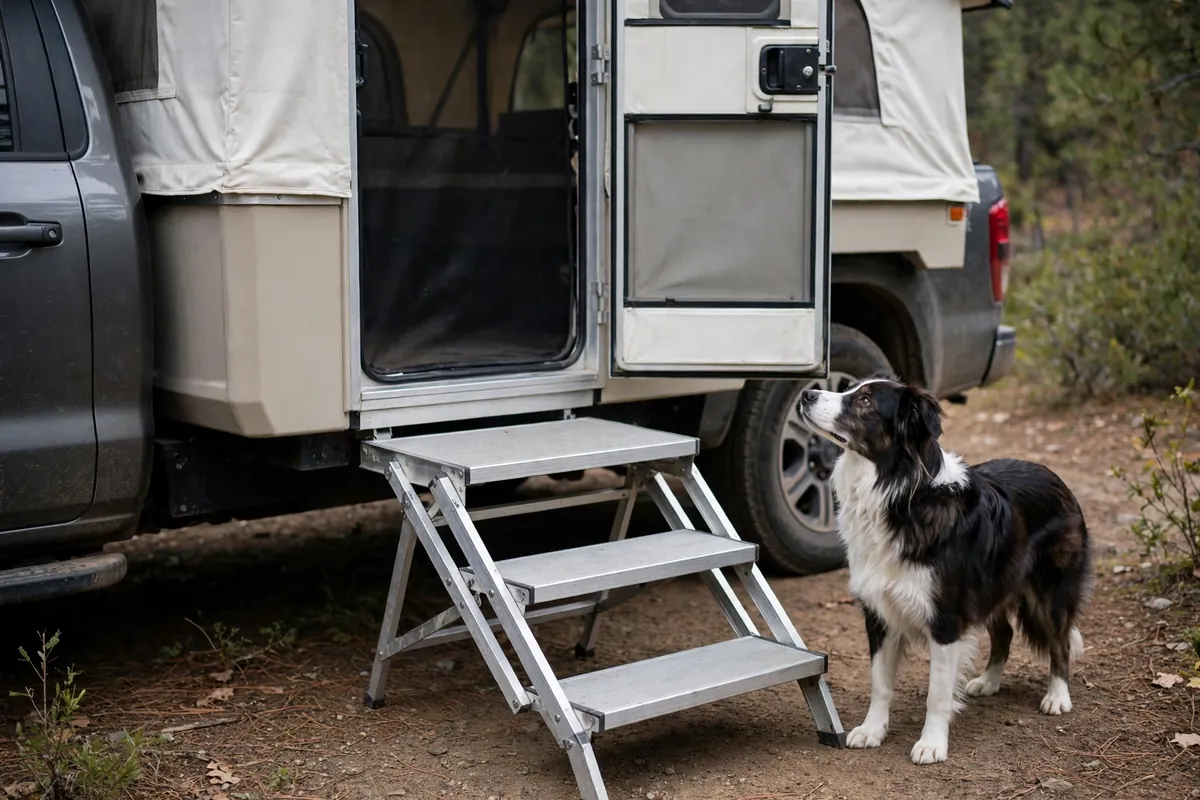
A freestanding folding platform you set in front of the door and carry inside when you travel. The Camco aluminium platform adjusts from 7.5 to 9 inches high; a single stool like the Ollieroo weighs about four pounds and is rated to about 330 lbs. Lippert puts fitted replacement steps at $300 to $800; a portable platform is a fraction of that. They suit a low camper, and double as a step for roof latches and window covers. But a plastic stool is fine on level ground and, in one owner’s words, “in danger of collapsing or tipping if it’s sloped or uneven.” Buy a wide one with splayed legs.
Hitch-mounted steps
A step that bolts into your 2-inch receiver, giving one or two wide treads behind the truck. The Easy Hitch Step, the name that comes up most, is steel, folding, and height-adjustable. Owners on Wander The West praise its grip in the rain and one advantage: the distance from the camper floor to the top step stays the same at every campsite, because the step is attached to the truck. Catches: it can rock at the receiver arm, weighs about 30 lbs, and can block your licence plate and trigger reversing sensors. Best for a low pop-up camper.
DIY wooden steps
Some of the best steps I have seen were built in a driveway. The Truck Camper Magazine owner above built a set from 3/4-inch pine, 24 inches wide, for about $50 in materials and eight hours of work, with plywood shims for uneven ground. Wooden steps are heavy and need weatherproofing, but they are wide, do not flex, and are easy to repair. Good for long stays; less good if you move every day.
Truck camper entry steps on uneven ground
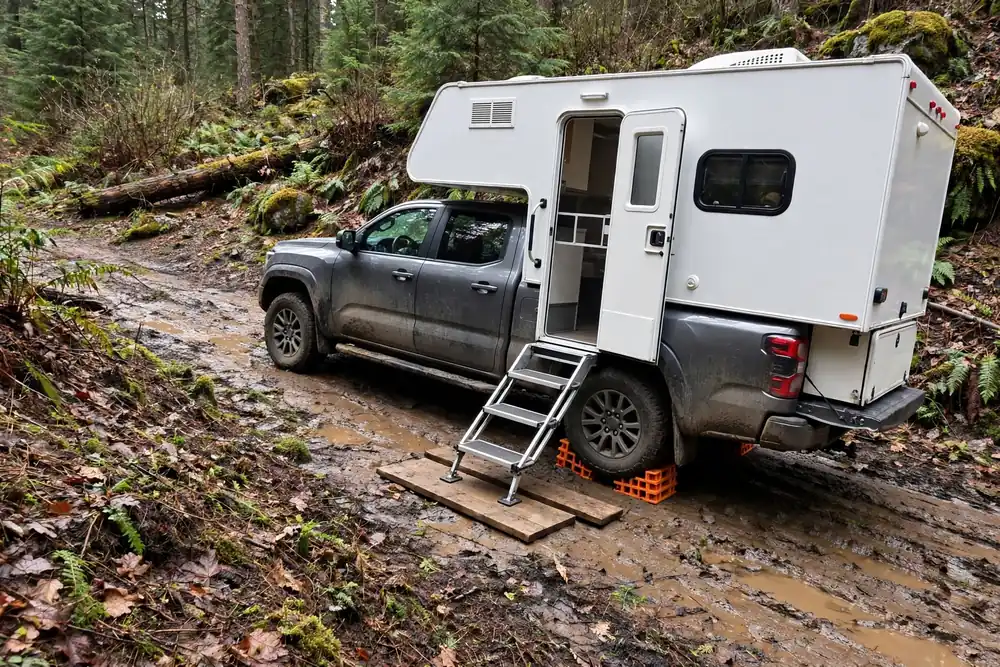
This is where most steps fail. A step that is rock-solid on concrete can be dangerous on a slope, and the failure is usually slow: a foot sinks into soft ground overnight, the step tilts a degree or two, and the next morning your footing is not where your muscle memory thinks it is.
Level the camper before you judge the steps. If you park with the door on the downhill side, the step gets taller and the ground under it gets softer, because that is where the rain runs. Level the camper properly first — side-to-side first, then front-to-back — and try to put the door on the uphill side. A step problem is often a parking problem in disguise.
Choose a design that touches the ground and adjusts. Independently adjustable feet let you level each side separately, so the treads stay level even when the ground is not. Carry boards or foot pads for soft ground; a foot that spreads the load sinks less. If your steps float, a drop-down stabiliser under the bottom step is a better fix than a stool — one owner on iRV2 says the Lippert stabiliser cost him less than $50.
Step height, and who is actually climbing
Seven to eight inches per step is the number to aim for. That is the GlowStep’s 7.5-inch rise, the Solid Step’s 8-inch rise, and roughly the rise of the stairs in your house. Past 10 inches, most people start hauling themselves up by the door frame. Past 12 inches, older knees, small kids, and dogs start needing help. At 14 inches, a lot of people cannot do it gracefully with their hands full.
Count the total, not just the rise between treads. The two gaps that hurt are the ground to the first tread and the top tread into the camper. A good design keeps both small: a top tread nearly level with the threshold, and a bottom tread close enough to the ground that you step onto it rather than climbing onto it. That is why a booster step matters — the GlowStep’s built-in booster, or MORryde’s Add-A-Step.
Think about who climbs. Kids need a reachable handrail and treads deep enough for a small foot to land flat. Dogs need a solid surface, not open gaps they can see through; owners report that dogs that refuse open-riser steps will use the same steps once SafeStep panels or a plywood riser closes the gaps.
Ground clearance, storage, and travelling with steps
A set that hangs low will drag on a steep driveway or a forest road crest. A set that sticks out behind the camper will catch a rock on a tight turn. And a loose set that is not properly latched can deploy on the road — owners on the Airstream forums report steps sagging and even dropping while driving when the latch or spring wears out.
Before every drive, check what you check for the jacks: steps stowed, latched, and not moving when you tug them. If they are loose inside the camper, strap them down. Storage is the quiet deal-breaker: a four-step GlowStep set is long when folded, and a Solid Step set is heavy — around 50 lbs for a triple-step version — and you lift that weight every time you deploy and stow it. Measure your storage before you buy, and be honest about who will be lifting the steps at the end of a long driving day.
If you use your camper off the truck, remember the steps are not designed to hold the camper’s weight, and the camper is far less stable off the truck.
Safety at night, in the rain, and with wet boots
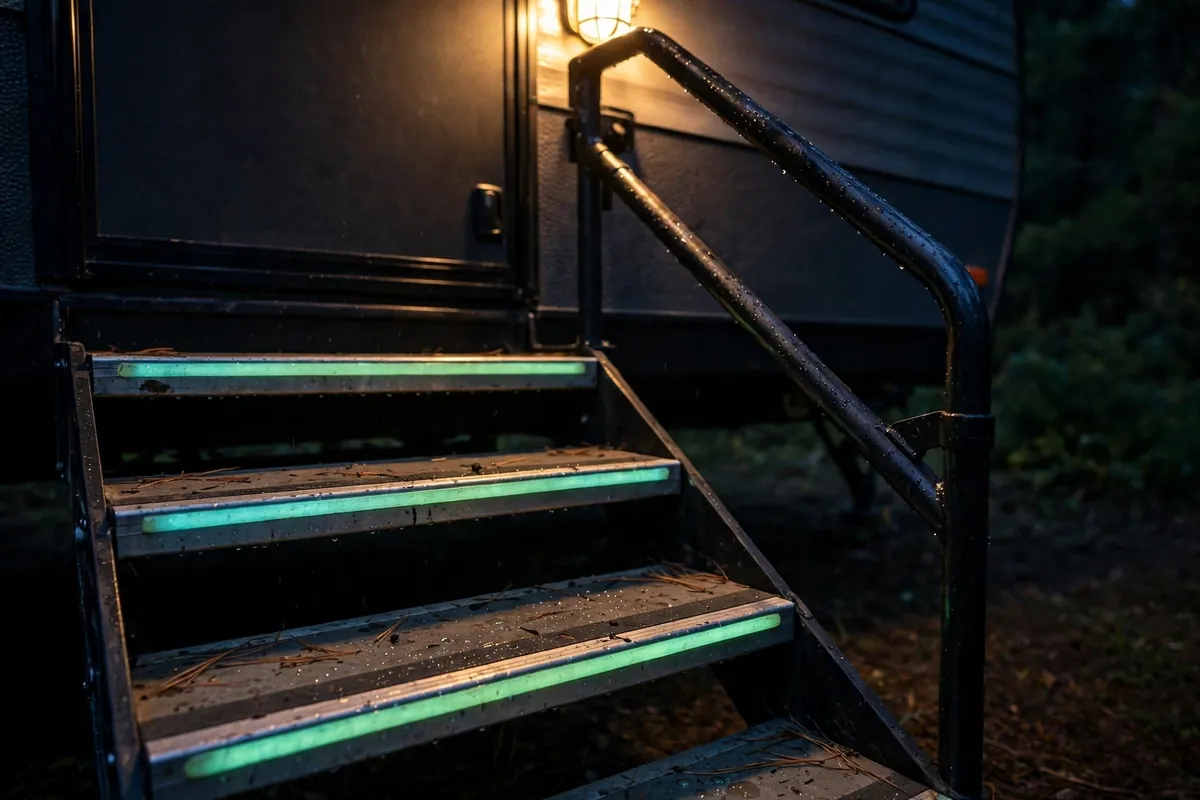
Most step injuries do not happen at noon on dry concrete. They happen at 2 a.m. on a wet step. Three things make the biggest difference, and none is expensive. First, visibility: glow-in-the-dark tread strips — standard on GlowSteps, available as stick-on tape for almost anything else — charge in daylight and glow for hours, marking the edge of each tread. A small motion-sensor light by the door helps too.
Second, grip. Smooth aluminium and wet boots are a bad combination. Look for built-in tread, or add grip tape or screw-down plastic tread grips. Clean the treads: mud, sand, and pine needles turn a grippy step into a slide, and they grind the pivots at the same time.
Third, a handrail. A rail that runs from the door to the first step changes the experience for anyone with a bad knee, a baby in their arms, or a dog pulling on a leash. Owners on Wander The West call the grab handle next to the door “almost as important as the step.”
What actually holds up over time
Steps live outside, in rain, dust, road salt, and mud. Aluminium and stainless steel win on longevity: they do not rust and are light enough to lift every day. Painted steel is cheaper and heavier, and it rusts from the inside out at the pivots and welds — which is why Lippert lists rust as a main reason owners replace standard steps.
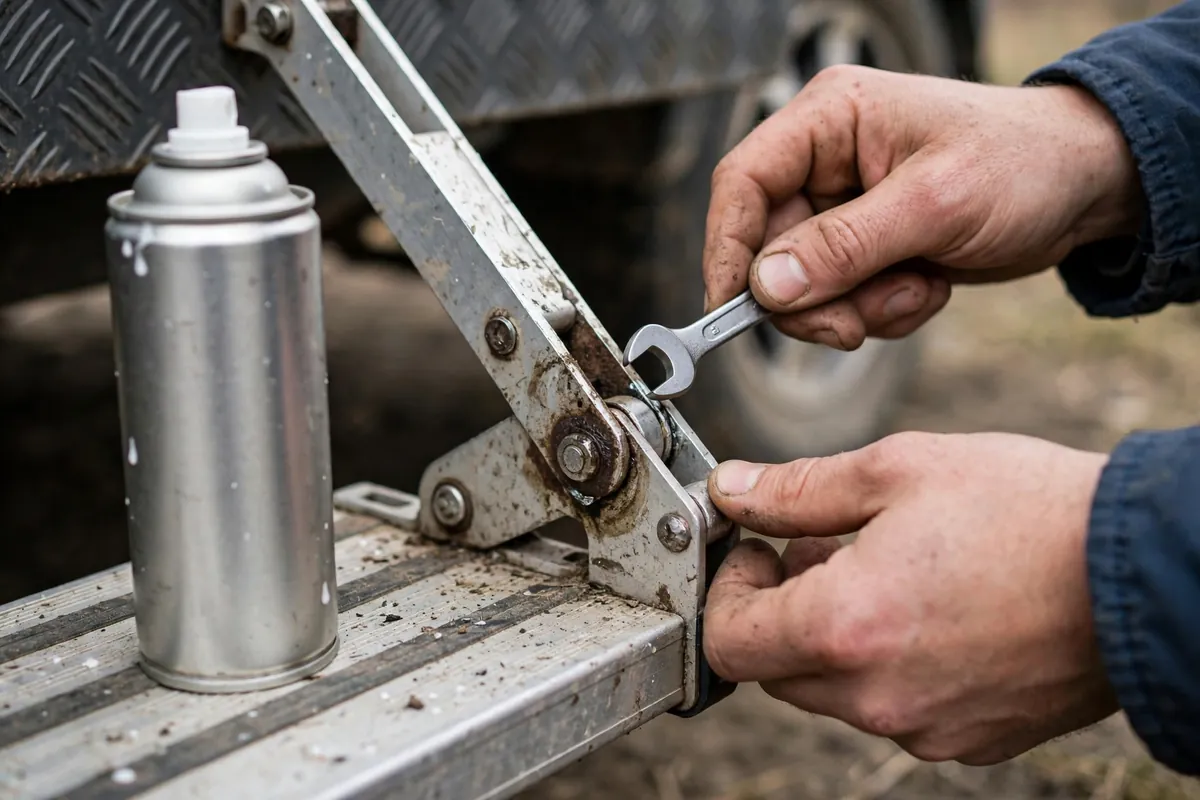
Pivots are the wear point on any folding step. Keep them clean and lightly lubricated — silicone spray or a drop of light oil on each pivot, a few times a season, more often after dusty or salty trips. Owners report that a step that binds or will not fold flat is usually a lubrication problem before it is a broken part, and that bracket screws loosen with use.
Weight ratings drop as the step gets longer. Choose a rating with headroom — at least 300 to 400 lbs, as Lippert recommends. Check the mount too: owners on iRV2 report the plate the steps bolt to can flex or tear on older rigs, and the fix is a reinforcing plate behind it.
How to choose: a simple decision
For most truck camper owners, a ground-supported scissor step — a GlowStep or Stow N’ Go, or a well-built equivalent — is the best balance of stability, adjustability, storage, and weight. It touches the ground, adjusts to uneven sites, stores outside the camper, and does not need a huge swing radius.
Choose a fold-in solid step if you camp mostly in roomy sites and want the most stair-like feel. Do not choose it if you overnight in tight parking lots. Choose a portable platform if your camper is low, you want the cheapest fix, or you need a multi-purpose step for roof latches. Choose a hitch step if you have a low pop-up camper and want a step that is always in the same place.
Whatever you choose, add a handrail if anyone needs one, add glow strips for dark returns, and keep boards in the truck for soft ground. Before you order, measure your threshold height and door width, check the weight rating and folded size, and check deployment room against the tightest place you actually park.
For kids, see our guide to truck camping with kids; for tall owners, our notes on truck campers for tall people; for off-truck use, our guide to using a truck camper off the truck and solo loading and unloading; and for upkeep, our truck camper maintenance schedule. A good set of truck camper entry steps disappears into your routine. The wrong set reminds you of itself every single time — with a wobble, a slip, or a step that is suddenly a foot higher than it was yesterday. Buy the boring, solid one. Your knees will thank you for years.
Frequently asked questions
How many steps do I need for my truck camper?
Measure from the ground to the bottom of your door threshold, on level ground at tow height. As a guide, Torklift’s charts put a 3-step set at roughly 20 to 27 inches, a 4-step at 27 to 35 inches, a 5-step at 35 to 42 inches, and a 6-step at 42 to 50 inches. Measure first, then check the maker’s fit chart.
What is the best truck camper entry step for uneven ground?
A ground-supported step with independently adjustable feet — the GlowStep’s All Terrain Landing Gear, the Solid Step’s adjustable legs, or the StepAbove’s adjustable feet. Carry boards or foot pads for soft ground, and park with the door on the flattest, uphill side. Floating steps are the worst choice here.
Are GlowStep steps worth the money?
For owners who camp regularly, yes, if you buy the right size. They fix the two most common factory-step complaints — the diving-board bounce and the too-high first step — with a 7.5-inch rise, ground contact, and 15 inches of adjustment. Lippert puts typical replacement steps at $300 to $800, so a premium set sits at the top of that range.
Can I use solid fold-in steps like the Lippert Solid Step or MORryde StepAbove on a truck camper?
Yes, if the fit works and you have room to deploy them. They need several feet of clear swing space and store inside the doorway, so sweep off mud and water before stowing them. They are a poor choice for tight overnight stops. Check the maker’s qualification guide first.
How do I stop my truck camper steps from sinking in mud?
Spread the load: put a board, plywood square, foot pad, or rubber mat under each foot. Park on the firmest, highest ground you can find, avoid the downhill side where water collects, and re-check the feet after rain — a step that was solid at setup can sink overnight.