Driving With a Truck Camper – Wind, Grades, Braking, and Backing In
The first time I drove a loaded truck camper any real distance, I thought I knew what I was doing. I had driven trucks for years. Then a gust caught the camper on an open highway, the whole rig stepped sideways in its lane, and my hands went white on the wheel. Nothing broke, but I pulled off at the next exit and admitted what I should have known before I left: driving with a truck camper is its own skill. The weight sits high, the walls catch wind like a sail, and everything takes longer and needs more room.
This guide is about the driving itself, not payload math, suspension upgrades, or towing behind the camper. It is what you feel in the seat: the lean in a curve, the push from a passing semi, hot brakes on a grade, and backing into a site.
Before You Roll: The Walkaround That Saves the Drive
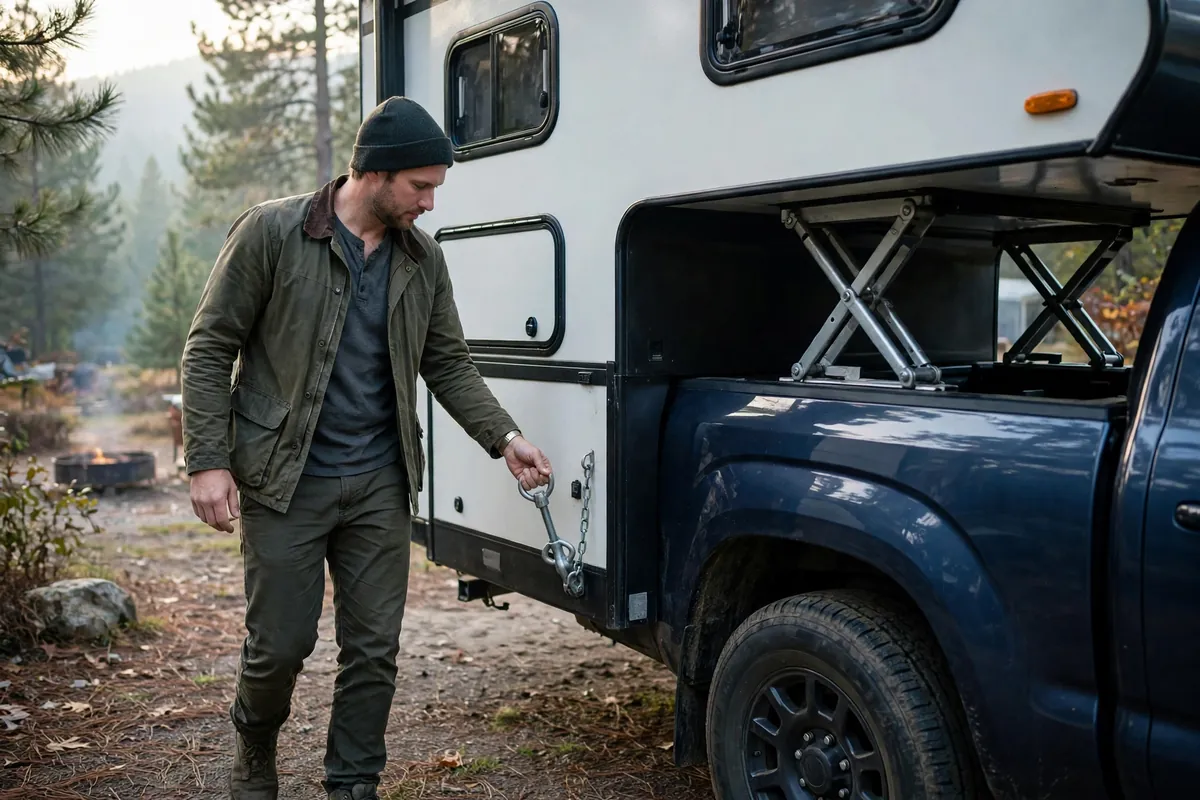
I do the same walkaround every time, even if I only moved the truck last night. It takes about five minutes.
Walk all the way around. Are tie-downs and turnbuckles snug? Are jacks fully up, steps in, and nothing hanging below the camper to catch a curb? Are roof vents closed and roof loads tied down? Inside, latch every cabinet and the fridge door — a loose frying pan becomes a projectile in a hard stop.
Then tires — a real look, not a glance. Check pressures for the loaded truck, not the empty-truck door sticker, and look for cuts and bulges. Our truck camper tire load ratings guide covers the details.
Finally, check fluids and adjust mirrors for the camper, and confirm you are within your ratings. Our truck camper payload calculator guide covers that math; technique cannot fix an overloaded truck.
How a Loaded Camper Changes the Feel — and Why Speed Is the Lever
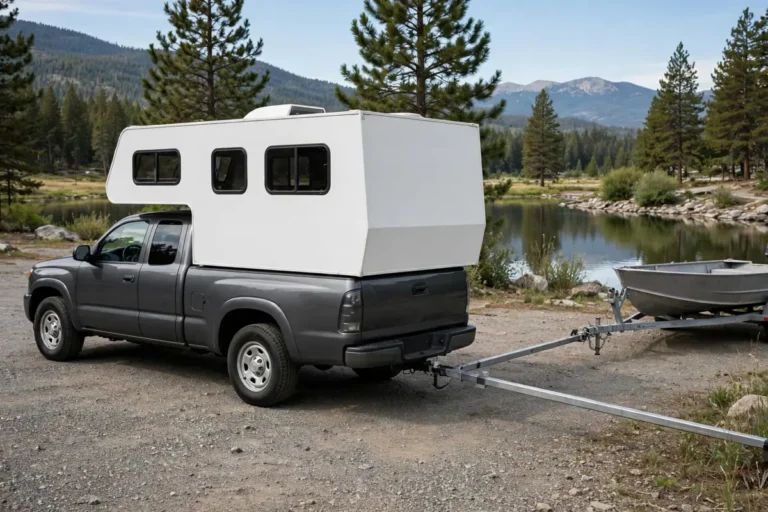
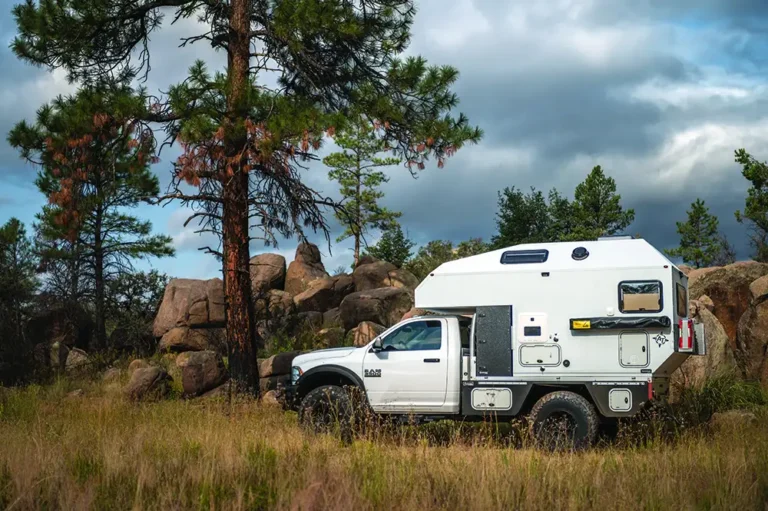
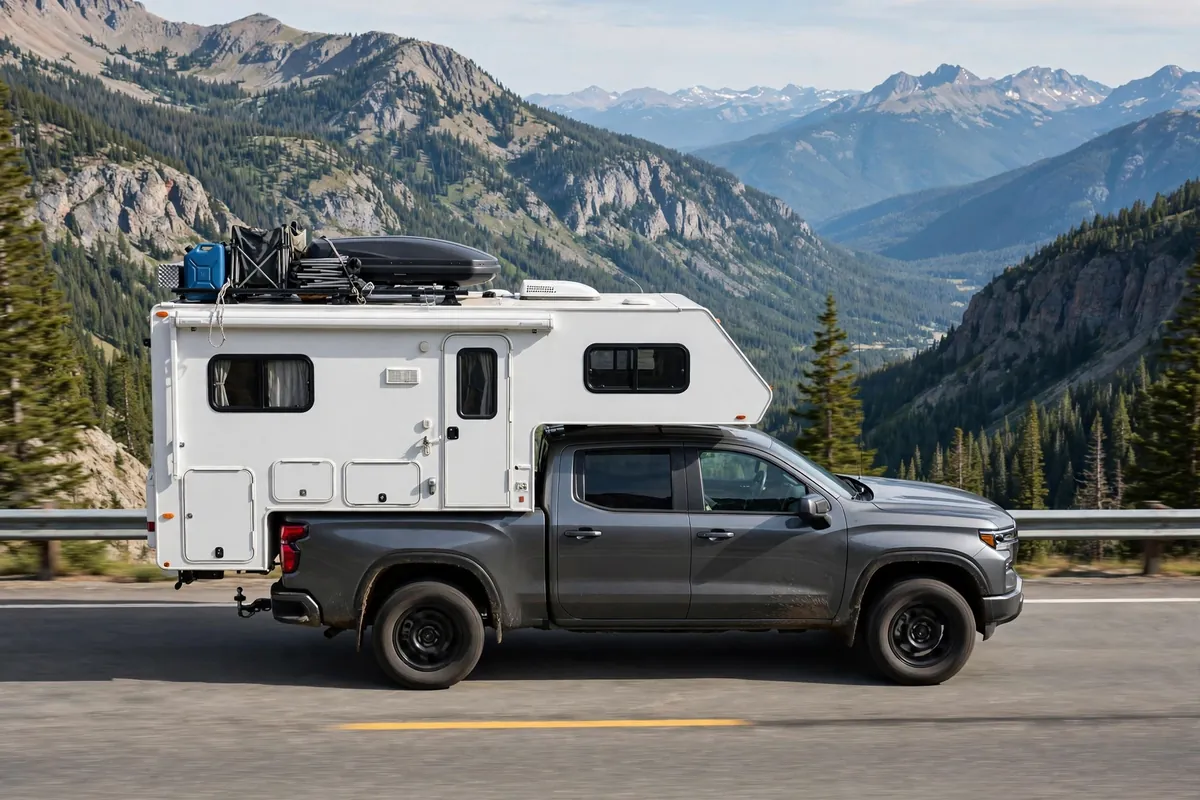
A truck camper raises the centre of gravity a lot: all that weight sits above the bed rails, and in a hard-side camper well above the cab. The truck leans more in curves, reacts more slowly to steering and braking, and wind has far more to grab.
That is why speed discipline is the single biggest camper-driving skill. Owners on iRV2 who drive the fast Texas interstates report settling at around 55 to 65 mph with a camper on, even where the limit is 75 or 80, and one driver described a single gust moving his rig three feet across the lane. I drive the same way. Going 62 instead of 75 costs a few minutes an hour and buys stopping distance and a much calmer afternoon. If the drive feels tense, I am going too fast. Slow down until the rig feels boring again.
Driving With a Truck Camper in Crosswinds and Passing-Truck Bow Waves
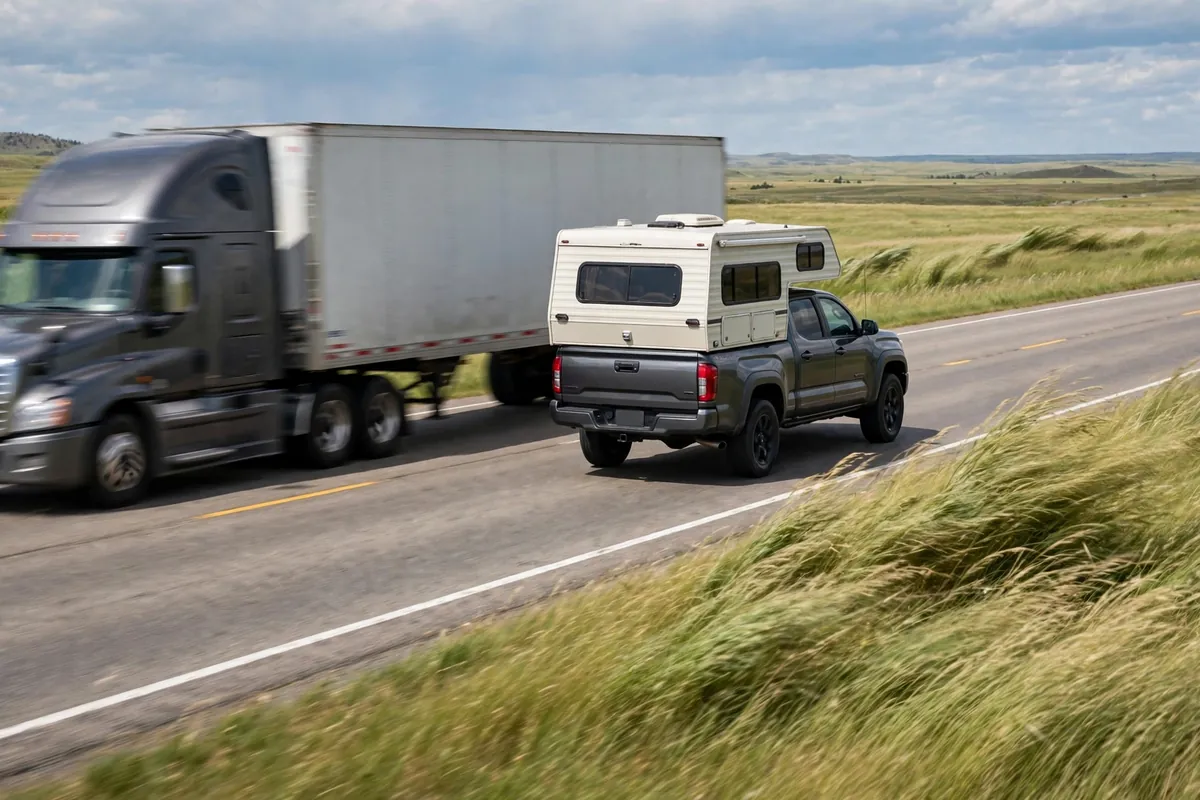
Crosswinds surprise new owners most, because the danger does not look dangerous. The sky can be blue and the road dry, and still a gust off an open plain or a gap between hills can shove you sideways.
Watch for warnings before you feel them: grass bending hard, dust blowing across the road, flags standing straight out, trucks ahead drifting. Bridges and overpasses are the worst spots, because wind blocked by trees suddenly hits you in full on the open span, then vanishes on the other side.
When wind hits, do not fight it with big steering corrections. Hold the wheel firmly, make small corrections, and ease off the gas. If gusts keep shoving you toward the edge of your lane, slow down more — or stop. Owners on RV forums describe exactly this progression, slowing to 45 mph, then 30, then pulling off to wait it out. The camper is, quite literally, your waiting room. For more on reading wind, see this guide to RV driving in crosswinds.
Passing trucks create a predictable version of the same problem: a bow wave pushes you away, pulls you toward the semi, then pushes you away again. Grip the wheel, hold your lane, and do not speed up to outrun it. If you are passing, pass decisively. In a crosswind from the left, I ride slightly right of lane centre, so a gust has somewhere to push me.
Downhill Grades: Pick Your Gear at the Top, Not Halfway Down
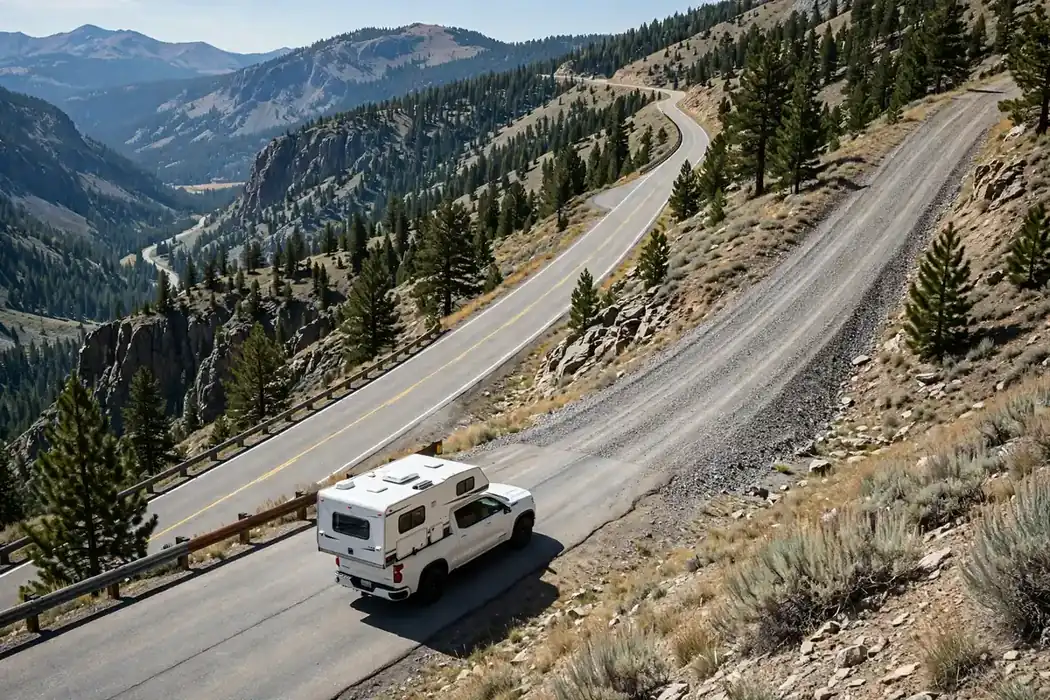
This is the section I wish someone had drilled into me before my first mountain trip. Downhill driving with a loaded camper is not about your brakes. It is about your gear.
The common mistake: crest a hill at highway speed, let gravity build speed, and ride the brakes to hold it back. Brakes get hotter, then softer — you press harder for the same slowdown. That is brake fade, and on the steepest part of the grade it can leave you with almost no brakes where you need them most. Georgia’s commercial driver guidance puts it bluntly: go slowly enough that brakes can hold you without overheating, and use engine braking as the principal way to control speed. Read the full mountain driving guidance before a big mountain route if you have never driven one loaded.
Here is the routine. At the top, before the descent, slow to the speed you actually want to descend at — often well below the posted limit. Shift down to a gear that holds that speed with little or no braking, often one or two gears lower than you climbed in. Use tow/haul or manual selection if you have it. A noisy engine holding 40 mph beats quiet brakes fading at 65.
Then brake in short, firm applications: let speed creep up a few mph, brake firmly to a few mph below target, then get off the pedal so brakes cool while the engine holds you. Never drag brakes lightly all the way down — that is what cooks them. Owners on RV forums repeat the same lesson: cross the crest at or below your descent speed, and if your gear cannot hold the rig within about 10 mph of target with only short brake applications, you are in too high a gear. Stay in the low gear to the bottom, and if you smell hot brakes or feel a soft pedal, pull off and let everything cool.
The Runaway-Ramp Reality Nobody Wants to Think About
Runaway ramps — gravel beds and uphill escape lanes on steep highways — exist for one reason: a vehicle whose brakes have faded beyond recovery. Deep, loose gravel, sometimes on an uphill slope, drags a heavy vehicle to a stop.
If you ever need one, it will almost certainly mean a tow and damage — but it is vastly better than a runaway rig at the bottom of a grade. Note ramp locations from road signs on unfamiliar mountain routes. If brakes truly fail, steer for the ramp, stay straight, and let the gravel do its job. The best runaway-ramp story is the one you never have.
Uphill Power and Transmission Heat: Slow Is Not Failure
Going up, the engine and transmission work hard for a long time at low speed, often in summer heat. Let the truck drop speed. I regularly climb long grades at 45 mph in a line of trucks, in no hurry, while cars fly past. That is not failure. That is listening to the truck.
Watch the transmission. Owners on iRV2 point out a subtle cause of heat on twisty climbs: when an automatic keeps shifting up and down, the torque converter unlocks and slips each time, and that slipping makes heat. Their fix, which I use, is to manually select a gear and hold it on a long climb.
Watch your gauges. If transmission or coolant temperature climbs steadily, back off, drop a gear, and slow down. If temperatures keep climbing, pull off and let things cool with the engine idling. Fuel up before a big pass, and use turnouts to let traffic pass on two-lane climbs.
Stopping Distances and Following Gaps: Buy Yourself Time
A loaded truck camper does not stop like an empty truck. It weighs more, its centre of gravity is higher, and weight shifts forward hard in a panic stop. I will not give you a fake precise number for extra distance — it depends on your rig, tires, road, and weather. What works on every rig is leaving far more space than feels necessary, and braking earlier than feels necessary.
On the highway I aim for at least four to six seconds behind the vehicle ahead in good conditions, and more in rain, wind, or on a grade. Commercial driver guidance uses a related rule — about one second for every 10 feet of vehicle length below 40 mph, plus an extra second above 40 mph. Count it: when the vehicle ahead passes a sign, count seconds until you pass it.
Brake early and progressively in normal traffic. In a genuine emergency, brake hard and straight — do not swerve unless you have a clear, safe escape. Keep your eyes two or three vehicles ahead, and on wet roads double your gap.
Height Clearance: Measure It Yourself, Write It on the Dash
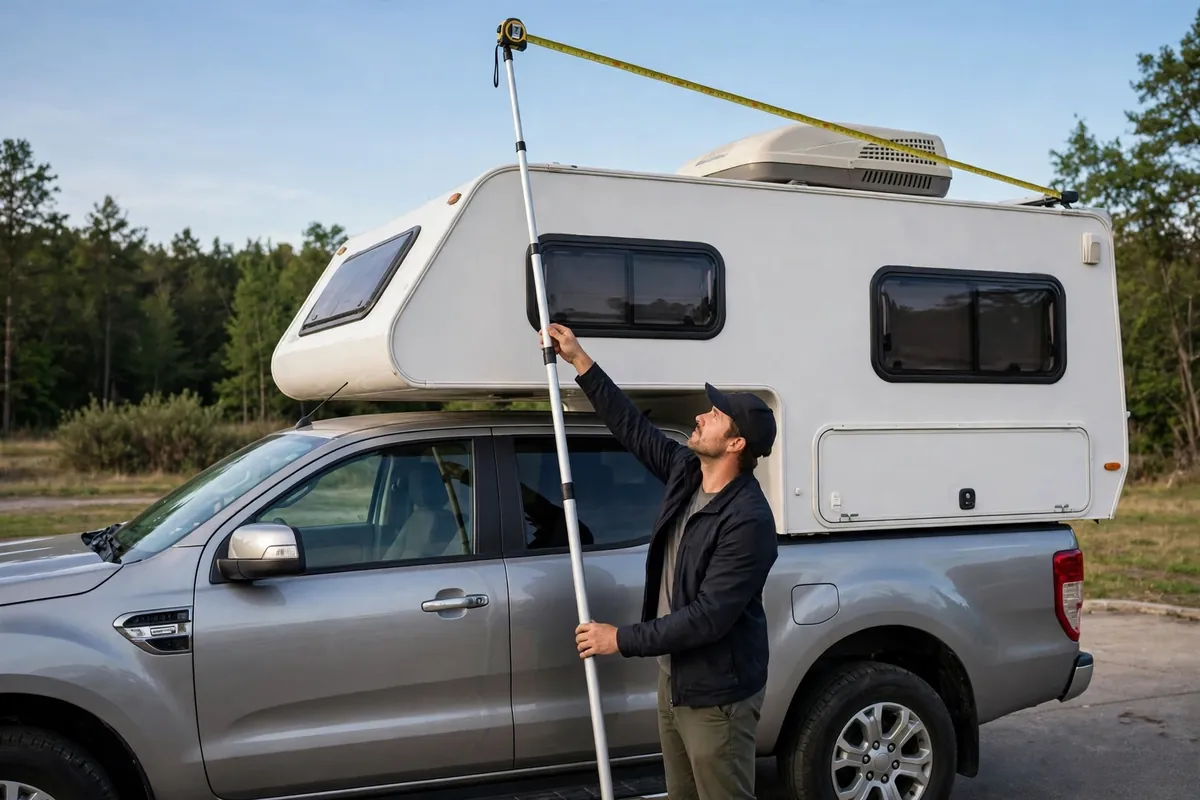
Nothing ruins a trip faster than a low bridge, and nothing is more preventable. Your brochure height is not your height. Your height is the distance from the ground to the highest point on your actual rig, as loaded, including the air conditioner, vent covers, and antenna.
Measure it yourself on level ground, loaded as you travel. Truck Camper Magazine tells the same story: a demo rig measured 11 feet 10 inches, and the owner’s rule was to avoid anything posted below 12 feet 5 inches, because roads get repaved and signs do not always get updated. Read their height-measuring guide and do the same. I write my height on a card on the dash and add a safety margin. If the sign says less than my height plus margin, I turn around. A three-point turn is free. A peeled-off air conditioner is not.
Plan routes with height in mind. Car navigation apps do not know you are 11 or 12 feet tall and will happily route you under a low railroad bridge. Use a truck or RV routing tool that accepts your height, and still read the signs yourself. Off the interstate, be extra careful: small-town bridges, railroad underpasses, canopies, and campground arches can be far lower. If unsure, stop and look, and re-measure after any roof change.
Tight Roads, Turnarounds, and Knowing When Not to Go
Truck campers go places trailers cannot, and that tempts owners down roads they should not be on. A narrow forest road with no turnarounds looks fine from the entrance and gets very interesting a quarter-mile in.
My rule: never enter a road or lot without knowing how I get out. If I cannot see a turnaround, and the road ahead narrows or drops, I stop and walk it first, or I do not go. On tight roads, go slow, use mirrors constantly, and watch your rear overhang — it swings wide on turns and clips posts, signs, and trees. If a road is posted with a weight or length limit, or says no RVs, believe it.
Fuel Stations and Parking Lots: Pick the Easy Pump, Not the Cheap One
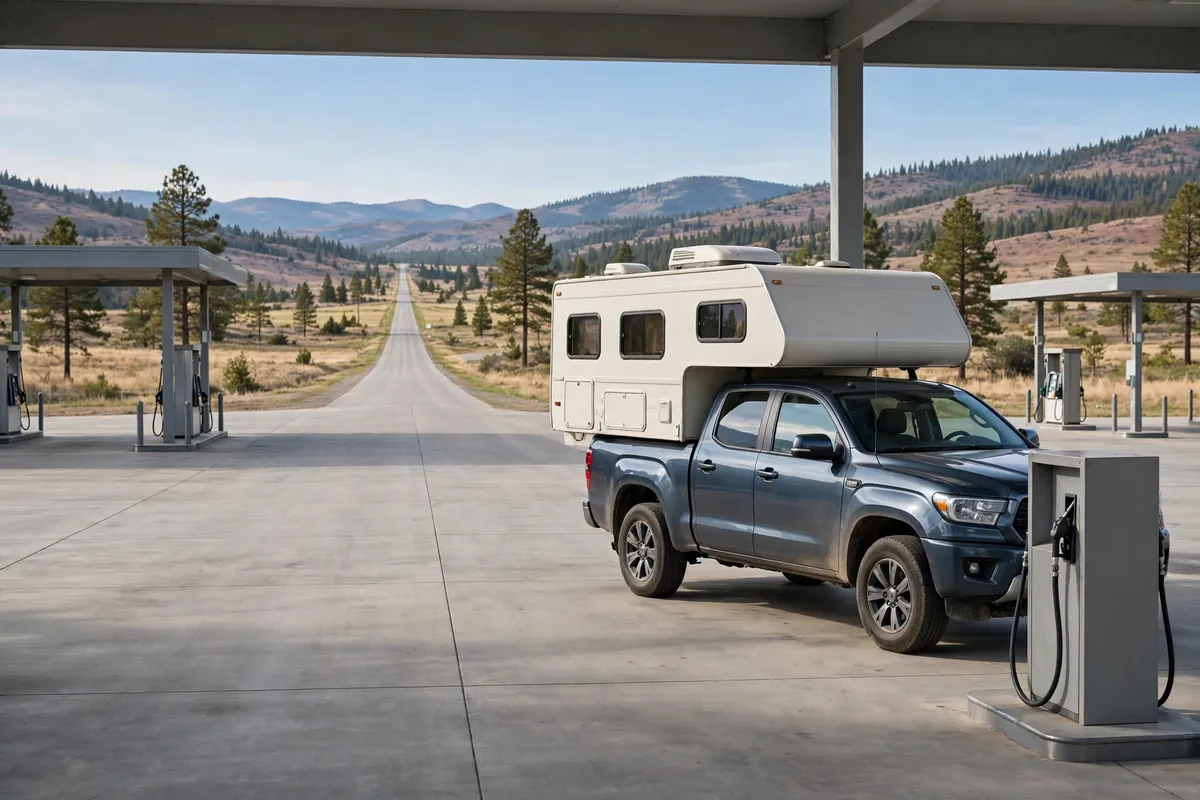
Fuel stops get stressful when owners pick the first station they see instead of one they can actually get in and out of. Owners on iRV2 who have wrestled big rigs through tight stations keep giving the same advice, which I have adopted: plan fuel stops in advance, look at the station from above on a map, favour end pumps and pumps parallel to the road over perpendicular islands that trap you, and pay a few cents more at a roomy station than fight a crowded cheap one.
My routine: fill up the night before a travel day when I can. On the road, start looking at about half a tank, not at the warning light. I prefer larger travel centres and an outside pump, for a straight exit. If I use truck lanes, I fuel promptly and pull forward clear of the pump. Before pulling in, survey from the road: can I enter, fuel, and exit going forward? If not, I drive on. Parking lots work the same way: park far out where you have room to swing. If you also tow behind the camper, our towing with a truck camper guide covers that setup separately.
Backing Into a Campsite: Slow, Talked Through, and Done Once
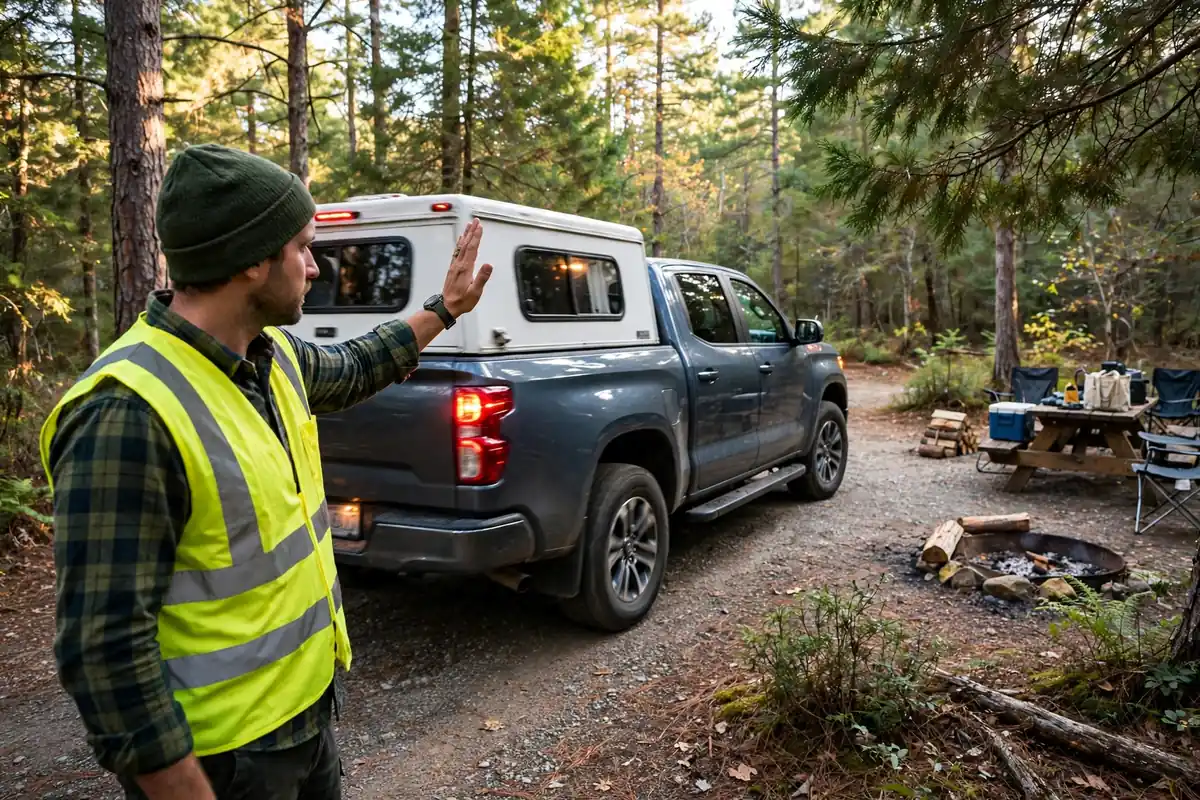
Backing a truck camper is easier than backing a trailer in one way: the camper moves with the truck, with no trailer pivot to fight. But you still cannot see behind a tall camper, and campsite roads are still narrow, angled, and lined with trees and posts.
Get out and look first. Every time. Walk the site, look for low branches, stumps, rocks, hookup posts, fire rings, and soft ground, and decide exactly where the camper should end up. Owners on iRV2 repeat this almost as a mantra: always get out and look before backing in, because the backup camera is only much use once you are already straight into the spot.
Agree the plan with your spotter before you move: where they will stand, where the back of the camper needs to go, and what the signals mean. Signals should always describe where the back of the camper needs to go, not where the steering wheel should turn. Agree a stop signal — a closed fist, both hands up — that means stop immediately.
Keep the spotter visible, ideally on the driver’s side, in your mirror. Never let them stand behind the camper where you cannot see them. If you lose sight of your spotter, stop. Owners on Forest River forums describe the upgrade that ended their backing arguments: walkie-talkies, or a hands-free phone call, so the spotter talks in a normal voice instead of shouting over an engine at dusk.
Back slowly, in short moves. Turn a little, back a little, straighten, check the mirrors, repeat. If the angle goes wrong, pull forward and reset — that is the technique, not failure. Favour a driver-side back-in when you have the choice: backing to your left, where you can see the site, is far easier than a blind-side back-in to your right. Once you are in, level before you settle — our truck camper leveling on uneven ground guide walks through that step. Loading and unloading solo is a separate skill — see our loading and unloading a truck camper solo guide before trying it alone.
Frequently Asked Questions
How fast should I drive with a truck camper?
As fast as conditions allow you to stay relaxed and in full control — for most owners, around 55 to 65 mph on the highway, slower in wind, rain, or mountains, regardless of a higher posted limit.
What gear should I use going down a mountain grade?
A low enough gear to hold your chosen descent speed with only short, occasional brake applications. Choose it at the top, before you pick up speed, and stay in it to the bottom.
How do I handle strong crosswinds in a truck camper?
Slow down, hold the wheel firmly with small corrections, and give yourself room on the side the wind is pushing you toward. Watch bridges and open gaps, where gusts hit hardest. If gusts keep pushing you out of your lane, pull off somewhere safe and wait it out.
What should I do if my brakes start to fade on a descent?
Use the lowest safe gear and engine braking, and pull off at the first safe turnout to let the brakes cool. If braking is truly failing and speed is still climbing, steer for a runaway ramp if one is available.
How do I back a truck camper into a tight campsite?
Walk the site first, agree the plan and signals with your spotter, keep the spotter visible in your mirror, and back slowly in short moves, pulling forward to reset whenever the angle goes wrong.
Do I need to worry about bridge height with a truck camper?
Yes. Measure your loaded rig yourself, from the ground to the highest roof point, write it on your dash, and add a safety margin before trusting any posted clearance. Re-measure after any roof change.
Disclaimer: This guide reflects owner experience, not professional driver training. Follow your truck and camper manuals, obey posted limits and local laws, never exceed your vehicle’s ratings, and get professional advice for mechanical or braking concerns. If conditions feel unsafe, stop and wait them out.