Best Truck Camper for Ford F-250 Super Duty – What Actually Fits Without Overloading It
The best truck camper for Ford F-250 Super Duty owners is not the biggest camper you can afford. It is the heaviest camper your exact truck can carry with real people, water, and gear on board, and still stop and steer properly. Most F-250s on dealer lots are Crew Cab 4×4 diesels carrying far less than the headline payload number suggests. A gas truck carries more than the same truck with a diesel, and no airbag adds a pound of legal payload.
The F-250 Payload Reality: Your Door Sticker Beats the Brochure
Ford rates the 2025 F-250 at a maximum payload of 4,268 pounds, but that number belongs to one specific truck: a 6.8-liter gas Regular Cab 4×2 with minimum equipment and a 10,000-pound GVWR. Almost nobody buys that truck.
The same chart drops to 2,437 pounds for a diesel 4×4 Crew Cab long box: same model year, same badge, nearly 1,800 pounds of difference. A gas 4×4 SuperCab with the 7.3-liter lands around 3,373 pounds, and a gas 4×2 Crew Cab short bed around 3,868. For 2026, Ford lists the range at 4,246 pounds at the top and 3,445 at the bottom. See Ford’s official 2026 Super Duty towing guide.
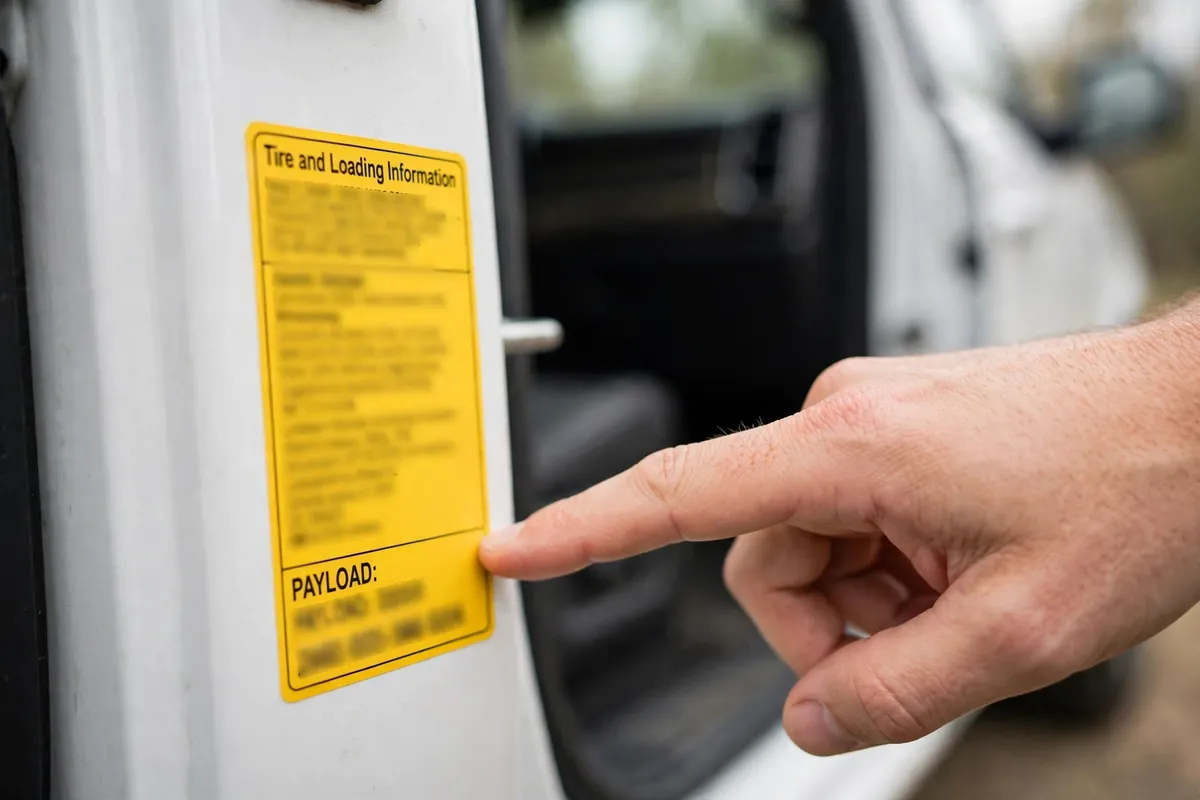
Payload is GVWR minus curb weight, and the F-250’s GVWR runs from 10,000 to 11,400 pounds. Every option eats payload: four-wheel drive costs roughly 300 pounds, the Crew Cab costs more than the SuperCab, and the diesel is the biggest bite of all. That is why the yellow Tire and Loading sticker on your driver door jamb is the only number that matters for your truck. Our truck camper payload calculator guide walks through the full math. Also check the rear axle rating (GAWR) and weigh each axle separately when you scale the rig.
Gas vs Diesel: The Payload Trade Nobody Tells You About
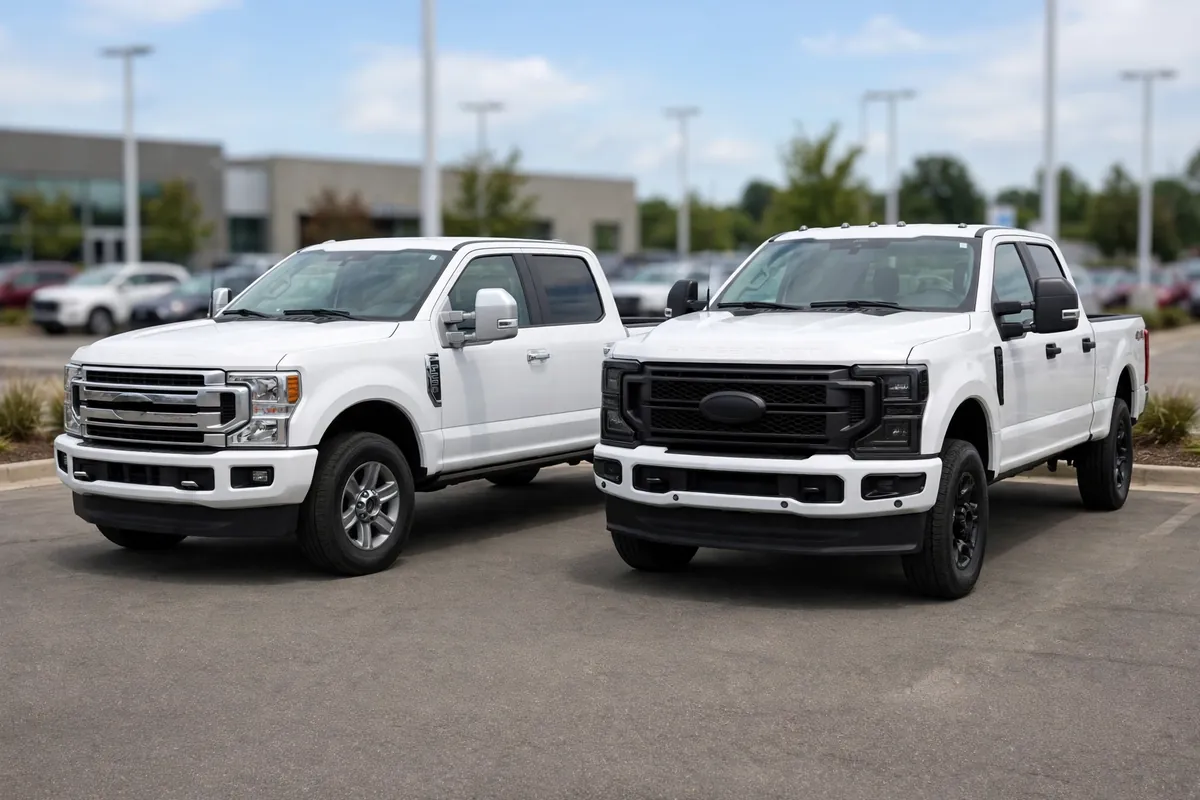
Here is the trap that catches diesel buyers, the same one our Ram 2500 diesel payload guide covers on the Ram side. The 6.7-liter Power Stroke makes 475 horsepower and 1,050 pound-feet of torque in standard form, 500 horsepower and 1,200 pound-feet in High-Output form. It also weighs roughly 990 pounds, against about 535 pounds for the 7.3-liter Godzilla gas V8, and every extra pound comes straight out of your payload.
So the diesel tows more and carries less, while the gas truck carries more and tows less. For a camper that lives in the bed rather than on the hitch, carrying matters more, which is why the gas truck is so often the smarter camper truck.
The High-Output diesel claws some payload back with higher GVWR packages up to 11,400 pounds, and a High-Output Crew Cab 4×4 can land in the mid-3,000s. But the standard-output diesel Crew Cab 4×4 long box at 2,437 pounds is the truck that breaks hearts. If you already own a diesel F-250, shop from the light end of the list below and travel with less water.
If you are still shopping, my blunt advice is a 7.3-liter gas F-250, Crew Cab or SuperCab, 4×4, with the Camper Package: the most payload, the simplest engine, and still 18,200 pounds of conventional towing.
Short Bed vs Long Bed: What Fits Your 6.75-Foot or 8-Foot Box
The F-250 comes with two beds: the short bed measures 81.9 inches at the floor, marketed as 6.75 feet, and the long bed 98.1 inches, marketed as 8 feet. Both are 66.9 inches wide, 50.5 inches between the wheel wells, and 21.1 inches deep. That 16-inch difference decides your whole shopping list.
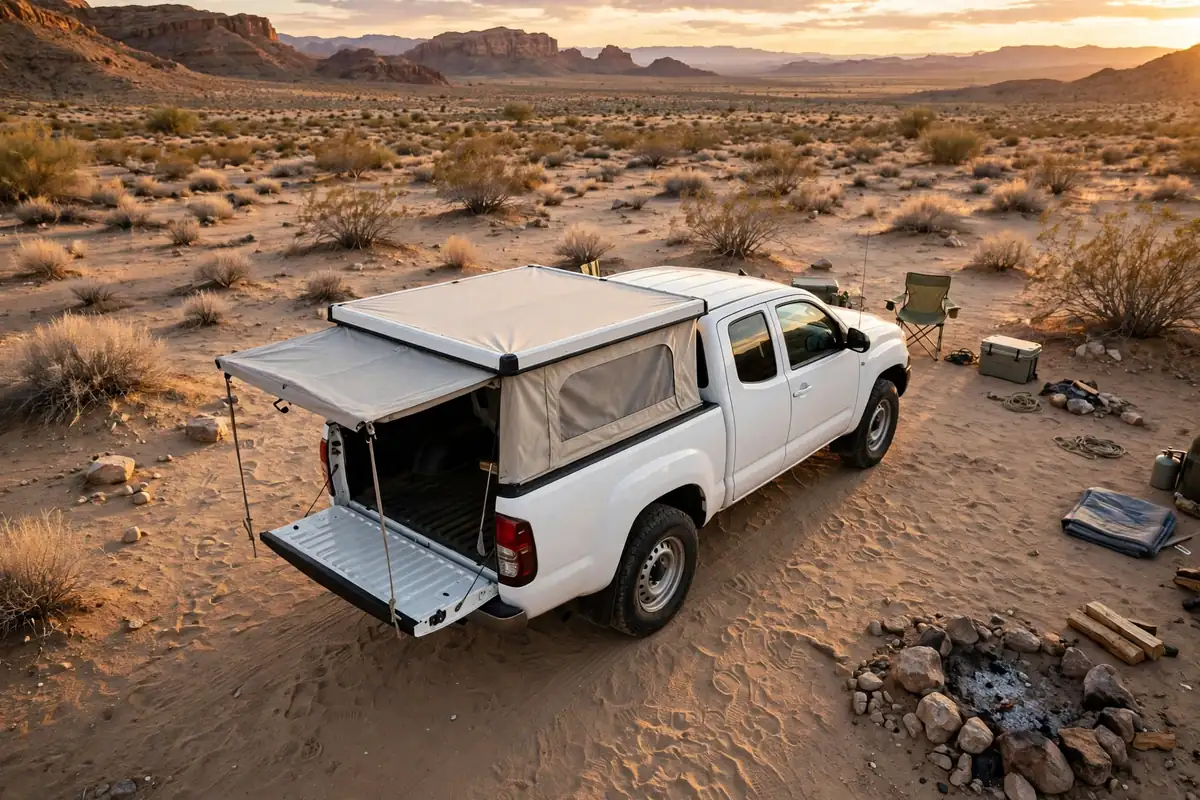
Short-bed campers have an 8-foot-ish floor with a rear overhang past the tailgate, which stays down. Long-bed campers use the full 8-foot floor and close the tailgate. A long-bed camper will not fit a short-bed truck, and owners on iRV2 warn that a long-box camper on a short-box truck puts the center of gravity too far behind the rear axle, and the handling goes bad in a hurry.
Center of gravity matters as much as weight: every camper has a center-of-gravity point, usually marked on the side, and it needs to sit ahead of the rear axle, or the steering goes light at highway speed. Our short bed vs long bed guide covers the trade-off in full: the long bed is the better camper truck, the short bed the better daily driver.
The Camper Package and the Tremor Trap
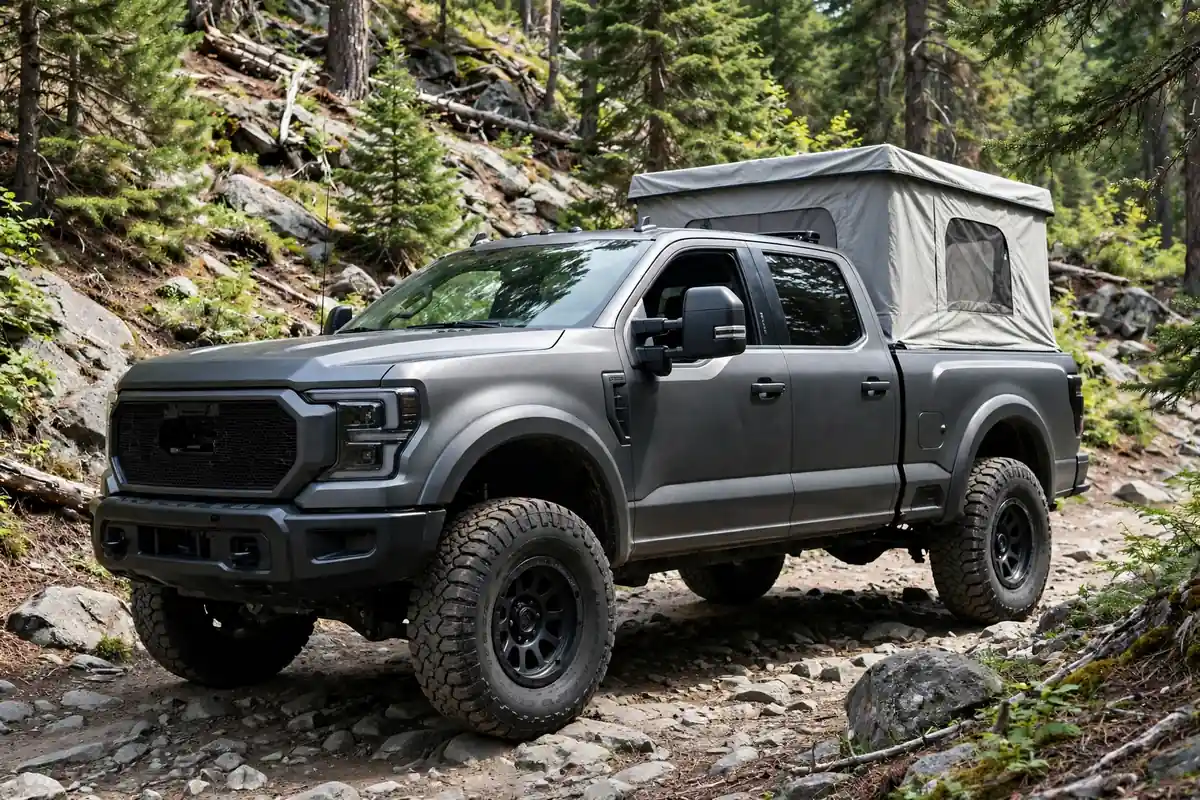
Ford’s own truck-camper loading guidance says F-250, F-350, and F-450 trucks are recommended for slide-in campers only when equipped with the optional Camper Package, option code 471. It is not standard equipment, and plenty of used F-250s do not have it.
Owners on the Ford-Trucks forum describe what the package does: it upgrades the rear springs to F-350 spec and adds a rear sway bar. One owner with a 7.3 gas F-250 and the Camper Package reports about 3,100 pounds of payload, and says the factory springs and sway bar made a real difference with a hard-side camper on board. If you are ordering new, tick the box. If you are buying used, check the window sticker.
Then there is the Tremor, the most misunderstood F-250 for camper buyers. It is a wonderful off-road truck: 35-inch tires, locking differentials, skid plates, raised ride height. It is also a worse camper truck than the standard F-250, because the big tires and off-road suspension cost payload: current selector charts put a Tremor Crew Cab 4×4 at roughly 3,255 to 3,384 pounds, and one 2021 Tremor listing showed just 2,665 pounds. Worse, Ford does not allow the Camper Package on the Tremor at all.
That does not make the Tremor a bad choice: owners on Expedition Portal run Tremors with light pop-ups like the Northstar Liberty and love them. But for a big hard-side camper with a slide, buy the standard F-250 with the Camper Package instead.
Campers That Actually Fit an F-250 Short Bed

These are the campers I would shop first for a 6.75-foot bed. Dry weights are from the manufacturers; wet weights use Truck Camper Magazine’s formula, which adds full water, propane, batteries, and 500 pounds of stuff.
| Camper | Dry weight | Wet weight | Why it works |
|---|---|---|---|
| Four Wheel Hawk (pop-up) | ~1,200 lbs base, ~1,428 avg with options | ~1,900-2,200 lbs estimated | Lightest here, fits almost any F-250 |
| Northstar Liberty | 1,775 lbs | 2,560 lbs | Hard-side, self-contained, big margin |
| Lance 650 | 1,813 lbs | ~2,000 lbs | Smallest hard-side Lance, four-season |
| Lance 825 | 1,795 lbs | ~2,300 lbs estimated | Classic light Lance, no slide |
| Northstar Wind Bandit | 2,050 lbs | 2,894 lbs | More space, small weight jump |
| Lance 865 | 2,012 lbs | ~2,600 lbs estimated | Longer floor, sleeps more |
One warning on the Four Wheel Hawk: the factory weighs every camper before it leaves, and says the average Hawk leaves at 1,428 pounds dry with options, with options swinging the weight by as much as 300 pounds. The sticker shows the weight without options, water, propane, or refrigerator, so add those back, per Four Wheel Campers themselves.
Run the math on the tightest realistic F-250, a diesel Crew Cab 4×4 long box at 2,437 pounds of payload. Two adults at about 340 pounds plus a loaded Hawk at roughly 2,000 pounds leaves you just under the limit, and only with a light camper. The same truck with a Lance 865 at roughly 2,600 pounds loaded is over before you put a cooler in the back. On a gas F-250 with around 3,300 pounds of payload, a Lance 825 at roughly 2,300 loaded leaves a comfortable margin. Our Lance 650 vs 825 vs 865 weights guide compares real loaded weights against the brochure numbers.
Campers That Actually Fit an F-250 Long Bed
Lance 855S. The single-slide favorite, and the most popular hard-side camper on an F-250. Dry weight is 2,857 pounds, and one owner measured his fully loaded 855S at about 4,100 pounds on the scale, so plan around the loaded number. On a gas F-250 with 3,300 to 3,800 pounds of payload, it fits if you travel light and keep the water tank partial. On a diesel Crew Cab, it usually does not fit.
Arctic Fox 865. The non-slide Arctic Fox, dry weight 2,641 pounds and wet weight 4,270 pounds once you add the mandatory 595-pound Fox Value Package, full water, propane, batteries, and gear. It is a four-season tank, and the heaviest camper I would put on a gas F-250. On a diesel, the wet weight alone eats the whole payload. Full specs are in the Arctic Fox buyers guide.
Arctic Fox 990. The single-slide long-bed Fox, dry weight 3,010 pounds and wet weight 4,781 pounds. It is a one-ton camper that some F-250 owners carry anyway. On the very best gas F-250s, up near 3,800 to 4,200 pounds of payload, a lightly loaded 990 can squeak in. On a typical Crew Cab 4×4, it does not. If the 990 is the camper you want, the honest answer is usually an F-350, not a bigger set of airbags. Anything heavier, like the Arctic Fox 1150 at 5,129 pounds wet, exceeds every F-250 payload rating.
Northstar Laredo SC. Dry weight 2,090 pounds, wet weight 3,050 pounds, and one of the best weight-to-space ratios in this guide. It fits a gas F-250 with real margin left, and even a well-optioned diesel F-250 if you are disciplined about water and cargo. If I had to pick one hard-side camper for a diesel F-250, this would be it. The full lineup is in the Northstar buyers guide.
Real Owner Math: The Scale Ticket That Changes Everything
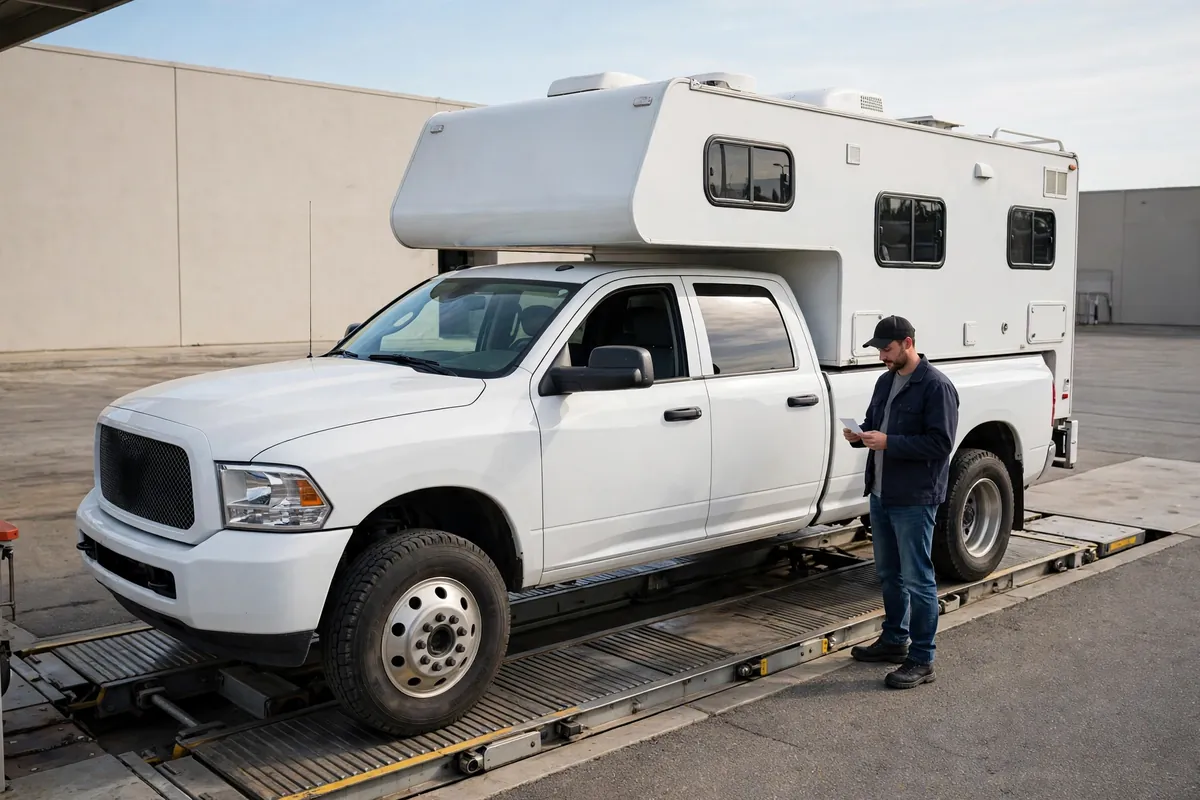
Three owner stories stuck with me.
First, a WanderTheWest owner who carried a Four Wheel Hawk full-time on a 2005 F-250 for years, then finally scaled it. With the camper stocked, a quarter tank of fuel, full propane, no water, and just himself aboard, the truck weighed 10,080 pounds against a 10,000-pound GVWR. With his wife, water, fuel, food, and dogs, he figured he was around 10,600 pounds. His advice, echoed by everyone who replied: get three scale readings, front axle, rear axle, and total, and compare each against the sticker. Airbags and good shocks had made his truck handle fine, which is why he had never noticed. Owners on that thread put it bluntly: airbags level the truck, they do not fix the braking of a rig that is too heavy.
Second, an iRV2 owner who bought a Bigfoot listed at 3,200 pounds dry and found it weighed 4,400 pounds once options and gear were aboard. His rule of thumb, echoed by a dozen owners in that thread: add about 1,000 pounds to any camper’s dry weight for real-world loading. Another owner in the same discussion ran a Lance his truck’s camper sheet rated for 2,700 pounds, while the camper was 3,100 pounds dry, and admitted he drove about 1,000 pounds overloaded and never felt good about the brakes. The stopping distance scared him, not the squat.
Third, a YouTube walkthrough from an Alaska camper builder put the cleanest number on it: most three-quarter-ton trucks on the road have between 2,200 and 3,200 pounds of payload, so the camper itself needs to be between 1,500 and 1,800 pounds to leave room for people, gear, and a trailer tongue weight.
The dry weight lies. The scale tells the truth. Weigh your rig loaded for a real trip before your first long drive.
Suspension Fixes That Help, and What They Cannot Do
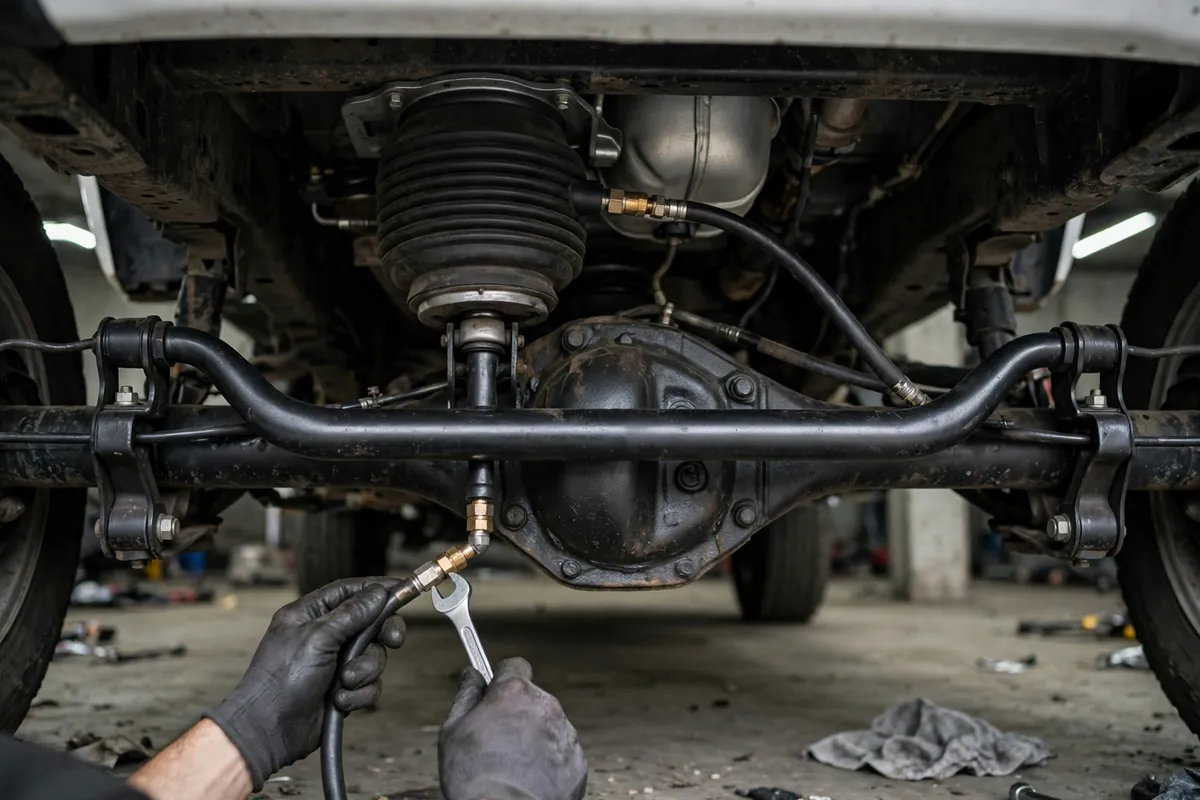
Suspension work makes a fitting rig drive right. On a rig that does not fit, it just hides the problem.
Airbags. The most popular fix, and the most misunderstood. Firestone Ride-Rite and Air Lift kits let you level the truck and adjust for the load, and owners on the Ford-Trucks forum swear by them for a Lance 855S or similar weight. Two details matter. First, run each side on its own air circuit with its own valve, never tee the two bags into one line: in a hard turn the air squeezes out of the compressed outside bag and into the inside bag, which makes the lean worse. Second, airbags do not add payload, and they do not help sway much. They fix sag and let you level the camper on an uneven pad. Our airbags vs Timbren vs SumoSprings guide covers the full owner verdict.
Timbren SES and SumoSprings. Hollow rubber helpers that bolt in where the bump stops live. No air lines, no maintenance, nothing to adjust. They cut sag and body roll, but like airbags, they do not raise your GVWR or payload by a pound. The rating on the box is what the rubber can take, not extra capacity.
Sway bars. The single best dollar-for-dollar handling fix for a tall camper, in my opinion. The Camper Package already adds a rear sway bar, and a heavier aftermarket bar from Hellwig or Roadmaster is the first thing I would add to a truck that wallows when a semi passes.
Shocks and tires. Rancho 9000 adjustable shocks come up again and again in owner threads, usually paired with airbags. Tires matter more than most people think: check the load rating on your actual tires against your scaled rear axle weight, not the brochure. One iRV2 owner found he was over his stock tires after weighing and upgraded to G-rated tires. Our truck camper tires guide covers load ratings and pressures in detail.
Tie-downs. Frame-mounted tie-downs are not optional on a heavy camper: bed-mounted ones can tear out of the bed under load. Use a proper frame-mounted system from Torklift, Happijac, or Brophy, and check the turnbuckles before every trip.
The Best Truck Camper for Ford F-250: My Shortlist
If you own a diesel Crew Cab 4×4 F-250, buy light. A Four Wheel Hawk or a Northstar Liberty is the honest answer, and the Laredo SC is the stretch goal if your sticker is strong and you travel light on water.
If you own a gas Crew Cab or SuperCab 4×4, the Lance 825, Lance 865, Northstar Laredo SC, and Northstar Wind Bandit are all comfortable fits, and the Lance 855S works if you keep it light and scale it. This is the sweet spot for the F-250.
If you are shopping for a truck specifically to carry a camper, buy a 7.3 gas F-250, Crew Cab or SuperCab, long bed if you can live with the length, with the Camper Package, and check the door sticker before you sign. That truck carries an Arctic Fox 865 or a Lance 855S with margin to spare.
And if the camper you want is an Arctic Fox 990 or 1150, or a big double-slide, shop for an F-350 instead. The F-250 is a great truck. It is not a one-ton truck, no matter how much you spend on the suspension.
Frequently Asked Questions
What is the best truck camper for Ford F-250?
A Lance 825, Northstar Laredo SC, or Four Wheel Hawk, because their loaded weights fit the payload of real Crew Cab 4×4 trucks. Gas trucks can stretch to a Lance 855S or Arctic Fox 865.
How much payload does an F-250 have for a truck camper?
Ford’s 2025 chart runs from 4,268 pounds for a gas Regular Cab 4×2 down to 2,437 pounds for a diesel 4×4 Crew Cab long box. Most Crew Cab 4×4 trucks land between roughly 2,400 and 3,900 pounds. Read the yellow sticker on your door jamb first.
Can a diesel F-250 carry a Lance 855S?
Usually not within its ratings. A loaded Lance 855S weighs about 4,100 pounds, more than the payload of most diesel Crew Cab F-250s. A gas F-250 with a strong payload sticker can carry one if you travel light.
Does the F-250 need the Camper Package for a truck camper?
Ford recommends F-250 trucks carry slide-in campers only with the optional Camper Package, code 471. It upgrades the rear springs to F-350 spec and adds a rear sway bar. Ordering new, get it. Buying used, check for it.
Can a Ford F-250 Tremor carry a truck camper?
Yes, but only a light one. Tremor Crew Cab 4×4 payload runs roughly 3,255 to 3,384 pounds, and Ford does not offer the Camper Package on the Tremor. A Four Wheel Hawk or Northstar Liberty is a great Tremor match.
Do airbags increase my F-250 payload for a camper?
No. Airbags, Timbren helpers, and SumoSprings level the truck and improve handling, but none raise your GVWR, rear axle rating, or legal payload by a pound.