Winter Camping in a Pop-Up Truck Camper: Canvas, Condensation, and Cold Nights
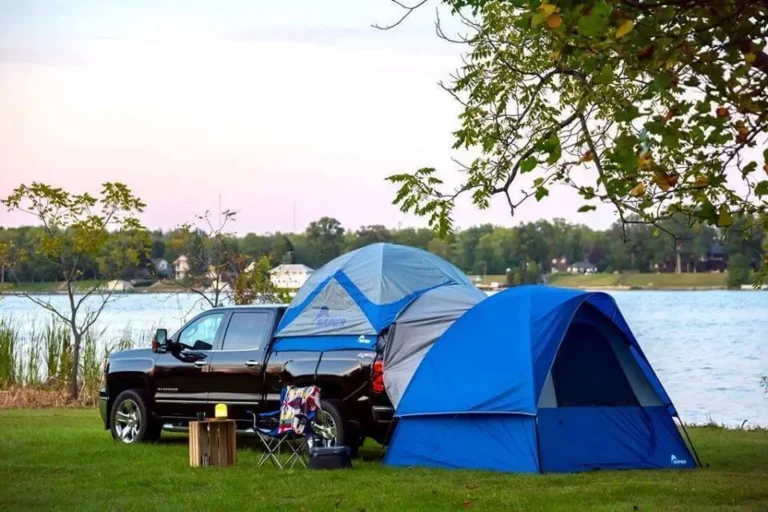
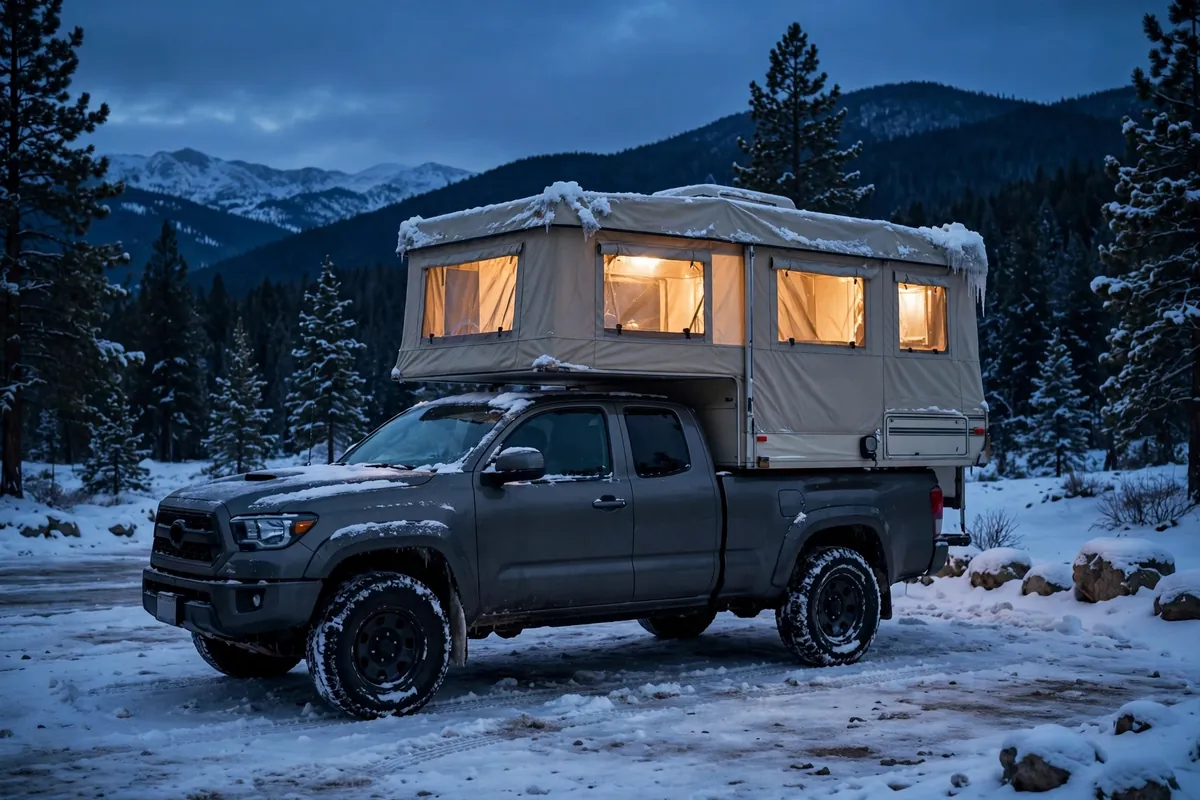
The first time I slept in my pop-up truck camper in a snowstorm, I woke up to ice on the inside of the canvas and a drip hitting my forehead. The furnace was running, the bed was warm, and I was still comfortable, but the tent section was its own weather system. That night taught me what nobody tells pop-up owners clearly: pop up truck camper winter camping is a completely different game from wintering in a hard-side. Our general winter camping guide covers water systems, batteries, and cold-weather logistics for any camper. This is the pop-up owner’s companion to it, written for the canvas wall specifically: condensation on soft sides, frozen lift panels and seals, keeping the uninsulated tent section warm, furnace ducting, skirting the gap, moisture control, thermal packs, and heater safety in a canvas rig.
Here is the honest starting point. A pop-up’s raised walls are roughly 18 inches of uninsulated fabric between you and the night. Pop-up owners on the truck-camper forums say it plainly: staying warm is not the hard part, a decent furnace handles that. Condensation is the hard part, and the moisture you fight at 25°F becomes the ice you fight at 10°F.
Heat First: The Furnace Is Your Best Friend, the Heater Is Not
Let me save you the expensive lesson some of us learned the long way. A vented furnace, one that burns fuel in a sealed chamber and dumps exhaust outside, is the only primary heat source that belongs in a pop-up in winter. A WanderTheWest thread on FWC winter camping includes an owner who ran a Mr. Buddy-style portable propane heater and watched condensation freeze onto every cold surface, then melt and rain down inside. He learned the painful way what forum veterans repeat: an unvented propane heater dumps an enormous amount of water into the camper air, owners figure roughly a gallon’s worth over a cold night. He switched to a Suburban forced-air furnace and the frozen condensation on the ceiling and LED strips dropped dramatically, because combustion moisture goes out the exhaust pipe instead of into your bedding.
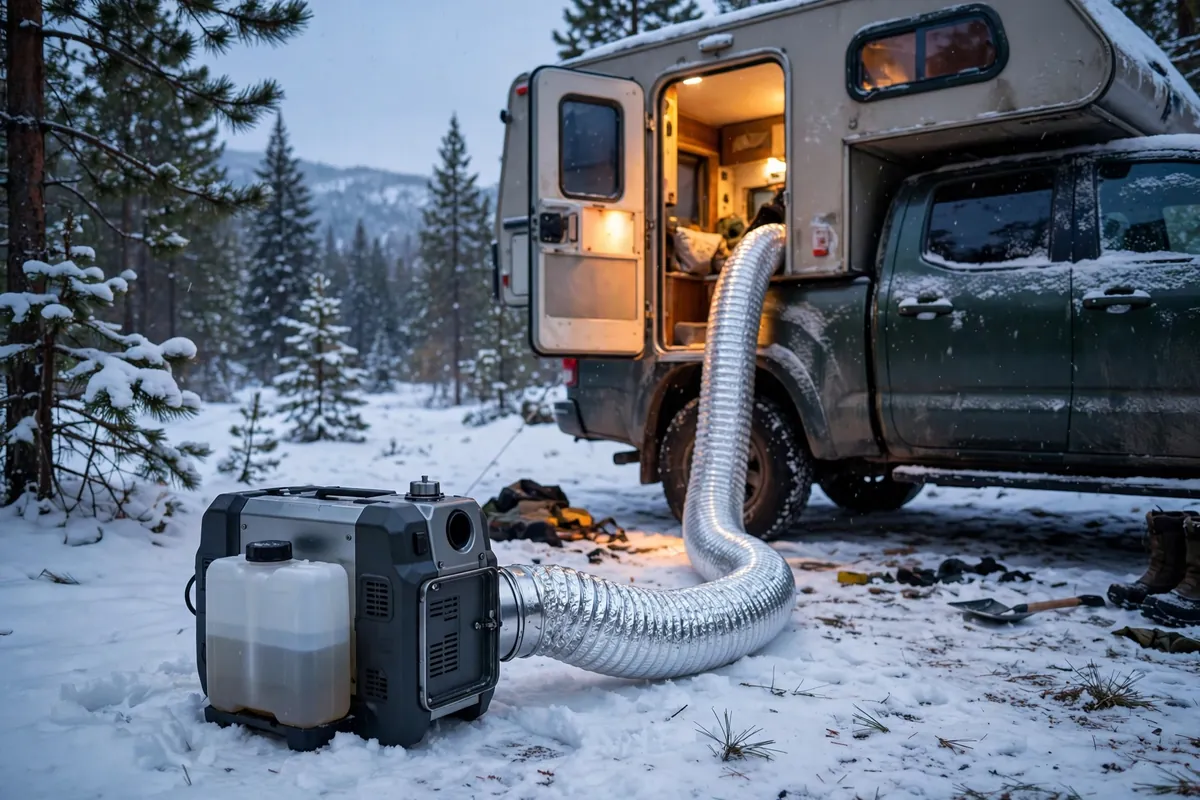
Our winter heating deep-dive compares diesel, propane, and electric in detail. The pop-up-specific takeaways: your furnace will run nearly continuously below freezing, so carry propane like it matters. One Good Sam forum owner living in his camper at 9°F burned a propane tank every one to three days in deep cold. Second, diesel air heaters are the pop-up owner’s favorite upgrade: sealed combustion exhausted outside, bone-dry heat, tiny fuel sips. Owners on OverlandBound commonly mount cheap 2 kW units outside the camper on a separate battery and duct the hot air in. Go small: 2 kW is plenty for a pop-up.
Third, get the heat up into the tent section, the trick hard-side owners never need. The cabover bed sits in the canvas zone, far from the floor-level furnace vent, and warm air pools down low while the bed freezes. A Good Sam owner fixed it with a small marine fan mounted up high, pushing warm air toward the head of the bed on a timer. An Expedition Portal builder in a home-built pop-up runs his roof vent fan on low all winter to keep air circulating, noting that moving air keeps the walls warm enough that they stop sweating. Don’t assume the factory furnace vent placement serves the tent section. Aim heat where the canvas is.
Dress the bed, not just the camper: Reflectix around the bed walls, a foam pad under the mattress, and a real winter sleeping bag beat a bigger furnace. Some owners sleep with the roof down on the worst nights. It works. Keep a vent cracked and your CO alarm on if you try it.
Condensation: The War You Fight Every Night

This is the section that matters most, because canvas condensation is the single most-discussed problem in every pop-up winter thread I’ve read. Two people breathing all night put a surprising amount of water into the air. Warm interior air meets the cold vinyl, one thin layer from the night outside, and moisture plates out on the inside of the canvas. At 25°F it drips. At 15°F it freezes into rime that melts at noon and drips anyway. One Expedition Portal owner in British Columbia late-fall conditions described it honestly: with two people, the furnace cycling, and limited venting, the camper sweated from everywhere. Canvas soaked on the inside, every aluminum frame piece beaded, and the wet areas behind the lift supports just stayed wet.
You never win this completely. You manage it with a nightly routine pop-up owners converge on everywhere. First, crack a roof vent a couple of inches, even on the coldest nights, and open a low vent on the other end, a turnbuckle access door works, so moist air draws out the top and drier air enters below. It feels backwards to let heat escape when you’re burning propane to make it, but owners are emphatic that this habit does more than any gadget. Second, keep air moving inside. A vent fan on low stops the dead layer of air against the canvas that cools below the dew point and condenses.
Third, wipe the canvas down in the morning before you lower the roof. Camp towels, a quick pass over the vinyl, done in minutes. Never fold wet canvas into the roof for storage. Pop-up owners repeat this like a mantra: if you must close it wet, open it again at the first opportunity, in the driveway at home, and let it dry. Folded wet vinyl grows mildew fast.
For the full condensation playbook, our truck camper condensation guide goes deep. The canvas-specific additions are the wipe-down-before-lowering ritual and the fact that more heat alone never fixes it. Ventilation plus circulation, every single night.
Thermal Packs and Insulating the Canvas: What Actually Helps
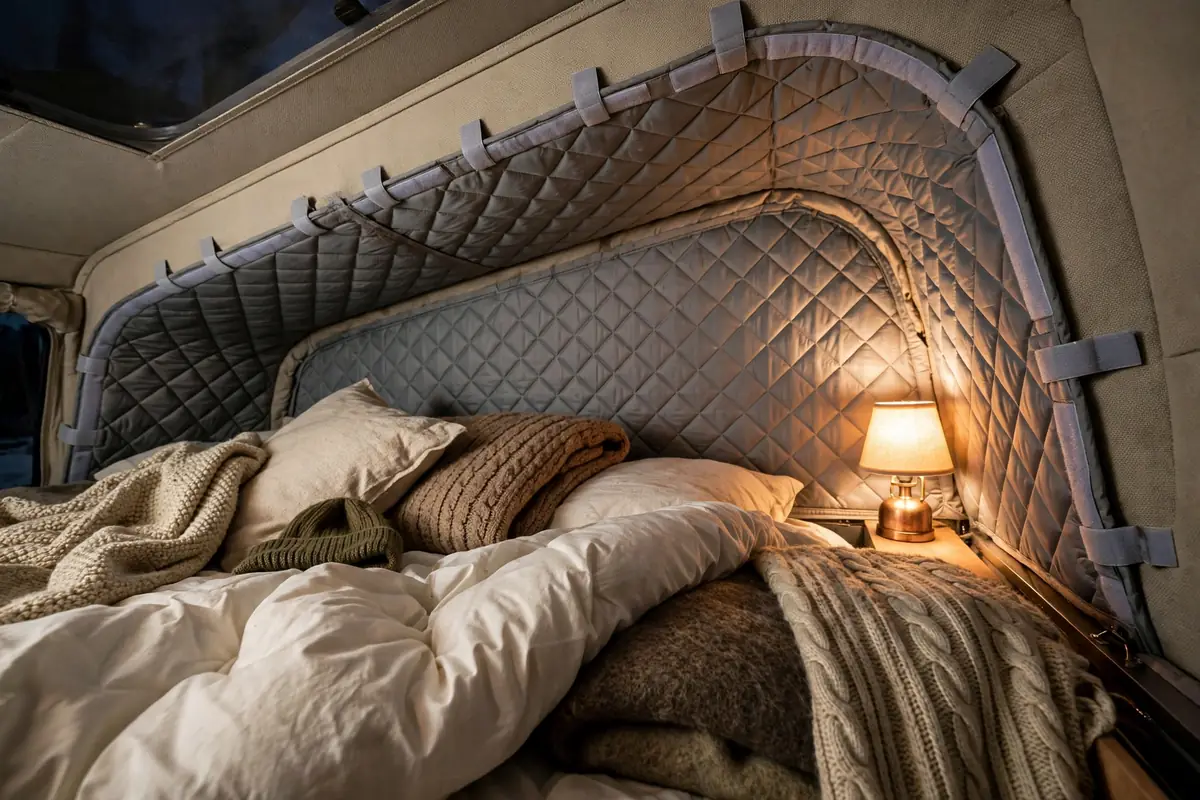
A thermal pack is the one accessory nearly every cold-weather pop-up owner ends up buying. Four Wheel Campers’ thermal pack is a quilted three-layer liner of polypropylene nonwoven fabric that velcros to the inside of the pop-up walls, trapping air between the liner and the vinyl. It adds little real R-value, but it breaks the radiant chill off the canvas, which slows condensation. Four Wheel Campers lists the quilted 3-layer thermal pack at $1,120 for the upper section and $1,450 for upper and lower on their official CampOut options page, and their winter checklist recommends it for camping below freezing.
Set honest expectations: the thermal pack makes a real, noticeable difference, but it is not a cure. The British Columbia owner had the thermal kit and still fought condensation in wet coastal cold; owners in dry mountain cold are far happier with it.
The DIY route works too. Reflectix cut to the shape of each soft-wall panel, taped with foil tape, and clipped inside with binder clips or Velcro is the standard budget build. The critical rule: whatever you hang must come off in minutes before you lower the roof. Nothing you add can interfere with the lift mechanism or the folding canvas, full stop.
Two more community tricks worth stealing. First, insulate from the outside. Owners on PopUpPortal figured out years ago that covering the outside of the canvas, even with a tarp, cuts condensation dramatically by keeping the exterior surface warmer. Second, hang moving blankets or heavy insulated curtains across the coldest openings. Removable, real thermal mass, nearly free.
And maintain the vinyl. Four Wheel Campers’ winter guidance says to wash the soft sides with mild soap and treat the vinyl inside and out with 303 Aerospace Protectant once a year, explicitly not Armor-All, whose oil damages vinyl. Their owner manual adds that 303 works on the rubber door, vent, and window seals too. Treated vinyl stays supple in the cold and sheds water. Do this before winter, not during.
Frozen Lift Panels, Seals, and Snow on the Roof
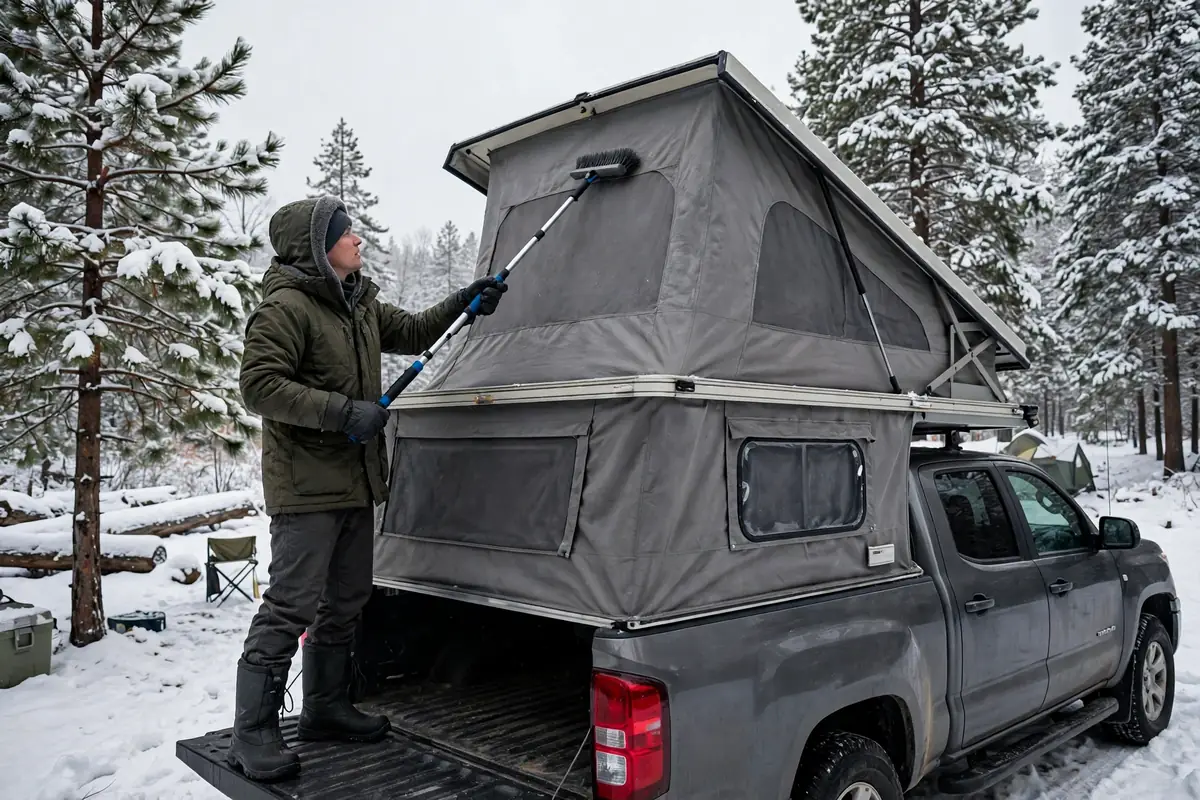
Moisture condenses on the lift panels, latches, and roof seals overnight, then the temperature drops and it all freezes. A latch you could flip with a finger at dusk becomes a popsicle at dawn. Old, untreated rubber seals get stiff and can stick. The 303 treatment from the last section is your first defense; wiping the lift mechanism and seals dry as part of your morning routine is your second.
The bigger winter-specific danger is the roof. An Expedition Portal owner learned this the hard way: after a foot of fresh snow landed on his FWC roof overnight, he lowered it without clearing it, and the weight forced the roof down so fast it nearly crushed him. Clear snow off the roof before you lower it, every time, with a soft telescoping brush, never a metal scraper that can tear the roof or vinyl. Watch for ice dams around roof vents and seams, where refreezing meltwater works under the sealant. Inspect the seals before winter.
Never force a frozen roof. If the lift panels are iced, run the furnace, warm the camper from the inside for twenty minutes, and try again gently. Don’t let a storm’s worth of snow compress into ice on the roof; that weight sits on the lift mechanism and latches, not just the skin. Watch the forecast like a pilot. If a real blizzard is coming, lower the roof, ride it out in hard-side mode, and pop back up when it passes. No shame in it.
For the water system side of winter prep, follow our step-by-step winterizing guide and camp with jugs of water instead of a live system, which is exactly what the cold-weather pop-up owners do.
Skirting the Gap: Wind Is the Enemy Under a Pop-Up
Skirting is usually a big-RV topic, but pop-up owners have their own version, and it’s about air, not R-value. A winter RV skirting guide puts it bluntly: stopping air movement is roughly ten times more important than any R-value the material has. Under a pop-up, the gaps are everywhere: turnbuckle access doors, the dead space between the turnbuckles, the gap between truck bed and camper floor. Cold air pours up through them as drafts you can’t quite find.
The fixes are humble and effective. One WanderTheWest owner traced his worst draft to air seeping up through the turnbuckle “hallway” and stuffed foam into the dead space between the turnbuckles. Reflectix or foam board cut to fit the bed walls and turnbuckle openings does the same job. Some owners rig a canvas skirt around the bottom edge of the camper to break the wind. Two rules: never block the furnace exhaust or any vent, and if you’re parked for a stretch, confirm your CO and smoke alarms still test clean. Skirting comes off before you drive and gets dried before storage, same as wet canvas.
Don’t forget the wind above. A pop-up in a hard gust is noisy, the price of admission. Keep windows and vents latched tight, orient nose-into the wind if you can, and check the canvas zippers and velcro before bed.
Heater and CO Safety in a Canvas Rig: The Non-Negotiable Rules
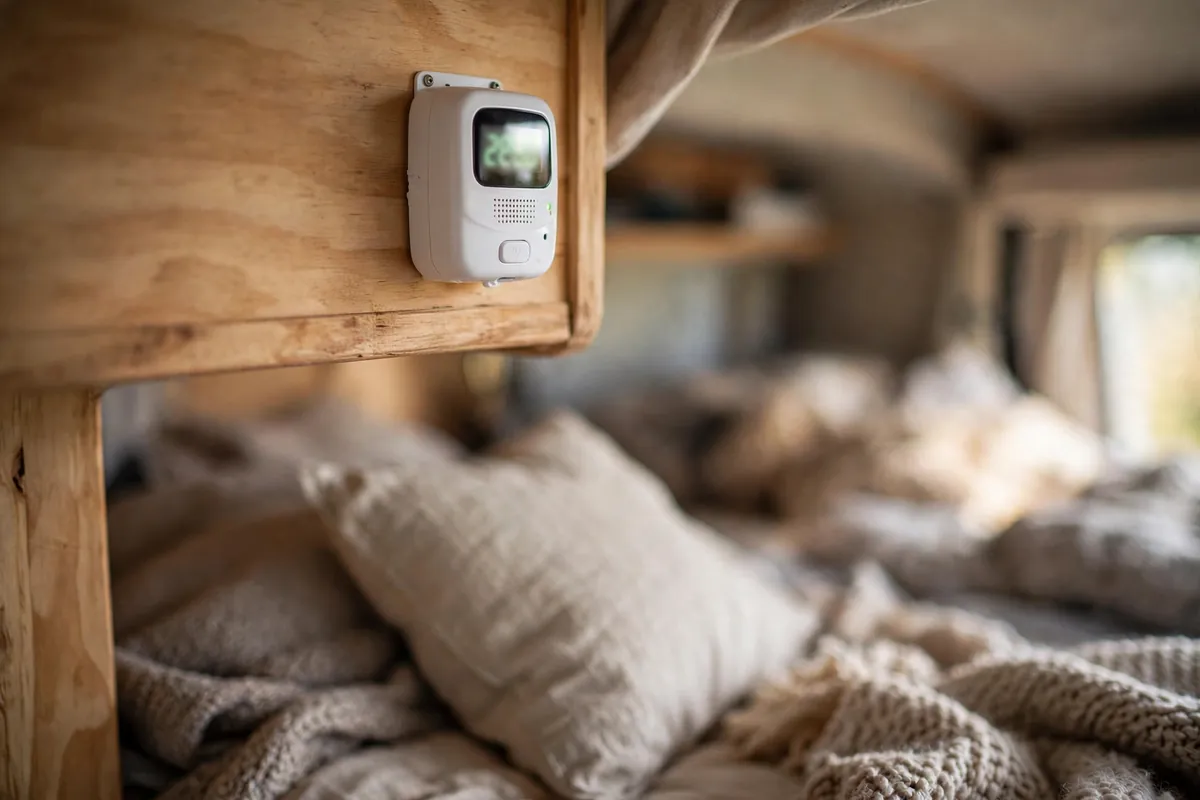
This section is mandatory, not optional. A pop-up in winter is a small, nearly sealed space with fabric walls, and carbon monoxide is odorless, colorless, and kills. The CDC is explicit: generators, grills, camp stoves, and any gasoline, propane, or charcoal-burning device should never be used inside a camper, and their carbon monoxide guidance lists the symptoms to know: headache, dizziness, weakness, nausea, vomiting, chest pain, and confusion.
The rules for a pop-up specifically. Install a battery-powered CO alarm near the sleeping area, down low where you breathe at night, and a second one in larger models. Test it before every winter trip. Modern Four Wheel Campers ship with an LP/CO detector and smoke detector as standard equipment; if yours is older or a shell model, adding your own alarm is a twenty-minute job that could save your life. Never run an unvented heater, a Buddy heater, a catalytic heater, a camp stove, or a generator for heat while you sleep, or inside the canvas at all. The moisture is a nuisance; the CO is the killer. Keep a vent cracked whenever any combustion heater runs, even a vented furnace, because fresh air is what keeps you alive if an exhaust ever gets blocked by snow. Keep the furnace exhaust outlet clear of snow and ice every morning. And never warm the camper by idling the truck with the camper on it in still air; exhaust pools under the rig and finds its way in through the very turnbuckle gaps you’re sealing.
If the alarm sounds, get into fresh air immediately and get help. CO poisoning mimics the flu, and sleeping through the early symptoms is how this goes wrong. Tell your camping partner the plan before the trip. The canvas keeps you warm, but only the alarm keeps you honest.
The Pop Up Truck Camper Winter Camping Night Routine
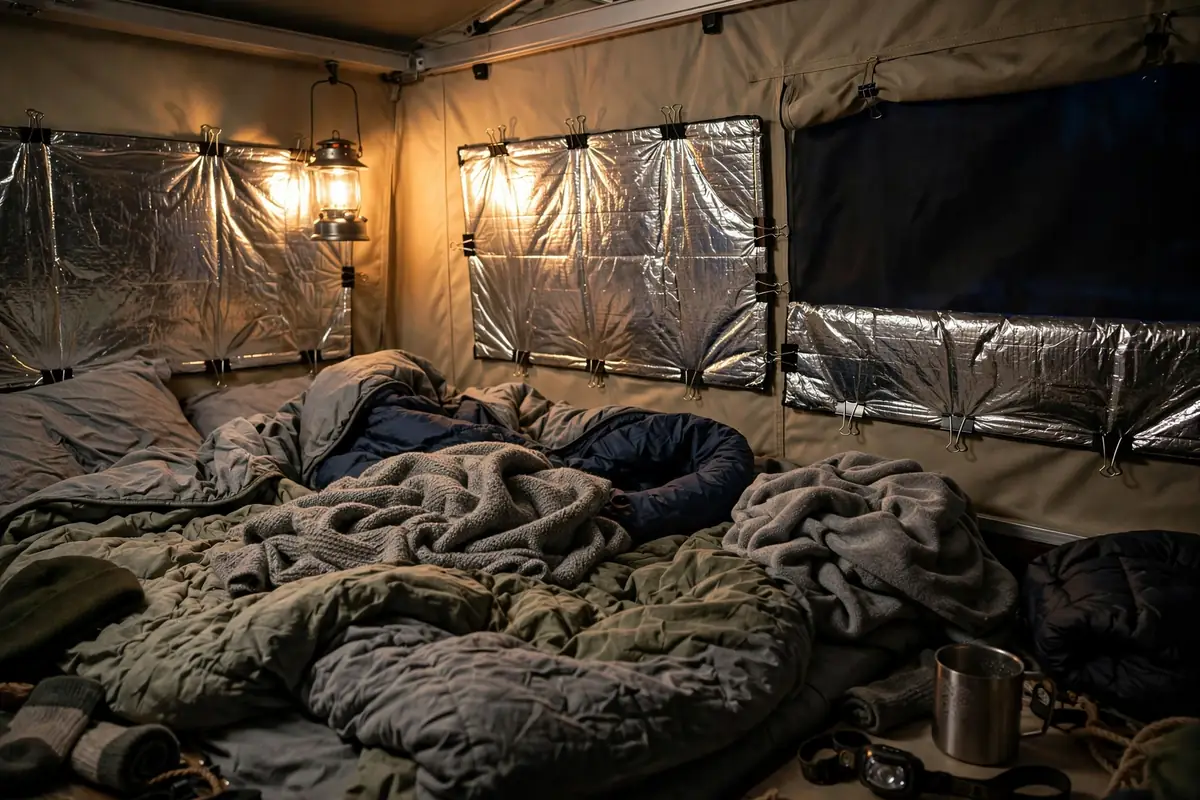
Here’s the rhythm that works. Evening: clear snow off the roof, pop the top, hang the thermal pack or Reflectix, crack the roof vent and a low vent, wipe down any damp spots, check propane and battery, test the CO alarm, and aim a fan to push warm air toward the bed. Overnight: furnace on the thermostat, vent fan on low, sleep in the good bag. Morning: crank the heat while you dress, open the roof vent wider, towel down the canvas, pull the Reflectix off, and let everything breathe before lowering the roof. Then brush the snow off, latch down, and drive to the next one.
Pop up truck camper winter camping asks more of you than hard-side camping. The reward is the part nobody talks about: empty ski lots, desert sunrises with frost on the ground, and a camper half the weight of the hard-sides. Treat the canvas as the living, breathing thing it is, vent like you mean it, keep the furnace fed, and the pop-up will take you places the big rigs can’t follow.
FAQ
Can a pop-up truck camper handle below-freezing temperatures?
Yes, with eyes open. Owners regularly camp into the teens and single digits in pop-ups like Four Wheel Campers. The furnace keeps the living space warm; the canvas wall is the weak point, leaking heat and collecting condensation. Expect the furnace to run nearly continuously and carry extra propane and battery capacity. Wet coastal cold is far harder on a pop-up than dry mountain cold.
Do thermal packs really make a difference for pop-up winter camping?
They make a noticeable difference in warmth and condensation, but they aren’t magic. The quilted liner traps air between the vinyl and the interior, breaking the radiant chill off the canvas. Four Wheel Campers prices their 3-layer thermal pack around $1,120 for the upper section. Pair it with ventilation and morning wipe-downs; it won’t eliminate moisture on its own.
What’s the best heater for winter camping in a pop-up truck camper?
A vented furnace is the correct primary heater because its combustion moisture exhausts outside. For boondocking upgrades, owners favor 2 kW diesel air heaters, often mounted outside with hot air ducted in, because they produce dry heat and sip fuel. Avoid unvented propane heaters as a primary winter heat source: they dump large amounts of water into the camper air and carry a CO risk.
How do I stop condensation on the canvas of my pop-up camper?
You manage it, not eliminate it. The owner-tested routine: crack a roof vent and a low vent every night, run a small fan to keep air moving against the canvas, wipe the vinyl down each morning before lowering the roof, use a thermal pack or Reflectix liners, and never fold wet canvas for storage. If you close it damp, open it again at home and dry it fully.
Is it safe to run the furnace overnight in a pop-up truck camper?
A properly installed, vented furnace with a clear exhaust is designed to run overnight, and owners do it routinely. The non-negotiables: a working battery-powered CO alarm near the sleeping area, a vent cracked for fresh air, the furnace exhaust kept clear of snow and ice, and no unvented heaters or stoves while you sleep. If the CO alarm sounds, get into fresh air immediately.
Should I clear snow off the roof before lowering a pop-up camper?
Always. An owner on Expedition Portal learned this the hard way when a foot of fresh snow forced his FWC roof down so fast it nearly crushed him. Clear the roof with a soft telescoping brush before lowering, never a metal scraper. And never force a frozen roof; warm the camper from inside with the furnace first and let the ice release on its own.