Truck Camper Towing Mirrors: Extended Mirrors That Actually Work Behind a Tall Camper
The first time I merged onto a freeway with a hard-side camper on the truck, I did everything right — signal, head check, slow drift — and still nearly sideswiped a sedan sitting in my blind spot. My stock mirrors showed me a perfect view of the camper’s white sidewall and nothing of the lane next to me. That is the moment most truck camper owners start shopping for truck camper towing mirrors, and it is also the moment most of them buy the wrong ones.
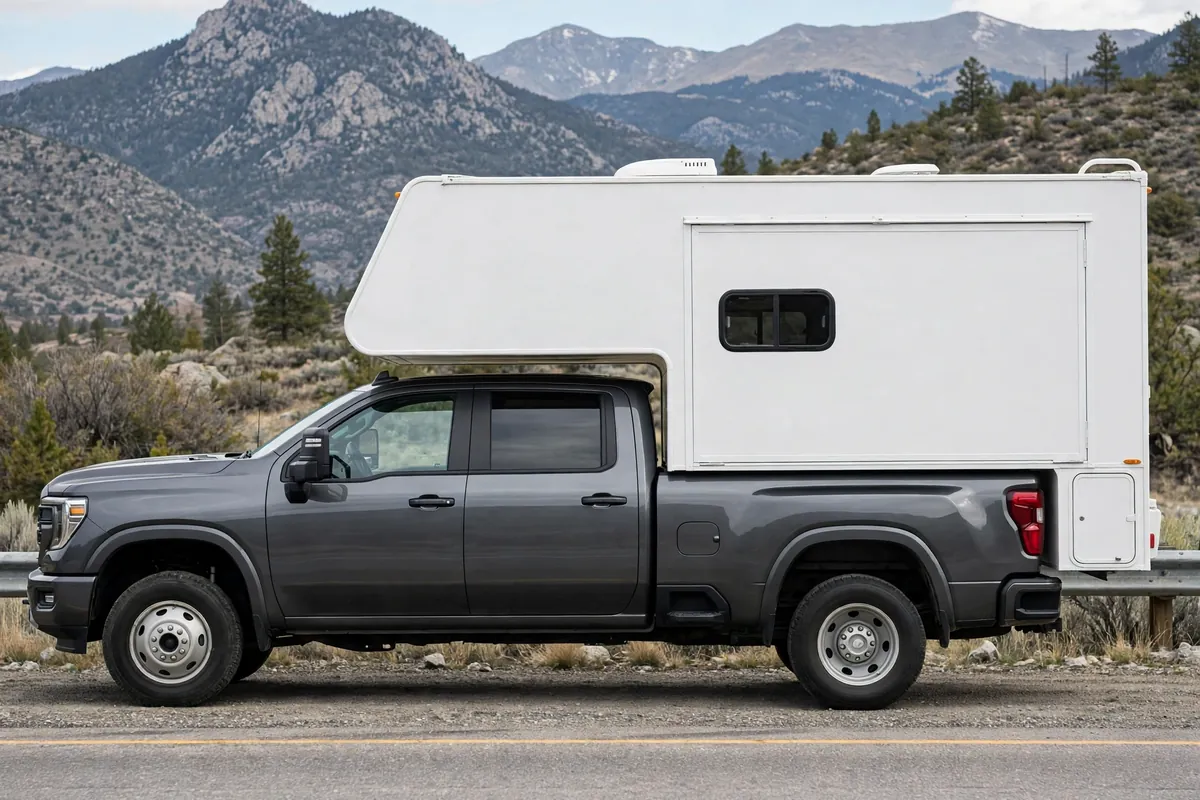
A camper is wider than your truck, taller than your cab, and it blocks your rearview mirror completely.
Why Your Stock Mirrors Fail Behind a Truck Camper
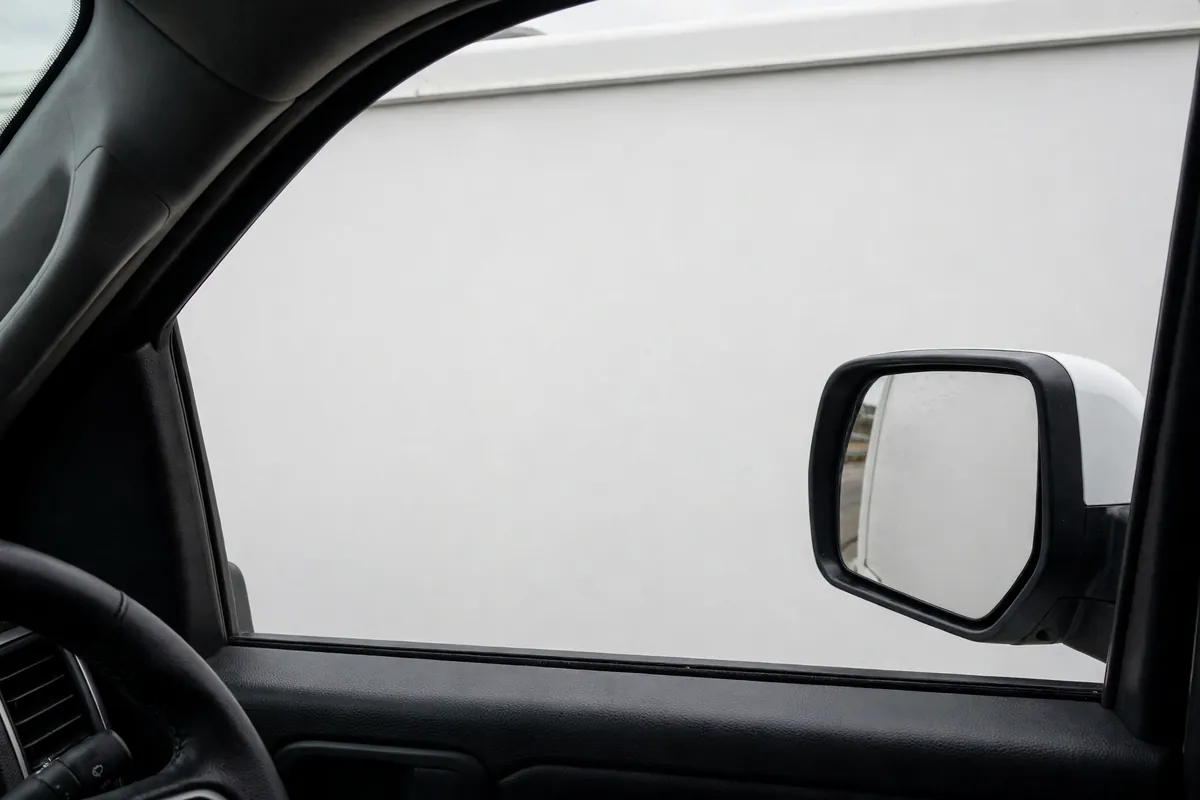
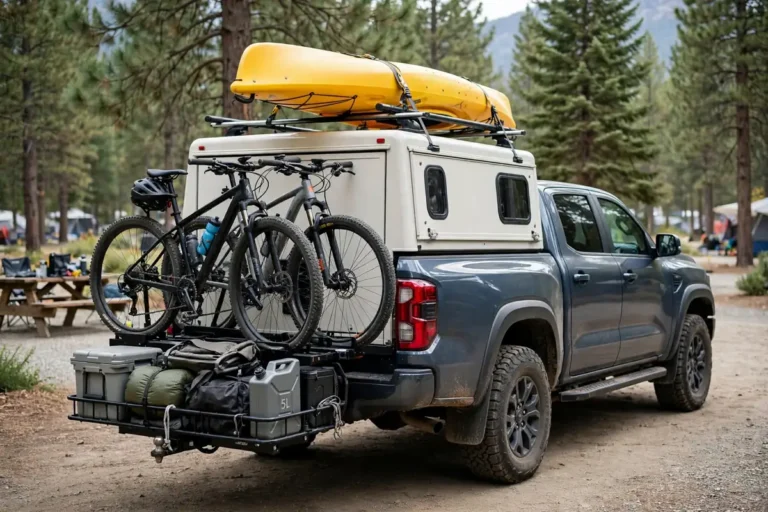
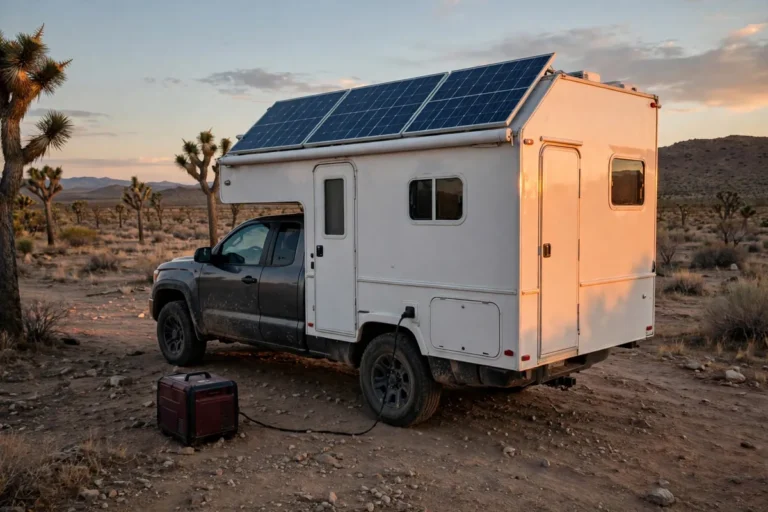
Do the geometry before you spend a dollar. A full-size pickup body is roughly 80 to 82 inches wide; a hard-side truck camper is typically 96 inches wide, and some wide-body models push toward 102 inches — the federal maximum width. So the camper sticks out 7 to 11 inches past each side of your truck, and your stock mirrors hit its front corners and stop. Everything behind that line — the whole adjacent lane — is invisible. The cabover makes it worse, hanging over the cab with sidewalls above the mirror line.
Test it in a parking lot: with the camper loaded, have a friend walk slowly backward along its side while you watch the mirror. If a whole person vanishes for more than a car length, so can a whole car.
Truck Camper Towing Mirrors: The Four Types That Actually Work
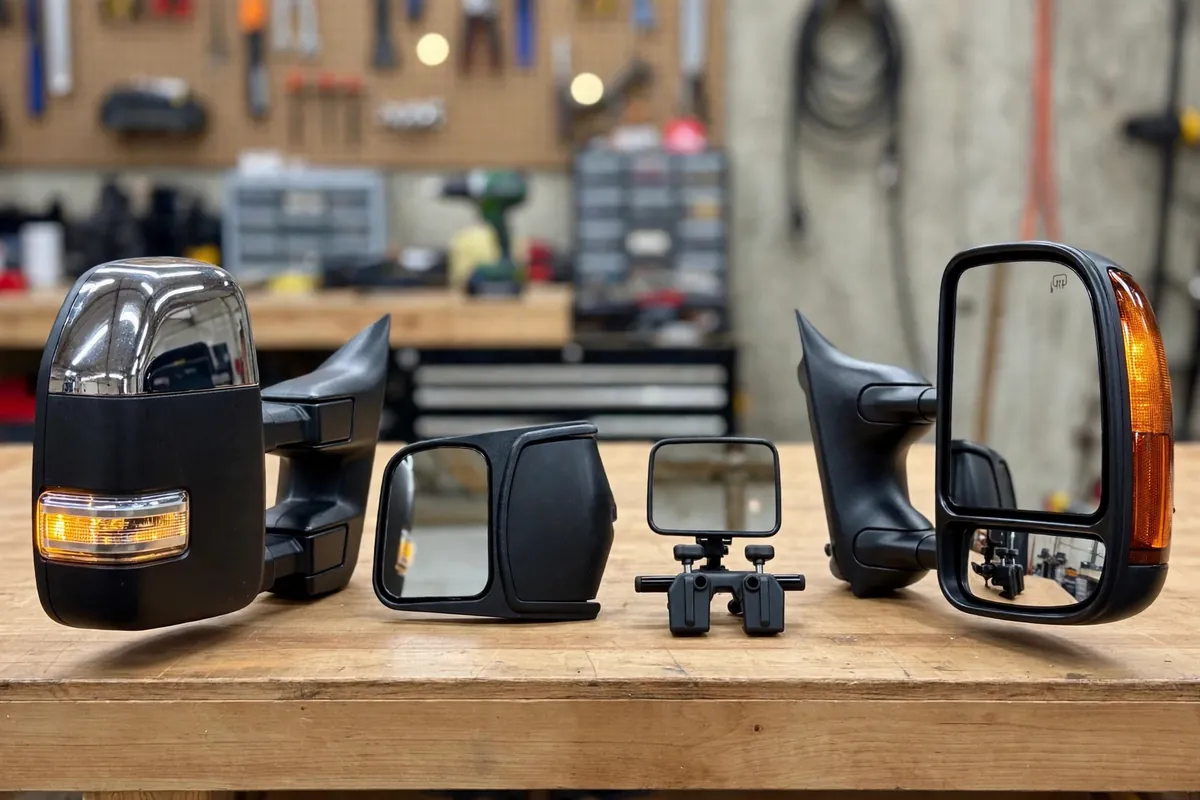
Every towing mirror on the market is one of four things, and the differences decide how much it shakes, how far it reaches, and whether it survives a season of highway driving.
1. Factory tow mirrors
These are the big dual-glass mirrors the truck maker offers as an option or standard on heavy-duty trucks. Ram’s are widely rated the best: they telescope out, flip up into tow position, and on higher trims the lower convex glass is power-adjustable from the door panel — the only brand that offers that. Ford’s Super Duty mirrors are the only dual-post design, and the PowerScope versions on Lariat, King Ranch, and Platinum let you choose exactly how far they extend. A recent ranking of factory and aftermarket towing mirrors puts Ram first and Ford second for exactly these reasons.
GM’s mirrors work, but owners flag a real limitation: on some generations they extend to about 103 inches mirror-to-mirror, versus about 107 for Ford and 108 for Ram, and owners towing 8-foot-6-inch rigs report they still cannot see past the load. If you are buying a truck and a camper is in your future, order the tow mirror option from the factory — on some trucks it has been a roughly $40 option, and retrofitting costs far more.
2. Slip-on (sleeve) mirrors — CIPA and friends
Slip-on mirrors slide over your existing factory mirror housing like a glove. CIPA is the name everyone knows: its custom towing mirrors are molded for specific truck models — over 40 applications — and install with a knob and a wedge, no tools, no holes, no marks left behind. Shaped to your exact housing, they fit snugly and shake far less than a universal strap-on.
Prices are reasonable. At AutoZone, CIPA custom towing mirrors run roughly $52 to $78 per side, with pairs around $56 to $81 — check the part number for your exact year, make, and model first, because a sleeve made for one mirror shape will not fit another. CIPA’s own listings note they will not fit over telescoping mirrors, signal-integrated housings, or full-chrome housings on some applications. If your truck already has factory tow mirrors, you do not need slip-ons at all.
Slip-ons suit the occasional camper hauler who carries the camper a few weekends a month and does not want anything permanently mounted. They come off in a minute when the camper comes off, and for most owners a properly fitted CIPA is the best dollars-to-visibility ratio in this guide.
3. Universal clip-on and strap-on mirrors
These are the cheapest mirrors you can buy — a CIPA 11960 universal mirror runs roughly $20 to $40 a pair — and they fit almost anything, because they clamp or strap onto whatever mirror you already have. Brands here include CIPA’s universal line, K-Source, and Fit System; the Camco Dual View adds a second wide-angle face to one unit.
Buy these if you tow rarely, switch trucks, or need something this weekend and the right slip-on is back-ordered. Do not buy them as a permanent solution for a heavy camper — this is the category where owners report the most trouble. Owners on the Fiberglass RV forums describe strap-on mirrors that bounced so hard they caused headaches on the highway, and one that folded flat when a big truck passed at speed. Owners on iRV2 report the same pattern: mirrors that vibrated too much for clear viewing, and one that came loose and hung down by its strap. A mirror you cannot trust at 65 mph is worse than no mirror, because it makes you think you checked a blind spot you never actually saw.
If you run clip-ons, tighten the straps before every driving day, add a felt or rubber strip under the clamp so it grips, and check them at every fuel stop. If you are retightening mirrors every stop, you have bought a rental, not a solution.
4. Full replacement towing mirrors
A replacement mirror unbolts your factory mirror and bolts a bigger one in its place, using the same door mounting points. This is the most stable option there is, and the only one that makes sense if the camper lives on the truck.
Aftermarket sets are far cheaper than most people expect. A basic manual Trail Ridge tow mirror pair for older Ram trucks runs about $160 at 1A Auto; power, heated, and signal-equipped sets for newer trucks run roughly $330 to $800, while budget brands like Spec-D and YITAMOTOR start around $115 to $190 a pair. Factory OEM tow mirrors from a dealer, by contrast, often run well over $1,000 a pair before installation. Match the wiring connector so power adjustment, heat, signals, and blind-spot monitoring keep working, and check the fitment notes — some trucks need reinforcement brackets inside the door for the upgrade.
What Actually Matters When You Choose
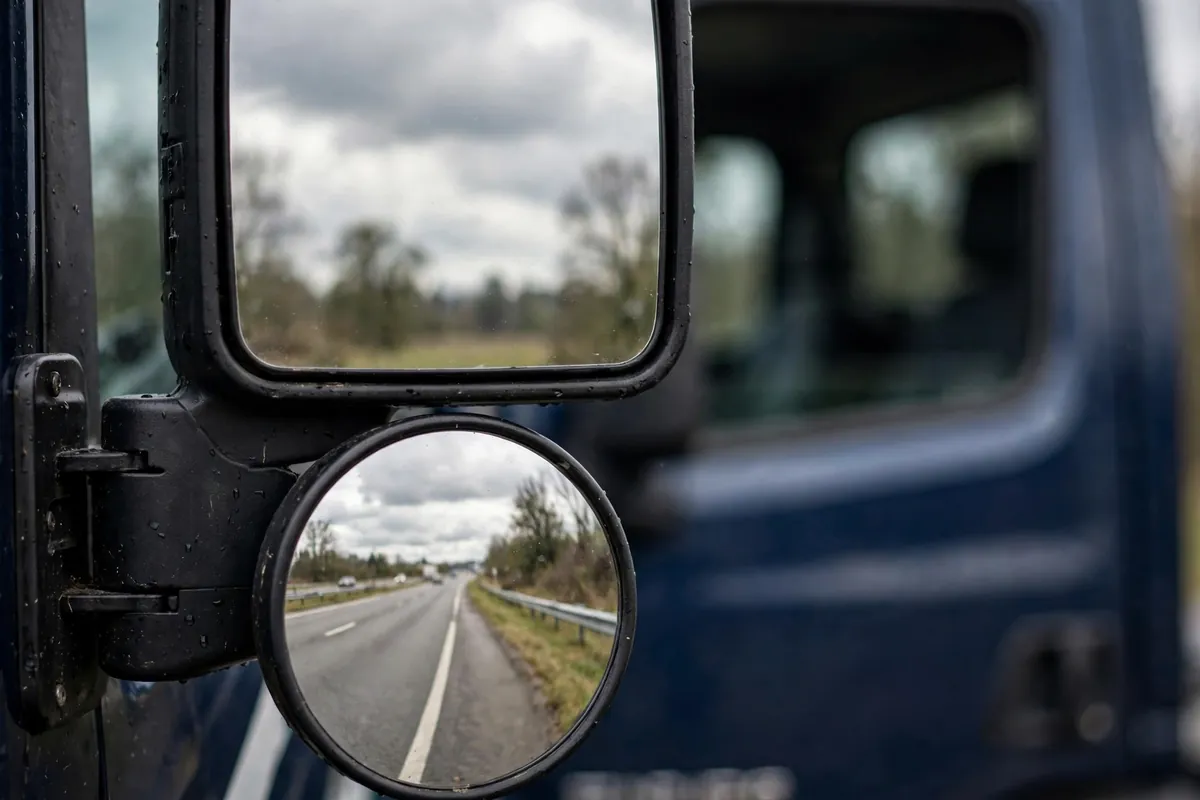
Judge any mirror on four things, in this order.
Extension. The mirror has to reach past the camper’s widest point with room to spare. Measure the camper’s width — usually the sidewalls or the jacks — and your mirror-to-mirror span extended. If the mirrors do not clear the camper by a couple of inches per side, you are still looking at sidewall.
Stability. A mirror that shakes is a mirror that lies. Dual-post arms (Ford) and welded arms (Clearview) resist vibration better than single-post or strap-mounted designs — check owner reviews for the words “vibration” and “highway speed” before buying.
Glass layout. The best tow mirrors have two pieces of glass: a flat upper mirror for true distance judgment and a convex lower mirror for the blind spot beside your rear wheels. If you are buying a single-glass mirror, add a stick-on convex spot mirror low on the glass, where it shows the lane and the curb — not in the middle, where it eats your main view. Owners on the RV forums swear by aiming the convex glass so you can see the white line on both sides of your lane.
Features you already have. Heated glass matters in cold or wet weather — a fogged mirror is a blind mirror. Power adjustment matters because you re-aim these mirrors every time the camper goes on and off. Blind-spot monitoring is the tricky one: some aftermarket replacements keep it, some do not, so confirm compatibility in writing before ordering.
How to Aim Towing Mirrors for a Truck Camper
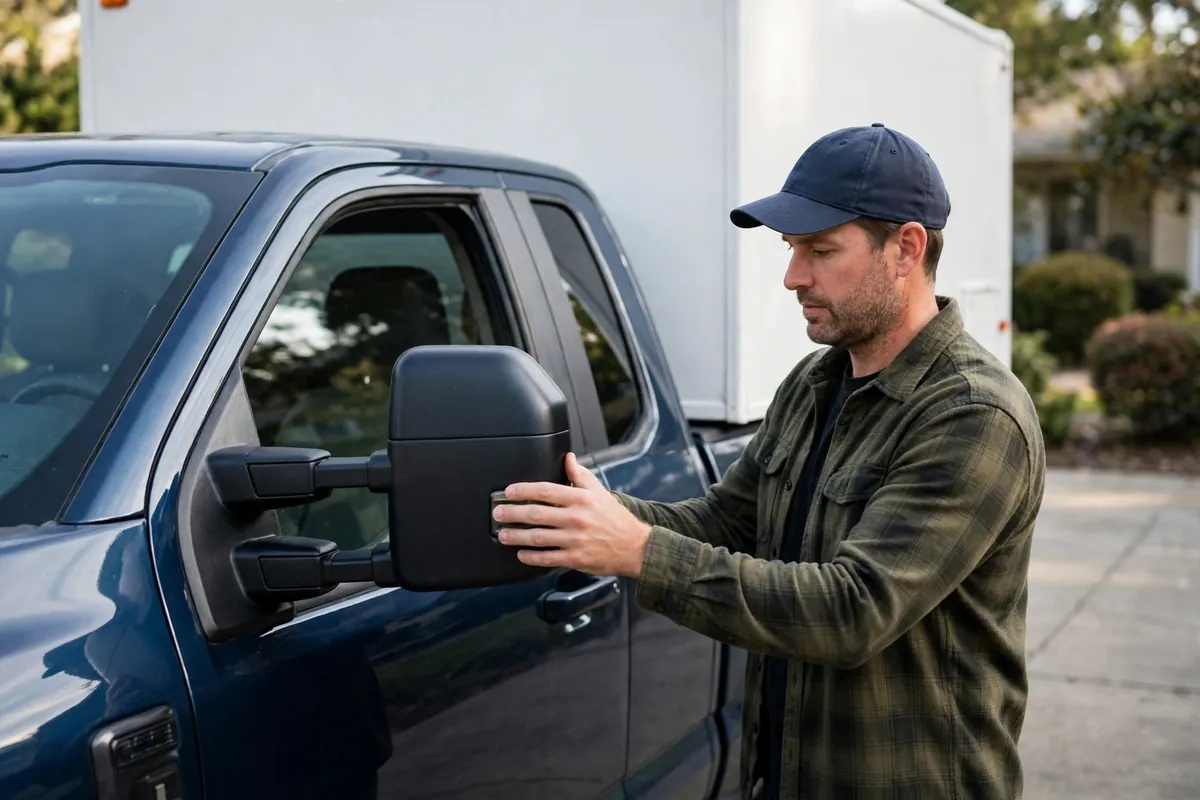
Do this with the camper loaded, on level ground, before you leave:
- Extend first, aim second. Push the mirrors all the way out and flip them into tow position (up on Ram; telescoped out on Ford and GM). Aiming a retracted mirror and then extending it just means aiming twice.
- Flat glass: down the camper’s side. Adjust the flat upper glass until just a sliver of the camper’s side shows at the inner edge, with the rest showing the lane behind you. The rear corner should take up no more than a quarter of the glass.
- Convex glass: the blind spot. Aim the lower convex mirror down and out until you can see the ground beside your rear wheels and the lane next to you — this is the mirror that catches the car the flat glass cannot see.
- Recheck after the first 50 miles. Mirrors settle and clamps loosen — a two-minute re-aim at the first fuel stop beats a perfect aim in the driveway.
Build one habit: glance in a fixed pattern — left mirror, road ahead, right mirror, road ahead — every few seconds. A mirror only helps if you look at it.
The Problems Owners Actually Run Into (and the Fixes That Work)
Clip-ons vibrating loose at highway speed. This is the single most reported towing-mirror problem. Owners on iRV2 and the Fiberglass RV forums report the same sequence: fine at 45 mph, a blur at 65, and eventually a strap worked slack — or a mirror folded flat by a passing truck. The fixes that hold: switch to a vehicle-specific slip-on like a CIPA, whose molded sleeve grips the housing; add a rubber pad under the clamp; and if you tow often, move to a full replacement mirror.
Mirrors that will not clear a wide camper. Owners towing 8-foot-6-inch-wide rigs report this constantly, and it is not always a cheap-mirror problem. On iRV2, owners found that even factory HD tow mirrors on some GM trucks — extended to about 103 inches — could not see past an 8.5-foot-wide load, while Ford and Ram mirrors reaching 107 to 108 inches could. The owner fix: measure before you buy, buy the widest extension your truck offers, and if your truck’s factory mirrors are the limit, a replacement set with longer arms beats any clip-on — no add-on can reach further than the housing it clamps to. Measure the camper’s actual width, not the brochure’s: jacks and awning arms add inches the spec sheet forgets.
The passenger-side blind spot is worse than the driver’s side. The driver’s side is a straight line from your eye to the mirror to the camper’s edge; the passenger side crosses the whole cab, so the angle is shallower and the blind spot bigger — owners consistently say the passenger side is where cars hide. Aim its convex mirror more aggressively outward, and add a camera to cover what it cannot.
The “I flipped them up and forgot” problem. Ram’s flip-up mirrors and Ford’s telescoping mirrors are wonderful until you leave them extended for a week of daily driving and catch one on a parking garage pillar. Owners on iRV2 joke about it, but the advice is consistent: make extending the mirrors part of your loading checklist and retracting them part of unloading. A folded mirror cannot be clipped by a passing truck.
Mirrors vs. Cameras: What Owners Actually Run
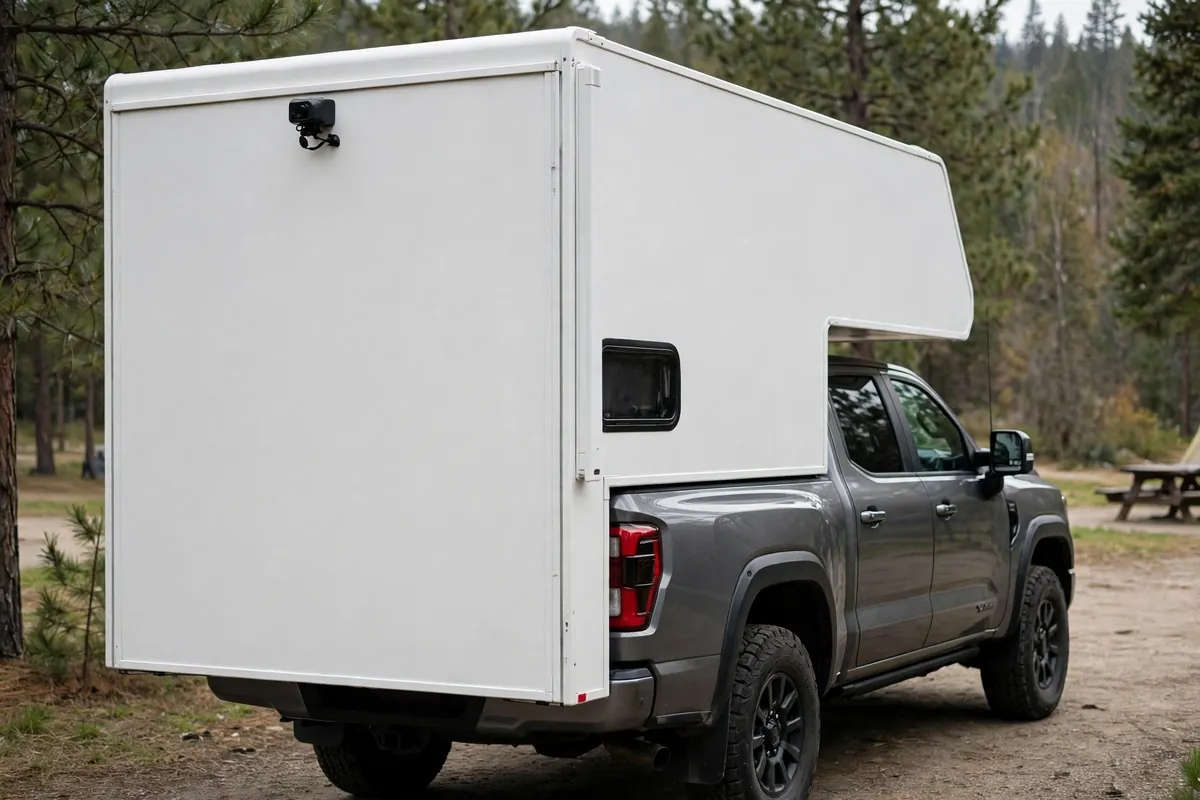
Can a camera replace the mirrors? Owners who have tried it say no — but a camera plus mirrors is the best setup most camper owners can buy.
One iRV2 member bought a three-camera Furrion system after strap-on mirrors vibrated loose and was very happy with it — but kept the strap-ons in a box as a backup, because the camera worked on day one of a trip, about 70 percent of the time on day two, and about 30 percent on day three, and he suspected water intrusion. Another owner put it bluntly: a camera is not a replacement for mirrors, and in some states towing with blocked mirrors is not legal — a screen does not satisfy a mirror requirement. Mirror requirements vary by state, so check your own, but do not plan a camera-only setup.
What owners recommend, over and over, is the combination. A rear camera on the back of the camper — the same kind covered in our truck camper backup camera guide — shows you what is directly behind the camper, which no mirror can ever show. The mirrors show you down the sides and into the adjacent lanes. Run together, they cover each other: the camera catches the car tailgating you out of mirror range, and the mirrors keep working when the camera fogs or quits on a rainy trip. If you buy one camera, make it the rear one, mounted high on the camper’s back wall, and leave it on while you drive — not just for backing up — to see the car behind you and know exactly when you are clear to pull back in after passing.
What I Would Buy
- Buying a truck soon? Order factory tow mirrors — the cheapest, most integrated option, and Ram’s power-adjustable convex glass is the best factory setup on the market.
- Already own the truck, camper goes on a few weekends a month? A vehicle-specific CIPA slip-on pair, roughly $56 to $81. Best visibility per dollar, comes off when the camper does.
- Camper lives on the truck, or you full-time? A full replacement set — a manual Trail Ridge pair starts around $160; a powered, heated set with signals runs roughly $330 to $800. Bolt it on once.
- Tight budget, one trip next weekend? A universal clip-on pair for $20 to $40 — but treat it as a trial, check it at every stop, and upgrade before it upgrades itself off your truck at 65 mph.
- Already have good mirrors and still nervous? Add a rear camera on the camper — the single best supplement to mirrors, covering the one view mirrors can never give you.
Before every driving day, tug each add-on mirror firmly — if it moves, reseat it before you roll. At every fuel stop, glance at both mirrors, and when the camper comes off, take the add-ons off too. Mirrors are only one part of driving a loaded truck safely — our driving guide covers wind, grades, and braking, and if you are also towing a trailer behind the camper, the problem doubles.
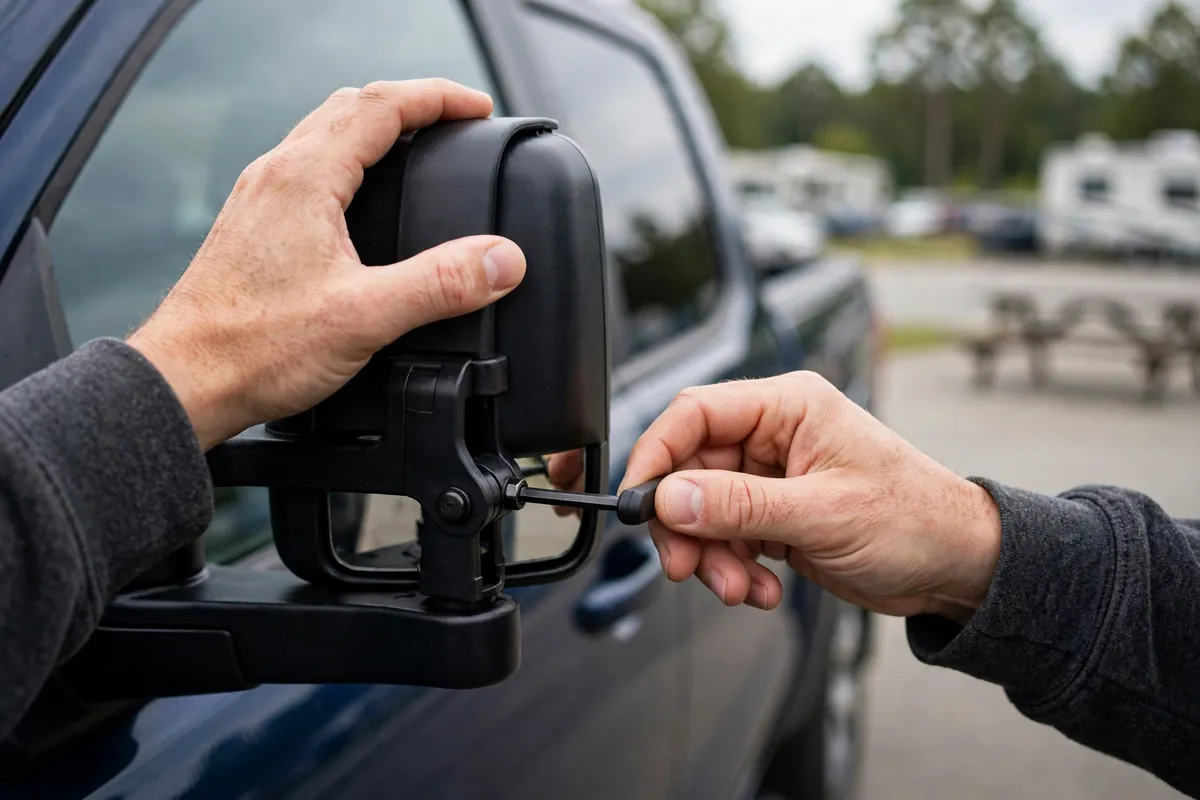
The right mirror is the one that lets you change lanes without holding your breath. Measure your camper, match the mirror to your truck, aim it with the camper loaded, and check it every driving day. The sedan in your blind spot will never know how close it came — and that is exactly the point.
FAQ
Do I need towing mirrors for a truck camper?
If your camper is wider than your truck — and nearly every hard-side camper is — yes. Stock mirrors show you the camper’s sidewall, not the lane beside you. Most states require a clear view behind the vehicle, but requirements vary by state, so check your own state’s rules.
Are clip-on towing mirrors any good?
For occasional use, yes — a good clip-on is far better than stock mirrors. For regular highway driving with a heavy camper, owners consistently report vibration, loosening straps, and mirrors folding back when large trucks pass. A vehicle-specific slip-on like a CIPA is a big step up in stability for not much more money; a full replacement mirror is the long-term answer.
What is the best towing mirror for a truck camper?
Factory tow mirrors if your truck has them, or a vehicle-specific slip-on pair (CIPA) if it does not. Full-timers should get full replacement mirrors — Trail Ridge, Spec-D, or Clearview. Ram’s factory mirrors are widely rated the best; Ford’s PowerScope mirrors are the only ones that power-telescope to a position you choose.
Can a backup camera replace towing mirrors?
No. Owners who tried camera-only setups report cameras that fail, fog, lose signal, and make distance judgment harder than flat mirror glass, and a camera does not satisfy mirror requirements in some states. Best setup: mirrors plus a rear camera on the camper — mirrors for the sides and blind spots, camera for directly behind.
How much do truck camper towing mirrors cost?
Universal clip-ons run roughly $20 to $40 a pair; vehicle-specific slip-ons like CIPA, roughly $56 to $81 a pair; aftermarket full replacement sets, roughly $160 for basic manual pairs to $330–$800 for powered, heated sets. Factory OEM mirrors from a dealer often cost well over $1,000 a pair. Prices checked November 2026.