Carrying Bikes, Kayaks and Extra Cargo on a Truck Camper
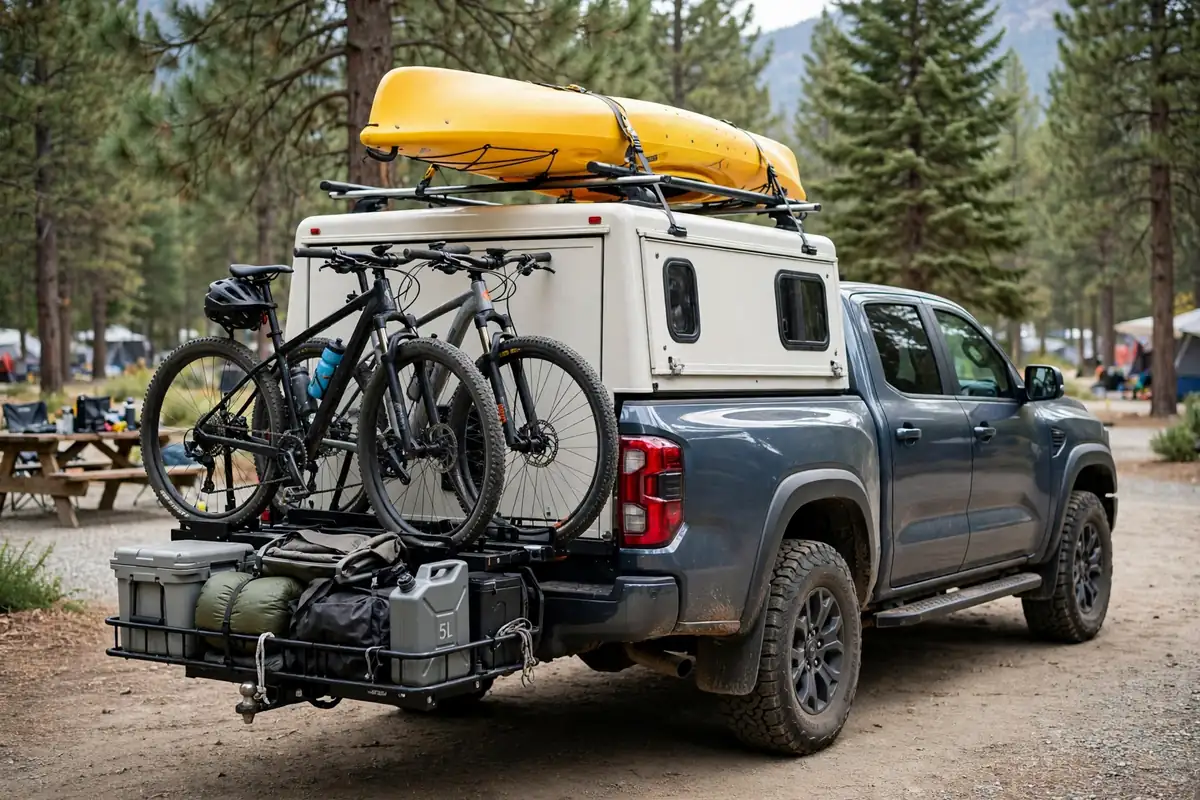
I learned the hard way that carrying bikes and kayaks on a truck camper is not just a shopping problem. It is a geometry, weight and daily-living problem stacked together. The rack that looks perfect in the driveway can block your door at camp, drag on a dip, or turn a paddle morning into a wrestling match with a 12-foot boat eight feet in the air.
This guide covers bikes, kayaks, SUPs and the odd cooler or firewood box mounted on or around the camper itself — not a general gear list, and not a towing manual. For the basics, see truck camping gear and accessories. My rule now: before you buy, decide how you will get the thing on, get it off, and get into your camper with it still mounted. Every bad setup I have seen failed one of those three tests.
Start with the map of your rig, not the catalog
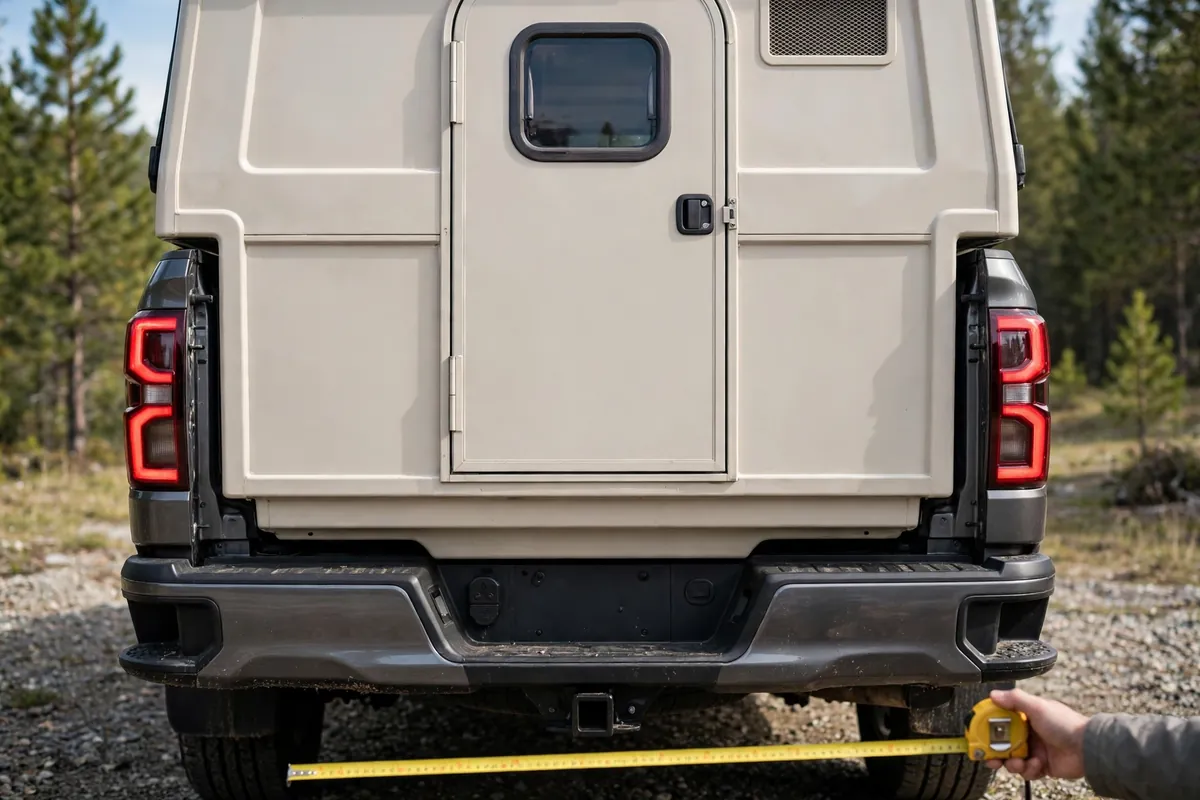
Stand behind your loaded rig and look at it honestly. Where is the door, where do the jacks sit, and how far does the camper overhang past the bumper? A truck camper already sticks out well behind the rear axle, so anything hung back there swings wider, bounces harder and scrapes sooner than the same rack on a plain pickup.
Measure three things before ordering: total height with the boat or box on top, total length with the rear carrier fitted, and ground clearance under the lowest point of the rear rack when loaded. Write them on a card in the cab. A kayak on a tall hard-side camper can easily push you past 11 feet. For height and clearance driving, see the truck camper driving guide before your first roof-load trip.
Weight hung far behind the axle acts like a lever: it lightens the front end and makes the rear bounce more. Weigh the rack plus the gear, not just the gear. I am not redoing payload math here — the truck camper payload calculator guide does that properly — but a heavy steel rack, two e-bikes and a swing arm add up to far more than the bikes alone.
Bikes: the rear rack trap most people fall into
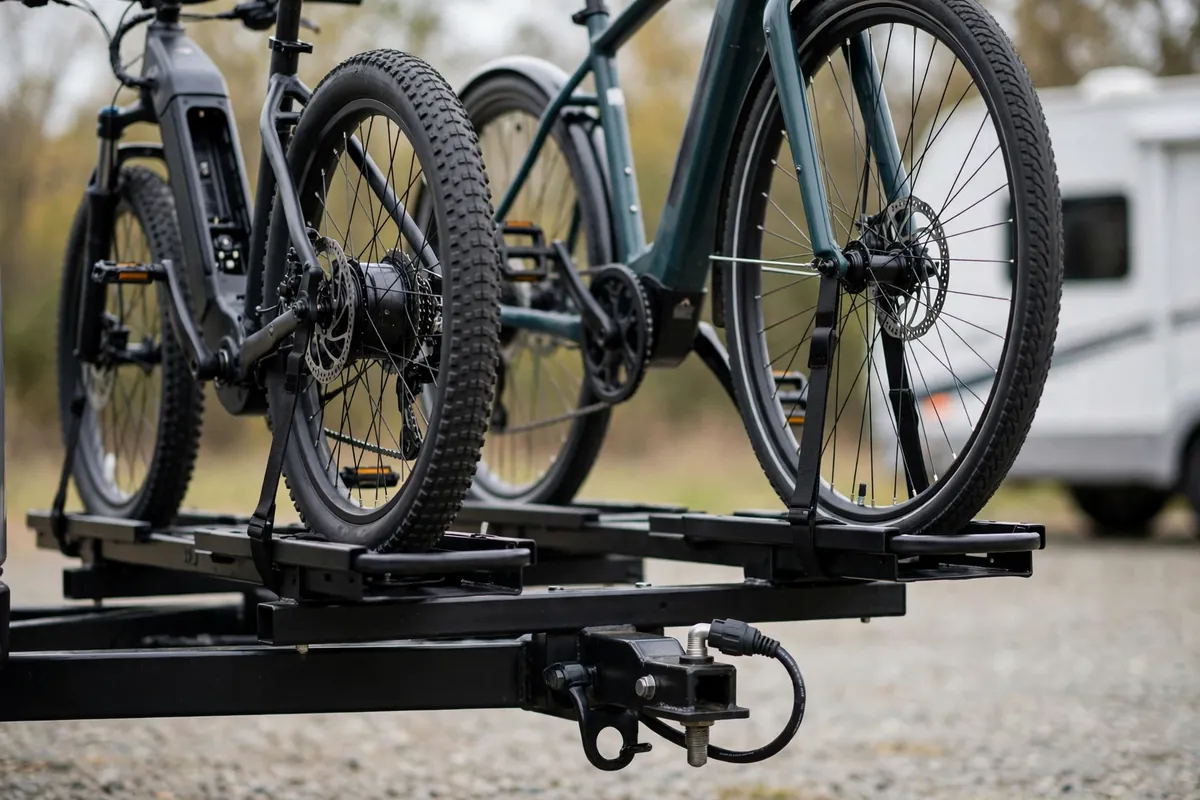
The most common bike mistake is bolting a regular car rack to whatever sits at the back of the camper and assuming it will hold. Owners on forums report the same failure pattern again and again: a bumper or light-duty receiver never meant to carry a bouncing load, a weld that cracks after a few rough trips, and bikes that end up riding inside the camper anyway. One owner on an RV forum described a weld starting to break after a couple of trips, and others warned that many camper bumpers are only rated around 100 pounds — before you add the leverage of a rack sticking out behind them.
So the mount matters more than the brand on the rack. A receiver welded or bolted to the camper frame, with a published rating, is a different animal from a clamp-on bumper mount. A rack rated for RV or trailer use is not marketing fluff: racks at the very back of a rig see far more bounce than the same rack on a car. Owners on iRV2 and Good Sam forums consistently steer people toward RV-rated platform racks, where wheels sit in trays, over hanging racks that let bikes swing — especially for e-bikes, and especially with step-through frames.
E-bikes change the math completely. A regular mountain bike might weigh 30 pounds; an e-bike often weighs 55 to 75 pounds, and two plus a rack can pass 170 pounds before a cover. Take batteries out if you can — owners report saving around 11 pounds each — and cover displays from rain and road spray. If your receiver is rated for only 300 pounds total, two fat-tire e-bikes and a heavy rack leave no margin for potholes.
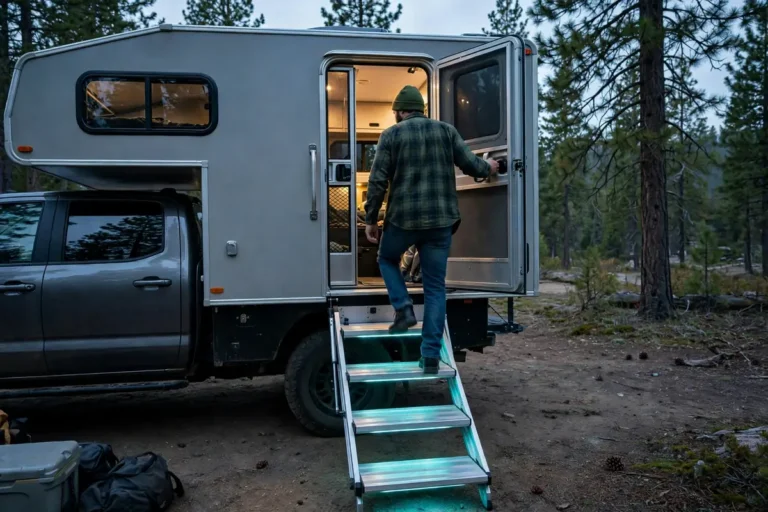
Then there is the door problem, which nobody mentions in product photos. Owners on truck camper blogs report buying a rear rack only to discover it blocks the camper entrance — a deal-breaker when you live in that door. Open it fully with the rack in place and check you can still get the steps down. If not, the fix is usually a swing-away arm or tilt-down rack.
A swing-away arm solves the door problem — it pivots the whole loaded rack aside — but it costs weight capacity and money, and adds a pivot to rattle. Heavy-duty models publish stepped ratings: more when the accessory sits closer to the receiver, less as it sticks farther out. Check the rating at your actual distance, not the headline number.
Front hitch racks are the other option owners argue about. Bikes up front do not block the door, and you can watch them in the mirror. But they catch every bug, stone and rainstorm, can block radiator airflow on a hard-working truck in summer, and make parking harder. Owners on iRV2 warn against loose covers that block cooling air. I would call a front rack a specialist solution, not the default.
The hitch extension rule that quietly halves your capacity
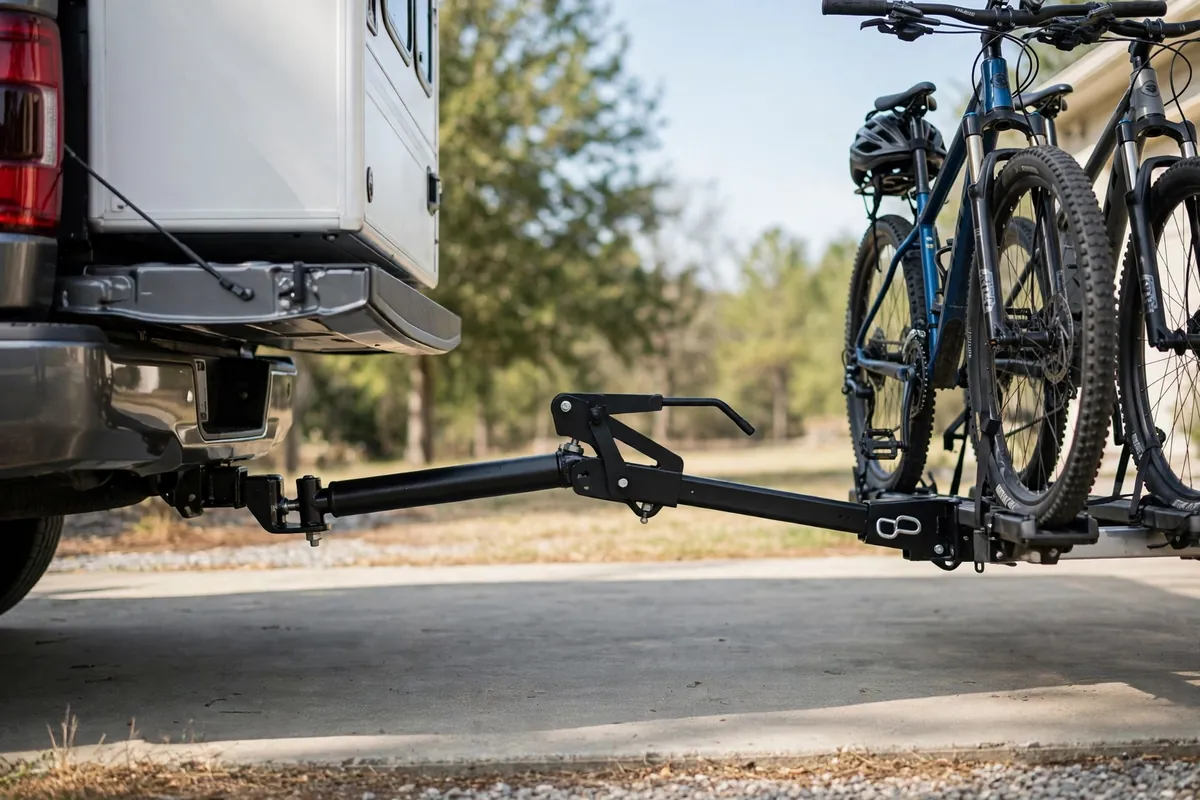
If your camper overhangs so far that a normal rack would hit the camper wall, you will be tempted by a hitch extension. Use one only with your eyes open. Extenders move the load farther from the receiver, and that leverage cuts capacity. CURT states it plainly in its hitch extender guide: extenders under 12 inches long reduce load capacity by roughly 25 percent, and extenders over 12 inches by 50 percent, and you must always obey the lowest-rated component in the system. Owners on Expedition Portal report the same 25 and 50 percent figures, and warn that the risk is not the extension snapping — it is the hitch and its mounting hardware being overloaded by leverage.
That matters twice over here: you may use the extension just to clear the overhang, then hang a heavy e-bike rack off its end — and if you also tow behind the camper, the derating applies there too. For tow-behind cases, read the towing with a truck camper guide first. My rule: shortest extension that clears, solid shank where possible, an anti-rattle tightener at every joint, and a re-check against the derated limit, not the original sticker.
Watch tail swing and departure angle too. A carrier sticking two feet past the camper swings wide and scrapes on dips and ferry ramps. Owners report dragging bike tires because the bikes hung lower than the bumper. Carry bikes high enough that the lowest wheel clears your worst dip, add a light or flag if the load hides your tail lights or plate, and check your state overhang rules — they vary.
Carrying bikes kayaks truck camper gear on the roof
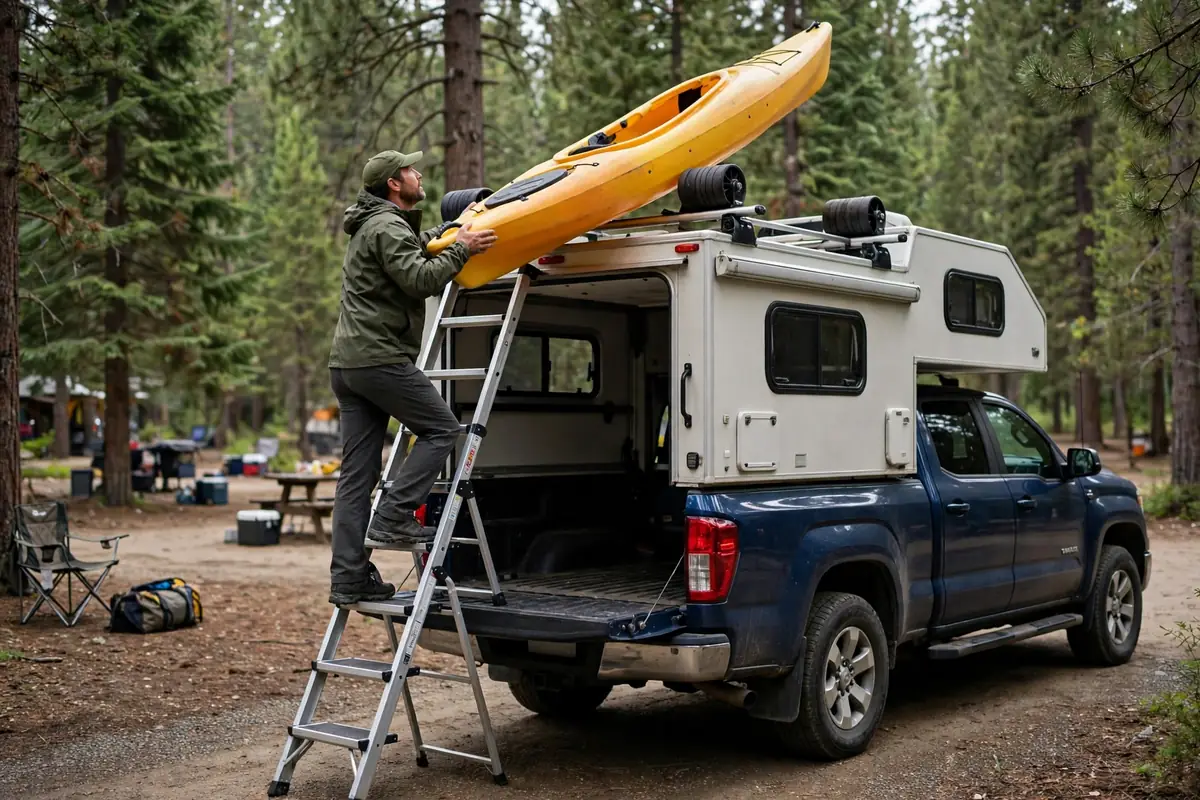
Kayaks are where owners either fall in love with the setup or quietly stop bringing the boat. The roof of a hard-side camper sits high — owners on Wander The West report crossbars over eight feet off the ground — and a pop-up roof is genuinely easier because it sits lower when down. That height difference alone should shape your choice: if you paddle every weekend, a pop-up or a load-assist system is worth more than any fancy cradle.
Owners on Wander The West describe the real routine honestly. Strapping a boat down usually means gymnastics unless you carry a small step ladder, and most experienced owners say the ladder is non-negotiable. One owner loads a 50-pound, 12-foot kayak solo with a step ladder and a roller-and-saddle combo, but still needs the ladder for the front bar straps. Another developed a rear-loading routine: rest the bow on the rear bar, then push the boat forward from behind, with gunwale stops to keep it from sliding sideways. That rear-slide method is the solo technique I recommend learning in your driveway, not at a busy boat ramp.
Load-assist racks exist for exactly this reason. A lift-assist cradle lowers to waist height at the side of the vehicle, you load there, and gas struts help lift it up. Thule lists its Hullavator Pro as taking up to 40 pounds of the kayak weight, and owners call it a game changer on tall vehicles — while warning it is complex, pricey, and awkward enough that some sold theirs after a season and went back to rollers and saddles. Buy load-assist if solo loading is what keeps you from paddling at all; otherwise rollers and saddles with a ladder may serve you just as well for far less.
Three roof rules I never skip. First, the limit is the weakest link: camper roof, rack and carrier ratings — the lowest wins, and rack and carrier weight counts against it. Never walk on a roof your manufacturer says not to walk on; use a ladder or folding step instead. Second, strap the boat to the rack and add bow and stern lines on long boats — owners report boats working loose in highway wind even when tight in the driveway. Third, check what the boat shades: owners on Wander The West were surprised by how much solar charging they lost when one kayak shaded a panel.
Pop-up owners can often leave a light boat on the roof and pop the top with it in place, but owners report that takes stronger gas struts and sometimes two people, especially with two boats up top. Try it at home first.
SUPs: the inflatable advantage, and when not to use it
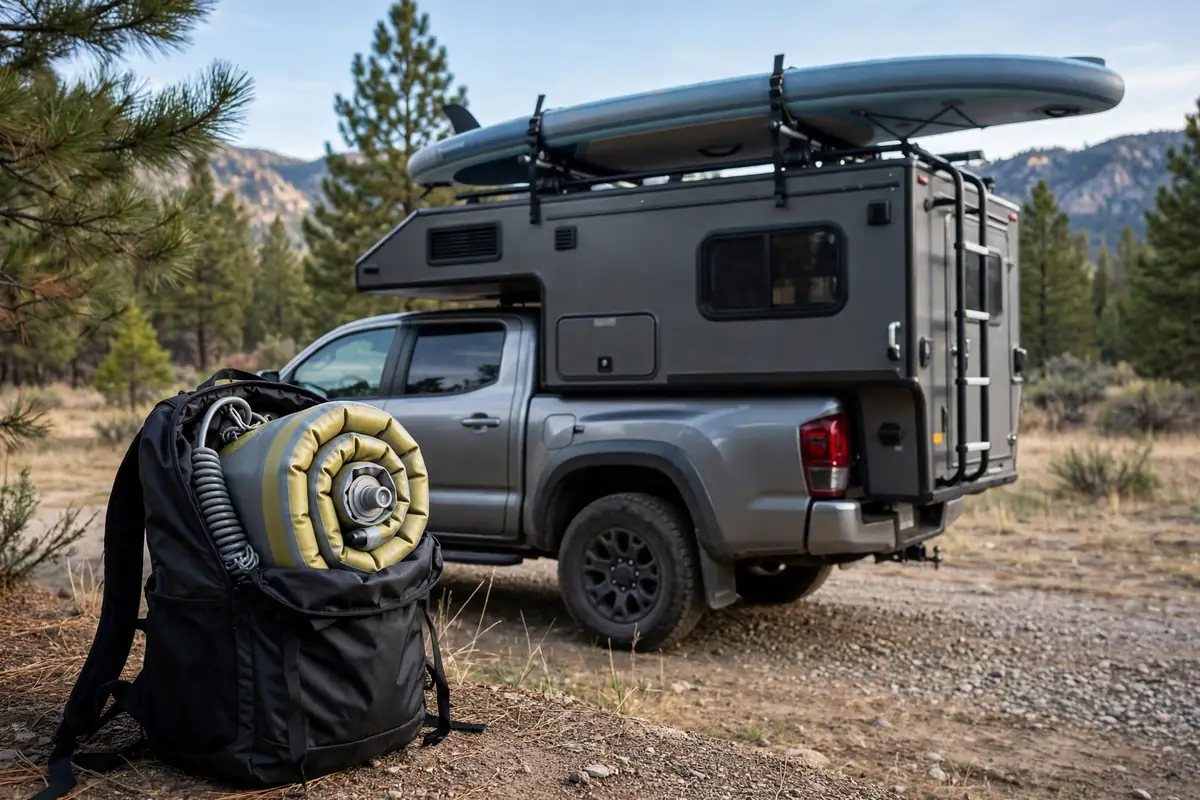
SUPs split into two different carrying problems. A hard board, usually 10 to 12 feet and 25 to 40 pounds, rides like a short, wide kayak: crossbars, pads, cam straps, deck down, bow and stern lines on longer trips. A board bag protects it from sun and road rash, and two boards stack deck-to-deck if you pad between them.
An inflatable SUP is the truck camper cheat code. Deflated, it rolls into a backpack and rides inside the camper, out of the wind, out of sight of thieves, and off your height measurement entirely. That is the right answer for most truck camper trips, especially if you paddle occasionally rather than daily. The compromise is inflation time at the put-in and a pump to carry — a small price for not adding 11 feet of wind sail to your roof.
Carrying an inflatable inflated on the roof works for short, slow trips, but SUP guides warn against making it a highway habit: wind lifts and flexes the light, wide board, straps rub, and heat raises its pressure. For a short hop, keep it near full pressure so it holds its shape, and drop a couple of PSI on a hot day. Over a half hour at highway speed, I deflate and bag it.
Extra cargo: rear boxes, baskets and the things that seem harmless
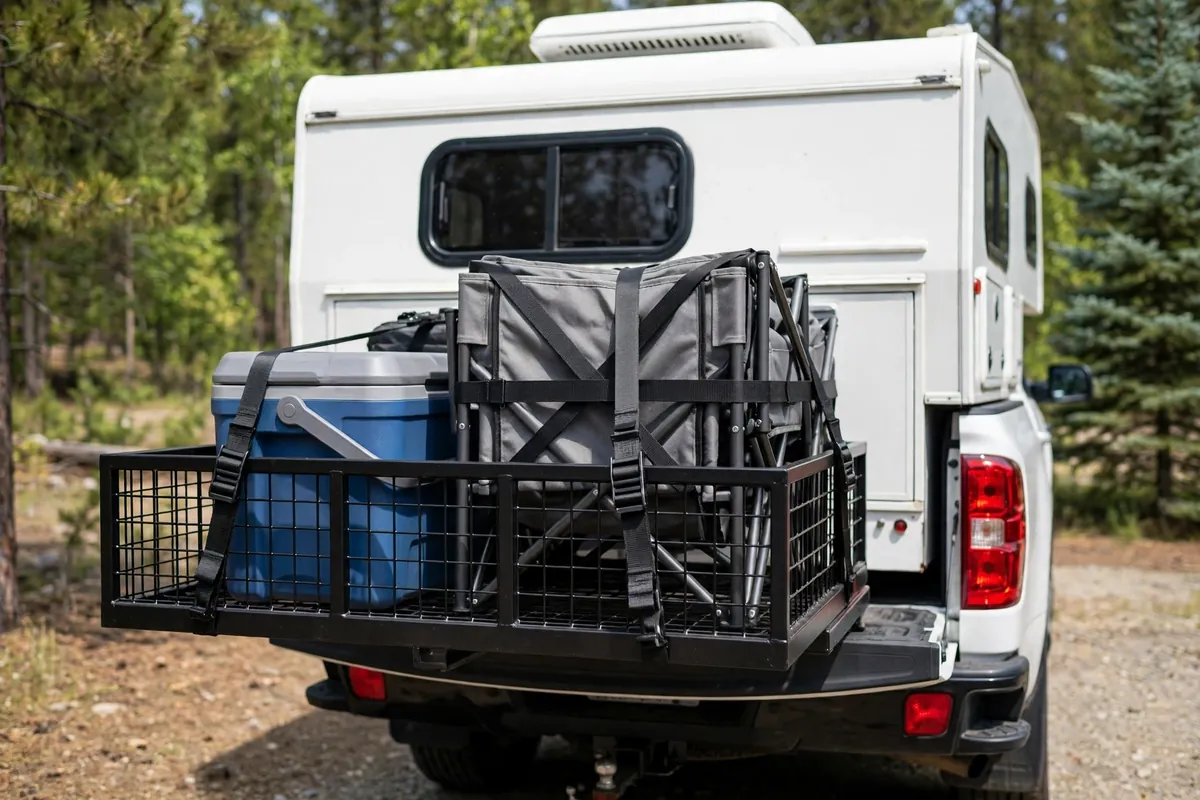
A hitch cargo basket or box is the most useful and most abused carrier on a truck camper. It is low, easy to load, and perfect for coolers, firewood, chairs and wet gear you do not want inside. It is also the thing most likely to get overloaded, because a big empty basket invites you to fill it.
Keep heavy stuff low and forward in the basket, strap everything so it cannot bounce out, and remember basket plus contents count against the same rear receiver limit as a bike rack. A locking swing-away cargo box solves the door problem and keeps gear dry, but it is heavy empty — some popular models weigh close to 100 pounds before loading — so do the derated math first. If it hides your tail lights or plate, add lights and move the plate as your state requires. Never carry gasoline inside the living space.
Roof baskets and boxes free the rear entirely, but keep weight high and hard to reach. On a tall hard-side camper, a roof box only works if you have a solid ladder routine and do not need what is in it daily. I keep daily gear low and rear, and roof cargo for bulky, light, rarely needed stuff. Anything heavy goes low.
Security: make it slow, visible and annoying to steal
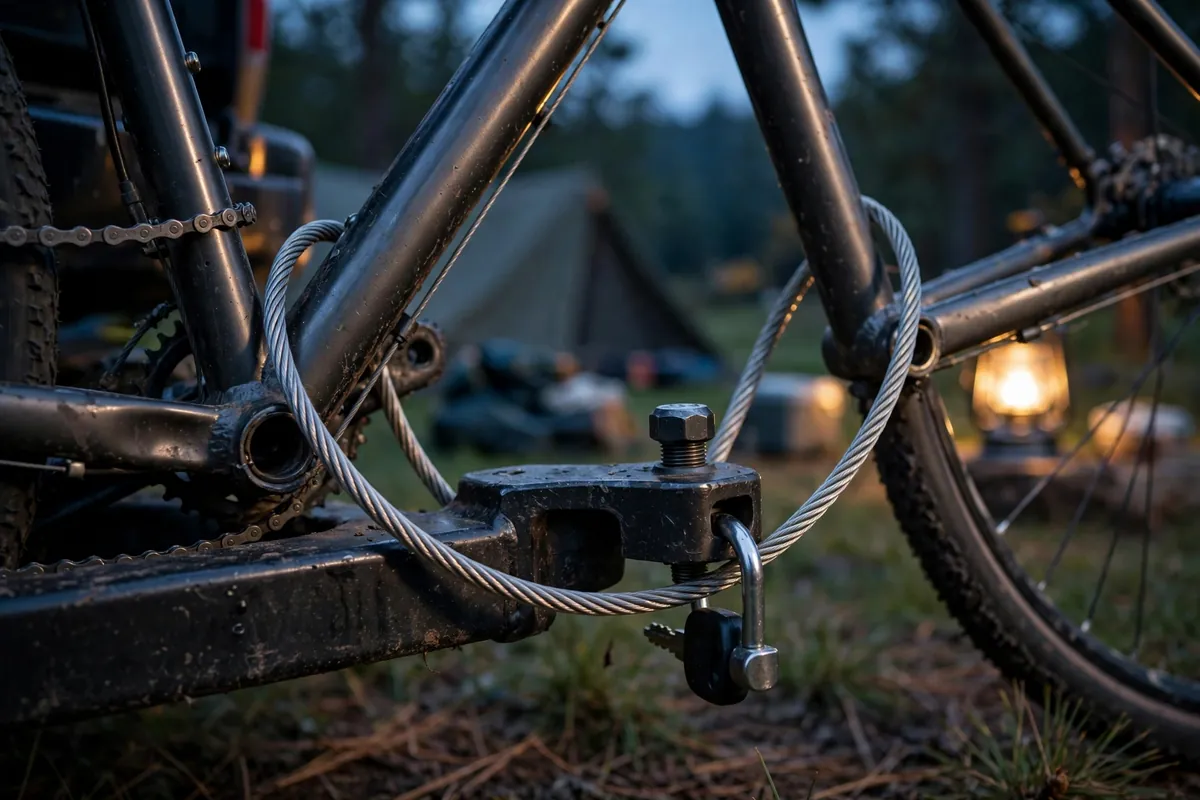
Nothing on the outside of a truck camper is truly theft-proof, and honest owners say so plainly. Owners on the Go Fast Campers forum put it bluntly: lock it, keep it out of sight where you can, and accept that a determined thief with time will get through most things — the goal is to beat opportunists, not professionals. That mindset shapes a better routine than any single lock.
Layer it: locking hitch pin, a lock on each bike, and a cable or chain through the frames to something solid when parked. At camp, owners on iRV2 report locking bikes to the camper or truck wheels with a long cable rather than leaving them on the rack overnight. Take e-bike batteries and displays inside at night. For the wider picture, see the truck camper theft prevention and security guide.
Kayaks and SUPs need the same thinking: a cable lock through a scupper hole or carry handle, plus locking straps, stops a grab-and-go. Never rely on a single cam strap — it cuts in seconds.
Loading solo without hurting yourself or the rig
Solo loading is where most damage happens — to backs, to gel coat, and to camper walls. Work out your routine before the trip and practice it twice. For bikes, that means a platform rack you can roll a bike onto at ground level, not a hanging rack you must lift a 70-pound e-bike onto at shoulder height. A small ramp, even a plank, turns an e-bike load into a roll-up. For kayaks, it means the rear-slide method or a load-assist cradle, a step ladder you actually bring, and straps pre-fed so you are not holding a boat with one hand and threading a buckle with the other.
Never load on a slope if you can avoid it, and do the final strap check after the first 10 minutes of driving — straps settle and boats shift. Check the hitch pin, anti-rattle bolt and bike straps at your first fuel stop. If loading solo is a regular part of your life, also read the loading and unloading a truck camper solo guide.
My starting-again setup: one RV-rated platform rack on a frame-mounted receiver, with a swing-away arm only if the door demands it; crossbars with saddles or a load-assist cradle for the kayak, plus a folding step ladder; one low hitch basket for the cooler and wet gear, never stacked on the bike rack; locking hitch pin, a cable per bike, batteries inside at night; height card in the cab and a strap check at the first stop.
FAQ
Can I put a regular car bike rack on the back of my truck camper?
Only if mount and rack are both rated for it. A bumper mount or non-RV-rated rack at the very back sees far more bounce than on a car, and owners report welds cracking on rough roads. Use a frame-mounted receiver and an RV-rated rack, and weigh rack plus bikes together.
How much does a hitch extension reduce capacity?
As a general manufacturer rule reported by CURT, an extender under 12 inches reduces load capacity by about 25 percent, and one over 12 inches by about 50 percent, with the lowest-rated component governing. Always check your specific extender and hitch ratings, and re-check the total rear load against the reduced number.
Can I load a kayak on a truck camper roof by myself?
Yes, with the right routine: a step ladder plus a rear-slide load onto rollers or saddles, or a load-assist cradle that lowers to waist height. Practice in your driveway first and pre-feed your straps.
Will a kayak on the roof block my solar panels?
It can, and owners report noticeable charging loss when a boat shades a panel. Check which panel it covers and plan for a lower charge that day.
Is a swing-away carrier worth it on a truck camper?
If a fixed rack blocks your door, yes. Weigh the swing arm itself, check its rating at your actual extension distance, and accept the extra cost and rattle point. If the door clears with a tilt-down rack, that simpler option may serve you better.
How do I keep bikes and kayaks from being stolen at camp?
Layer deterrents: locking hitch pin, locks on each bike, a cable to something solid, e-bike batteries inside overnight, and locking straps or a cable on roof boats. No outside rack is theft-proof; make your gear slower and harder to take than the next rig over.