Truck Camper Shore Power Hookup Guide: 30A vs 50A Without the Guesswork
My first truck camper shore power hookup did not go as I had pictured it. I pulled into a state park on a 94-degree afternoon, found the grey pedestal beside my site, stared at three different outlets, and had no idea which one was mine.
Once you know what you are looking at, a truck camper shore power hookup becomes a calm two-minute routine: learn your plug, check the pedestal, plug in in the right order, and manage what you run at the same time. This guide covers power coming into the camper. If something is already wrong inside it, start with our truck camper electrical troubleshooting guide instead.
Safety first: I am a camper owner, not an electrician. If you see burnt plastic, smell burning, feel a tingle when you touch the camper, or find a broken pedestal, do not plug in. Tell the campground office and call a qualified RV electrician for anything inside your camper’s wiring. Never defeat a ground, never file down a plug, and never use a damaged cord.
What Truck Camper Shore Power Hookup Means
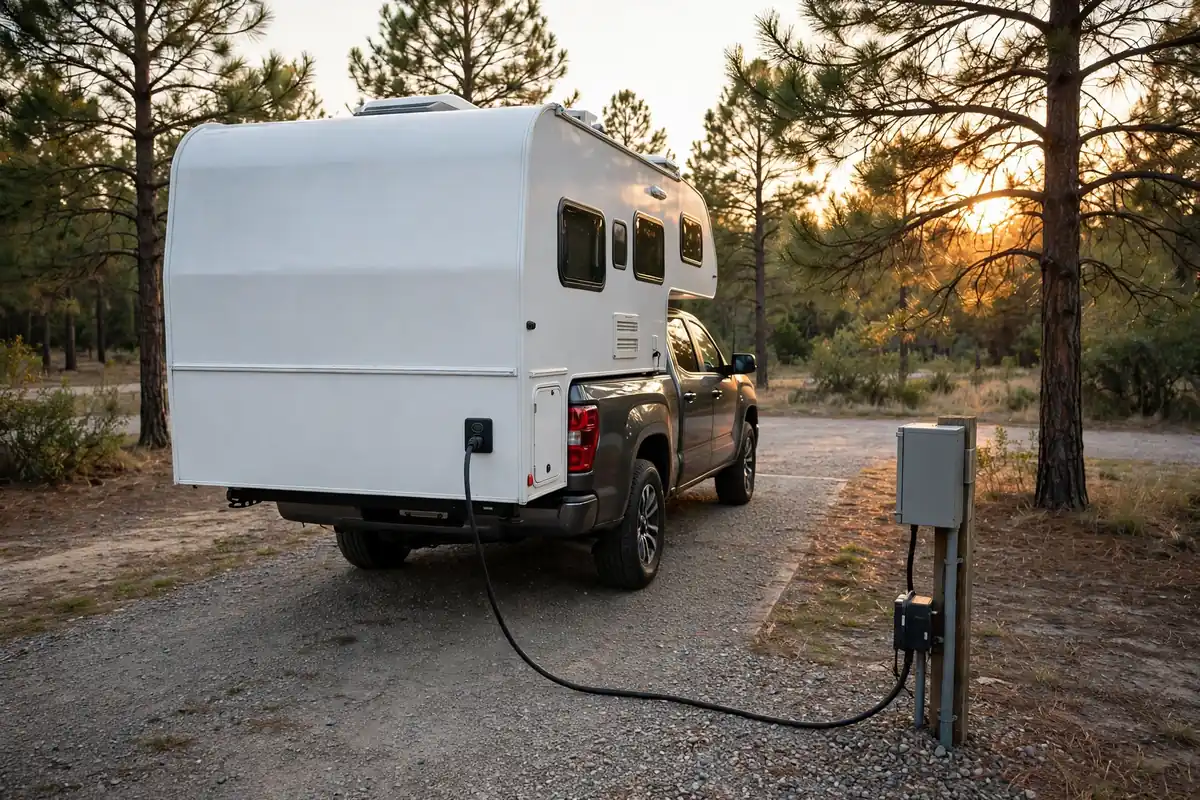
Shore power is campground electricity delivered through a pedestal — the weatherproof metal box on a post at your site. The pedestal feeds 120-volt AC power through your shore cord to the breaker panel inside, and from there to your air conditioner, microwave, outlets, and converter, which charges your house battery and runs your 12-volt lights and fans.
Most truck campers are 30-amp rigs. A 30-amp camper has one rooftop air conditioner, a main breaker rated at 30 amps, and a three-prong shore cord. Some larger rigs are 50-amp, with two air conditioners and a four-prong cord. Know which one you own before you buy a single adapter. Look at your shore cord: three prongs means 30-amp, four means 50-amp. Your main breaker will say 30 or 50 too.
30A vs 50A vs 15A: How to Tell Them Apart
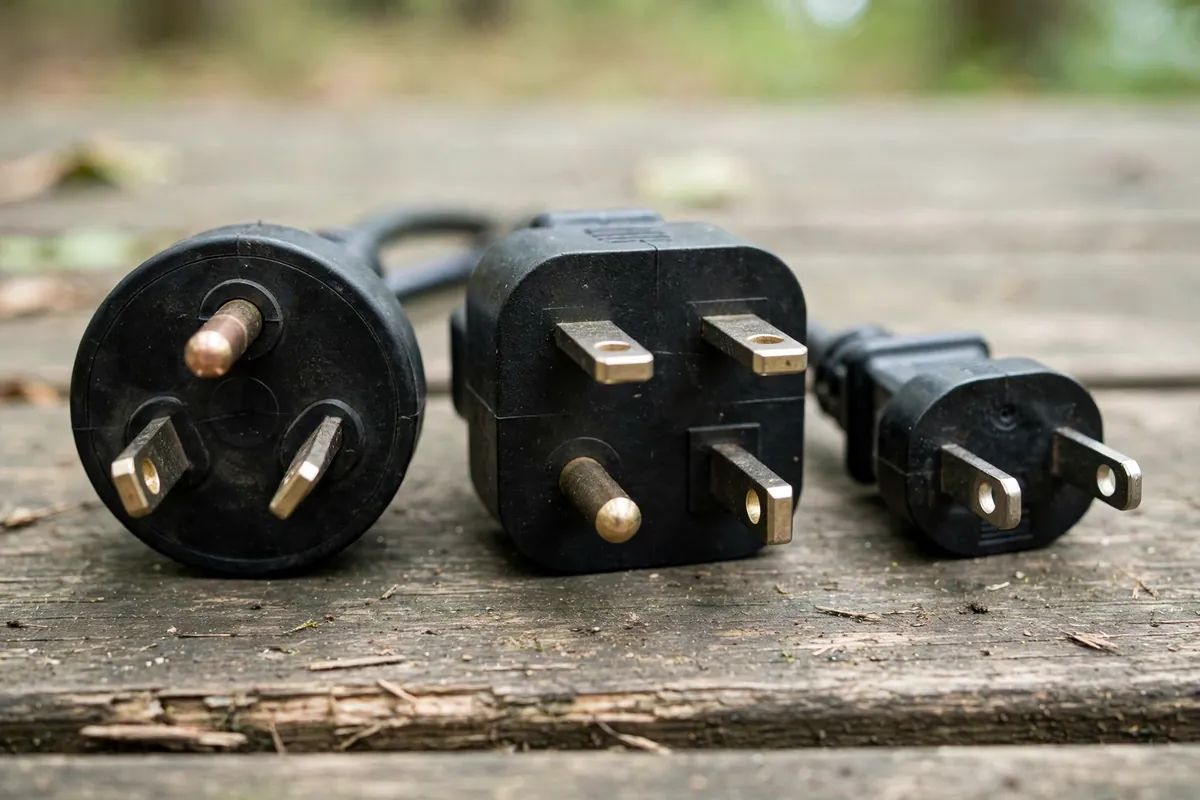
A typical pedestal has up to three outlets, each with its own breaker. They deliver very different amounts of power.
30-amp (NEMA TT-30) is the workhorse for truck campers: one 120-volt hot leg, plus neutral and ground, through a three-prong plug. The maths is simple: 120 × 30 = 3,600 watts. That is your whole budget for everything running at once. The outlet is larger than a household outlet, with two angled slots and a round ground hole.
50-amp (NEMA 14-50) has four prongs and two separate 120-volt hot legs, plus neutral and ground. The maths surprises most people: 120 × 50 × 2 legs = 12,000 watts — more than three times a 30-amp site, because of that second hot leg. A 50-amp rig can run two air conditioners, a microwave, and a water heater without the juggling a 30-amp rig needs. If your camper is 30-amp, a 50-amp outlet does not give you 50 amps. You still have 3,600 watts; the extra capacity sits unused.
15-amp and 20-amp household outlets are the third option: a 5-15R (15 amps, 1,800 watts) or a 5-20R (20 amps, 2,400 watts — look for the sideways T-slot). It is useful for charging a phone or keeping the fridge cold while you load up. It is not a real camping supply: a rooftop air conditioner alone draws 11 to 16 amps running, and far more for a second at startup.
| Service | Plug | Max watts | Good for |
|---|---|---|---|
| 15A household | 3-prong, flat blades | 1,800W | Charging, fridge, lights |
| 20A household | 3-prong, T-slot | 2,400W | Light loads |
| 30A TT-30 | 3-prong, angled | 3,600W | Most truck campers, one A/C |
| 50A 14-50 | 4-prong | 12,000W | Two A/Cs, large rigs |
A household dryer outlet is not a camper outlet: a dryer receptacle (NEMA 14-30) is a 125/250-volt outlet, and a TT-30 plug will not mate with it. Never bridge the two with a homemade adapter. Miller Creek RV Park’s pedestal guide explains the NEMA types and the dryer-outlet trap clearly.
Adapters and Dogbones: Which Ones Are Safe
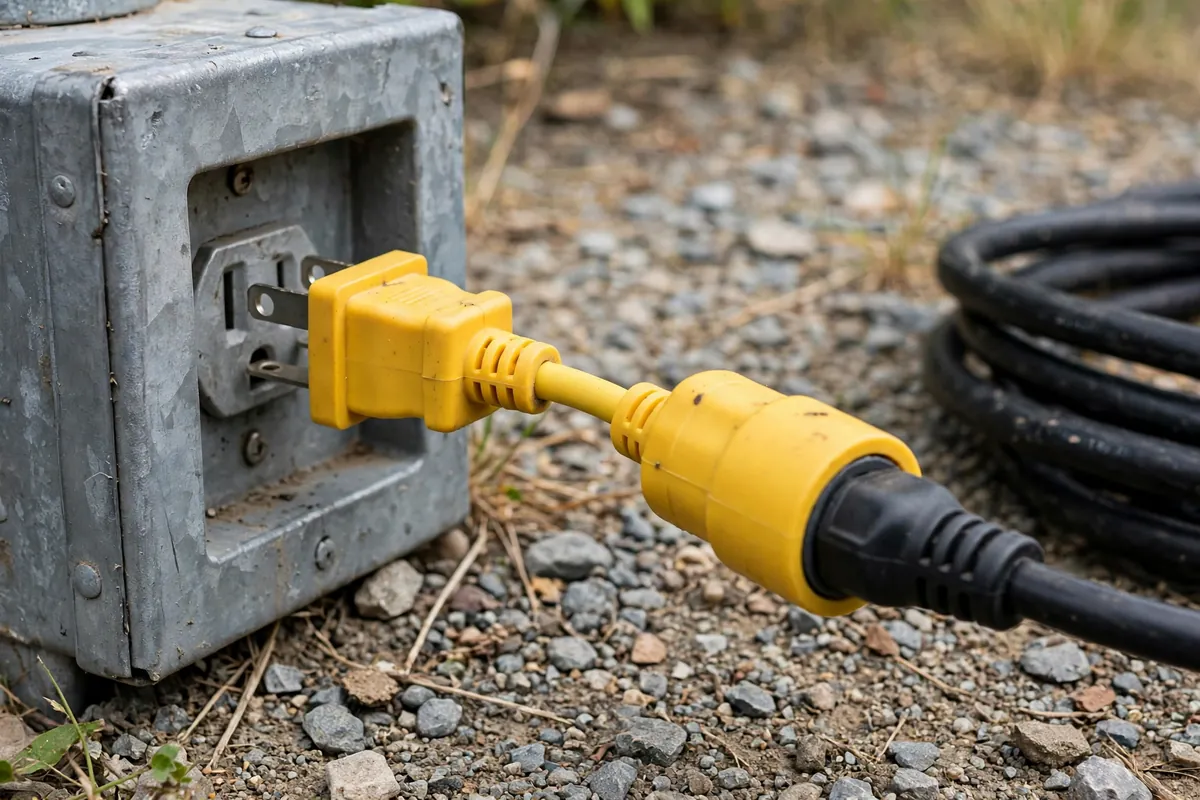
A dogbone adapter is a short, heavy cable with a different plug on each end. It changes the shape of the connection. It does not change how much power is available. The lowest-rated part in the chain always wins: pedestal, adapter, cord, or camper, whichever is smallest sets your limit.
- 50-to-30: your 30-amp camper plugs into a 50-amp pedestal. You get one hot leg at 120 volts, and you still have 3,600 watts. I use this most, because the 50-amp receptacle is often in better condition than the heavily used 30-amp one.
- 30-to-50: a 50-amp camper plugs into a 30-amp pedestal. You have 3,600 watts total, not 12,000. One air conditioner, and careful load management.
- 15-to-30: your 30-amp camper plugs into a household outlet. You now have 15 amps — 1,800 watts — for the whole camper. Fine for charging batteries and running the fridge, not for the air conditioner.
Buy listed, RV-rated adapters from a known brand such as Camco. Avoid no-name adapters, cheater plugs, and anything that ignores the ground.
A melted adapter is one of the most common owner complaints I found while researching this guide. Owners on iRV2 report the same pattern: a 30-amp plug that ran the air conditioner and microwave together for months, then started tripping, then showed a loose blade and melted plastic around one prong. The fix was replacing the damaged plug, checking the pedestal receptacle, and stopping the habit of running the two biggest loads at once. If a plug feels hot after an hour, or the prongs are browned or deformed, replace it.
Surge Protection and EMS: Why a Cheap Strip Is Not Enough
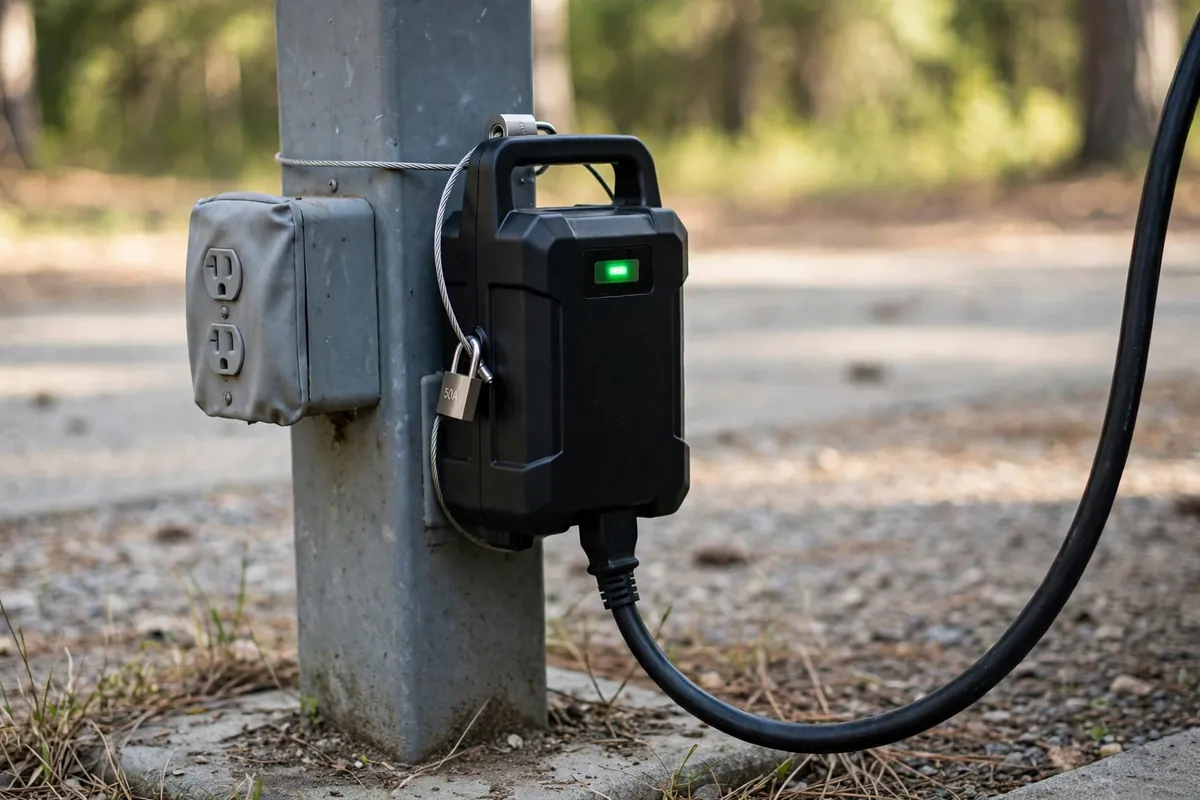
A cheap surge strip protects against one thing only: a brief voltage spike, usually from lightning. It does nothing about the problems that actually damage campers at campgrounds.
An EMS, or Electrical Management System, watches the pedestal continuously and physically disconnects your camper when something is wrong. A good portable EMS, such as the Progressive Industries EMS-PT30X or EMS-PT50X, or a Hughes Power Watchdog with EPO (Emergency Power Off), protects against high voltage, low voltage, reverse polarity, open ground, and open neutral — then reconnects automatically after a delay once the power is safe. Camping World’s surge-protector guide puts it plainly: a basic surge protector guards against high voltage only, while an EMS also protects against low voltage, open neutral, open ground, and reverse polarity.
Low voltage is the quiet killer. On a hot afternoon, voltage at your pedestal can sag well below 120 volts. A compressor motor trying to deliver the same cooling at lower voltage draws more current and runs hotter, and can cook without ever tripping a breaker. The Progressive manual states its cut-off clearly: below 104 volts for more than 6 seconds, the EMS shuts power off, shows an E4 error, and waits 2 minutes 16 seconds after recovery before reconnecting. Southwire units cut off below 102 volts, and Hughes around 104 volts, with high-voltage cut-off around 132 volts on all three.
A Hughes Power Watchdog adds a phone app showing live voltage, amps, and watts, and a replaceable surge module. Owners on Forest River Forums comparing Progressive Industries, Southwire Surge Guard, and Hughes generally conclude the same thing: all three catch the real faults, and the honest differences are display, app, warranty, and portable versus hardwired. Pick the one that matches your amperage, buy it once, and use it every time.
Extension Cords: Gauge, Length, and Why a Household Cord Is Dangerous
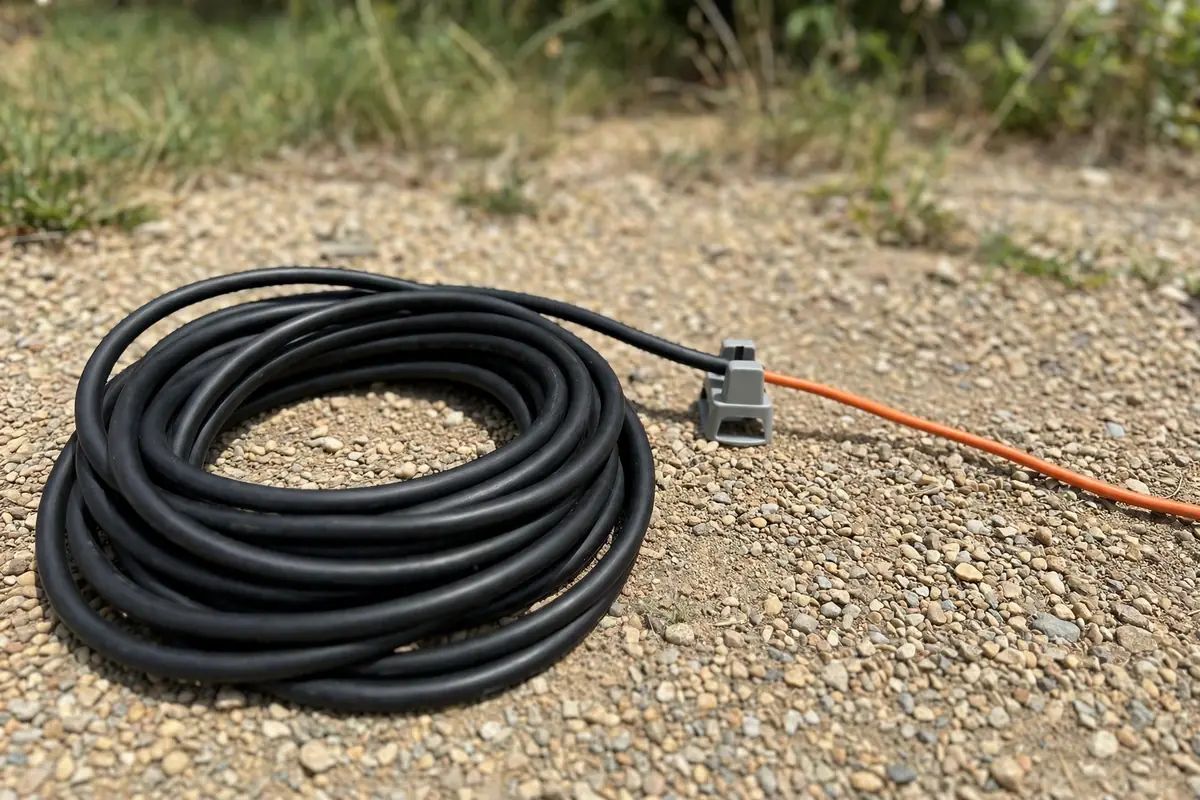
Your factory shore cord is usually 25 feet long. Sometimes it is not enough, and that is when people reach for whatever extension cord is in the garage. Do not do that.
A household extension cord is typically 14 or 16 AWG (American Wire Gauge), rated for 15 amps or less, and designed for a lamp or a drill, not for hours of continuous load outdoors. A 30-amp RV cord is 10 AWG, and a 50-amp cord is 6 AWG. Lower gauge means thicker wire and more current capacity. Put a thin household cord in series with a 30-amp load and you create a bottleneck: resistance turns into heat, voltage drops along the cord, and the air conditioner gets low voltage — the exact condition that damages compressors.
Length matters too: a 10 AWG cord at a full 30-amp draw starts to exceed comfortable voltage-drop limits somewhere past 50 to 75 feet of total run. My rules: use an RV-rated extension cord only, with the same amperage and plug type as your shore cord; match or beat the gauge of your main cord (10 AWG minimum for 30-amp, 6 AWG for 50-amp, and 8 AWG is safer for a 50-foot 30-amp run); keep the total run as short as you can and uncoil the cord fully, because a coiled cord traps heat; use one cord, not two chained together; and keep connections off the ground and out of puddles, with the EMS upright.
What to Do When Breakers Trip or the Pedestal Is Dead
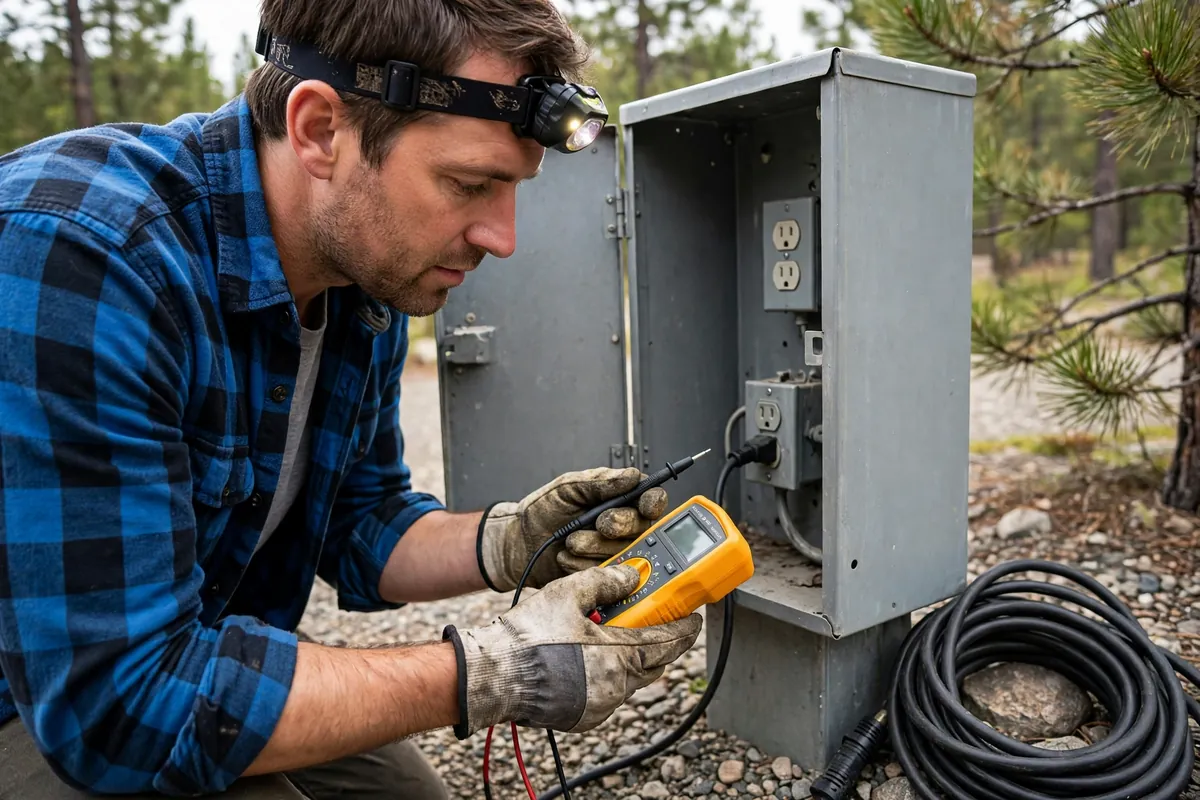
A tripped breaker is the system telling you either that you asked for too much at once, or that something is actually wrong. Tell the two apart before you reset anything.
If the pedestal breaker trips when you run too much, it is almost always a load problem. On 30 amps you have 3,600 watts. A 13,500 BTU air conditioner runs at about 1,350 watts (roughly 11 to 14 amps), a microwave at about 1,200 to 1,500 watts, and an electric water heater at about 1,440 watts. Add a converter and a fridge on electric, and you are over budget. The classic trip is air conditioner plus microwave, or air conditioner plus electric water heater, with the compressor cycling on at exactly the wrong moment.
Owners on iRV2 and the Jayco Owners Forum describe the same evening: air conditioner running, someone starts the microwave, everything goes quiet, and somebody walks outside in the dark to reset the pedestal. The fix: run the water heater on propane when the air conditioner is on, and run only one of the microwave, hair dryer, coffee maker, and space heater at a time. Our truck camper air conditioning guide covers amp draw and soft-start devices, which reduce the startup surge but do not lower running amps. To reset: turn off the big loads, flip the pedestal breaker fully off and then on, and switch loads back on one at a time. If it trips again with almost nothing running, stop resetting it — that points to a short or a fault.
If the pedestal is dead or your EMS refuses to connect, check in order: the pedestal breaker; your EMS display — write down the error code; your camper’s main breaker and GFCI outlets, because a tripped bathroom GFCI can kill a whole string of outlets while the panel looks normal; the other receptacle, or your 50-to-30 adapter on the 50-amp outlet; and ask a neighbour if their power is out too.
If the EMS says reverse polarity, open ground, or open neutral, do not plug in, and do not bypass the EMS. Those are pedestal wiring faults, and they are the campground’s responsibility to fix. Report the code and site number, and ask to move. An open ground can leave your camper’s metal skin energised — a hot-skin condition. A truck camper owner on Wander The West reported measuring about 50 volts on his door handle at campgrounds with reversed polarity and an open ground. Mike Sokol of RV Electricity / NoShockZone explains why in his guide to ungrounded pedestals: never plug into an ungrounded pedestal, and a ground rod is not a substitute for a proper ground wire. If you feel even a tingle touching the camper, unplug safely if you can, do not touch it again, and get help.
Hookup Etiquette and Common Mistakes
Most pedestal damage is caused by small, repeated habits that arc, pit, and loosen the contacts. Owners on iRV2 are emphatic: always turn the pedestal breaker off before you plug in or unplug, and turn off your big loads inside first. One new owner described a spark and a pop the first time he plugged in at home, because the fridge was already running on auto. The forum’s answer was the same every time: breaker off, plug in, breaker on. Plugging in under load draws an arc that pits the metal, raises resistance, and over time becomes heat and a fire risk. The same applies when you leave: breaker off, then unplug.
Other mistakes: plugging in with the air conditioner already on; leaving the cord and EMS in a puddle; running the A/C on 15 amps; daisy-chaining adapters; ignoring a loose receptacle; and leaving the pedestal breaker on when you leave. If shore power is out and you need a generator, check the park’s generator hours first — see our generator vs solar guide.
Your First-Time Truck Camper Shore Power Hookup Checklist
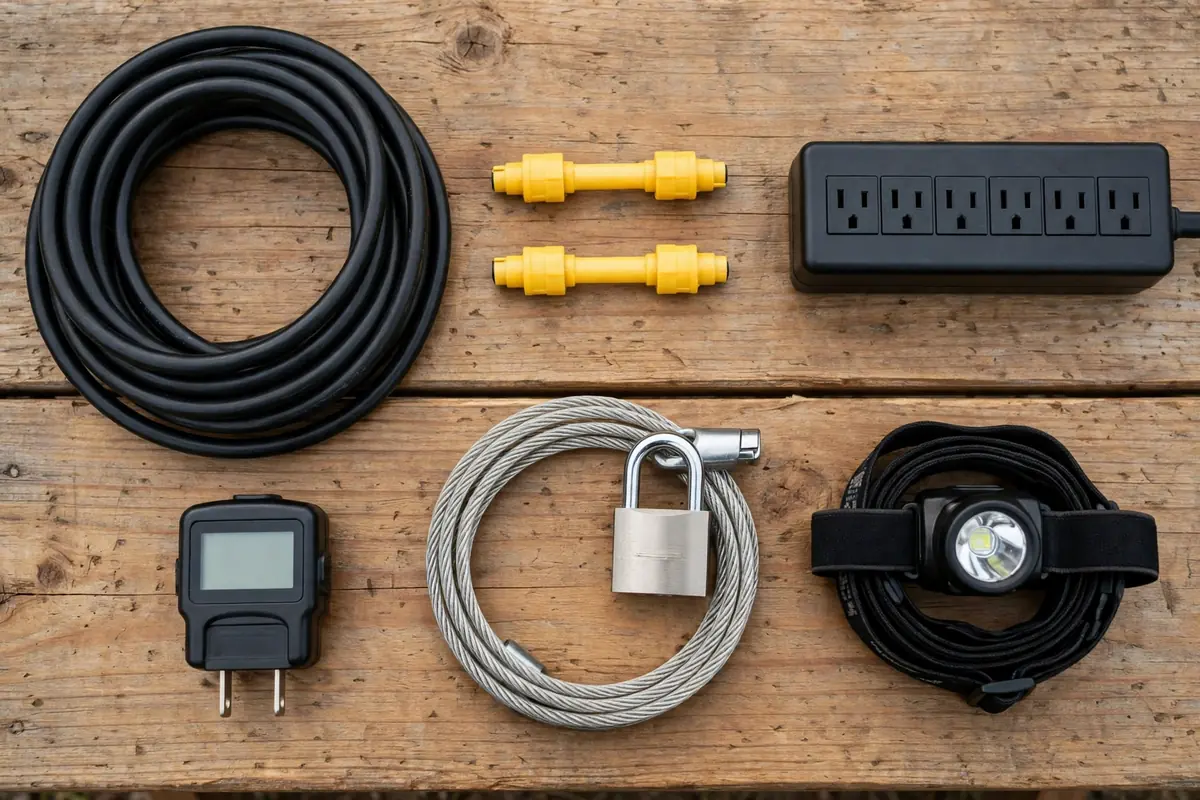
Run this in order until it becomes muscle memory. See our truck camper driving guide for the full arrival routine.
- Park and level first. Level the camper and chock the wheels before you touch power.
- Find your plug and amperage. Three prongs, 30-amp; four prongs, 50-amp. Grab the matching adapter if needed.
- Turn everything off inside. Air conditioner, electric water heater (switch it to propane), microwave, and your camper’s main breaker off.
- Inspect the pedestal. Breaker off. No burnt plastic, melted edges, broken slots, water, buzzing, or smell. If the outlet feels sloppy, pick the other outlet or ask to move.
- Inspect your cord and adapter. No cracks, exposed wire, browned or pitted prongs, or melted insulation.
- Plug in the EMS first. Read the display: roughly 114 to 126 volts, no error code. If it refuses to connect, stop. Do not bypass it.
- Flip the breaker off again, then connect your shore cord to the EMS. At the camper end, seat the locking connector fully and tighten the ring.
- Flip the pedestal breaker on. Wait for the EMS delay — about two minutes on many Progressive units — and watch the voltage settle.
- Turn your camper’s main breaker on, then loads one at a time. Converter and fridge first, then the air conditioner on fan for 30 seconds, then one big appliance at a time.
- Check the connections after an hour. Warm is a warning; hot is a stop. Check voltage again on a hot afternoon.
- When you leave, reverse it. Big loads off, camper main breaker off, pedestal breaker off, then unplug. Leave the pedestal breaker off for the next camper.
Frequently Asked Questions
Can I plug my 30-amp truck camper into a 50-amp pedestal?
Yes, with a listed 50-amp male to 30-amp female dogbone adapter. You use one hot leg at 120 volts, and you still have 3,600 watts.
Can I run my truck camper air conditioner on a 15-amp household outlet?
Usually not reliably. A 13,500 BTU unit runs at roughly 11 to 14 amps and can briefly pull 25 to 28 amps at startup. On 15 amps, charge batteries and run the fridge. For air conditioning, you need a 30-amp hookup.
Is a surge protector the same as an EMS?
No. A basic surge protector absorbs brief voltage spikes only. An EMS also disconnects your camper on low voltage (below about 102–104 volts), high voltage (above about 132 volts), reverse polarity, open ground, and open neutral.
What should I do if my EMS shows reverse polarity or open ground?
Do not plug in and do not bypass the EMS. Note the error code, tell the campground office, and ask to move. If you feel a tingle touching the camper, unplug safely if you can and get help.
How long can my RV extension cord be?
As short as possible. For 30-amp service, use a 10 AWG RV-rated cord, and keep the total run to 50 feet or less at full load. For longer runs, step up to 8 AWG. Never use a household 14 or 16 AWG extension cord.
Why does my pedestal breaker keep tripping?
Most often, you are running too much at once. Air conditioner plus microwave, or air conditioner plus electric water heater, exceeds 3,600 watts. Turn off the big loads, reset the breaker, and switch loads back on one at a time, with the water heater on propane. If it trips instantly with almost nothing running, stop resetting it and have the cord, pedestal, and camper checked.