Killing Truck Camper Black Tank Smell: Causes and Permanent Fixes
You know the exact moment. You open the camper door after a few hours in the sun, and it hits you — that thick, unmistakable sewage smell. You dumped the tank. You rinsed it. You dropped in a treatment. And it still smells. I have lived this exact frustration, and I can tell you straight: when it comes to truck camper black tank smell, it is almost never because you picked the wrong chemical. It is usually mechanical — a vent that is not venting, a seal that is not sealing, or a tank that never actually got clean. This guide walks you through the truck camper black tank smell problem the way owners actually solve it: diagnosis first, then the maintenance routine that keeps the smell gone for good.
Why Truck Camper Black Tank Smell Is Worse Than in Big Rigs
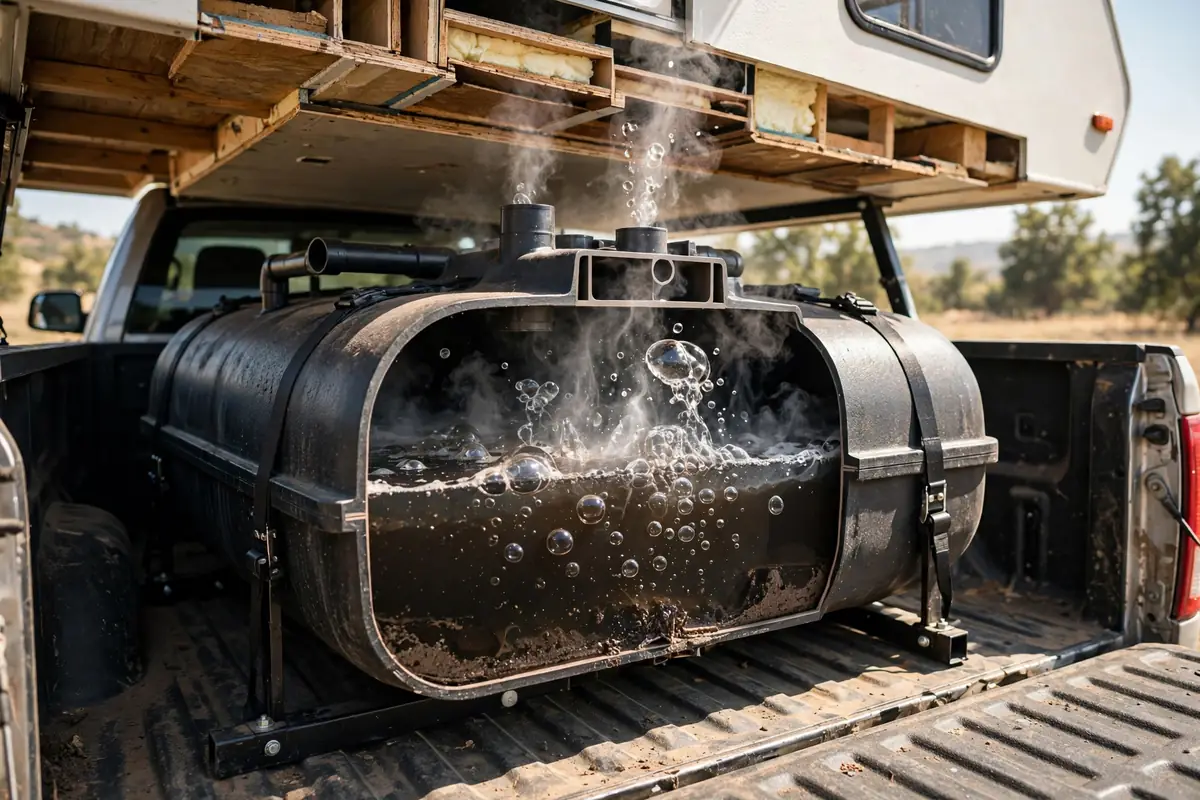
A black tank is a black tank, so why does the smell seem so much worse in a truck camper? Four reasons, and every one of them is baked into the design.
First, heat. Your tank hangs in the truck bed, wrapped in a shell that soaks up sun and engine heat all day. Heat accelerates the anaerobic breakdown that produces hydrogen sulfide — the rotten-egg smell. Owners on RV forums consistently report odor problems getting dramatically worse in summer, and a truck camper bed is one of the hottest places a tank can live.
Second, volume. Truck camper black tanks are small — many are 15 to 30 gallons versus 40-plus in a motorhome. A small tank fills faster, its waste is more concentrated, and there is less water diluting each flush. It goes from fine to full (and from full to foul) faster than you expect.
Third, dump frequency. Truck campers boondock. You hold waste longer because there is no sewer at your dispersed site, and the tank sits and ferments.
Fourth, geometry. In a truck camper the toilet is practically in the living room — bathroom and cabover bed are feet apart, and the roof vent stack is short. When something goes wrong with the vent or a seal, you smell it immediately. There is nowhere for escaping gas to hide.
None of this is a defect — it is just the physics of a small, hot, hard-working tank. And once you understand that, the fixes stop being mysterious.
Step One: Make Sure It Is Actually the Black Tank
Before you spend a dollar or a Saturday, confirm the culprit. Owners on RV forums will tell you that a huge percentage of mystery smells blamed on the black tank turn out to be something else entirely, and truck campers have the same suspects:
- The gray tank. Kitchen gray tanks rot food grease and soap film, and owners report the gray tank can smell worse than the black. If the stink is strongest near the kitchen sink, suspect gray.
- A dried P-trap. Every sink and shower drain has a P-trap that holds a plug of water to block sewer gas. Driving sloshes them empty; storage evaporates them. If the smell appeared after a drive, run water in every drain for a few seconds and see if it clears.
- A failed air admittance valve (AAV). Small under-sink valves with a rubber diaphragm that are supposed to let air in but not gas out. They fail with age, and tank odor vents straight into the cabinet. Multiple owners on iRV2 report that replacing the AAVs solved a cabin-wide stink they had blamed on the black tank for months.
The diagnostic shortcut: if the smell persists even when the tank is empty and just dumped, check the vent and the seals first. If it only shows up when the tank is partially full and hot, focus on deep cleaning and residue removal.
The Vent Stack Check: The Fix Nobody Talks About
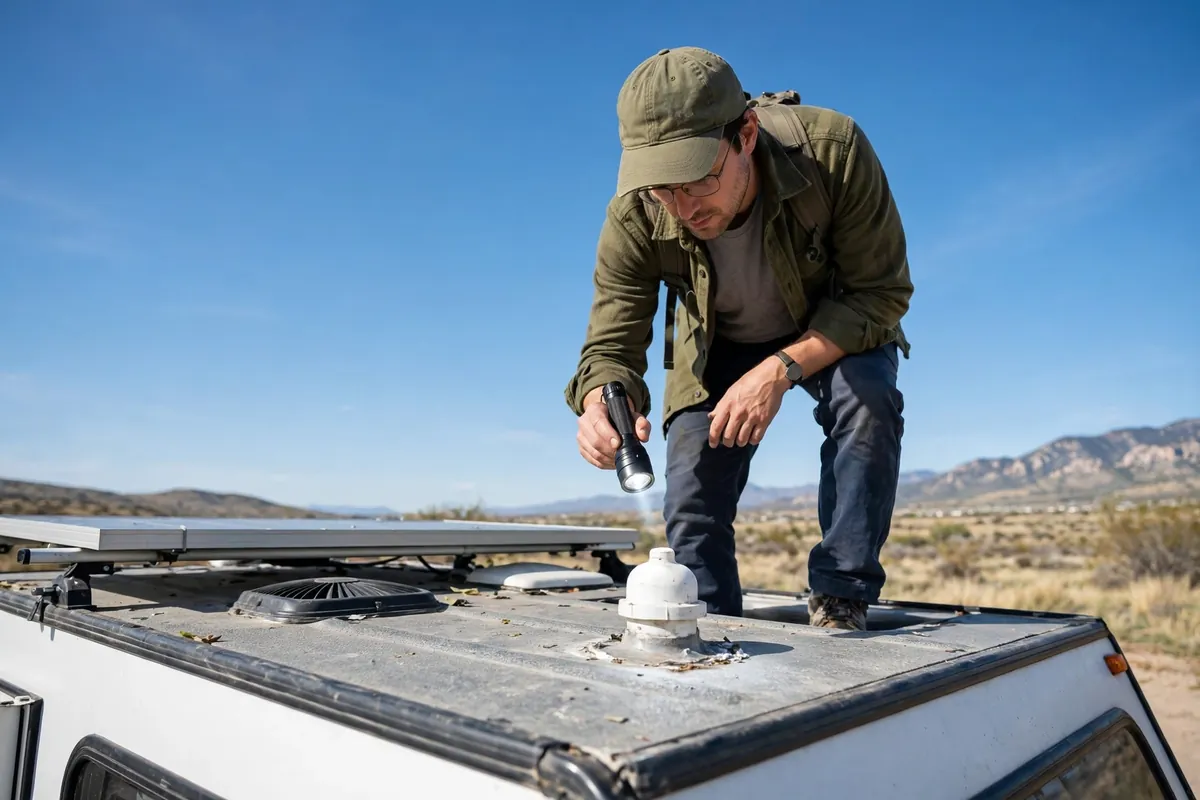
Here is the single most under-appreciated cause of truck camper black tank smell: the vent stack is not doing its job, and gas that should be going up and out over the roof leaks back into the camper instead. When the vent path is interrupted, pressure builds and gas finds the path of least resistance — back down through the toilet or into the ceiling cavity. Here is what to check:
Climb up and pull the vent cap. Look down the pipe for leaves, spider webs, mud-dauber nests, and — more than once — a chunk of roof material left over from the factory that fell in during construction. A flashlight and a screwdriver is all this takes.
Check the pipe-to-roof seal. Builders often cut the roof hole oversized to make the pipe easy to drop in, and the gap lets gas escape, bounce off the underside of the vent cover, and trickle down into the ceiling. If you see even a hairline gap between the pipe and the roof, seal it with sealant rated for your roof material.
Check whether the pipe has slipped down. This is the big one. A forum owner chasing a mystery smell found the vent pipe had slid down out of the roof seal entirely, so the tank was venting into the attic instead of outside. Pipes can slip down into the tank over thousands of miles of washboard roads. If you can reach under the cap and cannot feel the pipe coming up through the seal, it has dropped. Pull it back up and add a clamp or PVC collar so it cannot slide again; the owner who did this fixed odor, a prematurely full tank gauge, and a gurgling gray dump in one repair.
Consider a vent upgrade if the smell persists. If the stack is clear and sealed and you still get whiffs, especially while driving, a wind-powered vent cap is the classic next step. Products like the Camco Cyclone rotate with the breeze and use the venturi effect to actively draw gas up and out. Owners on the Good Sam forums report that a Cyclone-style vent ended a smell they had chased through every other fix.
Seal Diagnostics: Where the Gas Actually Gets In
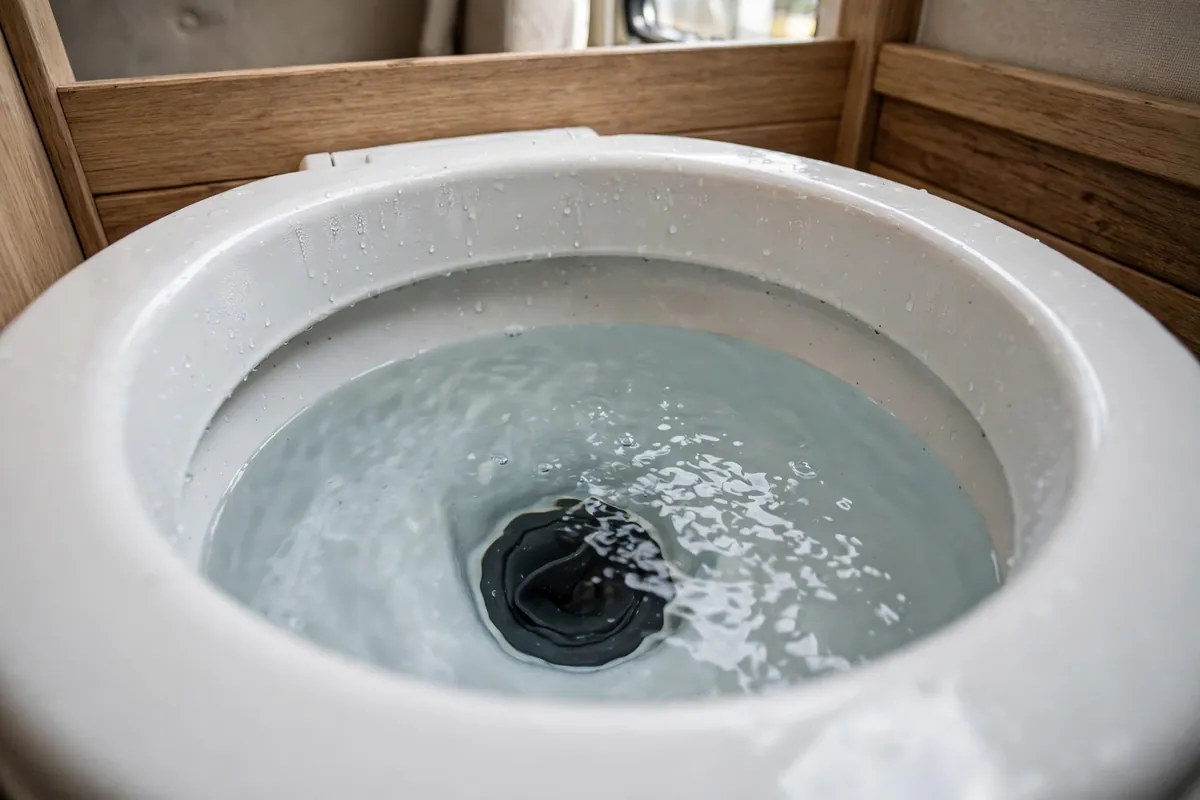
Even a perfect vent will not help if there is a direct air path from the tank into the camper — the toilet is the front door, and two seals guard it.
The bowl water test. Your RV toilet keeps smell out with water sitting in the bowl, held by a rubber blade or ball seal. Fill the bowl halfway, mark the level, and check it an hour later. If the water drained away, the seal is leaking and tank gas is rising straight into the bathroom. Often the seal is just dry or gummed up — press the pedal with the water off, wipe the seal with a damp cloth or a touch of plumber’s grease or petroleum jelly, and retest. If it still will not hold water, the seal or flange gasket needs replacing.
The flange seal under the toilet. If the bowl holds water but the smell is constant and strongest right around the base of the toilet, the gasket where the toilet meets the tank flange may have failed — a remove-and-reseat job worth doing once.
The fan rule. Here is a fix that costs nothing and that owners on fiberglass RV forums discovered the hard way: never run the bathroom exhaust fan on exhaust while you flush the toilet. The fan creates negative pressure in the tiny cabin and sucks tank air up through the open toilet valve. One owner traced an intermittent bathroom stink entirely to this habit — and the smell vanished the day they changed it.
The Deep Clean: Giving the Tank a Fresh Start
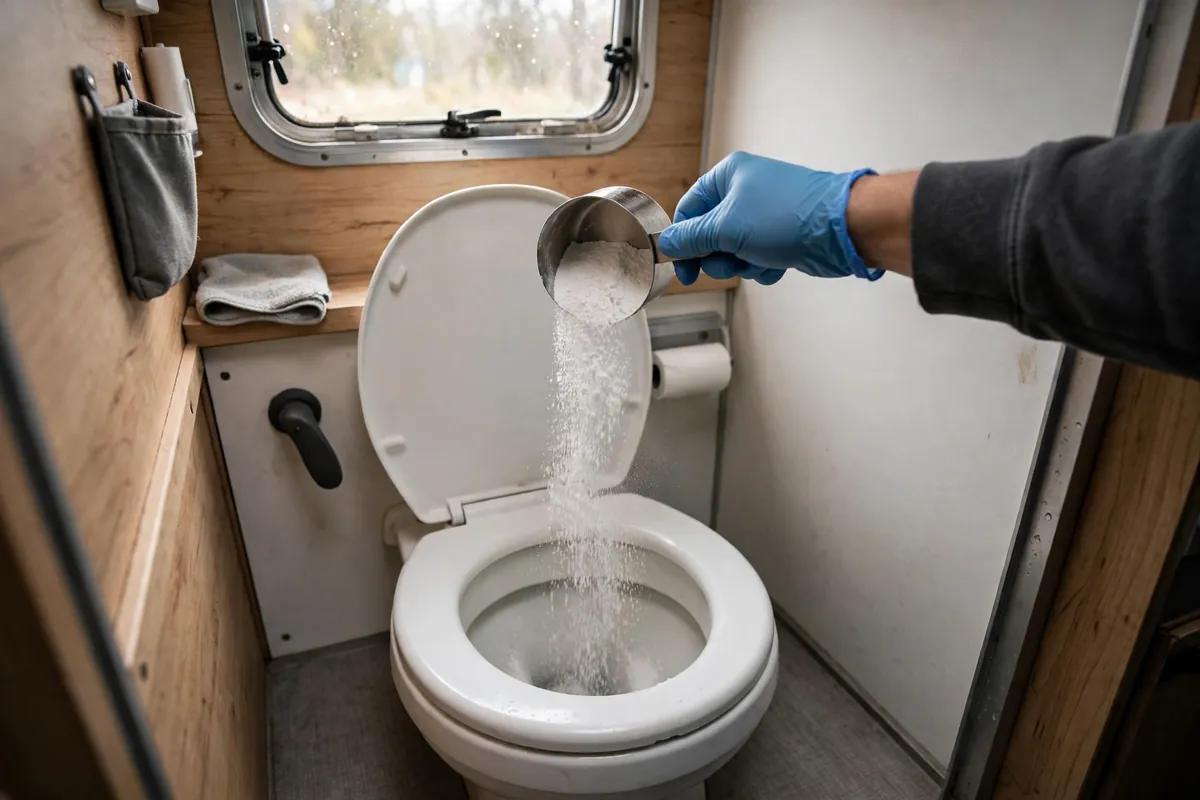
If the vent is clear, the seals are good, and the tank still stinks when it gets half full in the heat, the tank walls are coated in residue and nothing you pour in will fix it until you clean them. Truck camper tanks are especially prone to this because their small volume means a thicker relative layer of buildup per gallon.
The triple flush. Dump the black tank when it is at least two-thirds full (never dump a nearly empty tank — you need the volume and pressure to carry solids out). Then fill the tank with water through the toilet and dump again, twice more. A Lance 1172 owner on Truck Camper Magazine says this keeps his long-pipe setup flowing freely with no odor. If your camper has a built-in tank flusher, run it until the discharge runs clear; if not, a tank wand down the toilet does the same job.
The Geo Method. This decades-old owner formula is the closest thing the RV world has to folk wisdom on tank cleaning. The modern no-bleach version: after dumping, add about a cup of water softener (Calgon) and a cup of laundry or dish detergent to the tank with a few gallons of water, then drive. The sloshing scrubs the tank walls for you, and owners who run it monthly on travel days say the gunk that comes out at the next dump is impressive. One caution: the original Geo recipe uses a lot of chlorine bleach, which can damage rubber seals and valves — use the detergent-and-softener version and skip or minimize the bleach.
The ice trick. Before a drive to the next dump station, toss a bag of ice cubes down the toilet with a few gallons of water — the sloshing scrubs the walls and the ice melts.
Keep it wet. Never let a black tank dry out completely between trips. A gallon or two of water in the tank keeps residue from baking onto the walls into the cement-like layer that feeds odor for the rest of the season.
Treatments: What Truck Camper Owners Actually Use
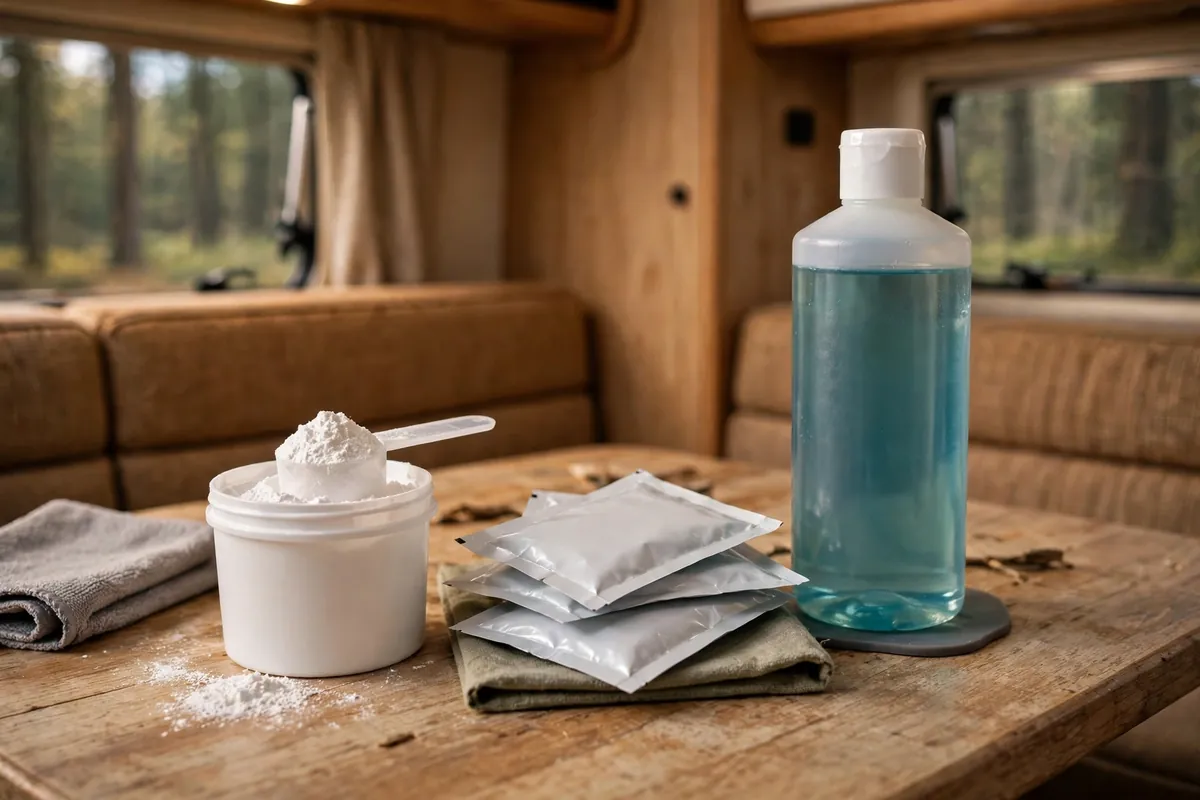
Chemicals do not fix mechanical problems — fix the vent and the seal first — but once the tank is clean, a good treatment keeps it that way. Truck Camper Magazine surveyed its truck camper readers on what they use, and a clear pattern emerged:
- Happy Campers. The most-repeated winner among truck camper owners: mineral-based, septic-safe, and designed to bind odor gases rather than mask them. The maker’s own guidance follows the pattern experienced owners recommend — diagnose the cause first, deep clean, then maintain.
- Walex Bio-Pak and Porta-Pak. Enzyme drop-ins with a strong owner following — one Eagle Cap 1160 owner runs Bio-Pak two at a time and reports zero smell; another pairs Porta-Pak with a quarterly Walex Commando deep clean.
- Unique RV Digest-It. A bacteria and enzyme liquid treatment. Their published instructions say it plainly: dump, flush thoroughly, close the valve, add 3 to 5 gallons of fresh water, then 2 ounces per dump for tanks up to 40 gallons. An Eagle Cap 1200 owner reports a decade of use with no odor.
- Thetford Aqua-Kem. The old standby, now in formaldehyde-free formulas — worth noting because owners specifically flag formaldehyde as something to avoid, since a number of dump stations restrict it.
Two things the community is consistent about: water matters more than product. Every one of these owners pairs their treatment with generous water — several gallons in the tank after every dump, a full bowl per flush. And skip the formaldehyde-based products — they kill the bacteria that actually break waste down.
A note on the cassette alternative: if you are reading this while shopping solutions and thinking the whole black-tank ritual is not for you, cassette toilets sidestep the entire black tank odor problem by design. Our full cassette toilet guide walks through the lifestyle honestly, and our toilet comparison covers cassette, composting, and dry-flush head to head.
The Prevention Routine That Keeps It Gone
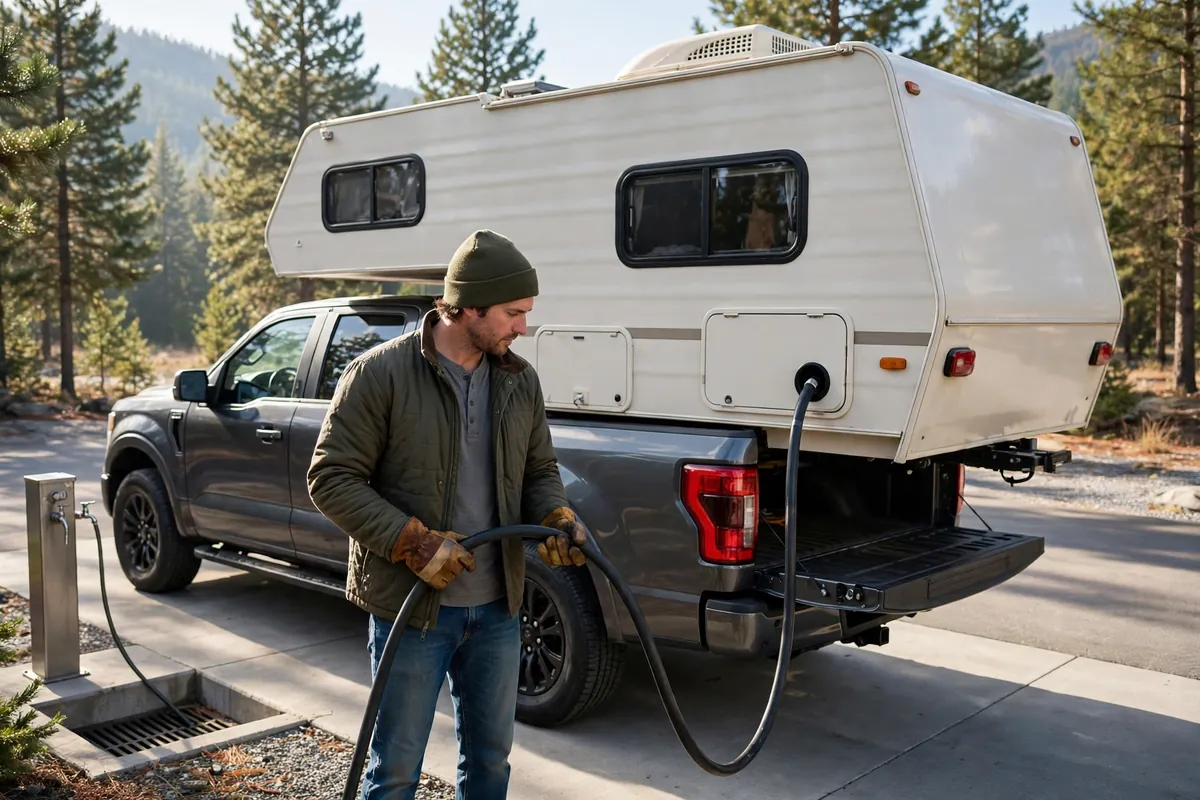
Smell is a symptom, not a trait. The owners who never deal with it all run some version of the same routine — and it folds naturally into the annual maintenance schedule:
- Use plenty of water. A full bowl per flush, several gallons in the tank after every dump. In a small truck camper tank, water is your cheapest and most effective treatment.
- Keep the black valve closed except when dumping. Leaving it open on hookups lets liquid drain off and leaves solids behind — the infamous poop pyramid, a permanent odor source.
- Dump at two-thirds full or more. Small tanks fill fast, so watch the gauge. Dumping a full tank flushes solids out; dumping a half tank just wets them.
- Treat after every dump. Add your treatment with fresh water to an empty tank so it works from the start, not as a rescue later.
- Treat the gray tank too. Grease and food film rot just as happily, so hit it with the same treatment now and then.
- Re-check the vent stack annually. Road vibration is the enemy. Once a year, pull the cap, check for blockages, and confirm the pipe has not slipped down out of the roof seal again.
- Winterize the tank, not just the pipes. Before storage, dump, flush, and add a gallon of RV antifreeze to the tank so seals stay wet and protected — our winterizing guide covers the full routine.
Do this and the black tank becomes what it is supposed to be: a forgettable box under the floor, not the defining smell of your camping trips.
A short safety note: wear gloves at the dump station, never mix bleach with ammonia-based products (it creates toxic gas), keep bleach concentrations low to protect seals and valves, and only dump at approved dump stations or septic systems. If a treatment smells strongly chemical, that is a mask, not a fix — go back to the vent and seal checks.
Frequently Asked Questions
Why does my truck camper smell like sewage even after I dump the black tank?
Because the smell usually is not coming from the tank contents — it is coming through a vent or seal problem. Dumped-and-still-stinky points to a blocked or slipped roof vent stack, a toilet seal that is not holding bowl water, a dried P-trap, or a failed air admittance valve. Work the vent and seal checklist in this guide.
Is the Geo Method safe for truck camper black tanks?
The detergent-and-water-softener version is widely used and safe: a cup of water softener plus a cup of detergent with a few gallons of water, sloshed around during a drive. Go easy on or skip the chlorine bleach in the original recipe — repeated heavy bleach can damage rubber seals, valves, and the toilet blade seal over time.
Do I really need black tank chemicals, or is water enough?
Plenty of experienced owners run on water alone with no odor — generous water per flush, dumping only when the tank is mostly full, and keeping the tank wet between trips. Chemicals help most in hot weather and long boondocking stretches. Think of treatment as insurance, not the cure.
Why is my black tank smell worse in summer?
Heat accelerates the bacterial breakdown that makes hydrogen sulfide gas, and a truck-bed tank runs hotter than a motorhome basement tank. More water per flush, a good treatment, and dumping more often are the summer answers.
My camper smells while driving but not when parked. What is that?
Most likely the roof vent is not drawing properly under the airflow changes of driving. Check the vent stack for blockages and for a pipe that has slipped down out of the roof seal — washboard roads do this — and consider a wind-powered vent cap that actively draws gas out while you move.
Should I leave my black tank valve open at full hookups?
No. Keep it closed until the tank is at least two-thirds full, then dump. An open valve drains the liquid and strands the solids, which dry into a mound (the poop pyramid) that clogs and stinks permanently — doubly true for small truck camper tanks.
What is the best black tank treatment for a truck camper?
There is no single winner, but truck camper owners name Happy Campers, Walex Bio-Pak and Porta-Pak, Unique RV Digest-It, and formaldehyde-free Thetford Aqua-Kem most often. Pick one, dose for your actual tank size (many truck camper tanks are under 30 gallons), and pair it with lots of water — the water matters more than the brand.
Can a gray tank really smell as bad as the black tank?
Yes, and sometimes worse. Kitchen gray tanks collect grease, food particles, and soap film that rot into a foul sludge. If the smell is strongest near the sink and the black tank checks out, treat the gray tank and refill its P-traps first.