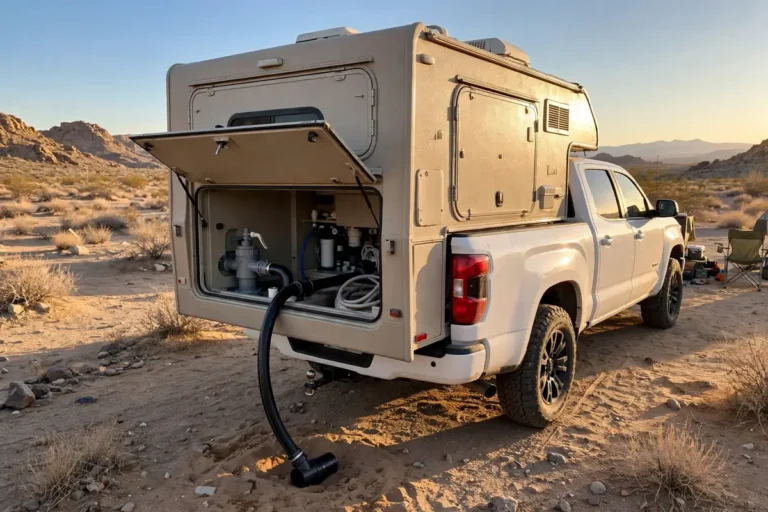
Truck Camper Water Heater Guide: Tank vs Tankless, Ignition Fixes, and Winter Care
I learned more about my truck camper water heater on one cold desert morning than in two years of owning the camper. The shower went cold, the red fault light was on, and I was standing outside in a towel wondering whether I had no propane, no power, or a dead heater. It was air in the propane line after a tank change, plus a burner tube that needed cleaning. Twenty minutes later I had hot water again. Most truck camper water heater problems are like that: small, fixable, and predictable once you know how the box on the side of your camper works.
How a truck camper water heater actually works
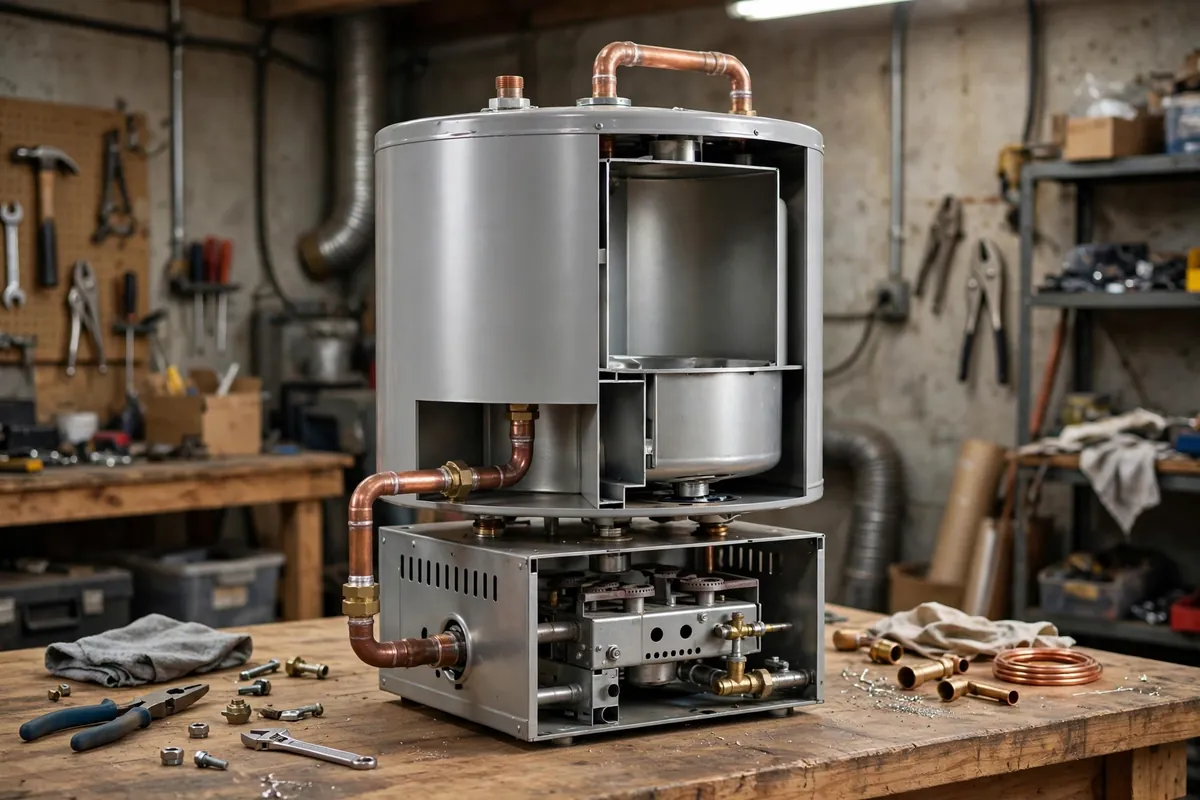
Most truck campers ship with a tank heater, usually 6 gallons. Cold water enters the bottom, a burner or element heats the tank to a fixed temperature — around 130°F on a Suburban, around 140°F on a Dometic/Atwood — and hot water leaves from the top. You mix that hot water with cold at the tap, so 6 gallons stretches further than it sounds.
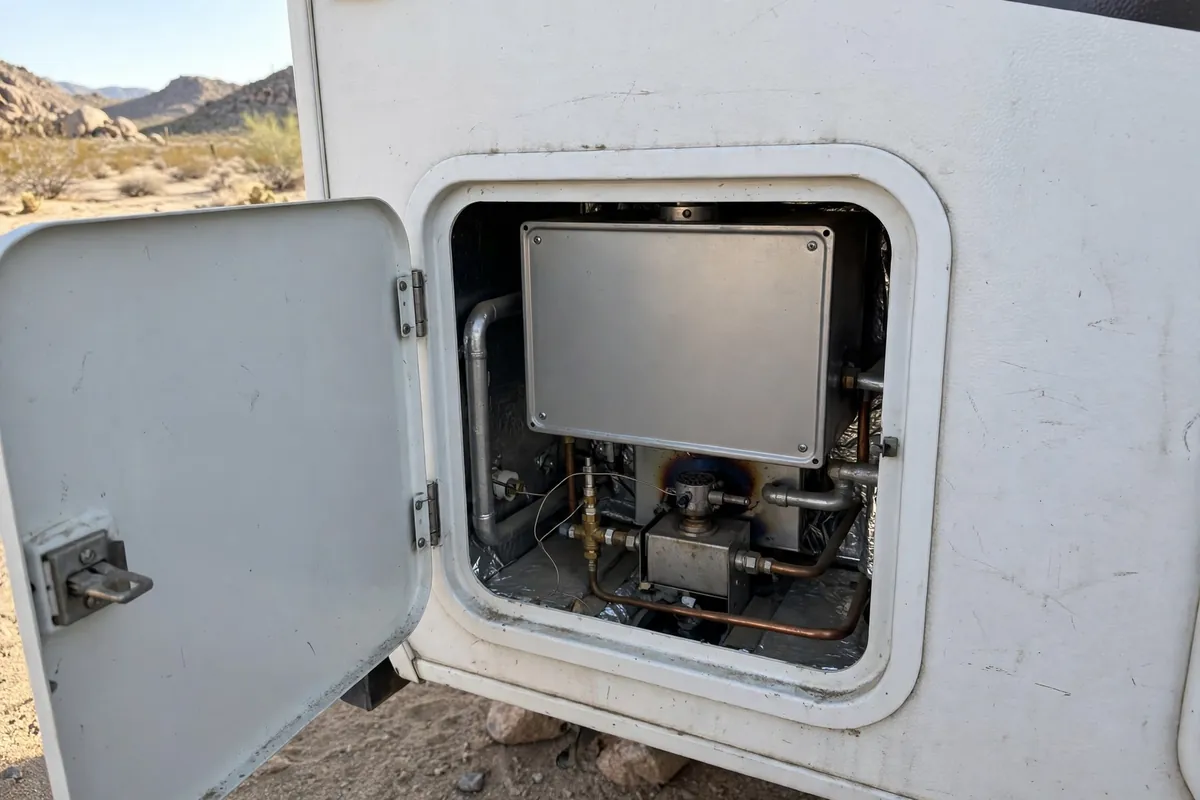
The thermostat is not adjustable on most units. A second, higher-temperature limit switch — the ECO — sits above it as a safety net. If the ECO trips, press the small reset button under the exterior access panel. Check that button first when a heater suddenly goes dead.
A tankless heater works differently: no stored hot water. Open a hot tap, a flow sensor fires the burner, and water is heated as it passes through a heat exchanger. In theory you get endless hot water — in a truck camper, only with enough flow, propane, and incoming water that is not too cold.
The common tank models are Suburban’s SW6D (propane only) and SW6DE (propane plus a 1,440-watt element), and Dometic’s WH-6GEA. Suburban lists the SW6DE at 12,000 BTU/h, recovering about 10.1 gallons per hour on gas, 6.1 on electric, and 16.2 with both. Truma’s AquaGo, by contrast, modulates between 20,000 and 60,000 BTU/h, per Truma’s AquaGo specifications. Before touching anything, photograph the label on your heater: it tells you whether you have a steel tank or an aluminum tank, which decides half the maintenance in this guide.
Tank vs tankless in a truck camper
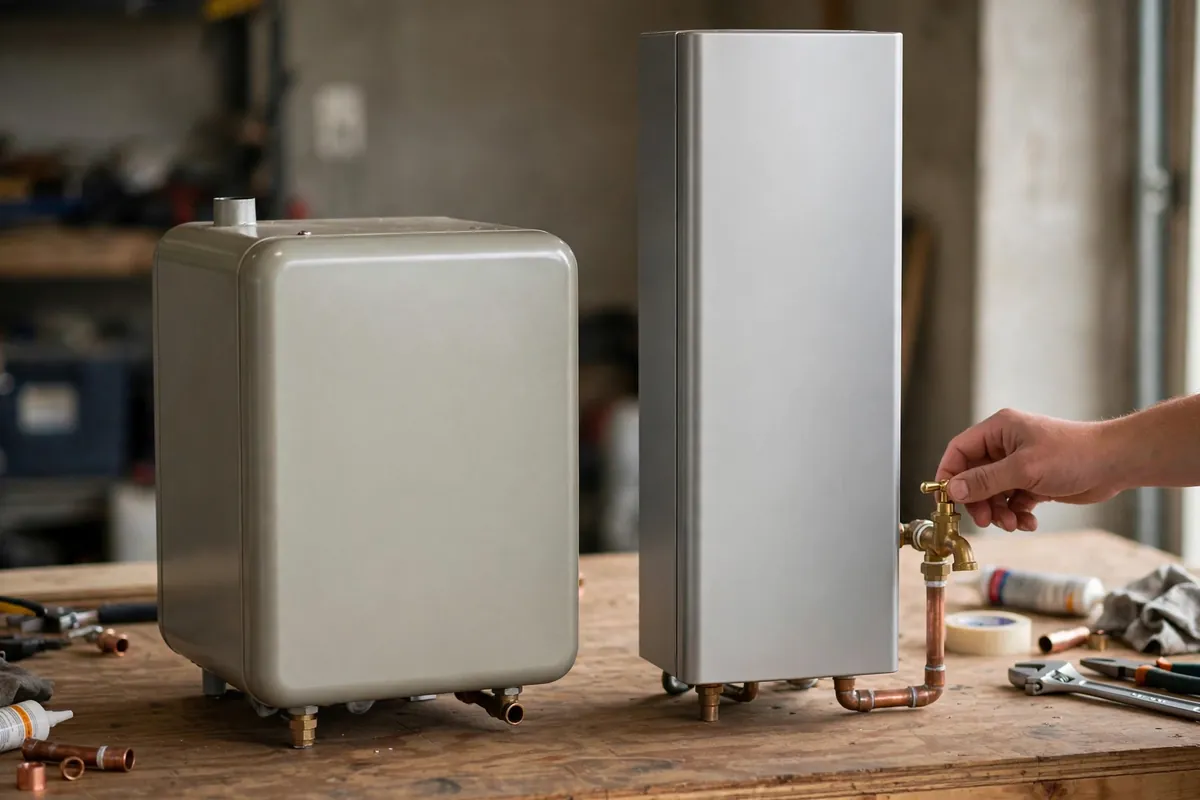
I would not swap a working tank heater for a tankless one just because “endless hot water” sounds better. In a truck camper, water is the scarce resource: you carry 20 to 40 gallons, and every gallon a tankless heater wastes while you wait for it to fire is gone.
A tankless heater wins on endless showers at a full-hookup site. Its weaknesses show up where truck campers live: boondocking. Owners on iRV2 report the same complaints with budget tankless units, especially Girard models: the heater will not fire at a trickle, mixing hot and cold drops flow below its minimum and the burner cuts out, and at altitude or with very cold incoming water it cannot heat enough at full flow. The workaround owners share: stop blending at the tap, set the temperature to what you can stand, and run the hot tap on its own. With a basic tankless unit, flow is the thermostat.
Premium tankless units handle this better: owners on iRV2 who swapped a Girard for a Truma AquaGo report steady temperature at low flow and at altitude, and its burner starts at about 0.4 gallons per minute. Comfort models add a circulation pump that kills the cold-water sandwich. Camping World’s guide to tankless water heater problems describes the same issues. My rule: hookups and long showers, consider tankless, preferably recirculating; boondocking or above 5,000 feet, keep the tank heater — it tolerates a trickle, works at altitude, and heats on electric at hookups.
Propane vs electric: when to use which
Propane heats fastest — roughly 10 gallons per hour of recovery on a 6-gallon Suburban, against about 6 on electric — so use gas off-grid, when you need hot water quickly, or when two people shower back to back. Electric is slower but silent and free where electricity is included in the site rate, and it saves propane for the furnace and stove. Run both together for the fastest recovery when plugged in.
Electric mode has two traps. The first is the hidden switch: on many Suburban models there is a small electric switch on the heater itself, behind the exterior access door, as well as the switch inside. Owners on forums report an afternoon lost to a dead electric mode before finding that outside switch off. Check both switches before blaming the element.
The second trap is dry firing. Switch the element on before the tank is full and it burns out, sometimes in seconds. Owners on iRV2 describe exactly this: a partner flips the switch while the tank is still filling, and from then on propane works but electric never heats again. Prevention is free: never switch electric on until water runs steadily from a hot tap. If propane works and electric does not, check shore power, breaker, both switches, and the ECO reset, then suspect the element (about 10 ohms) or thermostat. The heater still needs 12-volt DC for its board even in electric mode, so a dead battery can kill it — see our truck camper electrical troubleshooting guide.
DSI ignition failures: the red light, the clicks, and the fix
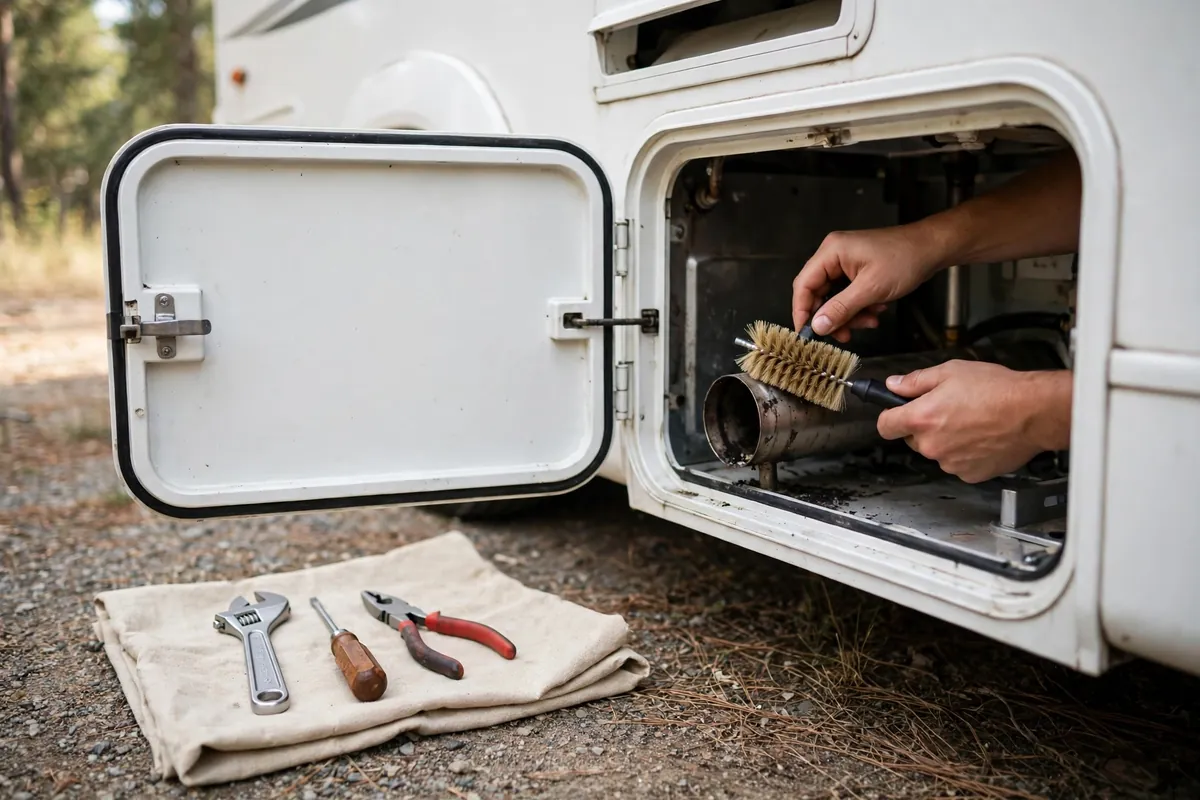
Direct spark ignition, or DSI, is on nearly every modern truck camper water heater. Flip the inside switch, the board opens the gas valve, an electrode sparks, and the same electrode senses the flame. If the board tries three times with no flame signal, it locks out and lights the small red DSI fault light inside. Reset it by switching off, waiting a few seconds, and switching back on.
That sequence — clunk of the gas valve, click-click-click of the sparker, then a roar or silence — tells you almost everything. Listen with a helper inside and you at the open access door.
No clicks at all. The board is not getting 12-volt power. Check the 12-volt fuse, then the spade connectors on the board and thermostat/ECO assembly — owners on iRV2 and Air Forums report this fix most: pull each connector off, look for green corrosion, push it back on firmly, and the heater fires. Also check the thermal cut-off, a small fusible link near the burner: if it has blown, find why before replacing it.
Clicks, but no flame. Usually air in the propane line. After a tank change or storage, three attempts are not enough to push it through. Owners share the same fix: light a stove burner for a minute or two to purge the air, then cycle the switch off and on; it may take two or three cycles. Check the stove flame first — a weak yellow flame points at the regulator, not the heater. For supply issues, our truck camper propane system guide covers regulators and leak checks.
Flame lights, then dies. The board is not seeing the flame. The electrode doubles as igniter and sensor, so a cracked ceramic, carbon buildup, or corroded wire can cause a heater that lights and shuts down. Clean the electrode, check its position, and reseat its wire. A yellow, sooty flame means look at the burner tube first.
The spider problem is real, and it is the fix owners mention most. Spiders are attracted to propane and build webs inside burner tubes during storage. Owners on Air Forums and Fiberglass RV describe the same symptoms — yellow flame, soot on the cover, a heater that will not light — and the same fix: remove the burner tube, run a bottle brush through it, blow it out with compressed air, and check the orifice for debris. One owner found a single speck blocking the orifice; removing it fixed the heater. Another traced repeated thermal cut-off failures to a spider nest that made the flame burn back. Fit mesh screens over the vents when stored, never poke a wire through the orifice, and do not touch igniter wiring while it is sparking.
Lukewarm water: the heater is often innocent
Lukewarm water usually means the heater works but cold water is mixing in downstream. Check the mixing points before replacing a thermostat.
First, the bypass valve. After de-winterizing, if it is still open or half-open, cold water slips past the tank and blends with hot at every tap. Lukewarm water on the first spring trip is a bypass valve until proven otherwise.
Second, the outdoor shower. If its hot and cold knobs are left open while the head is switched off, hot and cold cross-connect and mix before reaching indoor taps. Close both knobs fully when it is not in use.
Third, a failed check valve on the hot outlet, which stops hot water flowing backwards. Owners on iRV2 report low flow tracing to a mineral-fouled check valve, fixed by soaking it in vinegar or replacing a cheap part. Fourth, sediment: scale insulates the tank and slows recovery. Drain and flush with a rinse wand.
On a tankless heater, lukewarm water at full flow with very cold incoming water is often physics: slow the flow and the temperature climbs. A trickle that never fires the burner is the opposite problem — open the tap more and check the inlet screen.
The anode rod: a cheap part that saves an expensive tank
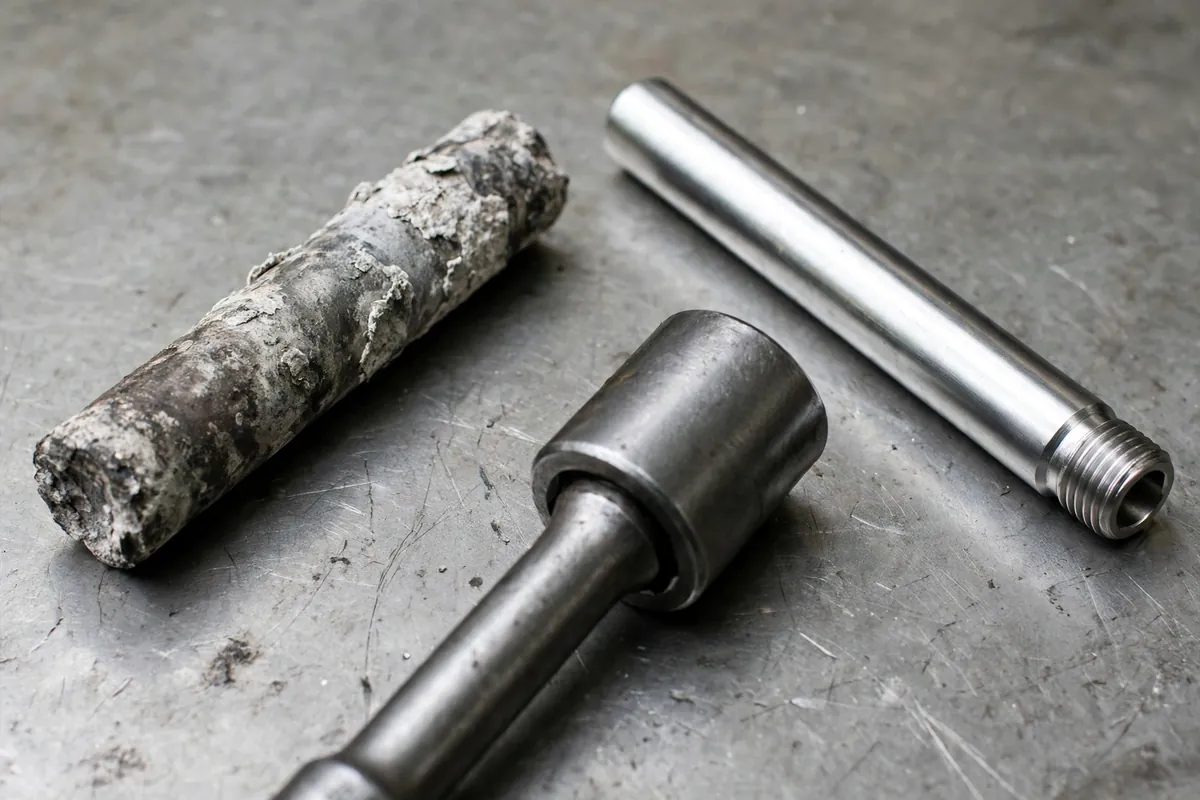
Suburban heaters have a porcelain-lined steel tank, and steel rusts. The anode rod is a magnesium or aluminum rod screwed into the tank in place of the drain plug; it corrodes sacrificially so the tank does not. Inspect it annually and replace it past 75 percent consumption. You need a 1-1/16-inch socket and Teflon tape, and a cool, depressurized tank — open the relief valve and a hot tap before loosening anything.
Dometic/Atwood tanks are aluminum, and Dometic’s support page states the aluminum acts much like an anode itself and aftermarket rods should not be used — they can damage the tank and void the warranty. A white nylon drain plug instead of a hex-head metal plug means a Dometic/Atwood tank: no rod to buy, just drain and flush sediment. Owners on Jayco and iRV2 forums report the confusion constantly; check the badge first. A walk-through of how to check and replace an anode rod covers the distinction with photos.
For Suburban owners, the rod also explains the rotten-egg smell. If only hot water smells of sulfur, the magnesium rod is reacting with sulfates in the water. The fix owners share: swap it for an aluminum-zinc rod and flush the tank. Do not just remove the rod: running a Suburban without an anode voids the tank warranty. If both hot and cold smell, the problem is your water source.
The bypass valve: one mistake, no hot water
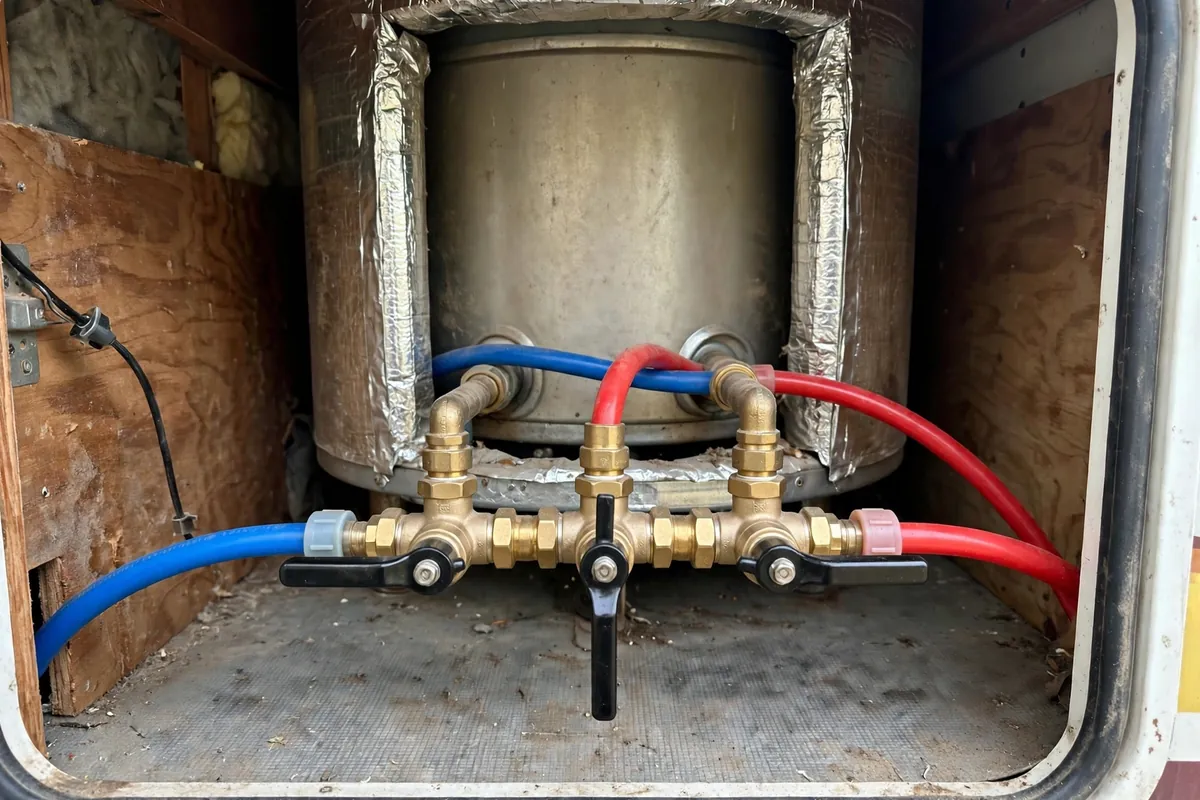
The bypass valve exists so you can winterize without filling a 6-gallon heater with antifreeze. There are three common layouts — a single lever, or a three-valve system with inlet, outlet, and crossover valves — and every spring, owners forget to put them back. In normal use, inlet and outlet are open and the crossover is closed; in bypass mode, the reverse. Lukewarm or no hot water on your first spring trip? Look at these valves before ordering parts, and photograph them in summer position — owners on RV Forum threads describe exactly this memory failure.
The worse bypass mistake is turning the electric element on while the heater is still bypassed and empty — it burns out. So de-winterize in order: fill the tank, confirm steady water from a hot tap, close the bypass, and only then switch the heater on. Our how to winterize a truck camper guide walks the full sequence.
Winter care: freezing is the expensive failure
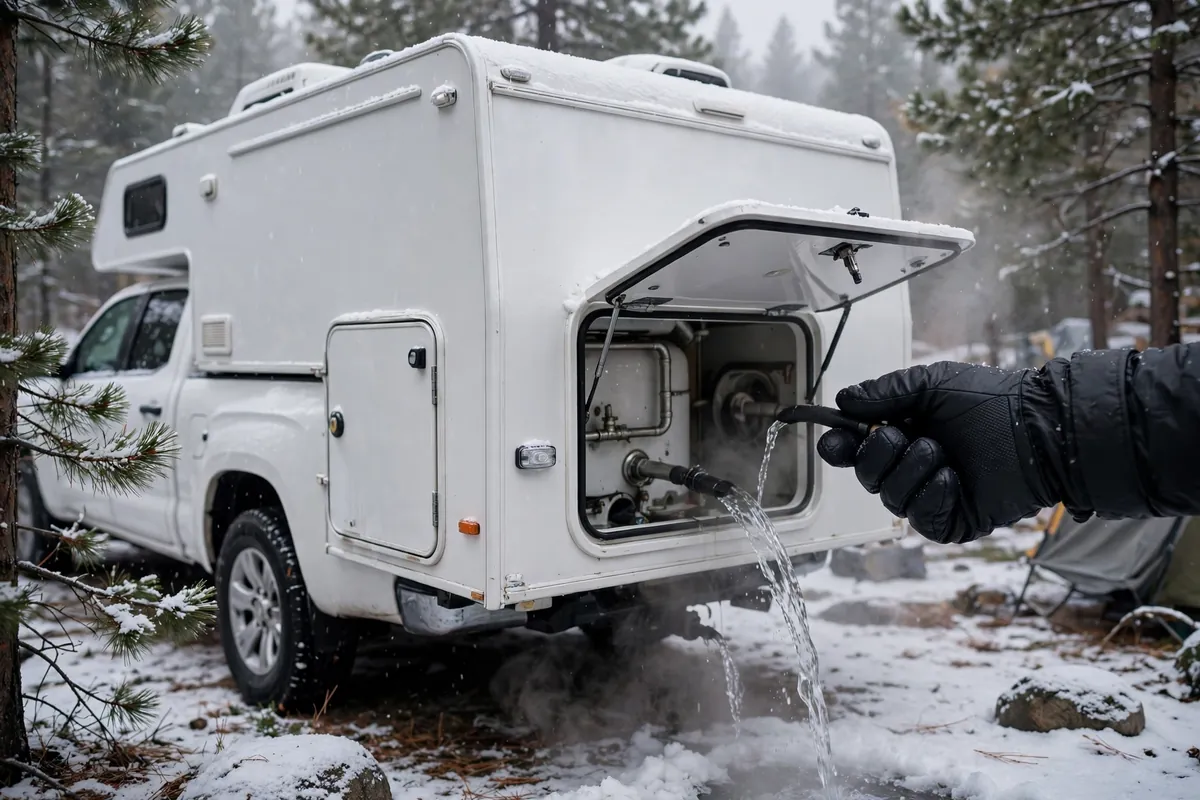
A truck camper water heater holds gallons of water in a thin-walled tank, and water expands when it freezes. A frozen tank can split, and a frozen bypass fitting can crack — an owner on Air Forums found water trapped in a bypass connector split the fitting, and the leak only showed up on the first summer trip.
If you camp in freezing weather, the heater is fine while it runs — it is heated and full of hot water. The problem is a full heater switched off overnight in a cold camper, or a camper stored with water still in the tank. Keep the camper heated, or drain the heater.
For storage, drain the tank through the anode rod or drain plug, leave the plug loose, open the relief valve, and set the bypass so antifreeze protects the lines without filling the tank. Tankless heaters differ: Truma says the AquaGo basic must be drained and must not run in frost, while Comfort models have an antifreeze mode — read your own manual.
If you are winter camping, keep the heater on and the camper warm — lines to and from the heater can freeze even while the tank is hot. Our truck camper winter heating guide covers heat as a system. Do not leave water sitting in the tank for months either: it shortens anode life and grows the bacteria behind the sulfur smell.
When to repair, when to replace
Once a year, at spring commissioning: pull the anode on a Suburban and replace it past 75 percent consumption; on a Dometic, pull the nylon plug and flush sediment. Clean the burner tube, test the relief valve, and confirm the bypass valves are in summer position. Every few trips, run the heater on gas briefly even if you mostly use electric, and watch for soot on the access door.
Replace the heater if the tank itself leaks or rusts through, or if a board plus a gas valve approaches the cost of a new unit. A board or electrode is a repair; a split tank is not. Match the cut-out dimensions when replacing — the Suburban SW6DE and Dometic WH-6GEA do not share the same opening.
FAQ
How long does it take a truck camper water heater to heat up?
About 20 to 30 minutes for a cold 6-gallon tank on propane (about 10 gallons per hour recovery); electric alone is slower, at about 6 gallons per hour.
Why does my truck camper water heater keep showing a DSI fault?
The board tried three times and did not sense a flame — usually air in the propane line, a spider web in the burner tube, a dirty electrode, or no 12-volt power. Purge via a stove burner, clean the tube, reseat connectors, and reset by switching off and on.
Does my truck camper water heater need an anode rod?
Only a Suburban with a steel tank. Dometic/Atwood heaters have aluminum tanks and a nylon plug — Dometic warns against fitting an aftermarket rod.
Why is my hot water only lukewarm?
Check the bypass valve first, then close both outdoor shower knobs. After that, suspect a stuck check valve, sediment, or — on a tankless heater — flow too high or too low.