Mice in a Truck Camper – How They Get In, the Damage They Do, and How to Keep Them Out
Mice in a truck camper are a problem I found the way most owners do: not by seeing a mouse, but by finding what it left behind — pellets in a kitchen drawer, a shredded paper towel behind the water heater, and a musty smell I first blamed on the tanks. Under the cabover mattress was a nest. It was not a disaster. It was the start of one: a mouse left alone for a storage season can mean chewed wiring, a dead furnace, and a camper that smells like a barn.
You are not doing anything wrong if this happens to you. Campers are warm, dry, full of nesting material, and parked where mice already live. The fix is mostly one unglamorous job — closing the holes — plus habits that make your camper a bad target.
How mice get into a truck camper
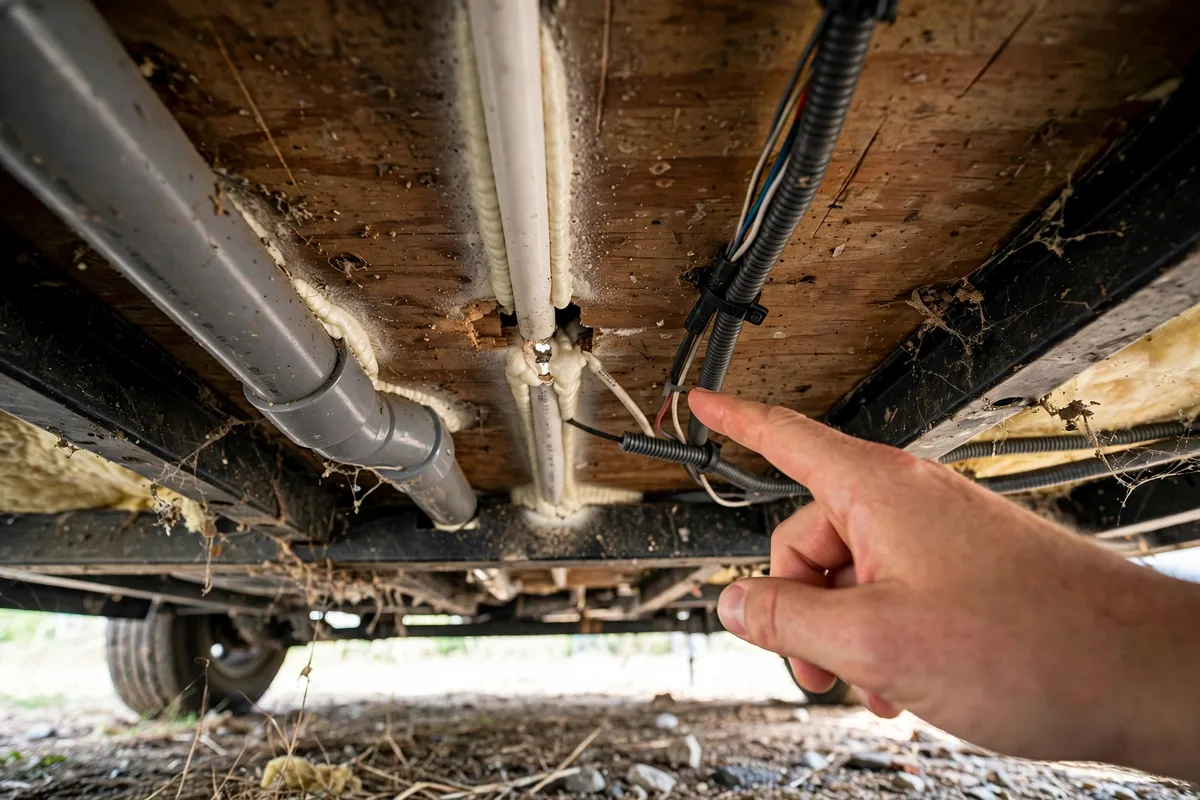
A house mouse can squeeze through a gap about the size of a dime. A truck camper has far more gaps than a house, and it moves and flexes in ways that open new ones. Start underneath and work up:
- Gaps where plumbing, wiring, and propane lines pass through the floor and walls. Factory sealant shrinks and cracks over time, especially around the water heater, the furnace, and the shore-power inlet.
- Worn slide-out seals, especially at the corners. Owners on forums describe mice chewing a fresh hole right through a worn slide seal after the camper sat for a few weeks.
- Fridge and furnace vents, roof vents, and gaps around vent fans. A vent that looks closed from inside can still have a gap at the frame.
- The cabover area, the entry door frame, and any opening around jacks and tie-downs.
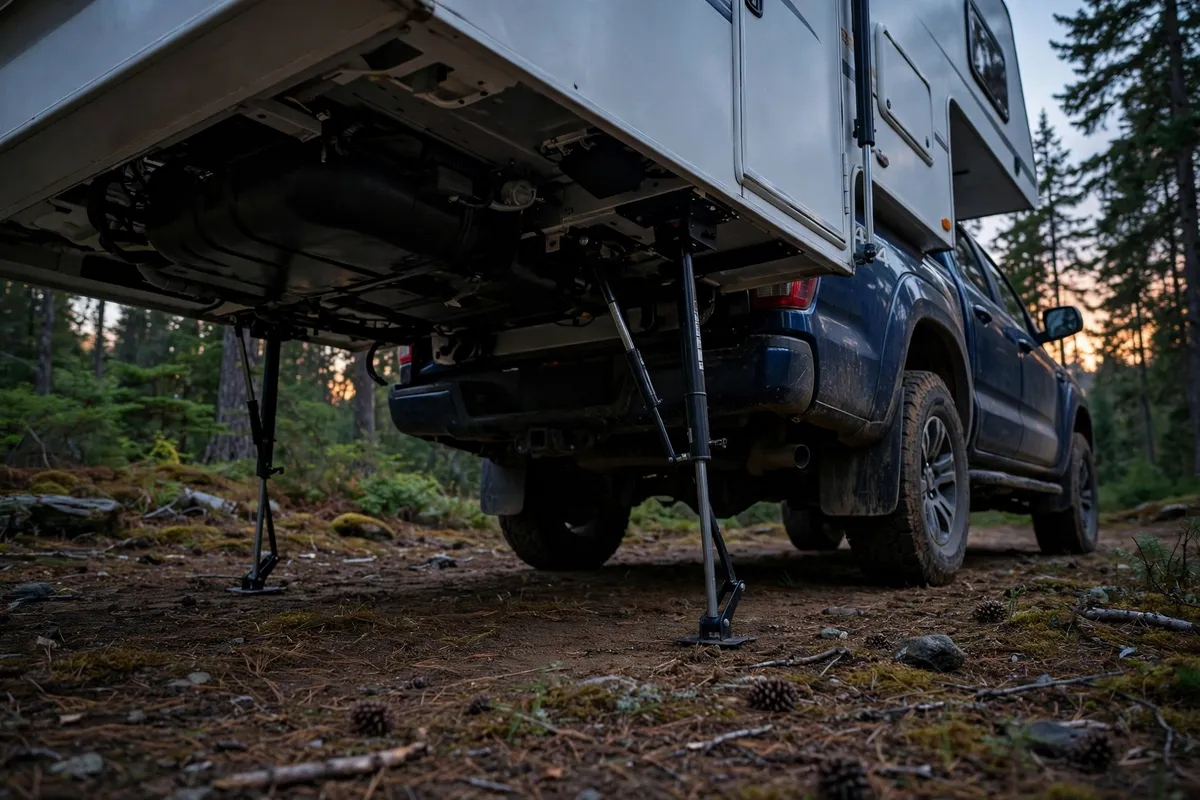
- The truck itself. Mice climb tires, jacks, power cords, and water hoses — anything touching the ground — and move from the engine bay into the camper. Owners on iRV2 put it bluntly: if a hose or cord touches the ground, it is a ladder.
A useful test comes from a truck camper owner quoted in an owner-magazine story: anywhere light can pass through, a mouse can crawl through. At night, have someone shine a flashlight from underneath and outside while you sit inside with the lights off and cabinets open. Wherever you see light, you have found a hole worth closing. Check under sinks and behind drawers too.
Pop-up owners should check canvas seams and sliding tie-down panels first, every time. One owner on the Wander The West forum found a whole winter nest packed into an upper wall cabinet after skipping a pre-trip check — the mice had come in through open tie-down panels.
The damage mice actually do
Mice chew constantly because their teeth keep growing. The damage owners report most falls into four buckets.
First, wiring. Mice chew 12-volt wiring, furnace and fridge wiring, and truck engine wiring. The result is often a furnace that will not light, a fridge fault, or a truck that misses after sitting all winter. One owner on the Wander The West forum reported a friend paying 3,000 dollars to have wiring replaced after a rodent got into it. Another had to pull a whole camper fridge out to remove a nest and repair cut flame-meter wires. A short hidden behind a wall panel can take a shop hours to trace, which is why wiring damage is usually the most expensive kind.
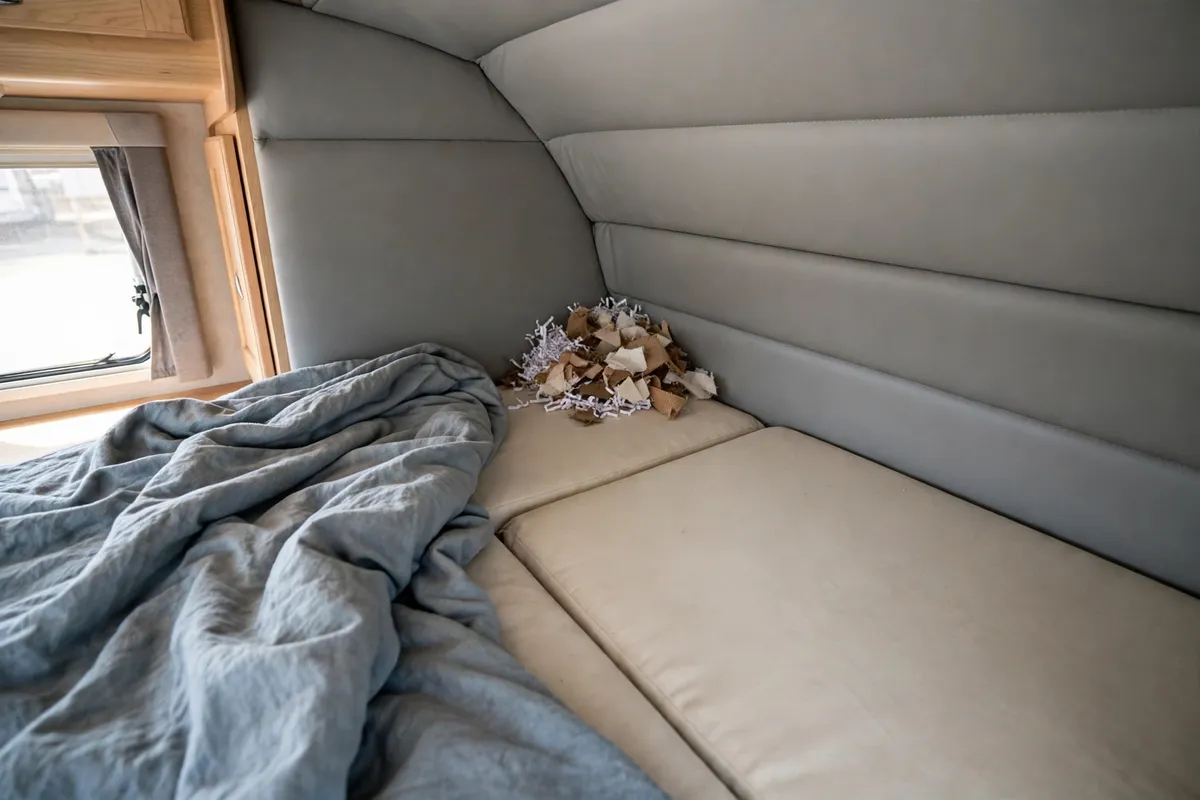
Second, nests in bedding and insulation. Mice love cabover bedding, cushions, and towels, and once urine soaks into foam, the smell is very hard to remove. One forum owner turned on the furnace after winter storage and watched shredded toilet tissue blow out of every vent — the nest was inside the ducting.
Third, plumbing and heat-system damage. Mice chew plastic water lines and drain hoses and nest near water heaters and furnaces. Any gnawing near a propane line, furnace, or water heater should be checked before you use that system, and nesting material must be kept away from burners, where it is a fire risk.
Fourth, contamination. Droppings and urine get into drawers, food packaging, and cutlery. Anything mice have walked across or chewed should be treated as contaminated: wash it, throw out open food, and clean the surface properly (see below). A mouse that finds open crackers will work for hours to widen the hole that got it in.
Rats and squirrels chew more aggressively, but the house mouse and deer mouse are the usual culprits, with pack rats a bigger issue in the desert Southwest, where owners report them nesting in engine bays.
What owners say actually works — and what does not
This is where honest reporting matters, because much confident online advice falls apart in a real camper.
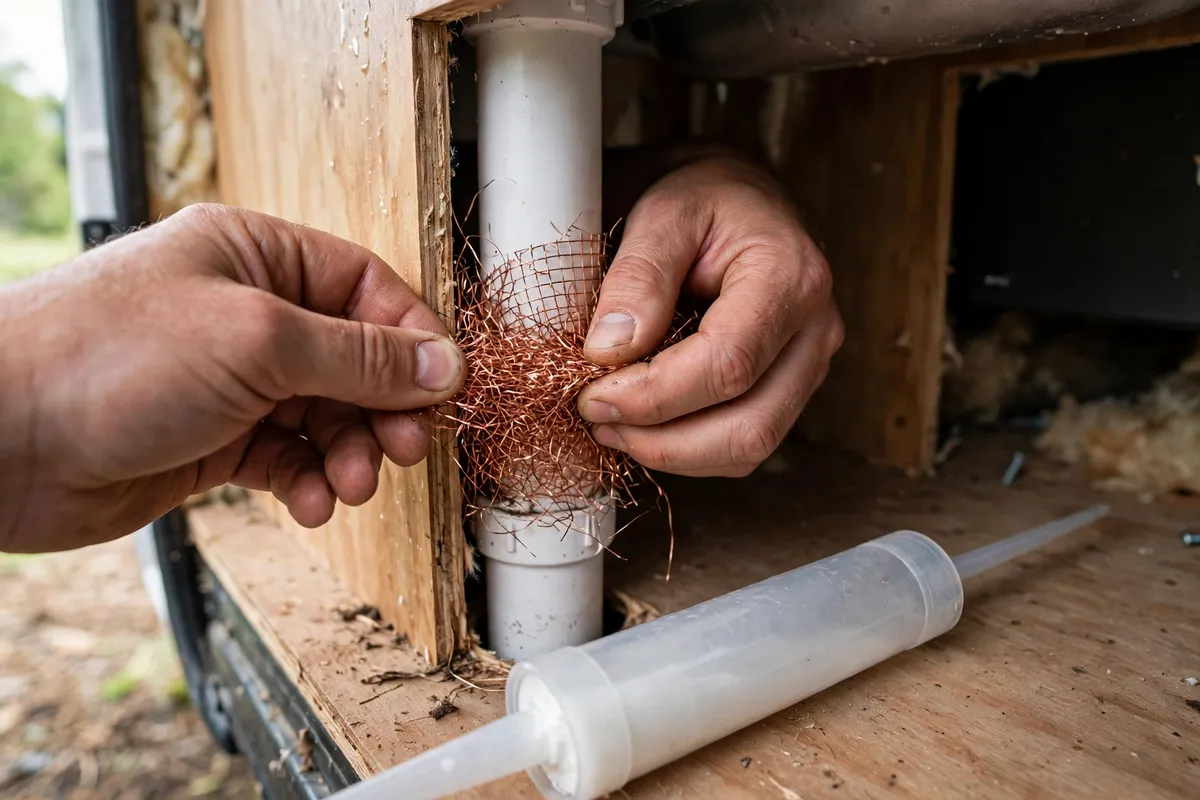
Sealing works. Everything else is a bonus. Owners across iRV2, the RV Forum, and truck camper publications agree: exclusion is the only reliable long-term fix. Pack small holes with copper mesh or coarse steel wool, then hold it in place with caulk or expanding foam. Do not use foam alone — mice chew straight through it. Copper mesh is better in damp spots like under sinks because it does not rust, and several experienced owners recommend copper scrub pads sealed with foam or silicone. For fridge vents, use half-inch hardware cloth riveted or screwed over the vent. On a slide-out, replace worn seals rather than stuffing the gap, because a stuffed gap reopens the next time the slide moves.
Do not forget the truck. If mice nest in the engine bay, they are one short climb from the camper. Owners who leave the hood partway up overnight at desert campsites report mice are less likely to settle there. It is a camping trick, not a substitute for sealing.
Peppermint oil, dryer sheets, mothballs, and ultrasonic repellers: mostly disappointing. Owners report mice nesting right next to dryer sheets and mothballs — one iRV2 thread sums it up as owners thinking they worked until the mice proved them wrong. Peppermint oil fades fast and mice work around it when food is on the other side. Ultrasonic repellers have the same problem: mice habituate to the sound, walls block it, and a repeller in an unplugged camper in storage does nothing. A pest expert interviewed by Truck Camper Adventure put it plainly: lights, noise makers, dryer sheets, mothballs, and ultrasonics do not work consistently. Botanical balsam-fir pouches get mixed reviews — some owners say they helped for a while, then stopped. Scent can be a mild extra, never the plan.
Traps work, but placement matters. Snap traps baited with peanut butter remain the CDC and owner standard, with a real advantage over poison: you know where the mouse died. Place traps perpendicular to walls along mouse routes — behind drawers, under the sink, near the cabover — not in the open floor. Anchor traps with string so one dragged into ducting does not become a smell problem, and check them daily while using the camper. Glue traps are widely regarded as inhumane and fail in cold weather — most experienced owners avoid them.
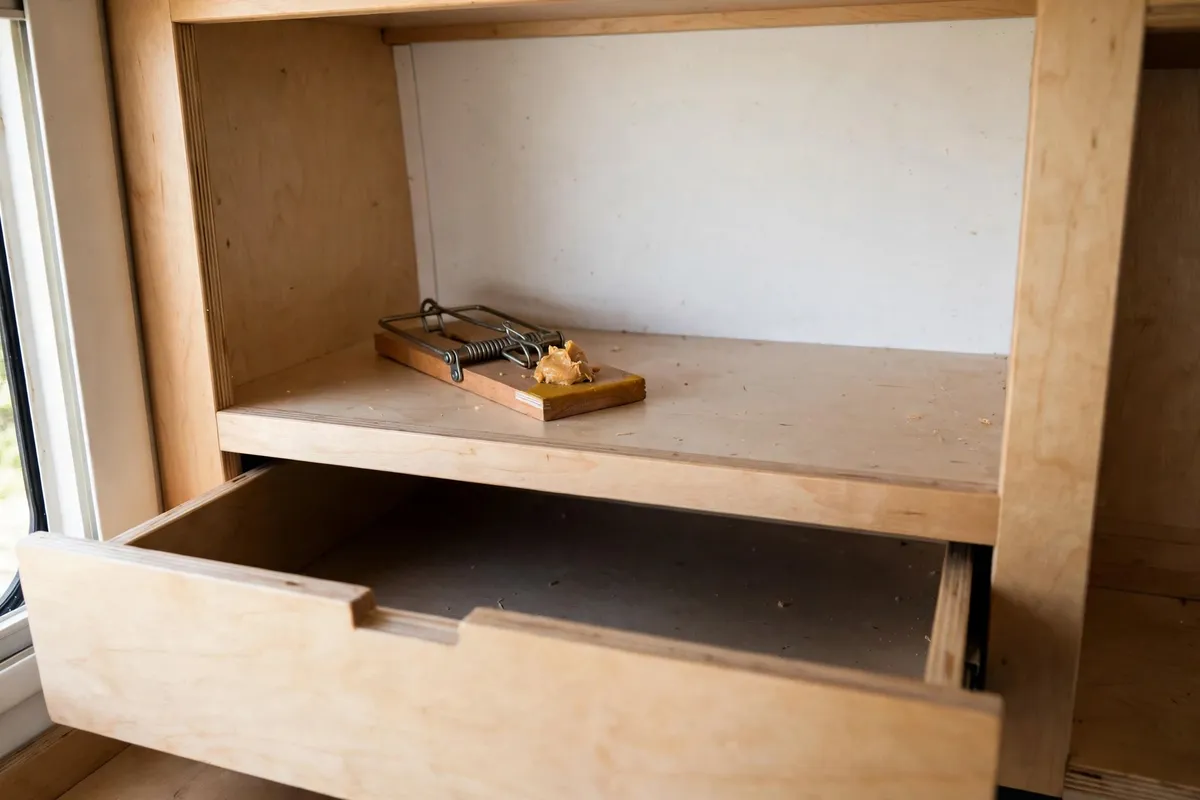
Food discipline is the other half of sealing. Store all food, including condiments and pet food, in hard containers with tight lids — glass, thick plastic, or metal. Cardboard and plastic bags are not mouse-proof. Wipe up crumbs, do not leave pet food out overnight, and take out trash before storage. One owner on iRV2 said it best: stored food is like a flashing neon sign saying soup kitchen.
Poison: use it last, and understand the risks
I keep poison at the bottom of the list for a reason. A poisoned mouse often dies inside a wall or ducting, where you cannot reach it and where it will smell for weeks. Loose pellets endanger children and pets, and a mouse can carry pellets into the camper and stash them. There is also secondary poisoning: dogs, cats, owls, and foxes can be poisoned by eating a poisoned rodent, and EPA and university guidance stresses that anticoagulant rodenticides carry well-established risks to non-target birds and mammals — see the Oregon State University summary of rodenticides and secondary poisoning.
If you do use poison, follow the label exactly, use tamper-resistant bait stations, keep it at least 50 feet from the camper, never loose pellets inside the living space, and never where children or pets can reach it. In a camper you sleep in, especially with dogs, snap traps and sealing are the safer default — see our guide to travelling with dogs in a truck camper before choosing any control method.
How to get mice out of a camper you are using now
Work in this order: trap first, seal in parallel, clean after activity stops.
- Confirm where they are: fresh droppings (dark and shiny when fresh, dry and grey when old), gnaw marks, shredded paper, scratching at night. Check under the sink, behind drawers, in cabover corners, and in outside compartments.
- Set snap traps along walls near the signs, baited with a pea-sized dab of peanut butter. If mice are trap-shy, leave traps unset and baited for a night or two, then set them.
- Seal the entry points you find, starting with the biggest — but trap aggressively for a few days first, or you trap mice inside.
- Remove food and nesting material: take out open food, wash contaminated dishes, bag shredded bedding for washing or disposal.
- After a week with no new droppings and no tripped traps, the camper is reasonably clear. If you are still catching mice after two weeks, you have missed an entry point — repeat the flashlight test.
If the infestation is heavy — nests in the walls, droppings throughout, or damage to wiring or propane fittings — call a pest professional rather than tearing into walls yourself.
Cleaning up safely: the part people rush
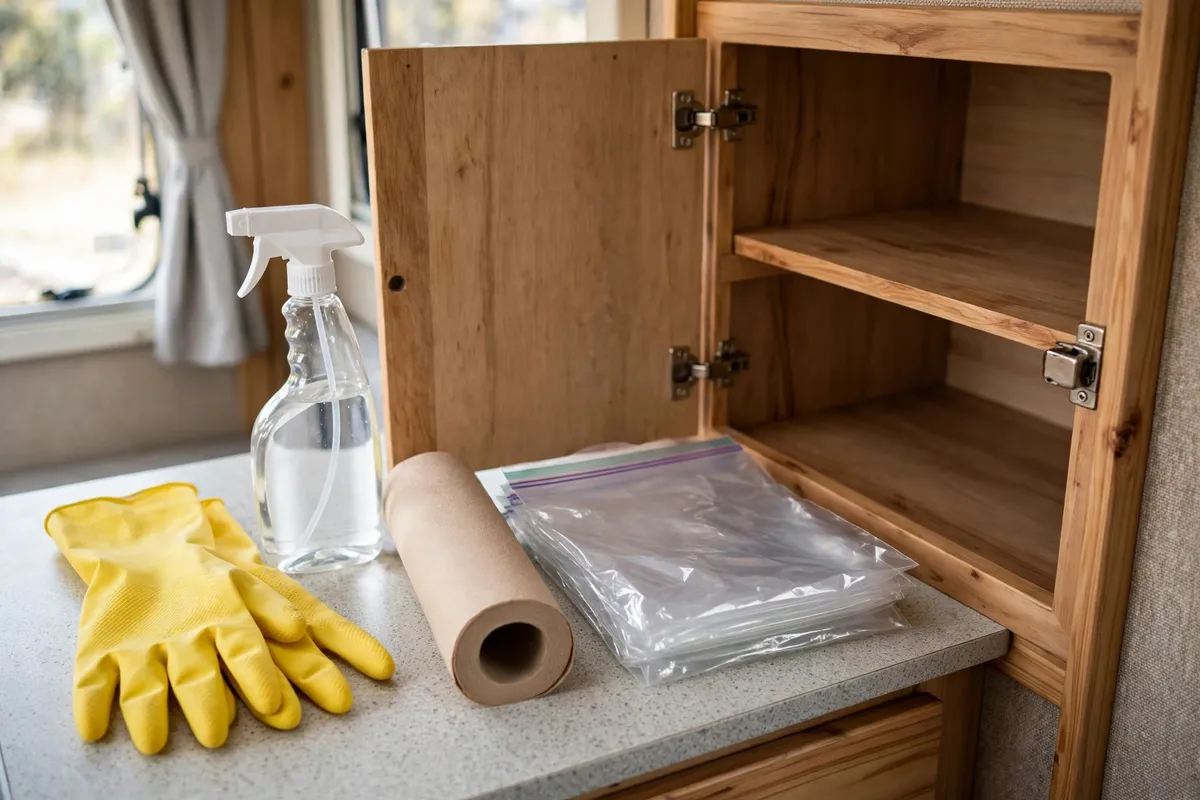
Do not sweep or vacuum dry droppings. That is the single most important cleanup rule, and it comes from the CDC. Sweeping and vacuuming throw contaminated dust into the air, and rodent urine, droppings, and saliva can carry hantavirus, a rare but serious illness — highest in a closed-up camper that has sat undisturbed.
The CDC guidance on cleaning up after rodents is straightforward. Ventilate first by opening doors and windows. Wear rubber or plastic gloves. Spray urine, droppings, and nesting material with disinfectant or a bleach solution until very wet, and let it soak about five minutes (about 1.5 cups of bleach per gallon of water, or an EPA-registered disinfectant used as labelled). Wipe up with paper towels, not a reusable rag. Double-bag the waste, tie the bags closed, and put them in a covered garbage can. Wash gloved hands, then bare hands with soap and warm water. Mop with disinfectant afterwards, and wash contaminated bedding in hot water with detergent. For the disease risk itself, see the CDC hantavirus prevention guidance.
For a heavy infestation in a long-closed camper, the CDC recommends extra precautions, including a respirator — read the full guidance before starting, and consider professional help rather than a dust mask and broom. This article is general information, not medical advice: if anyone develops fever, fatigue, and muscle aches in the weeks after rodent contact, they should see a clinician and mention the exposure. After cleanup, vacuum only after disinfecting, and leave a few unset traps in place for a week as an early warning.
Storage-season prevention
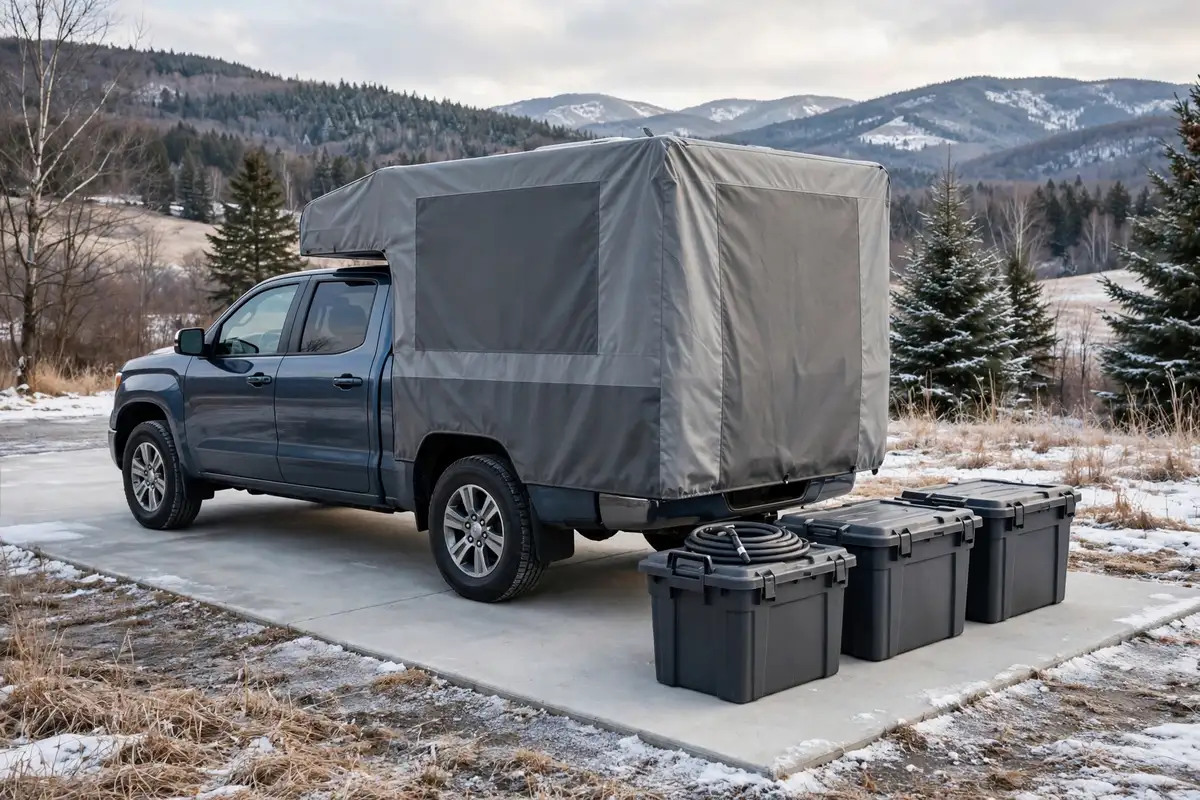
Most mouse damage happens while the camper sits. Fold this list into your year-round truck camper maintenance schedule and winterizing routine:
- Empty all food, including spices, tea, and pet food, and wipe down the stove, counters, and cabinets.
- Remove bedding, towels, and paper products, or store them in hard, sealed bins.
- Seal penetrations with copper mesh and caulk or foam, replace worn slide seals, and cover fridge and furnace vents with hardware cloth.
- Disconnect hoses and power cords, or keep them off the ground — a hose draped to the ground all winter is a bridge.
- Park on concrete or gravel, away from woodpiles, tall grass, and field edges if you can.
- Set snap traps and check them every couple of weeks if the camper is nearby. In remote storage, uncheckable traps become a smell problem.
- Inspect mid-storage if you can — a quick January check can catch a nest early.
- Before your first trip out of storage, repeat the flashlight test — our used truck camper inspection checklist is a good model.
One caution: seal the gaps mice use, but keep breathing vents protected with hardware cloth rather than blocked shut, or you will trap moisture.
What about insects, leaks, and smells?
The same habits keep insects down too. Ants follow food and water through the same plumbing gaps, so sealed food, wiped counters, and sealed penetrations do most of the work. If a persistent smell is drawing pests, check the tanks and drains: our guide to fixing black tank smell covers causes often mistaken for a pest problem. For wasps in a vent or a heavy infestation, call a professional.
A musty smell and stained panels do not always mean mice, either. A slow roof leak can soak insulation and create damp conditions mice love. If staining or a smell persists after cleanup, check the roof and seals: our guide to finding truck camper roof leaks before they rot the camper walks through the inspection.
The bottom line
Keeping mice out is not about one magic product. It is about closing the holes, taking the food away, and checking often enough to catch the next hole before a mouse family moves in for the winter. The owners who stay mouse-free did the flashlight test, packed copper mesh into the gaps under the sink, and emptied the camper before storage — and did it again the next year, because a camper that moves will always open new gaps. Start this weekend: flashlight test, seal what you find, set a few traps, empty the food.
Frequently asked questions
How do mice get into a truck camper?
Through gaps as small as a dime around plumbing, wiring, and propane penetrations, worn slide-out seals, fridge and furnace vents, and openings where the camper meets the truck bed. They climb tires, jacks, hoses, and power cords to reach them. A flashlight test from underneath at night reveals most of them.
What damage can mice do to a truck camper?
They chew wiring (furnace, fridge, and truck engine wiring), nest in cabover bedding and insulation, shred paper and fabric, contaminate food and dishes, and damage water lines. Wiring damage is usually the most expensive, and nests in ducting can leave a lasting smell.
Does peppermint oil keep mice out of a camper?
Not reliably. Owners report mice nesting near peppermint oil, dryer sheets, and mothballs, and the scent fades quickly. It can be a mild extra, but not a substitute for sealing and removing food. The same applies to ultrasonic repellers, which mice habituate to and which do nothing in an unplugged camper in storage.
What is the best way to seal mouse holes in a camper?
Pack small holes with copper mesh or coarse steel wool, then lock it in place with caulk or expanding foam. Do not use foam alone — mice chew through it. Cover larger vents with half-inch hardware cloth, and replace worn slide-out seals rather than stuffing them.
Are snap traps or poison better for mice in a truck camper?
Snap traps are the safer default where you sleep, especially with children or pets around, because you know where the mouse died and there is no secondary poisoning risk. Poison can leave a mouse dead inside a wall and endangers pets and wildlife that eat poisoned rodents. If you use poison, follow the label and use tamper-resistant stations away from the camper.
How do I clean mouse droppings in a camper safely?
Do not sweep or vacuum dry droppings. Ventilate, wear gloves, spray droppings with disinfectant or bleach solution until very wet, let it soak about five minutes, wipe up with paper towels, double-bag the waste, and wash your hands. See the CDC guidance linked above, and get professional help for a heavy infestation in a long-closed camper.
How do I keep mice out of my camper in winter storage?
Empty all food, remove or bin bedding and paper products, seal penetrations with copper mesh and caulk, cover vents with hardware cloth, disconnect hoses and cords from the ground, park on concrete away from woods and tall grass if possible, and check mid-storage. Fold this into your winterizing routine every year.