Truck Camper Mattress Upgrade – Fixing the Cabover Sleep Problem
The first three nights I spent in our truck camper, I slept worse than I had in a decade. The factory cabover pad was two inches of foam that felt like it had been selected by someone who never planned to lie on it. My hip found the plywood by night two, and when the temperature dropped into the thirties the memory foam topper I’d bought turned into something closer to a cutting board — my crash course in why a truck camper mattress upgrade matters.
That misery is practically a rite of passage for truck camper owners. The cabover is the best sleeping real estate in the camper world — perched over the cab, away from the dinette conversions — and yet manufacturers ship it with the cheapest foam that technically qualifies as a mattress. A proper truck camper mattress upgrade is one of the highest-value improvements you can make, and also one of the easiest to get wrong. The cabover has three problems a house bedroom doesn’t: memory foam that goes rock hard in the cold, a roof that has to close over everything (especially in pop-ups), and condensation that rots the plywood under your mattress.
This guide works through all three, with the fixes experienced owners actually use.
Quick note: some links in this post are affiliate links or point to manufacturer pages. If you buy through them, the site earns a small commission at no extra cost to you.
Problem 1: Memory Foam Turns Rock Hard in the Cold
Here’s the physics nobody warns you about. Memory foam gets its pressure-relieving feel from a glass-transition temperature that’s tuned to soften with body heat. Park a camper in freezing weather and the unheated cabover sits well below that point — and owners across the camping forums report the same result: foam that “gets rock solid” in the cold, like sleeping on a “giant ice cube.”
The cabover is the worst place in the camper for this because it hangs out over the truck cab with minimal insulation on three sides and a thin roof above. On a cold night it’s easily the coldest surface in the rig, and the foam absorbs that chill long before you climb in.
What actually works
Warm the camper before you sleep in it. This is the fix cold-weather owners repeat most — run the heater for a while before bed and the topper thaws out, then body heat finishes the job once you’re lying on it. The foam only needs to get back above its transition temperature. Our full winterizing routine — including keeping the cabover warmer overnight — is covered in our winterizing guide.
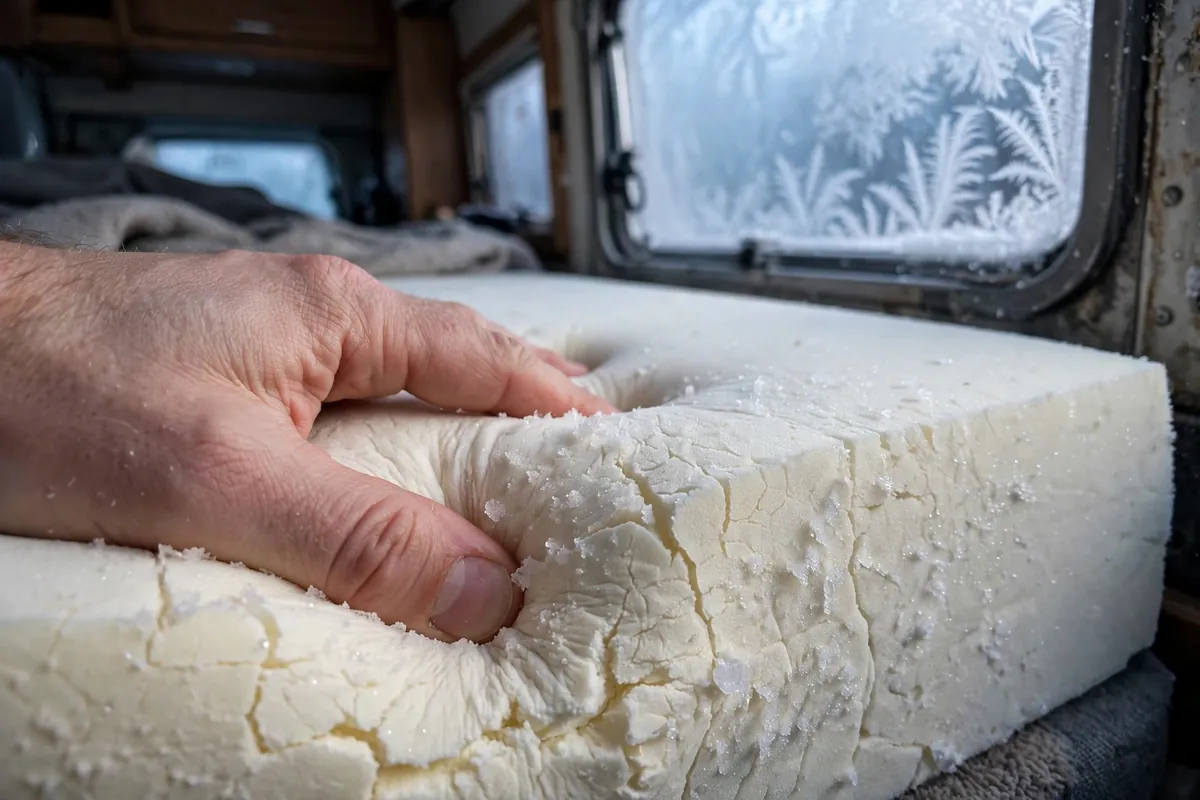
Pick foam that doesn’t harden. This is the real upgrade. A common piece of advice shared by experienced campers is to stop fighting memory foam and buy good conventional foam instead — 3 to 4 inches of high-density polyurethane in medium firmness, which stays pliable in the cold and springs back when you move. Gel-infused memory foam also hardens less than traditional memory foam in low temperatures, which is one reason gel toppers are so popular in the truck camper world. Latex foam is another cold-weather favorite: RV owners praise it for staying flexible in freezing conditions, though it costs more and weighs more. For shoulder seasons, a popular Four Wheel Camper setup is a firm high-density foam base with a thinner soft topper on top — roughly a 4 inch base with a 1 to 2 inch softer layer.
Safety note: if you use a heated mattress pad to pre-warm the bed, follow the manufacturer’s instructions and never leave it running unattended. And check that any foam you buy meets modern flammability standards — reputable RV makers build to 16 CFR 1632/1633.
Problem 2: The Pop-Up Roof Has to Close Over Everything
This is the constraint that surprises people upgrading a pop-up or soft-side truck camper for the first time. Whatever you put on the bed has to fit under the roof when it comes down, and there’s no negotiating with the latches.
Four Wheel Camper owners on the Wander the West forums have mapped this territory thoroughly. The working rule: a 2 inch topper over the factory mattress will let the roof close on most pop-ups. At 3 inches it gets marginal — one Grandby owner reported that a 3 inch topper closed, but wished he’d bought the 2 inch version instead. Anything thicker, and you’re dealing with it every time you travel.
How owners actually handle thick toppers
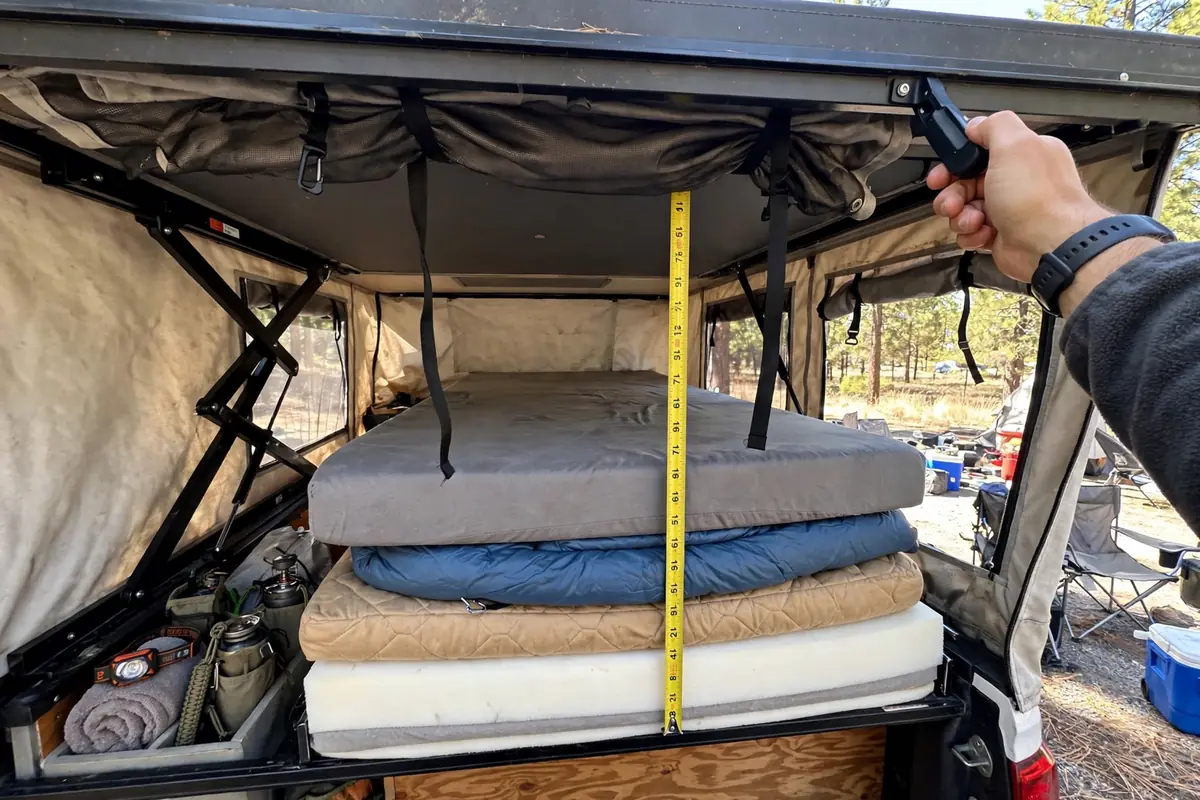
The most common solution is also the most annoying: buy the thick topper you want and store it somewhere else when the roof comes down. One Hawk owner called his 3 inch gel topper the best camping sleep he’d ever had — but rolling it up was like wrestling a bag of gelatin, and it moved to the dinette every travel day.
Other owners keep it simpler on purpose. A popular approach for pop-ups is a closed-cell sleeping pad — like a Therm-a-Rest Z-Lite — cut to fit under or over the factory mattress. It adds insulation and a little cushion, it’s thin enough to leave in place when the roof drops, and it rolls into its own stuff sack when you want it gone. You give up some plushness, but you never wrestle anything.
Measure before you buy anything
Pop-up cabover platforms are not rectangles — the front corners are often clipped or rounded, and the mattress may be split into a main section plus a pull-out extension. Measure every dimension yourself, then measure your closed clearance: with the roof down, how much stack height fits between the bed platform and the underside of the roof? Subtract your bedding, and whatever’s left is your mattress budget. If the latches won’t close easily, the stack is too tall — forcing it stresses the lift mechanism and the latches themselves.
If you’re still deciding between hard-side and pop-up, our comparison of hard-side vs soft-side truck campers and our roundup of the best pop-up truck campers will help you think through the trade-offs beyond the mattress.
Problem 3: Condensation Rots the Plywood Under Your Mattress
This is the problem that costs people real money. Your body gives off heat and moisture all night. The mattress sits on a plywood platform that’s cold from outside air. Warm, moist air meets cold plywood, and you get condensation — pooling invisibly under the mattress, soaking into the wood, and growing mold. One buyer on the Good Sam forums walked away from a used truck camper purchase after lifting the mattress and finding black mold on the platform.
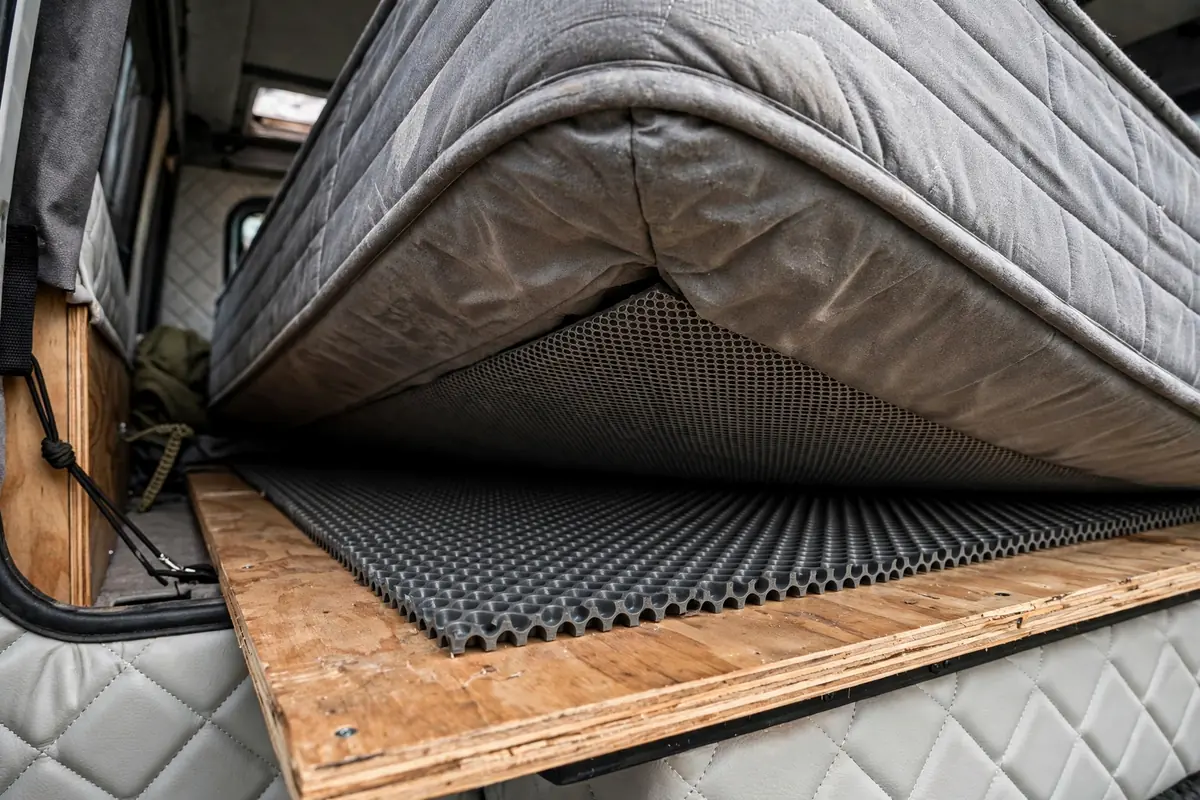
The fix is an air gap between the mattress and the platform — something that lets air circulate so moisture can evaporate instead of collecting. (For the full picture, see our guide to stopping condensation in a truck camper.)
The proven under-mattress solutions
HyperVent Aire-Flow matting is the gold standard in the RV and boating world, and truck camper owners use it heavily. It’s a 3/4 inch spun-polymer mesh bonded to breathable fabric that doesn’t compress under weight, so it holds an open air layer under the mattress permanently. It cuts with scissors and rolls up if you need it out of the way. It’s sold cut for RV beds — see Mattress Insider’s condensation prevention page — and marine retailers like Defender carry it by the foot for roughly $13 a linear foot. Owners on the forums report running it for years with zero mold. The trade-off: it eats 3/4 inch of your pop-up roof clearance budget, so measure accordingly.
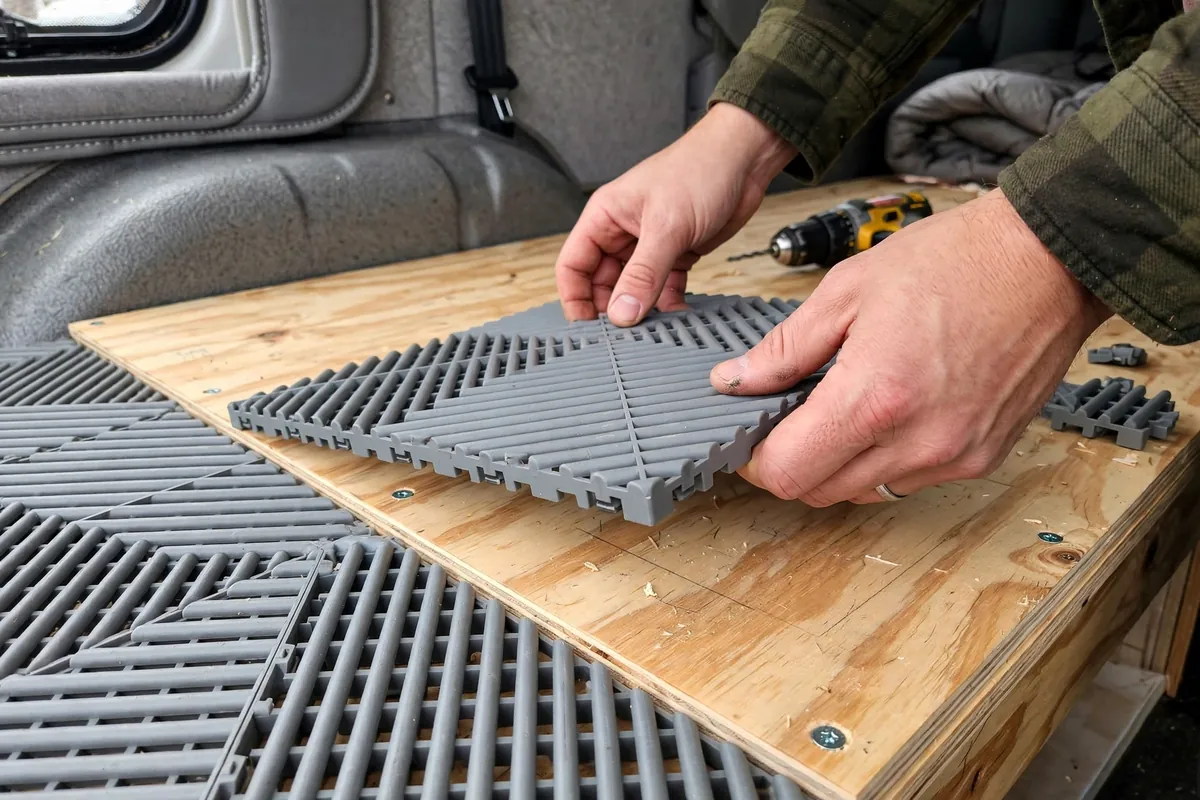
Dri-Dek tiles are interlocking boat-deck tiles that snap into a ventilated grid — superb airflow and easy to lift out for cleaning, though pricier and thicker than mesh matting, so better for hard-sides.
Froli Traveller springs are plastic spring elements that clip together under the mattress like a mini box spring, holding it off the platform. Four Wheel Camper owners pair them with 3 to 4 inches of high-density foam for a setup that breathes from below.
The budget plays. Owners share two cheap tricks that genuinely help: a sheet of 1/2 inch foam insulation board with the foil side up under the mattress (it warms the surface the mattress sees, so less condensation forms), and a foam pool noodle wedged between the mattress and the head wall to let air circulate. For humid climates, one full-timer on the iRV2 forums drilled ventilation holes through the plywood deck and ran a heated mattress pad a few times a week to drive residual moisture out of the bedding. If you go the drilled-holes route, make sure the platform stays structurally sound.
Topper vs Full Replacement: Which Truck Camper Mattress Upgrade Is Yours?
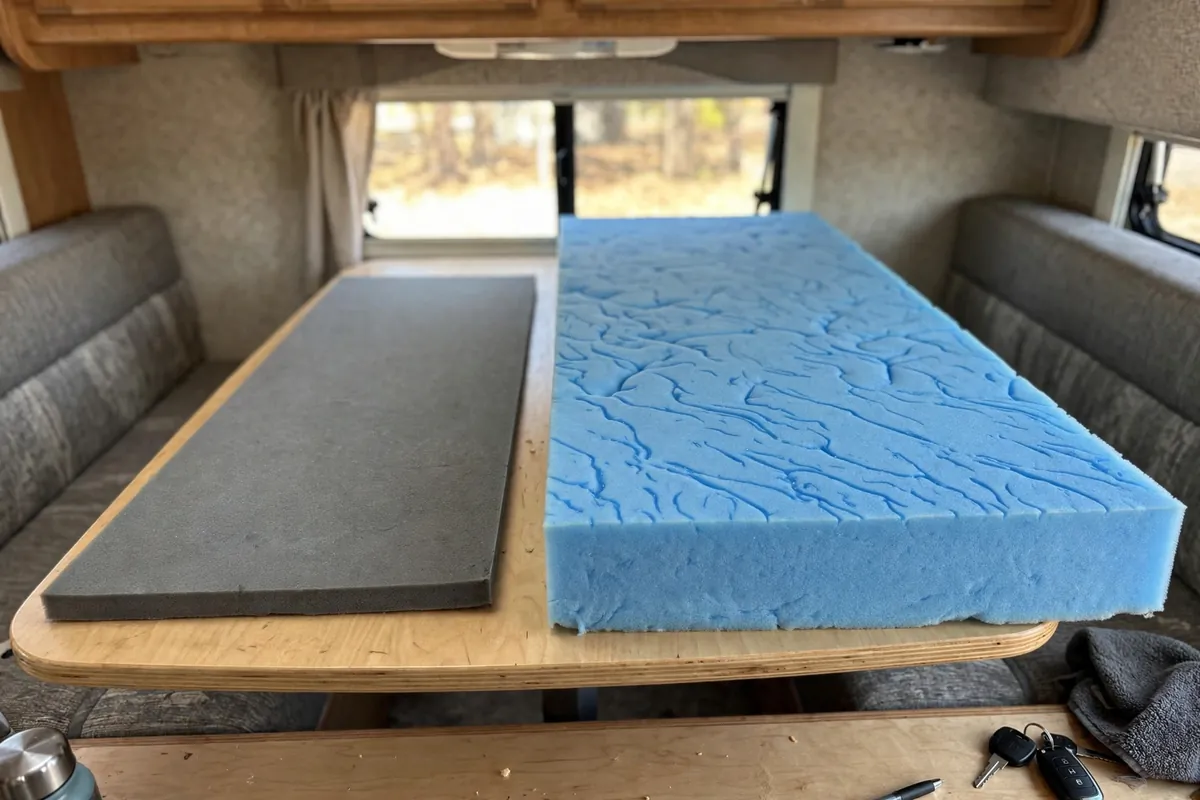
This is the decision every owner faces, and the forums have settled on practical advice: start with a topper unless the factory mattress is truly unsalvageable. A topper is cheaper, reversible, and — critically — it lets you figure out exactly what your back wants before you commit to a custom build.
Get a topper when: the factory pad is basically sound but too firm or too thin, you camp seasonally, you own a pop-up with tight roof clearance (a removable topper is far more flexible), or you’re not sure what firmness you like. A 2 to 3 inch gel memory foam topper over the factory foam transforms most cabovers for well under $150.
Get a full replacement when: the factory mattress has collapsed or has visible mold, you full-time and sleep on it every night, or the cabover platform has an odd shape that deserves a custom fit. This is also the moment to fix the underside with a ventilated mat — you’re lifting the whole mattress anyway.
Consider a hybrid when: you want custom comfort but pop-up clearance rules out a thick mattress. A 3 to 4 inch custom high-density foam base plus a removable 2 inch topper gives you a thin travel profile and a plush sleep profile — you just move the topper to the dinette on travel days.
How to Choose: Firmness, Thickness, and Foam Types
Firmness. Most truck camper owners land on medium to medium-firm. Side sleepers need enough give at the shoulder and hip; back sleepers need support that keeps the spine neutral. If two people share the cabover with different preferences, some custom makers build split firmness — one side medium, one side firm.
Thickness. For hard-sides, 4 to 6 inches of quality foam (or a 2 inch base plus a 2 to 3 inch topper) is the sweet spot most owners report. For pop-ups, work backwards from your measured roof clearance: factory mattress + underlayment + topper + bedding must all fit. When in doubt, go thinner on the permanent layer and keep a removable topper for comfort.
Foam types, quickly:
- High-density polyurethane foam — the workhorse. Stays pliable in the cold, good support, affordable. Look for 1.8 lb density or higher for a base layer.
- Memory foam — best pressure relief, worst cold behavior. Fine for three-season camping in a heated camper; miserable in an unheated cabover below freezing. Gel-infused versions handle the cold somewhat better.
- Latex (natural or Talalay) — excellent durability and cold-weather flexibility, breathes better than memory foam, but heavier and pricier. Many owners who try a 2 to 3 inch latex topper never go back.
- Egg-crate / convoluted foam — adds airflow and a little softness, but bottoms out faster than flat foam of the same thickness. Better as a supplement than a base.
Weight matters more than you think. A heavy latex mattress adds real weight over the cab, where payload is already tight. If you’re watching your numbers, run them through our truck camper payload calculator guide before you buy.
Product Mentions Worth Your Money
These are the names that come up again and again in owner discussions and check out on quality:
- A 2 to 3 inch gel memory foam topper (Lucid and similar). The Lucid blue gel topper gets mentioned by name on the Wander the West forums as one of the best-priced options, and Four Wheel Camper owners confirm the 2 inch version closes under pop-up roofs. For hard-sides, go 3 inches. This is the single best bang-for-buck truck camper mattress upgrade for most people.
- Custom RV mattresses from Tochta. When the factory size is weird — and cabover sizes are always weird — Tochta builds to your exact dimensions, ships free, and offers a 100-night trial. Their mattresses use latex and memory foam layers with a proper fire barrier built to federal flammability standards. Spec your cabover with their builder at tochta.com.
- HyperVent Aire-Flow underlayment. The closest thing to a universally recommended product in the truck camper mattress world. It goes under whatever mattress you choose and quietly prevents the mold problem that ruins plywood platforms. Mattress Insider’s condensation prevention page sells it sized for RV beds.
- A heated mattress pad for shoulder-season and winter camping. Full-timers use these both to pre-warm the bed and to periodically drive moisture out of the bedding. Get dual controls if two people share the bed, and follow the safety rules above.
The 30-Minute Upgrade Checklist

- Measure everything. Platform length, width at both ends, corner angles, and closed-roof clearance. Write it down.
- Lift the factory mattress and inspect the plywood. Any dark spots, mustiness, or soft wood means mold — treat it before the new mattress goes on.
- Decide topper vs replacement using the framework above.
- Order the under-mattress ventilation layer first. HyperVent, Dri-Dek, or Froli — whatever fits your clearance. It’s the cheapest insurance in this whole project.
- Order the mattress or topper to your measured dimensions, accounting for the ventilation layer’s thickness in pop-ups.
- Do a test close. Put everything in place — including your normal bedding — and close the roof before your first trip. If the latches fight you, something’s too thick.
- Do a test cold night. If you’re heading into freezing weather, sleep on it in the driveway first. A rock-hard topper discovered at midnight in a national forest is a lesson you only need once.
FAQ
What thickness of mattress topper can I leave in a pop-up truck camper when closing the roof?
Two inches is the safe rule of thumb — owners of Four Wheel Campers and similar pop-ups consistently report that a 2 inch topper over the factory mattress closes fine. At 3 inches it depends on your specific camper, bedding, and latch adjustment. Anything thicker should be stored off the bed on travel days.
Why does my memory foam topper feel like concrete in winter?
Memory foam stiffens as it gets cold — below its glass-transition temperature it genuinely turns rock hard. The cabover is the coldest part of the camper, so it hits toppers there first and hardest. Fixes: run the heater for a while before bed, switch to gel-infused or high-density polyurethane foam that stays pliable in the cold, or add a heated mattress pad to pre-warm the bed.
How do I stop mold from growing under my truck camper mattress?
Put a ventilated layer between the mattress and the plywood platform so air can circulate and moisture can evaporate — HyperVent Aire-Flow matting is the most recommended product for this. Also ventilate the camper itself — crack a vent or window — because humid interior air feeds the condensation cycle. Our condensation guide covers the whole moisture picture.
Should I get a mattress topper or a full replacement mattress?
Start with a topper if the factory mattress is structurally okay — it’s cheaper, reversible, and helps you learn what firmness you actually like. Go for a full replacement if the factory pad is collapsed, moldy, or shaped in a way no topper can fix, or if you full-time and need a proper long-term sleep surface.
What size mattress fits a truck camper cabover?
There’s no standard size. Cabover platforms vary by manufacturer and model year, and the front corners are often clipped or rounded. Measure your own platform — length, width at both ends, and the corner geometry — and order custom or trim-to-fit.
Are custom RV mattresses worth the cost?
For full-timers and anyone with back problems, usually yes — you’re sleeping on it every night, and a mattress cut exactly to your odd-shaped cabover is a different experience from a trimmed-down house mattress. For occasional weekend campers, a good topper over the factory pad delivers most of the benefit for a fraction of the price. Either way, don’t skip the under-mattress ventilation layer — it protects whatever you buy.