Truck Camper Air Conditioning: Options, Power, and Staying Cool
I learned about truck camper air conditioning on a July afternoon in southern Utah, when my camper hit 102 degrees and my little fan just pushed hot air around in circles. Since then I have run a rooftop unit on shore power, watched friends nurse 12V systems through desert nights, and spent too many evenings in owner forums figuring out why one camper stays comfortable and the next does not. Here is the short version: what cools a truck camper, what it takes to power it, and the cheap tactics that matter as much as the unit.
Why a Truck Camper Is So Hard to Cool
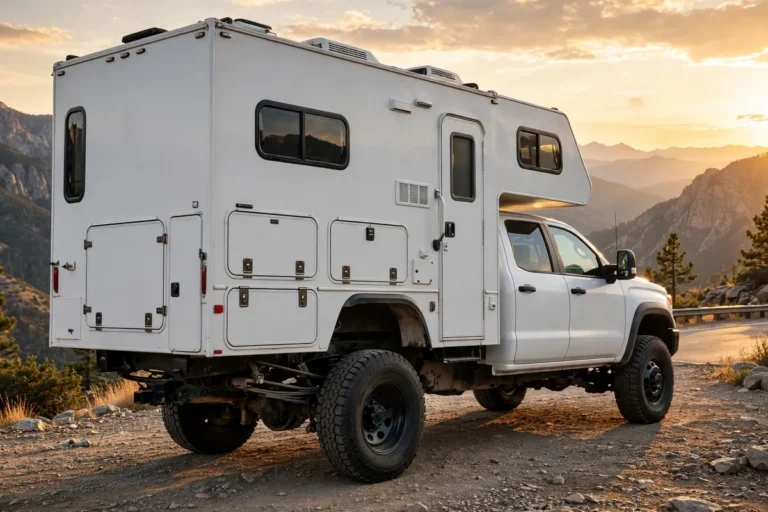
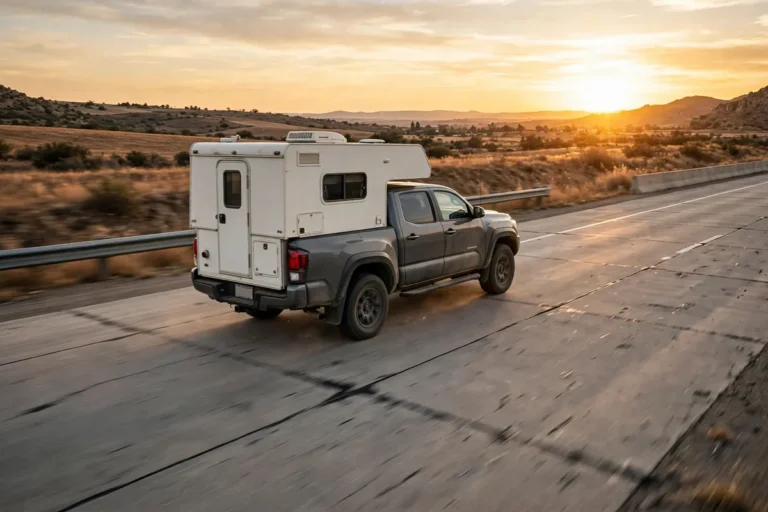
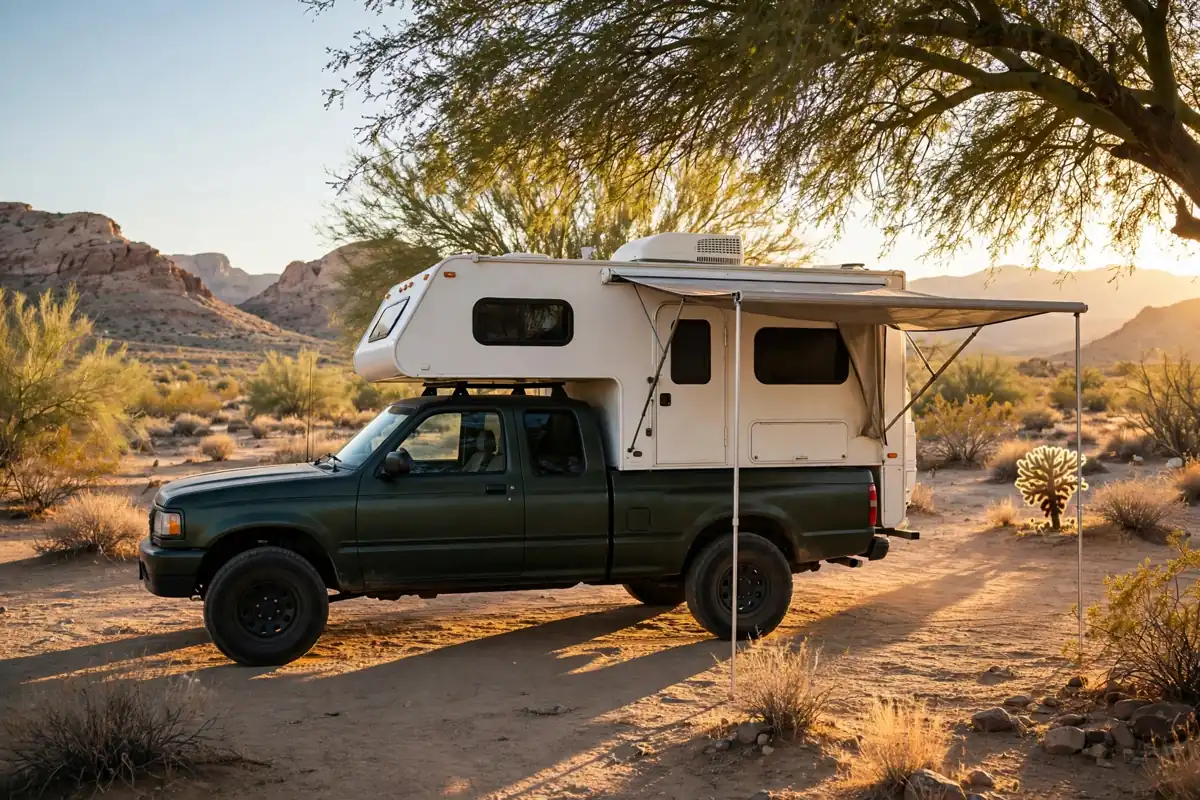
A truck camper is a small, tall, thin-walled box in full sun, often with a dark roof and a cab-over bed baking above the truck cab. There is little insulation to keep heat out and little thermal mass to soak it up. The sun heats the roof, the walls radiate it back in, and every window becomes a greenhouse. Cook inside and open the door a few times, and you add more heat on top.
That is why house logic fails here. A unit that is too big short-cycles, switching on and off without pulling humidity out, so the camper feels clammy. A unit that is too small runs all day and never catches up. And power is always the real constraint: the air conditioner is only half the purchase, and whatever runs it is the other half.
How Much Cooling Does a Truck Camper Actually Need?
For most hard-side truck campers, roughly 80 to 120 square feet, the sweet spot is 8,000 to 13,500 BTU. A small pop-up or wedge camper may get by on less, especially in shade or at elevation. A big hard-side with a slide-out, dark exterior, and lots of glass wants the top of that range, and will still struggle in 110-degree desert sun without other help.
Size for your worst afternoon, not your average evening. A unit fine at 85 degrees will not magically keep up at 105. But do not overshoot either: if you only hit real heat a few weekends a year, a mid-size unit plus shade and ventilation beats a monster rooftop unit that drains batteries and adds weight up high.
Humidity changes the math too. In dry desert air, ventilation and evaporative cooling can do real work. In humid Gulf Coast or Florida air, only a compressor unit that actually dehumidifies will feel comfortable. If your camper feels damp and sticky even with the fan running, read our guide on how to stop condensation in a truck camper before you blame the air conditioner.
Truck Camper Air Conditioning Options Compared
The standard rooftop unit: 120V, powerful, power-hungry
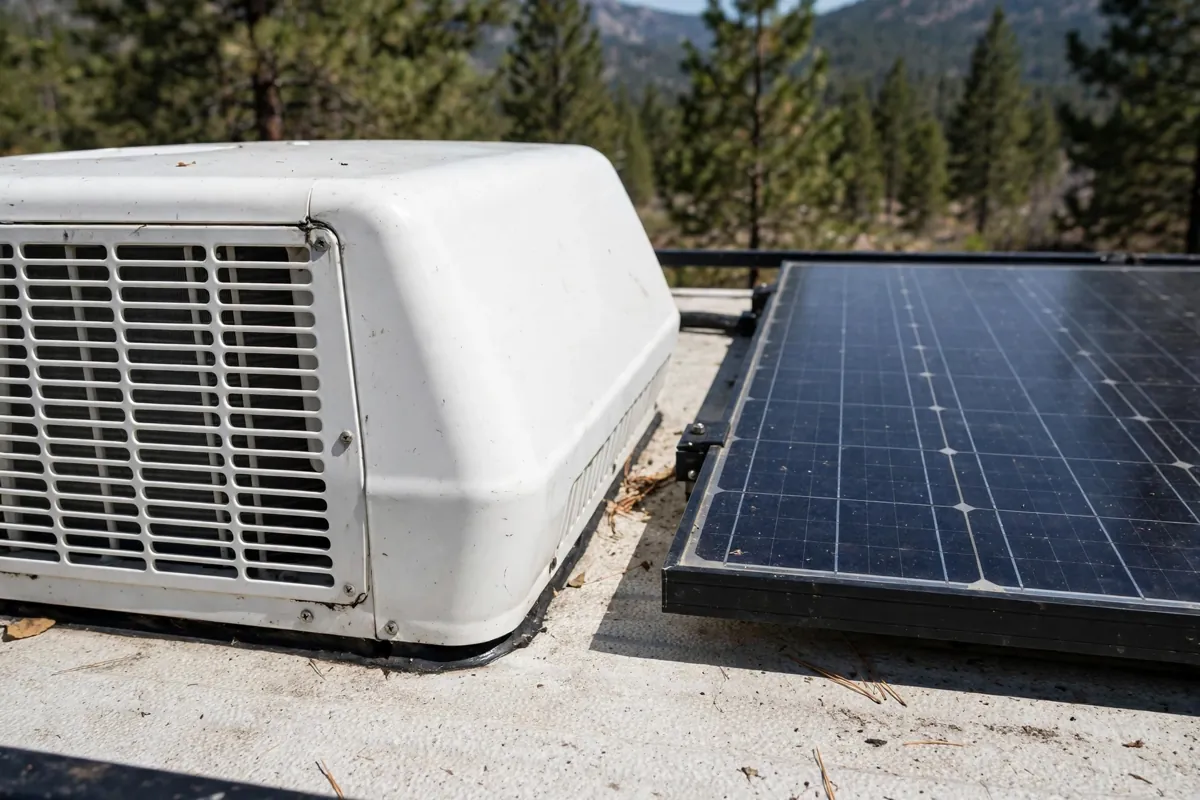
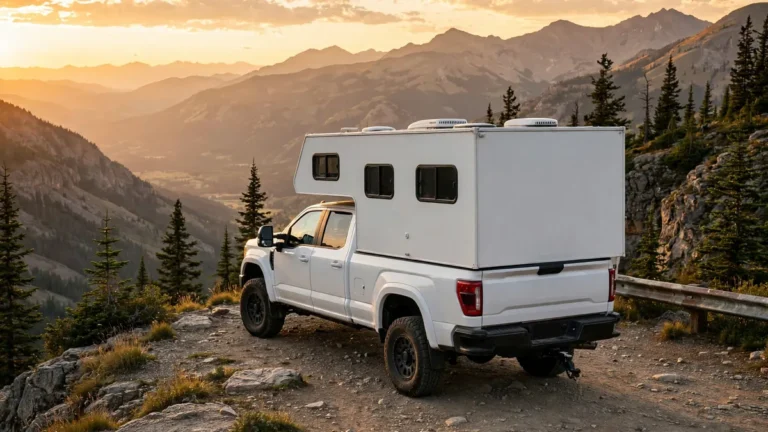
This is the air conditioner most truck campers come with: a Coleman-Mach or Dometic rooftop unit, usually 13,500 or 15,000 BTU, on 120V AC. It fits a standard 14-by-14-inch roof opening, cools fast, and on shore power just works. A Coleman-Mach 15,000 BTU unit is rated around 1,650 running watts with a locked-rotor starting current of 63 amps — that starting spike is why these units are fussy off-grid.
The downsides are weight, height, and power. A rooftop unit adds roughly 80 to 100-plus pounds on the roof, which matters for payload and handling in wind. It needs shore power, a generator, or a large inverter and battery bank, and it is loud enough that sleeping directly under it takes getting used to. If you mostly stay at campgrounds with hookups, this is the simplest answer. If you mostly boondock, read the power section first.
12V rooftop units: the boondocking-friendly option
The newer 12V rooftop units, like the Dometic RTX 2000 at 6,824 BTU and the Nomadic Cooling X2 at 8,188 BTU and about 720 watts, run straight off your battery bank without an inverter. The X2 draws about 27 amps in Eco mode and up to 55 amps at maximum: you skip inverter losses, but still need a serious lithium bank to run one for hours.
These units make the most sense for overnight cooling in a well-insulated camper, or for taking the edge off after the sun drops. They will not freeze out a big hard-side camper at noon in Phoenix the way a 13,500 BTU rooftop unit will, but they will let you sleep comfortably without a generator running all night, provided your battery bank is sized for it. See FarOutRide’s 12V air conditioner comparison for current BTU ratings and amp draws side by side.
Check the roof opening and structure before buying. Most units use the standard 14-by-14-inch vent opening, but not all, and a pop-up roof may not be rated for the weight or the cut.
Portable units: flexible, but choose dual-hose
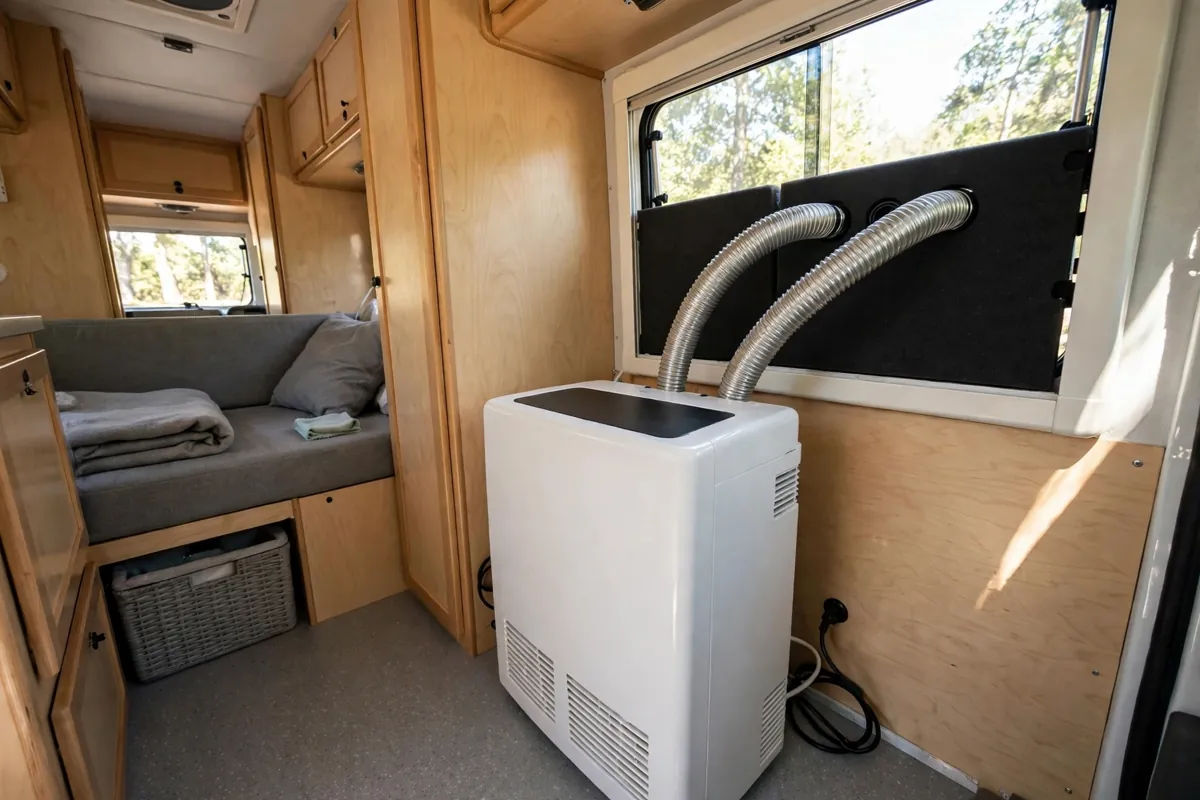
A portable air conditioner sounds perfect for a truck camper: no roof cut, no permanent install, move it where you need it. In practice, the type matters enormously, and this is one of the clearest lessons from owner forums.
Owners on iRV2 report the same problem with single-hose portables: the unit blows hot condenser air outside, dropping pressure inside, so hot outside air gets sucked back in through vents, window seals, and fridge vents. Several owners who switched to a dual-hose unit — one hose bringing outside air in, the other sending hot air out — report a night-and-day difference, and owners who kept a single-hose unit say insulating the hot exhaust hose helped.
If you go portable, buy dual-hose, vent it through a fitted window panel, and keep the hose run short. A dual-hose unit in the 8,000 to 10,000 BTU range can cool a truck camper on shore power or a generator. A tiny personal cooler is different: the Zero Breeze Mark 2 is rated at just 2,300 BTU and 240 watts, and its maker positions it for cooling the space right around you in an RV, not a whole camper. Pointed at your bunk it can help; it will not rescue a sun-baked camper at 2 p.m.
Evaporative coolers: great in dry air, useless in humidity
Evaporative coolers blow air across wet pads and cool it by evaporation. They sip power, often under 10 amps on 12V, and owners on WanderTheWest have long discussed them for dry Southwest camping, including low-tech wet towels over windows and doors. In dry air below roughly 60 percent humidity, they can feel wonderful.
In humid air they barely work and make dampness worse. If you camp in the Southeast or anywhere humid, skip the swamp cooler and buy a compressor unit. In Arizona, New Mexico, Nevada, and the high desert, one can be a cheap, quiet, low-power way to stay comfortable, paired with a vent fan.
What Actually Runs an Air Conditioner?
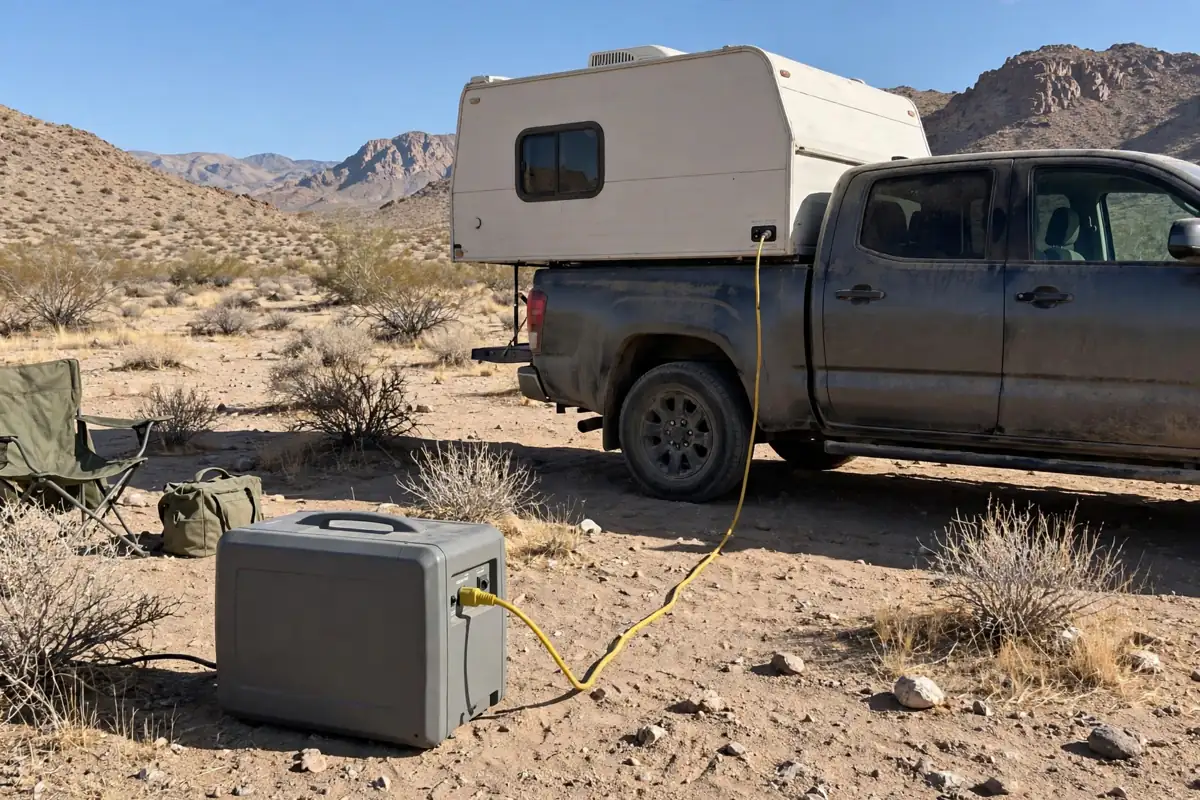
This is where most truck camper air conditioning plans fall apart, so let us be blunt about the numbers.
Shore power is the easy case. A 30-amp pedestal handles a single rooftop unit with room to spare, unless you also run the water heater on electric, the microwave, and a hair dryer at once. On a 15- or 20-amp household outlet, a big rooftop unit is marginal, and a soft-start kit (below) makes it reliable.
A generator is the classic boondocking answer. A 13,500 BTU rooftop unit needs roughly 2,800 watts or more to start reliably without a soft start, and a 15,000 BTU unit wants more. That is why so many owners end up with a 3,000-watt-class inverter generator, or two smaller ones in parallel. The trade-offs are fuel, noise, bed weight, and quiet hours that may ban generator use exactly when you want cooling most. See our truck camper generator vs solar power comparison.
Batteries and an inverter can run a rooftop unit, but only briefly. A unit pulling 1,500 watts through an inverter draws roughly 125 amps from a 12V bank before losses. A 200 amp-hour lithium bank gives barely over an hour of continuous running, less once you count fridge, lights, and fan. It is a “cool down for sleep, then cycle” strategy, not an all-afternoon one, unless you have a very large bank and serious solar. See our truck camper solar and lithium sizing guide and portable power stations for truck camping — and check whether a power station is really rated to start your compressor, not just run a fan.
12V units change the math, they do not repeal it. A unit drawing 30 amps eats 30 amp-hours every hour. Six hours overnight is 180 amp-hours, before anything else draws a watt. That works with a 300-plus amp-hour lithium bank and a way to recharge next day; it is a fantasy on a single stock lead-acid battery.
One habit I picked up from the forums: do not try to cool a hot box from scratch. Owners on iRV2 who travel in serious heat run the generator and rooftop air while driving, so they arrive with the camper already cool. At camp, start the air conditioner early in the morning and let it hold the temperature. Dragging a sun-baked camper down from 100 degrees at 3 p.m. is the hardest job you can give any unit.
The Soft-Start Kit: The Small Upgrade That Changes Everything
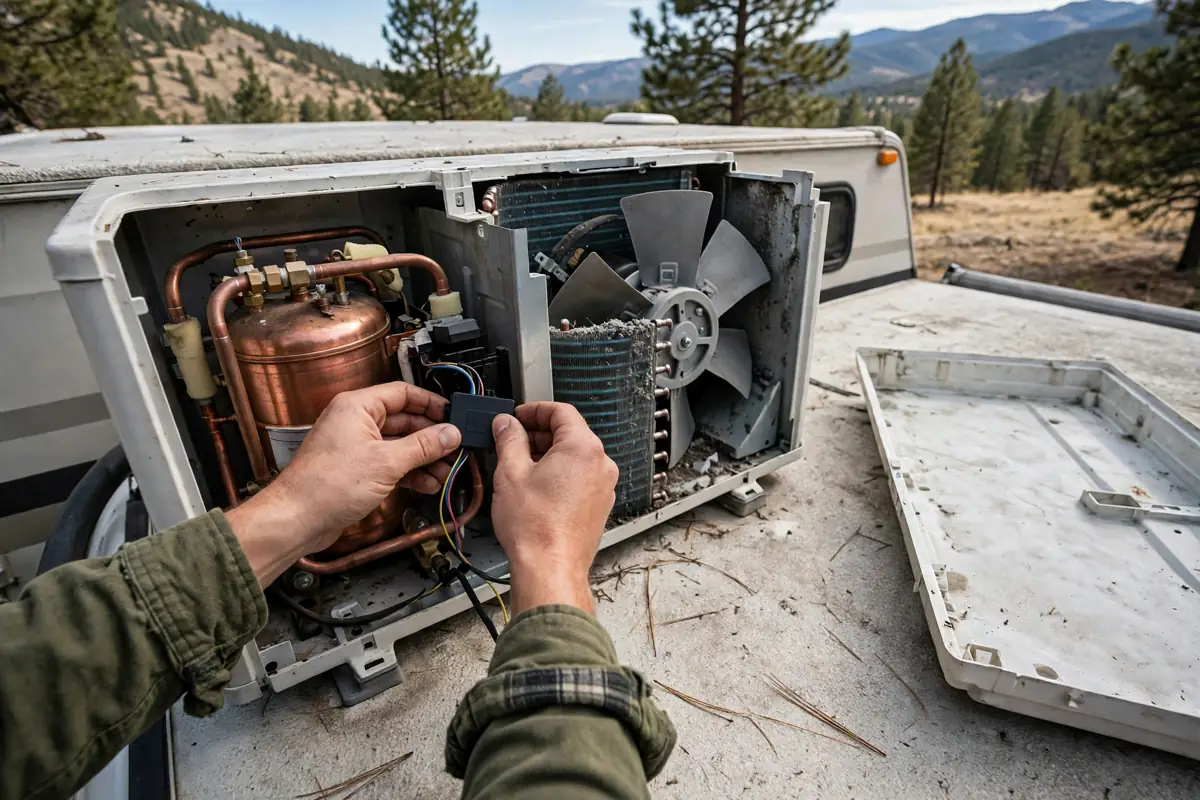
If you own a 120V rooftop unit and a small generator, a soft-start kit is the single best upgrade I know for truck camper air conditioning. A compressor at rest draws a huge inrush current for a fraction of a second — on a 15,000 BTU Coleman-Mach that locked-rotor figure is around 63 amps — and that spike is what trips a small inverter generator or a campground breaker even though the running draw would be fine.
A soft starter, like the Micro-Air EasyStart, ramps the compressor up gradually. Micro-Air says it can reduce starting current by up to 75 percent over the first several starts. Owners on Forest River Forums and iRV2 report rooftop units that would not start on a 2,000-watt inverter generator suddenly starting and running fine after install.
Two honest caveats. First, a soft start does nothing for running power: once the compressor is up to speed, it draws what it drew before, so it will not let a tiny battery bank run an air conditioner all afternoon. Second, it is not magic on an undersized generator at altitude or in extreme heat, where the generator loses output. It removes the starting spike; it does not add capacity. Check current pricing before you buy, since it moves around.
Staying Cool Without Running the Air Conditioner All Day
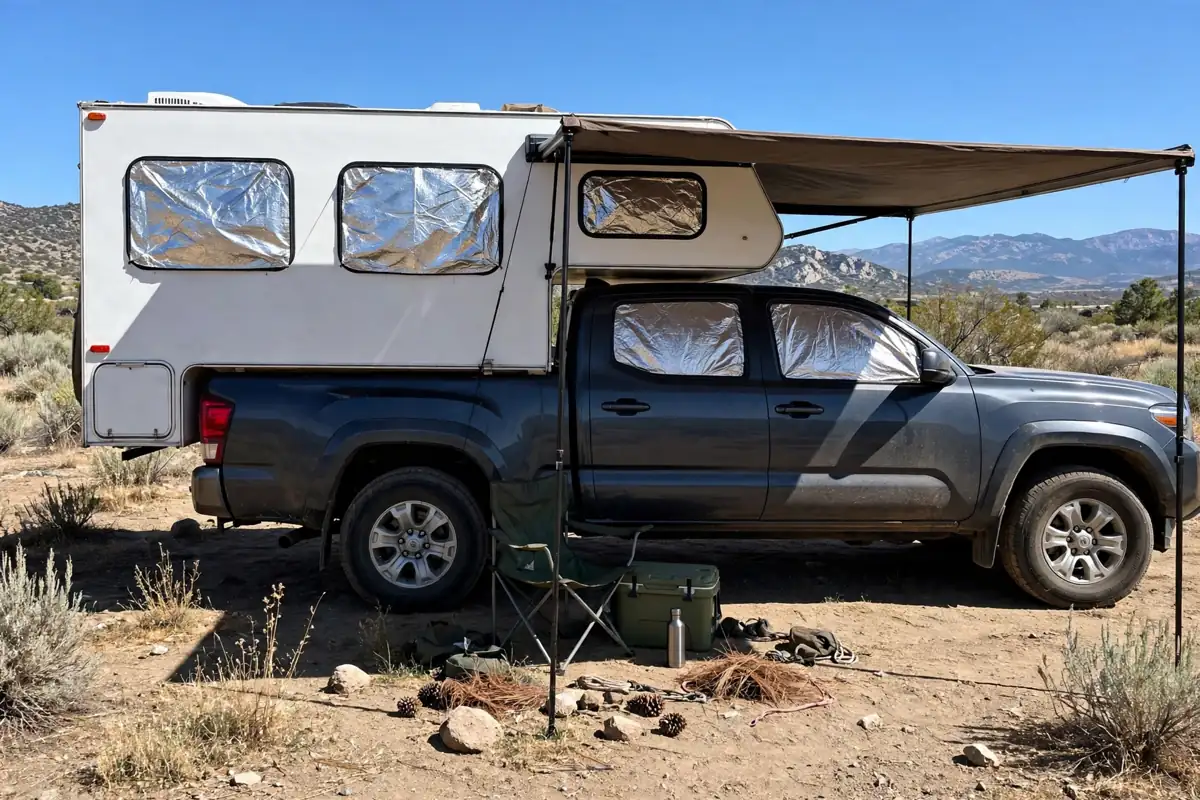
The cheapest cooling upgrade in truck camping is not a unit at all. It is shade, airflow, and timing, and owners who camp in real heat repeat the same list so often that it is clearly not just folk wisdom.
Park for shade and wind, not for the view. A shaded site is far cooler than bare asphalt or open dirt, which soaks up heat all day and radiates it back all evening. With no natural shade, make your own: deploy the awning on the sun side, add a shade cloth, and park with your biggest windows away from afternoon sun. Our truck camper awning guide covers setup — treat the awning as cooling equipment, not just a patio extra. Note the trade-off: deep shade cuts solar charging, so a battery-powered 12V unit may force a choice between shade and charging.
Block the heat at the glass, outside if you can. Owners on iRV2 repeat the same hierarchy: external covers beat internal ones, because they stop heat before it gets through the glass. Reflectix cut to fit your windows, vent pillows in roof vents and the shower skylight, and reflective covers outside the windshield all help; owners who measured report window temperatures dropping ten degrees or more after adding Reflectix.
Ventilate on purpose. A powered roof vent fan pulling hot air out, with a window cracked on the shady side for intake, moves more heat than a fan just stirring air inside. At night, flush the camper with cool air, then close up in the morning and trap it. Cook outside when you can, and switch incandescent bulbs to LED — every watt of light becomes heat in a space this small.
Pre-cool, then maintain. Start the air conditioner in the morning, close the blinds on the sun side, and keep the door closed. Every opening on a 100-degree afternoon trades cool air for hot air the unit must earn back.
Mistakes That Waste Money
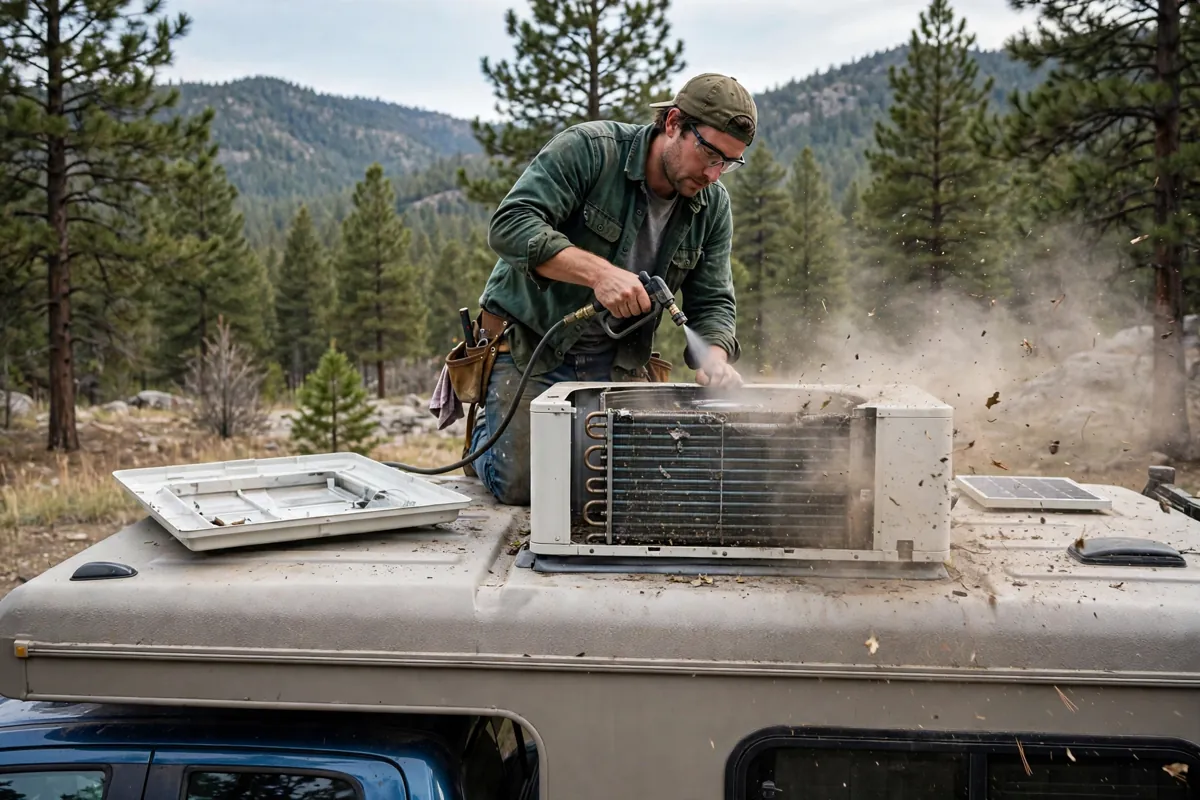
Buying a single-hose portable because it is cheap, then wondering why the camper never cools — buy dual-hose or rooftop. Buying a 12V unit without budgeting for its battery bank — the unit is the cheap part; lithium, wiring, fusing, and charging are the real purchase. Running a rooftop unit on a barely-big-enough generator without a soft start. And ignoring maintenance: a condenser caked with dust and bugs cools noticeably worse than a clean one. Clean filters monthly in dusty season, check the roof gasket once a season, and keep the drain clear, as part of your truck camper maintenance schedule.
So What Should You Buy?
If you camp mostly at campgrounds with hookups, get the standard 13,500 BTU rooftop unit, fit a soft start if you ever want to run it on a generator or household outlet, and spend the money saved on shade and window covers.
If you boondock and want quiet nights without a generator, a 12V rooftop unit plus a large lithium bank and real solar is the honest package — but price the whole package, not just the unit, and run it only when the camper is shaded and pre-cooled.
If you need something now, cannot cut the roof, and have shore power or a generator, a dual-hose portable is a workable stopgap, and a small personal cooler like the Zero Breeze makes sense only as a bunk cooler.
And if you camp mostly in dry heat and hate generator noise, try the low-power route first: shade, Reflectix, a vent fan, and an evaporative cooler, before committing to a compressor and its power system.
Truck camper air conditioning is not about finding a magic unit. It is about matching the unit to your power, climate, and the way you camp, plus the unglamorous work — shade, covers, ventilation, early starts — that lets it do its job. Get that right, and a July afternoon in Utah becomes something you nap through.
Frequently Asked Questions
What size air conditioner do I need for a truck camper?
Most hard-sides do well with 8,000 to 13,500 BTU, depending on size, insulation, and climate. Small pop-ups manage with less; large hard-sides with slides and lots of glass should aim high. Size for your hottest afternoon, but avoid oversizing so much that the unit short-cycles and never dehumidifies.
Can I run a truck camper air conditioner on batteries alone?
A 12V unit can run overnight on a large lithium bank, typically 300 amp-hours or more, with charging to refill it next day. A 120V rooftop unit on an inverter lasts only an hour or two on a typical bank, drawing roughly 125 amps at 12V. All-day off-grid cooling realistically needs a generator or shore power.
Will a soft-start kit let me run my rooftop AC on a 2,000-watt generator?
Often, yes, but not guaranteed. A soft start cuts the starting spike by up to about 75 percent, which is what usually trips a small generator. It does not reduce running power, and at altitude or in extreme heat a small generator loses output, so test it on a hot day with the unit cycling several times first.
Is a portable air conditioner good for a truck camper?
A dual-hose portable can work well on shore power or a generator as a no-roof-cut option. A single-hose unit is a poor choice for a small, leaky camper: it creates negative pressure that pulls hot air back in through vents and seals. A tiny personal cooler, around 2,300 BTU, cools the person next to it, not the whole camper.
Do evaporative coolers work in a truck camper?
In dry climates below roughly 60 percent humidity, yes, using very little power. In humid climates they add moisture without much cooling. Choose a compressor unit for humid regions.
How can I keep my truck camper cool without air conditioning?
Park in shade, deploy the awning on the sun side, cover windows from outside, stuff vent pillows into roof vents, run a roof vent fan with a shaded window cracked, cook outside, and flush the camper with cool night air before closing up.