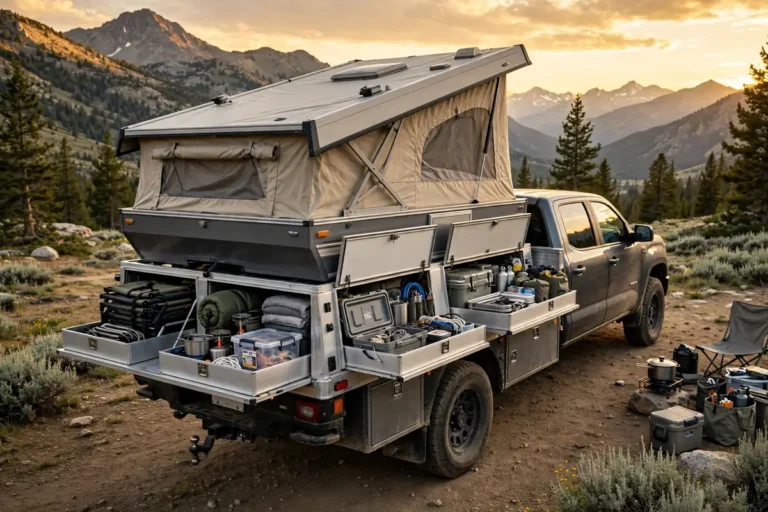
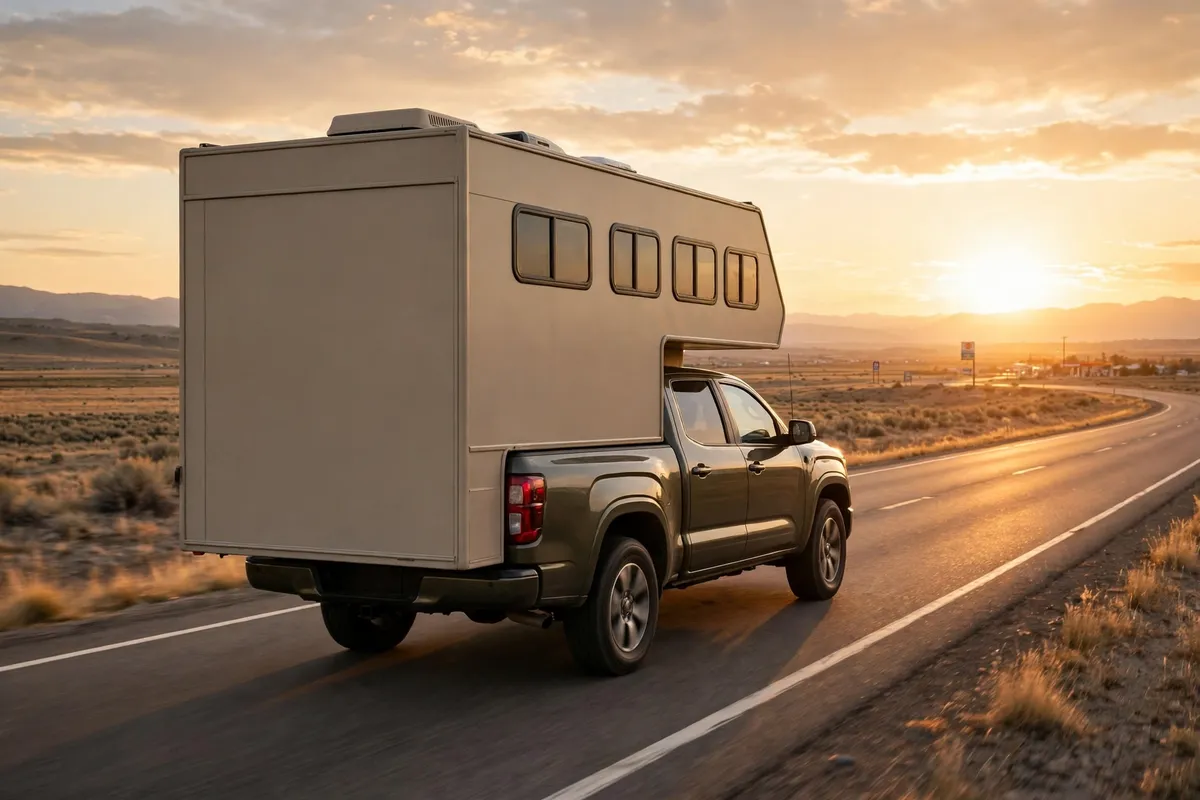
Truck Camper Fuel Economy – Real MPG, Range, and Fuel Costs
The first time I budgeted a long truck-camper trip, I looked at what my truck got empty, knocked off a couple of miles per gallon in my head, and called it close enough. It was not. By day two I was stopping for fuel far more often than planned, watching the gauge on windy stretches, and doing unhappy maths at every pump. That trip taught me the lesson behind this guide: truck camper fuel economy is not one number. It is a range, and where you land in it depends on your camper type, your engine, your speed, and the wind on the day.
No truck is rated for mileage with a camper in the bed, and the dashboard figure is usually optimistic. Use the numbers below to plan, then measure your own rig for a few tanks and replace my ranges with yours.
Real Truck Camper MPG: What Owners Actually Get
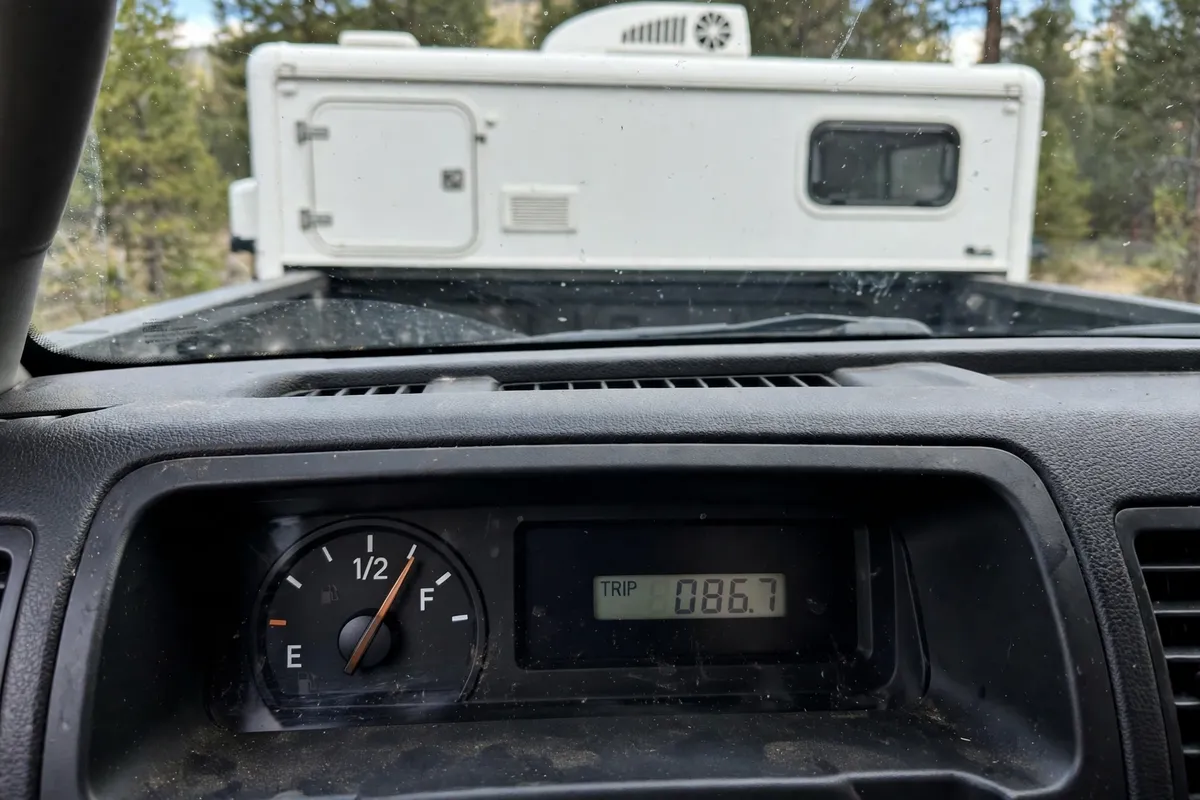
Most loaded slide-in setups land somewhere between 10 and 17 mpg on the highway. That wide spread is the point. A low, light pop-up on a half-ton is a very different animal from a tall hard-side on a one-ton gas truck.
| Setup | Realistic highway MPG with camper |
|---|---|
| Light pop-up or wedge camper, midsize or half-ton | 14–17 |
| Pop-up camper, full-size gas truck | 15–18 |
| Hard-side camper, half-ton gas truck | 10–13 |
| Hard-side camper, 3/4-ton or 1-ton gas truck | 9–12 |
| Hard-side camper, 3/4-ton or 1-ton diesel truck | 12–16 |
| Heavy hard-side, big tires and lift, mountains or towing | 9–12 |
Treat these as planning estimates for steady highway driving, not promises for a mountain pass into a headwind. Two identical trucks can sit 3 mpg apart just because one driver is doing 62 mph and the other 75.
Owner reports back this up. Owners on Wander The West who compared the same trips with and without a pop-up typically lost about 2.5 to 3 mpg — for example, from around 19 mpg empty to about 16.6 mpg loaded, or from 18–19 mpg to 15–16 mpg on an F-150. Owners on Expedition Portal with a lifted F-250 on 37-inch tires reported about 10–12 mpg loaded on mountain trips, a best of 13.5 mpg, and around 9 mpg off-road.
The hard-side shock is the one that catches people out. Owners on Good Sam forums describe driving out to collect a Lance 815 at about 21.7 mpg, then getting just 12.3 mpg on the way home with the camper on — at a slower speed, too. Other owners in that discussion pointed to the real culprit, and it was not mainly the extra 2,000-plus pounds. It was wind resistance. A tall camper turns your truck into a moving wall, and that wall gets expensive fast.
Why a Camper Costs You MPG: Speed, Height, Weight, and Terrain
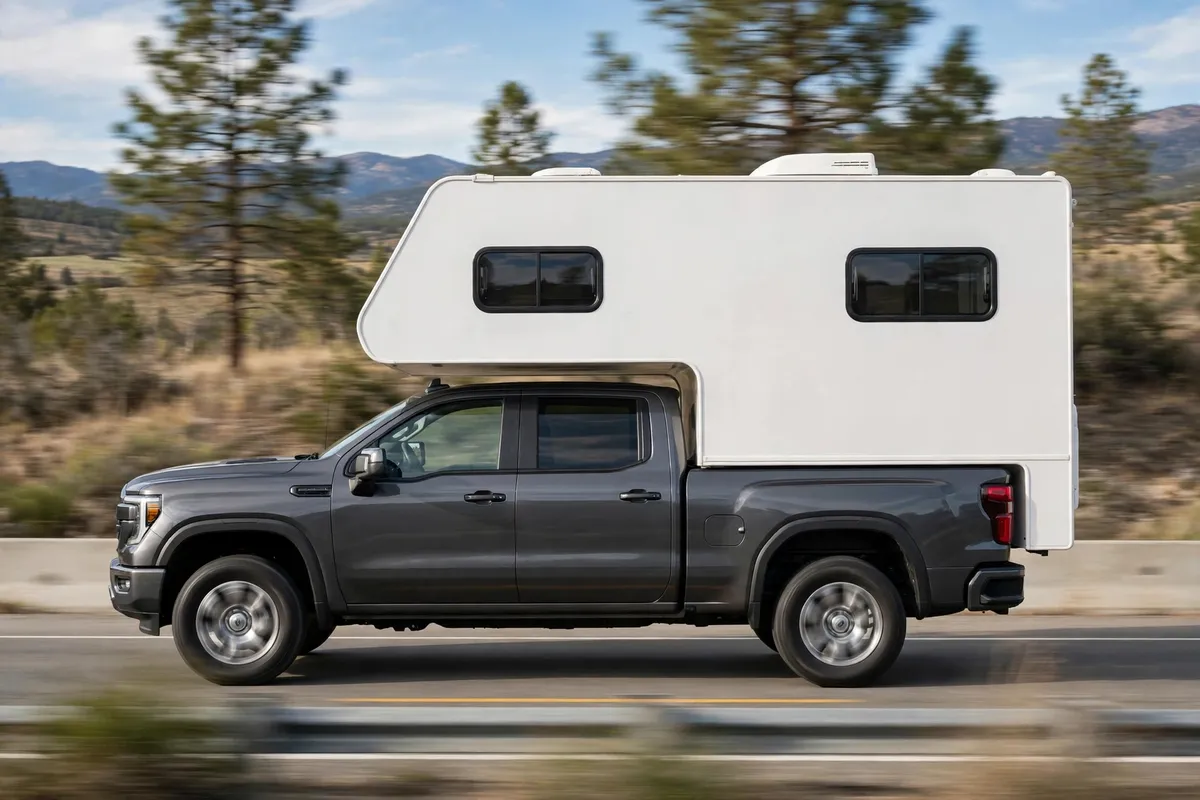
Speed and aerodynamics come first. Drag rises with the square of speed, which means going a bit faster costs a lot more fuel. The U.S. Department of Energy’s FuelEconomy.gov driving guidance puts it plainly: gas mileage usually drops rapidly above 50 mph, and each 5 mph over 50 mph is like paying roughly an extra 30 cents per gallon at today’s prices. Its research summary, published by the Department of Energy, found fuel economy about 27% lower at 80 mph than at 60 mph for light-duty vehicles. That matters more for a truck camper than for almost any other rig, because you have already added frontal area — every extra mph pushes a bigger wall through the air.
One clean owner experiment makes this concrete. An owner on Wander The West weighed his Tundra empty and loaded, then drove the same route both ways. Empty at about 62 mph he got 20.1 mpg (U.S.). With a 1,375-pound pop-up at the same speed he got 16.4 mpg, an 18% drop. When a 12–16 mph headwind picked up for four hours, that fell to 15.2 mpg, a 24% drop. His conclusion: expect a 15–25% loss with a pop-up, with wind pushing you toward the worse end. Empty at a higher speed was almost as bad as loaded at a lower speed — speed can cost you as much as the camper itself.
Weight matters, but not the way people think. Weight hurts most when accelerating, climbing, and stopping — in town, on grades, on dirt. At a steady highway cruise, height and wind matter more. Owners on iRV2 report a diesel Ram getting about 11–12 mpg at 70 mph both loaded and unloaded on the same highway run: wind load swamped the weight difference. Weight still matters for your truck’s limits. If you are near your payload ceiling, read our truck camper payload calculator guide first — an overloaded truck is a safety problem before it is a fuel problem.
Terrain and tires finish the job. Mountains mean long climbs in lower gears. Soft dirt, sand, and mud mean constant rolling resistance. Bigger, heavier all-terrain tires add rotating weight and rolling resistance, and under-inflated tires make it worse — FuelEconomy.gov notes about a 0.2% loss for every 1 psi drop across all four tires. That sounds tiny until your loaded truck is running 10 psi low on all four corners. Our truck camper tire load ratings guide covers pressures for the loaded truck, which are not the same as the empty-truck door sticker.
Hand-calculate for at least three tanks: fill up, reset the trip, drive, fill up again, and divide miles by gallons. Bigger tires throw off the odometer unless recalibrated, and the dashboard is often generous by 1 mpg or more.
Gas vs Diesel: Who Really Wins on Truck Camper MPG?
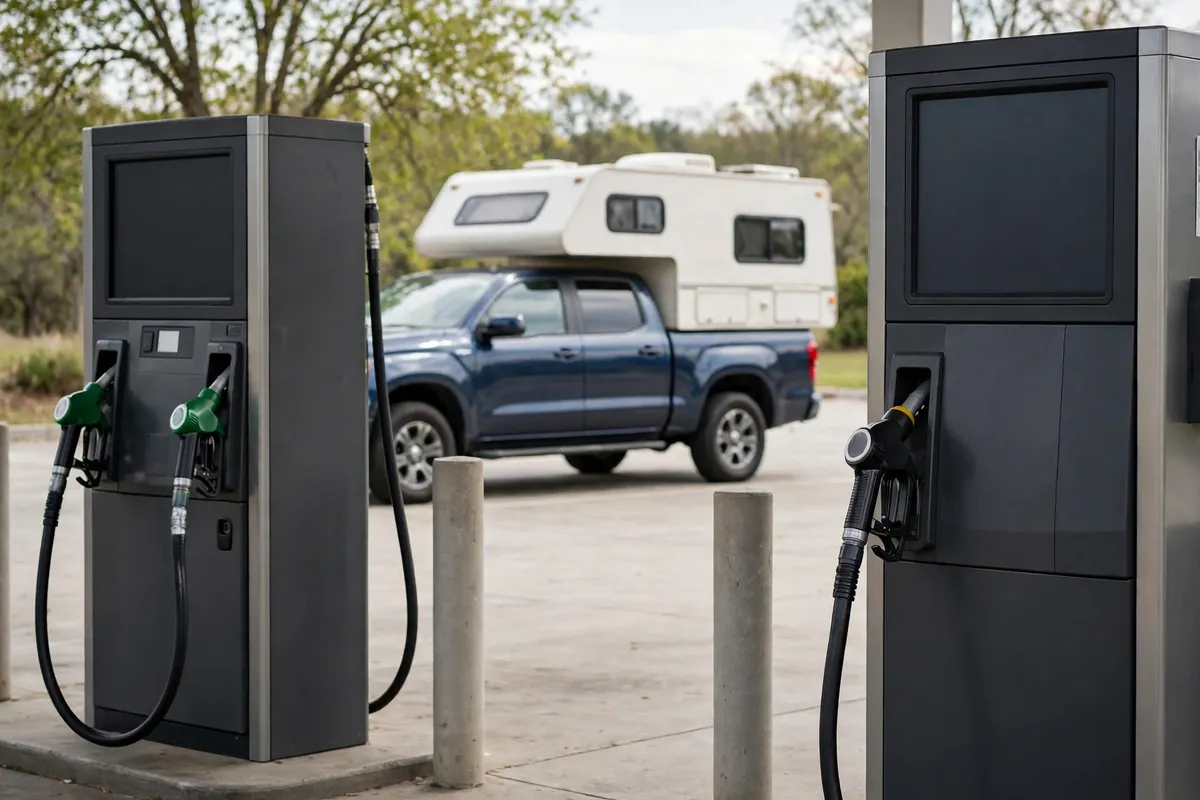
Diesel almost always wins on MPG. Diesel does not always win on cost per mile — and in late 2026, that distinction matters more than usual.
The MPG gap is real. A common pattern is a gas one-ton getting 9–10 mpg with a 3,000-pound hard-side at 60 mph while a comparable diesel gets around 14 mpg. Owners on iRV2 report a similar split: a 2014 diesel F-350 dropping from about 19 mpg empty to just under 16 mpg with a roughly 3,500-pound camper at 55–60 mph, while a gas Tacoma dropped from about 20 mpg empty to 10–11 mpg with a pop-up in the mountains. Diesel torque at low rpm means less strain under load, and small gas engines have less reserve.
But MPG is only half the pump equation. The other half is the price on the sign, and in late October 2026 the diesel premium was unusually wide. The U.S. Energy Information Administration’s weekly survey for the week of October 26, 2026 put regular gasoline at $4.269 per gallon and on-highway diesel at $6.352 per gallon — a gap of about $2.08 per gallon, with diesel near its record high after peaking at $6.529 in September. Check current prices before your trip, because that gap moves, but do the maths with whatever gap you actually face.
Here is that maths at those late-October prices, per 100 miles:
| Rig | MPG | Fuel cost per 100 miles |
|---|---|---|
| Gas hard-side | 11 | $38.82 |
| Gas pop-up | 16 | $26.69 |
| Diesel hard-side | 15 | $42.33 |
| Diesel hard-side | 17 | $37.35 |
Read that twice. At a $2.08 price gap, a diesel getting 15 mpg costs more per mile than a gas truck getting 11 mpg. The diesel has to reach about 16.4 mpg just to break even with an 11-mpg gas truck at those prices. That does not make diesel a bad choice — range, towing ease, and grade performance still count, and if the gap narrows the maths flips back quickly — but “diesel gets better MPG” is not the same sentence as “diesel is cheaper to run.” Diesel exhaust fluid is another small add-on cost, not a deal-breaker, but do not forget it.
Truck Camper Driving Range: How Far Does a Tank Actually Take You?
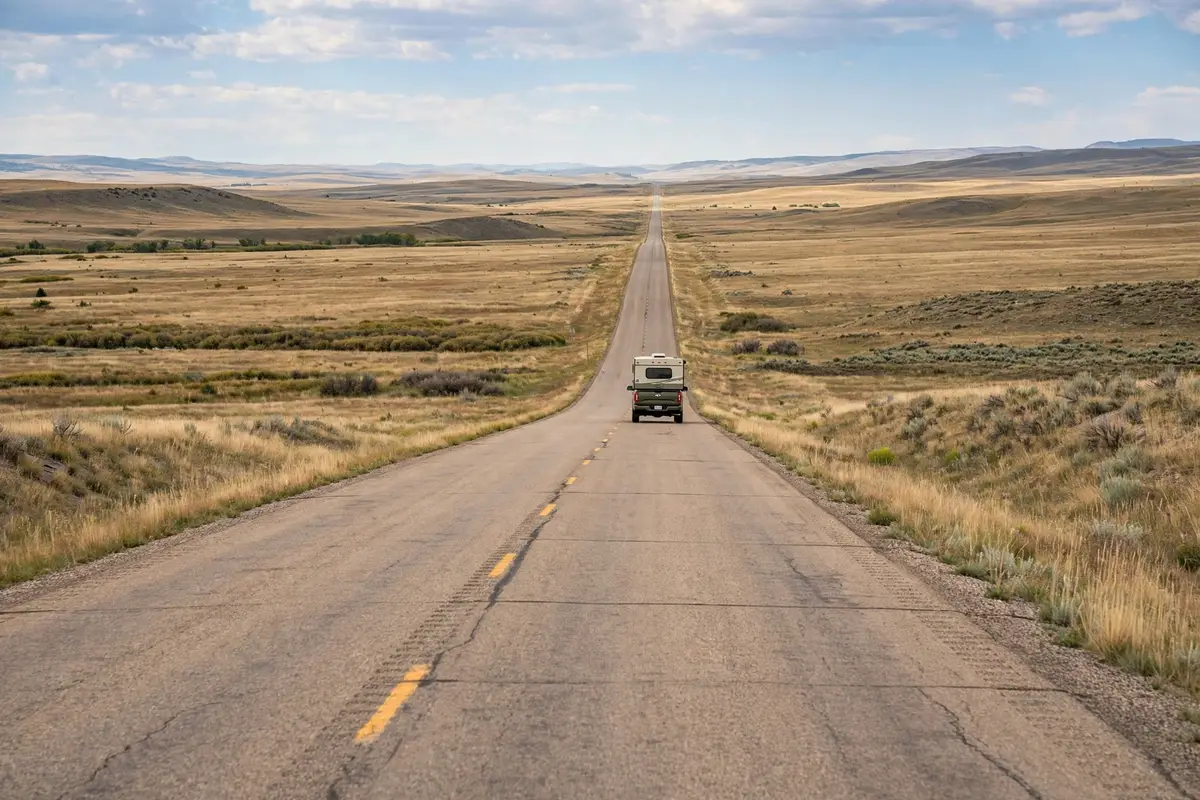
Range is simple arithmetic with one trap: you should never plan to use the whole tank.
Usable range = (tank size − reserve) × your real MPG.
I plan on a reserve of at least a quarter tank, or 5 gallons, whichever is larger. That reserve is for the closed station, the detour, and the stretch where the next fuel is further than the sign promised. Owners on iRV2 who travel remote western routes say the same thing in different words: a 31-gallon tank that only goes about 200 miles in the Rockies before the low-fuel warning is not a planning failure, it is a reason to carry a plan — and sometimes extra fuel.
| Tank size | At 11 mpg | At 14 mpg | At 16 mpg |
|---|---|---|---|
| 26 gallons | 286 miles | 364 miles | 416 miles |
| 36 gallons | 396 miles | 504 miles | 576 miles |
| 48 gallons | 528 miles | 672 miles | 768 miles |
Now knock off your reserve. A 36-gallon gas truck getting 11 mpg has a 396-mile full-tank range, but a sensible planning range of about 300 miles. A 26-gallon truck at the same MPG is a 200-mile planning truck, full stop. That is the number that decides whether you can skip the expensive station or make the next town.
For remote travel, that planning range is everything. Owners on iRV2 travelling the western slope of Colorado and remote Wyoming describe fuel stops 40 miles apart with a $2-per-gallon price difference, or a 60-gallon auxiliary tank in the bed because the next station is over a mountain and a long way off. Mark your fuel stops before you leave and know the gaps between them. Our guide to boondocking and dispersed camping is useful here, because the further you get from pavement, the more your fuel plan is your safety plan.
Auxiliary and larger replacement tanks are the owner solution when the stock tank is genuinely too small — owners on iRV2 report swapping a 38-gallon factory tank for a 65-gallon replacement, or adding a 40- to 60-gallon bed tank. They eat bed space and payload, and gasoline auxiliary tanks have stricter rules than diesel ones, so get a proper install. For most travellers, planned stops are cheaper.
How to Budget Fuel for a Trip

This fits on a sticky note:
1. Find your real MPG. Hand-calculate three tanks in conditions like your trip. If you have never measured it, use the table above and pick the pessimistic end of your row.
2. Work out gallons: trip miles ÷ MPG. A 1,000-mile trip at 11 mpg needs about 91 gallons. At 16 mpg it needs about 63 gallons. That 28-gallon difference is the whole story of camper choice and speed choice in one number.
3. Multiply by a realistic fuel price, then add a cushion. Use the highest price you expect on the route, not the cheapest station at home, and add 10–15% for wind, mountains, detours, and idling. Prices vary enormously by state — California diesel averaged over $8 per gallon in that same late-October EIA survey, while Gulf Coast gasoline was under $3.80.
4. Turn gallons into stops. Divide your trip into legs no longer than your planning range (usable tank × MPG). If a leg is longer than that, you need a fuel stop in the middle, a bigger tank, or a different route.
Worked examples at late-October 2026 national averages ($4.27 gas, $6.35 diesel, rounded):
- 1,000 miles, gas hard-side at 11 mpg: about 91 gallons, about $389 before cushion, about $430–$450 with cushion.
- 1,000 miles, diesel hard-side at 15 mpg: about 67 gallons, about $423 before cushion — more than the gas example, because of that $2.08 price gap.
- 1,000 miles, gas pop-up at 16 mpg: about 63 gallons, about $267 before cushion.
Same distance, same roads, wildly different bills — which is why “how much does a truck camper trip cost in fuel?” has no single answer.
For the bigger picture — insurance, maintenance, depreciation, and everything else over a year — see our true cost of truck camper ownership guide. Fuel is the most visible trip cost, but not the whole ownership bill.
Squeezing More Miles From the Rig You Already Have
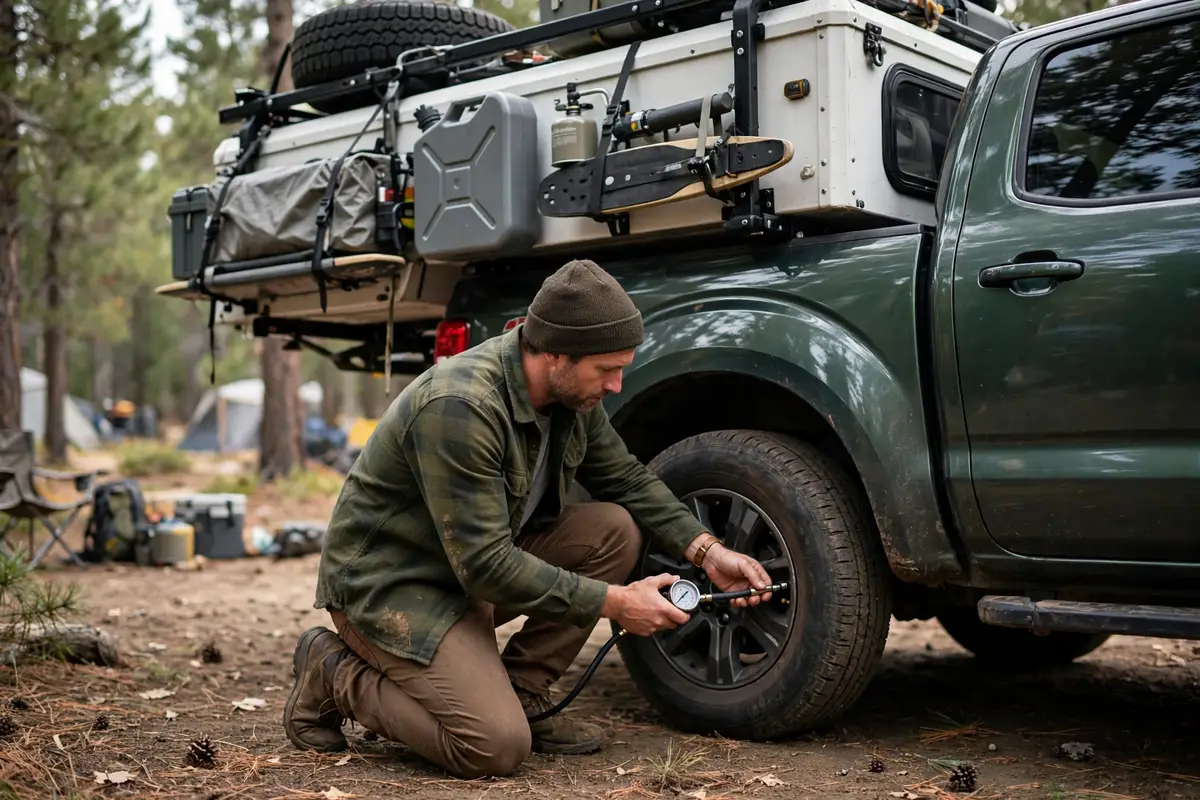
You cannot change physics, but you can stop paying its worst rates. These are fuel moves, not a driving course — for wind, grades, and braking technique, see our truck camper driving guide.
Slow down 5–10 mph on the highway. This is the single biggest lever, and it is free. Going from 75 to 65 mph on a tall camper can easily save 1–2 mpg, sometimes more into a headwind. On a 300-mile day that costs about 35 minutes and can save 3–5 gallons.
Be careful with cruise control in the hills. Owners on Wander The West report that cruise costs mileage on rolling terrain, because it downshifts hard to hold speed up every hill where a human would let speed bleed off and regain it on the way down. One owner reckoned manual driving gained him at least another mpg. On flat highway, cruise is fine.
Keep tires at loaded pressure, and check them cold — before you roll, not after 50 miles when the reading is meaningless.
Take the drag off when you can. Remove roof loads you are not using. If your camper jacks stay on while driving, know they add drag — owners on Wander The West flagged jacks as a possible reason for a surprisingly bad tank.
Travel light, but honestly. Water is 8.3 pounds per gallon, so a full 30-gallon tank is about 250 pounds. The “just in case” box you have not touched in three trips is riding at your expense.
Do not chase magic fixes. A special air filter, additive, or tuner chip promising big MPG gains usually delivers small ones at best once you measure properly. The reliable gains are speed, tire pressure, weight, and maintenance. Generator fuel at camp adds up too — our generator vs solar guide compares the running costs.
Frequently Asked Questions
What is a good MPG for a truck camper?
For a pop-up, 15–17 mpg on the highway is good. For a hard-side, 12–14 mpg on diesel or 10–12 mpg on gas is good. Anything above that is a light rig, slow speed, flat ground, a tailwind, or a generous dashboard.
How much does a truck camper reduce gas mileage?
Expect roughly 15–25% for a low pop-up and 30–50% for a tall hard-side, compared with the same truck empty at the same speed. Small gas trucks can lose proportionally more than big diesels, because the engine has less reserve.
Is diesel or gas better for truck camper fuel economy?
Diesel gets better MPG, typically 3–5 mpg better than a comparable gas truck with the same camper. Whether it is cheaper per mile depends on the fuel price gap. At late-October 2026 prices, a diesel needed roughly 16–17 mpg to match an 11-mpg gas truck on cost per mile.
How far can I drive a truck camper on one tank?
Multiply usable fuel (tank size minus a quarter-tank reserve) by your real MPG. A 36-gallon truck at 11 mpg plans to about 300 miles; at 16 mpg, about 430 miles. A 26-gallon truck at 11 mpg plans to about 200 miles. Never plan a remote leg on the full-tank number.
Does driving slower really save that much fuel with a camper?
Yes — more than with a car, because your frontal area is bigger. FuelEconomy.gov guidance is that each 5 mph over 50 mph costs roughly 7% in fuel economy, and its research summary found about 27% lower economy at 80 mph than at 60 mph.
Should I get an auxiliary fuel tank?
Only if your planning range regularly fails your routes — remote western travel, long gaps between stations, or a small stock tank. For most highway and weekend travel, planned stops are cheaper and simpler. If you do add a tank, get a professional install and watch the payload and bed space it consumes.
The Bottom Line
Truck camper fuel economy is not a mystery once you stop looking for one number. Know your rig’s type, measure your own MPG by hand, plan on usable fuel rather than the whole tank, and do the cost maths with the prices you will actually pay. Slow down a little, keep your tires right, and leave a reserve in the tank and in the budget. Start with your next tank: fill up, write down the miles, and find out what your rig really does.