
Generator vs Solar for Truck Camper Boondocking: Real Costs, Real Owners
Every truck camper owner hits this crossroad sooner or later: trying to settle the truck camper generator vs solar question once and for all. I have watched owners argue this in campgrounds, on forums, and in comment sections for years, and here is the uncomfortable truth — the internet mostly gives you the wrong framing. It is not generator versus solar. It is about how you camp, how many days a year you are actually off-grid, and how much silence is worth to you.
I have run both setups in my own rig over the years, and I have read thousands of owner posts from people who measured their actual consumption. Here are real costs, real owner numbers in watts and amp-hours, three honest budget tiers, and the verdict most long-term boondockers actually land on.
The Short Answer Up Front
If you boondock fewer than 20 nights a year and just need to top off batteries and run a microwave or coffee maker, a small inverter generator is the cheapest answer. If you are out 30+ nights a year and your power needs are modest (lights, 12V fridge, phones, fans), a mid-size solar-plus-lithium setup pays for itself in silence.
And the thing almost nobody says in the YouTube comparisons: most experienced owners end up with both. Solar carries the daily load silently, and the generator sits in the truck bed as insurance for cloudy weeks and air conditioning days. Owners on RV forums put it bluntly — a generator delivers 20 to 30 amp-hours into your batteries per hour of run time, so an hour or two a day and you are full. Solar owners counter that once the panels are on the roof, the daily top-up is silent and automatic. They are both right, which is exactly why the hybrid setup is so common.
Generator vs Solar: The Real Power Numbers
Before spending a dollar, you need to know what your camper drinks in a day. Owners who actually measured their consumption report numbers like these:
- 12V compressor fridge: about 50 amp-hours per day (one iRV2 owner measured this across a whole season)
- Furnace on a freezing night: 50 amp-hours or more overnight — the blower fan is the hungriest 12V load in most campers (winter heating loads explained here)
- LED lights, water pump, phone charging, vent fan: ~15–25 amp-hours per day combined
- Rooftop air conditioner: 1,200–1,600 watts continuous, with a startup surge near 2,400 watts — this one appliance dwarfs everything else
So a typical no-AC boondocking day lands around 80–120 amp-hours. A day with the air conditioner running is a different planet — one forum member calculated that a small AC pulls about 1,600 watts continuously, and running it off solar would take roughly 400–600 amp-hours of battery and more roof space than a truck camper has.
On the generation side, owners have settled on some useful rules of thumb. A 100-watt solar panel produces roughly 25 amp-hours on an average day — take one-fourth of the panel wattage as your daily amp-hour harvest, because real-world conditions never match the label. A 200-watt rooftop setup measured by DIY Solar Forum owners delivers about 1,000 watt-hours on a good summer day but only around 450 watt-hours in winter. A generator with a decent battery charger stuffs 20–30 amp-hours per hour into your batteries regardless of weather.
If you want to go deeper on matching panels and batteries to your exact loads, our truck camper solar and lithium sizing guide walks through the math step by step.
Tier 1: $1,500–$2,500 — The Generator-Forward Setup

This is where most people should start. The idea is simple: a quality inverter generator, one good lithium battery, and a proper charger.
What you buy:
- Inverter generator, ~$579–$1,399. The budget benchmark is the Champion 2500-watt dual-fuel at around $579 — 53 dBA at 23 feet, 39 pounds, 11.5 hours on a tank of gas at light load and up to 34 hours on a 20-pound propane bottle. The premium benchmark is the Honda EU2200i at $1,099–$1,399 at 2026 dealers: 2,200 watts max (1,800 rated), 48–57 dBA, 47 pounds, roughly 8 hours of light-load runtime per tank. Owners on Forest River Forums report the Champion is acceptably quiet at about half the Honda’s price, while Honda owners swear the resale value and reliability justify the premium. Both are inverter generators, which means clean power safe for laptops and CPAP machines.
- One 100Ah lithium (LiFePO4) battery, ~$799. The Battle Born 100Ah 12V lists at $799 and weighs about 31 pounds — versus 60+ pounds for an equivalent usable lead-acid bank, since lithium gives you nearly 100% usable capacity. Battle Born Batteries backs theirs with a 10-year warranty. Budget lithium brands exist for less, but this is the reference point most owners know.
- Accessories: a good battery charger ($100–$200 if your converter is not lithium-friendly), a CO alarm for the camper ($30), a locking cable for the generator ($40), fuel cans or a propane bottle, and an oil-change funnel kit.
What it does for you: Two hours of generator time morning and evening keeps batteries above 95% for most campers, burning roughly 2 gallons of fuel a day. One owner who boondocks 30 days a year worked out the fuel cost at about $180 per year — and pointed out it would take a very long time for a solar system to pay itself back at that burn rate.
The honest catch: you are tied to generator hours and campground rules (more on that below), you are carrying fuel, and you will never be the most popular neighbor at 7 a.m. For a weekender doing 10–20 nights a year, this tier is almost impossible to beat on cost — though for truly tiny loads (phones, lights, a fan), a portable power station charged at home can cover a long weekend with no generator at all.
Tier 2: $3,500–$6,000 — The Solar-Forward Hybrid

This is the sweet spot for regular boondockers, and it is where the community numbers get really specific. One iRV2 owner reports that 300 watts of solar paired with a 200Ah lithium bank gives his camper “virtually unlimited consecutive days” of boondocking with a 12V compressor fridge — about three days with zero sun before even needing help.
What you buy:
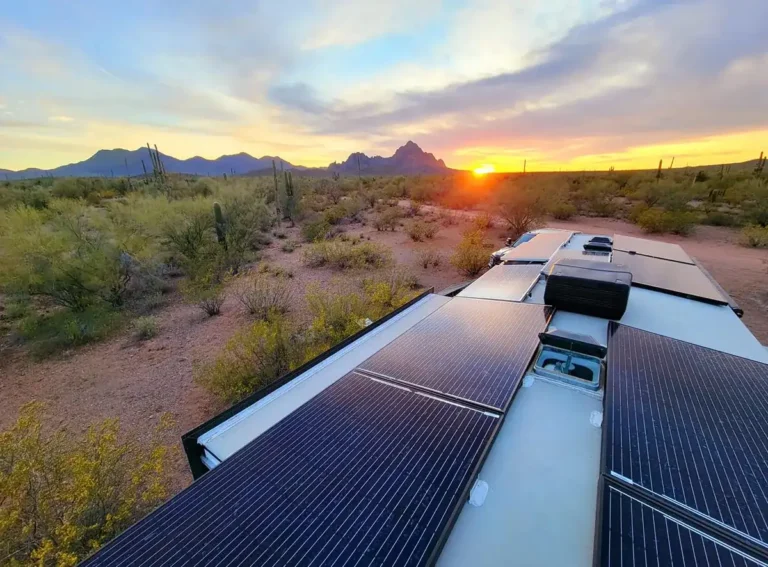
- 400–600W of rooftop solar ($400–$900 for panels, mounts, and wiring) plus an MPPT charge controller ($150–$300). Rigid panels run roughly a dollar per watt these days.
- 200–400Ah of lithium ($1,600–$3,200 at Battle Born pricing; less with budget brands).
- 2,000W pure-sine-wave inverter ($300–$600), a battery monitor with a shunt ($150–$250 — owners on the DIY Solar Forum swear by knowing their real state of charge instead of guessing), and a DC-DC charger ($150–$300) so your truck’s alternator charges the camper bank while you drive.
- Keep a small generator as backup — the Champion 2500 dual-fuel at $579 is the popular insurance policy. Many owners in this tier already own one from their Tier 1 days.
What it does for you: your daily 80–120 amp-hour needs are covered silently on any decent-sun day. The generator only comes out for week-long storms, shoulder-season trips, or air conditioning. A 200-watt portable solar suitcase ($247–$323) is the most-loved add-on in this tier — park the camper in the shade, set the panels in the sun.
The honest catch: this system is sized for your measured loads, not your fantasy loads. Add air conditioning to the wish list and you blow past this tier. And winter is the great equalizer — short days, low sun angle, snow on panels, and lithium that refuses to charge below freezing (unless you buy heated batteries or keep the bank in a heated compartment). One DIY Solar owner measured his 200W roof array at ~1,000Wh per summer day and ~450Wh in winter. Plan around that reality, not the brochure.
Tier 3: $7,000–$12,000+ — Full Off-Grid, Including A/C
This is the “I live in my camper and I refuse to compromise” tier: 800–1,000+ watts of solar, 600Ah or more of lithium, a 3,000-watt inverter/charger, a soft-start on the air conditioner, DC-DC charging, and usually professional installation.
What it does for you: you can genuinely run a rooftop air conditioner for hours off batteries and recharge the next day.
The honest catch: multiple experienced owners who priced this out concluded the air-conditioning part of the dream does not pencil out. A 2,200-watt inverter generator with a soft-start kit on the A/C (a ~$300 device that tames the startup surge) runs most truck camper air conditioners for the price of a few tanks of gas. If A/C is your actual requirement, price that comparison honestly before buying a single panel.
Also remember weight: batteries, panels, inverters, and a generator all eat into the same payload budget your camper already strains.
The Generator Case: What Owners Love and Hate
Love: It works in the rain, at midnight, in a snowstorm, and under a forest canopy. It recharges batteries fast — with a good charger, owners report putting a full day’s worth of amp-hours back in under an hour of run time, which makes even strict generator-hour windows survivable. A dual-fuel model running on propane means no gasoline smell, no carburetor gumming from stale fuel, and a 20-pound bottle that lasts up to 34 hours at light load.
Hate: Noise is the obvious one, but the subtler pain is logistics. Fuel has to be bought, carried, and stored. Oil changes come due — Honda’s schedule is the first change at 20 hours, then every 100 hours or yearly. And altitude saps power from gasoline engines; one owner notes Champion will send you a free high-altitude jet for extended high-country use on gas, while dual-fuel models sidestep the issue because the propane demand regulator self-compensates.
Noise Rules, Quiet Hours, and Being a Good Neighbor
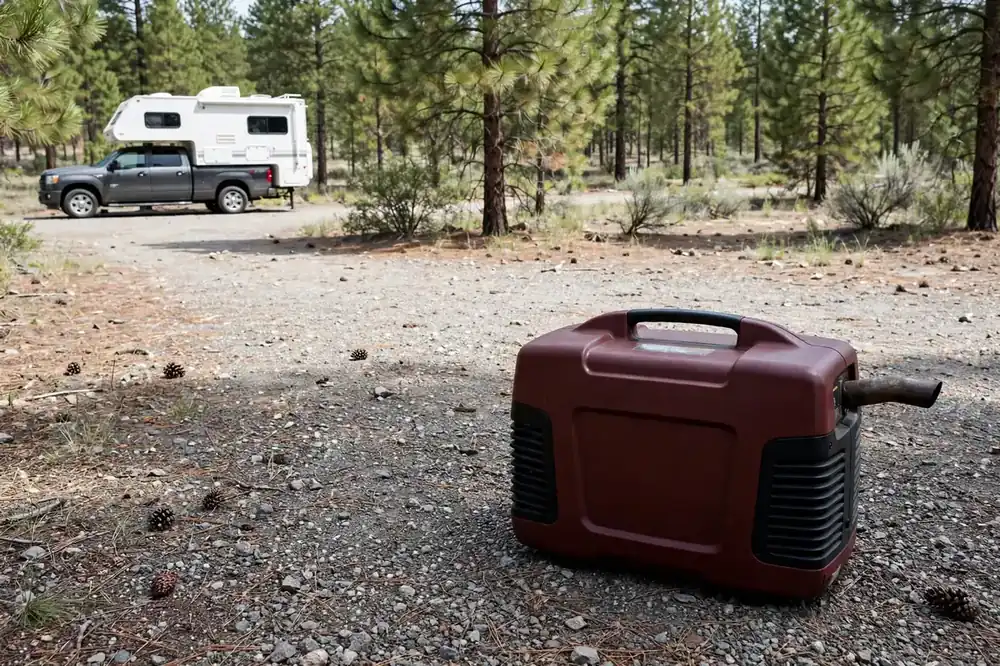
This is the part that bites generator owners who never read the fine print. The National Park Service caps motorized equipment at 60 dB(A) measured at 50 feet, and most NPS campgrounds enforce quiet hours around 10 p.m. to 6 a.m. (Cummins’ generator guide summarizes the NPS noise rule well). But individual campgrounds layer their own windows on top: some allow generators only in two or three short blocks per day, and a few prohibit them entirely. Dispersed camping on BLM and Forest Service land is far more relaxed, which is one reason serious boondockers prefer it — our dispersed camping guide covers where the free spots actually are.
The unwritten rules matter as much as the posted ones. Owners on forums repeat the same etiquette: never before 8 a.m. or after dark near other campers, keep run times short when neighbors are close, and own your own noise — do not park the generator at the edge of your site closest to someone else’s campfire. An inverter generator on eco mode (48 dBA for the Honda, 53 dBA for the Champion) is a different animal from an open-frame contractor unit. Buy the quiet one.
Carbon Monoxide: Non-Negotiable Safety
Place the generator at least 20 feet from the camper with the exhaust pointed away from you and your neighbors. Never run it inside the camper, in the truck bed under a closed topper, or tucked under the camper’s overhang where exhaust can pool. Honda’s CO-MINDER and Champion’s CO Shield both shut the engine down if carbon monoxide builds up around the unit — but neither replaces a working CO alarm inside the camper.
The Solar Case: What Owners Love and Hate
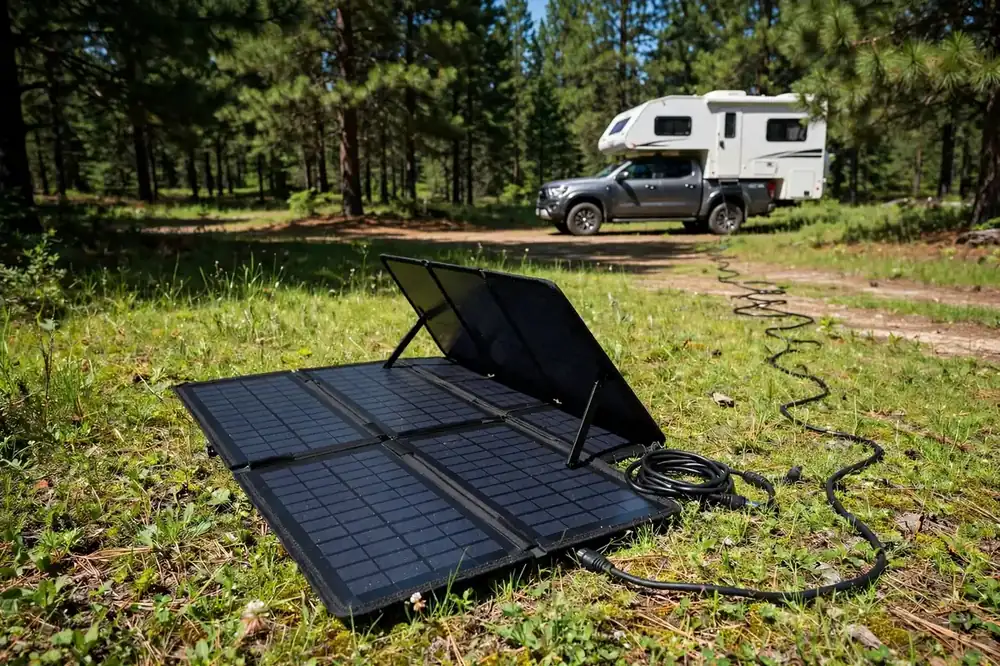
Love: Silence. That is the whole pitch, and it is a good one. Once installed, the system works every day without you touching it — no fuel runs, no oil, no 7 a.m. guilt. Owners describe the shift in attention: once power stops being a daily chore, your boondocking constraints move to fresh water and waste tanks instead.
Hate: Solar is a fair-weather friend that owners consistently overestimate. Shade is the number-one killer — one owner in Arizona put it perfectly: from March through November you cannot park in the sun because the camper interior hits 100–120°F, so you park in the shade and the rooftop panels produce almost nothing. His solution: portable panels you can place in the sun while the rig stays cool in the shade. Winter is the second killer: short days, low sun, snow you will not climb onto a truck camper roof to clear.
Also note the truck camper’s structural reality: roofs are small and crowded with vents, antennas, and the A/C unit, and every panel steals payload. Owners on the DIY Solar Forum warn against overloading the roof — measure your real estate before buying a single panel.
The Hybrid Verdict Most Owners Land On
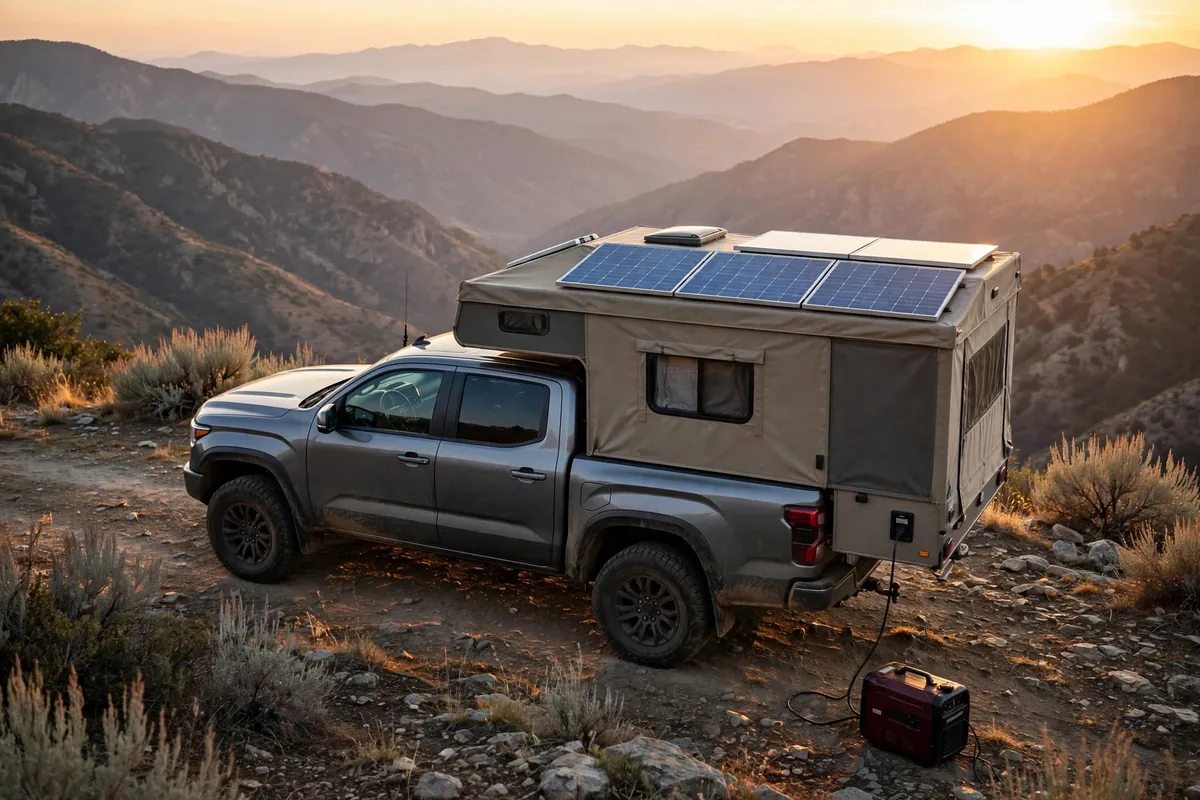
Here is the pattern I see again and again in owner reports:
- Start with a generator and one good battery (Tier 1). Go boondocking. Measure your real consumption for a season.
- Add solar sized to your measured loads (Tier 2). The generator becomes the backup instead of the primary.
- Keep both. The generator covers cloudy stretches, A/C days, and shoulder seasons; the solar covers everything else silently.
The owners who regret their purchases are almost always the ones who skipped step one — they bought a giant solar system before knowing their loads, or bought a loud cheap generator and discovered campground rules the hard way. One well-worn piece of advice: if you think you want solar, buy (or borrow) a generator first and go boondocking with it. A few trips will teach you more about your power needs than any calculator.
My own bottom line after years of watching this debate: solar is the better daily experience, the generator is the better insurance policy, and the question was never either-or. Buy the generator first, add solar second, and size everything from measurements instead of hopes.
FAQ
Can a 2,200-watt generator run my truck camper’s air conditioner?
Usually yes, with a caveat. A 2,200-watt inverter generator (Honda EU2200i class: 2,200W max, 1,800W rated) can run most truck camper rooftop A/C units, but the compressor’s startup surge can trip it. Owners solve this with a soft-start device on the A/C — with one installed, owners on the DIY Solar Forum report running their A/C reliably off a portable inverter generator. Test at home first before relying on it in high heat and altitude.
How much solar do I actually need for truck camper boondocking?
For typical no-A/C use (lights, 12V compressor fridge, phones, fan, water pump — roughly 80–120 amp-hours per day), owners report that 300–400 watts of solar paired with 200Ah of lithium covers them indefinitely in decent sun. A handy rule of thumb: expect about one-fourth of the panel’s wattage as daily amp-hours (a 100W panel averages ~25 Ah/day). Winter and shade cut that significantly, so size for your worst-case season, not your best. Our sizing guide has the full worksheet.
Is a dual-fuel generator worth it for a truck camper?
For most boondockers, yes. Running on propane eliminates stale-fuel carburetor problems, gasoline smell in the truck bed, and fuel stabilizer chores — propane stores indefinitely. The Champion 2500 dual-fuel runs up to 34 hours on a 20-pound propane bottle at light load, and owners note dual-fuel models avoid the altitude power loss gasoline engines suffer at 8,000+ feet. The tradeoff is slightly lower running watts on propane (1,665W vs 1,850W on gas) and carrying a propane bottle.
What are the generator rules at campgrounds?
It depends on the land manager. National Park Service campgrounds generally cap equipment at 60 dB(A) at 50 feet with quiet hours around 10 p.m.–6 a.m., but individual campgrounds set specific generator windows — some allow only two or three short blocks per day, and a few ban generators entirely. Dispersed camping on BLM and Forest Service land is the most generator-friendly. Always check the specific campground’s posted rules before you go.
Can I charge my lithium batteries from my truck while driving?
Yes, and owners increasingly treat this as a third power source. A DC-DC charger ($150–$300) lets your truck’s alternator charge the camper’s lithium bank properly while you drive — one DIY Solar Forum owner notes that a 500-watt DC-DC setup can replace a whole roof of winter solar panels in about two hours of driving. Popular with owners who move camp every day or two, since the drive between spots becomes free charging time.
Should I buy solar panels or a bigger battery bank first?
Owners who have done it both ways generally say: batteries first. A bigger lithium bank (200Ah+) with even modest solar gives you multi-day reserves that carry you through cloudy stretches — one iRV2 owner reports three days with zero sun on 200Ah lithium and 300W solar. Panels without enough battery just means your extra midday power has nowhere to go.