Tune M1 Pop-Up Truck Camper Review: 2026 Hands-On Verdict
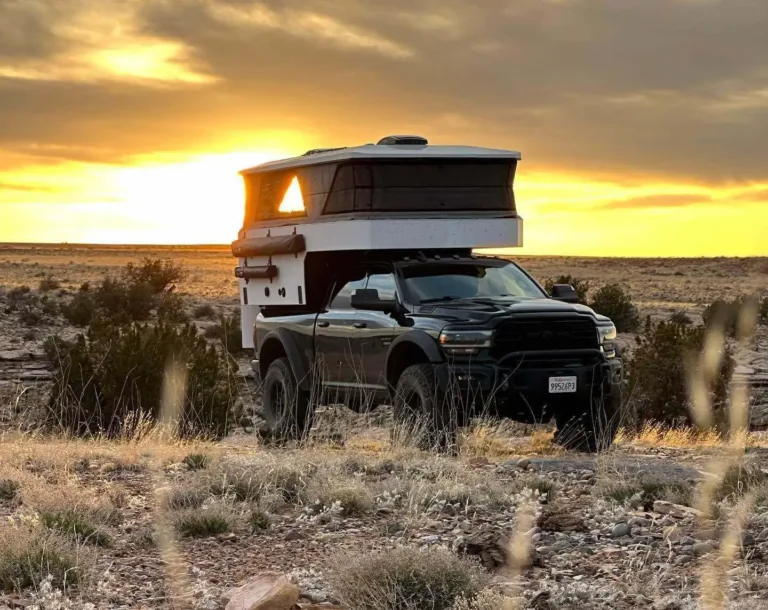
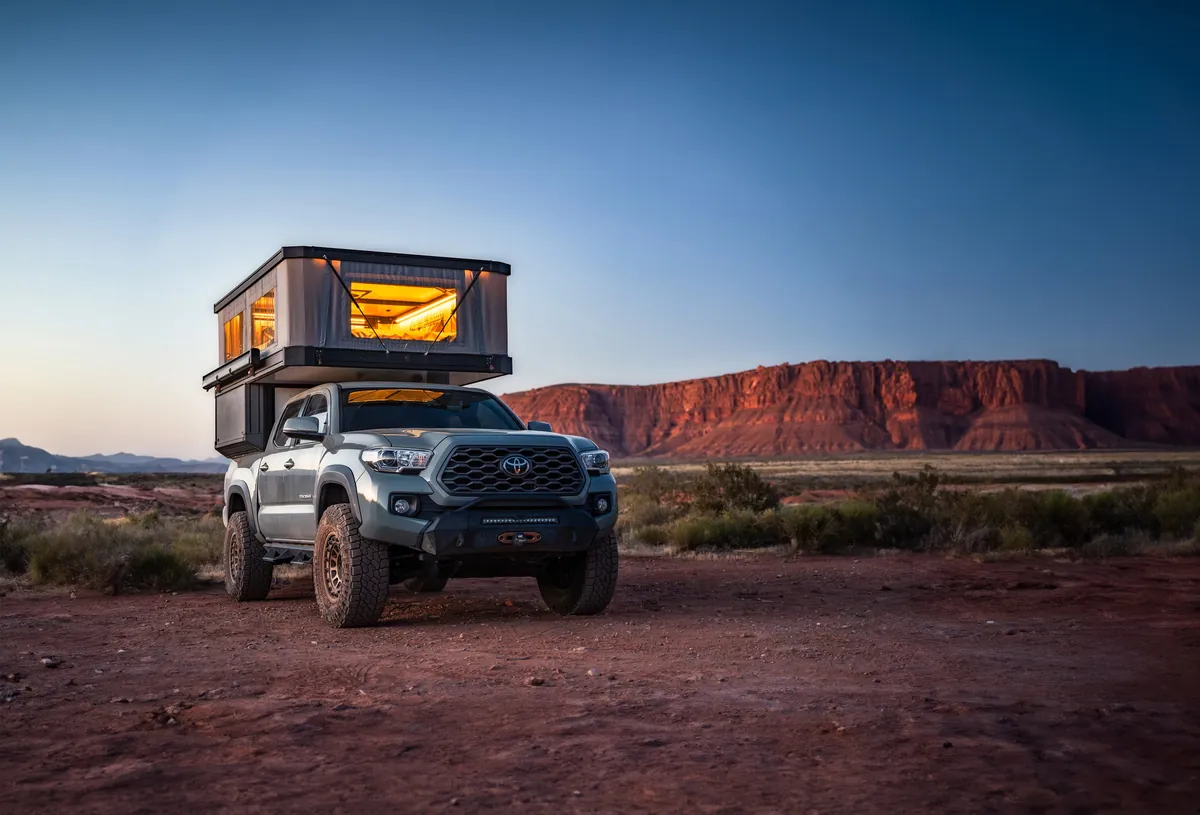
The Tune M1 pop-up truck camper is the odd one out in the wedge-camper crowd, and that’s exactly why it keeps showing up in my research. While Go Fast Campers, Super Pacific, and Lone Peak all build some variation of a wedge, Tune went a different direction: a vertical pop-up canopy that sits on your bed rails, opens straight up, and gives you a genuine stand-up living room under a big east-west bed. I spent the last week digging through Tune’s current spec sheets, their 2026 accessories catalog, owner forums, and long-term YouTube reviews — verified numbers and what real owners say after living with one, no marketing fluff.
Who’s Behind Tune Outdoor

Tune Outdoor is a Denver, Colorado company founded in 2020, and the founding team is the reason a lot of buyers take the M1 seriously despite the company’s young age. Co-founder Kris Arnold is the product lead — an industrial designer who started sketching the M1 because he couldn’t find a truck camper that fit his own ski-and-bike life in a Tacoma. Sean Kepler runs the business side, ex-The North Face, VF Outdoor, and Crocs Europe. They brought in mechanical engineer Broc Patterson, Backcountry Access co-founder Bruno McGowan, and COO Robert Koche, who previously launched GoPro in Europe.
That’s an unusually heavyweight team for a startup camper builder, and it shows: CNC-cut, bolt-together aluminum extrusions and composite panels on a real production line, not garage one-offs. Production models reached customers in 2023 after a long testing phase, and Tune now employs close to 50 people at a new, larger Denver headquarters (445 W 53rd Place — they outgrew the original shop in September 2026). They’ve since launched the smaller M1L and modular Tune Interior Systems.
2026 Tune M1 Pop-Up Truck Camper Specs
Every number below is from Tune’s current product pages or published third-party tests.
| Spec | Tune M1 (2026) |
|---|---|
| Base weight | 400 lbs (mid-size; varies by truck, builds run 360–400+ lbs) |
| Base price | $12,999 mid-size / $13,999 full-size |
| Sleeping platform | East-west queen, 72″ x 60″ standard; optional sliding king extension adds 20″ (80″ x 72″ on mid-size) |
| Standing headroom | 6’4″+, up to 6’10” depending on truck |
| Interior volume | 269 ft³ (mid-size) / 323 ft³ (full-size) |
| Frame | 6061 aluminum custom extrusions, glass-filled nylon corner brackets, bolted — not welded |
| Panels | Fiber-reinforced polypropylene roof panels; FRP honeycomb composite side panels |
| Tent fabric | Polyester pop-top canopy, six windows with bug netting and zip fabric panels; tan, blue, or charcoal |
| T-track | 440+ feet, interior, exterior, and roof |
| Access doors | Three full-opening aluminum awning doors (both sides + rear) |
| Closed profile | Adds roughly 12″ of height over stock; pops up about 3 feet |
| Standard extras | Built-in LED halo lighting, foam mattress, install and walkthrough included |
| Warranty | 3-year limited + lifetime customer support |
Two details worth emphasizing: the bolted construction lets Tune size the M1 for nearly any pickup from the late ’90s onward, and a damaged panel unbolts for replacement. And the 440+ feet of T-track is why DIY builders gravitate here — every extrusion accepts standard 40-series hammer nuts, so mounting lights, molle panels, or awnings is a weekend project, not a fabrication job.
On weight: 400 pounds is the headline, but glass awning doors add roughly 50 lbs and a loaded options list pushes real-world weight up. On a mid-size truck with marginal payload, run the numbers in our truck camper payload calculator guide before you fall in love with the glass.
2026 Pricing and Options: What It Actually Costs
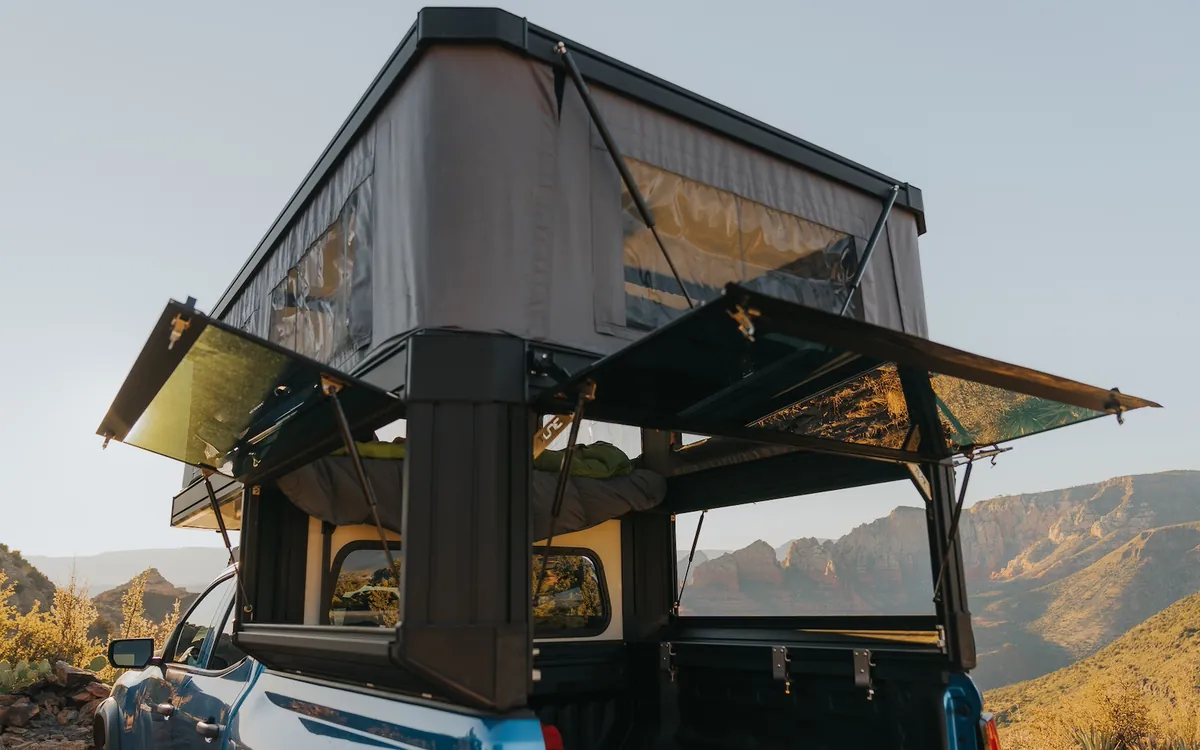
The base price gets you a camp-ready unit: three awning doors, LED halo lighting, six canopy windows, the queen platform with mattress, the full T-track system, and installation plus walkthrough at Tune HQ. That’s $12,999 for mid-size trucks and $13,999 for full-size.
Where it gets expensive is the configurator. Tune’s current accessories catalog tells the real story:
- King-size sliding bed extension: $400 — drops into the bed extrusion, stores under the mattress by day. The most popular option for couples and families.
- Glass awning doors: $750 each for side or rear glass; $850 for the rear door with tinted glass insert. Full smoked-glass surround runs ~$2,000+ and adds about 50 lbs.
- Insulation Pack: $500 — Tune’s removable insulation kit is now shipping after two years as “coming soon.” Big deal for shoulder-season campers.
- Anti-Condensation Mat: $150 — new, aimed at the moisture problem owners kept reporting (more below).
- Pecron E2400LFP power station: $800, plus $200 for the Tune battery mount. Pecron is Tune’s current house power brand.
- HEST mattresses: $629–$679 for the queen, $249–$289 for the matching extension. The stock foam mattress is fine; HEST is the comfort upgrade.
- Camper jack system: $1,200 — the M1 can come off the truck seasonally, unlike most wedge campers.
- MOLLE storage panels: $300 each; Lagun table: $550; Tune Single Bench: $1,800 (part of the new modular interior line); rain gutters: $150.
- Awnings: Kammok Crosswing $1,099–$1,299, Taruca Rogue 270° $1,399, plus a $175 universal awning mount.
One owner’s configurator run a while back landed at $25,200 with glass, solar, battery, king bed, and fan — and that math still roughly holds. Budget shoppers should read our budget truck campers under $15,000 guide first: a base M1 stays under that line, an optioned one blows past it. My advice: buy close to base, live with it a season, then add what you actually miss. Everything on that list bolts on later.
Two things still live only in the build configurator rather than the accessories store: the MaxxAir roof vent fan and the Truma propane heater option. Safety note: any propane or diesel heater in a small camper needs proper ventilation and a working CO detector, full stop.
Ordering and Installation: How Buying One Works
Tune sells direct — no dealer cut, which is part of how they hold the price:
- Design your build in the 3D configurator on tuneoutdoor.com.
- $500 deposit secures your spot in the build queue.
- Build review with their order team to lock final details.
- 50% minimum payment starts production; you schedule your install.
- Install and walkthrough at Tune HQ in Denver or through one of their dealers.
Current lead time on Tune’s site: install appointments starting in December, though your month isn’t locked until the first payment clears. Forum buyers report timelines roughly matching Tune’s quotes.
One honest gap: Tune doesn’t advertise a ship-to-your-driveway self-install program. Install happens at HQ or a dealer, and the camper is sized to your specific truck, so plan a road trip to Denver — or a dealer event, like the ones Tune ran in Colorado, California, and Michigan this fall — into your total cost. The upside is the walkthrough: owners consistently praise Tune’s team for teaching the setup, takedown, and maintenance routine properly.
Real-Owner Pros and Cons

I aggregated this from a three-year full-timer’s FAQ video, a two-year long-term ownership review on YouTube, a winter-storm test, and threads on Tundras.com, Tacoma World, and Wander the West.
What owners love:
- The space is real. The east-west queen that doesn’t eat bed space delivers — families of four genuinely sleep up top with the king extension while the truck bed stays open for gear or a lower sleeping platform. Multiple owners call the interior volume the reason they picked it over every wedge they cross-shopped.
- Standing headroom changes daily life. 6’4″+ of it, with bed and living area usable at the same time. Cooking, changing, and waiting out rain inside are normal activities instead of contortions — the single biggest functional gap between the M1 and wedge campers.
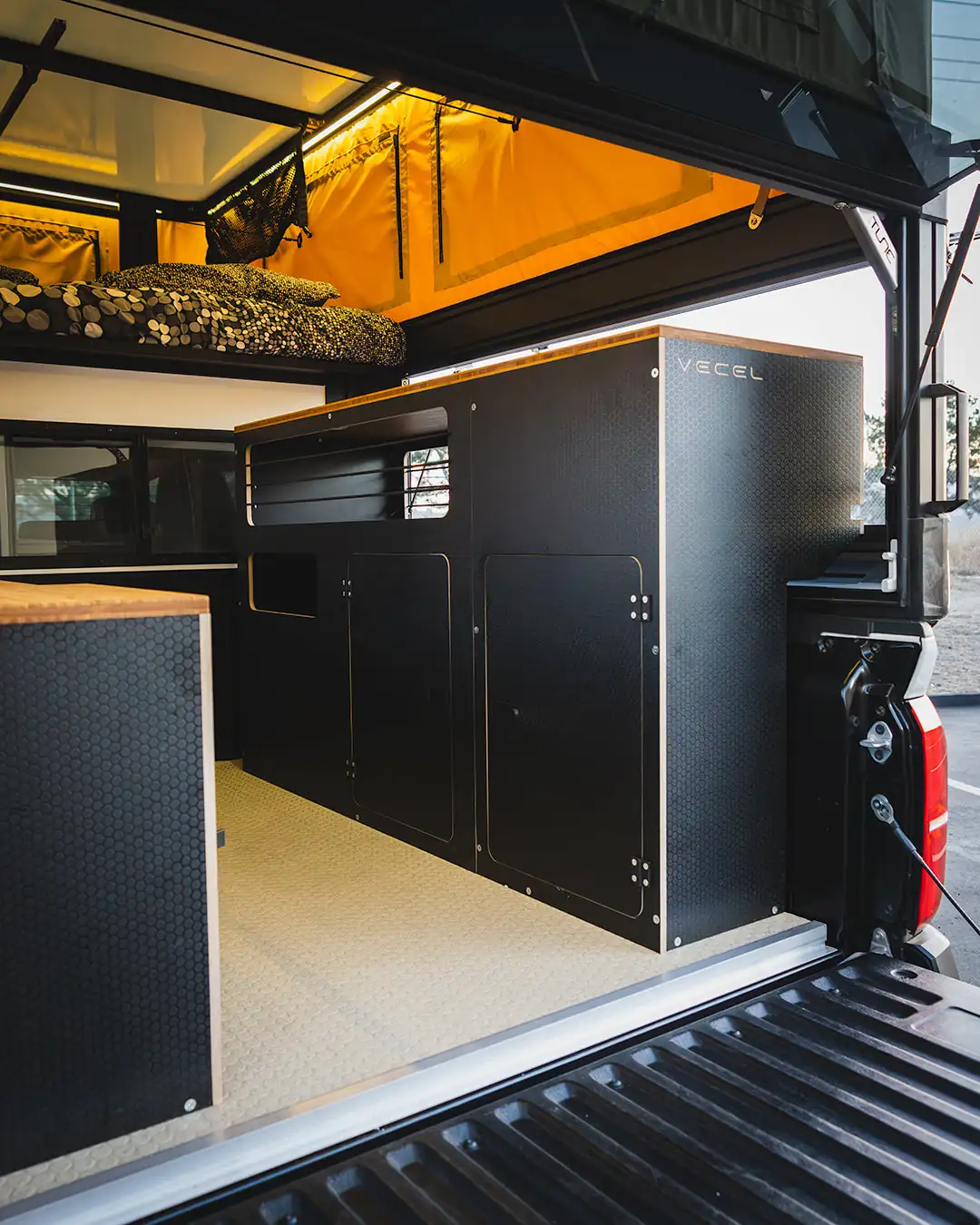
- The T-track system is as good as advertised. Owners mount everything from tool clamps to full 80/20 drawer systems with off-the-shelf 40-series hammer nuts. The aftermarket has noticed too — companies like Vecel now sell M1-specific modular interiors.
- Build quality holds up. A two-year ownership review reports the pop-up mechanism working like day one, and the bolted construction stays rattle-free. Tune’s customer support gets repeated praise by name.
- It still works as a truck. Top down it’s roughly a foot over stock height — garage-friendly — and three awning doors keep the bed usable for hauling. Several owners daily-drive their rigs.
What owners complain about — and the fixes that work:
- Condensation is the number one issue. Single-wall tent fabric plus aluminum extrusions plus human breath equals water beading on the ceiling panels and crossbeams in cold, humid conditions. What works: cycling the heater with the roof vent to push moist air out, keeping a window cracked whenever occupied, and toweling down in the morning. Tune now sells a $500 Insulation Pack and a $150 Anti-Condensation Mat for this, and one handy owner built a removable velcro insulation liner DIY for about $110 in materials. If you winter camp, budget for insulation from day one — and see our winter heating guide.
- Closing it wet lets water in. Pop the top down with a wet tent and water on the outside of the fabric can seep through onto the mattress. Fair-weather campers call it a non-issue; rain-country owners wipe the fabric down before closing or wait for it to dry. The $50 clear vinyl window inserts help in shoulder-season drizzle.
- The LED halo light wiring can be flaky. Multiple owners report the same failure: interior light strips cutting out from weak wire connections, fixed by re-soldering. Check every light at your install walkthrough and again after the first month of washboard roads.
- Setup is slower than a wedge. A wedge pops in seconds; the M1 takes a few minutes with latches, braces, and tent bungees. Fine for multi-night stays, annoying for a quick lunch stop. Know your travel style.
- Dust finds the tailgate. Like every bed-rail camper of this style, fine dust on dirt roads gets in around the tailgate. Owners seal the gaps with foam tape; some add a positive-pressure vent. Not Tune-specific, but budget an afternoon for sealing if you live on forest roads.
- The price climbs fast. The base price is honest; the configured price is where sticker shock lives. Community consensus: resist the configurator, buy base, add later.
Tune M1 vs the Alternatives
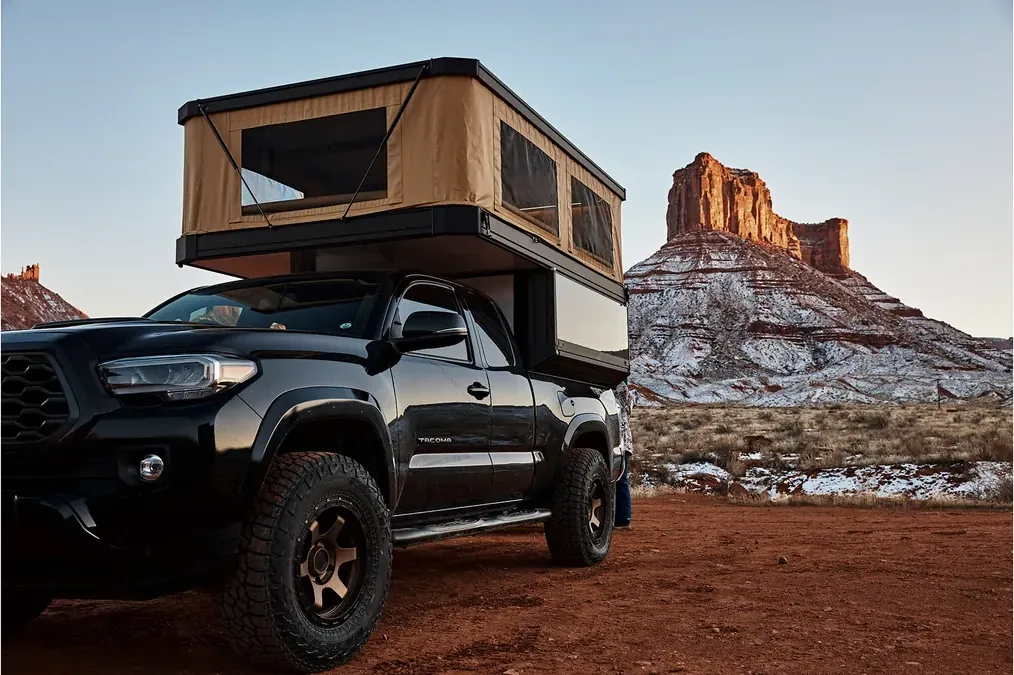
Here’s how the M1 stacks up against the wedge campers and pop-up slide-ins buyers actually cross-shop. Prices are current as of October 2026 and move around — treat them as starting points.
| Camper | Style | Base weight | Base price | Sleeping | Why you’d pick it |
|---|---|---|---|---|---|
| Tune M1 | Vertical pop-up canopy | 400 lbs | $12,999 / $13,999 | 72″×60″ E-W queen (80″×72″ king optional) | Most interior volume per pound; true stand-up living space; massive T-track |
| Go Fast Camper Platform Camper | Wedge | ~270–330 lbs | from ~$6,950 | 50″×90″ (mid) / 56″×90″ (full) | Lightest, cheapest, fastest setup; huge aftermarket |
| Super Pacific X1 | Wedge | 340–390 lbs | $13,495 / $13,995 | 2-person wedge loft | 4-season marine-grade tent, meticulous build, 4 windows |
| Lone Peak V2 | Wedge | 400 / 450 lbs | $7,000 / $8,000 | 50–54″×80″ | Budget wedge with stand-up pass-through and push-away bed |
| AT Overland Atlas | Vertical pop-up | 360 lbs | from $15,600 | 48″×80″ | Insulated composite panels, 6’10” headroom, most 4-season capable |
| Four Wheel Camper Swift | Slide-in pop-up | 950 lbs dry | $28,995 MSRP | North-south queen cabover | Real RV amenities — furnace, fridge, water; needs serious payload |
Against the wedges, the M1’s pitch is simple: wedges give you a bed and a gear garage, while the M1 gives you a bed plus a room you can stand in. The tradeoff is slower setup, more tent fabric to manage, and more money than the budget wedges. If setup speed and minimalism are your religion, the GFC is still the benchmark — our best wedge canopy campers roundup breaks down the whole wedge field.
The AT Overland Atlas is the M1’s closest philosophical rival: vertical pop-up, similar weight, stand-up room. It costs more and sleeps narrower (48″ wide) but brings insulated walls and a longer 4-season pedigree — cold-climate buyers should look hard at both.
The Four Wheel Camper comparison is a different sport. A Swift is a self-contained RV that happens to pop up — furnace, fridge, water, toilet options — at triple the weight and double the price, and it eats your truck bed entirely. If you want a camper that is the living space, that’s the move (see our Four Wheel Camper Fleet vs Swift vs Hawk breakdown). If you want a camper that protects a living space you build yourself, the M1 wins on weight, price, and flexibility.
One more worth knowing: Tune’s own M1L ($8,999, 322 lbs, north-south bed) undercuts the M1 for solo travelers and couples who don’t need the east-west palace.
Who Should (and Shouldn’t) Buy the Tune M1
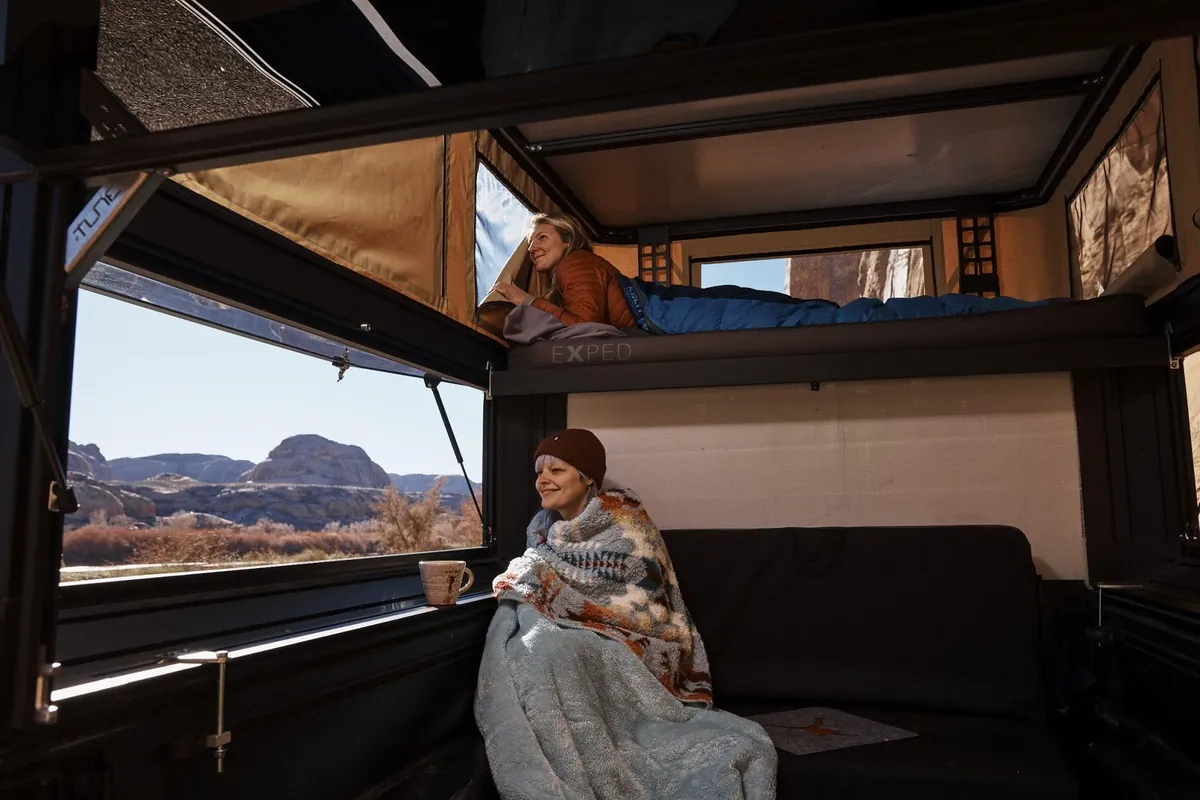
Buy it if: you want maximum livable space at minimum weight; you camp with a partner, kids, or dogs and need the east-west bed plus open floor; you’re a DIY builder who lights up at 440 feet of T-track; or you daily-drive your truck and need the low closed profile.
Skip it if: you want the fastest possible setup (get a wedge); you need a turnkey RV with plumbing and a furnace (get a Four Wheel Camper or similar slide-in); most of your camping is quick overnight stops where a multi-minute setup feels like a chore; you’re on a strict sub-$10k budget (look at the Lone Peak or the used market); or you camp in constant cold rain and don’t want to manage tent fabric and condensation.
The verdict: The Tune M1 pop-up truck camper earns its reputation — the roomiest sub-450-pound camper you can buy, from a serious company, with manageable owner complaints (condensation, wiring niggles, dust) rather than structural failures. Go in with eyes open: buy near base price, budget for insulation if you chase shoulder seasons, and seal your tailgate before the first dirt road.
Frequently Asked Questions
How much does the Tune M1 weigh?
The base camper starts at 400 pounds for mid-size trucks, with real-world builds landing between 360 and 400+ pounds depending on truck and options. Glass awning doors add roughly 50 pounds over aluminum. Verify against your truck’s payload — our payload calculator guide walks through the math.
Can I install the Tune M1 myself?
Tune installs the M1 at their Denver HQ or through dealers — no advertised ship-to-home self-install. The $500 deposit holds your build slot, a 50% payment starts production, and installs are currently booking for December. The install includes a full walkthrough. A $1,200 jack system allows seasonal removal.
Does the Tune M1 have condensation or leaking problems?
Condensation, yes — the most-reported owner issue. In cold, humid conditions, moisture beads on the ceiling panels and crossbeams. Owners manage it by cycling the heater with the roof vent, keeping a window cracked, and adding insulation; Tune now sells a $500 Insulation Pack and $150 Anti-Condensation Mat for exactly this. True leaks are rare — the known water issue is seepage when closing the camper with a wet tent, solved by drying the fabric first. For power to run a vent fan off-grid, see our portable power station picks.
Is the Tune M1 worth it compared to a Go Fast Camper?
Depends on what you value. The GFC is lighter (270–330 lbs), cheaper (from ~$6,950), and sets up in seconds — but you can’t stand up in it with the bed deployed and the platform is narrower. The M1 costs roughly twice as much and takes a few minutes to set up, but gives you a genuine stand-up living room and a bigger bed. Families, tall campers, and bad-weather travelers tend to pick the M1; minimalists and fast movers pick the GFC.
What’s the difference between the Tune M1 and the M1L?
The M1L is Tune’s smaller, lighter, cheaper sibling: $8,999 base, 322 pounds, about 20% less interior volume, and a north-south rather than east-west sleeping platform. It’s aimed at solo travelers and couples who found the M1 to be more camper than they needed — but you give up the signature east-west bed and some of that interior volume.
What trucks does the Tune M1 fit?
Tune builds the M1 to order for nearly any pickup from the late 1990s onward — Tacoma, Gladiator, Ranger, Frontier, Colorado, full-size Ford, Ram, GM, and Toyota trucks, including the F-150 Lightning. Fitment is confirmed during ordering since each unit is sized to the truck.