Truck Camper Cost Per Year: The True Cost of Ownership
When I first priced truck campers, I made the same mistake most people make: I looked at the sticker price, added insurance, and thought that was the math. The sticker is maybe half the story. The real truck camper cost per year shows up in the boring line items nobody puts in the brochure: the value quietly bleeding off your camper every twelve months, the extra fuel your truck burns dragging a wall of fiberglass down the highway, the tires you replace a year early, and the roof seals you either maintain or pay for later in rot.
Below are the actual cost buckets, what owners really report paying for each, and three complete owner profiles — a weekend warrior, a snowbird, and a full-timer — so you can find the version of this lifestyle that matches your wallet.
The Seven Buckets Every Truck Camper Cost Per Year Includes
- Depreciation — what the camper loses in value each year you own it.
- Insurance — usually cheaper than you expect, but with catches.
- Maintenance and resealing — seals, appliances, jacks, batteries, the annual roof tax.
- Storage — free if your driveway allows it, real money if it does not.
- The fuel penalty — the extra gallons burned carrying the camper versus driving the bare truck.
- Truck wear — tires, brakes, suspension components, all consumed faster under load.
- Registration and taxes — small in most states, but it varies wildly by state.
Depreciation: The Biggest Line Item Nobody Budgets
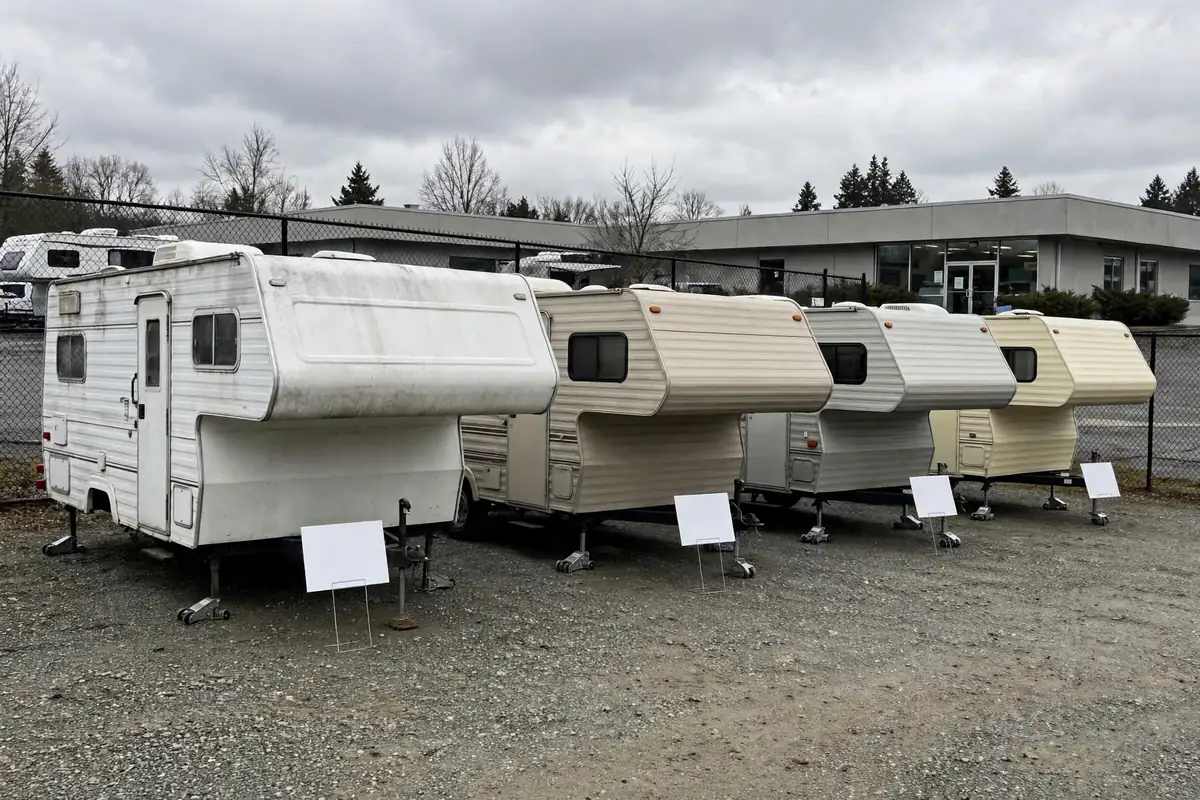
Depreciation is the silent number that dwarfs everything else in this article. Owners on RV forums consistently describe the same curve, said to match the formula behind NADA’s RV values: roughly 20 percent gone in the first year off the lot, then about 6 percent per year after that on the declining value.
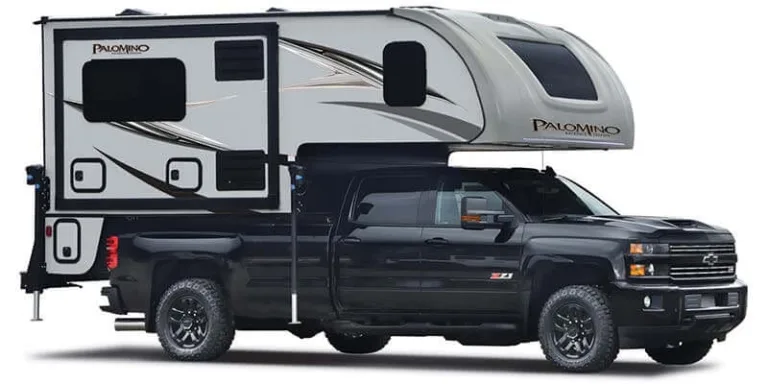
2026 sticker prices make it concrete: a new Lance 1191 lists at a $55,949 base MSRP ($60,289 with the slide), new Arctic Fox models carry MSRPs of $65,000 to $80,000 (street prices around $47,000 to $59,000), and even entry-level hard-sides like the Palomino Real-Lite list near $50,600.
Run the curve on a $40,000 new purchase: roughly $8,000 lost in year one, about $15,000 over five years — $3,000 a year just for owning it. The community’s consistent answer is to buy used. A well-kept 5-to-8-year-old hard-side sells for $12,000 to $18,000, where the curve has flattened and depreciation runs more like $800 to $1,200 a year. That single decision is the biggest lever on your annual cost. If you go that route, walk the camper with our used truck camper inspection checklist first — water damage is the depreciation event that happens all at once.
Insurance: The Cheap Surprise (With Fine Print)

Here is the good news. Truck camper insurance is famously cheap, because most owners do not buy a separate RV policy at all — they add the camper to their existing truck policy as a rider or scheduled accessory.
Owner-reported numbers from the Wander The West forums: anywhere from $82 a year for a 2006 Grandby to $150–$182 a year for newer builds insured for $16,000–$20,000, with aggregators putting the typical range at $150 to $500 a year. Compare that to $1,000 to $3,000 a year for a Class A motorhome: the camper is treated as cargo or an accessory of the truck, not as a second vehicle.
But the community also surfaced the catches. First, phone reps frequently have no idea what a slide-in truck camper is. Owners report agents confusing it with a pop-up trailer or quoting it as a full RV — one Progressive quote for a Four Wheel Camper landed at $525 a year for that reason. The owners who get the cheap rates use the same script: describe it as a slide-in camper carried in the truck bed, give the manufacturer name and serial number, send a few photos, and ask for it to be added to the truck policy. Several owners note USAA covers the camper as part of the truck, including when it is off the truck.
Two more catches. The on-truck/off-truck gap is real: your auto policy typically covers the camper only while loaded, and your homeowners policy may cover it on your property — in between, confirm a stated-value endorsement covers both. And every figure here depends on your state, insurer, and policy structure; one owner’s $82 a year is not a promise of yours. We go deeper on coverage types, claim gotchas, and the on/off-truck question in the truck camper insurance guide.
Maintenance and Resealing: The Annual Roof Tax
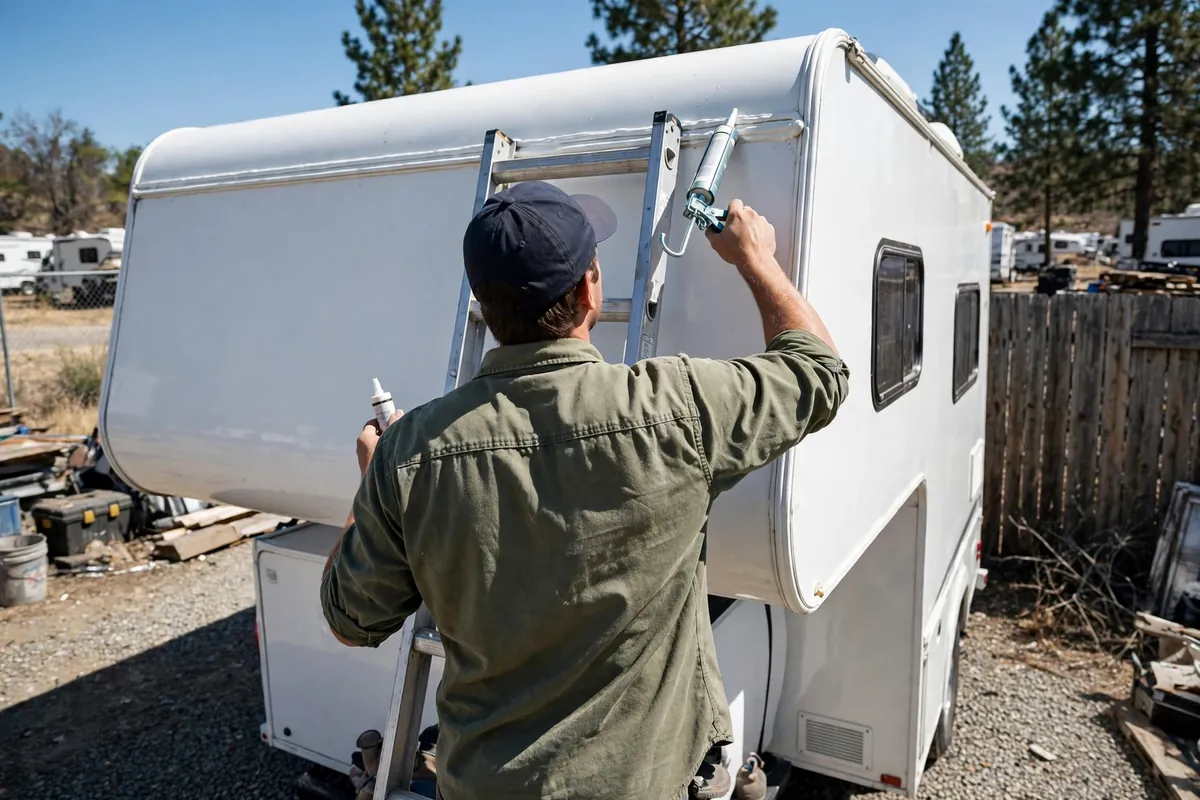
Ask owners what costs money year to year and two answers come back: seals and small stuff. Water intrusion is the terminal disease of truck campers, and the prevention is unglamorous: inspect and touch up the roof seams, window frames, and corner moldings every year.
The cost range is wide because the approach is wide. Doing it yourself, a full seal inspection and touch-up costs a few tubes of Dicor and an afternoon — owners on the Bogleheads forums report total DIY maintenance under $100 a year including winterizing. A mobile RV tech doing a leak check and reseal typically runs around $10 per linear foot plus a service call, and Camping World’s 2026 roof repair guide puts most full professional reseal jobs between $400 and $1,500 depending on roof size and penetration count.
One community favorite: Eternabond tape over the main seams, a one-time $200-to-$300 fix that stretches the interval between full reseals. And a Bogleheads owner put the stakes bluntly — the annual seal check is the difference between a camper that lasts 20 years and one that lasts 5.
Beyond seals, budget for the small stuff: a house battery every 4 to 6 years, jack maintenance ($100 to $400), and the random appliance repair that lands the week before a trip. Realistic annual maintenance: $150 to $300 DIY, $400 to $800 with pro reseals every few years, $800 to $1,200-plus as a full-timer.
Storage: Free, Until It Is Not
If your camper lives in your driveway or on your own land, this bucket is zero. For everyone else, RV storage runs roughly $55 to $150 a month uncovered and $125 to $200 a month covered — $660 to $1,800 a year just to park the thing. The community wrinkle: HOAs and city ordinances. Multiple owners report their storage cost was not a choice — deed restrictions banned parking at home. Check your HOA rules before you check dealer inventory.
The Fuel Penalty: Wind Costs More Than Weight
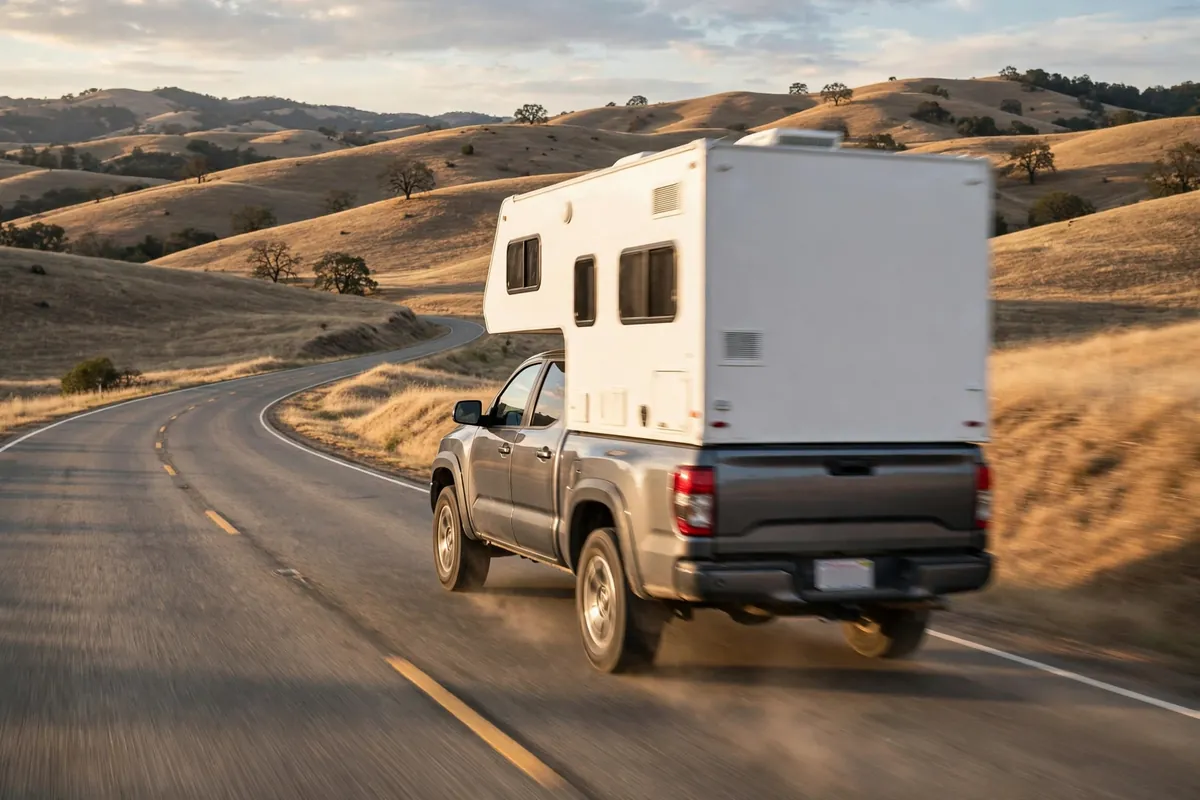
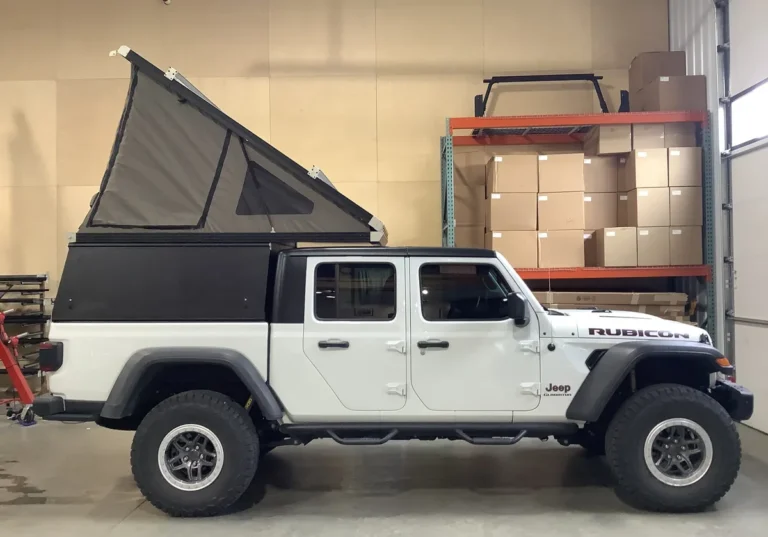
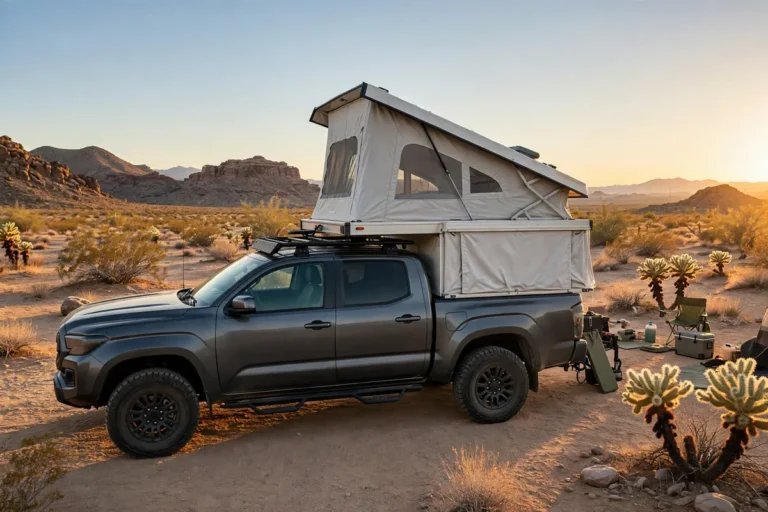
The owner data is remarkably consistent: a hard-side truck camper costs you 5 to 7 mpg, while a pop-up costs you about 2. The killer is aerodynamic drag from the cabover, not the weight in the bed.
The numbers from owner threads: a 1999 7.3L Power Stroke went from 17–18 mpg empty to 11–12 with a heavy Arctic Fox; a RAM 3500 diesel went from 19 mpg empty to 12 with the camper on; a Duramax dually dropped to 9.5–10.5 with any frontal wind. One Wander The West owner ran a careful multi-tank experiment and concluded the camper cuts mileage 15 to 25 percent, with headwinds at the bad end. Owners with pop-up campers on V8 trucks reported only about a 2 mpg difference, thanks to the low profile. Two takeaways: slow down and the penalty shrinks, since drag rises with the square of speed; and cruise control in rolling terrain can hurt mileage versus a careful right foot.
Now price it at 2026 fuel costs, because this is where the year matters. AAA’s national average for regular gasoline sat at $4.34 to $4.36 a gallon in October 2026 — the highest autumn prices on record. Take a weekender driving 5,000 camper-miles a year in a gas truck that gets 17 mpg bare and 11 mpg loaded: 455 gallons versus 294, or 161 extra gallons — about $700 a year at current prices. A diesel truck’s per-gallon figure runs higher still. (If you are still matching a camper to your truck’s payload, run your numbers through the truck camper payload calculator guide first — an overloaded truck burns even more fuel and eats tires faster.)
Truck Wear: Tires, Brakes, and Suspension
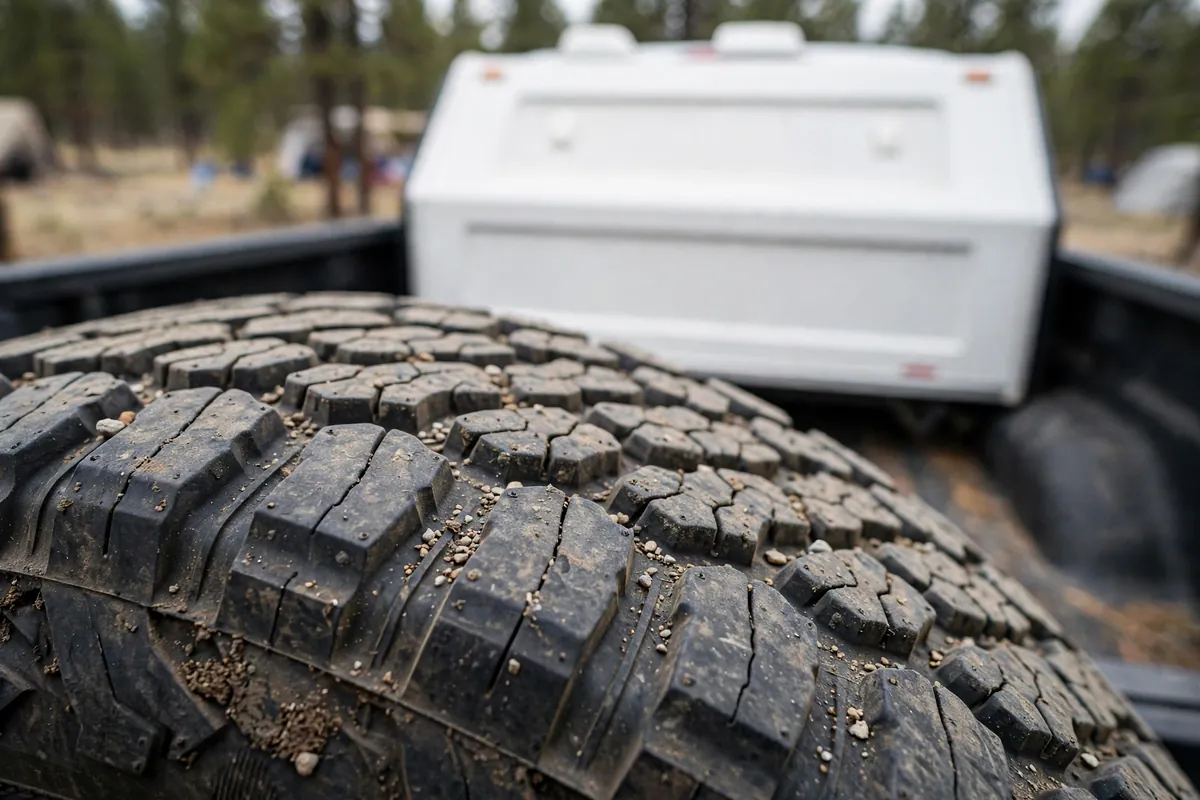
Carrying 2,000 to 4,000 extra pounds — high up, behind the cab — accelerates wear on everything between the camper and the road, and owners under-budget this bucket more than any other.
Tires are the big one. Owners on Wander The West are near-unanimous: run E-rated (10-ply) tires and tune pressures to your actual axle weights rather than the sidewall maximum. One owner who measured tread wear across 10,000 miles settled on 60 psi front and 58 psi rear for even wear with a Grandby loaded — and the chalk method (chalk across the tread, drive, check the wear pattern) comes up repeatedly as the DIY way to dial it in. Budget $1,000 to $1,600 for a full E-rated set and expect to replace tires 20 to 30 percent sooner than the bare truck — roughly $250 to $500 a year for a weekender and $500 to $800 for a full-timer.
Suspension is the second wear item, and the community drew a useful distinction: Timbren bump stops engage only after the suspension has sagged, while airbags hold the truck at the correct ride height and adjust for the camper being on or off. Neither raises your legal payload rating. We compared all three systems in airbags vs Timbren vs SumoSprings.
Then the incidentals: brakes, shocks, and alignment all work harder under load. Budget $1,000 to $1,500 a year in extra truck-wear costs as a full-timer, $250 to $500 as a weekender.
How Much Does a Truck Camper Cost Per Year? Three Owner Profiles
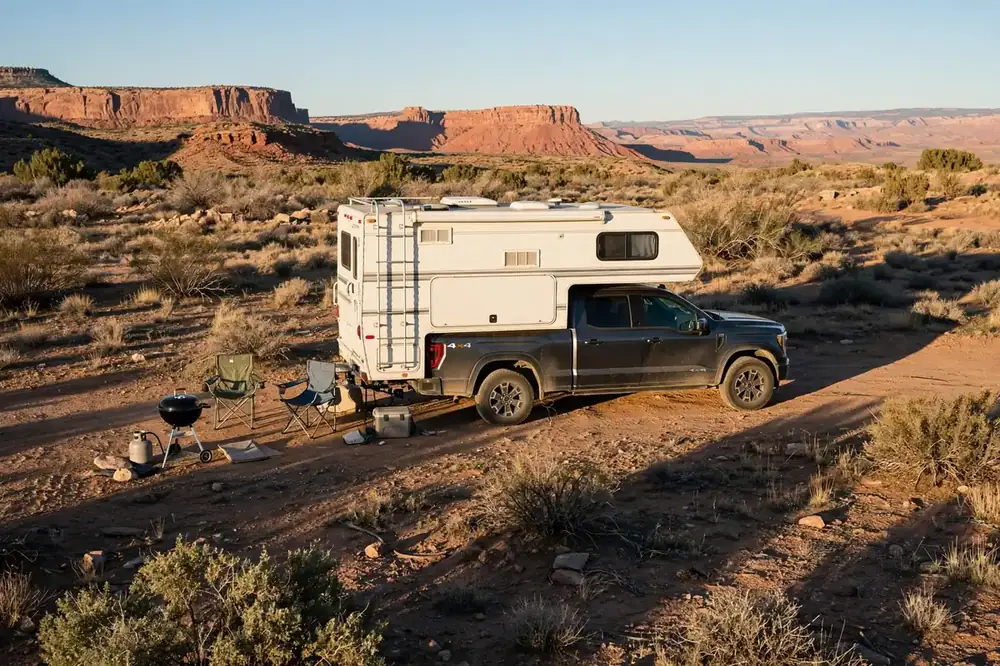
Every line is an honest range, not false precision. Fuel math uses the AAA October 2026 national average of about $4.35 a gallon.
Profile 1: The Weekend Warrior
Buys a used hard-side for about $15,000, does 8 to 10 weekends a year (roughly 5,000 camper-miles), parks it in the driveway, and handles maintenance himself.
| Cost bucket | Annual range |
|---|---|
| Depreciation (used, curve flattened) | $800–$1,200 |
| Insurance (rider on truck policy) | $100–$200 |
| Maintenance and resealing (DIY) | $150–$300 |
| Registration and taxes | $10–$60 |
| Storage (driveway) | $0 |
| Fuel penalty (~161 extra gallons) | ~$700 |
| Extra truck wear | $250–$500 |
| Total | $2,000–$3,000 |
At $2,000 to $3,000 a year, the weekender’s cost per night out is genuinely low — 16-plus nights a year works out to under $200 a night all-in, and it drops with every extra trip. This is the profile where buying used does the heaviest lifting — see budget truck campers under $15,000 for what that money actually buys.
Profile 2: The Snowbird
Buys a new mid-range hard-side for about $40,000, travels 4 to 6 months a year (roughly 8,000 camper-miles), and stores it covered the rest of the year.
| Cost bucket | Annual range |
|---|---|
| Depreciation (new, steep early curve) | $3,000–$4,500 |
| Insurance (full coverage, stated value) | $250–$400 |
| Maintenance and resealing (mixed DIY/pro) | $300–$600 |
| Registration and taxes | $30–$100 |
| Storage (covered, ~6 months) | $600–$1,200 |
| Fuel penalty (~256 extra gallons) | ~$1,100 |
| Extra truck wear | $400–$600 |
| Total | $5,500–$8,500 |
Depreciation dominates this profile — more than half the total. That is the price of buying new and selling within a few years; keep the camper eight to ten years and the annualized figure falls hard as the curve flattens.
Profile 3: The Full-Timer
Buys a new premium hard-side for about $55,000, lives in it year-round, and drives roughly 20,000 miles a year.
| Cost bucket | Annual range |
|---|---|
| Depreciation (new premium, heavy use) | $4,000–$6,000 |
| Insurance (full coverage) | $400–$525 |
| Maintenance and resealing (heavy use) | $800–$1,200 |
| Registration and taxes | $50–$150 |
| Storage | $0 |
| Fuel penalty (~642 extra gallons) | ~$2,800 |
| Extra truck wear (tires, brakes, suspension) | $1,000–$1,500 |
| Total | $9,000–$12,000 |
Nine to twelve thousand a year sounds like a lot until you compare it to the alternative: $750 to $1,000 a month for housing and transport combined, with no rent or mortgage. If this is your plan, read the best truck campers for full-time living before choosing the rig, since four-season insulation and tank heating change both comfort and cost.
The Hidden Costs Owners Forget to Mention
Propane and batteries. A weekender might spend $50 a year on propane; a full-timer running a furnace through a cold month can burn a 20-pound tank in days — one iRV2 owner reported going through a tank and a half in a single 8-hour night at 35 degrees. Budget accordingly if you camp cold.
Campground fees are not ownership costs, but they are costs. Boondocking is free; private parks run $40 to $80 a night in 2026. A snowbird spending 60 paid nights a year at $55 a night adds $3,300 — more than their insurance, maintenance, and registration combined.
The truck itself. Every profile above assumes you already own a suitable truck. If you are buying a $60,000 diesel to carry a $40,000 camper, the truck’s costs dwarf everything in this article.
Frequently Asked Questions
How much does a truck camper cost per year on average?
For a weekend warrior with a used camper and a paid-off truck, $2,000 to $3,000 a year. A snowbird with a new mid-range camper runs $5,500 to $8,500 a year. A full-timer in a new premium rig should budget $9,000 to $12,000 a year. Depreciation is the largest bucket in every profile, followed by the fuel penalty.
Is truck camper insurance really that cheap?
Usually, yes — most owners add the camper to their truck policy as a rider and pay roughly $80 to $300 a year, with some new-camper full-coverage policies reaching $400 to $525. The figure depends on your state, insurer, the camper’s value, and policy structure. Make sure coverage applies both on and off the truck.
What is the biggest hidden cost of truck camper ownership?
Depreciation. A new camper can lose around 20 percent of its value in the first year and roughly 6 percent per year after that — about $3,000 a year averaged over five years on a $40,000 purchase. Buying used is the single biggest way to cut your annual cost.
How much worse is fuel economy with a hard-side camper versus a pop-up?
A hard-side camper costs about 5 to 7 mpg (a diesel truck dropping from 19 mpg empty to 12 loaded is typical), while a pop-up costs only about 2 mpg thanks to its lower profile. Wind resistance from the cabover matters more than weight, and headwinds make it worse.
How often do I need to reseal my truck camper?
Inspect roof seams, window frames, and corner moldings at least once a year and touch up failing sealant promptly — owners call this the difference between a camper that lasts 20 years and one that lasts 5. A full professional reseal every 3 to 5 years runs $400 to $1,500; DIY touch-ups cost under $100 in materials.
The Bottom Line
A truck camper is one of the cheapest ways to own an RV — insurance is a rounding error, there is no second engine to maintain, and a used rig’s annual cost can genuinely land under $3,000. But cheap to own is not free to own, and the two numbers that decide your real budget are the ones nobody advertises: depreciation and fuel. Buy used, maintain the seals like your wallet depends on it, and price the fuel penalty in at today’s gas prices, not last decade’s.