F150 Truck Camper Guide: Real Payload Math for Your F-150
If you own a Ford F-150 and you’re dreaming about a slide-in camper, you’re not alone. The F-150 has been America’s best-selling vehicle for decades, so half the people researching an F150 truck camper setup already have the truck in the driveway. The real question is whether your specific truck — your door sticker, not Ford’s brochure — can carry a specific camper without turning your rig into a white-knuckle science experiment.
I’ve watched people do this math wrong for years, not from carelessness but because Ford’s marketing numbers and the real numbers on your truck are two different things. This guide uses owner-verified weights from people who actually weighed their rigs, walks through the CAT-scale math step by step, explains the legendary Heavy-Duty Payload Package (and what happened to it on new trucks), and lays out which campers fit an F-150 and which don’t.
One safety note up front: never exceed your truck’s GVWR, payload rating, or tire load ratings. Suspension upgrades improve how a loaded truck rides, but they don’t raise the ratings on your door sticker. If the math doesn’t work, the answer is a lighter camper or a bigger truck — not wishful thinking.
The Brochure Trap: Max Payload vs. Your Door Sticker
Here’s the number Ford wants you to see: for the 2025 F-150, maximum payload is 2,440 pounds with the 3.5L EcoBoost. The 2024 model year was nearly identical at 2,445 pounds. Sounds generous, right? You could practically carry a small apartment.
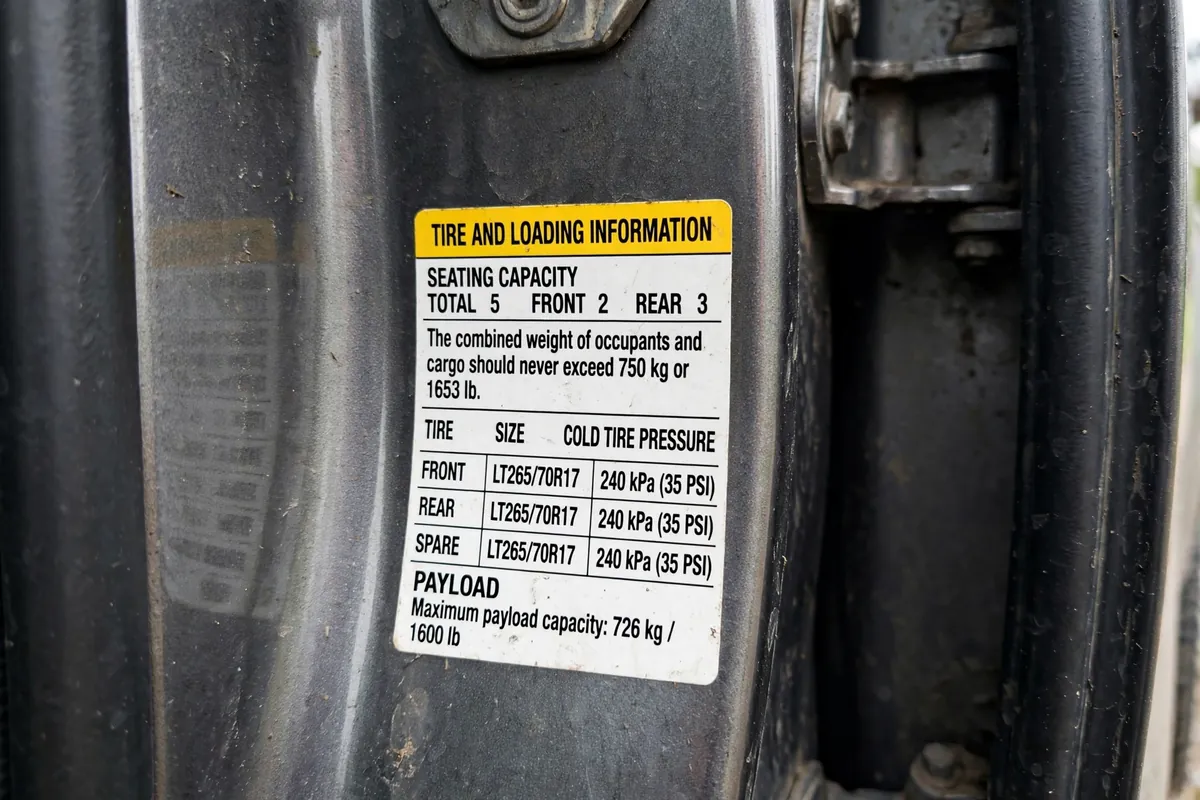
Now here’s the number that matters: the one on the yellow-and-white tire and loading sticker inside your driver’s door. That figure belongs to your actual truck, with its actual cab, bed, drivetrain, engine, and options. And it’s almost always hundreds of pounds lower than the brochure number.
Why? Because Ford’s maximum payload figure is earned by a base regular-cab work truck with the smallest engine and zero options. Nobody cross-shopping campers drives that truck. Real-world examples tell the real story:
- A 2025 F-150 STX 4WD SuperCrew with the 5.5-foot bed — a hugely common configuration — lists a GVWR of 6,650 pounds and a maximum payload of about 1,650 pounds. Nearly 800 pounds below the brochure headline.
- One truck camper forum owner bought a 2016 F-150 SuperCab XLT 6.5-foot bed specifically because its door sticker showed 1,945 pounds of payload, while most trucks on dealer lots around him showed only 1,200 to 1,600. He picked through inventory deliberately, and said he needed every pound.
- Options eat payload fast: 4WD, a crew cab, a bigger engine, a sunroof, leather, running boards. Every one adds curb weight, and payload is simply GVWR minus curb weight. The fancier your F-150, the less it can carry.
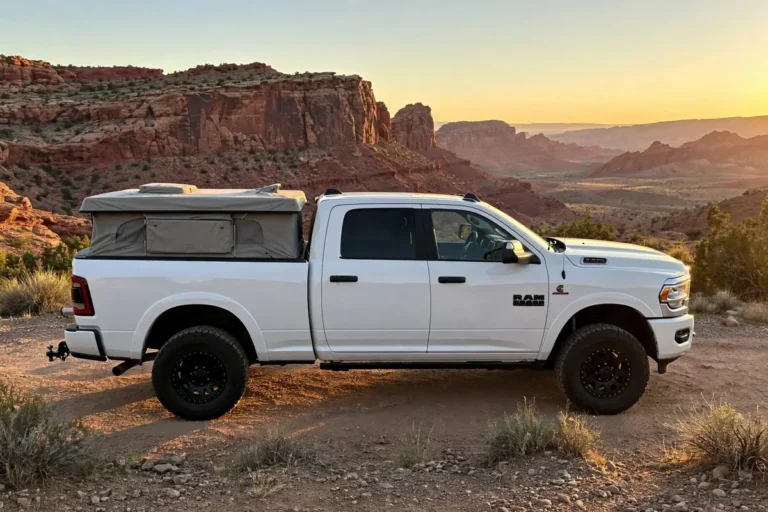
Step one of honest F150 truck camper math: walk out to your truck, open the driver’s door, and read the sticker. Not the website. The sticker. If you haven’t bought the truck yet, I did the same honest-math teardown for the Ram 2500 diesel payload trap — the diesel engine alone eats roughly 800 pounds of payload versus the gas version, and most buyers never realize it until the camper’s already ordered.
The Heavy-Duty Payload Package: What It Was, and What Changed in 2024
Ask around truck camper circles about the F-150 and sooner or later someone mentions the Heavy-Duty Payload Package, option code 627. For years, this was the cheat code. Order it from the factory and Ford fitted your truck with upgraded springs, heavy-duty shock absorbers, a 9.75-inch rear axle with a 3.73 electronic-locking differential, LT-rated tires instead of passenger tires, beefier wheels, and a 36-gallon fuel tank. The headline change: GVWR jumped to 7,850 pounds.
What that meant in practice was a half-ton with legitimate three-quarter-ton-adjacent payload. A 2021 F-150 4WD XLT owner on an F-150 forum reported his HDPP truck’s door sticker at 7,850 pounds GVWR with 2,412 pounds of payload. Another camper owner with a regular cab long-bed reported 2,800 pounds of payload, hauling a full-size Grandby pop-up “easily without sag or modifications” and averaging 15 to 16 mpg with the camper on.
But there were catches:
- You had to special-order it. Dealers almost never stocked HDPP trucks — owners on Expedition Portal call it “a unicorn.” Expect a factory order and a longer build time.
- It was configuration-limited. In later years it was mainly offered on XL and XLT trims, typically SuperCrew with the 6.5-foot bed and the 5.0L V8 or 3.5L EcoBoost. Don’t assume your dream Lariat could get it.
- The empty ride was rough. Stiff springs ride like a lumber wagon unloaded and great with the camper on. That’s the trade.
And here’s the big one: Ford dropped the Heavy Payload Package for the 2024 model year. A Ford spokesperson confirmed the removal to automotive press, saying the company was simplifying its offerings. That’s why maximum payload fell from 3,300-pound territory in 2023 to about 2,455 pounds in 2024 — and it hadn’t returned as of 2025 (max payload 2,440). I couldn’t verify Ford’s plans for the 2026 model year, so check the current order guide or ask a dealer. Specs change by year, and this package is the perfect example of why.
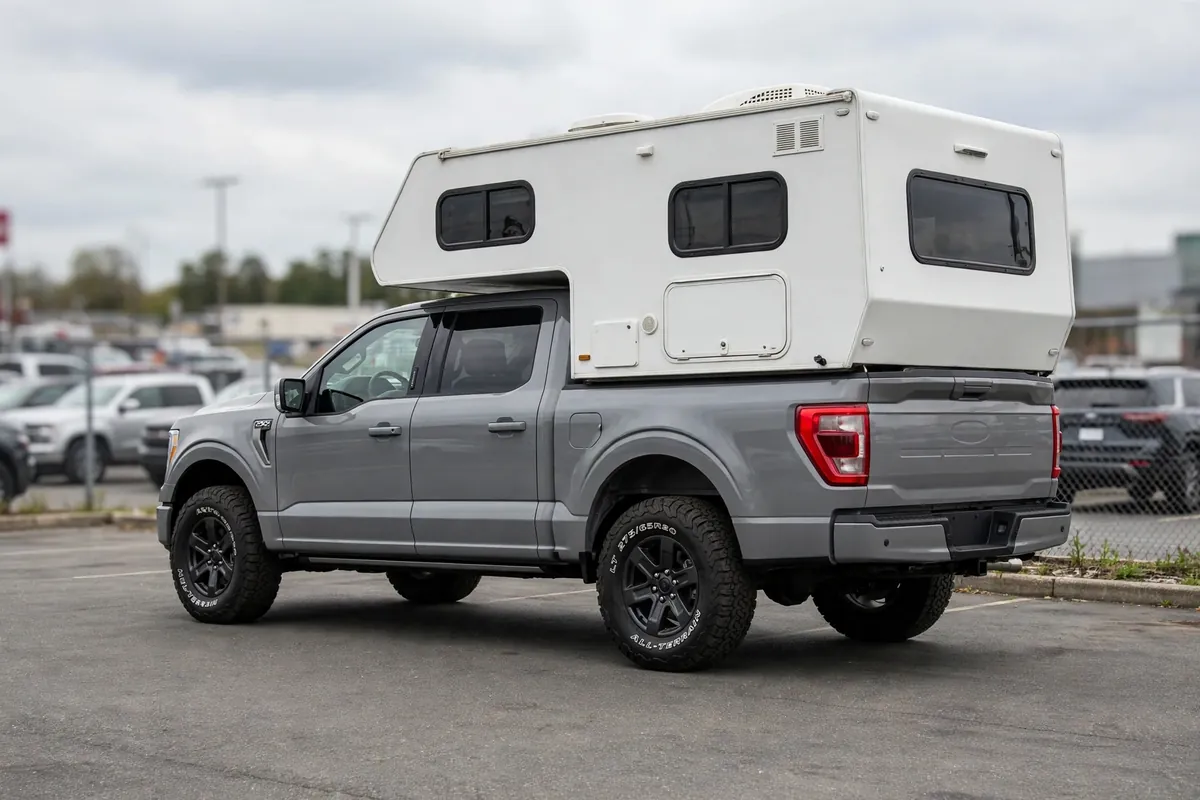
Bottom line: if you’re shopping used, a 2021–2023 F-150 with the HD Payload Package is the single best half-ton camper platform Ford ever built. If you’re buying new, the package is gone, and you need to do the math with the standard numbers.
Do the CAT-Scale Math: Your Real Camper Budget
Forget brochure numbers entirely. Here’s the workflow every experienced truck camper owner eventually lands on:
- Load the truck like you’re going camping. Full fuel tank, all passengers, the dog, the cooler, tools, recovery gear, bikes — everything that rides in the truck.
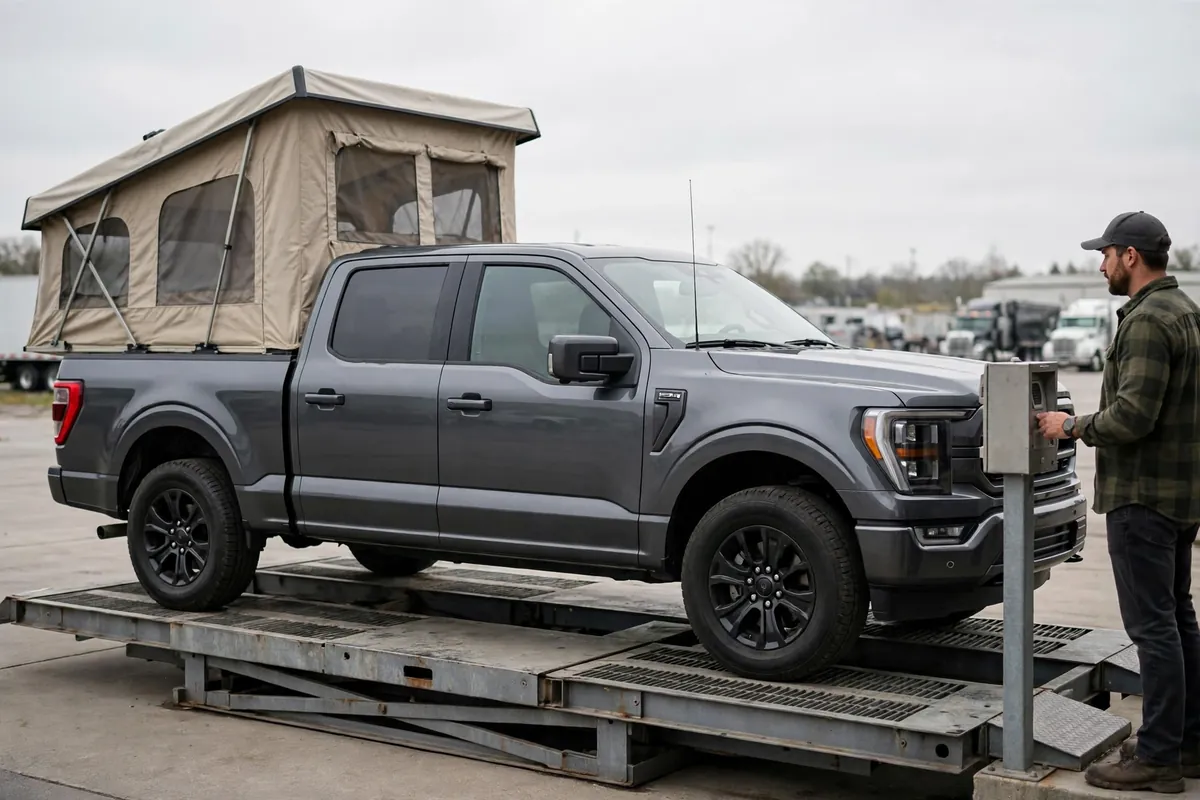
- Drive to a CAT Scale at a truck stop. They’re certified, they’re everywhere, and a weigh costs a few dollars. (Find one here.)
- Weigh the whole truck — total, plus front and rear axle weights separately if you can.
- Subtract the scaled weight from your GVWR (door sticker). The result is your real camper budget.
- Check the rear axle too. Subtract your scaled rear-axle weight from the rear GAWR (also on the sticker). The camper sits almost entirely on the rear axle, so this is often the tighter constraint.
Realistic example: your F-150 SuperCrew has a 7,050-pound GVWR. Loaded for a trip — two adults, full 36-gallon tank, gear — the scale reads 5,700 pounds. Your real camper budget is 1,350 pounds. That’s what your camper, its water, propane, batteries, and everything inside must fit under. Not 2,440. Not what the salesman said. 1,350.
One more trap: your truck’s curb weight keeps growing after you buy it. Aftermarket bumpers, a winch, skid plates, a bed rack, a tonneau cover, bigger tires, a toolbox — forum owners warn that every one of those pounds comes straight out of your remaining payload, and Four Wheel Campers explicitly tells buyers to count aftermarket accessories. For the full step-by-step version, see our truck camper payload calculator guide.
The F150 Truck Camper Short List: What Actually Fits
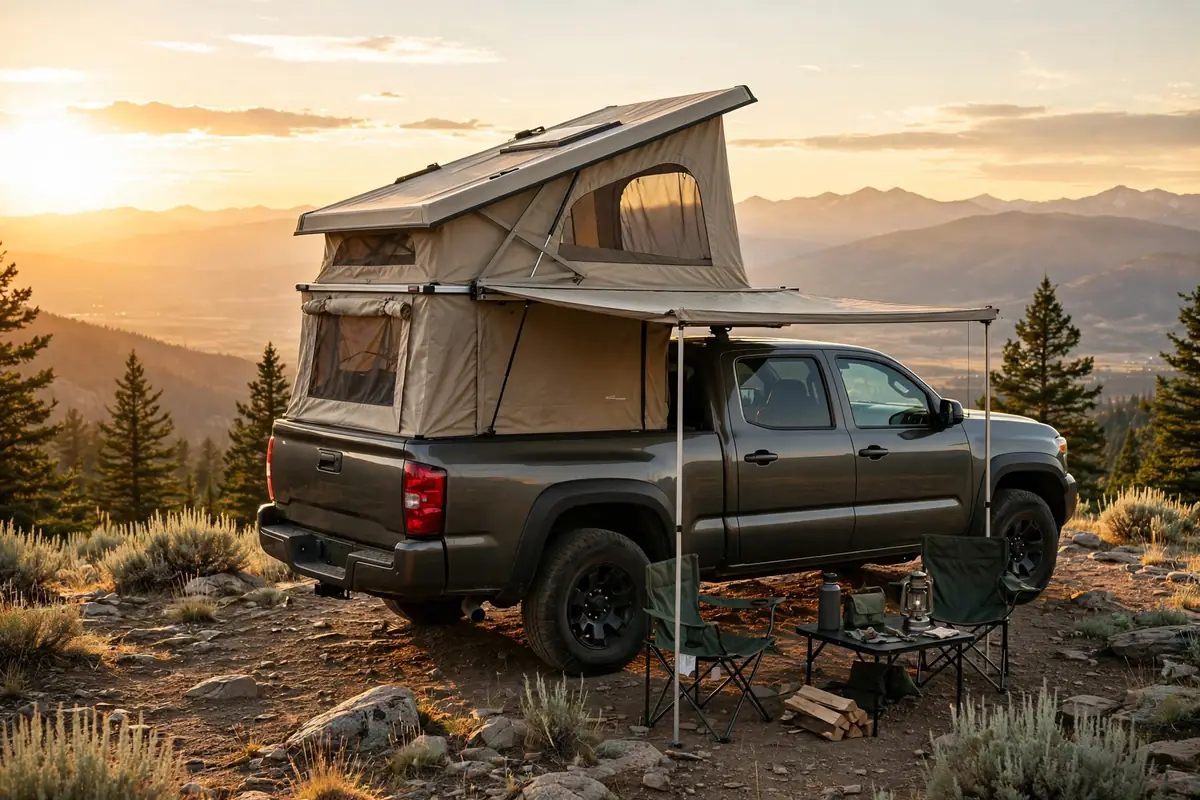
Now the fun part. With honest math in hand, which campers can a half-ton F-150 actually carry? The short answer: pop-ups and lightweight hard-walls, almost exclusively. Here’s the current landscape with verified dry weights, all from manufacturer spec pages or current buyers’ guides:
Pop-up slide-ins (the classic F-150 answer):
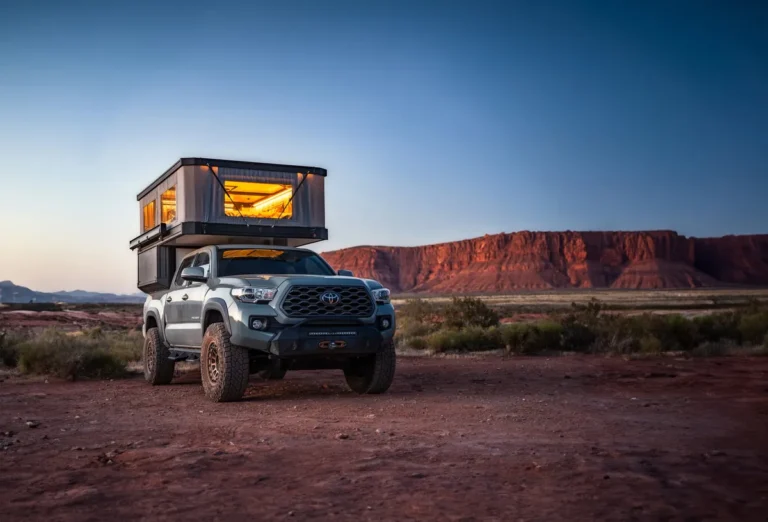
- Four Wheel Camper Hawk — about 1,200 pounds dry in base form, roughly 1,950 wet with water, propane, battery, and the standard 500-pound gear allowance. It fits 6.5-foot beds and keeps the center of gravity low with the roof down. One long-term F-150 owner with a fully loaded Hawk (shipping weight 1,400 pounds including jacks) weighed his whole rig on a CAT scale at 2,450 pounds fully loaded — water, bikes, a week’s supplies. His verdict after 36,000 miles: “the F150 is a suitable option to carry the camper, just be smart.”
- BundutecUSA Wild — 1,610 pounds dry. A pop-up with a genuine wet bath (shower plus cassette toilet) and a 17-gallon grey tank — a rare combination in a half-ton pop-up, and Truck Camper Adventure notes it’s “light enough to be hauled on most half-ton pickups, including the most popular vehicle in America, the Ford F150.”
Lightweight hard-walls:
- Scout Olympic — Scout’s hard-wall built for full-size trucks: around 1,072 pounds per their spec page (their video tour says 1,145 base — call it roughly 1,100 dry). Scout’s FAQ says the Olympic “typically does well on 1500 trucks and above,” and their fitment list includes the F-150 in 5.5, 6.5, and 8-foot beds. (Scout’s FAQ.)
- Kimbo 6 — 830 pounds base dry, about 1,000 with typical modules, roughly 1,200 fully loaded, starting at $27,990. Frameless aluminum shell, R5 insulation, and Kimbo’s FAQ lists the F-150 as compatible. Kimbo is refreshingly blunt with buyers: the door-jamb payload is your cargo budget, and suspension upgrades “do not raise GVWR or axle ratings, which are fixed by the manufacturer.” (Kimbo’s spec page.)
- Scout Yoho — 913 to 958 pounds dry. Built for midsize trucks, but works on an F-150 if your door sticker is on the low end and you want a hard wall with minimal payload impact.
- Scout Tuktut — just 577 pounds dry, the minimalist option.
Wedge toppers (the ultra-light route):
- Four Wheel Camper Project M — a pop-up topper on your bed rails rather than a slide-in: 390 pounds for 5.5-foot beds, 420 for 6.5-foot, 465 for 8-foot, starting at $12,900. Four Wheel lists the F-150 (2004–2026, all bed sizes) as compatible, and you keep your bed usable as a truck bed. (Official Project M specs.)
The pattern: dry weight is only the starting point. Water is 8.34 pounds per gallon (a 20-gallon tank adds 167 pounds), then propane, batteries, and gear — the industry planning allowance is 500 pounds of “stuff.” A 1,200-pound-dry camper is a 1,900-pound reality. Always do your math with wet, loaded weight. Our best lightweight truck camper roundup and pop-up vs. hard-side comparison go deeper if you’re still choosing a style.
Why a Full Hard-Side Cabover Is Generally Off the Table
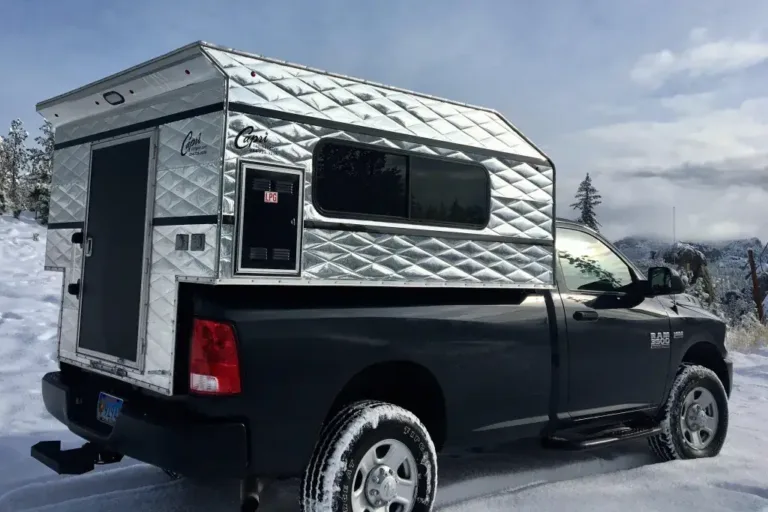
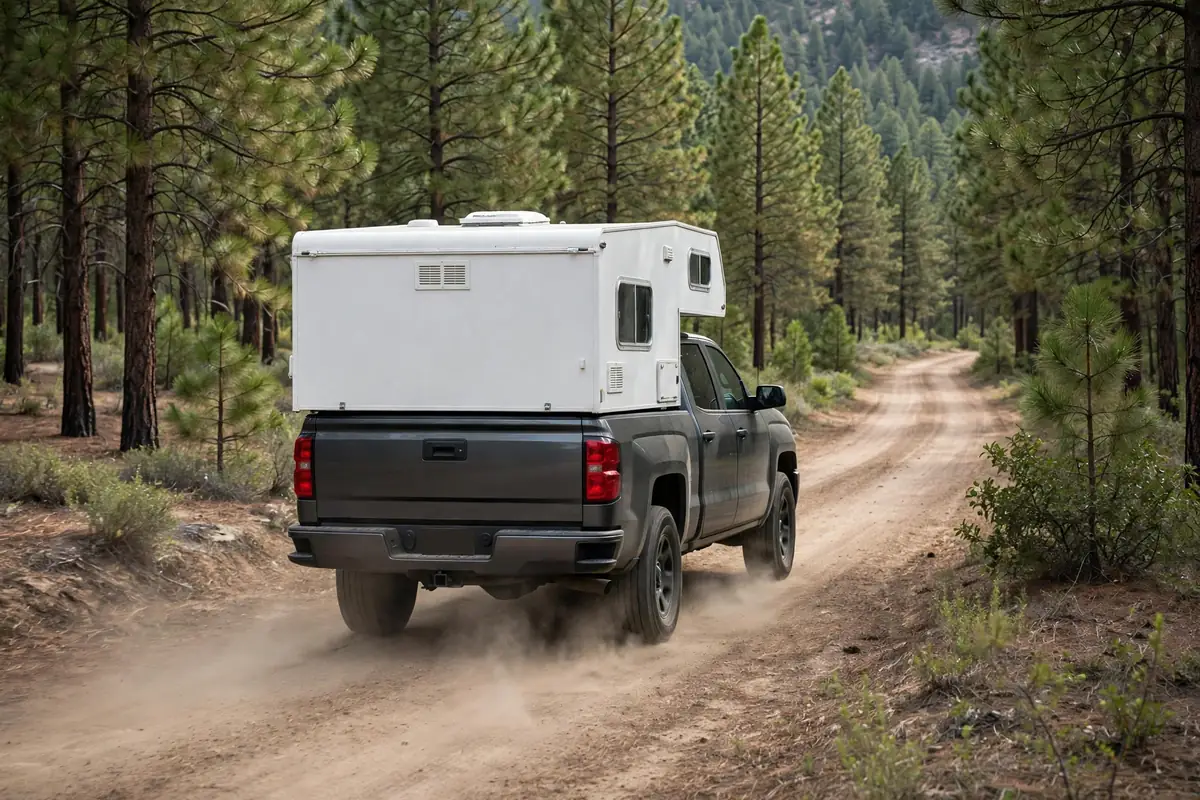
A traditional hard-side, full-height cabover — big overhang over the cab, full bathroom, tall walls — is generally not an F-150 camper. Even the hard-sides marketed toward half-tons start around 2,000 pounds dry for a short-bed model and climb from there; Bundutec’s custom hard-wall version of their Wild came in at 2,095 pounds dry. Loaded with water and gear, you’re routinely looking at 2,500 to 3,000-plus pounds sitting behind and above your rear axle.
On a truck with 1,400 to 1,900 pounds of real payload, that math doesn’t just fail — it fails dangerously. A tall, heavy camper raises the center of gravity dramatically, and a short 5.5-foot bed pushes it rearward, which owners say makes the truck feel unsettled in crosswinds and emergency maneuvers. One owner who ran a 2005 F-150 Lariat with E-rated tires, airbags, and a rear sway bar said his gut told him the rig would not perform well if an evasive maneuver was needed on the highway. He moved up to an F-250 and called it a non-issue afterward.
The honest line: a pop-up or lightweight hard-wall on an F-150 is a proven combination with thousands of happy owners. A big hard-side on the same truck is a combination you’ll spend every mile managing.
Making It Ride Right: Tires and Suspension
Once the math works on paper, two things matter most for how the truck actually behaves — and owners are nearly unanimous on both.
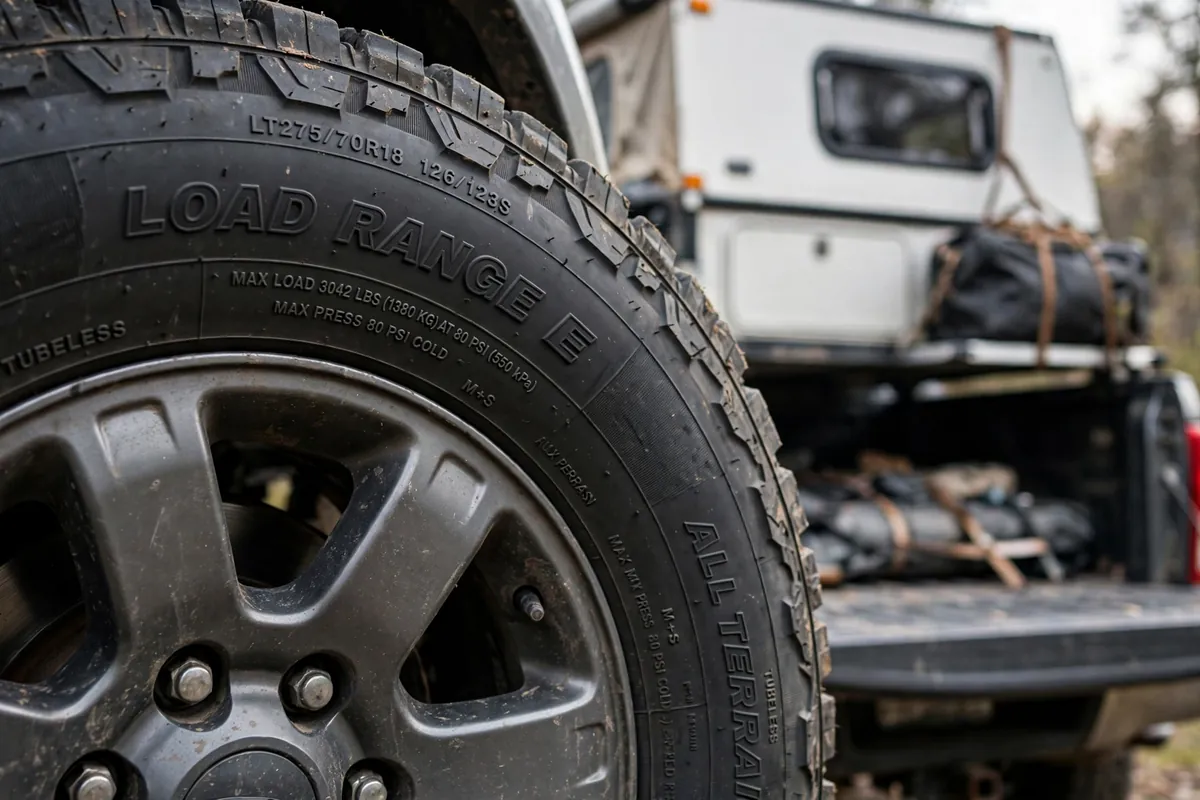
Tires first. A surprising number of F-150s ship with passenger-rated tires chosen for comfort and price. Multiple forum owners flag this as a real hazard: a passenger tire’s load rating may not cover your loaded rear axle. The fix is a Light Truck (LT) tire — E-rated is the common recommendation for camper duty. Check the max load rating molded on the sidewall against your loaded rear-axle weight, and run the pressures the load demands. The old HD Payload Package shipped with LT tires from the factory; if your truck didn’t come with them, budget for the swap.
Suspension support second. Airbags, Timbrens, and SumoSprings level a loaded truck and improve stability — we’ve compared all three in our airbags vs. Timbren vs. SumoSprings guide. Frequent on-and-off owners tend to prefer airbags for adjustability; always-loaded rigs often suit the set-and-forget options.
The critical point, straight from manufacturers and experienced owners alike: these upgrades do not increase your payload rating. Four Wheel Campers tells buyers that airbags or upgraded springs improve comfort and stability but don’t change the factory-rated payload — a higher-capacity tire doesn’t turn a 1,380-pound door label into 1,800 pounds. Kimbo’s FAQ adds that exceeding the rating has insurance and warranty implications. Suspension mods make a legal load ride better. They don’t make an illegal load legal.
The Honest Verdict
Can an F-150 carry a truck camper? Yes — if you pick the right camper and do honest math. The proven formula is a pop-up like the Four Wheel Hawk or Bundutec Wild, or a lightweight hard-wall like the Scout Olympic or Kimbo 6, matched against your actual door-sticker payload with CAT-scale weights, riding on LT tires. Thousands of owners run this setup for tens of thousands of miles — owners report 15–16 mpg with a pop-up aboard — and the F-150’s ride quality and daily-driver manners are genuine advantages over a heavy-duty truck.
But the margin is thin, and brochure numbers will lie to you if you let them. Read the door sticker. Weigh the truck. Budget for wet weight, not dry. And if the camper you really want is a big hard-side with a full bath and tall walls, the honest answer is a 3/4-ton. Nobody ever complained their truck was too capable.
FAQ
Can an F-150 carry a truck camper?
Yes, with the right camper. Pop-ups (Four Wheel Hawk, Bundutec Wild) and lightweight hard-walls (Scout Olympic, Kimbo 6) are proven F-150 combinations. Match the camper’s loaded weight against your truck’s actual door-sticker payload — not Ford’s maximum published figure. Full-size hard-side cabovers are generally too heavy for a half-ton.
What is the real payload capacity of an F-150?
It depends entirely on your truck’s configuration. The 2025 F-150’s maximum published payload is 2,440 pounds, but that’s a base regular-cab work truck. A typical crew-cab 4WD on a dealer lot shows 1,200 to 1,650 pounds on the door sticker. Options like 4WD, larger cabs, and bigger engines all reduce payload. Check the tire and loading sticker inside your driver’s door.
Is the F-150 Heavy-Duty Payload Package still available?
Not on new trucks. Ford offered it (option code 627) through the 2023 model year, raising GVWR to 7,850 pounds with upgraded springs, LT tires, and a heavier rear axle. Ford removed it for the 2024 refresh, and it had not returned as of the 2025 model year. If you’re shopping used, a 2021–2023 F-150 with this factory-ordered package is the best half-ton camper platform Ford built. For 2026, check the current order guide — specs change by year.
Should I add airbags or upgrade my suspension for a camper?
Airbags, Timbrens, or SumoSprings can level your truck and improve ride quality and stability under load. But they do not increase your factory payload or GVWR ratings — the door sticker is the law. Do the weight math first, make the load legal, then use suspension upgrades to make a legal load ride better.
Pop-up or hard-wall camper on an F-150?
Pop-ups (around 1,100–1,600 pounds dry) keep the center of gravity low and are the safest bet for most F-150s. Lightweight hard-walls like the Scout Olympic (~1,100 pounds) or Kimbo 6 (830 pounds base) also work if your payload math supports them. Hard-walls give you better insulation and no setup, but watch the weight — and skip full-size hard-side cabovers on a half-ton.
Do I really need to weigh my truck on a CAT scale?
Yes. It’s the single most valuable step in this whole process. Brochure curb weights don’t include your options, your passengers, or your gear. A CAT-scale weigh with the truck loaded for travel, subtracted from your GVWR, gives you your true camper budget in about ten minutes. Guessing is how people end up 500 pounds over without knowing it.