Four Wheel Camper Fleet vs Swift vs Hawk: Which Pop-Up Fits Your Truck?
I’ve lost count of the times I’ve been parked at a trailhead at dawn, coffee in hand, watching another truck pull in with a Four Wheel Camper popped up and wondering which model they picked and why. The Four Wheel Camper Fleet vs Swift vs Hawk question comes up more than any other: three models, three truck sizes, and just enough overlap to make the decision genuinely confusing.
The short version: your truck’s bed size decides most of this for you. The Swift is built for mid-size trucks with a 5-foot bed, the Fleet is built for mid-size trucks with a 6-foot bed, and the Hawk is built for full-size trucks with a short bed. But weight, sleeping layout, options, and price all matter once you’ve narrowed it to one or two models. I pulled every number below straight from Four Wheel Campers’ current model pages, so nothing here is borrowed from an old brochure.
Four Wheel Camper Fleet vs Swift vs Hawk: The Specs, Side by Side
This is the table I wish someone had handed me the first time I tried to sort these out. All figures below are the base-model numbers from fourwheelcampers.com as of October 2026.
| Spec | Swift | Fleet | Hawk |
|---|---|---|---|
| Fits | Mid-size trucks, 5′ bed | Mid-size trucks, 6’0″–6’7″ bed | Full-size trucks, 6.0’–6’7″ bed |
| Base dry weight | ~950 lbs | ~1,050 lbs | ~1,200 lbs |
| Roof length | 118″ | 128″ | 128″ |
| Floor length | Not published on current model page | 80″ | Not published on current model page |
| Body width | 75″ | 75″ | 80″ |
| Interior headroom (popped up) | 6’4″ | 6’4″ | 6’6″ |
| Cabover bed | 72″ x 76″ | 72″ x 76″ | Std. queen 64″ x 77″; optional king 80″ x 77″ |
| Lower bed (seat conversion) | 33″ x 62″ | 33″ x 72″ | 35″ x 72″ |
| Adult sleeping | 2–3 | 2–3 | 2–3 |
| Fresh water | 20 gallons | 20 gallons | 20 gallons |
| Propane | (2) 2.5-gallon tanks | (2) 2.5-gallon tanks | (2) 2.5-gallon tanks |
| Base models start | $20,275 | $20,800 | $20,800 |
| Full camper models start | $30,150 | $30,675 | $30,675 |
| Floorplan options | Roll-over couch or open (single floorplan) | Roll-over couch, side dinette, front dinette | Roll-over couch, side dinette, front dinette |
One honest note on that table: FWC’s current model pages publish roof length, body width, and bed dimensions for all three, but only the Fleet page lists a floor length (80″). For the Swift and Hawk, check the Build & Price tool or the downloadable spec sheet before you order.
The Swift: The 5-Foot-Bed Specialist
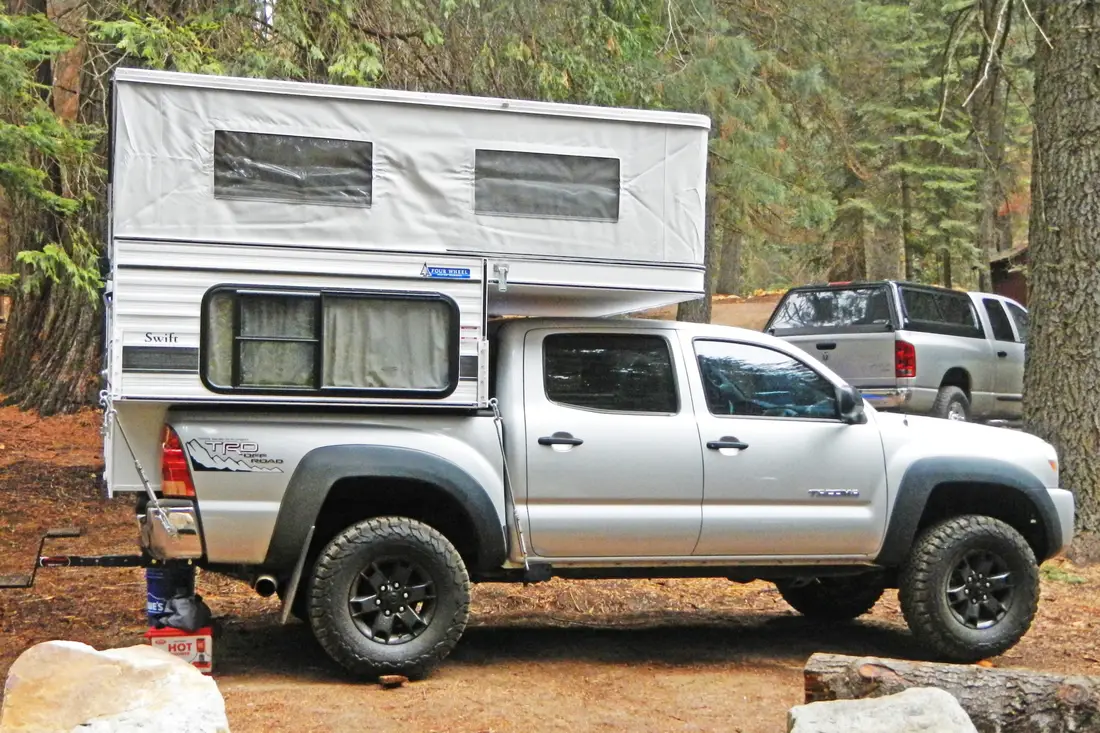
The Swift exists for one reason: mid-size trucks with short beds — Tacoma and Frontier crew cabs, Rangers with the 5-foot box. The Swift is the Four Wheel Camper built for those trucks, and it’s the lightest of the three at roughly 950 pounds dry. That weight is the whole point on a Tacoma’s famously tight payload.
Inside you get the 72″ x 76″ cabover bed and a 33″ x 62″ lower bed from the seating conversion, sleeping two to three adults, with 6’4″ of headroom popped up. Floorplan choices are the simplest of the three: roll-over couch or open interior. Owners in truck camper forums who run Swifts on Tacomas say the same thing — cozy for two, and the reason they chose it over the Fleet is payload math on the 5-foot bed.
Base models start at $20,275 with no fridge, sink, or shower option; full campers start at $30,150. One compatibility caveat from the current model page: FWC doesn’t offer the Swift for crew-cab short-bed Chevy Colorados or GMC Canyons — no tie-downs exist for those trucks, so check with a dealer if that’s your rig.
The Fleet: The Most Popular Mid-Size Camper FWC Builds
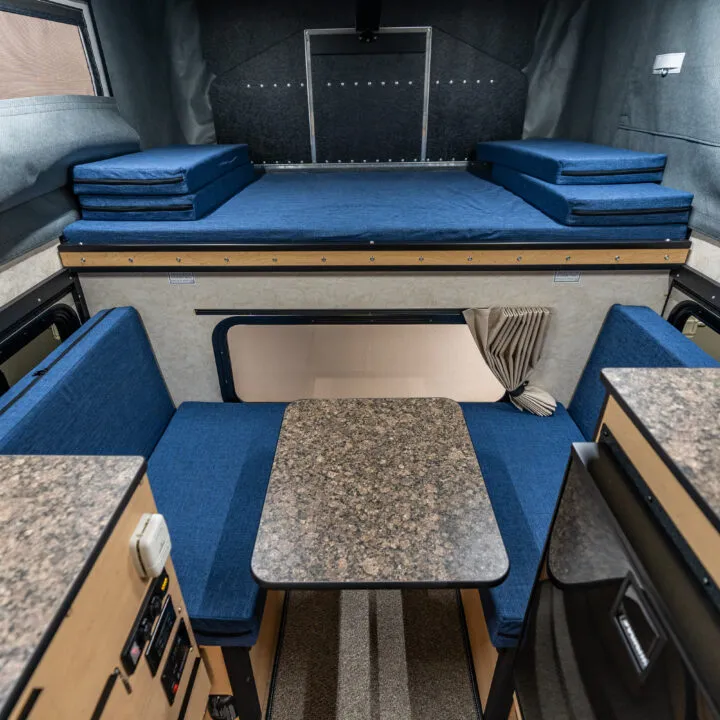
FWC calls the Fleet its number-one most popular mid-size camper, and it makes sense: the 6-foot bed is the most common mid-size configuration out there. At about 1,050 pounds dry, 80 inches of floor length, and a 128-inch roof — ten inches longer than the Swift’s — the extra length buys you real layout choice. Before you commit, spend ten minutes measuring your truck bed properly — bed rail height and tailgate width decide more than most people expect.
That’s the Fleet’s biggest practical advantage over the Swift: three floorplans. The roll-over couch comes standard, a side dinette adds $1,295 to the build, and a front dinette adds $2,600. A full-time couple I met at Big Bend had lived fourteen months in a front-dinette Fleet on a Tacoma and said the dinette was what made full-timing work — a real place to sit out a rain day beats any appliance. The front-dinette Fleet sleeps three adults outright on the spec sheet; the other layouts list two to three with the seat conversion.
Pricing runs $20,800 base to $30,675 full, with the same no-fridge-no-sink base caveats as the Swift. If you’re comparing the Fleet against other brands, our best pop-up truck camper roundup puts it in context.
The Hawk: The Full-Size Short-Bed Classic
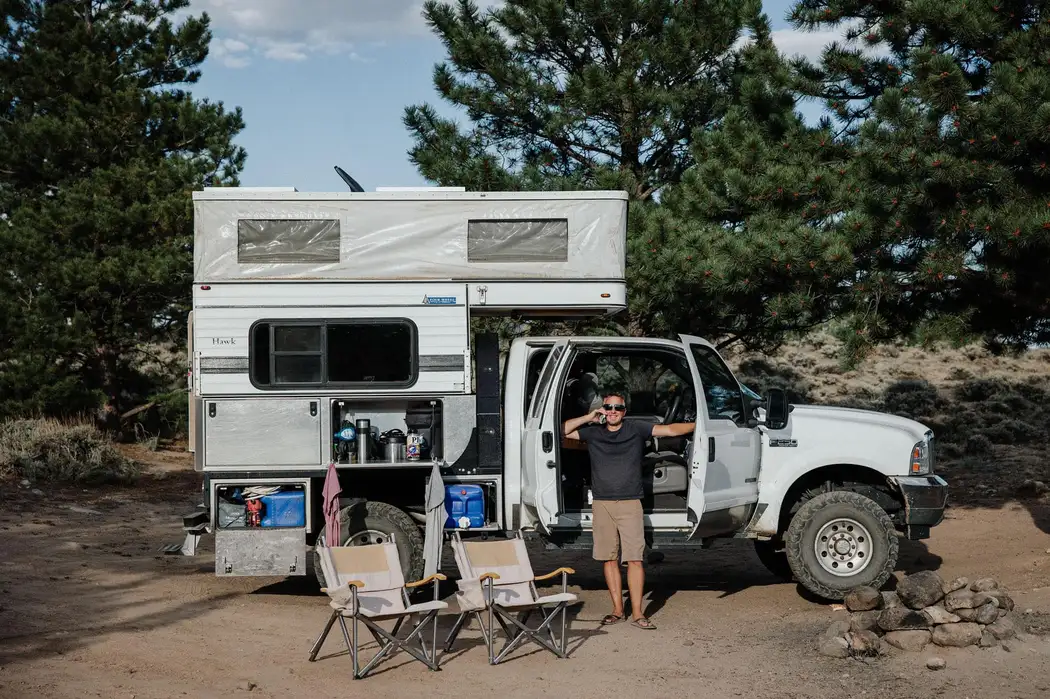
The Hawk is the model that built Four Wheel Campers’ reputation with the overland crowd. It’s sized for full-size trucks with 6.0′ to 6’7″ beds — F-150, Silverado and Sierra 1500, Ram 1500 short beds. At roughly 1,200 pounds dry and 80 inches of body width (five wider than the other two), that width shows up in the cabover — standard queen 64″ x 77″, with an 80″ x 77″ king option — the wider 35″ x 72″ lower bed, and 6’6″ of standing headroom with the roof up.
For tall campers, the king options — 80″ x 77″ standard, or 75″ x 77″ with the front dinette — matter more than almost any option on the price sheet. The Hawk’s floorplan menu mirrors the Fleet’s — roll-over couch standard, side dinette plus $1,295, front dinette plus $2,600 — and pricing is identical to the Fleet’s: $20,800 base, $30,675 full.
In practice, the Hawk is the family-and-dog choice of the three — the model most often paired with half-tons doing real off-road travel. A long-term owner review of a Hawk running a Dometic furnace, 65-liter DC fridge, 2,000-watt inverter, and Fiamma awning describes the design as intentionally simple: no grey or black tanks, no built-in water heater, no indoor bathroom. Grey water drains through an exterior port into a container, and the space saved becomes extra cabinetry.
Sleeping Layouts and Floorplans Compared
All three models sleep two to three adults, but “sleeps three” means different things in each:
- Swift: The cabover (72″ x 76″) sleeps two comfortably. The 33″ x 62″ lower bed is genuinely a third-adult bed, though at 62 inches long it’s better for a kid or a shorter adult.
- Fleet: Same 72″ x 76″ cabover, but the lower bed stretches to 33″ x 72″ — a real adult-length bed. The front-dinette layout is officially rated for three adults, and it’s the floorplan I’d pick for a family with a kid who needs a defined sleeping spot every night.
- Hawk: The widest cabover of the three, with the king-bed options. The 35″ x 72″ lower bed is the roomiest conversion here. For two tall adults, the Hawk with the king option is the clear winner.
My rule of thumb after watching these in the wild: if you regularly camp with three adults, get the Fleet with the front dinette or the Hawk. If it’s two people and occasionally a third, any of the three works. For anything beyond that, you’re looking at the Grandby or a flatbed model, not these three.
Standard Features and Popular Options
Across all three slide-in models, the standard equipment list is nearly identical on the current spec sheets: queen-size extended cabover bed with mattress, roll-over couch seating with a portable table, Formica countertops, a 65-liter two-way refrigerator/freezer, 20-gallon fresh water tank, flush-mount kitchen sink with electric water pump, flush-mount two-burner propane stove, two 10-pound propane tanks, powered roof vent fan, LED interior lights and porch light, sliding side windows with safety exit, privacy curtains, a lithium battery, a modern 12-volt system with truck charging, 120-volt shore power with a 30-amp converter, solar pre-wiring, the welded-aluminum Flex-Frame, insulated side walls and roof, gas-strut roof lift assists, and the rugged pop-up liner with four windows.
The options list is where builds diverge and where budgets go to die:
- Furnace: The single most popular cold-weather option across all three models. Owners in truck camper forums treat it as mandatory for shoulder-season camping — winter camping in a pop-up without one is a short experiment.
- Solar: The campers come prewired, and Four Wheel Campers’ build tool lists a 160-watt roof-mounted solar panel at $1,250 on the Swift. Size your battery to match — our truck camper solar and lithium sizing guide walks through the math.
- Roof racks: Popular on all three for kayaks, recovery boards, and cargo boxes.
- Awning: The Fiamma F45S shows up constantly in owner builds, especially on Hawks.
- Thermal pack: The insulated liner upgrade. If you camp below freezing, forum owners rate it alongside the furnace. It also helps with condensation — see our guide to stopping condensation in a truck camper.
- Fridge upgrades, exterior hot shower, and the interior shower/toilet option (Fleet only among these three) round out the common adds.
Then there’s the base-versus-full decision. The base models — $20,275 to $20,800 — are shells with seating and a bed: no fridge, no sink, no shower option. They’re popular with the DIY crowd and with owners who’d rather spec their own electrical and water setup. Full campers start around $30,150–$30,675 and include the appliance package.
The Payload Conversation Nobody Skips
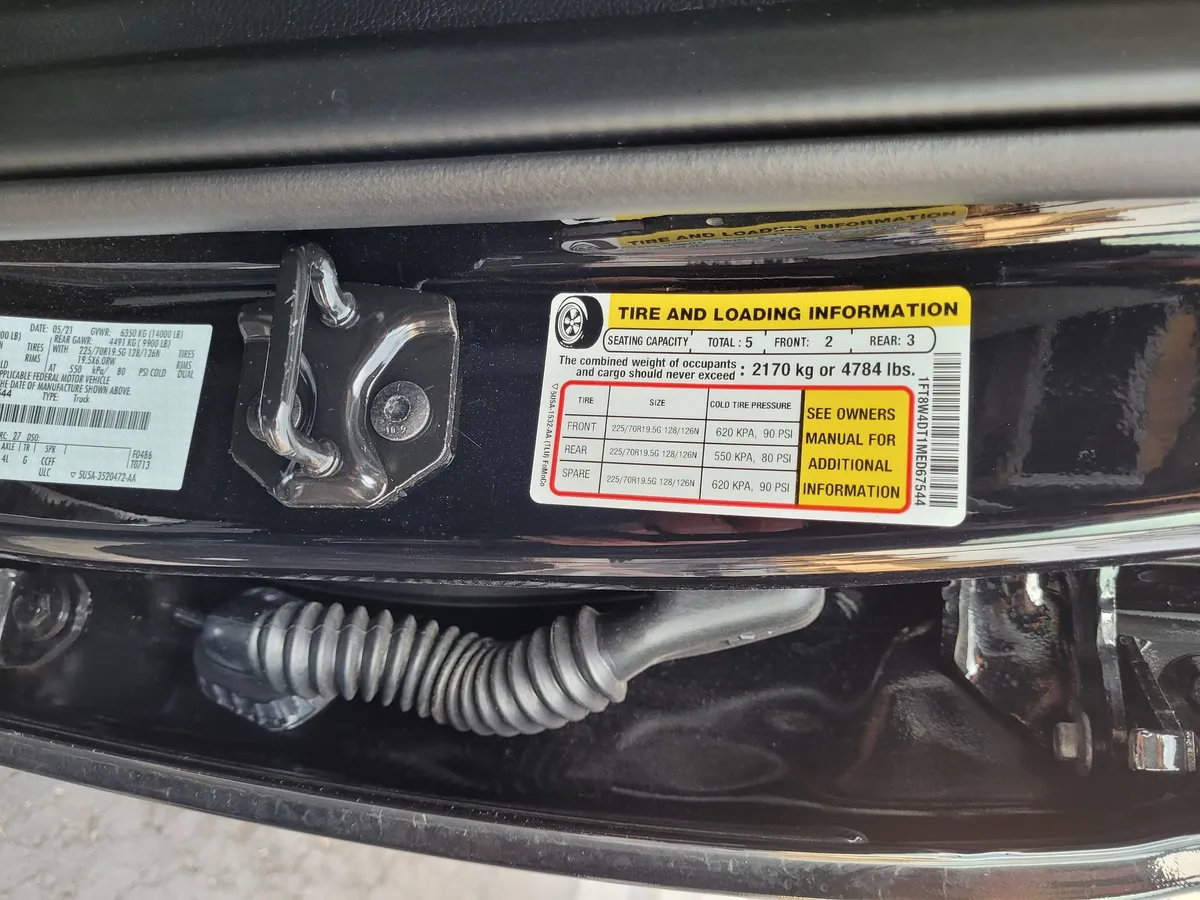
Here’s the part of the Four Wheel Camper Fleet vs Swift vs Hawk decision that actually ends trips: payload. The brochure dry weights — 950, 1,050, and 1,200 pounds — are the base models before options, water, propane, gear, passengers, and the dog. Twenty gallons of water is about 167 pounds. Two adults, recovery gear, a fridge full of food, and a furnace-equipped build can add 600 to 800 pounds on top of dry weight without trying.
This is why the Swift exists — and why forum owners repeat the same advice: weigh your loaded truck at a CAT scale, read your door-jamb payload sticker, and do the math honestly. If you’re still shopping the broader market, the best lightweight truck campers roundup covers the sub-1,000-pound segment.
Who Should Buy Which Model
Buy the Swift if: you have a mid-size truck with a 5-foot bed, payload is tight, and it’s usually one or two people camping. It’s the lightest, simplest, cheapest way into a Four Wheel Camper.
Buy the Fleet if: you drive a mid-size truck with a 6-foot bed and want floorplan choice. The side and front dinettes genuinely change how the camper lives — especially on longer trips or with a kid. It’s the best-selling mid-size model for a reason.
Buy the Hawk if: you drive a full-size truck with a short bed (F-150, Silverado/Sierra 1500, Ram 1500) and want the widest bed, the tallest interior, and the most layout flexibility. It’s the classic for a reason, and the king-bed option settles the “I’m 6’3″ and can’t sleep in campers” problem.
Reconsider all three if: your truck is a long bed (look at the Grandby), you want a bathroom with tanks (look at hard-side campers in our best truck camper to buy guide), or your payload sticker says no — in which case the Project M topper or another ultralight is the honest answer.
What Owners in Truck Camper Communities Say
The Four Wheel Camper owner base is one of the most vocal in the truck camper corners of YouTube, Facebook, and Instagram, and a few themes come up constantly with these three models:
Owners in truck camper forums who full-time in Fleets report that the front dinette is the difference between “camping” and “living” — a dedicated sitting and working space matters more than extra storage after month two. Hawk owners on half-tons consistently praise the simplicity: no tanks to winterize, no water heater to fail, everything fixable with basic tools. Swift owners are the most payload-obsessed of the bunch, and the common refrain is that the camper disappears behind the truck on the highway in a way heavier rigs don’t.
Complaints are consistent too: condensation in cold weather (it’s a fabric liner — the thermal pack and ventilation discipline matter), and the lack of a real bathroom divides people. And nearly everyone says the same thing about pricing: the base price is a starting point, and a well-optioned build lands well above it. Run the Build & Price tool with your must-have options before you budget.
If None of These Three Fit Your Truck
The Swift, Fleet, and Hawk cover mid-size 5-foot beds, mid-size 6-foot beds, and full-size short beds. If your truck falls outside that — or you want something these don’t offer — the pop-up segment has solid alternatives. Hallmark’s composite campers (like the Guanella), Scout Campers’ Kenai, BundutecUSA’s Sable and Wild, and Palomino’s Backpack Edition pop-ups all compete in the same lightweight off-road space with different construction and feature philosophies. They’re worth a look in our best pop-up truck camper comparison before you commit.
Frequently Asked Questions

Which Four Wheel Camper fits a Toyota Tacoma?
A Tacoma crew cab with the 5-foot bed takes the Swift (about 950 lbs dry). A Tacoma with the 6-foot bed takes the Fleet (about 1,050 lbs dry). Four Wheel Campers even publishes a dedicated Tacoma guide covering both pairings.
Which model fits a full-size short bed like a Ford F-150 or Silverado 1500?
The Hawk. It’s built for full-size trucks with 6.0′ to 6’7″ beds, runs about 1,200 pounds dry, and is five inches wider than the Swift or Fleet with 6’6″ of standing headroom.
What are the dry weights of the Fleet, Swift, and Hawk?
Per Four Wheel Campers’ current model pages: the Swift is approximately 950 lbs, the Fleet is approximately 1,050 lbs, and the Hawk is approximately 1,200 lbs. These are base-model dry weights — options, water, propane, and gear add several hundred pounds in the real world.
Do these campers come with a furnace?
A furnace is an option, not standard equipment, on all three models — but it’s one of the most commonly ordered options. Owners in truck camper communities consistently recommend it for any shoulder-season or winter camping.
What’s the difference between a base model and a full camper?
Base models (starting at $20,275–$20,800) are essentially shells with seating and a bed — no fridge, no sink, no shower option. Full campers (starting at $30,150–$30,675) include the appliance package: fridge, sink, stove, water system, and power system. Most buyers build something in between using the Build & Price tool.
Can three adults sleep in a Swift, Fleet, or Hawk?
All three are rated for two to three adults. The Fleet’s front-dinette floorplan is officially rated for three, and the Hawk’s wider lower bed (35″ x 72″) and optional king cabover make it the most comfortable of the three for three adults. The Swift’s 33″ x 62″ lower bed is the tightest — fine for a kid, snug for an adult.