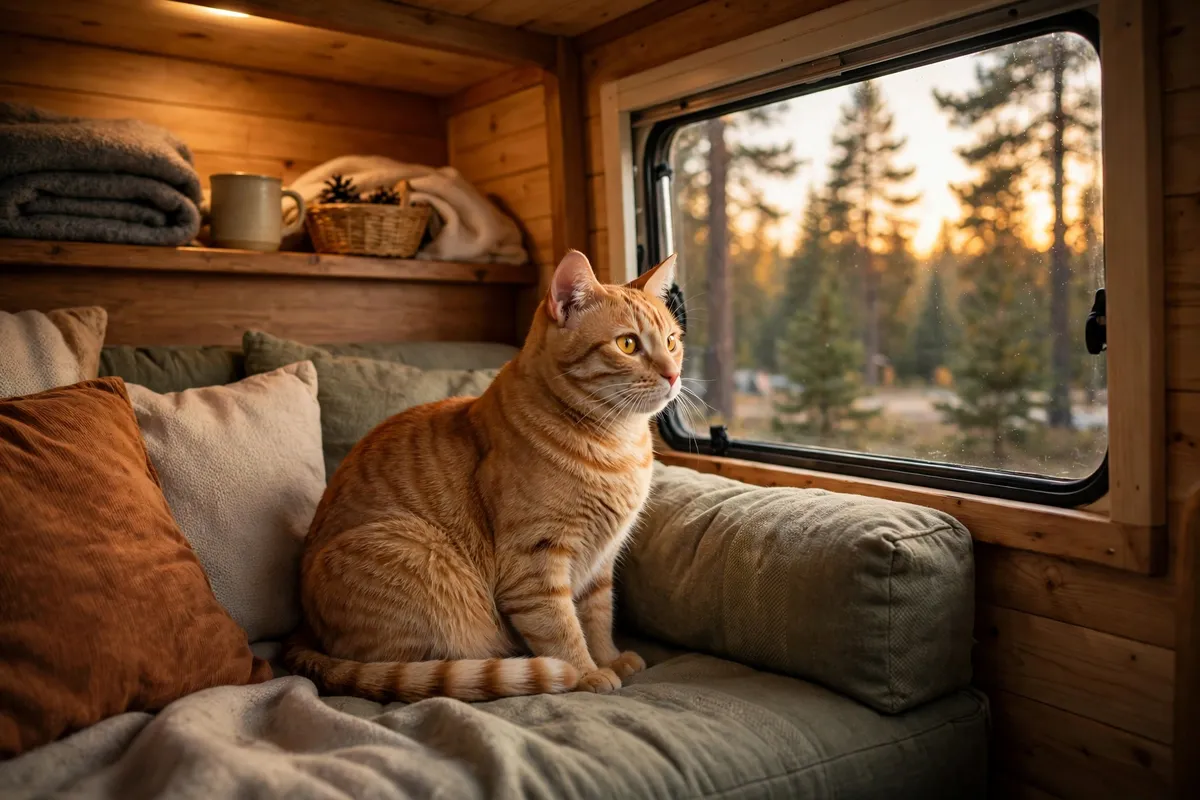
Truck Camping With Cats – How to Travel Safely and Happily With a Cat in a Truck Camper
I did not expect my cat to be the easy traveler in our family. Dogs get the reputation for loving road trips, while cats get the reputation for hating change. But truck camping with cats can work beautifully if you stop trying to make your cat act like a dog and build the trip around what a cat actually needs: territory, routine, a safe hiding place, and a litter box that does not turn a tiny camper into a smelly box.
That last part is the real test. A truck camper is not a big motorhome. Every square foot matters, every door opening is an escape route, and a sunny afternoon can heat the inside fast. Get the litter box, the door routine, and the heat plan right, and the rest is mostly patience. A cat does not need a walk before bed. It needs to feel safe in a small, familiar space, and it needs you to notice stress early.
First, is your cat a good candidate?
Not every cat will enjoy this, and that is not a failure. Older cats, very anxious cats, cats with serious medical problems, and cats that panic in a carrier may be happier at home with a trusted sitter. The American Veterinary Medical Association advises owners to consider whether travel is right for the individual pet, and to choose a sitter or boarding if travel is likely to be uncomfortable because of illness, injury, or temperament.
A good candidate recovers fairly quickly from new experiences, keeps eating and using the litter box after a change, and can be handled without extreme panic. Do a trial weekend close to home first: park the camper in your driveway, sleep in it with your cat, and watch what actually happens. If you are new to truck camping, our beginner guide to truck camping how to start covers setup and first-night mistakes that are much easier to fix without a stressed animal watching you.
The drive rule: your cat rides in the cab, never in the camper
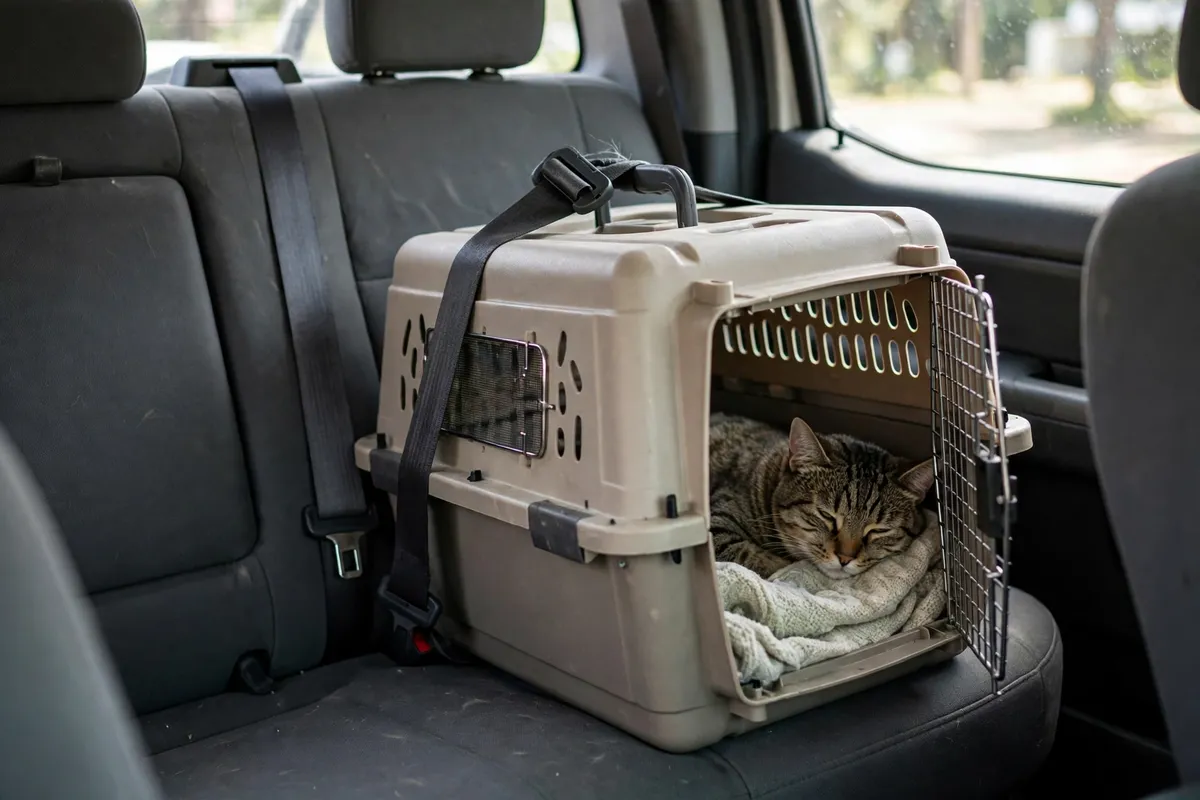
This is the rule I will not bend. A truck camper bouncing down the highway is not a safe, temperature-controlled room. You cannot see what is happening back there, you cannot reach your cat in a sudden stop, and loose items can shift and fall. The AVMA says it is unsafe for pets to be loose inside motor vehicles, and that the preferred transport is a species-appropriate enclosure or a properly designed safety harness. Vetstreet makes the same point for RV travel: never let a pet ride alone in a fifth wheel or camper you are hauling.
So the routine is simple. The cat goes in a sturdy carrier, the carrier goes in the cab, and the carrier is secured so it cannot slide or tip. I put ours on the back seat, belted in, with a familiar blanket inside and a light towel draped over part of it. I never put a cat in the truck bed, even in a carrier, and I never let a cat ride loose around my feet while driving.
Owners on RV forums report the same lesson: cats allowed to roam wedge under seats, climb toward the driver, and bolt when a door opens at a rest stop. A secured carrier is boring, and boring is exactly what you want at highway speed. Load the cat last, unload the cat first, and count the cat out loud before you open any exterior door.
Train the carrier and the camper at home
The biggest mistake I see is bringing out the carrier ten minutes before leaving. To a cat, that carrier means vet, car ride, and stress. Leave it out at home for weeks, door open, with a soft bed inside and treats dropped in at random times.
Then do the same with the camper. Put the litter box, food, water, and a familiar blanket inside, and let your cat explore in short sessions. Feed a meal in there. Owners on Fiberglass RV forums describe exactly this approach: feeding the cat only in the trailer for weeks, starting with short stays and building up, so the new space starts to smell like food and safety. Build up in steps: camper parked with the engine off, then a short drive around the block, then a driveway overnight. If your cat howls, drools, or vomits on short drives, stop and regroup rather than pushing through to a long haul.
The litter box problem, solved for a tiny space
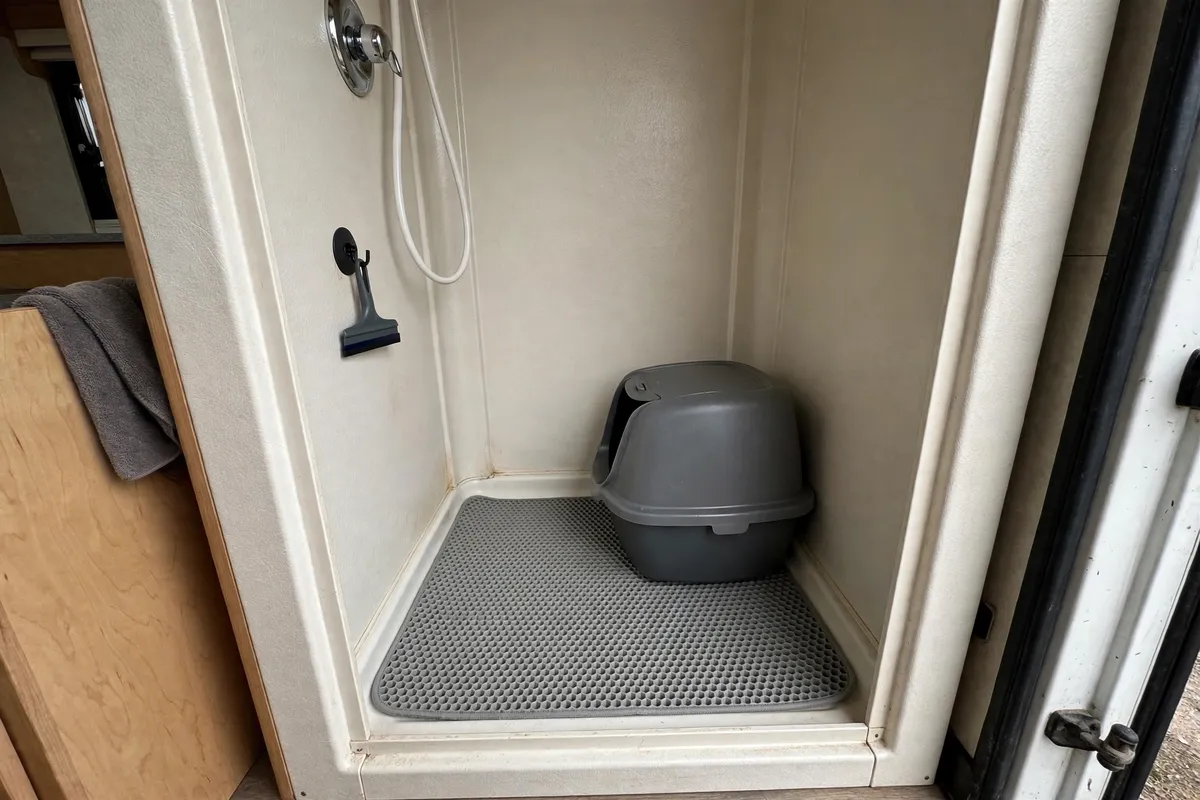
Here is the truth nobody tells you before your first cat trip: the litter box is not just a hygiene problem, it is a floor-plan problem. In a truck camper you do not have a spare bathroom or a mudroom. You have a wet bath if you are lucky, a dinette bench, and not much else.
Pick one permanent spot and protect it, rather than moving the box around every day: the shower stall, moved out only when you shower; under a dinette bench, with a cat-sized opening cut into the bench end; or a low, covered box in a corner on a litter-trapping mat, where you can scoop without moving furniture.
Owners on iRV2 and Fiberglass RV forums keep coming back to the same practical fixes: a lidded plastic tub with an entrance cut into one end, which stops an enthusiastic digger from kicking litter across the floor, and a top-entry box, which helps with tracking. Several owners warn against burying a box under the bed where you cannot scoop it easily, because out of sight quickly becomes out of mind, and then the whole camper smells. Scoop at least twice a day. In a small camper, odor builds fast, and a dirty box is the fastest way to get a cat to choose your bedding instead. Bag waste sealed and dispose of it properly. Bring the same litter your cat uses at home, plus extra: a new litter type plus a new place is two changes at once.
Use a shallow, heavy water bowl that cannot tip on a rough road, and check our truck camper fresh water system guide before the trip so you know how to flush, fill, and sanitize the tank properly.
Escape-proofing: cats do not need a big gap
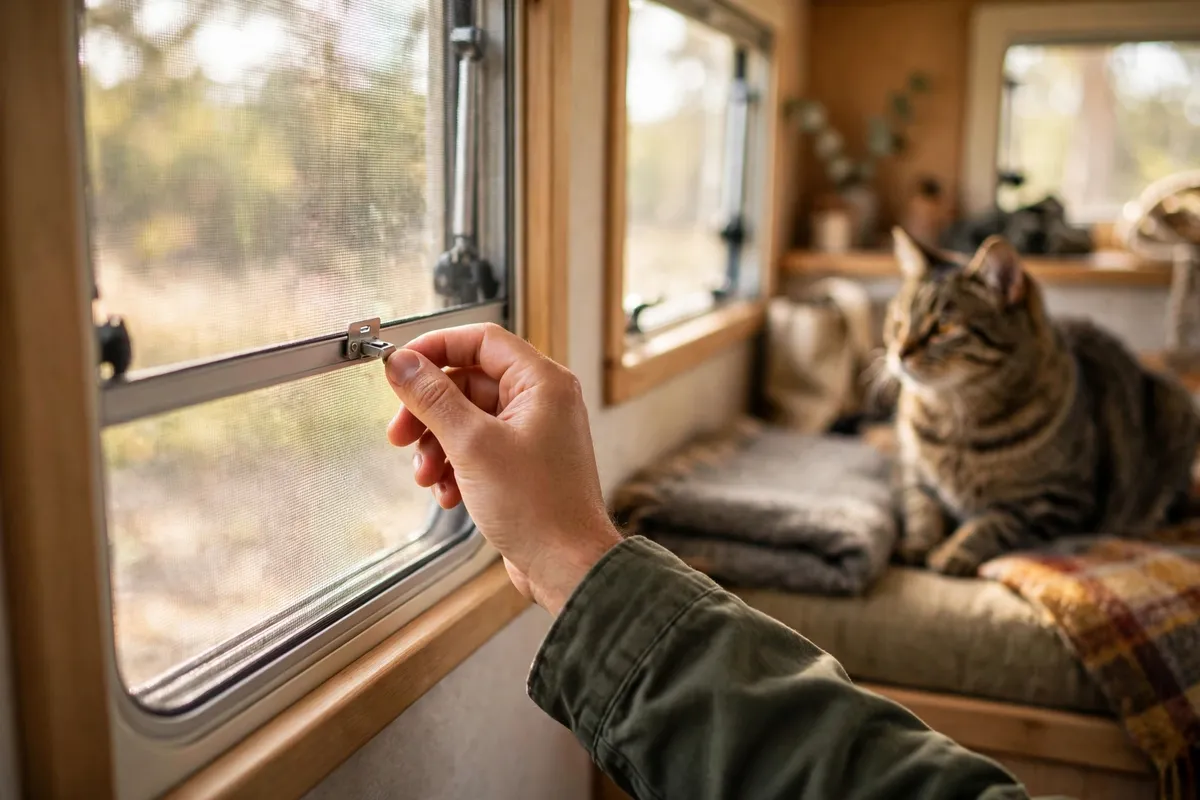
A dog needs a door left open. A cat needs a moment. A truck camper door, a roof vent, a window screen, and an access hatch are all potential exits, and a frightened cat will find the one you forgot.
My door routine is now automatic. Before any exterior door opens, the cat is either in the carrier with the door latched, in a closed bathroom, or wearing a harness with the leash in my hand. Owners on RV forums repeat this warning: the bolt happens at rest stops and campgrounds, not on the highway, and it happens when you are distracted.
Check screens before you rely on them. A standard camper window screen will not stop a determined cat: if it flexes or pops out of its track, do not leave that window open unsupervised. Check roof vents and any compartment that connects to the outside. Before you move a slide, a bed, or a dinette, find the cat first. Vetstreet warns owners to know where the cat is before extending or retracting a slide-out, because cats love to hide in exactly the moving parts you are about to operate. For backup, use a breakaway collar with a tag showing your cell number, plus a microchip with up-to-date registration. If your cat does get out, search close and quiet first: under the camper, under nearby vehicles, and in bushes.
Heat: the rule that overrides everything else
Never leave a cat in a hot camper unattended. A parked camper in sun heats up like a greenhouse, even with a window cracked. Air conditioning helps only while it has power, and power can fail, a breaker can trip, or a campground pedestal can go out while you are on a hike.
Vetstreet advises temperature monitors with battery backup, because they can alert you if the interior gets too hot or too cold, although they cannot be relied on where cell reception is spotty. I treat a monitor as a backup, not permission. If I cannot get back quickly, or if the weather is hot, the cat comes with me or the plan changes. Park in shade, use window covers and roof vent fans, and test the air conditioner before any short, planned absence. Our truck camper air conditioning guide covers sizing and power draw. If a temperature alert goes off, go back immediately. Heavy panting, drooling, lethargy, or vomiting are signs to cool the cat and seek veterinary help promptly.
Disclaimer: I am not a veterinarian, and this article is not a substitute for veterinary guidance. If your cat has breathing, heart, or kidney disease, is very old or very young, or is a flat-faced breed, talk to your vet before any summer trip. Cold matters too: give your cat a warm bed off the floor.
Harness training: start early, expect flops, never trust it completely
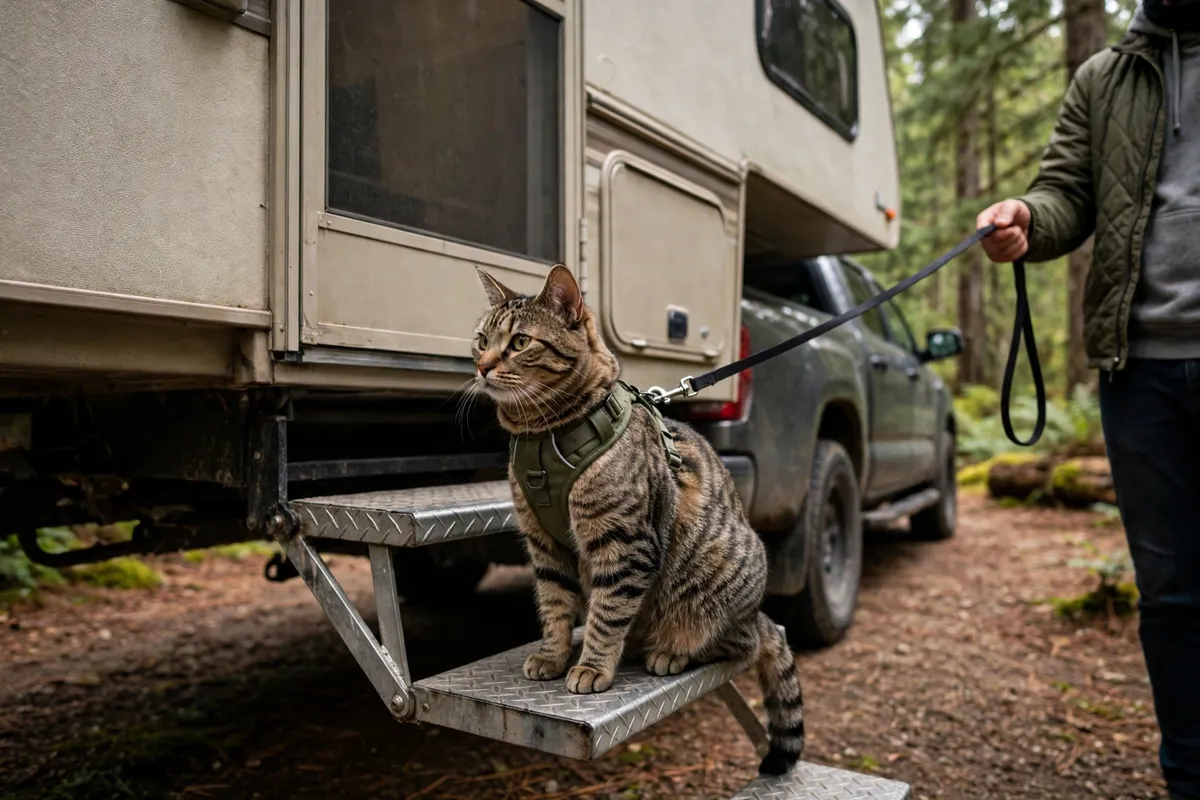
Harness training is useful, but it is not magic, and it is not escape-proof. Owners on forums are blunt about this: one owner used two harnesses at once after a cat learned to back out of a single harness, and another described a cat that simply flopped on its side the moment a walking jacket went on.
Start at home, weeks before the trip. Let the cat sniff the harness, reward with treats, drape it over the back for a few seconds, then clip it on for a minute indoors. Build up to walking around the house, then a quiet patio, then a calm campground. Keep sessions short and end on a good note. A harness that fits snugly around the body, not just the neck, is much harder to back out of than a collar. Check the fit every time.
At camp, keep outdoor time supervised, short, and close. I do not tie a cat out alone, and I do not take a harness-trained cat on a busy dog trail and expect dog behavior. Most cats, owners report, enjoy about half an hour outside and then want to go back inside. That is a successful outing. A pet stroller or soft backpack carrier is a good middle option: the cat gets fresh air, you keep control, and there is no leash tangle. Keep it zipped and shaded, and never leave it unattended.
Motion sickness, hiding, and the 3 a.m. zoomies
Motion sickness in cats is often stress plus motion, not just motion alone. VCA Animal Hospitals notes that many cats that travel only once or twice a year associate car rides with stressful vet visits, and that signs can include vocalizing, drooling, lip licking, lethargy, vomiting, and defecation. If those signs repeat on every drive, talk to your vet. Never give a cat human motion-sickness medicine without veterinary advice.
What helps most owners is gradual exposure and a calm, cool, quiet cab: short practice drives, a familiar-smelling blanket, and a covered carrier. Some vets advise withholding food for a few hours before travel for cats prone to nausea, but do not apply a fasting rule to kittens, diabetic cats, or cats on medication without asking your vet first.
Hiding is normal, so plan for it. Owners on iRV2 describe cats that vanish into the same spot every time the engine starts: beside the bed, under a seat, or in an open carrier. That spot is not a problem unless it is unsafe. Give your cat a legal hiding place that is better than the dangerous one: an open carrier with a blanket, or a covered bed under the dinette, introduced before the trip and kept in the same place.
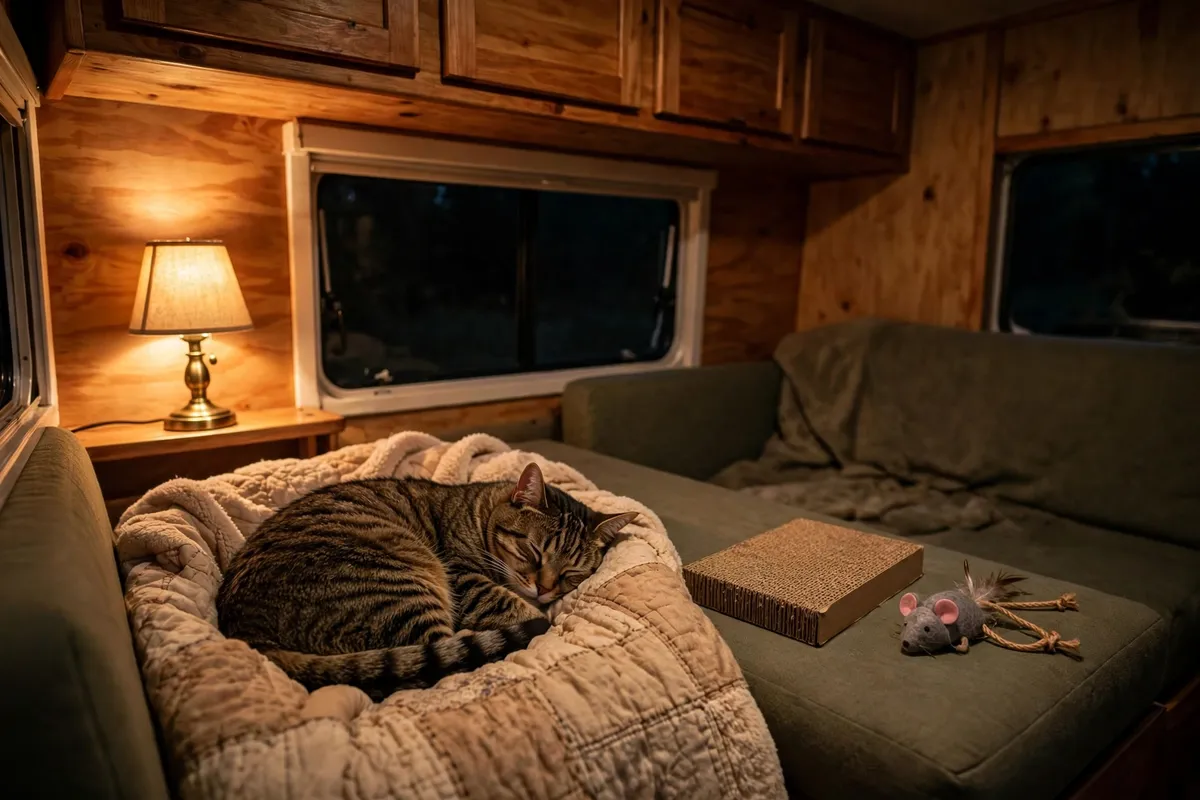
Night zoomies are the other classic complaint. A cat that slept all day in the cab may wake up ready to play at midnight in a space the size of a closet. Play hard before bed with a wand toy, and keep food bags and loose cords put away. Bring a small scratching pad. A quick check of seals, latches, and screens before each trip, as part of a regular truck camper maintenance schedule, will catch the loose screen or worn door latch before your cat does.
Food, routine, packing, and campground manners

Cats thrive on routine, so protect a few anchors: same feeding times, food brand, and litter type as at home, bowls in the same spot every day, and roughly the same bedtime.
Pack one cat bag: food for the trip plus two extra days, bowls, litter and scoop, medication, vet records, a recent photo, harness and leash, a carrier blanket, familiar toys, and cleaning supplies for accidents. Accidents will happen, especially early on. Clean them without fuss, and check whether stress, a dirty box, or a medical issue is the cause.
At campgrounds, follow the pet rules even if your cat never leaves the camper. Some sites charge pet fees, some limit pets to certain loops, and some require pets to be leashed or contained outdoors. Declare your cat honestly. Do not let your cat roam free at camp, even if it roams free at home: a new territory has unfamiliar dogs, traffic, and other cats. Level ground helps too: a sloping camper can spill water and slide a litter box across the floor, so see our guide to truck camper leveling on uneven ground for a stable setup.
Compared with dogs, cats can actually be easier in some ways, because they do not need walks or outdoor bathroom breaks. That is why our guide to truck camping with dogs covers walks and outdoor exercise that do not transfer neatly to a cat that would rather watch the world from a window.
When to leave your cat at home, and a realistic first trip
There are trips where bringing your cat is not the kindest choice: extreme heat with no reliable power, a long driving itinerary with no time to settle, a campground with heavy dog traffic and no shade, or a cat recovering from surgery. A good sitter and a calm cat at home are better than a stressed cat in a beautiful location. Try again on a shorter, cooler, calmer trip.
If I were starting again, I would do it like this. Two weeks before: carrier out at home, harness sessions indoors, vet check, and camper visits with food and litter inside. One week before: short drives, then a driveway overnight. Trip day: cat in the carrier in the cab, litter box already set in its permanent spot. First night: play before bed, scoop before bed, door routine rehearsed, and a legal hiding place ready. Expect the first day to be imperfect, and expect your cat to surprise you on day two or three.
Frequently asked questions about truck camping with cats
Can a cat ride in the truck camper while driving?
No. Your cat should ride in the cab with you, in a secured carrier or a properly fitted safety harness. Never let a cat ride loose in a towed camper or in the truck bed.
Where should I put the litter box in a truck camper?
Pick one permanent, private, easy-to-scoop spot: the shower stall, under a dinette bench with a cat opening, or a covered box in a corner on a litter-trapping mat. Scoop twice a day and use the same litter as at home.
Can I leave my cat alone in the camper while I hike?
Only for a short time, in mild weather, with reliable power and ventilation, and only if you can return quickly. Never leave a cat in a hot camper unattended.
How do I stop my cat escaping at camp?
Use a door routine every time: cat in the carrier, in a closed room, or on a harness in your hand before any exterior door opens. Check screens and hatches, find the cat before moving slides, and use a collar tag plus a microchip as backup.
Will my cat ever get used to harness walks?
Some will, some will only tolerate short, calm outings, and some prefer to stay inside and watch from a window. Start indoors, keep sessions short, and never tie a cat out alone. A harness is a safety tool, not a guarantee.
What if my cat gets carsick?
Talk to your vet, especially if vomiting, drooling, or distress repeats on every drive. Gradual practice drives, a cool quiet cab, and a sensible feeding plan help many cats. Do not give human medication without veterinary advice.