Truck Camper Furnace Not Working? Fix It Tonight
A truck camper furnace not working on a cold night is the worst kind of problem — small camper, dropping temperature, nowhere else to go. I have stood in mine at 2 a.m., in socks, holding a flashlight in my teeth, listening to a fan blow cold air. Most of the time it is not a dead furnace. It is one small part, one dirty switch, one weak battery, or one nest in the wrong tube — and the furnace tells you exactly which one if you know how to listen. Work through the symptoms in order, free checks first.
Safety first: if you smell propane — that rotten-egg smell — stop. Shut off the gas at the tank, open the doors and vents, get out, and do not flip any electrical switch. If your carbon monoxide alarm goes off, get out and ventilate. Never run a faulty furnace unattended, never bypass a sail switch or limit switch, and do not do gas-line work beyond the furnace’s own connections unless you are qualified.
How a Truck Camper Furnace Works in 60 Seconds
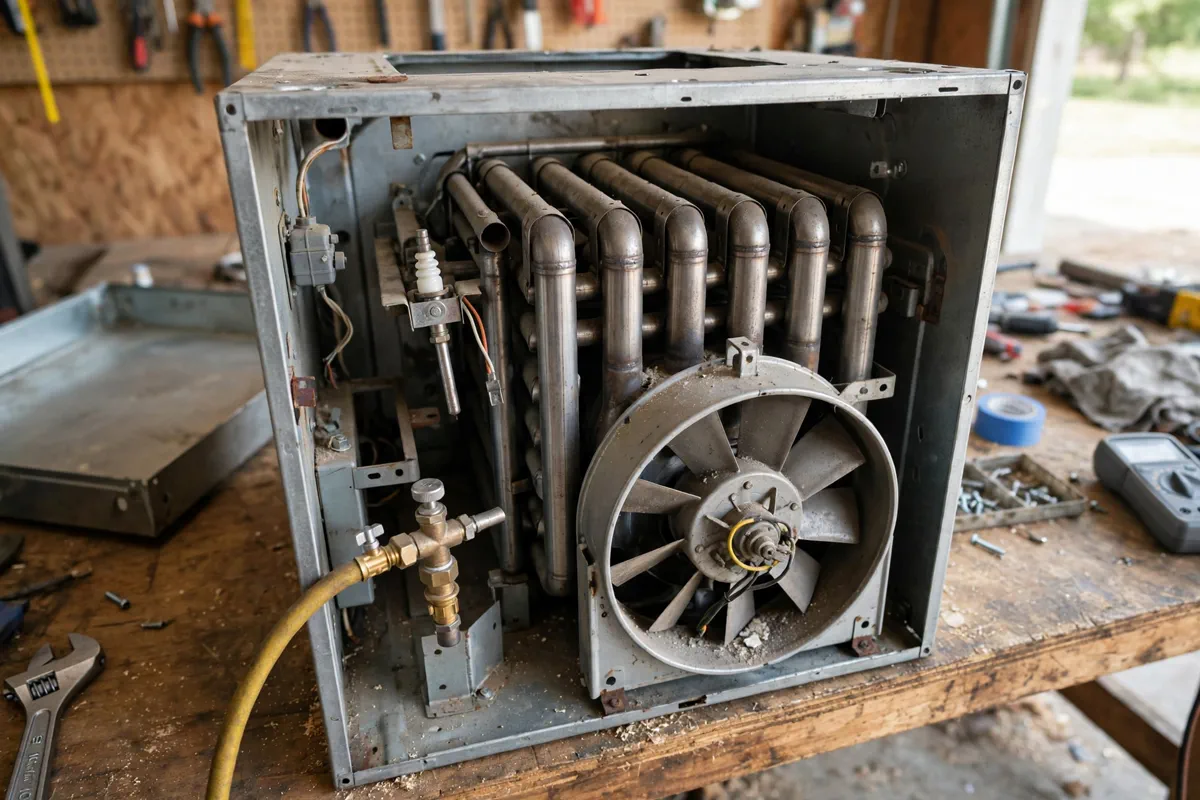
Almost every truck camper furnace is a forced-air propane furnace made by Suburban or Dometic — older Atwood models are now part of the Dometic family. Propane makes the heat; your 12-volt battery runs the thermostat, control board, and blower fan. Shore power helps only because your converter keeps the battery charged.
The sequence never changes. The thermostat calls for heat. The blower starts and purges the chamber for roughly 10 to 20 seconds. Airflow pushes a little paddle called the sail switch closed, proving the fan is moving air. The control board checks the limit switch, opens the gas valve, and fires the spark igniter — a fast tick-tick-tick. The flame lights, a sensor proves it, and warm air comes through the ducts. If the flame never proves, the board tries again, usually up to three times, then locks out. To clear a lockout, cut 12-volt power for a full 60 seconds — pull the fuse — then try again. There is no red reset button on most RV furnaces. Write down where yours stops.
The Five-Minute Checks: Do These Before Anything Else
Thermostat. Set it to Heat, not Fan or Cool, and at least 5 degrees above room temperature. Check it has power — a dead AA battery in a digital thermostat has fooled more than one owner into pulling a furnace out.
Propane. Is the tank open, and does it have propane in it? Light a stove burner — a strong, steady blue flame tells you propane is reaching the camper. If you have just changed a tank, run the stove for 10 to 15 seconds to clear air from the line before you try the furnace again.
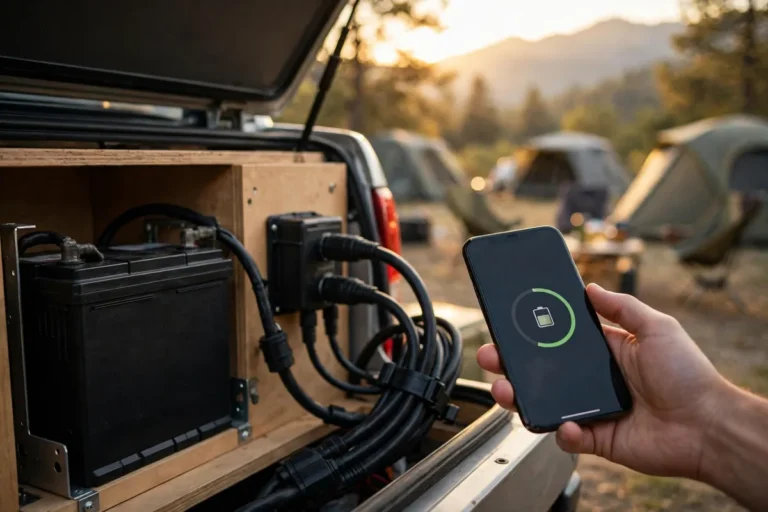
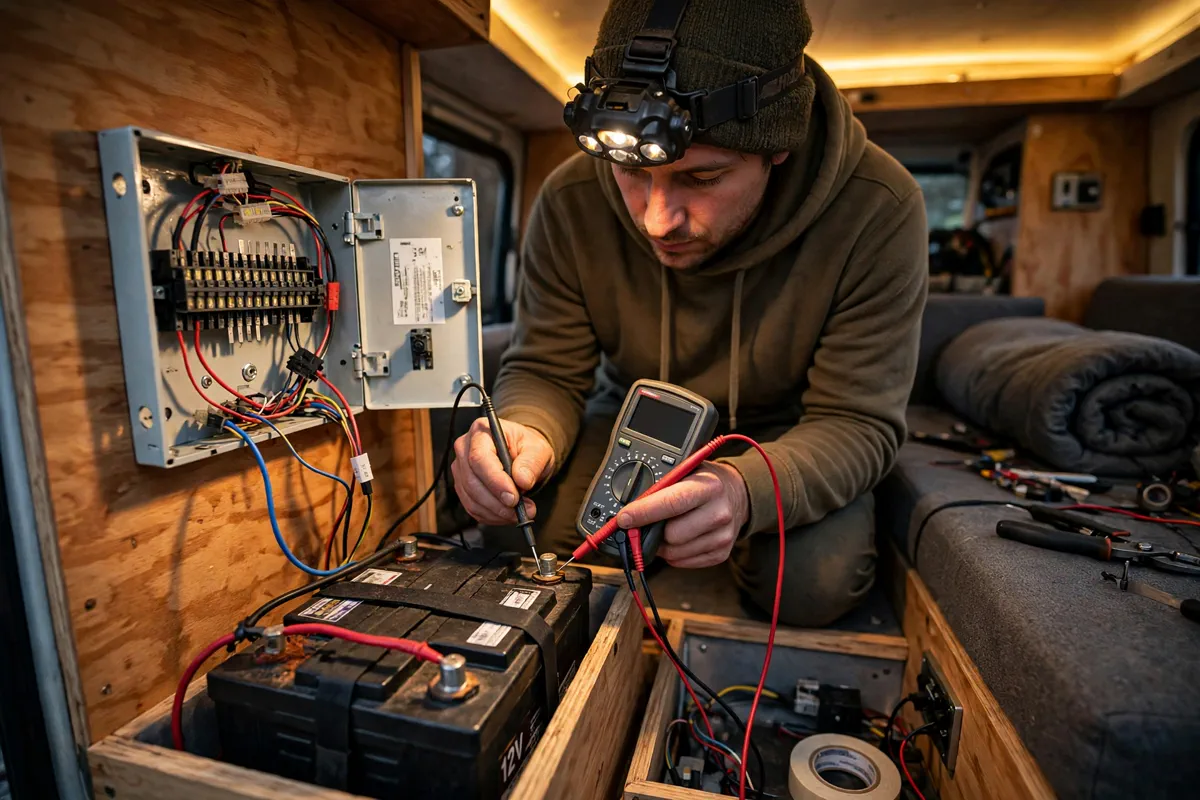
Battery voltage. This is the one most people skip, and it causes more no-heat calls than any broken part. A blower has to spin fast enough to close the sail switch, and a tired battery can spin it just slowly enough that nothing else ever happens. Roughly 12.4 to 12.6 volts at rest is healthy; around 12.2 volts is roughly half charged. If the lights dim when the blower kicks on, or the furnace works on shore power but quits while boondocking, voltage sag is your prime suspect. Charge the battery, plug in, or run the truck, then try again — see truck camper electrical troubleshooting for more.
Fuses and the furnace switch. Check the furnace fuse in the DC panel and replace a blown one with the exact same amp rating, never a bigger one. Some furnaces have their own on/off switch — make sure it is on.
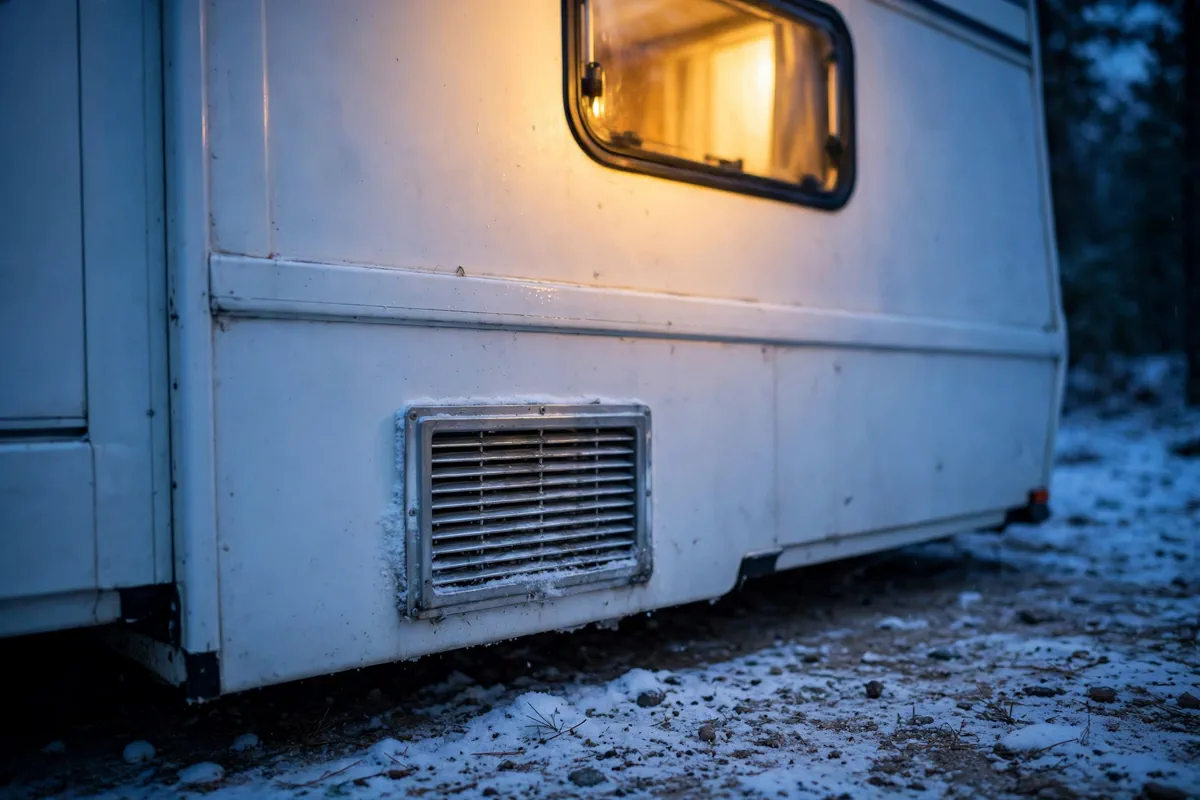
Airflow. Check the exterior intake and exhaust vent, the return-air grille, and every floor register. A cushion leaning against the return grille can starve the furnace of air. Clear them all before you assume a part has failed.
Truck Camper Furnace Not Working at All — No Fan, No Sound
Complete silence means the furnace is not getting the call, or it is not getting power. Check the thermostat first: jumpering the two heat terminals at the wall plate is the classic test — if the furnace fires with the thermostat bypassed, the thermostat is the problem. If you are not comfortable with that, swap in a known-good basic thermostat.
Then check the fuse, the battery disconnect switch, and the wiring at the furnace. Look for loose spade connectors and green corrosion on the ground wire. If a fuse blows again the moment you replace it, stop: that is a short, and it belongs to a technician.
Symptom 2: Fan Runs, Blows Cold Air, Then Quits — No Clicking
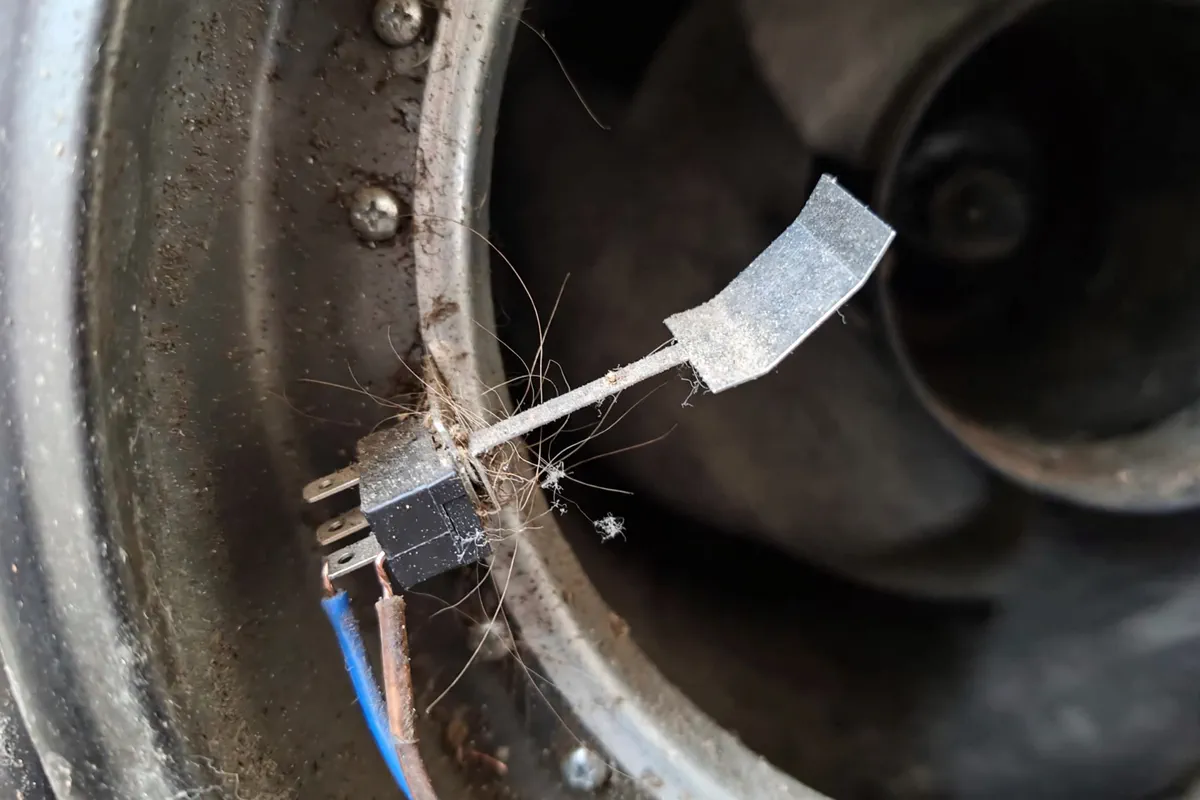
This is the most common failure I hear about. The fan starts, runs for about 10 to 30 seconds, you never hear the igniter tick, and the fan shuts down. Owners on the Keystone Forums describe the diagnostic exactly this way: listen for the snap-snap-snap of the igniter after the fan is up to speed. No snap means the sequence stopped before the gas valve ever opened, and the sail switch is the best first suspect. If you do hear the snap but no whoosh of flame, the sail switch is fine and your problem is on the fuel side.
The sail switch is a thin metal paddle in the blower airstream attached to a microswitch. Airflow pushes it closed; no airflow, no gas. Three things stop it closing. Low battery voltage is the first — the fan never spins fast enough. The second is dirt: lint, pet hair, and sawdust collect on the paddle hinge and stop it moving. Owners on the Airstream Forums report the same pattern over and over: a furnace that would not fire, then fired after a gentle tap near the sail switch freed a sticky paddle. Tapping is a diagnostic, not a repair. The real fix is to kill 12-volt power, close the propane valve, and clean the paddle and hinge gently with compressed air or a soft brush. Test it with a multimeter: open circuit at rest, continuity when you press the paddle by hand. If it will not close electrically while you press it, replace it.
The third sail-switch problem is mechanical — a detail you will not find in most generic guides. Owners report the paddle rubbing against the heat exchanger or catching on its own housing. In one case on a Suburban NT-16SEQ, the sail rubbed the heat exchanger just enough to stop it returning when the blower stopped; bending the arm slightly so it cleared everything fixed it permanently. If your paddle drags, look for that interference before you buy a new switch, and handle the vane gently. On some installations, reaching the sail switch means pulling the whole furnace out; if yours is that kind, hand the job to a tech.
Symptom 3: Fan Runs, You Hear Clicking, But It Never Lights
Clicking with no flame means the sail switch closed, the board opened the gas valve, and the spark is firing — but there is no propane to burn, or the spark is not reaching it. Check the supply: tank valve open, tank actually full, and try another propane appliance. Then reset the lockout — pull 12-volt power for 60 seconds — and try again.
Air in the line after a tank change is the classic here. Owners on the Keystone Forums report the exact sequence: no clicking, no whoosh, then after reconnecting the tank, opening the valve very slowly, and lighting the cook stove, the furnace finally clicked and lit on the fourth try. Opening the tank valve too fast can trip the excess-flow valve in the pigtail, choking propane flow to a trickle. If you opened the valve fast, close it, loosen the pigtail to bleed pressure, tighten it, and reopen the valve slowly. For the wider propane picture, see my truck camper propane system guide.
If propane is definitely reaching the furnace and it still will not light, look at the igniter and electrode. With power and propane off and the unit cool, inspect the electrode: carbon buildup, a cracked ceramic, or a spark gap out of spec will all give you clicking with no flame. Clean carbon gently with a fine abrasive pad and check the gap against your model’s manual. A burned tip needs replacing — match the part number on your furnace data plate. Low propane pressure is a technician job: it is tested with a manometer, and adjusting a regulator without one is guesswork.
Symptom 4: It Lights, Then Dies
A flame that lights and then dies within seconds usually means the flame was never proven. On most furnaces the igniter electrode doubles as the flame sensor, and a dirty, corroded, or misaligned probe cannot sense it. Clean the probe, check its position, and make sure its wire is firmly connected. A cracked ceramic lets the spark leak to ground instead of proving the flame.
If it lights, runs a minute or two, then dies and repeats, suspect the control board. The board runs the whole sequence, and a cracked solder joint or failing relay can drop the flame after ignition. Owners on the RV Forum and iRV2 report this pattern repeatedly, and many replace the board with an aftermarket Dinosaur Electronics board, which owners describe as better built, with diagnostic LEDs showing which stage the furnace is in. One owner noted the practical difference: the original board kept running the blower after three failed attempts and killed the battery, while the replacement shut the blower off. Before you buy a board, rule out the cheap stuff — sail switch, electrode, propane supply. Photograph every wire first and match the board to your exact furnace model.
Symptom 5: Short Cycling — Heats for a Few Minutes, Then the Burner Cuts Out
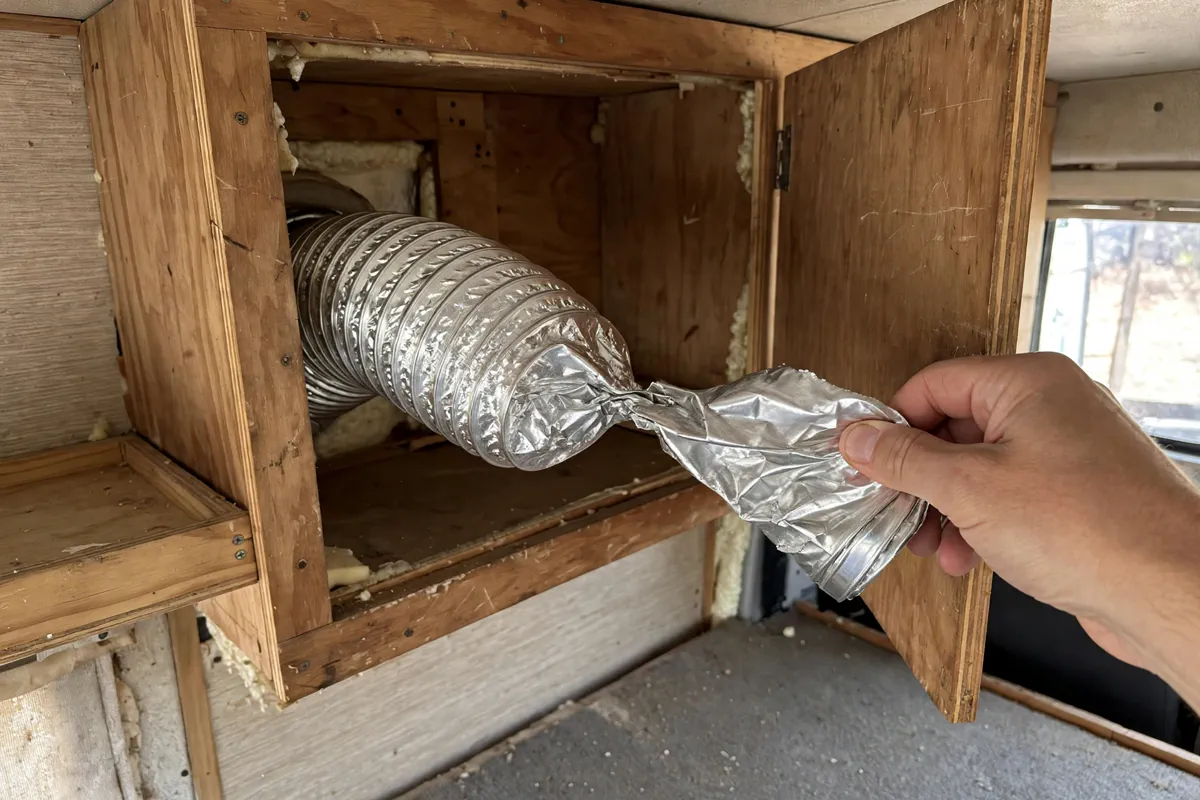
Short cycling is a different fault from failing to light. The burner lights, blows warm air for two to five minutes, cuts out while the fan keeps running, then relights and repeats. That is almost always the limit switch doing its job: the furnace is overheating inside, and the switch opens to shut the burner down until the plenum cools. Do not bypass it. The cause is almost always airflow: blocked or crushed flex ducting, a closed register, a return-air grille blocked by bedding, or a blower wheel caked with pet hair.
Owners on the RV Forum worked this one through in public: one owner replaced the limit switch and the cycling improved, but did not go away — he then found mud dauber nest remnants lodged in the combustion-air fan blades. A limit switch can be part of the fault and still not the whole fault.
Here is a diagnostic trick from the Airstream Forums: disconnect the ducts temporarily and let the air blow straight out and straight back to the unit. If the short cycling stops, the obstruction is in the ducting, not the furnace. Feel each register while the furnace runs: a trickle where the others are strong tells you where the restriction is.
Symptom 6: Weak Heat, Smells, or Soot
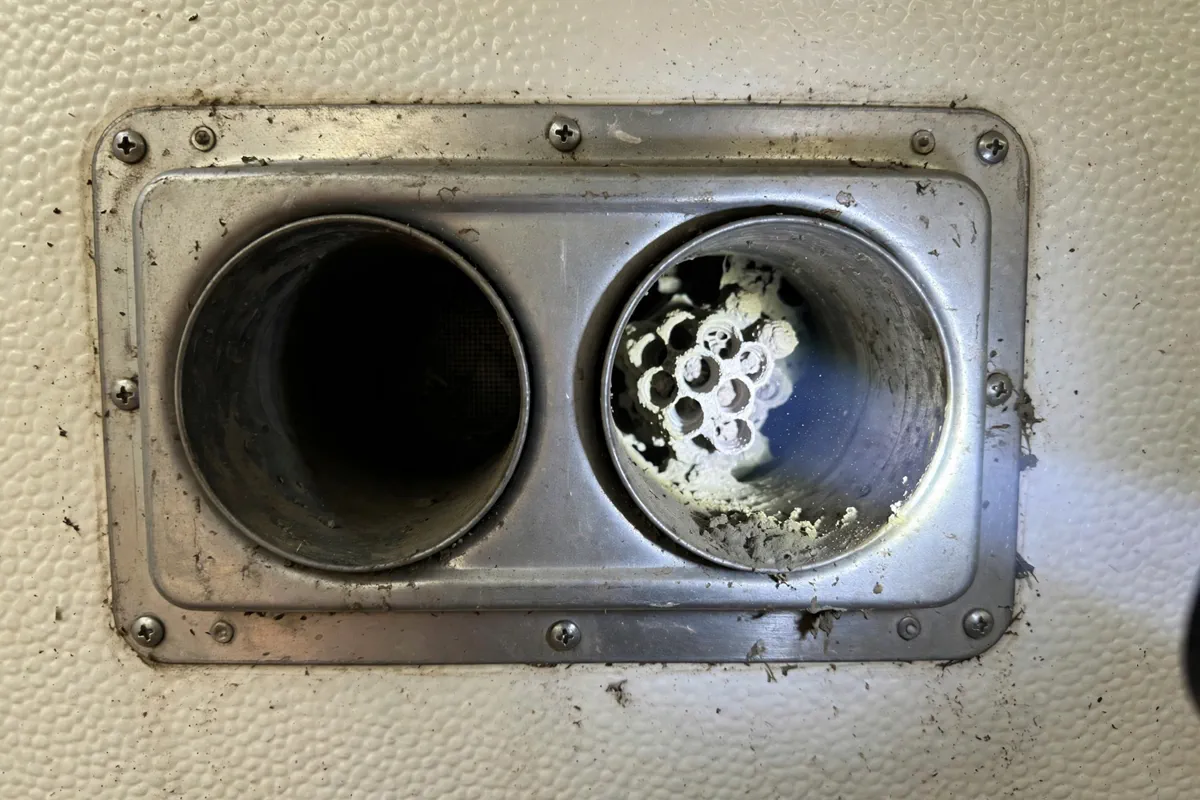
Weak heat with a normal-sounding furnace often means the heat is going somewhere other than the cabin: a disconnected or crushed duct, or a return-air path pulling cold air from an unheated compartment. A brief dusty smell on the first run of the season is normal. A persistent propane smell is not: shut off the gas, ventilate, and get out. A sharp exhaust smell, or black soot above the exterior vent, means incomplete combustion — stop using the furnace and call a technician.
Mud dauber nests are the classic cause here: owners on multiple forums report furnaces that worked in April and not in October, because wasps built in the intake and exhaust tubes over the summer. With the furnace off and cool, clear the tubes with a soft brush and low-pressure air and you should be able to see daylight through both. If the furnace runs but the camper never really gets warm, the camper may be losing heat faster than the furnace can make it — see my guide to truck camper winter heating.
When to DIY and When to Call a Tech
DIY: thermostat settings and batteries, fuses, battery voltage, clearing grilles, registers, and the exterior vent, cleaning the sail switch paddle and electrode, resetting a lockout, tracing ducts, and replacing a sail switch, limit switch, electrode, or control board when you can reach it safely. Those cover the large majority of failures.
Call a certified RV technician for: any propane smell you cannot explain, gas-valve or regulator work, pressure testing, burner work beyond a gentle cleaning, a cracked heat exchanger, soot or exhaust smells, a fuse that blows repeatedly, and anything inside the combustion chamber you cannot identify. Also call a tech if you have worked through the symptoms above and the furnace still will not light.
Never bypass a sail switch or a limit switch, even temporarily, even to test. They exist to stop raw propane pooling in a chamber with no airflow. Jumping one tells you nothing you cannot learn from a multimeter.
Parts and Tools to Carry
I carry a multimeter, screwdrivers and a nut driver, a small socket set, compressed air and a soft brush, a fine abrasive pad, spare fuses in the exact ratings my panel uses, and a headlamp. For parts, the smart spares are a sail switch matched to your furnace model, a spare electrode, and a spare limit switch — buy them by the part number on your furnace data plate, not by the brand alone. Write your furnace make, model, and serial number on a card and keep it in the camper.
Download the manual for your exact model and keep a copy on your phone — Dometic posts its DF series furnace installation manual online, and Camping World’s Suburban and Dometic guide is a good starting point for identifying your model.
Prevention: The 30 Minutes That Save a Cold Night
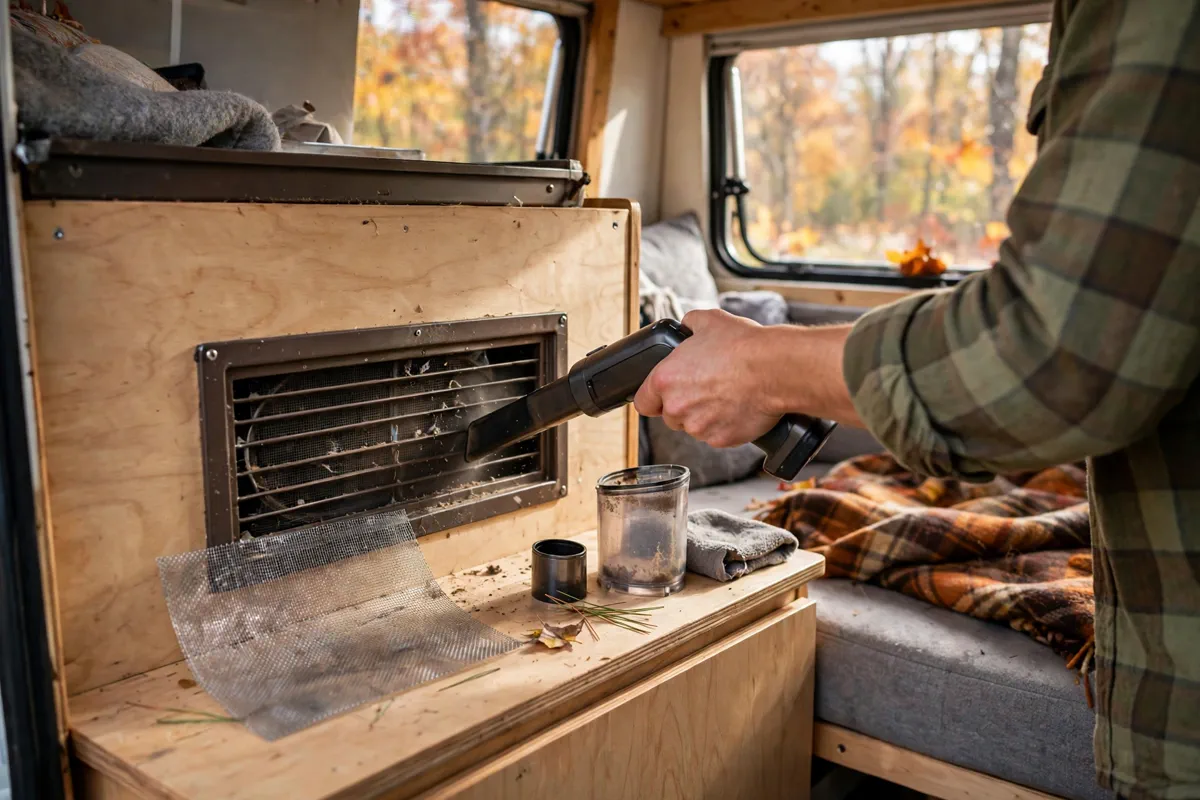
Do this once a year, in early autumn. Vacuum the return grille and every register. Pull the exterior vent cover and clear the intake and exhaust tubes — mud daubers build in them over a single summer, and a plugged exhaust is the classic cause of a furnace that worked in spring and not in autumn. Vacuum the burner compartment and blower wheel, check the sail switch paddle moves freely, and run a full test cycle: fan, click, whoosh, warm air, clean shutdown. Fit a mesh vent screen over the exterior vent if your model allows it. Add the check to your truck camper maintenance schedule and your how to winterize a truck camper routine.
A truck camper furnace not working is usually a power, propane, or airflow problem — not a dead furnace. Listen for where the sequence stops, and check those three before you buy parts.
Frequently Asked Questions
Why does my truck camper furnace blow cold air but the fan runs?
The sequence stalled before the gas valve opened: low battery voltage, a dirty or stuck sail switch, a lockout after three failed attempts, or propane not reaching the burner. Reset the lockout, check voltage, and prove propane at the stove.
How do I reset a truck camper furnace after lockout?
There is usually no reset button. Cut 12-volt power for a full 60 seconds — pull the furnace fuse — then restore power and call for heat again. If it fails three more times it locks out again, so the underlying fault is still there.
Can a weak battery stop my RV furnace from lighting?
Yes — one of the most common causes. The blower must spin fast enough for airflow to close the sail switch, and below roughly 10.5 to 11 volts under load many furnaces will run the fan but never ignite.
Where is the sail switch on a Suburban or Dometic furnace?
It sits in the blower housing, near the blower wheel — a thin metal paddle on a small microswitch. On some models you can reach it through an interior access panel; on others you have to slide the furnace out.
Why does my furnace short cycle?
Short cycling usually means the limit switch is tripping because the furnace is overheating inside. Check for blocked or crushed ducting, closed registers, a blocked return-air grille, or a dirty blower wheel before blaming the switch.
Is it safe to run my truck camper furnace overnight?
A properly working furnace with a working carbon monoxide detector is designed to run overnight. Never run one you know is faulty, sooty, or smelling of gas or exhaust.