Truck Camper Slide-Out Problems: The Honest Reliability Guide
There’s a special kind of silence that falls over a campsite when you press the slide-out button and nothing happens. That moment — and everything that leads to it — is what this guide is about: truck camper slide out problems, honestly assessed.
I’m not writing this to talk you out of a slide-out. Slides are wonderful when they work — that extra foot and a half of floor space turns a truck bed box into something that actually feels like a room. But the problems nobody mentions in the showroom are real: a mechanism that can strand you with a wall stuck open, seals that leak if you so much as look away, and a weight penalty that quietly eats your truck’s payload. Here’s the honest reliability guide — what’s actually failing, what owners say really fixes it, and the math that decides whether a slide is worth it for how you camp.
A note on scope: our used truck camper inspection checklist covers what to check on a slide at purchase. This guide is about living with one over years of ownership — maintaining it, troubleshooting it, and deciding whether the space is worth the headaches.
Why Truck Camper Slides Fail More Than You’d Expect
Start with physics. A slide-out is a big hole cut in the side of a box that spends its life being shaken down washboard roads at 60 mph. Every wall opening is a structural compromise, and truck campers are the one RV type that gets used hardest — bounced down forest roads, parked unlevel on dirt, loaded and unloaded off the truck in the rain. Slides add weight high up, add motors, gears, rails, and seals to maintain, and add a failure point that can literally trap you outside your own bathroom.
That doesn’t make them bad engineering. It makes them a moving part on a machine that lives outdoors, and moving parts outdoors need maintenance.
The Real Weight Cost of a Slide-Out (It’s Not What the Brochure Says)
Ask an owner what a slide costs in weight and you’ll hear “about a thousand pounds per slide.” That’s the folk number, and like most folk numbers it’s half right in an interesting way.
Here’s the part nobody argues about. When Truck Camper Magazine pressed Lance on the 2026 Lance 1191 Slide, the company said the slide mechanism itself adds about 341 pounds — on a camper with a base dry weight of 3,930 pounds, versus roughly 3,518 pounds for the non-slide 1191. Same story on the older Lance 855S, where the slide version weighed only about 200 pounds more than the non-slide 855. So no — the mechanism alone is not a thousand pounds.
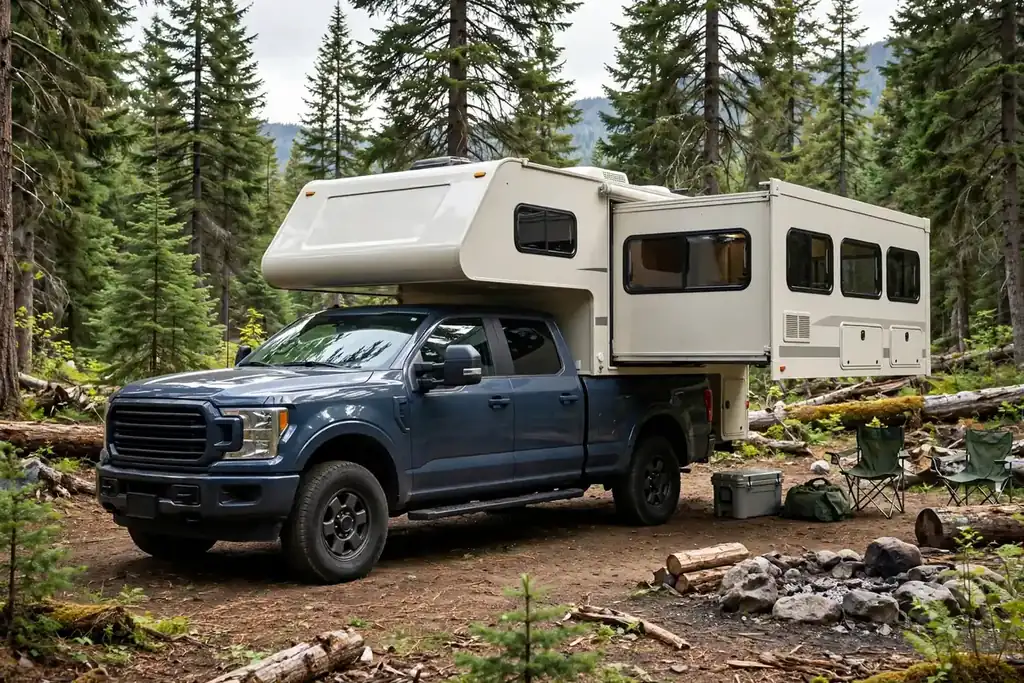
But here’s the catch, and this is why the folk number persists. Slide-out campers aren’t just the same camper plus a mechanism. They’re bigger rigs: longer boxes, bigger tanks, more furniture, more everything. Compare like for like and a slide floorplan runs roughly 800 to 1,000 pounds heavier than a comparable non-slide — and it climbs fast from there. A double-slide Lance 1172 is 4,063 pounds dry. Triple-slide flagships like the Eagle Cap 1165 or Host Mammoth run 4,500 to 6,000 pounds wet — pushing triple-slide setups into one-ton-dually-only territory, as owners on the Good Sam forums note. Another owner on Truck Camper Magazine summed up his own upgrade math: his double-slide Lance was a full 2,000 pounds heavier than the non-slide camper it replaced.
So the honest version: the slide adds a few hundred pounds; choosing a slide floorplan typically costs you around a thousand. On a half-ton truck that’s the difference between legal and over gross. If you’re shopping slide campers for an F-150, read our F-150 truck camper payload guide before you fall in love at the dealer lot — and if you’re running a diesel, remember the engine already eats hundreds of pounds of your payload, which is exactly what our Ram 2500 diesel payload trap breakdown is about. A slide camper on a diesel one-ton can put you over payload before you’ve loaded a single bag of groceries.
There’s also the center of gravity. A slide is a big chunk of mass hanging off one side of the camper. Lance kept the 1191 Slide’s shift modest (60 inches from the front wall versus 52.5 on the non-slide), which is good engineering — but any slide moves weight outward, and on a tall, narrow truck camper that’s weight you feel in crosswinds.
Failure Mode #1: The Slide That Won’t Move
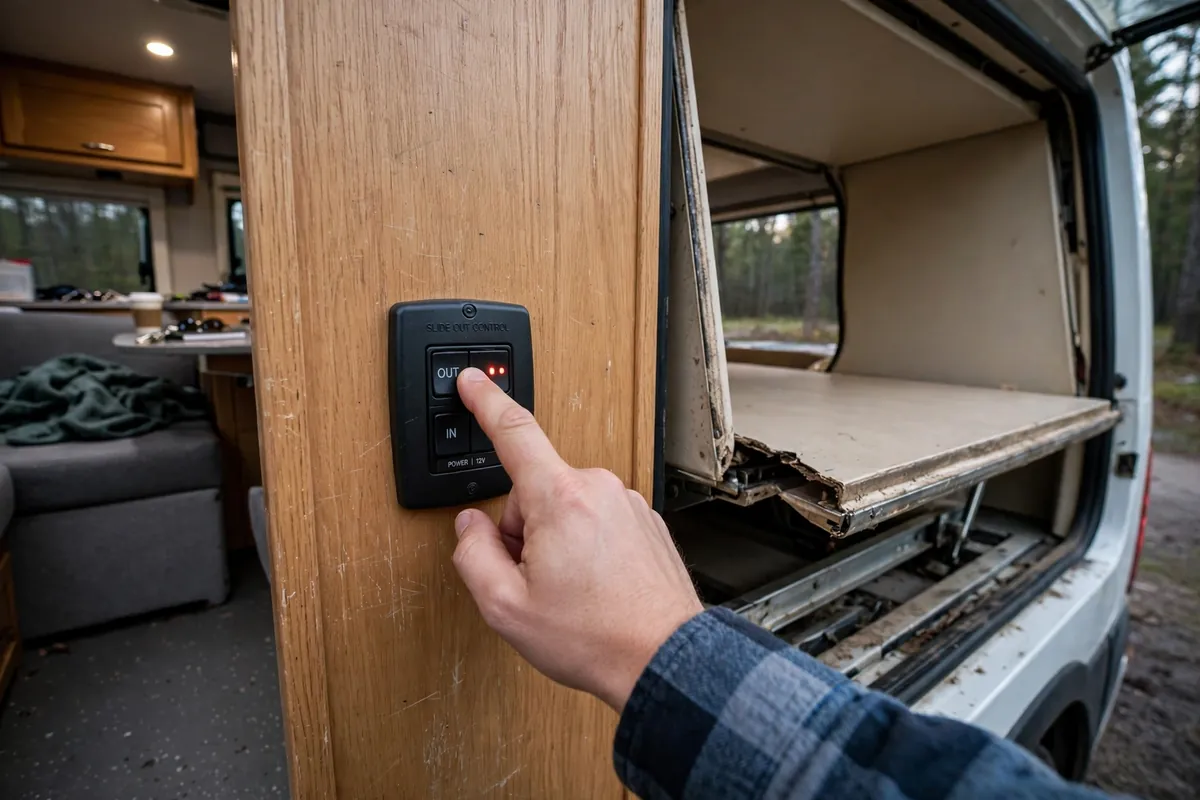
This is the failure that ruins trips, and it has a dirty little secret: most of the time, it’s not the slide. It’s the battery.
Slide motors are among the thirstiest 12-volt loads in a camper. On the Forest River forums, one owner came home from their first trip, parked the rig, and found the slides completely dead — no sound, no movement. Breakers fine, everything else fine. The cause was a house battery drained on the drive home. Owners on iRV2 say the same thing in almost every “my slide won’t move” thread: check battery voltage first, clean and tighten the terminals and the ground connections at the frame, and run the truck engine while operating the slide so the alternator carries the load.
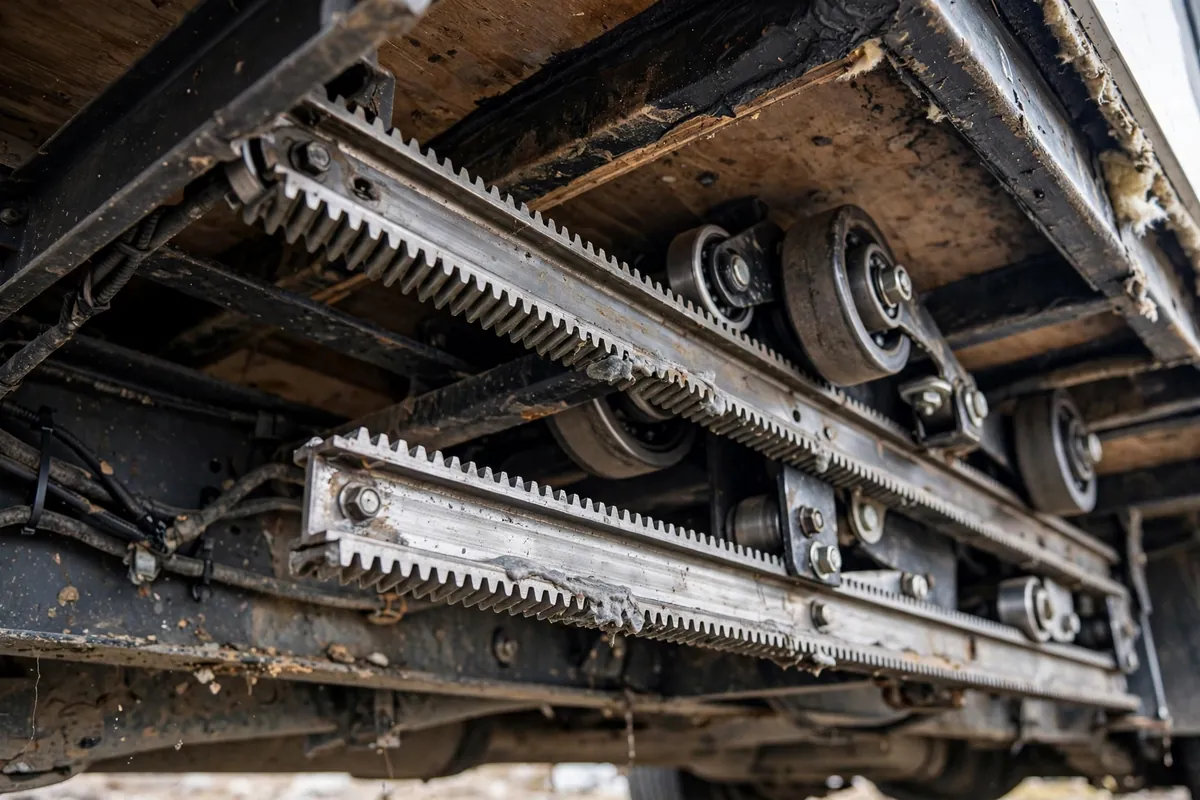
Behind the battery, the usual suspects are the motors themselves. Most modern truck camper slides use dual-motor in-wall systems (the Schwintek-style setup you’ll see referenced in owner forums) — two small motors, one on each side of the slide, that have to stay in sync. When they don’t, the slide racks: one side extends further than the other, it cocks sideways in the opening, and then it wedges. One Eagle Cap 1165 owner on Truck Camper Magazine described the roadside dread perfectly — needing to extend two of his three slides just to reach the bathroom, “hoping the motors don’t decide to fail right now.” If your slide moves unevenly, stops halfway, or one side lags, stop immediately and don’t keep holding the button; forcing it is how a small sync issue becomes a wedged room.
The practical takeaway, and this comes straight from years of owner threads: learn which system your camper has and where its manual override lives before you need it. Every slide has one, but the procedure is different for every system, and it is not something you want to be reading for the first time in the dark at a trailhead. Keep the manufacturer’s manual — not a screenshot, the actual procedure — in the camper.
Failure Mode #2: Leaks — The Slow Killer
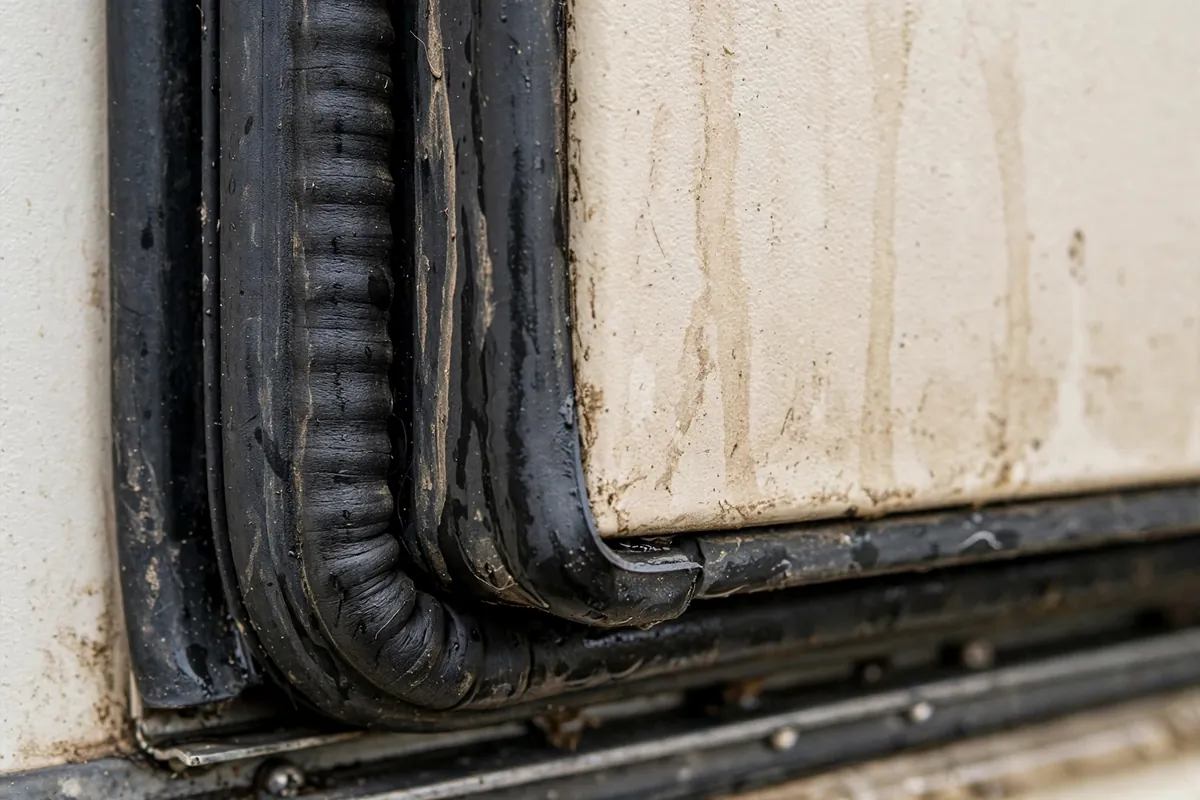
A stuck slide ruins a weekend. A leaking slide ruins a camper.
Slide-outs leak more than roofs do, for a simple reason: a roof is one big sealed surface, while a slide is a moving wall that has to seal itself in two positions — open and closed — through wiper seals and bulb seals that flex every time the room moves. Those seals dry out, crack, get compressed flat, and worst of all, fold wrong.
One of the most common fixes truck camper and RVer owners share on forums is embarrassingly simple. The vertical wiper seals at each end of a slide are supposed to flip outward as the room extends, but on some units they fold inward instead and stay tucked — which leaves a gap for driven rain. The fix owners report working: stop the slide about eight to ten inches short of full extension, go around and flip each seal outward by hand, then finish extending. It takes thirty seconds and it solves leaks that owners had been chasing with caulk for years.
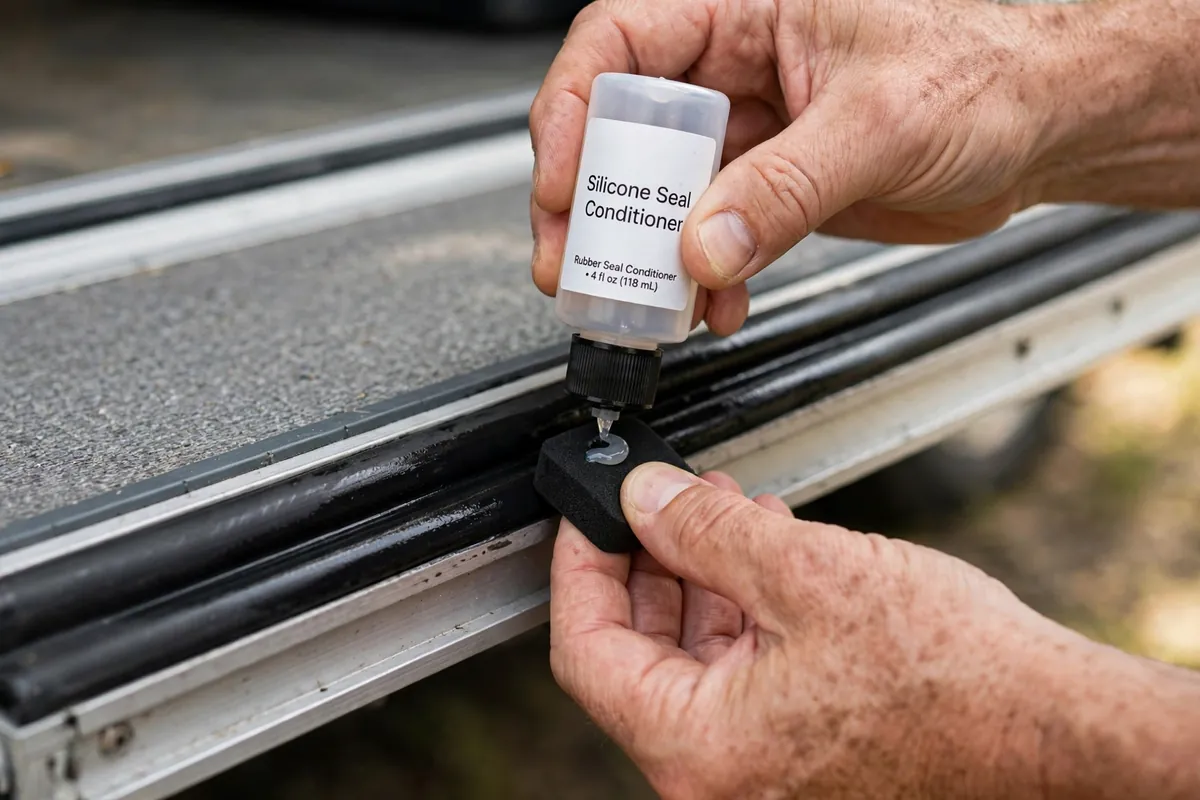
Heat does its own damage. On iRV2, owners in hot climates describe a loud pop when extending the slide — the rubber seals literally sticking to the slide wall after baking in the sun. The community fix is baby powder or a silicone-based seal conditioner on the seals a few times a year. Not petroleum products, which eat rubber — silicone or a dedicated seal treatment. Treated seals slide instead of sticking, which also reduces strain on the motors and rails. If you’re building a seasonal maintenance routine, our truck camper maintenance schedule is the framework to slot this into.
The other leak path is the slide roof itself. Water ponds on slide roofs because they’re nearly flat, and without a slide topper (that little awning over the slide) debris sits there, rots, and works its way under the seals. A slide topper is the single best leak-prevention money you can spend on a slide camper, and if your camper came without one, budget for the retrofit.
And a crooked slide is a leaking slide. If the gaps around your slide aren’t even — one top corner showing daylight while the other crushes the seal — the mechanism is worn, a rail is damaged, or the floor is sagging, and the seal can’t seat evenly. That starts a loop: it leaks, the floor rots, the floor sags further, it leaks worse. If you see uneven gaps, that’s a shop visit, not a caulk job.
Failure Mode #3: Racking, Binding, and Getting Stuck
A slide should move smoothly, evenly, and quietly. Grinding, hesitation, popping, or one side leading the other are all the mechanism asking for help, and truck campers punish neglected mechanisms harder than any other RV because the box flexes on rough roads.
The number one owner mistake is deploying the slide on unlevel ground. The slide room is engineered to travel in a frame that’s square; when the camper is sitting twisted — one corner low, the opposite high — the opening is a parallelogram and the room binds in it. Our solo loading and unloading guide covers leveling the camper properly, and that discipline matters double with a slide. Level first, extend second, every single time. If you’re boondocking on soft ground, this is where wide leveling pads earn their keep — jacks sinking into sand overnight can leave the rig unlevel enough that the slide won’t come back in square the next morning.
Off-road use adds a second stressor: flex. Owners on iRV2’s truck camper forums have been blunt about this. One Lance 1181 owner reported developing a small crack in the lower rear corner of the slide opening after taking his full-side-slide camper down rough forest roads — and he traded it for a no-slide Arctic Fox 865, saying he’d grown tired of a slide that had to be fully extended just to reach the bathroom. The consensus in that thread: big multi-slide campers with large openings cut into the walls are the worst candidates for washboard and rough tracks, and the ones that do go rough should have their slides fully retracted and locked before a single mile of dirt.
Tree branches deserve their own warning. A slide extends a foot or more beyond the camper wall — beyond the track your mirrors just cleared. Walk your site and look up before you press the button.
Slides Off-Road: The Honest Liability Case
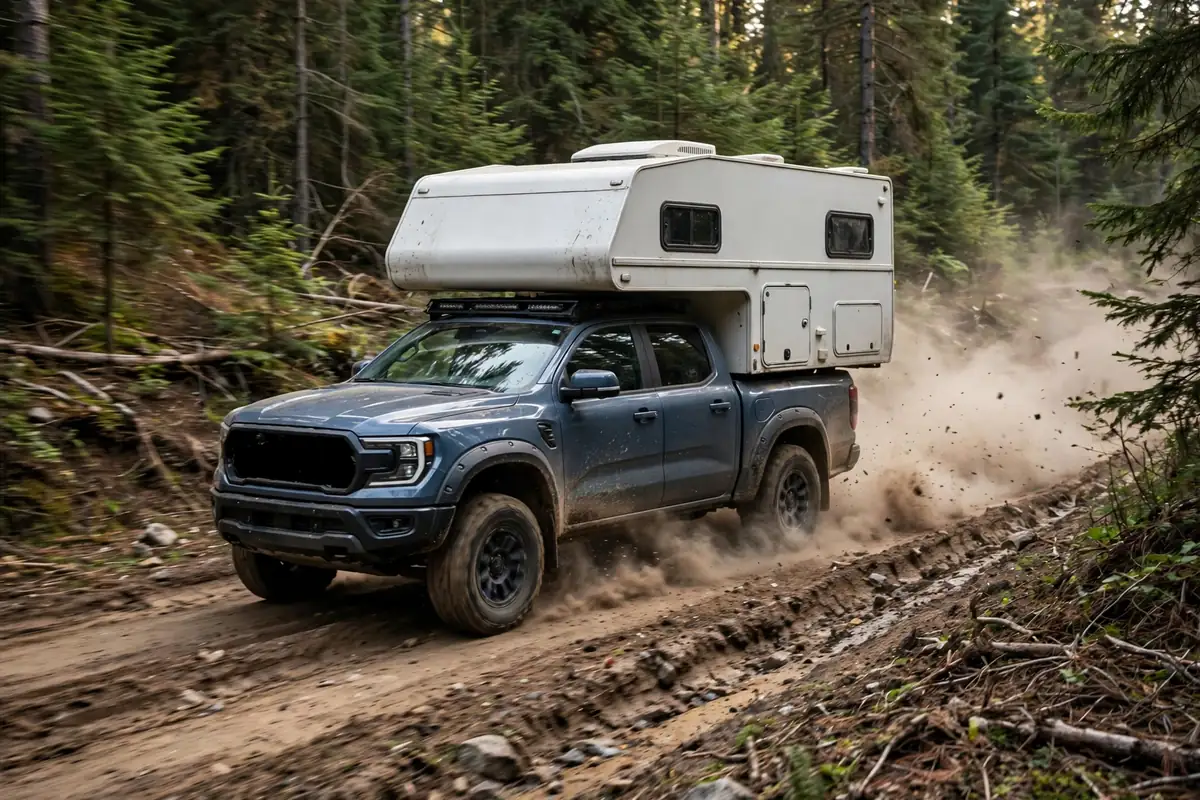
Let’s put it together, because this is the part where forum debates get heated and the truth is actually clear. A slide-out is a liability off-road in three specific ways: the openings weaken the wall structure (cracks at the corners of slide openings are a documented owner complaint), the mechanism hates being run unlevel (and boondocking ground is rarely level), and the extra weight and width shrink your margin on rough tracks and tight turns.
None of that means slide campers can’t go off-pavement. The owners who do it successfully follow a boring playbook: slides in and locked before dirt, level before deploying, and realistic expectations about where a 4,000-plus-pound slide camper belongs. If your camping is mostly forest roads and BLM land, a no-slide camper simply gives you fewer things to worry about. If your trips are mostly campgrounds and RV parks with level pads, the slide’s failure modes mostly come down to maintenance, which you control.
The 20-Minute Maintenance Routine That Prevents Most Failures
Almost everything in this guide is preventable, and the prevention takes less time than washing the truck. Twice a year — spring and fall — do this:
- Inspect every seal, open and closed. Run the slide out, look at the wiper seals all the way around. Run it in, look again. Cracks, tears, compression set, seals folded wrong — replace what you find. Seal kits are cheap; water damage is not.
- Condition the rubber. Silicone-based seal conditioner or baby powder on sticking seals. This is the fix that stops the popping, reduces motor strain, and keeps seals supple.
- Clear the slide roof. Sweep debris off the slide roof before retracting — leaves, pine needles, and twigs get dragged inside and chewed up by the seals. If you don’t have a slide topper, add one.
- Check the mechanism. Look at the rails or gears for rust, bent teeth, or loose fasteners. Lubricate only what your manufacturer says to lubricate, with what it says to use — some systems want dry lube, some want none at all, and the wrong grease attracts grit that wears things faster.
- Check the battery. If your slide has been slow or hesitant, check battery voltage and clean the terminals before you blame the motor. The fix is often electrical, not mechanical.
- Deploy only when level. Make it a rule, not a suggestion.
That’s it. Twenty minutes, twice a year, and you’ve covered the three failure modes that account for the overwhelming majority of truck camper slide out problems.
When a Slide-Out Is Worth It (and When It Isn’t)
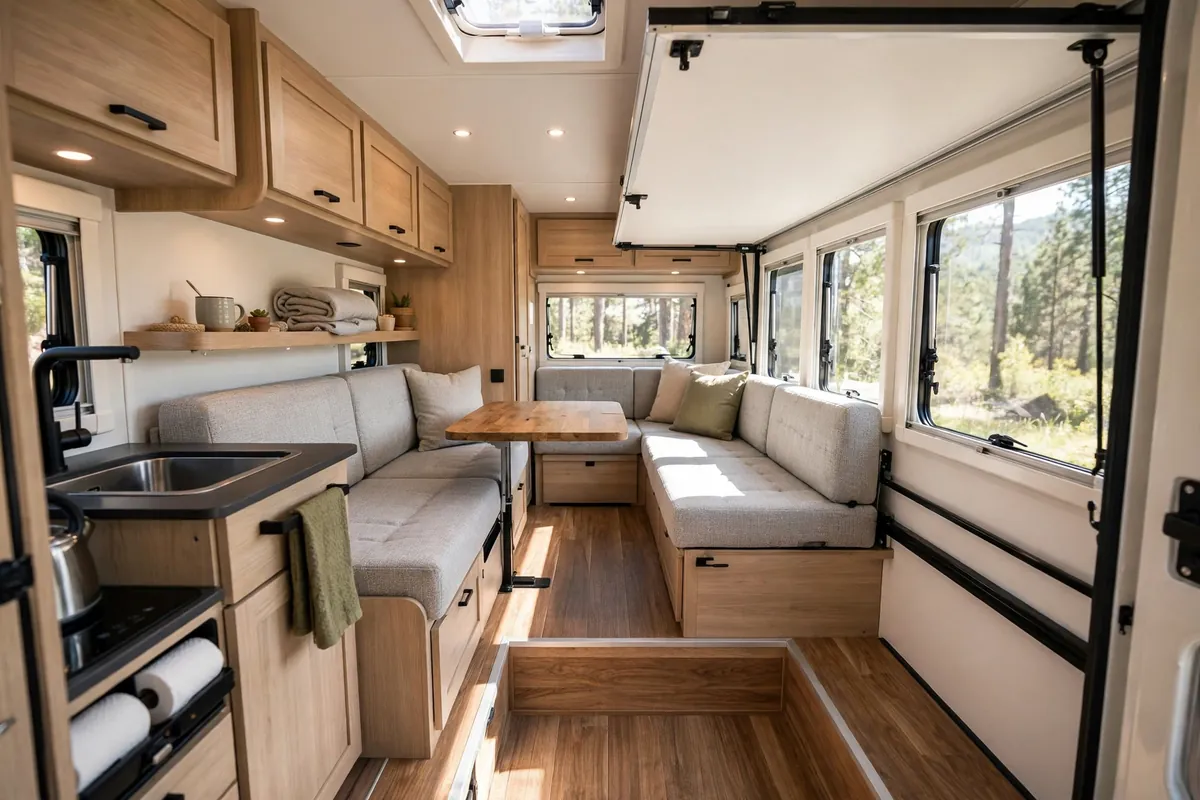
After all that honesty, here’s the other side, because the forums are full of slide owners who’d never go back. If you full-time, winter somewhere, travel with kids or dogs, or just hate the feeling of living in a hallway, a slide genuinely changes the camper. That extra 16 inches of floor turns a dinette into a place four adults can sit. For couples spending months on the road, the space is the difference between a camper they keep and a camper they sell.
The industry has noticed the tension. When Lance brought back the 1191 for 2026, it led with the non-slide version — demand has shifted toward floor plans with instant access to everything without deploying a slide. But it also brought back the slide version, designed so the bathroom, kitchen, refrigerator, and cabover all stay usable with the slide in. That’s the design standard to demand when buying: if the camper is useless until the slide goes out, you’re one dead battery away from a very bad night.
The owner consensus, distilled from years of forum threads, is pretty stable:
- Weekend warriors and boondockers: skip the slide. The weight, the maintenance, and the off-road stress buy you space you use two nights at a time. A well-designed non-slide feels bigger than you’d think.
- Long-trip and full-time couples: the slide is usually worth it, if you buy one that’s fully usable with the slide in and you commit to the maintenance routine.
- Families: almost always worth it. The floor space per person in a truck camper is brutal without one.
- Off-road-focused rigs: skip it. Every slide owner who trades down to a no-slide camper cites the same thing — the relief of having one less thing that can break a hundred miles from pavement. One owner wrote that her triple-slide camper developed a slide problem on a Texas trip that nobody at a full rally of truck campers could fix, and she traded it for a Host Mammoth on the spot.
And if you’re still deciding between camper styles overall, frame the decision before you start shopping floor plans.
One more honest number for the road: repairs aren’t cheap and shops aren’t fast. A slide mechanism repair can run into the thousands, with owners routinely reporting weeks-long waits for parts and a service bay — one more factor we broke down in the true cost of truck camper ownership. A slide is a wonderful thing to own and a terrible thing to neglect. Treat it like the moving part it is, and it’ll give you the room you’re paying for. Ignore it, and it’ll teach you the lesson the hard way — probably on a Sunday, probably in the rain.
FAQ: Truck Camper Slide-Out Problems
How much weight does a truck camper slide-out add?
The slide mechanism itself adds a few hundred pounds — Lance reports about 341 pounds on the 2026 1191 Slide, and the older Lance 855S was only about 200 pounds heavier than its non-slide sibling. But a slide floorplan is typically 800 to 1,000 pounds heavier than a comparable non-slide camper once you count the bigger box, tanks, and furniture, and triple-slide flagships can run 2,000 pounds heavier. Budget for the floorplan, not just the mechanism.
What is the most common cause of slide-out failure in truck campers?
A weak or dead battery. Slide motors draw heavy 12-volt current, and low voltage is the first thing to rule out — check voltage, clean and tighten the terminals and ground connections, and run the truck engine while operating the slide. Behind that, the usual culprits are dual-motor systems falling out of sync and worn or dry rails and gears.
Can you drive with a truck camper slide-out extended?
No. Never drive with a slide extended — it can be ripped off or damaged by wind loads and obstacles, it’s dangerously wide for the road, and it can destabilize the rig. If your slide is stuck out, retract it with the manual override procedure in your owner’s manual before driving, or call a mobile RV tech. (Safety disclaimer: when in doubt, don’t drive it — get help.)
Do truck camper slide-outs leak?
They can, and they’re more leak-prone than the main roof because the room has to seal in both the open and closed positions. The most common fixes owners report are flipping folded wiper seals outward by hand, conditioning the rubber seals with silicone a few times a year, keeping the slide roof clear of debris, and adding a slide topper if the camper didn’t come with one.
Are slide-outs reliable enough for off-road and boondocking?
They’re a liability off-road: wall openings can develop stress cracks at the corners on rough roads, mechanisms bind when deployed unlevel, and the extra weight and width hurt on tight tracks. Owners who boondock with slides successfully keep them retracted and locked on dirt, level before deploying, and stick to roads the rig can handle. For serious off-road use, most experienced owners recommend a no-slide camper.
Is a truck camper slide-out worth the maintenance?
For full-timers, long trips, and families, owners overwhelmingly say yes — the extra floor space transforms the camper. For weekenders and off-road-focused campers, the weight, maintenance, and failure risk usually aren’t worth it. Either way, only buy a floor plan that’s fully usable with the slide retracted.