
Buying Truck Camper Dealer Tips: Red Flags That Keep You From Getting Ripped Off
Let me tell you about the most painful truck camper story I have ever read. A dealer sold a Lance 1172, a big double-slide camper that tips the scales around 5,300 pounds loaded, to a buyer whose Ram 2500 diesel had a payload sticker of roughly 3,160 pounds. The salesman said it would be fine. It was 2,100 pounds over what the truck was engineered to carry.
This is why buying truck camper dealer tips matter more than which camper you pick. The camper itself is just fiberglass, aluminum, and plumbing. The dealer is the one who can cost you twenty grand in a single afternoon, and most buyers walk onto the lot completely unarmed. This article is the armor. Every tactic below comes from real buyer reports, forum threads, and consumer cases.
Red Flag 1: The salesman does your payload math for you

Here is the single most important sentence in this whole article: never let a dealer tell you whether a camper fits your truck. Do the math yourself, because his math is a sales script and yours is physics.
The classic trick is quoting dry weight. A salesman will say the camper weighs 4,063 pounds dry, and your truck is rated for 3,160 pounds of payload, and then he will add some soothing words about air bags fixing the difference. Dry weight is a fantasy number. It is the camper as it left the factory floor, with no water, no propane, no batteries, no options, and none of your gear. Real loaded weight runs 800 to 1,500 pounds over the brochure figure, sometimes more. A Forest River Forums member put it bluntly: do your own math, because nobody else’s math protects you.
Open your driver door and read the yellow Tire and Loading Information placard. That number already accounts for a full tank of fuel, so subtract you, your passengers, your dog, your toolbox, and everything else that rides in the cab or bed. What is left is what the camper can weigh fully loaded. Then go to a CAT Scale (catscale.com) and weigh your truck loaded for a trip, because the sticker is the ceiling and the scale is the truth. My full truck camper payload calculator guide walks through this step by step, and if you drive a Ram 2500 diesel, read the Ram 2500 payload trap before you believe anything a salesperson tells you about half ton towable or fits a 2500.
Truck Camper Adventure has called exceeding your truck’s payload the number one truck camper pitfall for years (truckcamperadventure.com).
Red Flag 2: The advertised price is a mirage

Advertised price and out-the-door price are two different species. The advertised number gets you in the door. The out-the-door number is what you actually pay after dealer prep, doc fees, freight surcharges, and electronic filing fees.
Some of those fees are real. A doc fee covers actual paperwork processing, and many states cap it. But combined prep, doc, and freight fees over about $1,500 on a truck camper should make your hand pause over the pen. These fees are mostly dealer margin wearing a costume, and they are negotiable. On the iRV2 forums, owners compare notes about RV show pricing games, and the consensus is simple: a dealer who can discount for a show can discount any other day too.
Regulators are watching this too. In March 2026 the FTC warned 97 dealership groups nationwide that advertised prices must include every mandatory fee, not just the pretty number. So when a dealer quotes you $42,000 and the contract says $47,300, you are looking at exactly the behavior the FTC is telling dealers to stop.
Your counter-move is one sentence: give me the out-the-door price in writing, itemized, every fee on it. A good dealer does this without blinking. A bad one suddenly remembers fees they forgot to mention.
Red Flag 3: The financing office is where the profit hides

You negotiate the price of the camper first, then you negotiate the money. Mixing the two is how dealers win. The classic move is payment packing: you agree on a price, then the finance manager steers you to a monthly payment that looks comfortable, and buried inside that payment are add-ons you never agreed to, stretched over 144 or 180 months so you barely notice.
Watch for these F&I office greatest hits:
- Mandatory dealer financing. If the advertised price only works if you finance through them, walk. The loan is how they get their second cut.
- Extended warranties sold at massive markup. A warranty has value, but dealer-marked extended service contracts carry some of the fattest margins in the business. Price the same coverage from a third-party provider before you sit down.
- Paint sealant, fabric protection, and undercoating packages. They sound protective and are nearly pure profit.
- Monthly payment anchoring. Negotiate the total out-the-door price and the interest rate separately.
Get pre-approved before you visit.
Red Flag 4: They treat the PDI like a formality
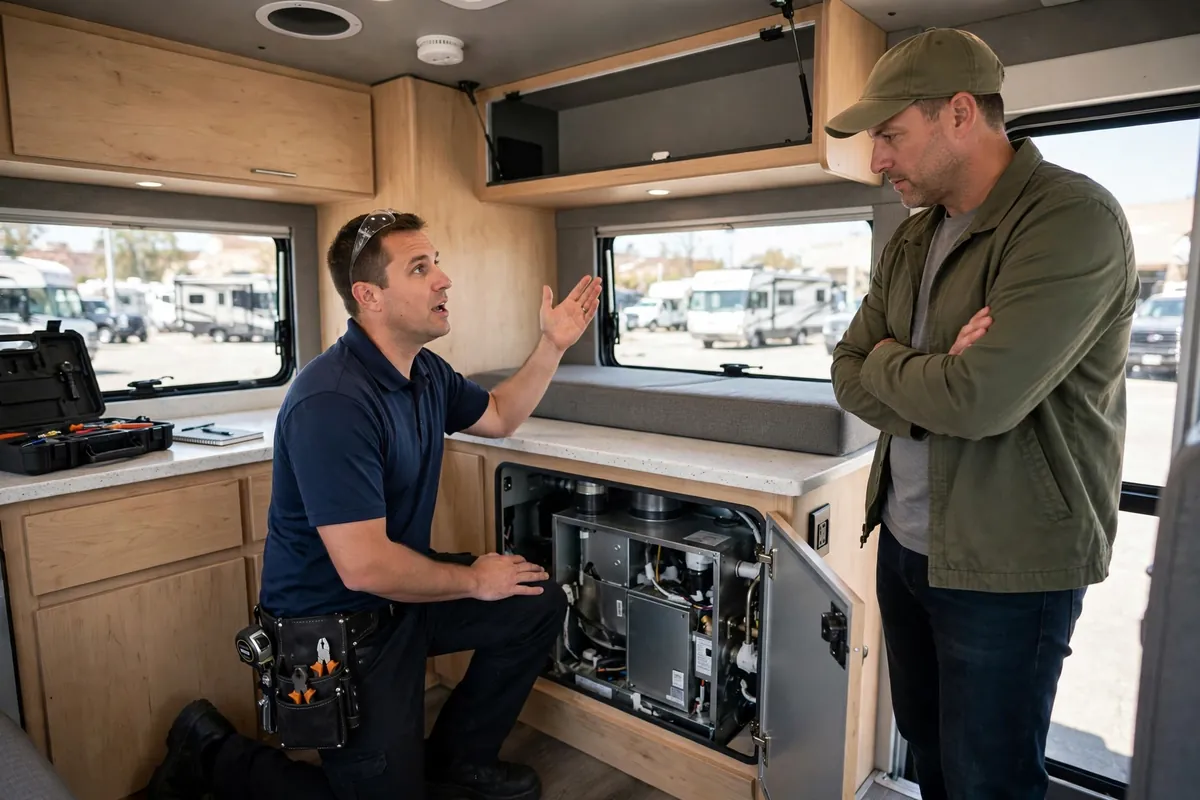
A pre-delivery inspection is supposed to be a four-to-six-hour shakedown of every system on the camper: fridge on both gas and electric, furnace burn-in, water system pressurized and leak-checked, roof and seal inspection, every appliance demonstrated, jacks and tie-downs verified. Then the dealer hands you a signed checklist proving it happened.
What actually happens at bad dealers: the unit gets a spit shine. One iRV2 member described buying from a lot where new units still had sawdust in the cabinets, loose trim, and peeling tape over interior joints, because the dealer figured they would clean it up when somebody bought it. Another camp of buyers reports the opposite, a dealer who spent nearly four hours going through every drawer, switch, and access panel with the furnace running and the fridge already cold. That second dealer is the one you want.
So: ask to watch the PDI, or at least ask for the signed checklist. One RV consumer site phrases the rule as bluntly as possible: if the dealer will not let you observe the PDI, that is an admission, not a policy.
Red Flag 5: They block your independent inspector
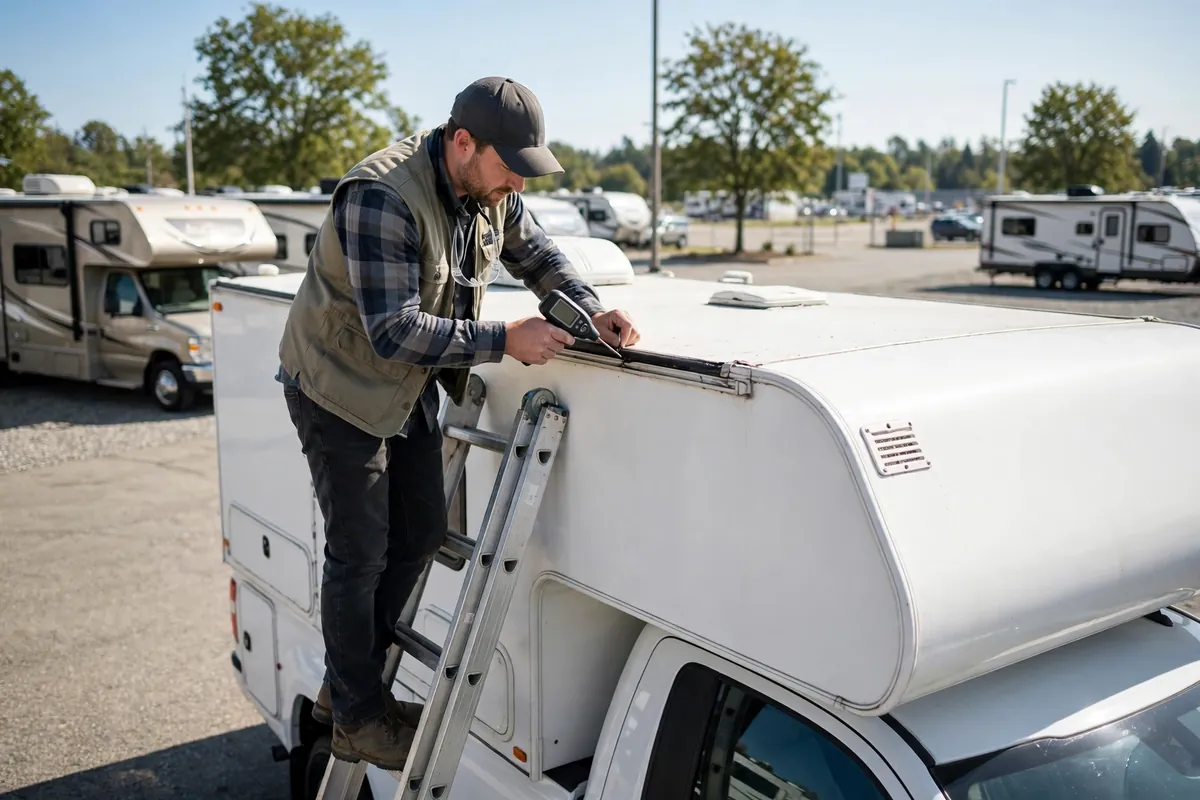
This is the reddest flag on the lot. A professional, independent RV inspector goes through the unit like a home inspector goes through a house: roof seals, propane leak-down test, outlet wiring, water intrusion, appliance function, hundreds of line items. They routinely find things the dealer’s PDI missed, and their report becomes your negotiating leverage or your reason to walk.
A buyer in a Facebook RV group once reported that a dealership refused to allow his independent inspector on the lot, citing insurance reasons. The group consensus was unanimous: inspectors carry their own insurance, so that excuse is nonsense. (getawaycouple.com)
Once the dealer’s behavior checks out, here is what to check on the unit itself before you buy. But no checklist replaces an inspector. Expect to pay a few hundred dollars for a thorough inspection, depending on the size and location of the unit. That is pocket change next to the five-figure mistake it prevents. And always schedule it before any non-refundable money changes hands.
Red Flag 6: The salesperson cannot answer five simple questions
Memorize these. Ask them on every visit. The honest dealers will answer them all; the rest will start performing.
- What does my truck’s payload sticker say, and what will this camper weigh loaded, not dry? If they cannot distinguish the two numbers, they have no business matching campers to trucks.
- Will you put the out-the-door price in writing, itemized? Hesitation here means the price was never real.
- What did the PDI cover, and can I see the checklist? Vague answers mean there was no real PDI.
- Can I have it inspected independently before money changes hands? Any no is an automatic walk.
- What does the warranty actually cover, and who does the warranty work? See the next section.
Print these out. Bring them on a card. Watch the salesman’s face. His face will tell you everything the brochure does not.
Red Flag 7: The warranty story changes when you ask who does the work
The warranty is only as good as the shop that honors it. Many truck camper manufacturers authorize warranty work through the selling dealer only. So ask: is the work done in-house, what is the current service backlog, and do you prioritize your own customers?
A dealer that is sixty days out on warranty appointments is selling you a warranty year that belongs to their calendar, not yours. One consumer guide to dealer warning signs lists exactly these questions, and warns that vague or dismissive answers signal future problems. Owners on the forums echo it: the smooth salesperson sells the camper, but the service department decides what ownership feels like for the next five years.
Here is the test I run: walk the service lot on a Saturday. A dealer with no service bay at all, just a sales office that outsources everything, is a warning sign.
Red Flag 8: The paperwork has gaps
The paperwork is boring right up until it saves you. Before you sign anything:
- Match the VIN on the buyer’s order to the VIN plate on the camper, character by character. On a used unit, run that VIN through NHTSA’s free recall lookup for open safety recalls and through NICB’s free VINCheck for theft, salvage, and flood records. A dealer should be doing this anyway; you are verifying they did.
- On a new unit, ask to see the MSO, the Manufacturer’s Statement of Origin. It is the camper’s birth certificate, and it should be in the dealer’s hands with the right VIN before money moves.
- On a used unit bought through a dealer, confirm the title status and lien situation. Whoever held the previous loan needs to be paid off and the lien released, or that lien can follow the camper to you.
- The buyer’s order must show the out-the-door price, every fee itemized, the delivery date, and every promise anyone made you in writing. Spoken promises are dust.
If the contract contains an arbitration clause, a no-return clause, or anything you do not understand, stop and read it at home. A dealer who rushes you past the fine print is telling you the fine print is not in your favor.
Red Flag 9: Delivery day comes with missing pieces and a rushed walkthrough

Delivery day is when the dealer’s attention is already on the next customer. Do not let yours be rushed. At handover you should receive the owner’s manuals for the camper and every major appliance, all keys including compartment and shower door keys, remotes for jacks or awnings, and any spare parts the dealer’s listing promised.
The walkthrough is the dealer’s final exam. The furnace should fire. The fridge should be cold. The water pump should build pressure and shut off. If the dealer hands you the keys in the parking lot with a handshake, that is a red flag about everything that came before it, including the PDI.
Before you drive off, photograph the camper, the VIN plate, the signed PDI sheet, and the buyer’s order. This takes four minutes and it is the cheapest insurance you will ever buy.
Red Flag 10: They pressure you to decide today
The discount ends tonight. Another buyer is coming at four. This is the last one at this price. Every one of these lines is designed to shut down your thinking, and they work because buying a camper is exciting and your brain is already picturing campfires.
A reputable dealer gives you time to inspect the unit, review the numbers, and sleep on it. One dealer executive put it this way in an interview about warning signs: watch how the dealership treats you from the beginning, because the sales process tells you what the service experience will be like later.
There is no camper deal so good that it expires before you can get an inspection. The ones that expire are the ones you were meant to lose.
Buying truck camper dealer tips: your playbook to flip the power
Now the constructive part. Here is how smart buyers flip the power dynamic.
Get competing quotes in writing. Email three dealers the exact model and ask for the itemized out-the-door price. Owners on the Forest River Forums recommend exactly this: know the lowest real number so you can decide whether buying closer to home is worth the difference.
Consider private party, but eyes open. A private seller has no fees, no F&I office, and often a camper with quirks disclosed by an actual owner. But you get no warranty and no service department, so a private purchase makes the independent inspection even more important. For budget shoppers, the private market is where most campers under $15,000 live.
Walk away as leverage, not as theater. The single most powerful sentence in any negotiation is “thanks, I need to think about it,” said while standing up. If they chase you into the parking lot with a better offer, you just learned the first price was padded. Real offers survive the night.
And budget the full picture before you shop. A camper’s purchase price is the down payment on a lifestyle. Maintenance, insurance, storage, suspension upgrades, and fuel all stack up. Run the real numbers in my true cost of truck camper ownership breakdown and my truck camper insurance guide so you know what you are signing up for beyond the lot.
One honest note: I am a camper owner, not a lawyer. This is consumer guidance based on real buyer experiences and public consumer-protection sources, not legal advice. Fee rules, title and lien laws, and return rights vary by state.
Frequently asked questions
Can I trust what a truck camper dealer tells me about my truck’s payload?
Trust the door sticker and the CAT scale, not the salesman. Dealers routinely quote dry weight, which is 800 to 1,500 pounds lighter than the real loaded weight, and many salespeople cannot explain the difference. Do your own math using the yellow Tire and Loading Information placard on your driver door, subtract passengers and gear, and verify with a scale weigh before you sign.
Should I get a truck camper inspected before buying from a dealer?
Yes, even on a new unit. An independent RV inspector checks hundreds of items the dealer’s PDI often misses, and their report gives you repair demands or a reason to walk. Any dealer who refuses to let your inspector on the lot, for any reason, is a dealer to walk away from. This applies on top of doing your own unit inspection checklist walkthrough.
What fees can a truck camper dealer legally charge?
It varies by state; many states cap doc fees, some do not. What matters is disclosure: the FTC expects advertised prices to include all mandatory fees, with only government taxes and registration excluded. Any fee that appears at signing but was not in your written, itemized out-the-door quote is negotiable at best and deceptive at worst.
Is it normal for a dealer to require full payment before the PDI walkthrough?
No, and it is a serious red flag. Paying in full before inspecting hands all leverage to the dealer. RV owners on the forums report that dealers who collect everything up front become much harder to deal with when PDI findings need fixing. Standard practice is a deposit, then the balance after the PDI and walkthrough are complete and any agreed repairs are done.
What should a proper truck camper PDI include?
A real PDI takes several hours: fridge tested on gas and electric, furnace burn-in, water system pressurized and checked for leaks, roof and seals inspected, every appliance demonstrated working, and jacks and tie-downs verified. Get the completed checklist in writing with a signature. A dealer who will not show you the checklist, or who will not let you observe the PDI, almost certainly did not do a real one.
What if the dealer is the only one who can do my warranty work?
That makes the service department the most important part of the purchase. Ask about current backlog, whether warranty work is done in-house, and whether out-of-area owners get help on the road. If the dealer has no real service bay, or is months out on warranty appointments, factor that in as a cost of buying there, and consider a dealer with an actual shop even if the price is slightly higher.