Best Truck Camper for Toyota Tacoma: What Actually Fits Without Overloading It
The Toyota Tacoma is the most camper’d midsize truck in America, and the one most often overloaded by the camper in its bed. Both things are true at once, and every Tacoma camper thread on every forum eventually lands on the same uncomfortable math: a 3rd-gen Tacoma’s payload sticker usually reads somewhere between 1,120 and 1,685 pounds depending on cab, bed, and trim, and the 2024+ trucks run roughly 1,230 to 1,705. That number is not your camper budget. It is your camper plus people plus water plus gear plus every bolt-on you’ve added to the truck. Most owners who actually put their loaded rig on a scale discover they’re over — usually by a few hundred pounds — and then spend a year arguing with strangers on the internet about what that means.
I have spent a lot of time in those arguments, because they are where the real answers live. If you’re hunting for the best truck camper for Toyota Tacoma, here is what actually fits, what the dry-weight numbers become once you add options and water, and what owners who have lived with these campers say about the part the brochure never mentions: the suspension.
Start With Your Door Sticker, Not the Brochure
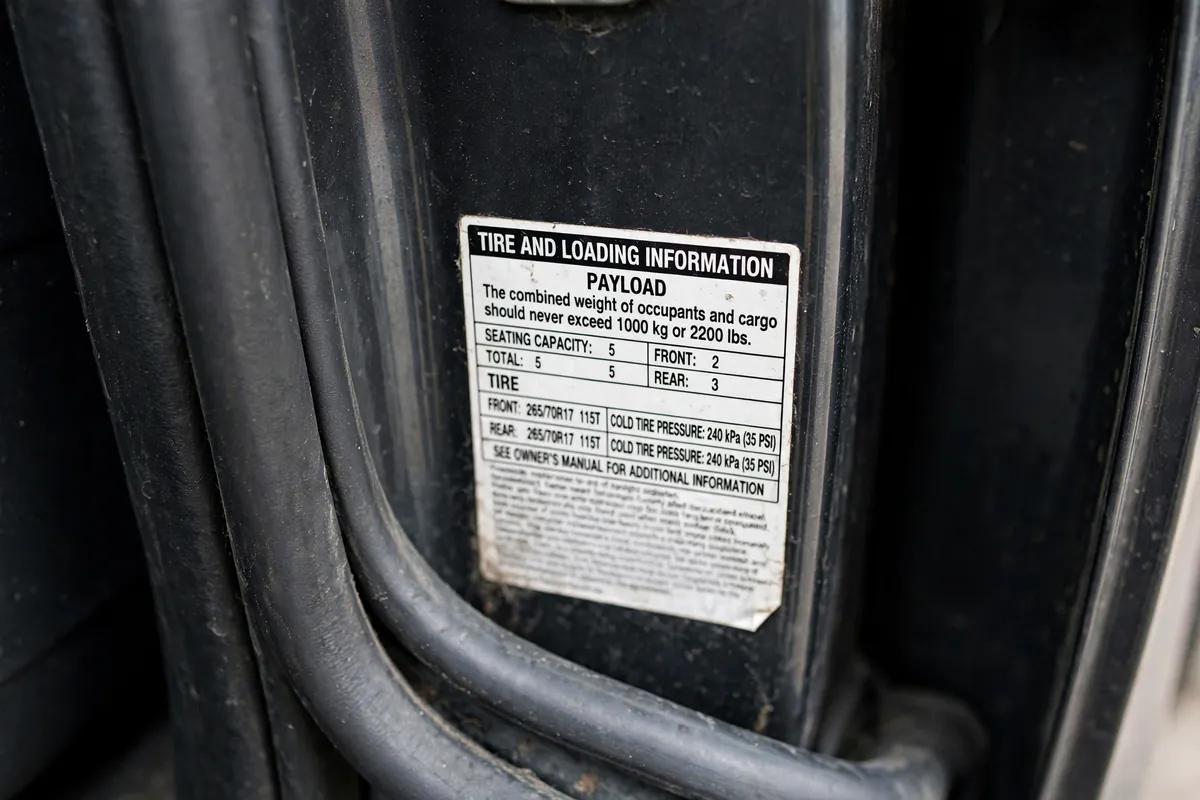
Toyota’s headline payload numbers are maximums for specific configurations. Your truck’s real number is printed on the driver-door jamb sticker, and on a loaded 4×4 double-cab it can be a couple hundred pounds below the brochure. One 2025 TRD Off-Road owner weighed his and found about 1,297 pounds of real payload, with roughly 30 pounds of gear and a full tank. The hybrid Trailhunter, for all its overlanding hardware, carries one of the lowest ratings of the lineup at around 1,475 pounds, because the battery, steel bumpers, and 33s all eat into the budget before you buy a single camping item.
So before anything else, read the sticker. Then do the subtraction owners call the “consumables tax”: two adults at roughly 350 pounds combined, a full 20-gallon freshwater tank at 167 pounds, propane at 20 to 40, and a couple hundred pounds of food, bedding, tools, and recovery gear. That is 600 to 700 pounds gone before the camper enters the picture. On a Tacoma with a 1,300-pound sticker, your honest dry-camper budget is about 600 to 700 pounds.
If you want to work the numbers properly, our truck camper payload calculator guide walks through real scale weights. The single most useful thing a Tacoma owner can do, though, is what one Overland Bound member did and then warned everyone about: take the loaded rig to a CAT scale once, before you spend a dollar on upgrades, and face the number.
The Slide-Ins That Fit: Four Wheel Camper Swift and Fleet
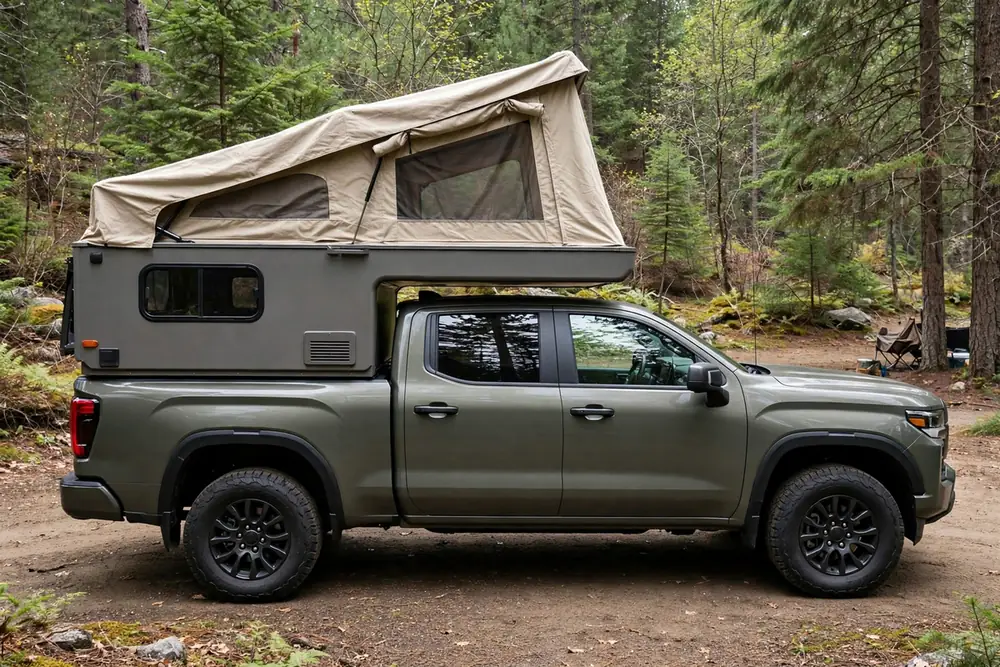
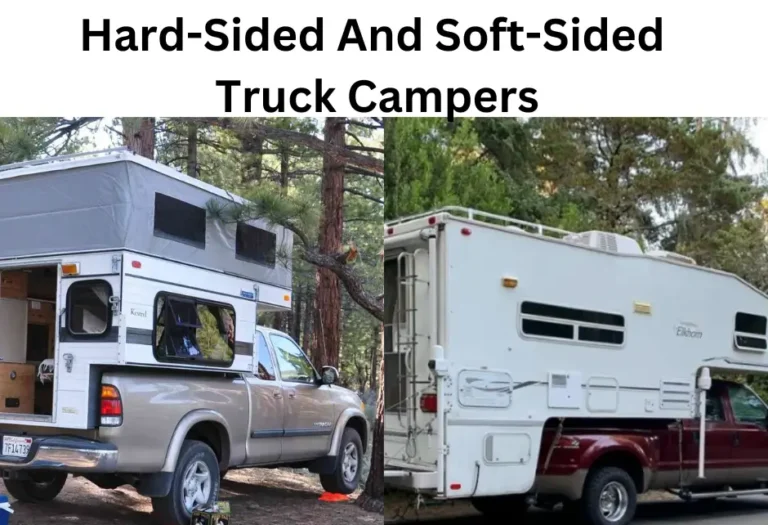
This is the classic Tacoma pairing, and it is classic for a reason — Four Wheel Campers builds models specifically around the Tacoma’s beds. The Swift fits 5-foot beds and the Fleet fits 6-foot beds, and the Fleet is FWC’s best-selling midsize model for a reason. Our Four Wheel Camper Fleet vs Swift vs Hawk breakdown covers the model differences in detail; what matters for the Tacoma question is weight.
The numbers to work with: the Swift’s dry weight is around 935 to 950 pounds, and the Fleet sits around 1,050 pounds, per Four Wheel Campers‘ own materials. Those are dry, base-model weights — options like the furnace, water heater, and awning add up fast, and a full water tank adds another 167 pounds. A built-out Fleet with water is realistically a 1,300-plus-pound camper. On a 1,600-pound-sticker long-bed Tacoma, that is a workable setup with careful packing. On a 1,200-pound-sticker short-bed truck, you are starting over and choosing it anyway, which is exactly what most Swift owners do.
Which is the part nobody warns you about at the dealership: most slide-in Tacoma rigs are at or over GVWR in real travel trim. An Expedition Portal owner running a flatbed Fleet on a Tacoma weighed his rig at 6,840 pounds — over his rear axle rating — and has put 75,000 trouble-free miles on it by doing the unglamorous things: driving conservatively, leaving extra space, and upgrading brakes and adding sway bars after a hot downhill grade cooked his stock brakes. His conclusion was honest rather than preachy: the truck is overweight, he knows it, and he drives it like it. That attitude — know the number, adjust the driving — is the consensus among long-term owners.
Pricing: FWC’s slide-ins currently start around $20,275 on their site, with the October 2025 spec sheets listing Swift package builds at $28,995 (Custom), $36,420 (Essential), and $41,170 (Advanced). These are not cheap campers, and Tacoma buyers are usually cross-shopping them against lighter, cheaper wedge options. If you are unsure which class you actually want, our best wedge canopy campers roundup lays out the lightweight alternative in full.
The Hardwall Middle Ground: Scout Yoho
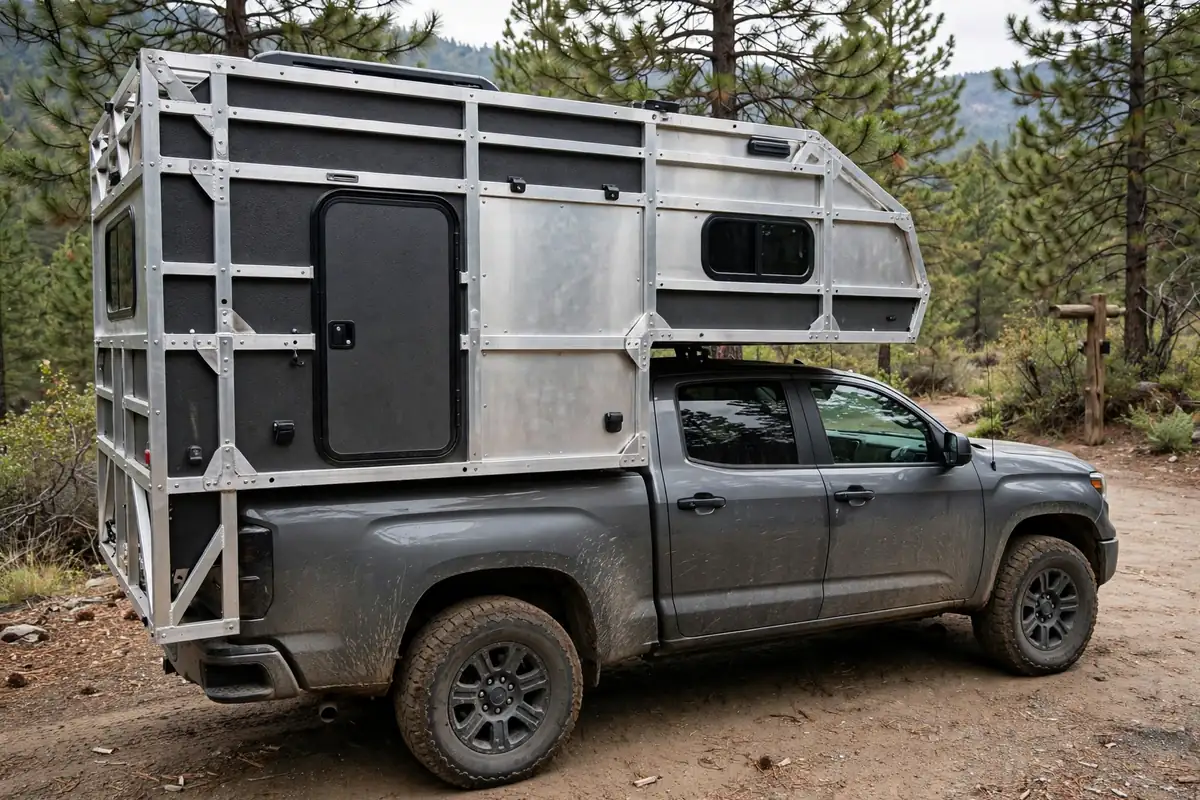
The Scout Yoho is the camper that makes the Tacoma payload problem nearly disappear on paper. The hardwall version lists a base weight around 929 pounds — Scout’s own spec page also shows 904 pounds in the specs table, so call it 905 to 930 — and it is designed explicitly for midsize trucks, with Toyota Tacoma 5-foot and 6-foot beds called out in the fitment list. At $27,990 starting, it slots between the wedge campers and a built-out FWC.
The Yoho is worth understanding because it attacks the Tacoma problem from a different angle than FWC: no canvas pop-up liner, a fiberglass-and-composite hardwall body, solar and a lithium power tower standard, and removable jacks that save 124 pounds of travel weight when you pull them off. A 4th-gen Tacoma owner on the Tacoma4G forum researching a Yoho pairing reported that real-world equipped weight runs closer to 1,200 pounds once you add the fridge, heater, awning, and your own gear — still dramatically friendlier than a Fleet.
If the hardwall price stings, Scout also builds a pop-up Yoho at roughly 976 pounds estimated weight starting at $27,900 — similar money, less insulation. For most Tacoma owners the decision between the Yoho and an FWC comes down to camping style: hardwall four-season comfort and a higher price, or the classic pop-up with its lighter wallet hit up front.
The Heavy End: Palomino Backpack SS-500
The Palomino Backpack SS-500 gets mentioned in every “campers for midsize trucks” list, and it is the one I would treat with the most caution. Palomino is still building it — the 2026 lineup includes the SS-500 soft-side, and Truck Camper Magazine covered Palomino’s 2026 model updates — but the weight tells the real story. Published dry weights range from about 1,197 pounds up to roughly 1,419 in dealer 2026 listings, and its 2025 MSRP sat around $17,495.
Do the subtraction on a 1,300-pound-sticker Tacoma: a 1,200-plus-pound camper plus 167 pounds of water plus two people puts you over before you’ve packed a single bag. The SS-500 only pencils out if you have one of the higher-payload Tacoma configurations — a long-bed 4×2 SR5, for example — and even then it’s a tight fit. Palomino still builds it — the 2026 lineup at palominorv.com includes the SS-500 soft-side — but weight is the whole story here. It is also the only option on this list with an electric roof lift, a genuine kitchenette, and a price thousands below the FWC and Scout slide-ins, which is why it keeps selling.
The Wedge Campers: GFC, Super Pacific, and Hiatus
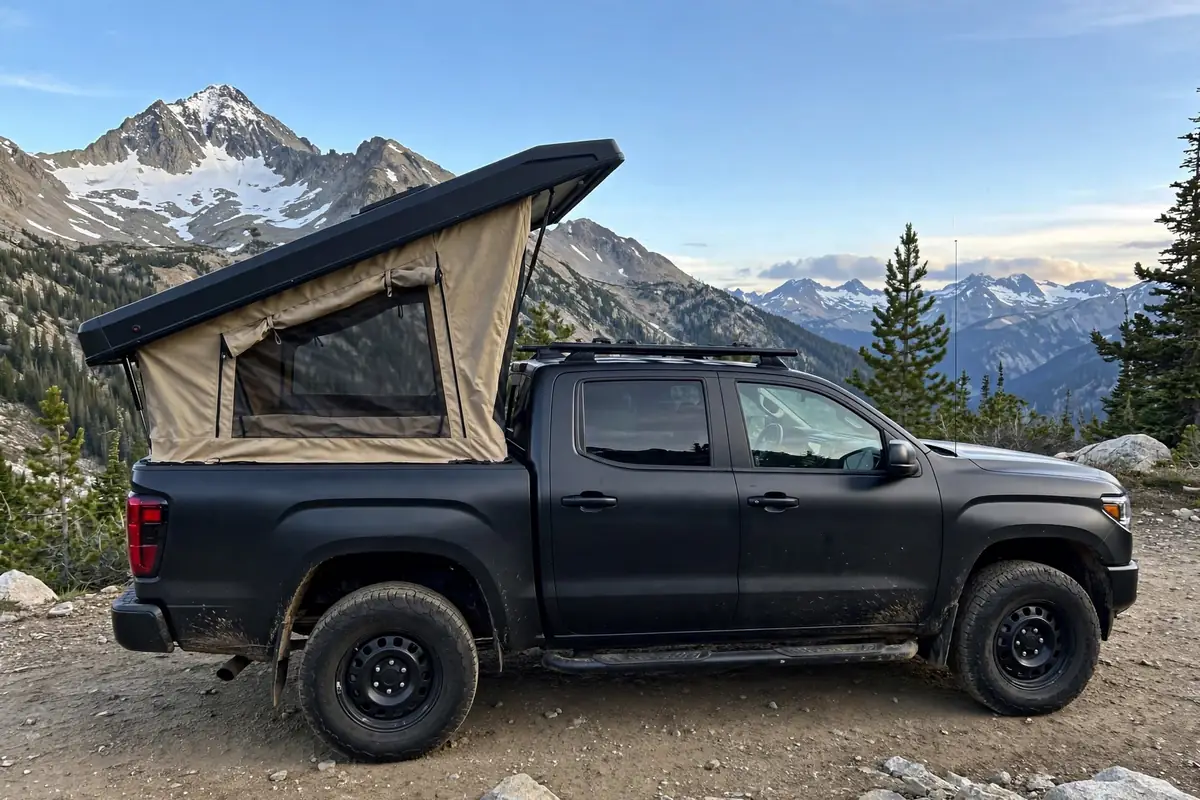
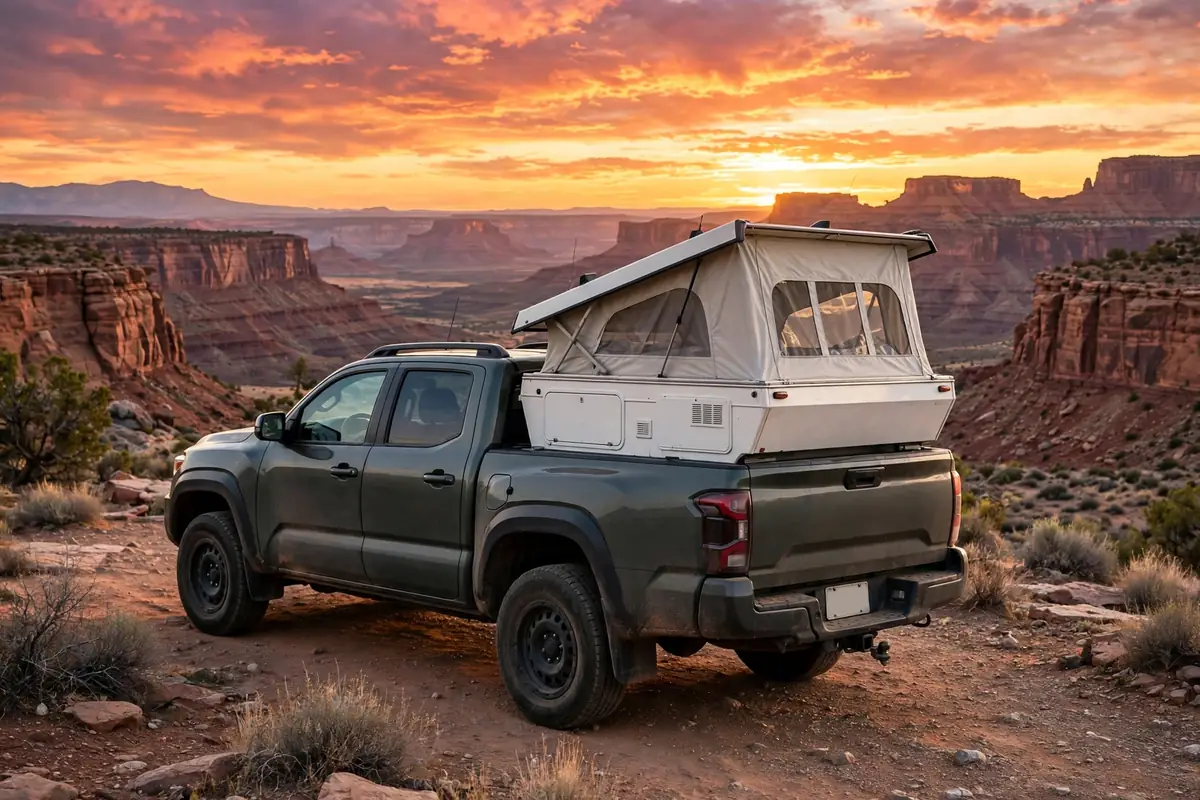
This is where the Tacoma crowd actually lands when the payload math gets honest. Wedge campers weigh a fraction of a slide-in, keep the bed usable, and stay well inside even a 1,200-pound payload sticker. Our full best wedge canopy campers comparison goes deep, but here is the Tacoma shortlist:
Go Fast Campers (GFC). The lightest serious option: the Tacoma-fit Platform Camper weighs roughly 266 to 278 pounds depending on bed length, and a Tacoma owner who ran one for two and a half years reports it barely affects daily driving — a small MPG hit, a little top-heaviness, but nothing that makes the truck unpleasant. GFC’s current lineup has moved to the V2 Pro and V2 MAX campers, with partner retailers listing the V2 Pro around $8,550. The tradeoff: it’s a sleeping platform over your bed, not a camper interior. No furnace, no kitchen, no standing up.
Super Pacific X1. The Portland-built wedge, 345 to 397 pounds depending on truck, at $13,495 for midsize trucks. Riveted aluminum like an airplane, a real Exped mattress, 5-year warranty, and free installation at their Portland shop. It’s the wedge for people who want the GFC concept with more refinement and a bigger-tent feel.
Hiatus Campers. The hard-sided pop-top from Bellingham — no fabric walls, folding composite panels instead — at 460 to 490 pounds for a midsize truck, starting at $17,000. It’s the most camper-like of the wedges, with a full-height interior when popped, and owners pick it specifically because the hard walls handle weather and condensation better than tent fabric. Lead times run long — roughly a year — because each is custom-built.
What Owners Actually Do About the Suspension
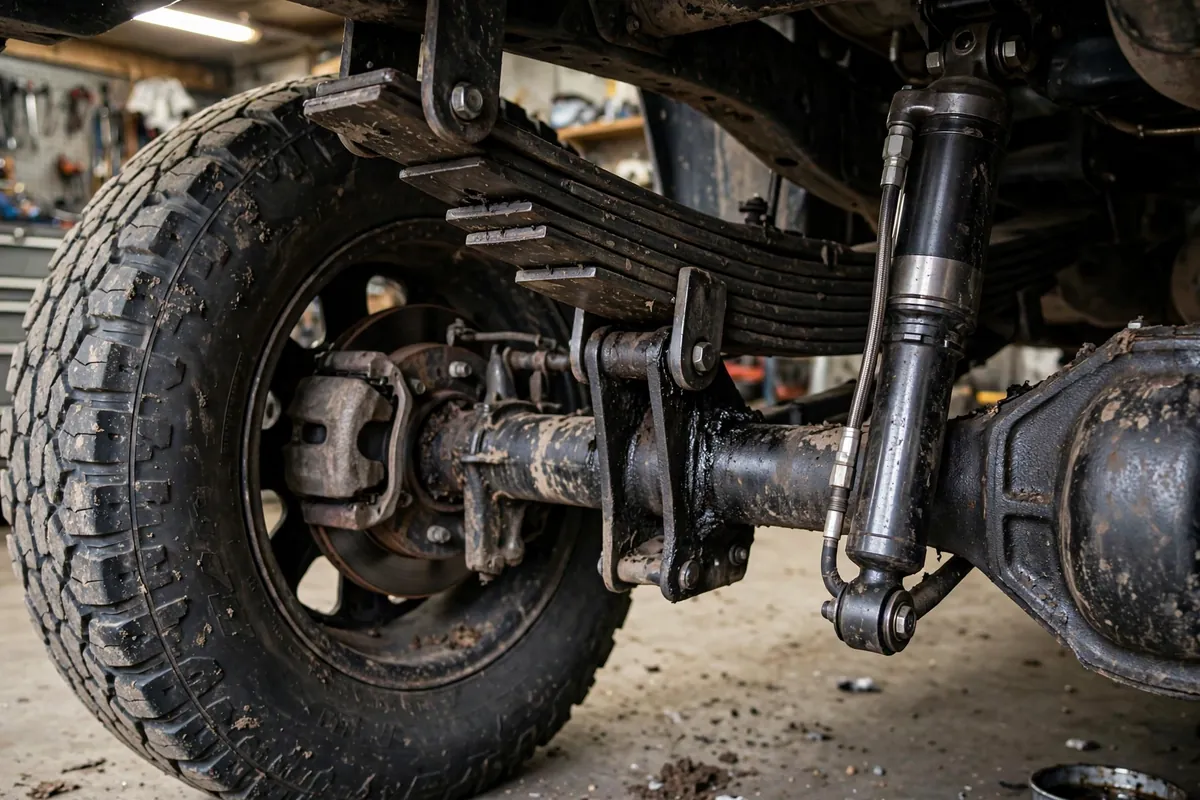
Here is where the forum research pays off, because the community verdict on Tacoma camper suspension is remarkably consistent — and it contradicts most of what the accessory catalogs suggest.
Problem 1: Airbags alone don’t carry a camper. A WanderTheWest owner with a 2010 Tacoma and a 2017 Fleet learned this the hard way: he thought airbags would be the only upgrade he needed, and one of them imploded under the load. The owner consensus is that airbags restore ride height but don’t carry weight — they’re a supplement to adequate springs, not a replacement. If your leaf pack is tired or too light, the correct fix is springs first.
Problem 2: Add-a-leafs are a gamble. Exploring Overland’s long-term Tacoma/FWC build is the cautionary tale: they broke two add-a-leafs and know of a half-dozen more, because a generic extra leaf is rarely matched in rate and shape to the existing pack and ends up overstressed — especially when used to revive a worn spring pack. The fix owners land on: a full replacement leaf pack (Deaver, Alcan, OME Dakar) built for the actual load, not a bolt-on leaf. One Expedition Portal member had a local spring shop build a custom pack rated to the truck’s real weight and ended up sitting level with a thousand pounds in the bed.
Problem 3: Off-roading with airbags tears them. If you do run airbags and take the truck off-road, owners share a specific fix: Daystar airbag cradles instead of the standard bottom mount, so the bags can separate from the axle at full articulation rather than getting ripped. It is a small part that prevents an expensive failure.
Problem 4: The 4th-gen trucks changed the game. The 2024+ Tacoma ditched rear leaf springs for coil springs, which means the entire helper-spring playbook (airbags, Timbrens, SumoSprings) works differently — and at the time 4th-gen owners were shopping, only two airbag kits existed for the platform. If you own a 4th-gen, verify fitment for your exact year before buying any suspension product designed around the leaf-spring trucks.
One thing every camp agrees on, and it showed up in nearly every thread I read: suspension upgrades make a heavy load ride and handle better, but they do not change your GVWR, your payload sticker, or your axle ratings. A TacomaWorld member with an FWC put it bluntly — upgrading your suspension only subtracts from your available payload, because the springs themselves add weight. The helpers are about control and safety margins on a load you’ve already committed to, never a permission slip to ignore the number.
The Porpoising, Sway, and Daily-Drive Reality
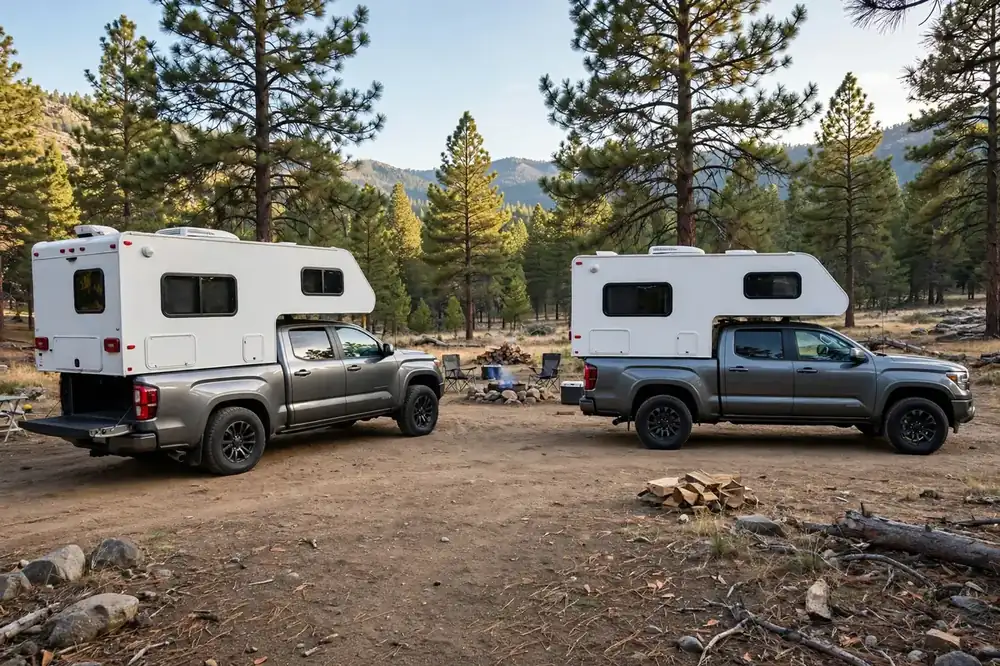
A loaded Tacoma camper rig has a personality, and owners describe the same three traits: it porpoises on rolling highways, it leans in crosswinds and when semis pass, and it rides like a different truck empty versus loaded. The first two are physics — a tall camper over the rear axle — and the fixes are the same ones that work on every truck camper: a real rear leaf pack, a rear sway bar, and load-range E tires run at full sidewall pressure. Our truck camper porpoising fix guide covers the full playbook.
The third trait is the one that surprises people: a Tacoma that rides like stock on Monday with the camper off and hauls 1,000 pounds of camper all weekend is genuinely two trucks, and that’s why so many owners pull the camper between trips. If you’re buying a slide-in, budget for camper jacks and a flat place to store it.
So Which One Is Actually the Best Truck Camper for a Toyota Tacoma?
It depends on your sticker and your honesty about weight, but here’s how the decision tree actually plays out for most buyers:
If your door sticker reads 1,500-plus and you camp year-round: the FWC Fleet (6-ft bed) or Swift (5-ft bed) is the answer. It’s the most camper for a Tacoma, the dealer and service network is the deepest in the industry, and the pop-up profile keeps highway manners acceptable. Budget $20,000-plus to start, and accept that you’ll be near GVWR in travel trim. This is also the pick if you’re comparing against the Gladiator world — our Jeep Gladiator camper guide shows the same slide-in logic playing out on the other midsize truck, and the Tacoma wins on payload in most configurations.
If your sticker reads 1,200 to 1,400 and you want four-season comfort: the Scout Yoho hardwall. It leaves you the most payload margin of any real camper on this list, it’s genuinely four-season, and the modular gear philosophy means you only carry what each trip needs.
If you want the lightest possible setup that still sleeps two: a wedge — GFC for the minimalist, Super Pacific for the refined build, Hiatus for hard walls. You’ll never think about payload again, and the truck stays a truck.
If you want a full kitchen on a budget and your sticker supports it: the Palomino SS-500. Just don’t buy it hoping the weight works out. Do the math first, with your actual sticker, your actual water, and your actual people.
And whatever you choose: weigh it loaded, once, on a real scale. Every owner who has done it says the same thing — the number is always higher than the estimate, and knowing it is the difference between a rig you’re confident in and a rig you’re guessing about. For the broader lightweight landscape beyond the Tacoma, our best lightweight truck camper roundup puts these weights in context across every truck class.
FAQ
What is the payload capacity of a Toyota Tacoma for a truck camper?
For 3rd-gen trucks (2016–2023), the door-sticker payload typically falls between about 1,120 and 1,685 pounds depending on trim, cab, and bed. The 2024+ trucks range from roughly 1,230 to 1,705 pounds. Always use your own door-jamb sticker, not the brochure — and remember that people, water, gear, and accessories all come out of the same number.
Can a Toyota Tacoma carry a Four Wheel Camper Fleet?
Yes — the Fleet is FWC’s midsize-truck model and is specifically fitted for 6-foot-bed Tacomas (the Swift fits 5-foot beds). But “fits” and “stays under GVWR” are different things: a built-out Fleet with water is realistically a 1,300-plus-pound camper, so it works cleanly on higher-payload Tacoma configurations and runs at or over the limit on lower-sticker trucks. Most owners run it anyway with suspension upgrades and conservative driving.
Is a Scout Yoho too heavy for a Tacoma?
No — the Yoho is one of the lightest real campers available at roughly 905 to 930 pounds base weight, and it’s explicitly designed for midsize trucks including the Tacoma. Equipped weight with fridge, heater, awning, and gear runs closer to 1,200 pounds according to owners, which still leaves margin on most Tacoma stickers.
Do I need suspension upgrades for a camper on my Tacoma?
For a wedge camper in the 300-to-500-pound range, usually no — stock suspension handles it. For any slide-in camper (FWC, Scout, Palomino), plan on suspension work: at minimum a proper rear leaf pack, plus quality shocks and load-range E tires. Airbags help with leveling but shouldn’t be your only upgrade — owner experience says they restore ride height without actually carrying the load.
What’s the lightest truck camper option for a Tacoma?
The Go Fast Campers Platform Camper at roughly 270 pounds is the lightest serious option, followed by the Super Pacific X1 at 345 to 397 pounds and the Hiatus hard-sided pop-top at 460 to 490 pounds. These wedge/topper designs keep the bed usable and stay far inside even a 1,200-pound payload sticker.