How to Finance a Truck Camper: Loan Types, Rates, and What Lenders Actually Check
A truck camper is a strange product from a bank’s point of view: expensive enough to need a real loan, light enough to slide into a pickup bed, and hard enough to value that plenty of lenders would rather not deal with it. First-time buyers walk in with car-loan expectations and walk out surprised — by the age rules, the insurance demands, or what a twenty-year note actually costs.
If you’re researching how to finance a truck camper, the short version is this: three loan types work, the lender scrutinizes the camper as much as you, and the cheapest-looking payment usually costs the most. Here’s the full picture.
Quick honesty note before we go further: I’m not a financial advisor and this isn’t financial advice. Rates move, every lender has its own underwriting book, and the numbers below are illustrative examples and advertised figures, not promises. Verify everything with your actual lender.
How to finance a truck camper: the three routes that work
You have three real options, and they behave very differently.
A secured RV loan. The camper is the collateral, the lender holds a lien, and in exchange you get a lower rate and a longer term — commonly 10 to 15 years, sometimes 20 on larger amounts. The Good Sam Finance Center, which explicitly lists truck campers among the RVs it finances, publishes terms of 20 years for loans of $50,000 and up, 15 years for $25,000 and up, and 6 to 10 years under $25,000. Bankrate’s October 2026 RV loan survey lists advertised starting rates like 6.24–7.24% at Alliant Credit Union, 6.49% at Good Sam, 7.45% at Navy Federal, and 7.99% at U.S. Bank.
An unsecured personal loan. Here your credit score is the collateral. LightStream’s camper financing is the best-known example: a fixed-rate, unsecured loan from $5,000 to $100,000, no fees, no prepayment penalties, no appraisal — money lands in your bank account and you go buy whatever you want. The tradeoff is real money: Bankrate pegs the average personal loan rate at 12.28% as of mid-2026, versus the mid-6s advertised on secured RV loans, and terms run shorter. For a cheap used pop-up, this is often the only game in town.
Dealer-arranged financing. Convenient, and that’s the whole pitch. You sit in the finance office, they call their bank partners, and you drive off with the camper. Sometimes the rate is genuinely competitive. Often it isn’t, because the dealership marks up the rate the lender actually approved — more on that below. Never take dealer financing as your first and only quote.
The sensible order: get pre-approved by a credit union or RV lender before you set foot in a dealership, then let the dealer try to beat it. You lose nothing by comparing, and it changes the entire dynamic of the negotiation.
What lenders actually check before they say yes
Qualifying for an RV loan is harder than a car loan and closer to a mortgage application, especially once you’re asking for a long term on a big amount.
Your credit score is the whole ballgame. Most RV lenders want at least 670 for standard terms; the best rates go to scores of 760 and up. The gap between brackets is brutal. One current rate table shows a $50,000–$74,999 loan at 9.24% for a 700–739 score versus 15.45% for 680–699. On a $60,000 loan over 15 years, that’s about $617 a month against about $858 — roughly $51,000 in lifetime interest versus roughly $94,500. Slipping under 700 can cost you on the order of $43,000 over the life of the loan. If your score is near a cutoff, a few months of credit cleanup before applying is the highest-paying work you’ll ever do.
Your debt-to-income ratio. Most RV lenders want your total debt load, including the new payment, under 40% of income; some stretch toward 45%. They’ll verify income with pay stubs or tax returns, and self-employed buyers should expect to show two years of history.
The camper itself has to qualify. This is the part car buyers never think about. The lender wants the year, make, model, and VIN, and they’ll pull a valuation from the J.D. Power (formerly NADA) guidebooks the industry runs on. They want a clean title, good condition, and recreational use only — most RV lenders won’t finance a rig you’re going to live in full-time. Some require a professional inspection on used units, which can cost a few hundred dollars before the loan even funds.
Your down payment. Plan on 10 to 20 percent. Zero-down programs exist — Good Sam advertises one up to $100,000 — but expect a higher rate, and borrowing the full price of a depreciating asset puts you underwater the day you sign.
The used-camper age trap
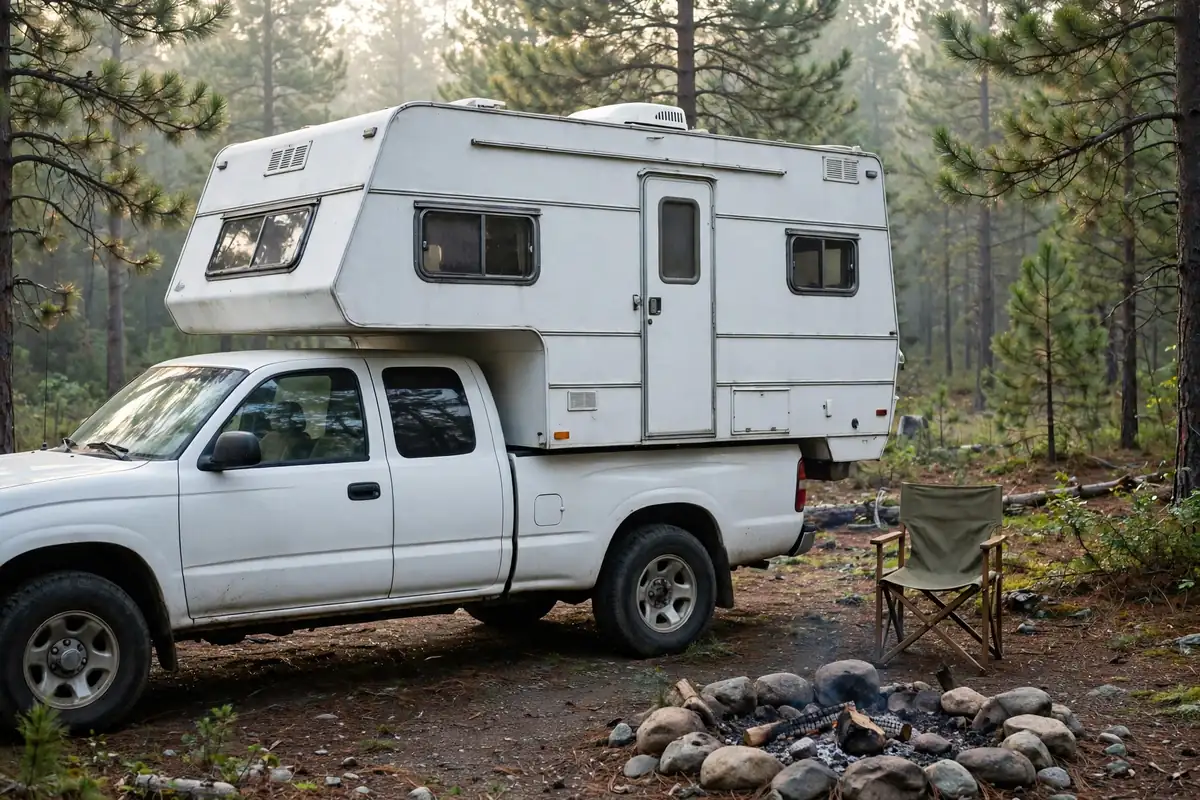
Here’s the surprise that ruins more used-camper purchases than anything else. Most banks will only finance an RV that’s 10 to 15 model years old or newer. Credit unions sometimes stretch to 15. Specialty RV lenders go further — Good Sam says it finances standard RVs up to 20 years old — but they’re the exception.
It’s not just approval; it’s the term. Many lenders use an age-plus-term cap: the camper’s age plus your loan term can’t exceed roughly 20 years. A 10-year-old camper caps you at about 10 years of financing; a 15-year-old unit might only qualify for 5 years or get declined outright.
And every January the math moves against you, because cutoffs are measured in model years — a 2010 camper shopping for a loan in 2026 is 16 model years old. If you’re eyeing a unit sitting on the edge of a cutoff, apply sooner rather than later.
The age rule hits truck campers in a special way. The used market under $15,000 is full of solid campers that are 15 to 20 years old — exactly the units conventional lenders won’t touch. That’s when your options shrink to a credit union you belong to, an unsecured personal loan, or cash. Owners on Expedition Portal are blunt about it: most of them paid $3,500 to $8,000 cash for used pop-ups and follow a “zero debt for hobbies” rule.
There’s a stranger edge case too. If your camper has no book value at all — a custom build, a DIY shell, a flatbed one-off — a secured lender cannot establish the collateral’s value, so there’s nothing to secure the loan against. Owners who’ve been through it say the only paths are an unsecured personal loan or cash — and Good Sam’s FAQ confirms its unsecured loans are designed for exactly this: older RVs and models not listed in NADA or other value guides.
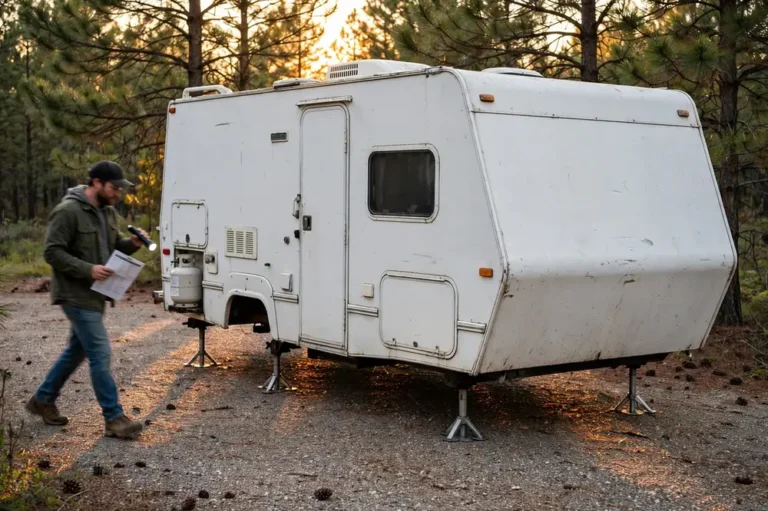
Whatever used camper you’re chasing, walk it with a proper checklist before money moves. Our used truck camper inspection checklist is the one I’d print and bring — leaks and soft floors are how a financed camper turns into a loan on something worth less than you owe.
Dealer financing and the markup game

Now for the part nobody at the dealership wants to explain. When a dealer arranges your loan, the lender approves you at one rate — the “buy rate” — and the dealer is allowed to present you with a higher one. The spread is dealer markup, and it drops straight into the dealership’s pocket. Owners who’ve worked in the business say the markup split runs roughly three-quarters to the dealer, one-quarter to the lender, and the finance manager’s commission is built on that back-end spread plus extended-warranty contracts. The rate you’re quoted in the finance office is negotiable whether or not anyone admits it.
The community stories are consistent. On iRV2, one buyer got pre-approved at his bank, walked in with that letter, and watched the dealer beat it by two full percentage points — about $40 a month back in his pocket. Another regular puts it bluntly: credit unions are usually a couple of points cheaper than RV dealers. And on the Good Sam forums, a longtime poster tells of watching a dealer collect a fee for selling an 8% loan to a buyer who qualified at 6%.
The defense is simple and it works: get pre-approved elsewhere first, then ask the dealer for the buy rate in so many words. “What rate did the lender actually approve me at, before your markup?” Naming it out loud kills the game. Even if dealer financing ends up winning — and sometimes it does, dealers have real lender relationships — you want that to happen by comparison, not by default. Negotiate the out-the-door price first, show your pre-approval second, and decline the extended warranty and paint protection without guilt.
The credit-union route

If dealer financing is the most convenient route, the credit-union route is usually the cheapest — and owners say so with remarkable consistency. Adirondack Federal Credit Union’s current published tables start at 6.00% for new campers and 6.25% for used, with terms out to 120 and even 144 months. Bankrate’s October 2026 survey has Alliant and Southeast Financial advertising 6.24% starting rates. Credit unions also tend to be more flexible on the weird stuff — older units, private-party sales, oddball truck campers — because they underwrite the borrower as much as the collateral.
The catches: you have to be (or become) a member, and some credit unions cap RV terms lower than specialty lenders. The play is to join early, get pre-approved with your rate locked in writing, and use that letter as your weapon at the dealership.
Down payments: what 10% versus 20% actually buys you
A bigger down payment cuts the financed amount, the monthly payment, and the total interest — and it pulls your loan-to-value into the range where lenders offer their best rates. On a $35,000 camper at 7.5% over 10 years, 10% down means financing $31,500 at about $374 a month; 20% down means financing $28,000 at about $332 a month. That’s roughly $42 a month and $5,000 less interest over the life of the loan, plus real equity from day one instead of a prayer.
The zero-down programs deserve a hard look before you celebrate them. Borrowing 100% of the price of something that loses 10 to 15 percent of its value in the first year means you’re underwater immediately, and the rate premium on zero-down loans deepens the hole. If you have the cash and choose to finance anyway to keep reserves liquid, that’s a strategy. If you’re going zero-down because you have no down payment, you probably can’t afford the camper yet. That stings, but a repo on your credit report stings for seven years.
The total-interest math on long terms

This is where the long terms reveal their true cost. Take a $50,000 loan. At 8% over 20 years, the payment is about $418 a month — but total interest comes to roughly $50,373, for a grand total of about $100,373. You pay for the camper twice. At 7.5% over 15 years, the payment rises to about $464 a month and total interest drops to roughly $33,431 — about $83,431 all-in, saving you $17,000 in interest for an extra $46 a month. At 7.5% over 10 years, the payment is about $594 a month but total interest is only about $21,221 — about $71,221 all-in, nearly $30,000 saved versus the 20-year loan.
These are illustrative figures computed at fixed rates — your actual numbers will differ — but the shape never changes. Long terms trade a smaller payment for a dramatically larger total cost, and on a depreciating asset it’s worse than it looks: in year twelve of a twenty-year loan you’re still paying full price for a camper worth a fraction of the balance. My rule of thumb: take the longest term only if the payment genuinely requires it, then pay it like a ten-year loan. Most RV loans have no prepayment penalty, so every extra dollar goes straight to principal.
And if you want the full picture beyond the loan — insurance, maintenance, storage, truck upgrades — run it through our true cost of truck camper ownership guide. The payment is never the whole payment.
The insurance surprise at closing

Here’s the gotcha that blindsides buyers at the worst possible moment. Most secured RV loans require proof of comprehensive and collision insurance before the loan funds. Not liability-only, not your truck’s policy with a shrug — full coverage on the camper, with the lender listed as lienholder, bound before they’ll release the money. Good Sam’s closing checklist lists proof of insurance right alongside the purchase agreement and title, and plenty of buyers discover this two days before delivery while scrambling for quotes.
Get quotes before you’re under contract, not after — truck camper coverage is its own odd corner of the market, and on unusual units you can end up needing an agreed-value policy, which owners report as expensive. Our truck camper insurance guide walks through the options. And a smaller, lighter camper costs less to insure too — see our best lightweight truck camper picks.
The second trap comes later: let coverage lapse mid-loan and the lender can force-place its own policy on your camper and add the premium to your balance. Force-placed insurance is priced for the lender’s convenience, not your wallet. Keep the policy current and the lienholder endorsement on it for the life of the loan.
Buying used and cheap? Read this first
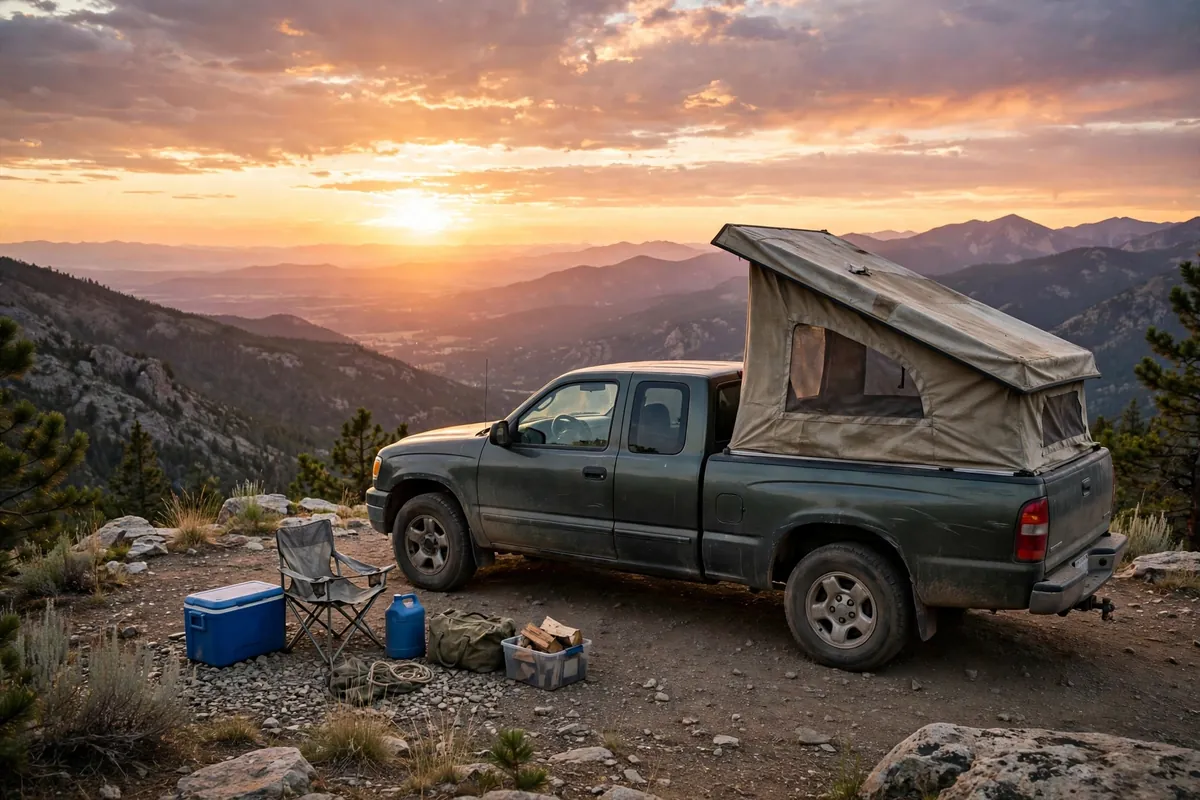
Not every camper needs financing. The used market under $15,000 is where truck camping gets affordable, and it’s also where bank financing mostly doesn’t reach — the units are too old for conventional lenders and the amounts too small for the big RV loan desks. A personal loan or cash is the realistic path, and forum owners genuinely prefer cash at these prices. Browse our budget truck campers under $15,000 roundup and you’ll see why: at these prices, a year of saving beats five years of interest.
One more financing-adjacent headache before you borrow for a used camper: selling it later. An owner on Expedition Portal flags something car buyers never deal with — selling a private-party camper that still has a lien on it. With a car, there’s a VIN, a state title process, and everyone knows the drill. With a truck camper the documentation is less standardized, and buyers treat a liened private-party camper as a serious turn-off. If you might upgrade in two years, a shorter loan you can clear before selling beats a fifteen-year note you’ll have to unwind mid-sale.
And if you’re still deciding whether truck-camper life is even for you, renting one before you buy is the cheapest education in camping. A weekend rental costs less than one month’s interest on the wrong loan.
Frequently asked questions
Can I finance a truck camper with a low credit score? Yes, but the terms get ugly. Specialty lenders like Good Sam publish a 600 minimum FICO for purchases, and some subprime RV lenders go into the mid-500s. Expect double-digit rates, a bigger down payment, and shorter terms — and run the total-interest math first, because at 15% plus, most of your early payments are pure interest.
Can I get a loan on a 20-year-old truck camper? Rarely through a conventional bank — most cap out at 10 to 15 model years. Good Sam says it finances standard RVs up to 20 years old, and credit unions are sometimes more flexible. Anything older is realistically unsecured-personal-loan territory, which doesn’t care about the camper’s age because the camper isn’t the collateral.
RV loan or personal loan for a truck camper — which is better? A secured RV loan usually wins on rate and term if the camper qualifies. A personal loan wins on flexibility: no age limits, no inspections, no lien, money in your account for private-party deals. For campers under about $15,000 or older than 15 years, a personal loan or cash is often the only practical choice.
How much down payment do I need for a truck camper? Plan on 10 to 20 percent. Zero-down programs exist — Good Sam advertises one up to $100,000 — but you’ll pay a higher rate and start underwater on a depreciating asset. More down means a better rate, a smaller payment, and equity from day one.
Do I need insurance before the loan funds? Almost always yes. Secured RV lenders require proof of comprehensive and collision coverage, with the lender listed as lienholder, before releasing funds. Arrange it during the purchase process, not after — and keep it current, because a lapse lets the lender force-place expensive insurance and add it to your balance.
Can I sell a truck camper that still has a loan on it? Yes, but it’s messier than selling a car. The buyer pays off your lien as part of the deal, and you coordinate the title release with your lender. Private-party buyers are warier of liened campers, since truck camper titling paperwork is less standardized than auto titles. If you plan to upgrade in a couple of years, favor a shorter loan you can pay off before selling.