Showering in a Truck Camper: Wet Bath Routines That Actually Work
The first time I tried showering in a truck camper, I showered the way I do at home — and paid for it. Four minutes in, the hot water ran cold halfway through rinsing my hair, and the whole bathroom was soaked: toilet, sink, walls, towel.
That is the honest starting point. A truck camper shower is not a small home shower. It is a tiny room that is also your toilet, a finite tank of water, a finite tank of hot water, and a grey tank that fills fast. Once you learn the routine, though, a truck camper wet bath works well. I shower in mine most days on the road now.
What a truck camper wet bath is really like
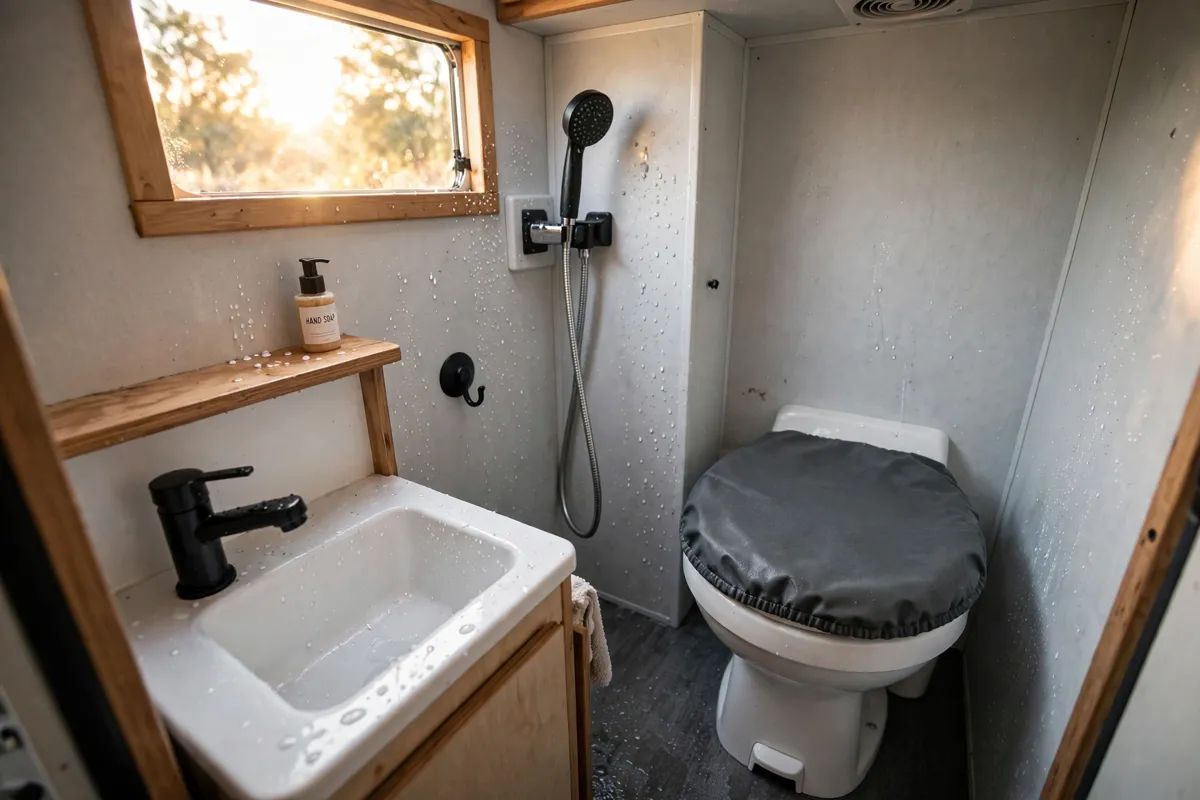
Most truck campers have a wet bath: toilet, sink and shower in one small waterproof room, usually about three feet square. When the shower runs, everything in that room gets wet unless you protect it. The shower head is usually a handheld wand on a hose, clipped to the wall or sink tap. A few larger hard-sides have a dry bath, where a curtain or wall keeps the shower separate — if you have one, skip the toilet-cover section below.
Your fresh tank is probably 20 to 40 gallons — check your own rig, it varies a lot — and that water must also cover drinking, cooking, washing up and flushing. Your grey tank is often smaller, commonly around 20 to 30 gallons. That maths shapes everything here. If you have not mapped your own tanks yet, our truck camper fresh water system guide will help you make sense of the numbers below.
The navy shower: the routine that makes it work
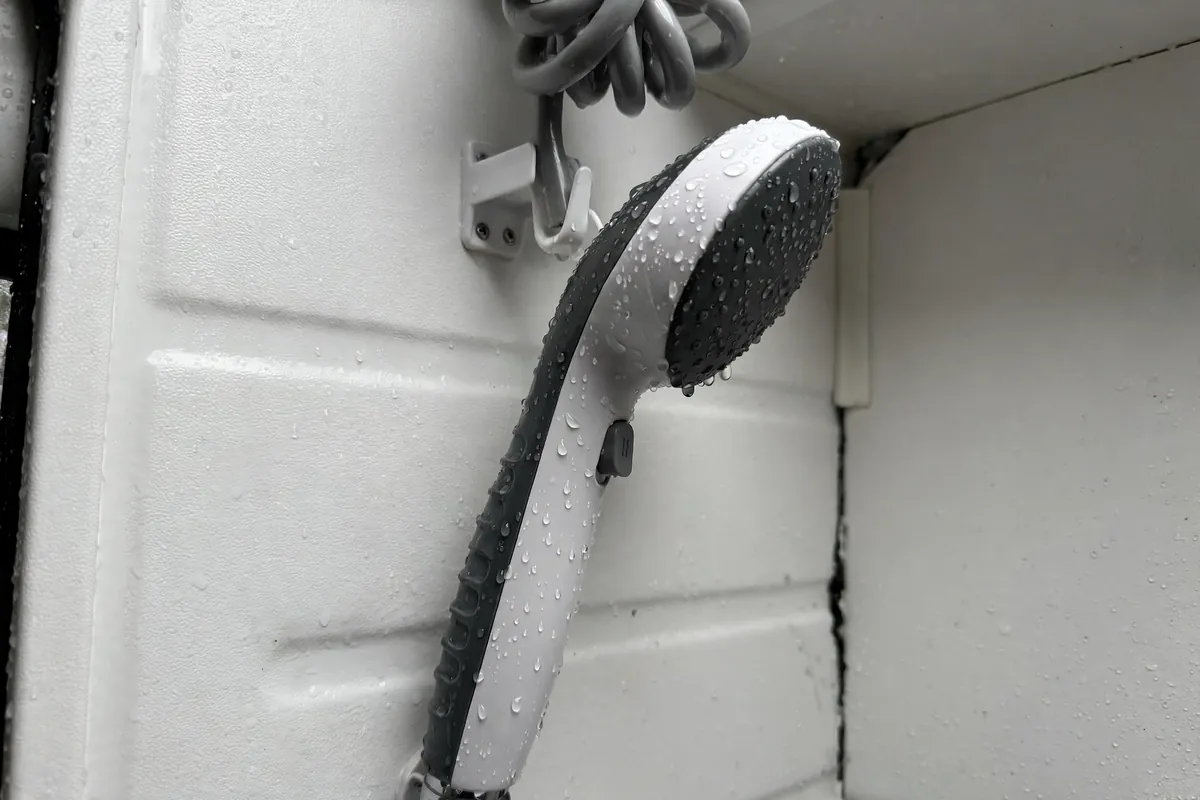
The navy shower is the basic technique in a truck camper, not a lifestyle choice: get wet, turn the water off, soap up, turn it back on and rinse. Almost every experienced owner uses some version of it.
Heat the water first. With a tank heater, switch it on 15 to 20 minutes before you shower, not an hour before — a well-insulated tank holds its heat, and leaving the heater running all day burns propane for nothing. Tank versus tankless heaters behave very differently here, as our truck camper water heater guide explains.
Catch the warm-up water. When you first turn the tap on, the water in the pipes is cold. Hold a jug or collapsible bucket under it instead of letting it run down the drain. I catch roughly a litre most mornings, and it goes to flushing the toilet or washing dishes. Long-time RVer Andy Baird describes exactly this trick — catching about three cups of warm-up water in a jug and reusing it all day.
Then get wet fast, soap up with the water off, and rinse once. Wet your hair and body in 15 to 30 seconds, turn the water off, and lather everything at once instead of soaping one arm, rinsing it, then starting the next. Turn the water back on and rinse from your hair down for 30 to 60 seconds. Done.
Two things make it feel less miserable: a shower head with a pause button, so the temperature holds while you soap up instead of resetting into a cold blast, and warming the bathroom first — run the fan, close the door, let the little room warm up for a minute.
That cold-in-between feeling is the most common complaint owners raise. In the RV Lifestyle Facebook group, one member called the get-wet, turn-off, soap-up, turn-on routine “awful” and asked if a good shower in a camper was even possible. The answers were practical: fit a pause valve, upgrade the head so the rinse is faster, and stagger showers so the heater recovers. If your shower feels awful, something in the setup needs fixing.
How much water does a truck camper shower use?
A standard home shower head uses about 2.5 gallons per minute, according to the US EPA’s WaterSense programme, so a relaxed eight-minute home shower can use around 20 gallons. A careful navy shower in a camper is usually quoted at 2 to 3 gallons.
One owner who actually measured it — a blogger at The Freedom 2 Roam, tracking his Lance 850 over two trips — averaged 2.8 gallons per navy shower against 9 gallons per “Hollywood shower,” where he just let the water run. Another experienced RVer reports a full wash, hair included, down to about 0.7 gallons. Landing between 2 and 3 gallons is doing fine, and on a 30-gallon fresh tank that is the difference between showering daily for a week and rationing by day three.
The grey tank usually bites first. Every gallon you shower with becomes a gallon in the grey tank, which also takes your sink water. A five-minute home-style shower at 2 gallons per minute sends 10 gallons in — most of a small tank in one go. Shaving is the hidden cost: fill the sink basin and shave from that instead. WaterSense heads use no more than 2.0 gallons per minute, and most RV heads are rated 1.5 to 2.0, often running lower on a 12-volt pump.
Keeping the toilet dry
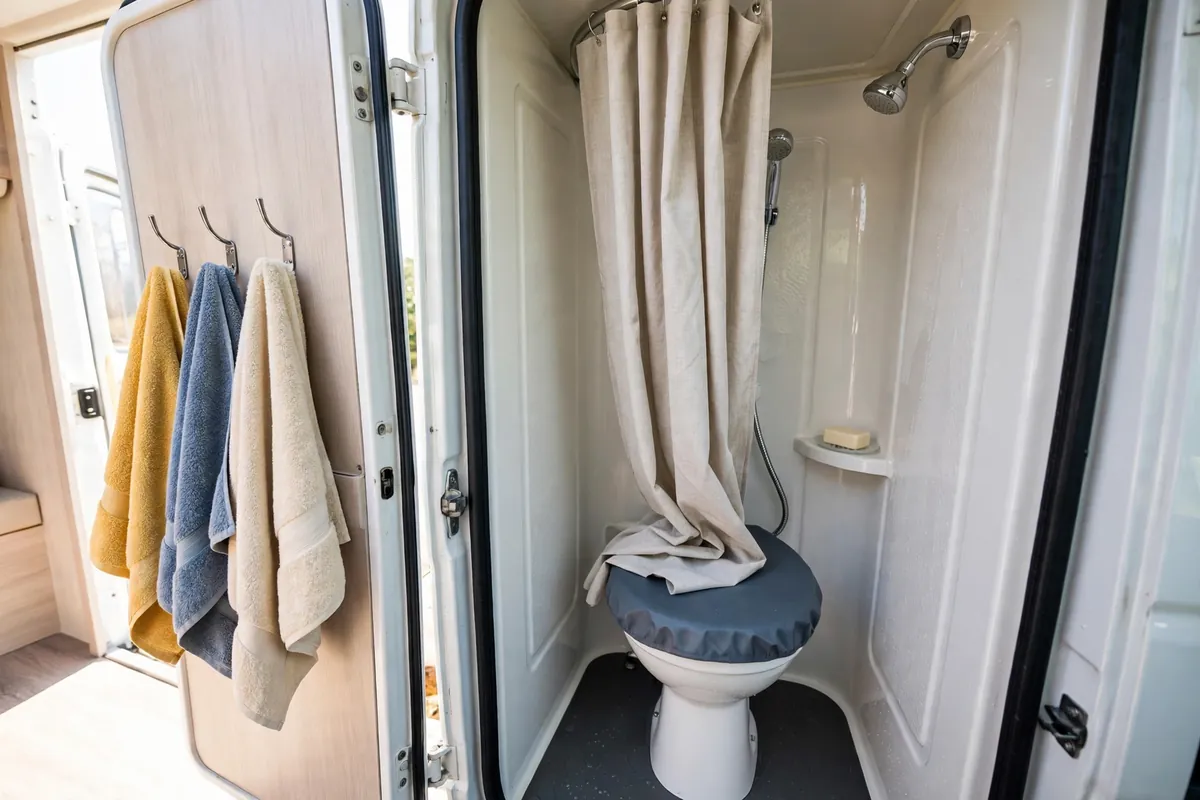
The toilet is in the shower. The toilet paper is in the shower. Everything gets wet unless you protect it — and this is the part that puts some people off using the wet bath at all.
Cover the toilet. Truck Camper Magazine asked 75 readers how they dry their wet baths, and a toilet cover came up again and again. One owner in a Lance 992 sewed one from marine vinyl and nylon fabric, with a handle to hang it up afterwards. Another made a surround from water-resistant nylon shower curtains attached with Velcro. Buy one, or make one from a cheap shower curtain and Velcro in an afternoon.
Point the curtain at the toilet. Drape the shower curtain over the toilet bowl and the door while you shower, so the curtain takes the spray, then drape it over a drying rack or the open lid so it can drip dry without wetting the floor.
Move the toilet paper and the towels. Take the roll off its holder first — a soggy roll happens to everyone exactly once — and hang your dry towel on a hook just outside the door, with the clothes you are about to put on.
Put something on the floor. The shower pan gets slippery when wet. Owners in the same survey use interlocking perforated tiles — Dri-Dek and similar — or a teak mat cut to fit, keeping feet out of the puddle. A cheap rubber bath mat does most of the same job.
The two-minute drying routine
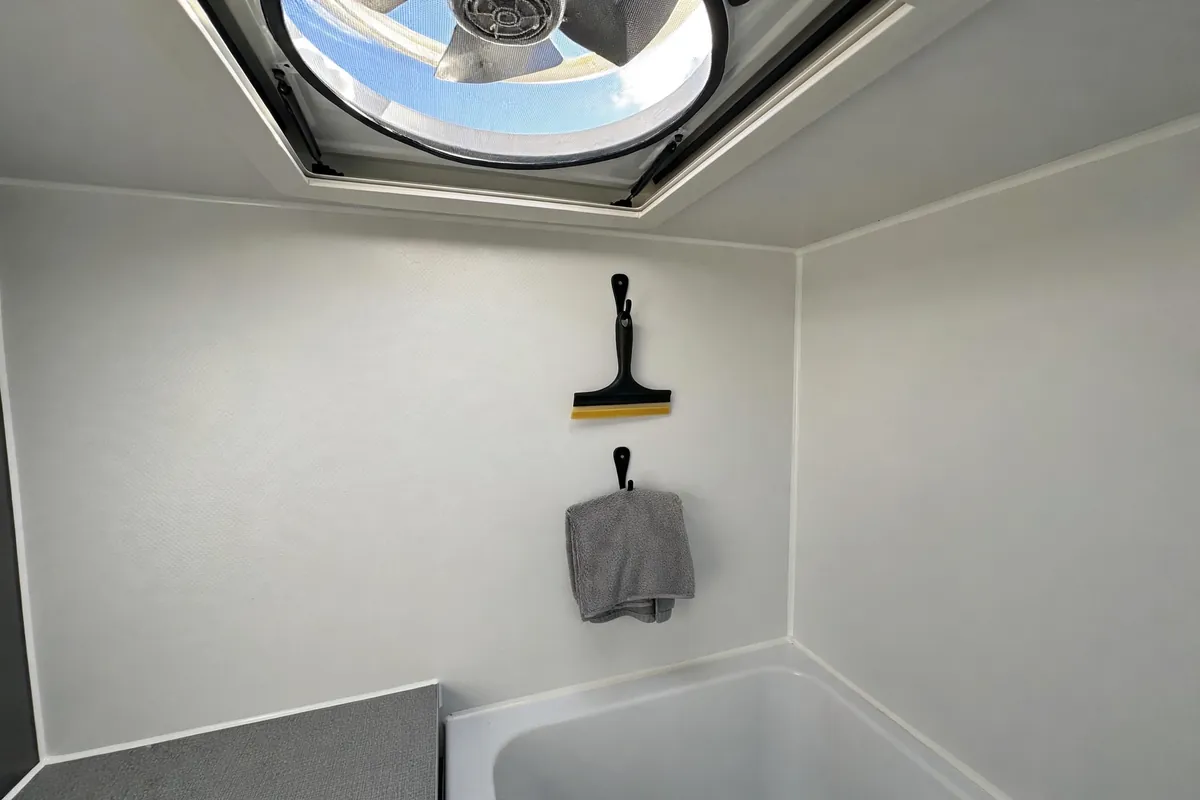
The shower is the easy part. Drying the bathroom afterwards decides whether your camper smells fresh or musty a week later — a wet bath left wet grows mould in corners and seals, and in a space that small the smell reaches the whole camper fast. The routine takes about two minutes.
Squeegee the walls and floor. Keep a small 6-inch squeegee in the bathroom and pull the water off the walls and down to the drain as soon as you turn the water off. One owner in the Truck Camper Magazine survey put it simply: squeegee, then towel, then done. Another uses a tile grout sponge, which soaks up water from corners a squeegee cannot reach.
Wipe the toilet, sink and fixtures with a dedicated microfibre cloth — the squeegee cannot get behind the toilet or around the taps.
Run the vent fan during the shower and for at least five to ten minutes after. Crack a window a touch so air actually moves through. Several owners said a thermostat-controlled Fantastic Fan was the best drying upgrade they made — it keeps running until the humidity drops. If it is cold, run the furnace for a few minutes too. Then leave the bathroom door open; a closed wet bath stays damp for hours.
Never mix bleach with ammonia or vinegar-based cleaners in a tiny space; the fumes are a real hazard. Skip the routine once and nothing terrible happens. Skip it daily for a fortnight in humid weather and you will find dark spots in the sealant. Condensation is the wider version of the same problem, and our guide to stopping condensation in a truck camper covers ventilation and heating for the whole rig.
The showerhead upgrade
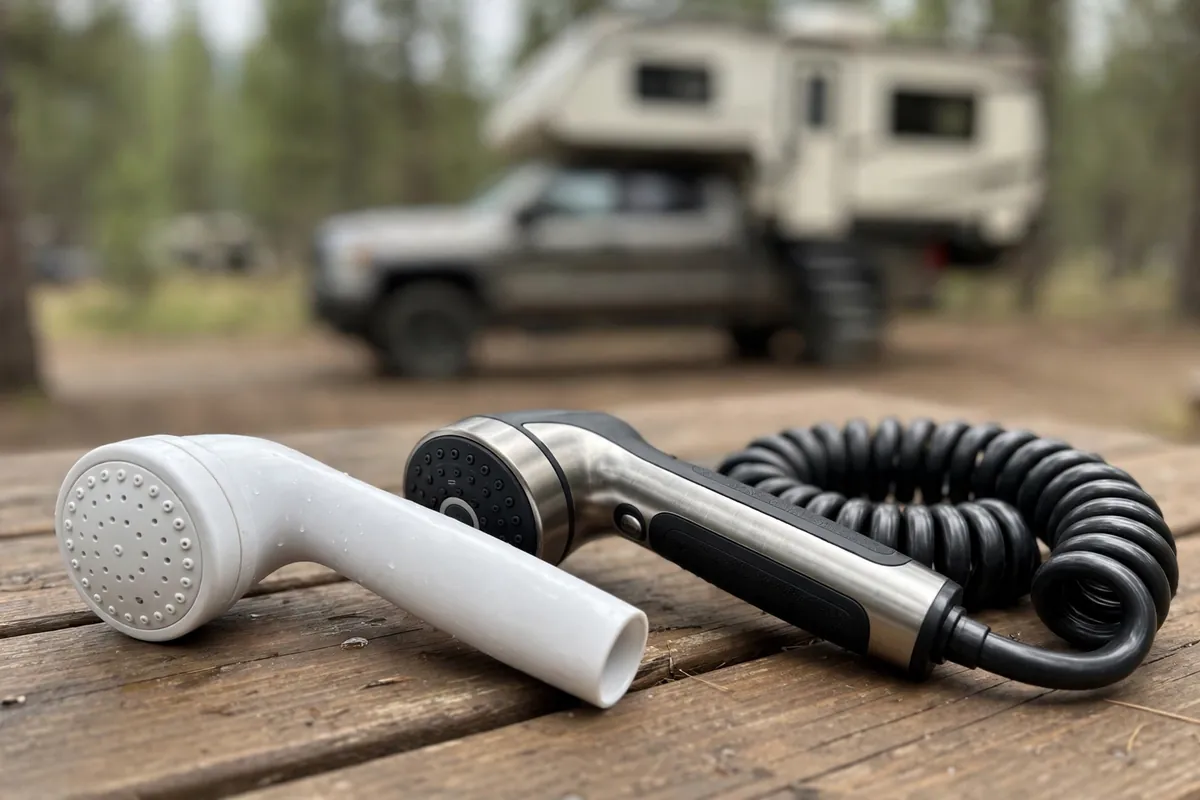
If you do one upgrade, make it the shower head. The stock head in most campers sprays weakly, rinses slowly and wastes water doing it. A good RV shower head costs roughly $35 to $55, fits in ten minutes with no tools, and changes the shower more than any other single change.
Look for a pause valve on the handle, a hose of 60 inches or more, and a flow rate of 2.0 gallons per minute or less. Do not fit a home head rated at 2.5 gallons per minute — it will drain your tanks faster and your pump may not drive it properly.
The Oxygenics BodySpa is the head most often recommended by full-timers. Its SmartPause valve drops the flow to a trickle while you soap up, and Oxygenics describes its air-injection design, which mixes air into the water stream so a lower flow still feels strong. Its RV heads are rated at 1.8 to 2.0 gallons per minute. Camco shower head kits are the budget alternative, with an on/off switch and a 60-inch hose — Camco is the other staple brand here.
One warning: the pause button is a trickle valve, not a full shut-off. A little water keeps dribbling through by design, so the temperature does not spike when you restart. Check the hose connection when you fit a new head, too — a slow drip quietly adds up, and thread tape usually fixes it.
Kids, dogs and two-person showers
Shower kids first, while the water is hottest, then shower yourself. A handheld head lets you rinse a small child without them standing under a spray they cannot control. Keep their towel and clothes outside the bathroom, within reach of the door. For more on family trips, see our guide to truck camping with kids.
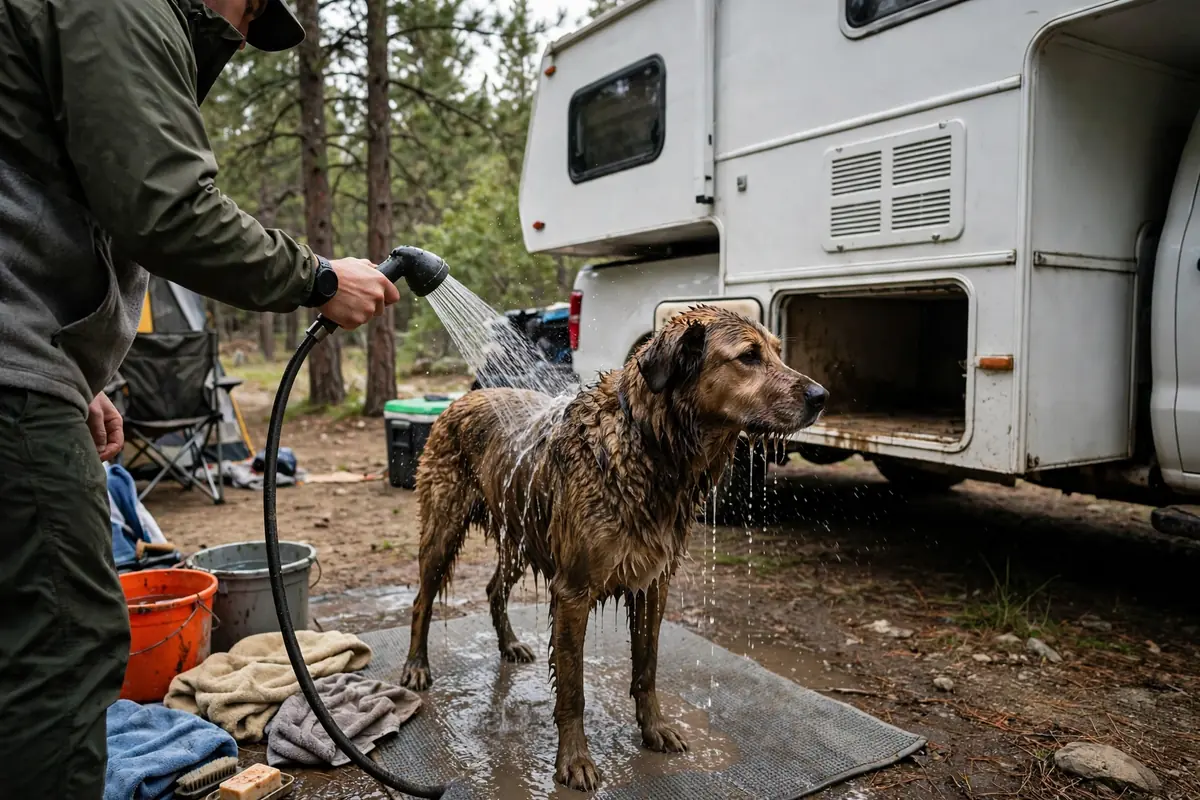
Most owners do not wash the dog in the wet bath — it is too small, the dog hates it, and hair goes straight down a drain with no strainer. Use the outdoor shower or a portable rinse instead. If you must wash the dog inside, put a drain strainer in first and have towels ready outside the door. Our guide to truck camping with dogs has more on keeping a dog clean on the road.
Two people, one heater, is the other classic squeeze: the second person gets the colder, shorter shower, so stagger by 15 to 20 minutes. Long hair takes more water, so budget an extra gallon, use dry shampoo on alternate days, and wash your hair first while the water is hottest.
Outdoor showers
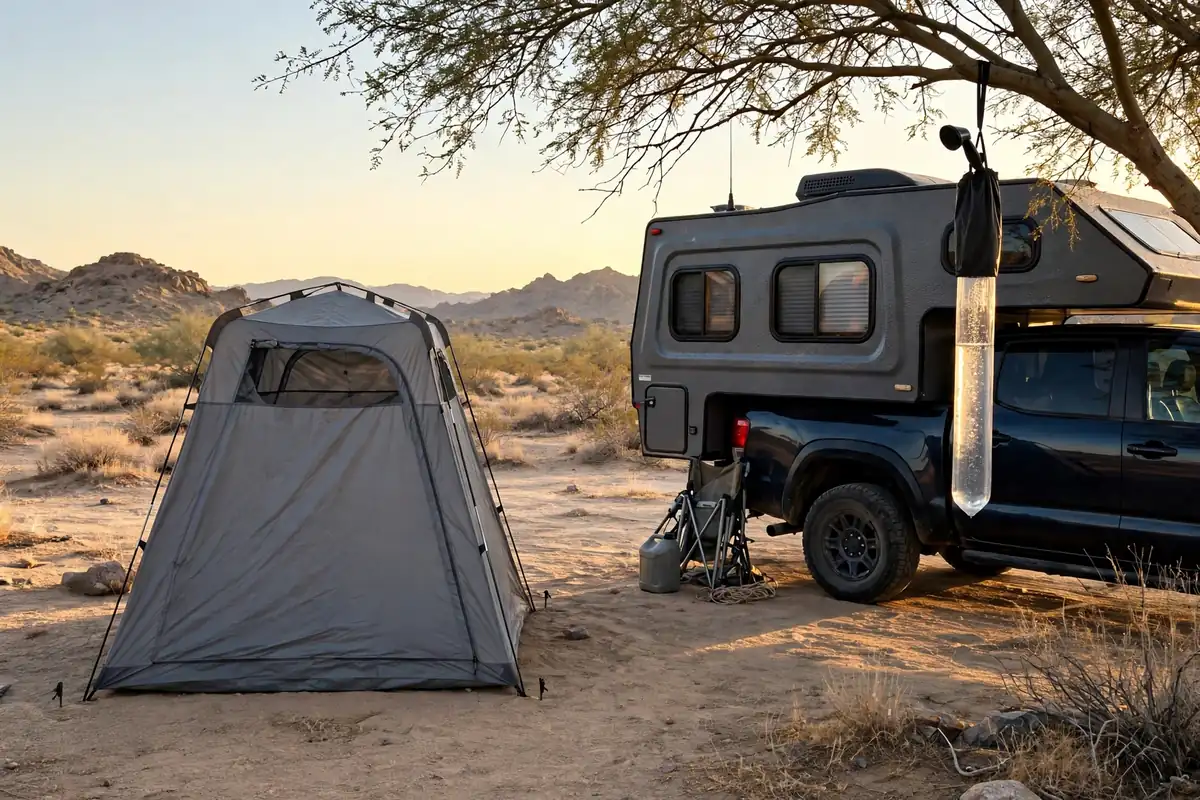
Sometimes the best shower in a truck camper is not inside it. An outdoor shower keeps the wet bath dry, keeps mud and sand outside, and gives you room to move. Many campers have an exterior shower fitting — a hot and cold tap with a handheld head behind a small hatch — ideal for rinsing off after a swim or a dusty hike, or washing the dog.
Without an exterior point, a portable setup is cheap and packs small. A solar shower bag holds about 3 gallons, enough for a navy shower: fill it in the morning, leave it in the sun, hang it from a tree in the afternoon. It only works when the sun cooperates, and the water can be scalding by late afternoon, so test it on your wrist first. A pressurised portable shower like the Nemo Helio sits on the ground, pressurised by a foot pump — no tree needed. A battery pump shower drops into a bucket of warm water from the camper. Add a pop-up privacy tent, well under $100, and stand in a plastic bin inside it to catch the runoff.
The rules matter outdoors. In a campground, ask at check-in — most private campgrounds allow outdoor showers with conditions, usually about where the water goes and whether you are screened. In national parks, grey water on the ground is prohibited outright. On dispersed land, wash at least 200 feet from any lake, stream or trail, use as little soap as possible — biodegradable soap is only biodegradable in soil, not in water — and scatter the water widely. The full rules are in our grey water management guide.
Hookups, campgrounds and a weekly rhythm
On full hookups, you can take a longer shower and enjoy it. Two things still apply: if you have no sewer at the site, the grey tank still fills at the same rate — a ten-minute shower at 2 gallons per minute is 20 gallons — and the drying routine, because a wet bath left wet on hookups grows mould just as fast.
There is also no rule that says you must shower in your camper. On the Escape Trailer forum, owners describe the split clearly: some use the campground shower block whenever one is available and keep the camper shower for dispersed nights; others use their own shower daily and only use a campground block for a long, hot shower. One owner showered at a laundromat in Quartzsite for $8 while the clothes were in the dryer. Most people mix the two, with a sponge bath on the days in between.
Keep it simple: every shower, heat the water, catch the warm-up, navy shower, squeegee and wipe, fan on, door open. Every day off-grid, one navy shower per person, max. Every few days, a campground shower if one is available, to reset your tanks. Every week, check the shower head and hose for drips — a small leak, left for a month, does more damage than a year of navy showers.
Showering in a truck camper is not as good as a home shower. It is smaller, colder between rinses, and it asks for a two-minute cleaning job every time. But it is private, available wherever you park, and comfortable once the routine becomes habit. Learn the routine, protect the toilet, dry the room — and on the days when it does not work, walk to the bathhouse. That is what it is there for.
Frequently asked questions
How much water does a navy shower use in a truck camper?
Usually 2 to 3 gallons for a full wash including hair. One owner who measured his showers averaged 2.8 gallons per navy shower against 9 gallons when he let the water run. A five-minute home-style shower would use 10 to 12 gallons — most of a small grey tank in one go.
How do you keep the toilet dry in a wet bath?
Cover it with a waterproof cover or cut-down shower curtain, drape the shower curtain over the bowl so it takes the spray, and move the toilet paper off its holder first. Wipe the toilet down with a microfibre cloth afterwards.
How do you stop a truck camper wet bath going mouldy?
Squeegee the walls and floor after every shower, wipe the fixtures, run the vent fan during and for at least five to ten minutes after, and leave the door open. In humid weather, a light spray of bathroom cleaner on the floor and seals a couple of times a week helps.
Can you shower outside a truck camper?
Yes. Use your camper’s exterior shower point if it has one, or a portable setup such as a solar shower bag or a pressurised pump shower, with a pop-up privacy tent. Check the campground’s rules first, keep wash water at least 200 feet from lakes and streams, use minimal soap, and catch or scatter the runoff — grey water on the ground is prohibited in national parks.
What is the best shower head for a truck camper?
An RV-specific handheld head rated at 2.0 gallons per minute or less, with a pause valve and a 60-inch or longer hose. The Oxygenics BodySpa is the most commonly recommended upgrade among full-timers; Camco kits are the budget alternative.
Is it better to use the campground shower or the camper shower?
Both. Use the campground block when it is clean, close and included in your fee. Use your own wet bath when you are dispersed camping, when the block is a long walk, or when you want privacy. Many owners mix the two, with a sponge bath on the days in between.