Best Truck Camper for Ford F-450 Super Duty
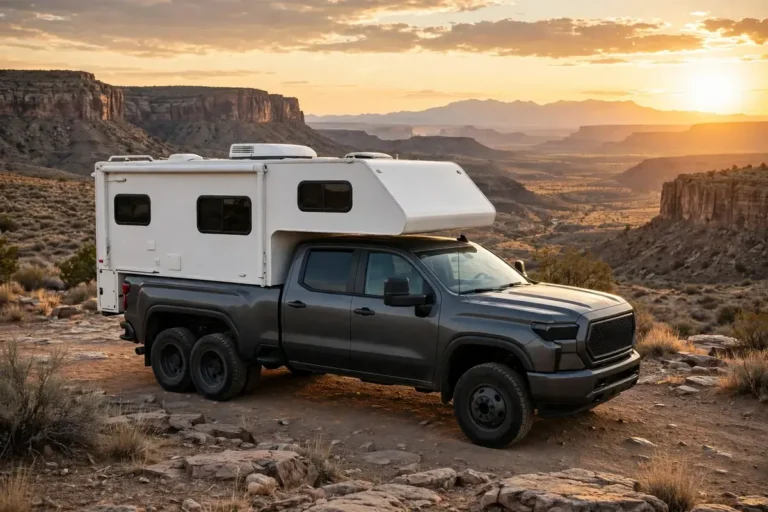
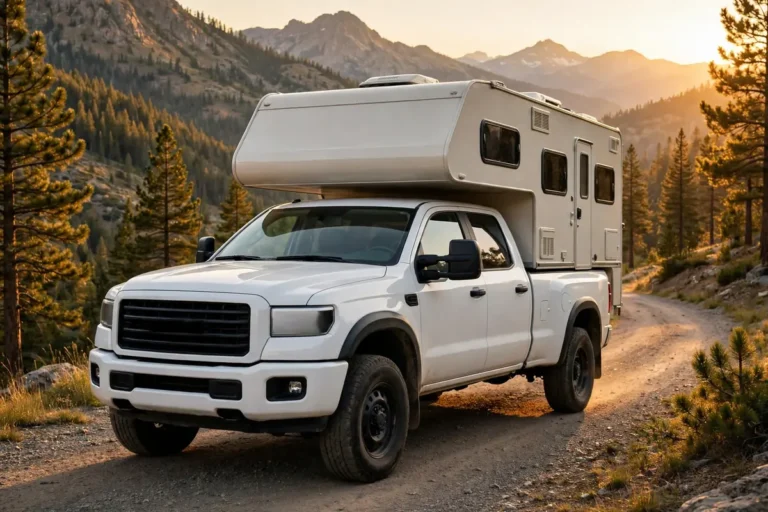
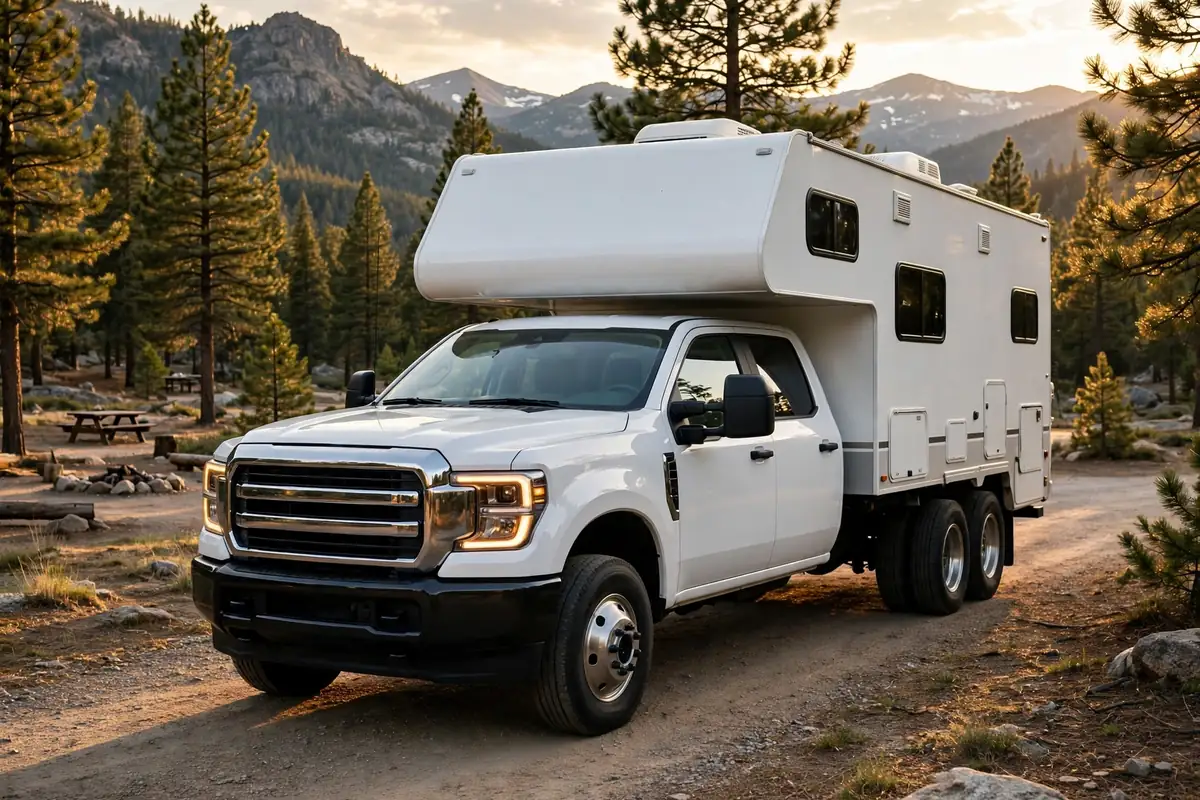
I have watched guys roll into campgrounds with a triple-slide camper on a one-ton truck that was clearly begging for mercy — rear end squatting, headlights aimed at the treetops. Then I watched a Ford F-450 roll in with a Host Mammoth on its back, sitting dead level. That is the best truck camper for Ford F-450 Super Duty ownership in one image. But here is the twist nobody tells you at the dealership: on paper, the F-450 pickup actually has less payload than a gas F-350 dually.
The F-450 Payload Surprise
Ford caps the F-450 pickup at 14,000 pounds GVWR — the same ceiling as the F-350 dually. That is a licensing line, not an engineering limit. The F-450 is simply heavier before you load anything: wide-track front axle, bigger brakes, 19.5-inch wheels, heavier rear axle — all of it eats into the same 14,000-pound budget, and payload is GVWR minus curb weight.
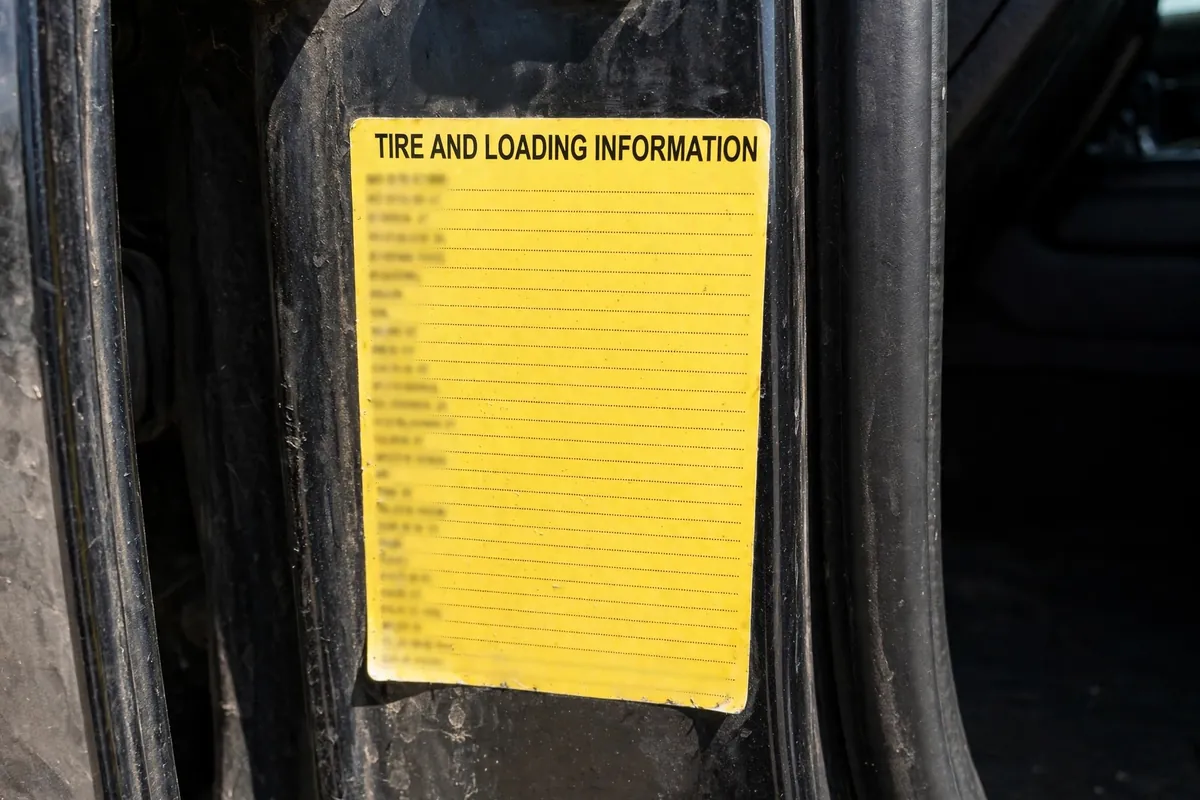
Ford’s own figures put maximum Super Duty payload at 8,000 pounds, and that number belongs to an F-350 DRW with the gas engine and the heavy-duty payload package — not to the F-450. For the F-450 pickup, published figures conflict. A dealer window sticker for a loaded 2024 F-450 Limited Crew Cab 4×4 shows 5,320 pounds of payload; other guides quote up to about 6,322 pounds for a stripped Regular Cab 4×2 diesel. Treat the range as roughly 5,300 to 6,300 pounds of payload, and treat your own truck’s yellow door-jamb sticker as the only number that governs your truck.
Gas vs Diesel: The Pickup Is Diesel-Only
The F-450 pickup is diesel-only. There is no gas F-450 pickup in any trim. You get the 6.7L Power Stroke V8 in two tunes: the standard version at 475 horsepower and 1,050 lb-ft of torque, or the High Output at 500 horsepower and 1,200 lb-ft, both with the 10-speed automatic and a standard 4.30 rear axle ratio. You can confirm the current lineup on Ford’s 2026 Super Duty specs page. The 7.3L gas V8 only shows up on the F-450 chassis cab, detuned to 335 horsepower and 468 lb-ft — so anyone claiming a gas F-450 pickup actually bought a chassis cab with a flatbed on it.
Diesel-only means three things. The engine is heavy, which is part of why the payload sticker reads lower than the gas F-350’s. You get enormous low-end torque for pulling grades — full torque at just 1,600 rpm. And you pay diesel prices and maintenance bills, while the 4.30 gearing costs you fuel economy. Owners are blunt: the F-450’s mileage is worse than an F-350’s.
Pickup vs Chassis Cab: Two Different Trucks, One Badge
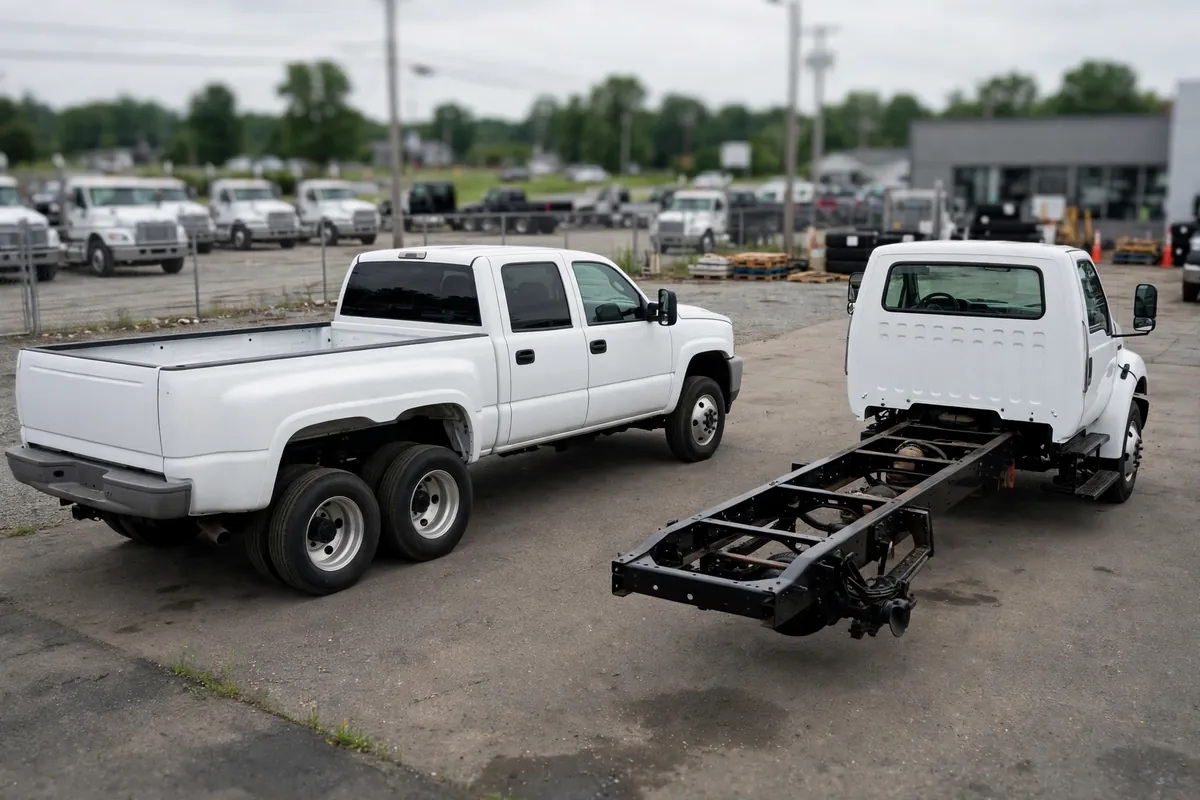
The F-450 pickup is a complete dually with an 8-foot factory bed, a 14,000-pound GVWR, and a tailgate. It takes a standard slide-in camper. The F-450 chassis cab is a bare cab and frame with a 16,500-pound GVWR and no bed until an upfitter bolts a flatbed, service body, or custom camper box onto it. Its payload is in a different league — Ford’s commercial materials list up to around 12,750 pounds for the cab-and-chassis configuration, though published numbers conflict and the figure depends entirely on what body gets fitted.
A slide-in camper does not drop onto a chassis cab without modification: the frame rails are straight from the cab back, narrower than a pickup’s, and the cab-to-axle distance is different.
Want a slide-in camper — a Lance, a Host, an Eagle Cap? Buy the pickup. Want a flatbed camper or a custom expedition box? The chassis cab is your platform. Overland Explorer Vehicles, for example, builds its High Country Pop-Up specifically for F-450/550 and Ram 4500/5500 chassis cabs with a 60-inch cab-to-axle measurement. Chassis-cab trims top out at Lariat, and owners report thinner safety equipment — a claim I could not verify against Ford’s materials, so confirm it on the truck you buy.
GVWR and Payload Math by Cab and Bed
The F-450 pickup only comes one way in the back: dual rear wheels and an 8-foot bed. What varies is the cab and drivetrain:
| Configuration | GVWR | Approx. payload |
|---|---|---|
| Regular Cab 4×2, diesel | 14,000 lb | ~6,300 lb |
| Crew Cab 4×4, diesel | 14,000 lb | ~5,300–5,600 lb |
Options eat payload fast: the High Output diesel, the sunroof, the big luxury interior, running boards — every one comes straight out of your camper budget. If you are ordering new, get the $160 Camper Package: heavy-service front springs, rear auxiliary springs, a rear stabilizer bar, and slide-in camper certification.
Now the worked example. Take the most common truck: a Crew Cab 4×4 diesel with a 5,320-pound sticker. Load a Lance 1172, about 4,063 to 4,174 pounds dry depending on model year and roughly 4,600 to 5,100 pounds once you add water, propane, food, and gear. Add two adults (~350 pounds), tie-downs and a bed mat (~100 pounds), and a few hundred pounds of gear. You are at roughly 5,500 to 5,900 pounds against a 5,320-pound sticker — over the yellow label, and this is the exact situation thousands of F-450 owners are in every day.
The sticker is the manufacturer’s rating, and it is the number that matters for warranty, insurance, and legal purposes in most states. But the F-450’s axle and tire ratings tell a different story: the rear axle is rated at 9,900 pounds GAWR, the rear tires together at 14,360 pounds. An owner on iRV2 with a 2017 F-450 worked through exactly this dilemma with a Host Mammoth: about 4,600 pounds on the yellow sticker, a camper that loads out near 6,000 pounds, and yet a rear axle and tire combination with thousands of pounds of headroom. His conclusion, shared by many owners in that thread, was that the truck handles the load safely and comfortably even though the sticker math does not close — and owners report that law enforcement, where it checks at all, looks at axle and tire ratings, not the yellow sticker. One owner added that British Columbia does enforce the sticker, so cross-border travellers should be careful. I am not telling you to exceed your sticker — weigh your rig on a CAT scale, axle by axle, and know your real numbers before you decide.
The 19.5-Inch Wheels: Commercial Tires, Commercial Rules
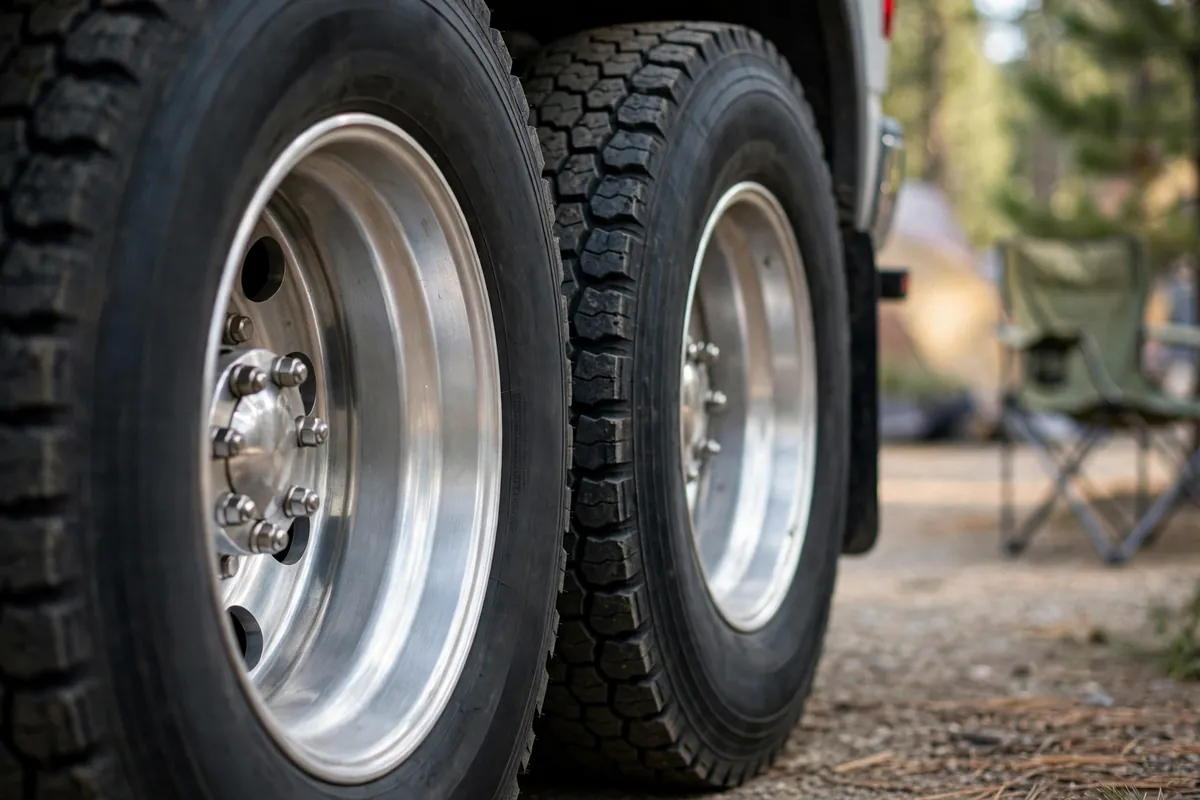
The F-450 rolls on 19.5-inch forged aluminum wheels with 225/70R19.5 load-range-G commercial tires: the front tires together are rated at 7,180 pounds and the rears at 14,360 pounds, which is why the 9,900-pound rear axle rating is never the limiting factor. The wide-track front axle also gives the F-450 a famously tight turning circle — owners report about 47 feet versus roughly 57 for a comparable Ram dually.
But these are commercial tires with commercial rules, and owners on the Ford-Trucks forums are emphatic about them. The 19.5-inch tires run at a minimum of about 70 psi and cannot be aired down for sand or soft dirt — try it and you risk a sidewall “zipper” failure, because the bead is shallower and the sidewall is far stiffer. If your camping involves beach driving or soft desert sand, the F-450’s tires are a genuine limitation. All-terrain options exist — owners name the Toyo M608 and M655, the Michelin XDS2, and the Hankook DH07 — and one owner reports 65,000 miles on Toyo M608s hauling a 16,000-pound combined rig. But selection is thin and the tires cost more. Check pressures against a load-and-inflation chart for your actual axle weights, and read my truck camper tires guide before buying replacements. Owners also warn the truck “rides terrible when empty” — drive one empty before you buy it if it will be your daily driver.
Best Truck Camper for Ford F-450: Which Campers Actually Fit
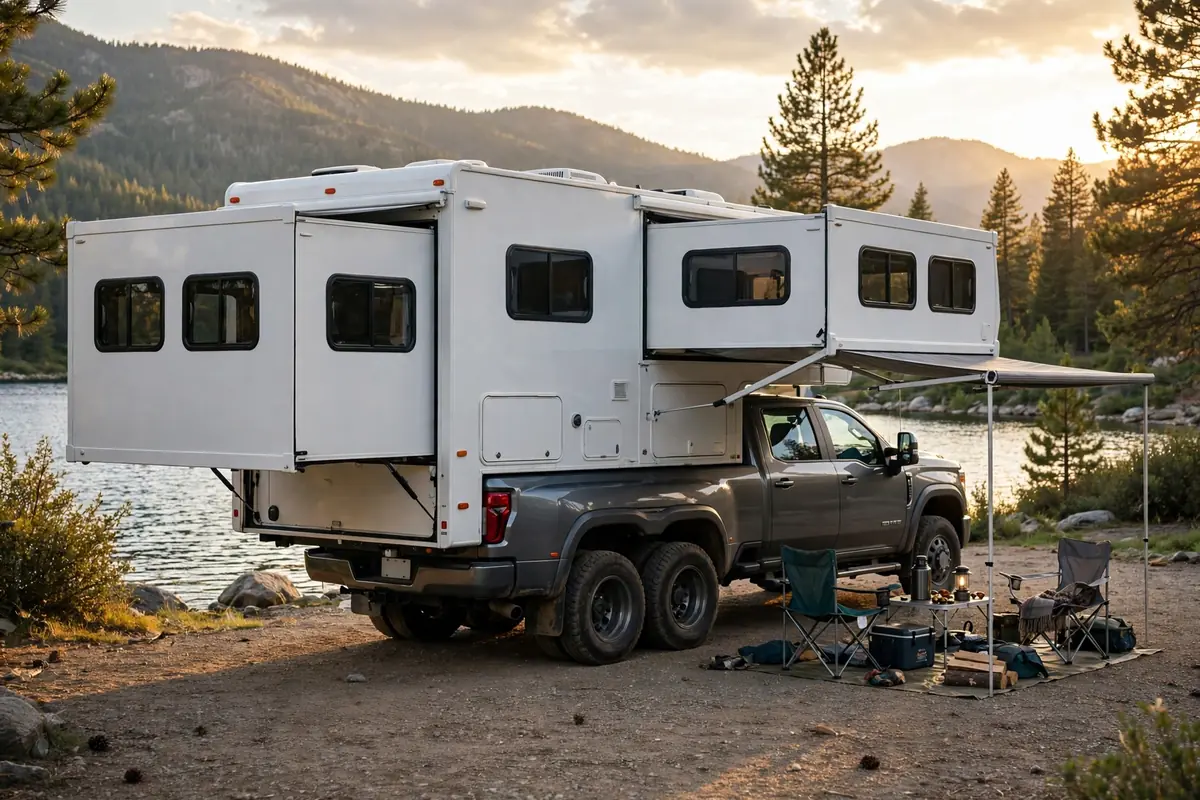
Fitment here is mostly a weight question: options, water, propane, batteries, and gear typically add 800 to 1,200 pounds to dry weight, and a Host Mammoth’s 65 gallons of fresh water alone weighs about 542 pounds.
| Camper | Layout | Approx. dry weight | Loaded reality |
|---|---|---|---|
| Host Mammoth 11.6 | Triple slide, dry bath | ~3,955 lb | ~5,000–6,000 lb |
| Lance 1172 | Double slide, dry bath | ~4,063–4,174 lb | ~4,600–5,100 lb |
| Eagle Cap 1200 | Triple slide | ~4,933 lb | ~5,800–6,500 lb |
| Arctic Fox 1150 | Single slide, dry bath | ~3,358 lb | ~4,300–4,900 lb |
| nuCamp Cirrus 920 | Non-slide, dry bath | ~3,900 lb | ~4,700–5,300 lb |
The Mammoth is the signature F-450 camper, though the sticker math is tight on a loaded Crew Cab. The Lance 1172 is the most popular big Lance, and the F-450 is its natural home — note the 4,174-pound figure in Lance’s 2020 brochure versus 4,063 pounds in current dealer listings. The Eagle Cap 1200 at nearly 4,933 pounds dry is the one camper here that can genuinely overwhelm even an F-450 once loaded; owners who buy it tend to travel light on water or end up on a chassis cab.
Torn between the two big names? Owners who have lived with both say the Mammoth wins on layout and build quality — one owner put it bluntly that the only reason to buy the Lance over the Host is that the Lance is cheaper — while the Lance wins on Azdel construction and its dealer network.
Suspension and Tie-Downs
Here is where the F-450 earns its reputation. On an F-350 carrying a Mammoth, owners routinely add airbags, Torklift StableLoads, or stiffer spring packs. On the F-450, owners report the opposite: most carry a Mammoth with no suspension modifications at all, and one owner was running at 16,000 pounds gross combined with no suspension mods at all. Owners who moved from an F-350 to an F-450 with the same camper report that the F-450 handles and rides better.
If your rig does squat or sway, the usual fixes apply in the usual order: check tire pressures first, then look at airbags, Timbren SES, or SumoSprings. My airbags vs Timbren vs SumoSprings comparison covers what owners actually run — but add hardware only if a scale ticket and a test drive say you need it.
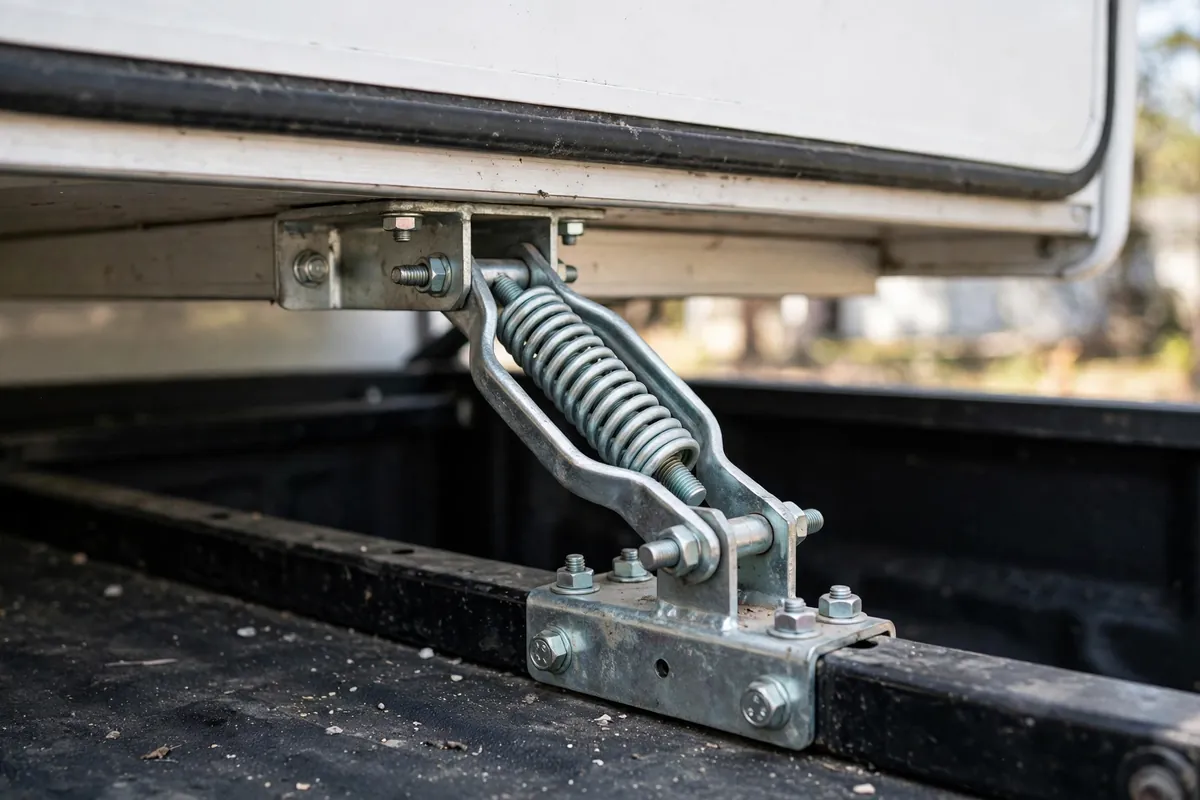
Tie-downs are not optional, and they are not the place to save money. The factory cargo rings are designed for light, temporary loads — unrated, attached to the bed floor, not the frame. You need a proper four-point frame-mounted system. Torklift makes the standard kit: the F2032 front Talon tie-downs fit 2018–2027 F-450 pickups with the factory 8-foot bed, bolt directly to the frame with no drilling, and pair with the correct rear tie-downs and four spring-loaded turnbuckles. Confirm part numbers against your exact year and cab with Torklift’s fit finder before ordering. My full comparison is in best truck camper tie-downs compared.
Two small details owners flag that brochures never mention. First, the tailgate backup camera: when the camper is loaded, the tailgate comes off and the camera goes with it — CameraSource makes a plug-in relocation replacement for just over $200. Second, cab-over clearance: some campers need a small lift to clear the bed rails, and owners report that a 4×8 sheet of rigid foam insulation under the camper weighs almost nothing and works well as a platform.
Towing Behind the Camper
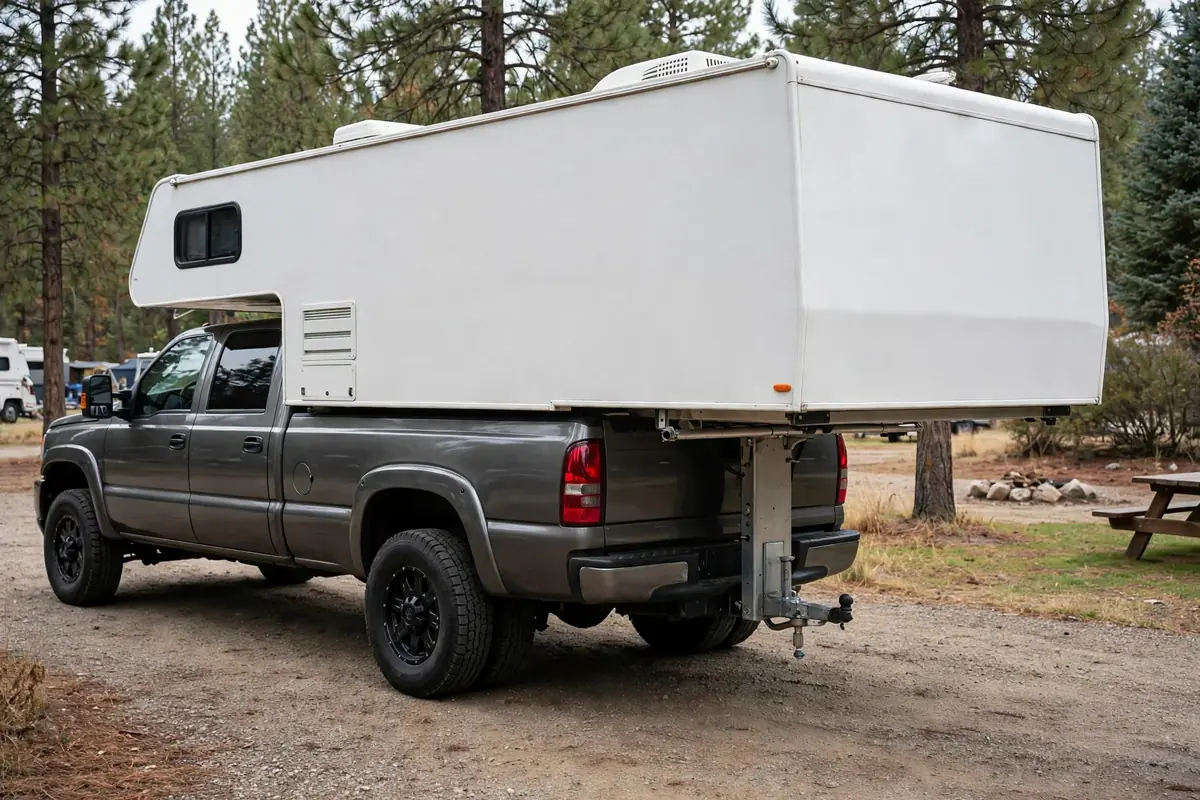
A lot of F-450 buyers plan to tow a boat or car hauler behind the camper — the truck is rated to tow up to 40,000 pounds on a gooseneck. The truck can do it. The camper usually cannot. A long-bed camper like the Mammoth overhangs the bed, and the receiver ends up buried about two feet underneath the camper with almost no room for a trailer tongue. Owners report that with a foot or less of overhang you can still tow, but with two feet it gets risky at best and dangerous at worst. The standard fix is a Torklift SuperHitch with a long extension, but extensions reduce the hitch’s rated capacity, so do the math on tongue weight first. If towing heavy behind the camper is a core part of your plan, owners say to step up to a chassis cab. My towing with a truck camper guide covers hitch extensions, weights, and sway in detail.
Buying Used: The Model Years That Matter
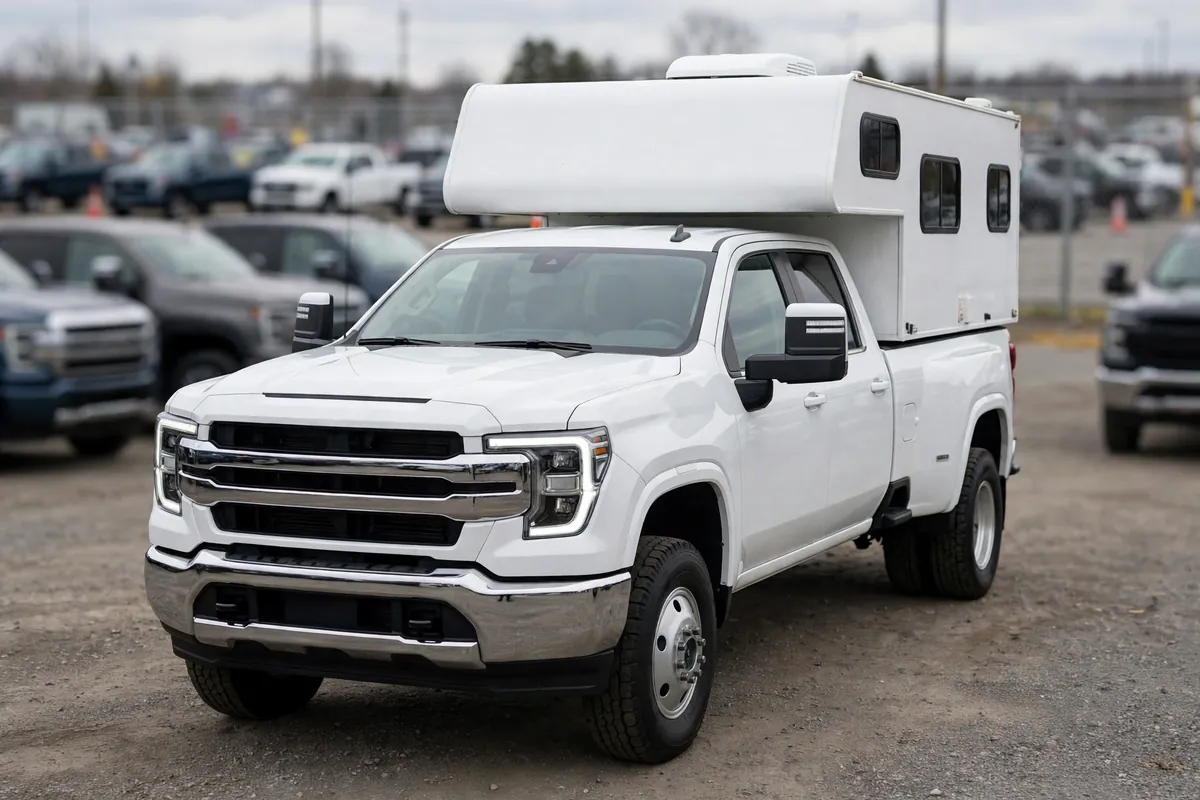
The owner forums have a clear warning about one generation. The 2011 through 2014 F-450 pickups were, in the words of one Good Sam forum member, “dumbed-down” compared with the 2008–2010 trucks: no 19.5-inch wheels, no Dana S110 rear axle, and the same brakes as the F-350. Ford went back to the proper heavy-duty specification for 2015 and 2016, and the 2017 redesign started a new generation. The 2008–2010 trucks had their own problem — they predate DEF, so they used massive amounts of EGR to control emissions, and owners report that did not work out well for any manufacturer of that era. That is owner-forum consensus, not a Ford bulletin, so verify the spec on any used truck — but a 2015 or later pickup is the safe bet.
What Owners Actually Say
Owners who switched from an F-350 to an F-450 with the same big camper say the F-450 is calmer, more stable, and easier to drive — one owner moving from a 2012 Chevy 3500 dually to an F-450 called it a world of difference. The empty ride is the complaint that never goes away. And the cost conversation is real: commenters on Facebook posts showing big Host campers on F-450s keep coming back to the same numbers — roughly $120,000 for the camper plus roughly $100,000 for the truck.
Owners call the F-450 the reigning king of camper haulers — not because of the payload sticker, but because of the axle, the brakes, the tires, and the turning radius.
The Short Version
Buy the F-450 pickup if you want a triple-slide or big double-slide camper — a Host Mammoth, a Lance 1172, an Eagle Cap 1200 — and the most composed slide-in rig on the road. Order it stripped down, get the Camper Package, budget for frame-mounted tie-downs, and weigh the finished rig before your first long trip. Buy the F-350 DRW instead if the payload sticker matters most to you, or if you want the gas engine. Buy the F-450 chassis cab if you want a flatbed camper or a custom expedition box.
Frequently Asked Questions
Can a Ford F-450 carry a Host Mammoth?
Yes — the F-450 pickup is the most commonly recommended truck for the Host Mammoth. The Mammoth runs about 3,955 pounds dry and roughly 5,000 to 6,000 pounds loaded, which fits within the F-450’s roughly 5,300 to 6,300 pounds of payload on most configurations, though a loaded Crew Cab 4×4 can end up over its yellow door-jamb sticker. Owners report carrying it with no suspension modifications. Check your rear axle weight against the 9,900-pound GAWR.
What is the payload of a Ford F-450 pickup?
Roughly 5,300 to 6,300 pounds depending on cab, drivetrain, and options — a loaded Crew Cab 4×4 diesel stickers around 5,320 pounds. Published figures conflict, so the yellow label on your own truck’s door jamb is the only number that governs your truck.
Is the F-450 pickup available with a gas engine?
No. The F-450 pickup is diesel-only: the 6.7L Power Stroke in standard (475 hp, 1,050 lb-ft) or High Output (500 hp, 1,200 lb-ft) tune. The 7.3L gas V8 is available only on the F-450 chassis cab, detuned to 335 hp and 468 lb-ft.
What is the difference between the F-450 pickup and the F-450 chassis cab?
The pickup is a complete dually with an 8-foot bed and a 14,000-pound GVWR, built for slide-in campers. The chassis cab is a bare cab and frame with a 16,500-pound GVWR and no bed, built for flatbeds and custom bodies. A slide-in camper does not fit a chassis cab without modification.
Do I need airbags on an F-450 with a truck camper?
Most owners say no — they report carrying triple-slide campers with no airbags, StableLoads, or spring upgrades, while the same campers on F-350s often need them. Check your ride height and handling with the camper loaded first, and add help only if a scale ticket and a test drive say you need it.
Can you air down the F-450’s 19.5-inch tires for sand?
No, and you should not try. The 225/70R19.5 commercial tires run at a minimum of about 70 psi, and airing them down risks a sidewall zipper failure — a real limitation if soft sand and beach driving are a big part of your camping.
Payload figures come from Ford’s published 2026 Super Duty specifications and dealer window stickers, which conflict by several hundred pounds depending on configuration. Confirm the ratings on your own truck’s door-jamb label and weigh your loaded rig before travelling. Exceeding GVWR or payload can affect warranty, insurance, and legal compliance; regulations vary by state and province.