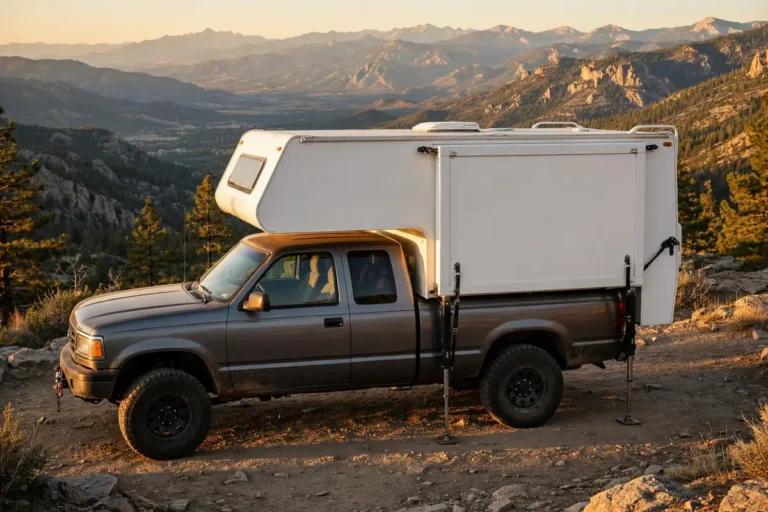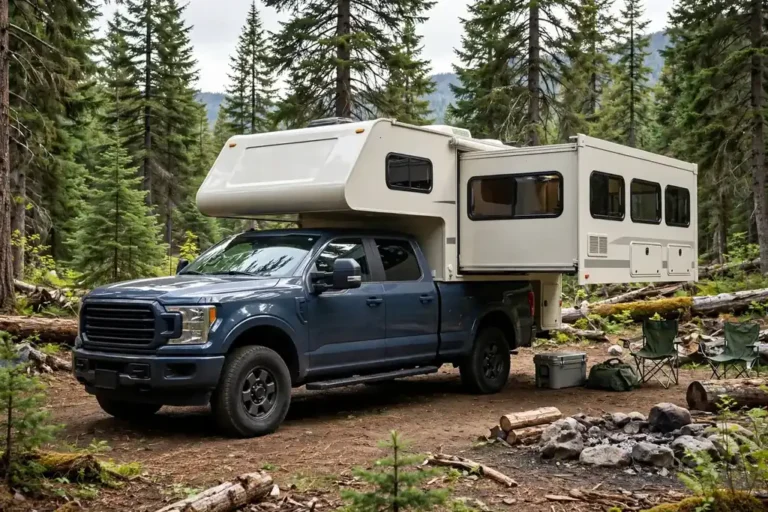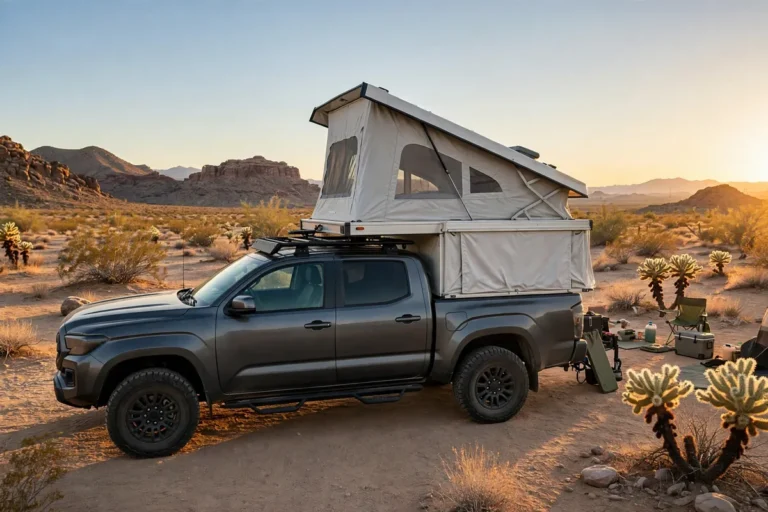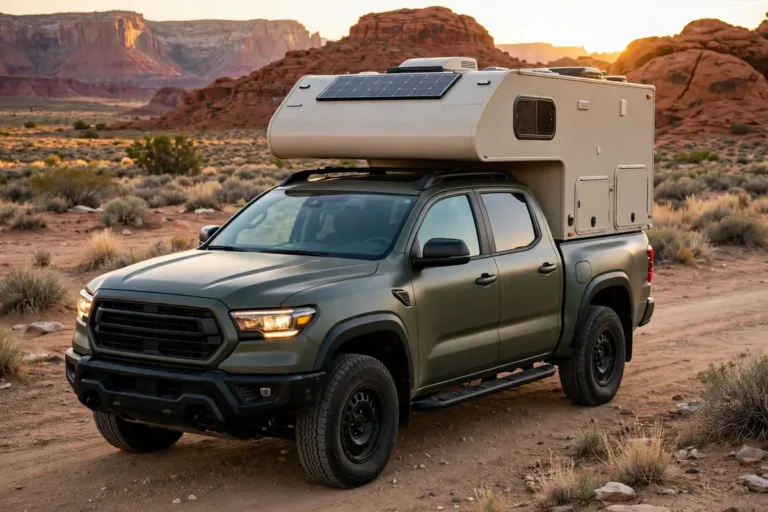
The 7 Best Wedge Campers & Canopy Campers for 2026 (Real Prices, Real Weights)
The first time I crawled into a wedge camper at a trailhead outside Moab, I popped the roof in five seconds, stood up in the bed of my truck, and thought: this is what a rooftop tent wishes it could be. If you’re hunting for the best wedge camper for 2026, you’re looking at the sweet spot of truck camping — lighter than a slide-in, roomier than a rooftop tent, and you keep your truck bed for actual truck stuff.
But “wedge camper” covers a lot of ground: true wedge tent toppers, aluminum canopy campers with stand-up interiors, hard-side pop-ups, and full wedge campers that blur into slide-in territory. I dug through spec pages, current pricing, forums, and owner reviews to round up seven real, purchasable options — trade-offs included. The question I started with: which is genuinely the best wedge camper you can buy this year, not just the best-marketed?
The 7 Best Wedge Campers & Canopy Campers for 2026
Every pick below is a real product you can order today, with verified weights and current pricing — though prices move fast, so confirm on the manufacturer’s site before ordering.
1. Go Fast Campers Platform Camper — Best Overall Wedge Camper
Weight: ~270–330 lbs depending on bed size | Starting price: from ~$6,950 (standard) / ~$7,450 (XL) | Best for: weekend warriors and daily drivers who want the lightest proven option
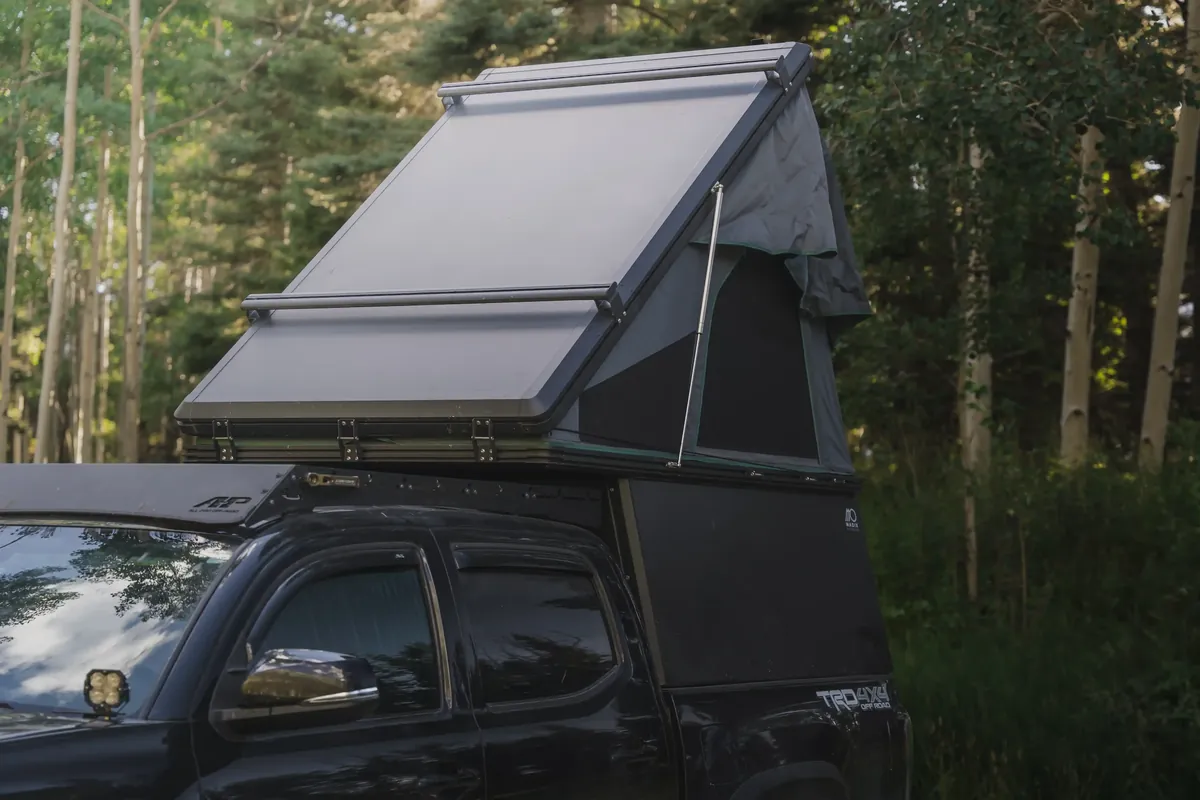
The GFC Platform Camper started the modern wedge craze and still sets the benchmark for weight-to-simplicity ratio. It’s a hybrid of truck topper and rooftop tent: aluminum spaceframe, lockable side panels, wedge tent up top, and a transform-a-floor for standing room in the bed. It sits only 6–8 inches above your cab, so your truck still drives like a truck. For my money, it’s still the best wedge camper for anyone who daily-drives their truck.
GFC’s newer V2 Max (launch pricing from $10,250) stretches the platform 18 inches for a pass-through between bed and sleeping area — handy if you hate moving bed panels at 2 a.m. Sleeping area is 50×90 inches mid-size, 56×90 full-size.
The honest part: GFC’s tent is basic by design, and owners say so. Long-term owners report condensation in cold weather (par for the course with single-wall tents — see our condensation fixes), and some V2 owners mention checking tent seams for water intrusion at pickup. The stock mattress gets panned; budget for an upgrade. In return you get the lightest footprint in the class and a massive owner community with every mod documented.
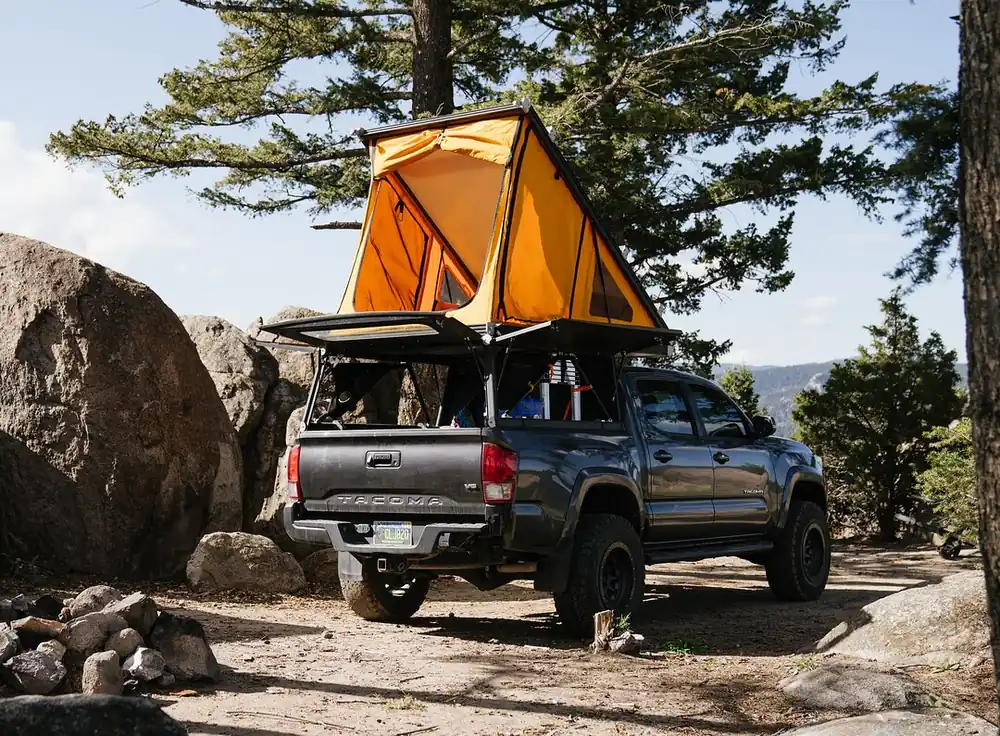
2. Super Pacific X1 — Best Turnkey Wedge Camper
Weight: mid-300s lbs (Super Pacific lists the Rivian R1T fitment at 342 lbs) | Starting price: from ~$13,495 mid-size / ~$13,995 full-size | Best for: buyers who want the most finished, livable wedge with premium build quality
If GFC is the minimalist’s wedge, the X1 is the “buy once, cry once” alternative — arguably the best wedge camper for buyers who’d rather pay once than tinker forever. Super Pacific builds these in Portland, Oregon: aerospace-style riveted fuselage, full side-access doors (all three lock), an included Exped Megamat Duo sleeping pad, and closeable tent vents that owners say genuinely help with moisture. Wiring is the real standout: built-in chases and solar ports everywhere, versus GFC’s bring-your-own-zip-ties approach.
The honest part: it’s roughly double a base GFC, and at that money you expect perfection — some owners report minor water weep at door seals in heavy rain. But the company holds a 5-star Google rating across 200+ reviews, practically unheard of in this industry, and owner threads are full of “zero buyer’s remorse” posts. Switchers from GFC cite the included premium mattress, better ventilation, and side-door access as why they don’t look back.
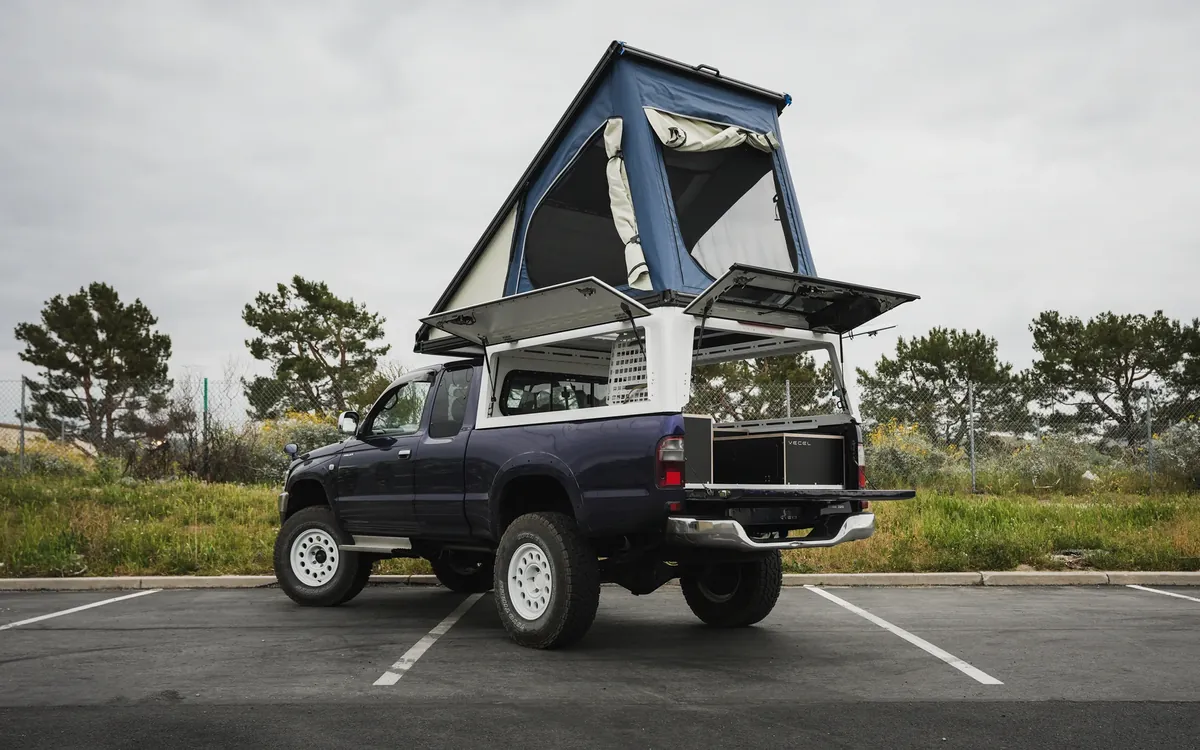
3. Tune M1 — Best Canopy Camper for Interior Space
Weight: 400 lbs | Starting price: $12,999 base | Best for: campers who want a real hangout space with stand-up headroom
The Tune M1 isn’t really a wedge — it’s a full canopy camper with a patented “wing-wall” design and flared sidewalls delivering 6’4″ to 6’10” of stand-up headroom. That’s van territory. The loft sleeps east-west on a queen platform (optional king extender), and the build is an aluminum frame with composite corner brackets and FRP honeycomb paneling. Over 440 feet of T-track inside and out means you can mount basically anything, and it carries a 3-year warranty.
The honest part: at 400 lbs it’s heavier than the wedge toppers here, and $12,999 is premium money — though still half a loaded traditional slide-in. If the M1 is more camper than you need, the M1L (322 lbs, from $8,999) is a lighter, simpler take on the same concept. Confirm pricing on tuneoutdoor.com, since launch-era intro pricing has come and gone.
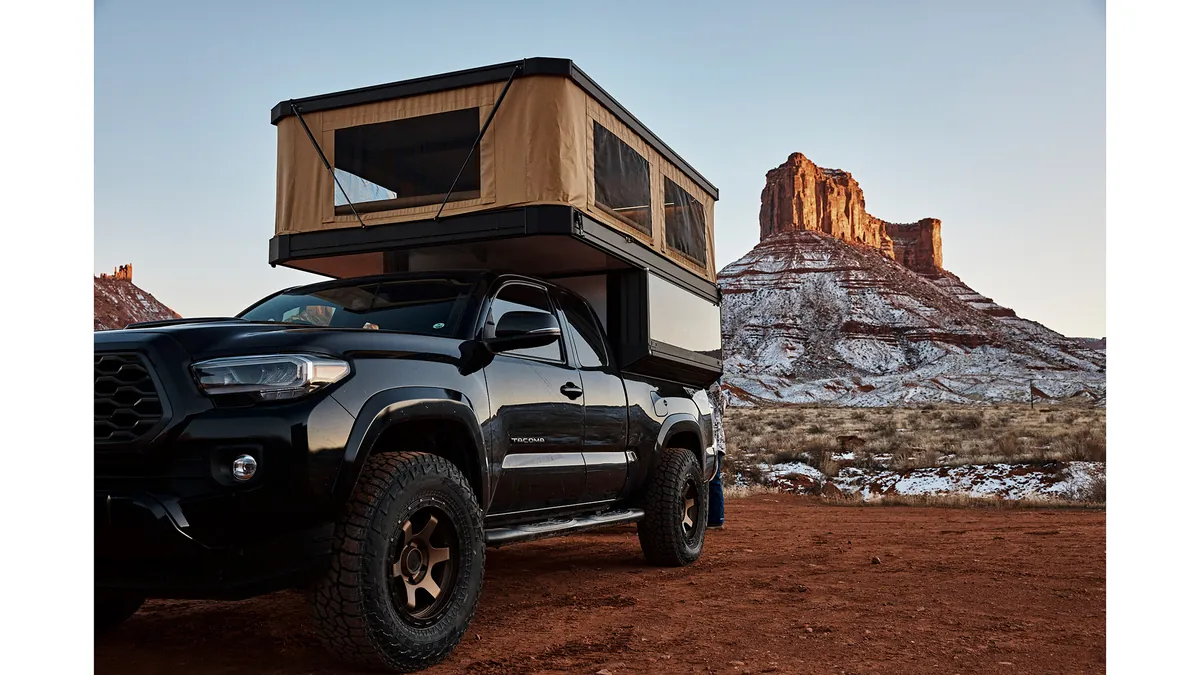
4. Four Wheel Campers Project M — Best Canopy Camper From a Legacy Brand
Weight: 400–515 lbs depending on truck and bed size | Starting price: $12,900 base (official configurator) | Best for: buyers who want dealer support, proven resale, and a blank-canvas build
The Project M is Four Wheel Campers’ answer to the topper trend: a canopy-style pop-up topper that bolts to your bed rails and keeps your factory tailgate. Unlike the wedge tents above, it pops straight up with vertical walls, so the interior feels roomier — and it comes from a company building truck campers since the ’70s, with a real dealer network and the best resale values in the business. It’s pre-wired for power and solar, with a big menu of factory options (windows, gear tracks, Rotopax mounts, jacks).
The honest part: it’s the heaviest “lightweight” option here — over 500 lbs for an 8-foot bed — and one installer walkthrough on YouTube devotes an entire chapter to the dust issue endemic to every bed-mounted camper (more below). It also costs more than most wedge toppers while offering less tent ventilation. But if you want to walk into a dealership and finance it like a normal purchase, nothing else here offers that. Our pop-up truck camper roundup goes deeper on the pop-up side.
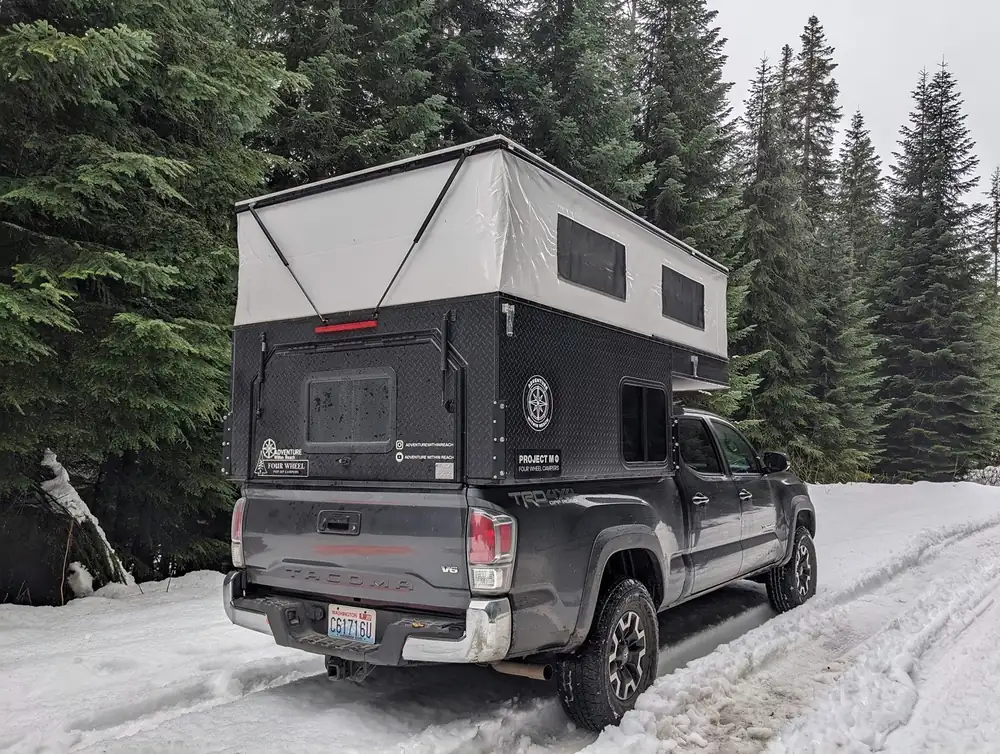
5. Hiatus Campers — Best Hard-Side Wedge-Style Topper for Four Seasons
Weight: 420–520 lbs depending on truck size | Starting price: from the mid-teens (custom builds — check the configurator for current pricing) | Best for: shoulder-season and winter campers who want hard walls, not canvas
Hiatus takes a completely different approach: a patented hard-sided pop-up with folding composite walls that deploys in under 15 seconds. The walls are insulated — the only topper here I’d take into a snowstorm without a second thought. The angled-frame models have a wedge profile, and the double rear doors seal far better against dust and water than the typical lift-up window and tailgate entry.
The honest part: hard walls cost you — 420 to 520 lbs, and pricing starts in the mid-teens for a mid-size build, climbing past $18,000 for a full-size 8-foot bed before options. (One long-term owner’s YouTube review mentions spending $30,000 fully optioned.) Lead times have historically been long since they build to order. But winter campers consistently say the insulation is worth every pound and dollar — pair it with our winter camping guide and you’ve got a genuine four-season rig.
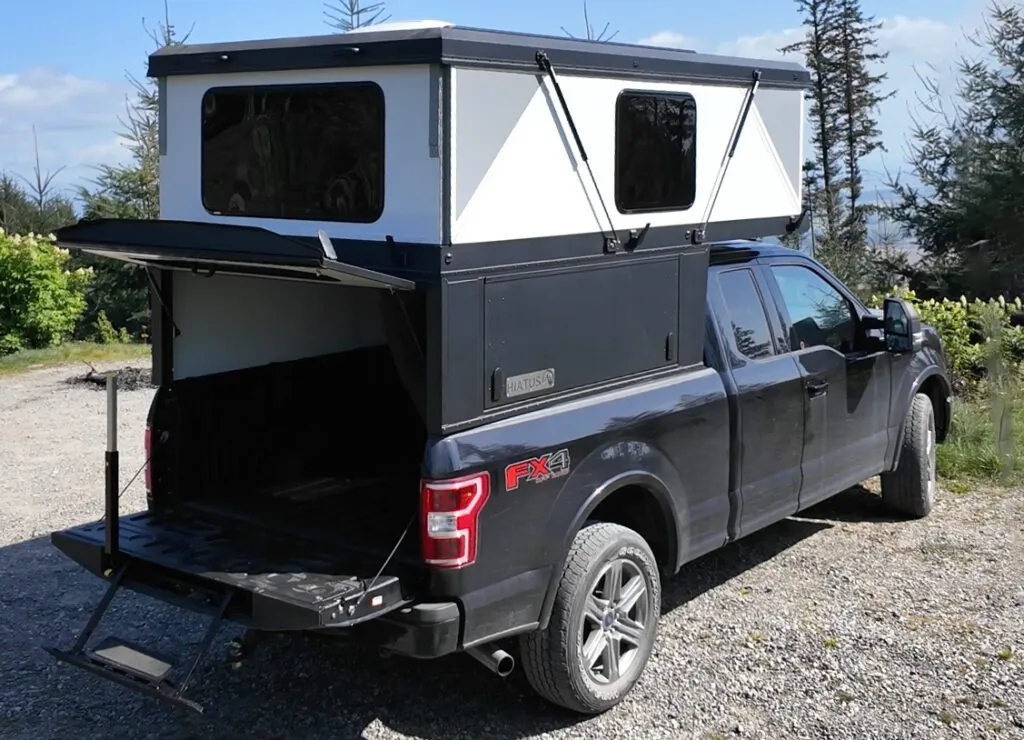
6. Scout Kenai — Best Full-Featured Wedge Camper
Weight: 1,232 lbs dry | Starting price: $29,990 | Best for: families and anyone who wants slide-in features in a wedge profile
The Kenai is what happens when a wedge grows up: hard-wall wedge profile with a pop-up roof, sleeping for 4–6, a mud room with a stainless drain pan, 80 inches of headroom, and an aluminum exoskeleton with wood-free composite panels that never rot. Built for heavy half-ton to 1-ton trucks, short or long bed, solar-ready with a removable power station.
The honest part: at 1,232 lbs dry, this is not a “throw it on a Tacoma” camper — do the payload math below before you fall in love. At $29,990 starting, optioned dealer builds list in the low $40,000s. But per pound it’s one of the best values in truck camping, and the wedge pop-top keeps the driving profile far lower than a traditional hard-side. See scoutcampers.com for the current build sheet.
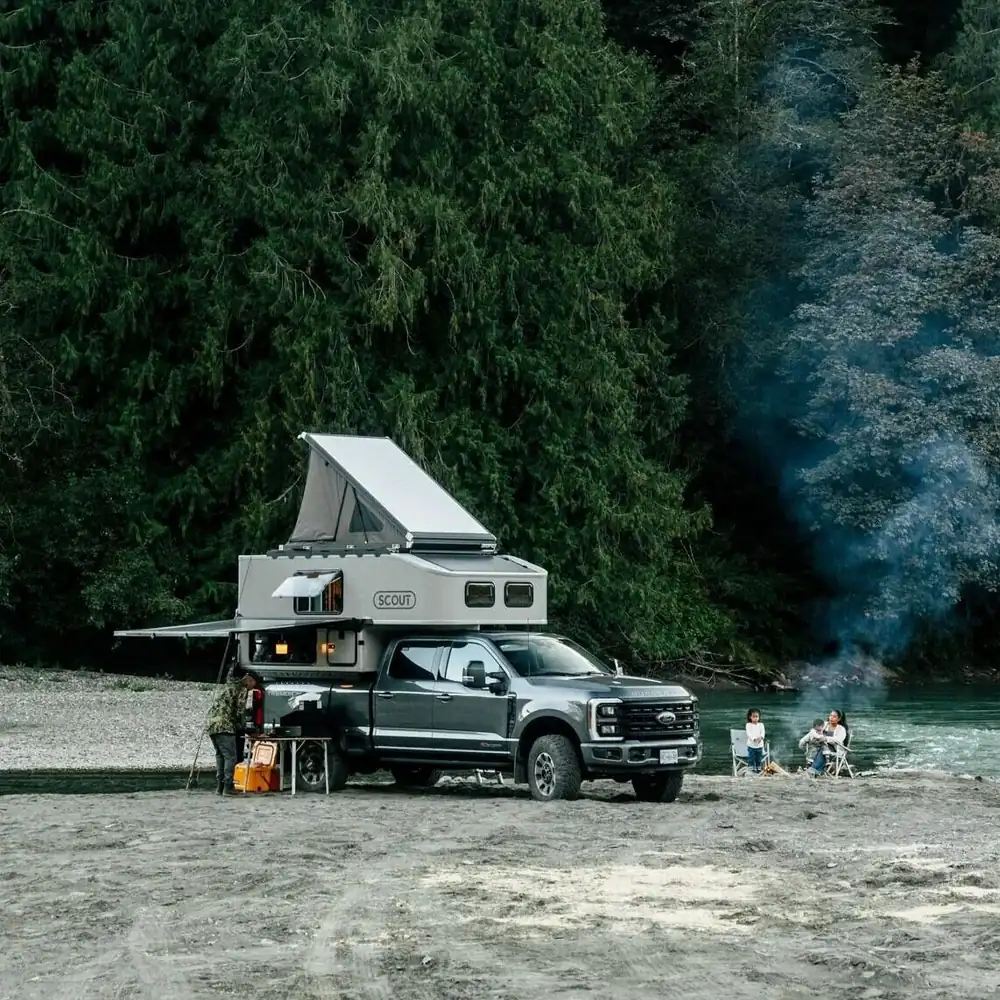
7. Madix Drift — Best Budget Wedge Camper
Weight: from 285 lbs (short-bed mid-size) | Starting price: $5,700 (beds 6′ and under) / $7,200 (beds over 6′) | Best for: budget-conscious buyers who want maximum included features per dollar
Madix Outdoors is the newcomer punching above its price. The Drift is a wedge camper built from a solid 1/8-inch aluminum shell, with a 600-lb static roof payload, gas-strut pass-through floors, front and rear windows included, a 2.5-inch mattress and anti-condensation mat in the base price, plus LED tent lighting, a ladder, and cross bars. Lead times run as short as five weeks — and installation is free.
The honest part: Madix is a small, young company, so you’re betting on them being around for warranty work — that’s the trade for saving thousands. Fit and finish won’t match Super Pacific. But for Tacoma and mid-size owners who want into the wedge game under six grand, nothing else is close. Details at madixoutdoors.com.
Wedge Campers Compared: Weight, Price, and Best Use
| Camper | Weight | Starting Price | Best For |
|---|---|---|---|
| GFC Platform Camper | ~270–330 lbs | ~$6,950 | Lightest proven wedge; daily drivers |
| Super Pacific X1 | mid-300s lbs | ~$13,495 | Turnkey quality and finish |
| Tune M1 | 400 lbs | $12,999 | Max interior space, stand-up headroom |
| Four Wheel Campers Project M | 400–515 lbs | $12,900 | Dealer network, resale, blank canvas |
| Hiatus Campers | 420–520 lbs | mid-teens | Hard-side four-season camping |
| Scout Kenai | 1,232 lbs | $29,990 | Full-featured family wedge |
| Madix Drift | from 285 lbs | $5,700 | Budget wedge, most features per dollar |
Wedge vs. Full Pop-Up: The Real Trade-Offs
A wedge camper pops up at an angle — low at the cab, tall at the tailgate. A traditional pop-up (like a Four Wheel Camper Hawk or an OVRLND-style topper) lifts straight up with vertical walls. Here’s how that plays out in real life:
Wedges win on: aerodynamics and clearance — the sloped nose slips under branches and through tight trails where vertical walls snag — plus wind stability and setup speed. Seconds, not minutes. That’s why wedge owners actually use their campers on random Tuesday nights, not just expeditions.
Wedges lose on: standing room and nighttime bed access. The low end sits over the cab, so usable standing space concentrates at the rear, and getting from the loft down into the bed usually means moving a bed panel — owners with small bladders mention this more than anything else. Full pop-ups give you vertical walls and more even headroom, at the cost of height, weight, and windage.
If you’re cross-shopping, our best pop-up truck camper guide covers the straight-lift side of the family.
Buying the Best Wedge Camper: Payload, Bed Fitment, and Fit
Do the payload math before you fall in love
Every wedge camper here is light for a camper, but “light” is relative to your truck’s payload sticker — the label on the driver’s door jamb, not the brochure number. A realistic mid-size example:
- Camper (GFC-style wedge): 300 lbs
- Bed platform, fridge, battery, water: 200 lbs
- Two adults: 350 lbs
- Dog, gear, firewood, bikes: 250 lbs
- Total: ~1,100 lbs
A stock Tacoma or Gladiator often carries just 1,100–1,200 lbs of payload. A 300-lb wedge plus a normal load can max out a mid-size truck — and a 1,232-lb Scout Kenai belongs on a full-size with 2,000+ lbs of payload, full stop. If you’re close to the limit, budget for suspension help (air bags or upgraded leaf packs). More in our lightweight truck camper guide.
Bed fitment: 5 ft, 6.5 ft, or 8 ft
Wedge and canopy campers are built to your bed — width, rail height, and tailgate design vary by make and model year. Measure yours with our truck bed measuring guide before ordering.
- 5-ft beds (Tacoma/Gladiator short bed): every wedge topper here fits, and wedges are arguably the best option for short beds since the loft extends over the cab. Gladiator owners, see our Gladiator camper roundup.
- 6.5-ft beds (most full-size short beds): the sweet spot — every manufacturer builds for these, with the best weight distribution.
- 8-ft beds: roomiest, and the only comfortable fit for the Scout Kenai — but expect premiums (Project M jumps to 515 lbs; Hiatus climbs past $18k optioned).
Wedges add 6–8 inches above your cab — measure your garage door before ordering; it’s the most common “oh no” in owner forums.
What Owners Actually Say (Beyond the Marketing)
I spent a few evenings in the forums and owner groups so you don’t have to. Five themes came up too consistently to ignore:
Dust is the universal enemy. Factory beds aren’t sealed — gaps around the tailgate and bed corners funnel dust in on dirt roads, and whenever owners debate the best wedge camper online, dust derails the thread. One installer-focused YouTube walkthrough of the Project M devotes an entire chapter to dust mitigation; Super Pacific owners on Tacoma World fixed it with bulb seal around the tailgate and bed seams. In August 2026, GFC even showed off a positive-pressure dust-filtration prototype on Instagram. Budget a sealing weekend, whatever you buy.
Condensation is a fact of wedge-tent life. Single-wall wedge tents sweat in cold or wet weather — GFC owners on forums are blunt about it, and even Super Pacific owners (who get four closeable vents) wipe down the roof and walls before packing up. The fix is ventilation, not wishful thinking: crack a vent, run a small fan, never pack the tent away wet. Our condensation guide has the full playbook.
The stock mattress question is real. In one long-running owner thread, a GFC owner who switched to Super Pacific called the GFC mattress “horrible” after weeks-long trips and praised the X1’s included Exped Megamat. Check what’s included before comparing prices — a $400 mattress upgrade narrows the gap fast.
Setup speed is the superpower. Across every brand, owners cite the same thing: pop the roof, done. Seconds. That’s why wedge owners use their campers on random Tuesday nights, not just expeditions.
Customer service reputations vary wildly — and owners remember. Super Pacific’s 5-star Google rating across 200+ reviews gets cited constantly in “which wedge” threads, and GFC’s huge owner community means every problem has a documented fix. With smaller builders, ask about lead times and warranty support before you put down a deposit.
Frequently Asked Questions
How much does a wedge camper cost in 2026?
In 2026, a wedge camper runs anywhere from $5,700 (Madix Drift) to $30,000+ (Scout Kenai, or a fully optioned Hiatus). Most quality wedge toppers land between $7,000 and $14,000 before options; canopy campers with real interiors run $12,000–$18,000. Installation, shipping, and options can add $1,000–$3,000 — budget beyond the base price.
Do wedge campers leak or let dust in?
They can — but usually it’s the truck bed, not the camper, that’s the weak point. Water and dust enter through tailgate gaps and bed seams, and owners fix it with bulb seal, tailgate seals, and sealing the bed’s drain holes and stake pockets. Hard-side options like Hiatus seal better than soft-tent wedges, but budget a sealing weekend regardless of brand.
Can I still use my truck bed with a wedge camper installed?
That’s the whole point. Unlike a slide-in, a wedge or canopy camper sits on the bed rails, so the bed stays usable for gear, dogs, bikes, and dump runs. Removable or lift-up bed panels let you stand inside with the tent deployed, and the locking side panels turn the bed into a secure gear locker when closed.
Will a wedge camper fit a 5-ft, 6.5-ft, or 8-ft bed?
Yes — each camper is built to your specific truck, bed length, and model year. Five-foot beds (Tacoma, Gladiator) are the most popular fitment and work great since the loft extends over the cab. Confirm your exact make, model, year, and bed length when ordering, and measure with our bed measuring guide first.
If the wedge format clicked but you want to compare straight-lift pop-ups too, our best pop-up truck camper roundup is the natural next read — and if weight is your top constraint, the lightweight truck camper guide keeps your payload honest. Whichever you pick as the best wedge camper for your rig: measure the bed, seal the tailgate, go sleep somewhere good.