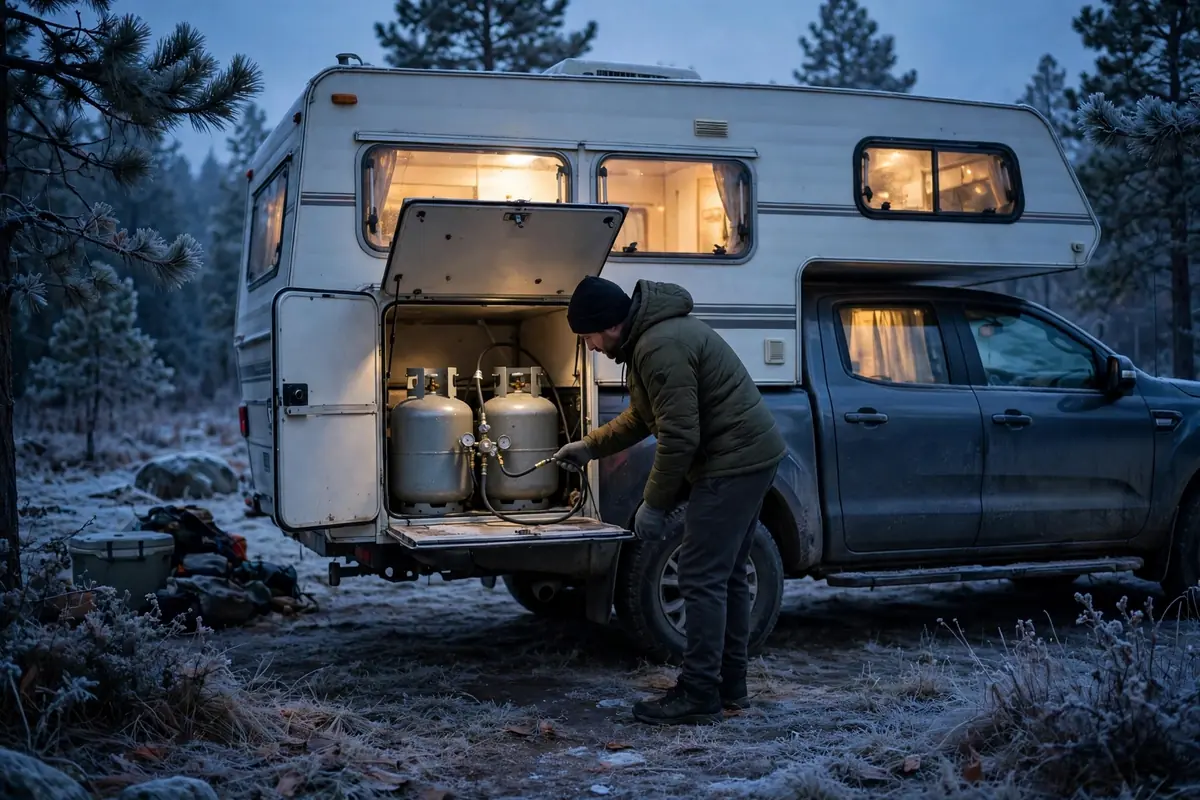
Truck Camper Propane System Guide: Tanks, Regulators, Hoses and Leak Checks
I learned most of what I know about a truck camper propane system the embarrassing way: standing outside in the cold, in my socks, staring at a stove burner that would barely light while a supposedly full tank sat right there. The tank was fine. The regulator, the hose, and the way I had opened the valve were not. Propane runs the furnace, water heater, stove, and, in many rigs, the fridge — and when it fails, everything stops at once.
This guide covers the supply side only: tank, valve, pigtail hose, regulator, and the line into the camper, plus sizing, filling, leak testing, and cold-weather care. If you are still weighing winter heating choices, or deciding between fridge types, read those separately.
Safety disclaimer: Propane is flammable gas under pressure. This is general education from an owner, not a substitute for your camper manual, local codes, or a qualified gas technician. If you smell gas, cannot find a suspected leak, or are unsure about any fitting, shut the tank valve if it is safe to do so, get clear, and call a professional. Never test for leaks with a flame.
How Your Truck Camper Propane System Actually Works
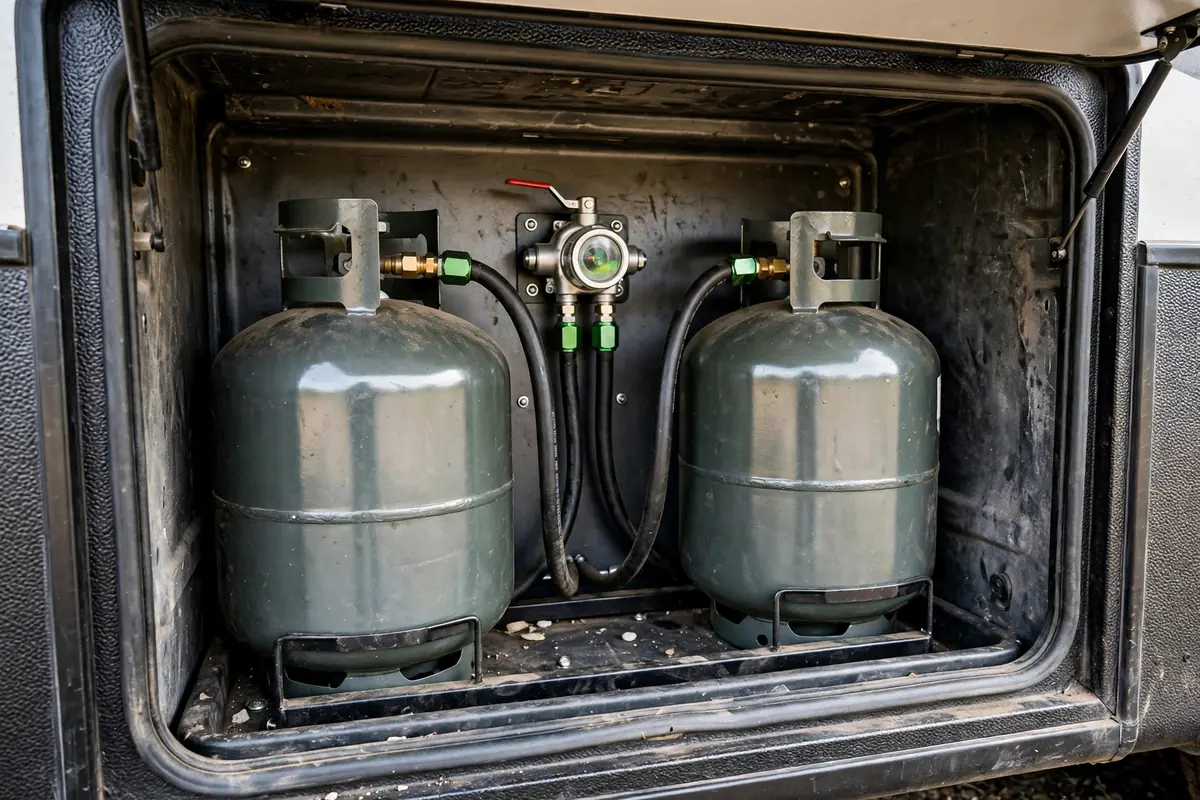
Inside the tank, propane sits mostly as a liquid under pressure. Open the valve and liquid boils off into vapour, which travels through a short hose called a pigtail to the regulator, then through a hard line to your appliances. Tank pressure varies with temperature and fill level, and it is far too high for an appliance to use directly. That is the regulator’s whole job.
A proper RV regulator is a two-stage regulator. The first stage knocks tank pressure down to roughly 10 to 15 psi. The second stage drops it again to a steady 11 inches of water column, only about 0.4 psi, which is what your appliances are built for. If pressure drifts high, flames get wild and sooty. If it drifts low, burners go yellow and lazy and the furnace may fail to light.
Most truck campers carry removable DOT cylinders. A 20-pound cylinder holds about 4.6 to 4.7 gallons, stands roughly 18 inches tall, and weighs around 37 pounds full. A 30-pound cylinder holds about 7 gallons, stands roughly 24 inches tall, and weighs around 55 pounds full. Measure your compartment door before you “upgrade” to a taller tank that will not fit, and remember weight counts against payload.
A tank is never filled to the brim. The overfill prevention device, or OPD, stops filling at 80 percent so liquid has room to expand as it warms. The triangular handwheel on a modern valve is the clue you have an OPD valve; if yours still has an old round or star-shaped handwheel, most fill stations will refuse it.
Tanks, Valves, and the Date Stamp to Check Today
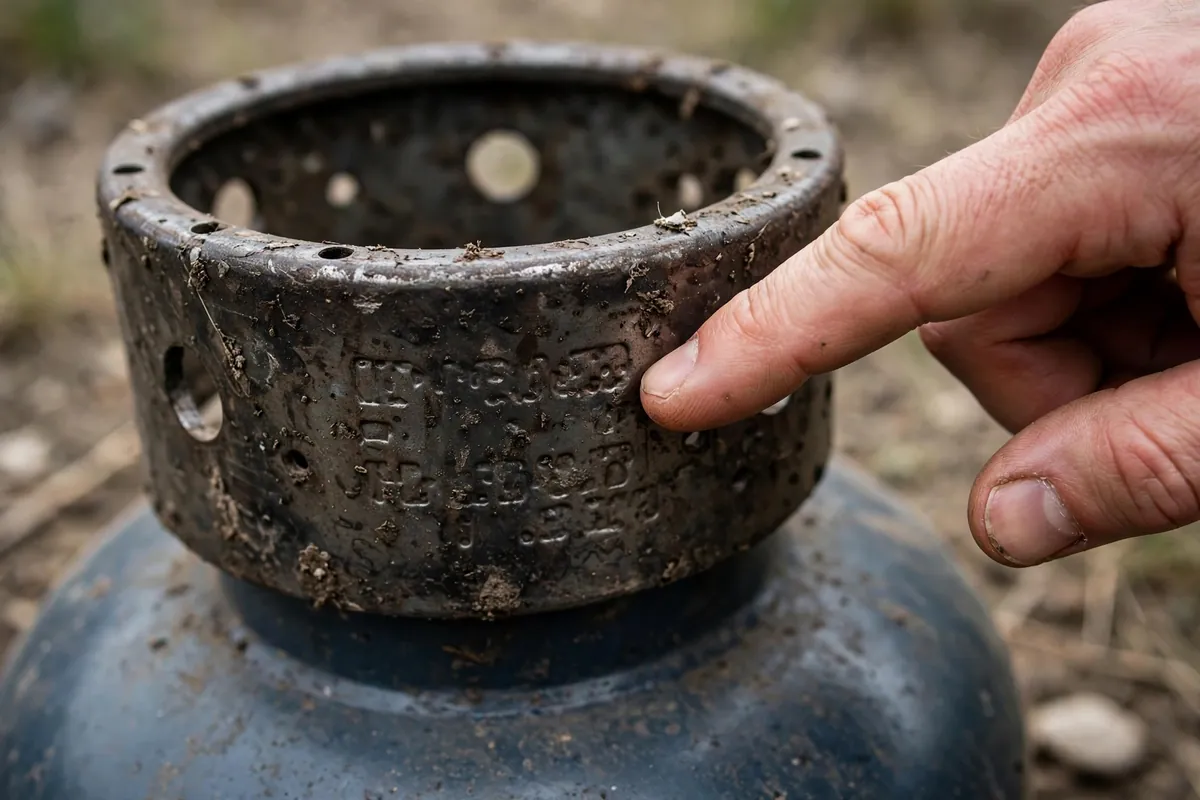
Read the collar of your cylinder. Stamped around the valve are the manufacture date and the tare weight marked “TW.” Under U.S. Department of Transportation rules, a portable cylinder must be requalified within 12 years of manufacture, then again at intervals depending on the test method — five years after a visual inspection, for example.
The tare weight is the most useful number on the tank: weigh the cylinder, subtract the tare weight, and the result is the propane you actually have — important because most cheap gauges lie, as explained below. Inspect every season and retire a tank with deep rust or pitting near the bottom, dents, bulges, cuts, a damaged foot ring or collar, or a leaking valve. Keep cylinders upright and secured, valve closed and cap on when disconnected, never inside the living space. A propane compartment is vented for a reason: vapour is heavier than air, so a leak pools low.
The Regulator: Two Stages, One Vent, No Adjusting
Your regulator lives outside in rain, dust, and freezing wind, yet must hold 11 inches of water column whether the tank is full or nearly empty. First, the vent must point down, within about 45 degrees of vertical, and stay clear. The vent is how the diaphragm inside breathes; if it fills with water, mud, or a wasp nest, regulation goes wrong.
Second, match capacity to your appliances. Capacity is rated in BTU per hour: add up the ratings on your appliance plates for everything you might run at once, and buy a regulator rated above that total. A common RV two-stage regulator is rated around 160,000 BTU per hour, and Marshall Excelsior auto-changeover models run around 225,000 standard and 350,000 high-capacity. A regulator rated below your simultaneous load starves the last appliance in line — owners on forums report the oven failing to hold temperature when the cooktop and water heater also run, starting right after a regulator swap.
Do not try to adjust a sealed RV regulator to “turn it up.” These are factory-set. One that will not hold pressure, smells of gas, or is more than about ten years old — Camco’s manual says to inspect and replace after ten years, sooner in severe conditions — should be replaced, not coaxed. If you are not confident about gas-tight connections and the leak test that follows, pay a technician.
Pigtails and the Valve You Opened Too Fast
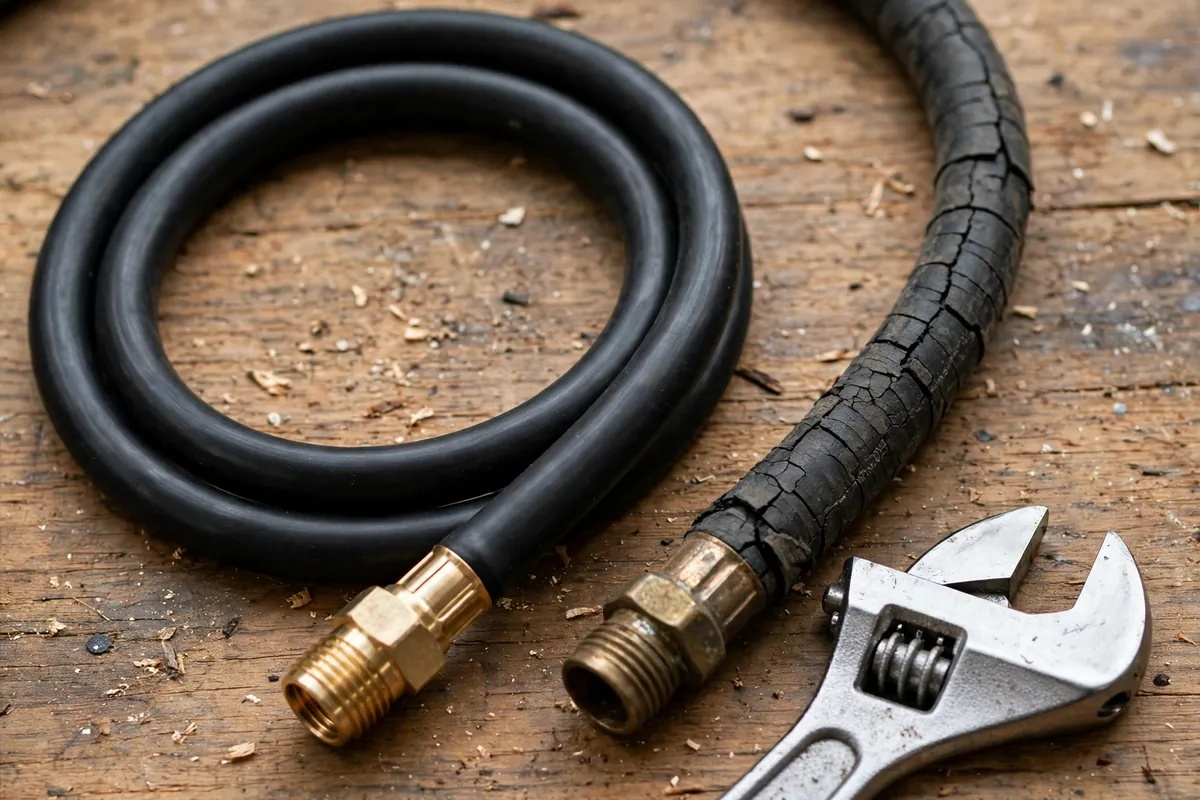
The pigtail is the short hose from the tank valve to the regulator, with a big green ACME hand nut on the tank end. Inside that nut sit an excess-flow device, which chokes flow if gas rushes out suddenly, and a thermal shutoff for fire. The other end is either a 1/4-inch inverted flare or a 1/4-inch pipe thread, depending on your regulator — buy the wrong end and it will look almost right and seal not at all, so photograph the old one before ordering a spare.
Pigtails age even when they look fine. Rubber cracks and stiffens with sun and weather, and owners on forums regularly trace a slow leak or weak flame back to a pigtail years past its best. Budget to replace rubber pigtails about every five years, sooner if stiff, cracked, or weeping oily residue. Stainless-braided pigtails hide the rubber inside, so treat those as replace-on-schedule too.
One community pattern catches almost everyone once. Owners on forums describe the same scene: full tank, but only a faint flame, or one burner works and the furnace will not. The usual culprit is the excess-flow device tripping because the tank valve was opened too fast, which it reads as a sudden rush of gas, exactly what a broken line would cause. The fix costs nothing: close the tank valve and the appliances, wait a few minutes, then reopen the valve very slowly, a quarter turn at a time. I do this every time now, and I have not had a mystery low flame since. If the problem survives a slow reopen, look at the pigtail and regulator next. When connecting, hand-tighten the green ACME nut until it stops; never force it with a wrench.
Auto-Changeover: The Lever Does Not Move Itself
If you have two tanks, you probably have an auto-changeover regulator, the most misunderstood part of the system. Point the black lever at the tank you want to use first and open both tank valves. The indicator shows green while the selected tank has gas; when it empties, the regulator automatically draws from the reserve so your furnace does not quit mid-night, and the indicator flips to red.
What it does not do is move the lever for you. Owners on forums report this confusion again and again: gas keeps flowing from the reserve, the indicator stays red, and they assume the regulator is broken. It is not — flip the lever to the tank now in use, the indicator goes green again, and take the empty tank for a fill. The other classic mistake is leaving the reserve valve closed; the regulator cannot switch to a tank that is shut. Open both valves, every time.
A stuck indicator is also common and usually harmless: owners describe gauges wedged between red and green that start working after a tank cycles. But if gas will not flow from one side at all with both valves open and the lever pointed at it, suspect a stuck check valve or a failed regulator and get it checked.
How Long a Tank Lasts, and Refill vs Exchange
Propane holds about 91,500 BTU per gallon. A full 20-pound cylinder at about 4.6 gallons holds roughly 420,000 BTU; a full 30-pound cylinder at about 7 gallons holds roughly 640,000 BTU. Divide by what your appliances burn, remembering furnaces cycle on and off. Example: a furnace rated 20,000 BTU per hour at half duty averages 10,000 BTU per hour, so ten hours plus an hour of cooking at 15,000 BTU costs about 115,000 BTU for the night — roughly three and a half nights per 20-pound tank, before the fridge and water heater take their share. Propane and electricity are separate budgets: if you are weighing generator vs solar for power, neither refills your propane.
A refill station fills your own cylinder by the gallon, up to the 80 percent limit. An exchange cage swaps your empty for a pre-filled one — fast and useful when your tank is out of date, but refill is almost always cheaper per pound. The catch: major exchange programs commonly put 15 pounds in a 20-pound-size cylinder, not 20. You pay a flat price, often roughly $20 to $30 in recent U.S. checks, for three-quarters of a tank, while a refill at roughly $3 to $4 per gallon typically lands in the high teens to about $20 for the full 4.6 gallons. Prices move with region and season, so compare cost per pound locally, not the sign. Refill also lets you top off a half-full tank before a cold trip, and exchange cages mostly stock 20-pound cylinders, so 30-pound owners usually need refill anyway.
How Much Is Left? Weigh It, Don’t Trust the Dial
A cheap screw-on pressure gauge does not measure liquid level. Propane vapour pressure stays nearly constant as long as any liquid remains to boil off, so the needle sits on “full” from 90 percent down to nearly empty, then crashes. Owners on forums report running dry while their gauge still showed plenty — not a defective gauge, just a pressure gauge doing what pressure gauges do.
What works: weigh the tank (scale minus stamped tare weight); use a real float gauge, or an ultrasonic sensor stuck to the tank bottom that reads the liquid level; or, as a rough trick only, pour hot water down the side of a tank in use and feel for the cold line. My routine: weigh before a trip, weigh when the changeover indicator flips, and never trust a pressure dial for a go or no-go decision.
Leak Detection: The Soapy Water Test
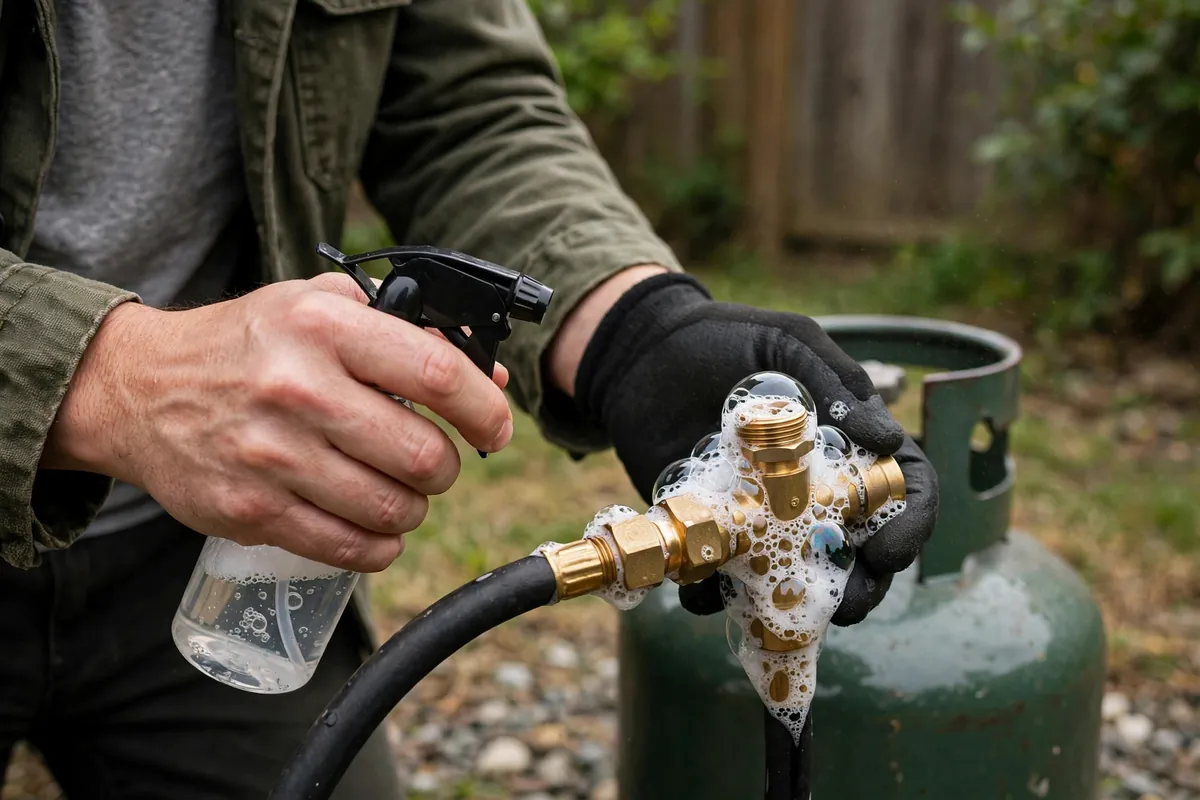
Propane itself is odourless, so suppliers add ethyl mercaptan, the rotten-egg smell, so you can detect a leak. Your nose is the first alarm, not the only one. A propane detector belongs low in the camper, because vapour sinks; National Fire Protection Association guidance puts LP-gas alarms within 18 inches of the floor. Test yours monthly, and do not rely on smell alone, since odour can fade in a new or rusty tank.
For a suspected fitting leak, use the soapy water test: a few drops of dish soap in water, or commercial leak-detector fluid. With gas on and appliances off, brush or spray it onto every connection you disturbed or suspect. A leak shows as bubbles that keep growing and reforming, not the few bubbles from the first squirt. If you find bubbles, close the tank valve, do not force a leaking flare fitting tighter, and fix the cause: reseat the connection, replace a damaged seal or pigtail, or call a technician, then test again.
If the smell is strong, the detector is alarming, or you cannot find the source, stop testing and treat it as an emergency: get everyone out, do not operate lights, switches, phones, or appliances, and call 911 or your gas provider from a safe distance. Do not re-enter until responders or your provider say it is safe. A faint smell gets the same treatment as a strong one. Add this to your routine: the annual maintenance schedule already covers seals, tires, and batteries, so add hoses, regulator vent, detector test, and a soapy test at season start and after any part change.
Cold Weather: Why Regulators Freeze When Propane Does Not
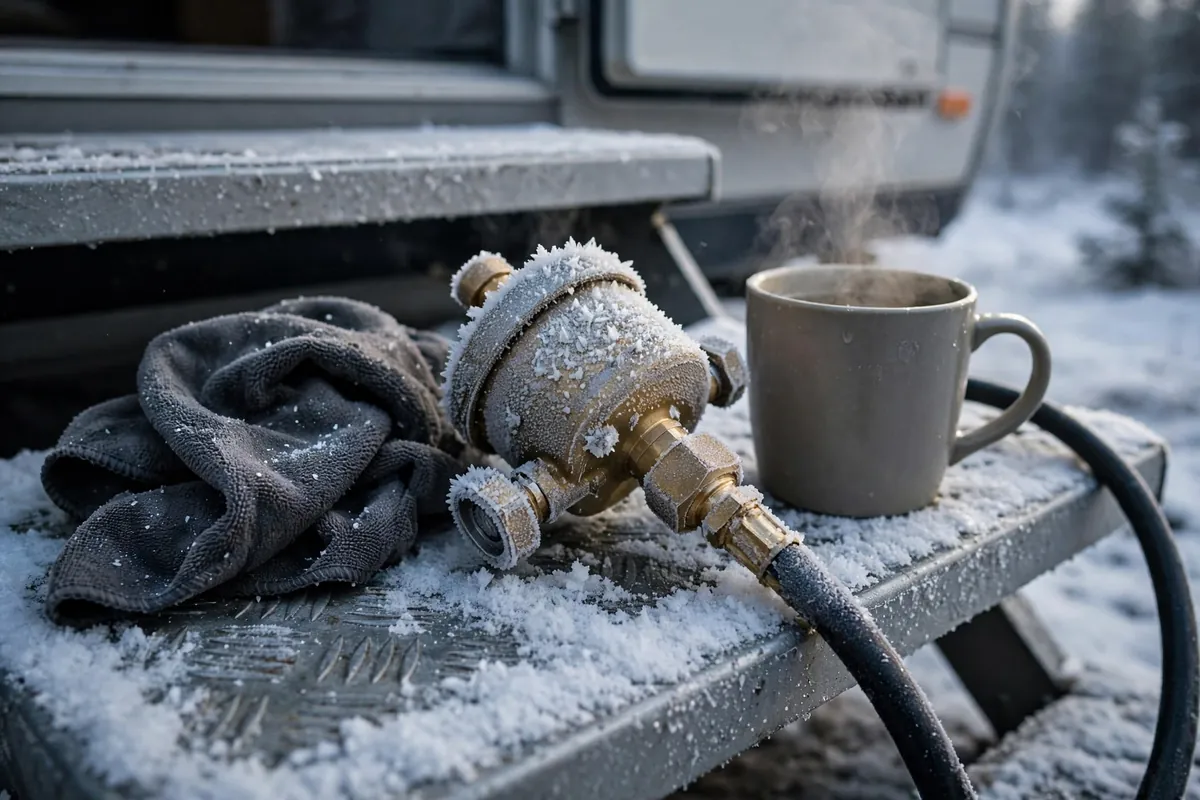
Propane itself does not freeze in any weather you will camp in; it boils at about minus 44 degrees Fahrenheit. What freezes is moisture, and what fails is pressure. Owners on forums describe the classic version: full tanks, then on a damp night in the twenties the flame shrinks, the furnace locks out, and by morning everything works again, sometimes with the regulator frosted white. Usually one of three things happened: moisture in the tank or regulator turned to ice and blocked the tiny orifice; an overfilled tank sent liquid into the regulator, where it flashed to vapour and chilled it far below air temperature; or the tank could not vaporise fast enough for a hard-working furnace.
Try this in order. First, slow-reopen the valve in case the excess-flow device tripped, and check the changeover indicator so you are not diagnosing a frozen system that is really an empty tank. Second, thaw a frosted regulator gently with a cloth soaked in warm water, never an open flame or torch on gas fittings. If ice returns quickly, suspect moisture or overfill and have your supplier purge the tank or inject an approved de-icer; do not pour additives in yourself. Third, keep the vent clear and covered, and keep empty tank valves closed. Fourth, keep tanks reasonably full in cold weather. Changeover regulators also sometimes need time to equalise after gas has been off; owners report patience plus a slow valve opening clears problems a rushed replacement did not.
When to Call a Professional

Swapping a pigtail, swapping a like-for-like regulator, weighing a tank, and running a soapy water test are reasonable owner jobs, with gas off while you work and a leak test after. These are not: repairing a tank valve, requalifying a cylinder, modifying hard gas lines, adjusting a sealed regulator, or chasing a leak you cannot find. If a fitting leaks after reseating and a new pigtail, or the system has run dry and air may have entered the lines, get a technician to pressure-test it first.
Keep a small kit in the camper: a spare pigtail of the correct fitting type, soapy water in a spray bottle, and a propane dealer’s number. Before a trip, weigh both tanks, check date stamps, inspect both pigtails, confirm the vent points down, and test the detector. At setup, open valves slowly, confirm the lever points at the intended tank, and soapy-test any connection you touched. During the trip, glance at the changeover indicator every evening, not every morning after the furnace has already quit.
Frequently Asked Questions
How do I know if my truck camper propane regulator is bad? Weak or yellow flames on all appliances at once, a furnace that fails to light, or a gas smell around the regulator. Rule out an empty tank, a tripped excess-flow device, and a cracked pigtail first.
Why does my gauge say full when the tank is almost empty? Most screw-on gauges measure pressure, not liquid level, and vapour pressure stays nearly constant until liquid is almost gone. Weigh the tank and subtract the tare weight, or use a float gauge or ultrasonic sensor.
Should I refill or exchange? Refill when you can: you pay by the gallon, get a full 80-percent fill, and can top off a half-full tank. Exchange when your tank is out of date or you need fuel after hours, but remember a 20-pound exchange cylinder commonly holds 15 pounds, so compare cost per pound.
Why did my furnace quit on a cold night with full tanks? Common supply causes: tripped excess-flow device, empty selected tank with the reserve valve closed, moisture ice in the regulator, or overfill sending liquid into the regulator. Slow-reopen the valves, check the indicator and lever, thaw frost with warm water only, and have a supplier check moisture or overfill if it repeats.
How often should I replace hoses and regulators? Rubber pigtails about every five years, sooner if stiff, cracked, or leaking. Regulators: inspect routinely, replace after about ten years, sooner in severe conditions or at the first sign of leaking or erratic pressure. Leak-test with soapy water after any replacement.
Sources: NFPA fuel gas alarm fact sheet. PHMSA cylinder safety guide. Camco regulator instructions.