How to Stop Truck Camper Rattles, Squeaks, and Road Noise
The first time I drove with the radio off, I discovered what truck camper rattles really sound like. It was like a cutlery drawer falling down a flight of stairs — a rattle from behind me, a squeak every time the truck flexed, a groan from up near the cabover, and a whistle I could not place. My camper was not falling apart. It was just a truck camper doing what truck campers do: two big structures bolted together, full of loose stuff, flexing over every crack in the road.
The good news: most truck camper rattles are cheap to fix once you know where they come from. The hard part is diagnosis — noise travels through frame and walls, so the rattle you swear is the back door is often a cabinet three feet away, or something underneath you. This guide walks through diagnosis zone by zone, with fixes that worked for me and other owners.
Safety first: not every noise is harmless. A new clunk or metallic rattle that started suddenly can mean a loose tie-down, slack turnbuckle, or a jack leg not fully retracted. If you suspect any of those, pull over and check before you keep driving. This is general owner guidance, not a substitute for your maker’s instructions, and anything pointing at structure or a damaged anchor deserves inspection, not foam and hope.
How to find a truck camper rattle before you fix it
Start with a twenty-minute diagnosis drive, not sound-deadening mat — a fix aimed at the wrong place fixes nothing.
First, empty the obvious suspects: everything loose out of the overhead cabinets, the cutlery tray, the pots off the stove. Drive your usual noisy stretch again. If the noise is gone, you have a contents rattle, and the cabinet section below will sort it in an afternoon.
If the noise survives, bring a passenger — you drive, they listen and point. Better still, reproduce it parked: have someone bounce each corner of the truck and push and pull on the cabover, door, and cabinets while you listen inside. A noise you can reproduce parked is a noise you can find.
Use the press test: press a cabinet door over a bump (stops = door or latch), push up on the cabover platform (stops = platform-to-frame contact), press the door from inside (stops = seal or striker). Each press that silences the noise narrows the search by half.
Timing is a clue too. Noise only over bumps means something loose or bouncing; only when the truck twists, like turning into a driveway, means something rubbing; steady above a certain speed, not pulsing with bumps, is wind. A new noise after a rough road means stop and inspect tie-downs, jacks, and mounts first.

Tie-downs and turnbuckles: check these first, every time
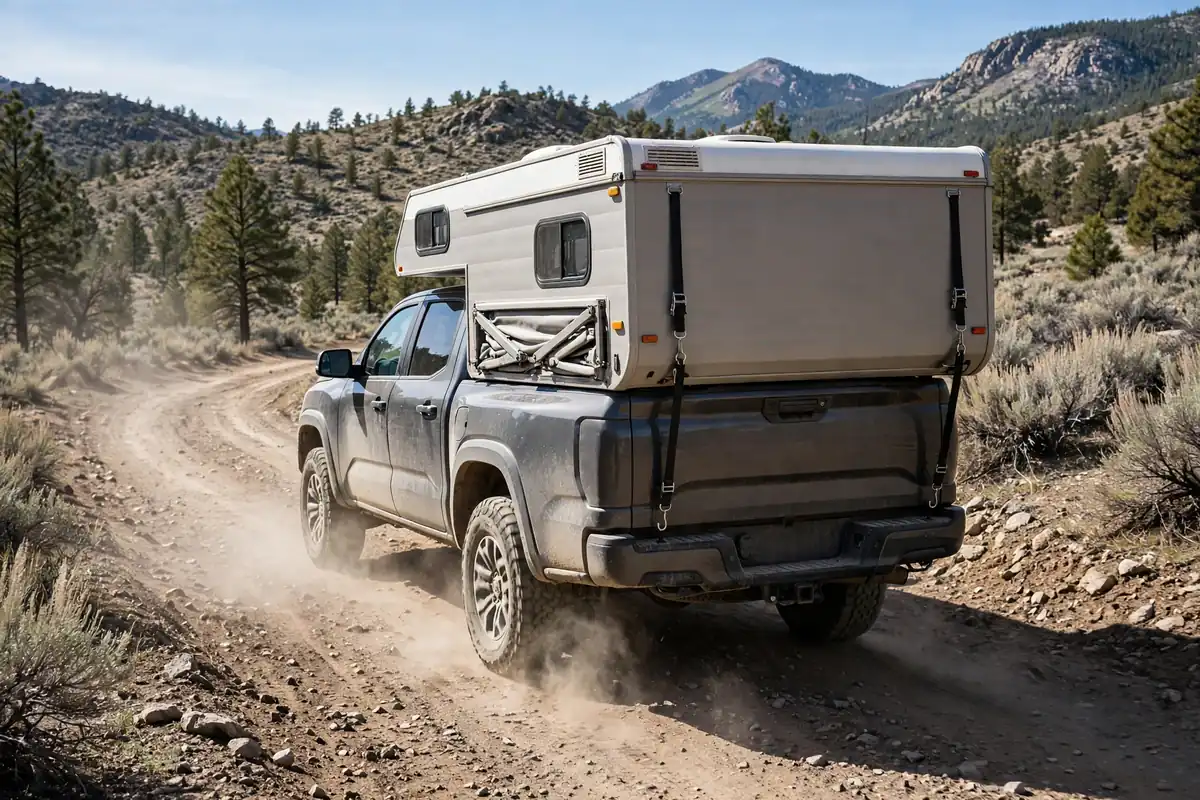
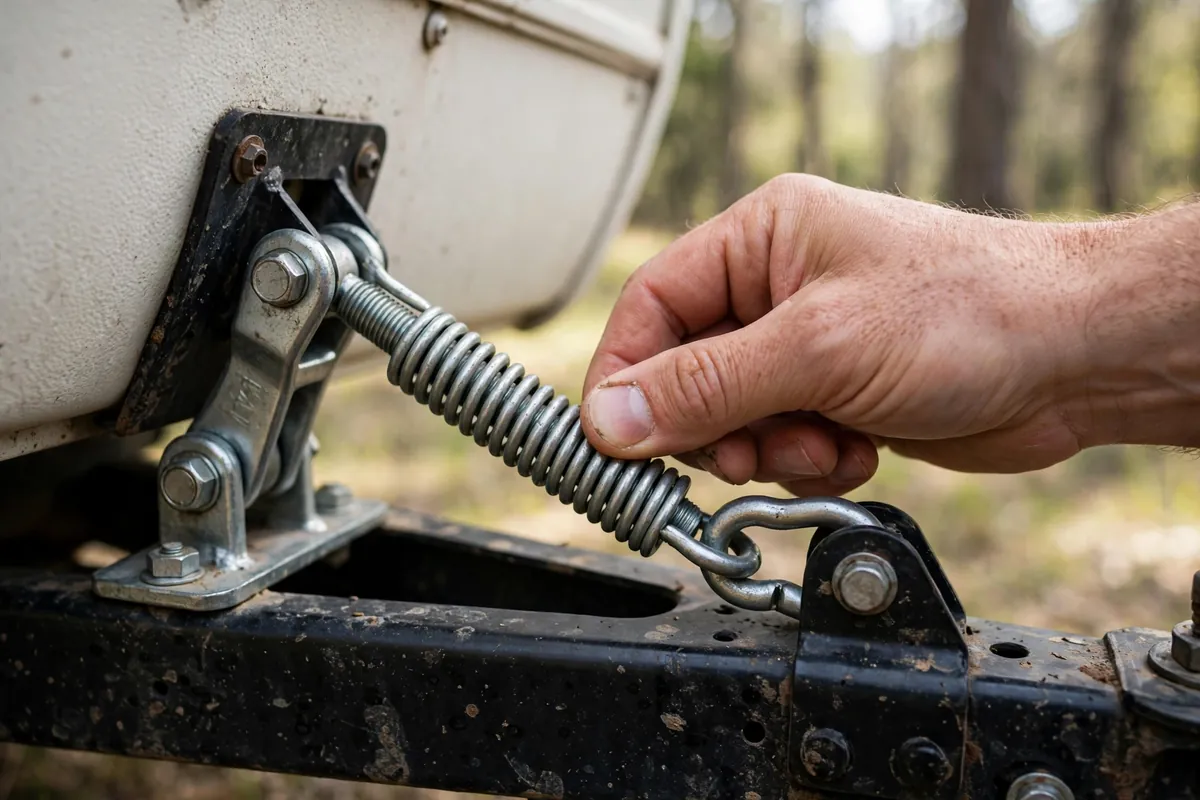
If I could only check one thing on a noisy rig, it would be the four turnbuckles. Slack here does not just rattle. It lets the camper shift a fraction of an inch in the bed on every bump, and that tiny shift makes a clunk or groan that sounds like it is coming from everywhere at once. Worse, slack turnbuckles are a safety issue, not a comfort issue — they hold your camper on the truck.
Check them before a trip and again after the camper settles. Owners on WanderTheWest report a pattern worth copying: re-tighten after the first 200 miles, and again around 400 to 500 miles, because camper, bed mat, and hardware all settle in those first miles. After that, a check at fuel stops on rough-road trips is cheap insurance.
At each corner, look for slack you can wiggle by hand, a spring fully compressed solid or fully slack, bent hooks, cracked welds, rusted threads, or a turnbuckle rubbing on a jack leg. Rubbing makes its own ticking squeak, and a bent hook is a replacement, not a tighten-and-hope. Also look for the camper sitting off-centre, or rub marks on the bed rails where it has shifted.
On tension, follow your system’s instructions, but the widely published figure from Torklift is 300 pounds per anchor point for spring-loaded turnbuckles: on a FastGun, the O-ring sits about a quarter inch below the body when tension is correct. Do not just crank a turnbuckle until it feels “really tight” — over-tightening can damage anchor points. If one corner keeps loosening, something is moving: check mount bolts, the anchor point, and whether the camper sits flat. See also Best Truck Camper Tie Downs Compared.
Jacks: the rattle hiding in plain sight
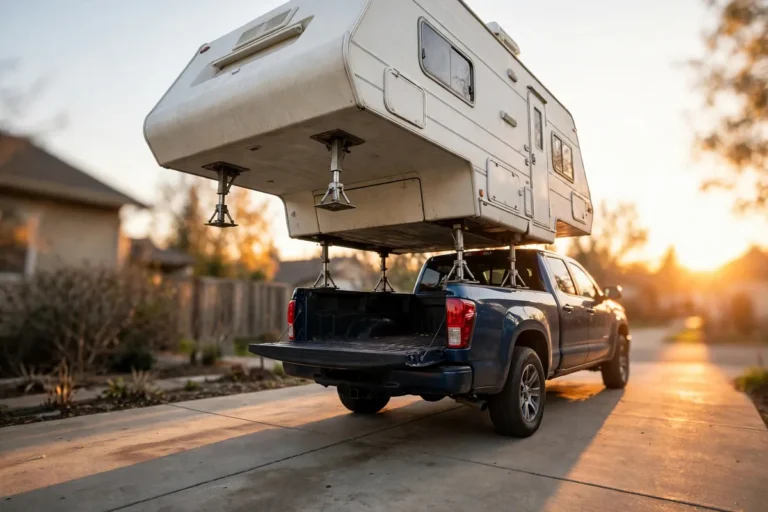
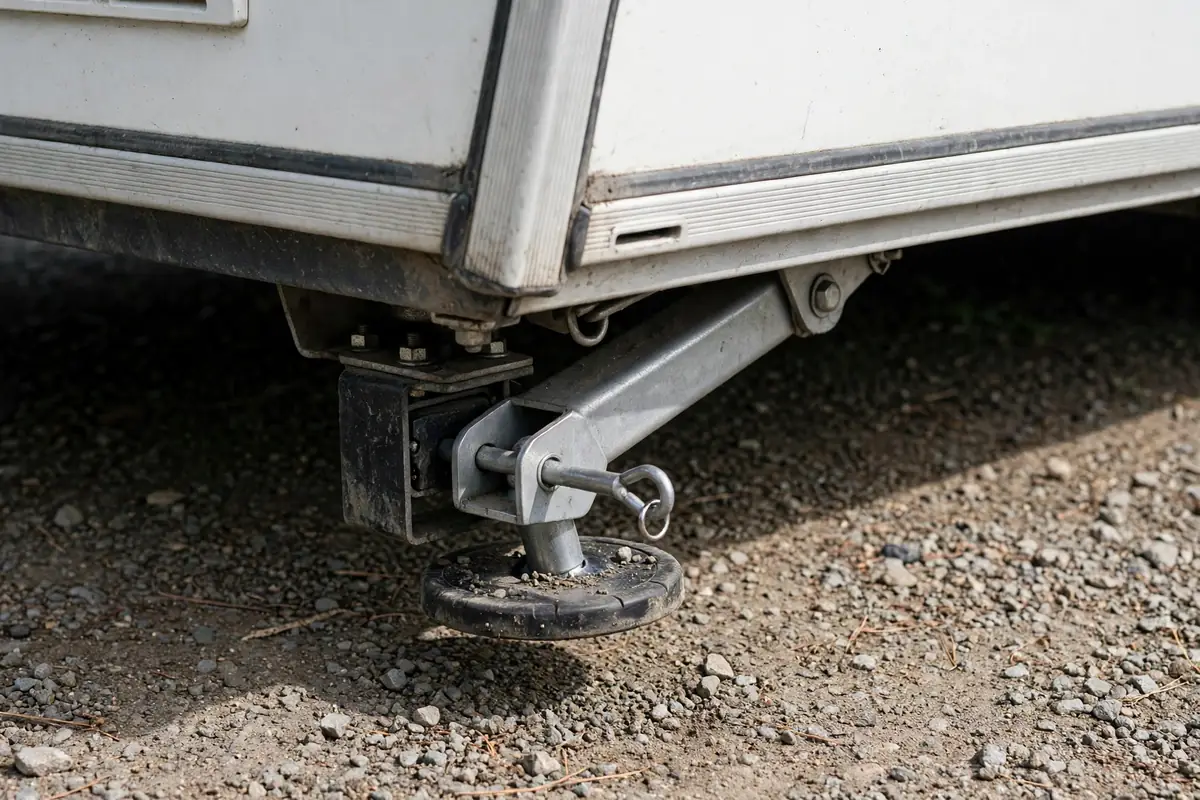
Truck camper jacks stick out at the corners, and when not fully retracted and locked, they bounce. A leg dropped even half an inch will knock on every bump. Owners on iRV2 have reported a scarier version: a broken roll pin let an inner leg drop to the pavement and skate along the road. That is why a jack noise deserves a walk-around, not a shrug.
Before every drive, check all four legs as part of your walk-around, the same habit covered in my truck camper jacks guide: legs fully retracted (look, do not assume — a leg can hang a half inch low and still look up from the driver’s seat), locking pins and clips in place, no free play when you shake a leg, feet tight, and no fresh scrape marks. A missing hairpin clip alone lets a leg chatter in its housing.
If you have electric jacks, a new grinding or clicking from a motor is a gearbox problem, not a rattle to quiet. Lubricate shafts and pivots as your maker recommends (dry silicone is usual, because wet grease collects dust), and cycle the jacks fully a few times a season. Remove detachable lower sections for travel — owners who leave them on hear them bouncing all the way to camp.
The cabover and the floor: where squeaks love to live
The cabover bunk is a big flat platform, and the camper floor is a big flat sheet sitting on a truck bed. Both are perfect squeak generators, because any two large surfaces rubbing under load will sing about it.
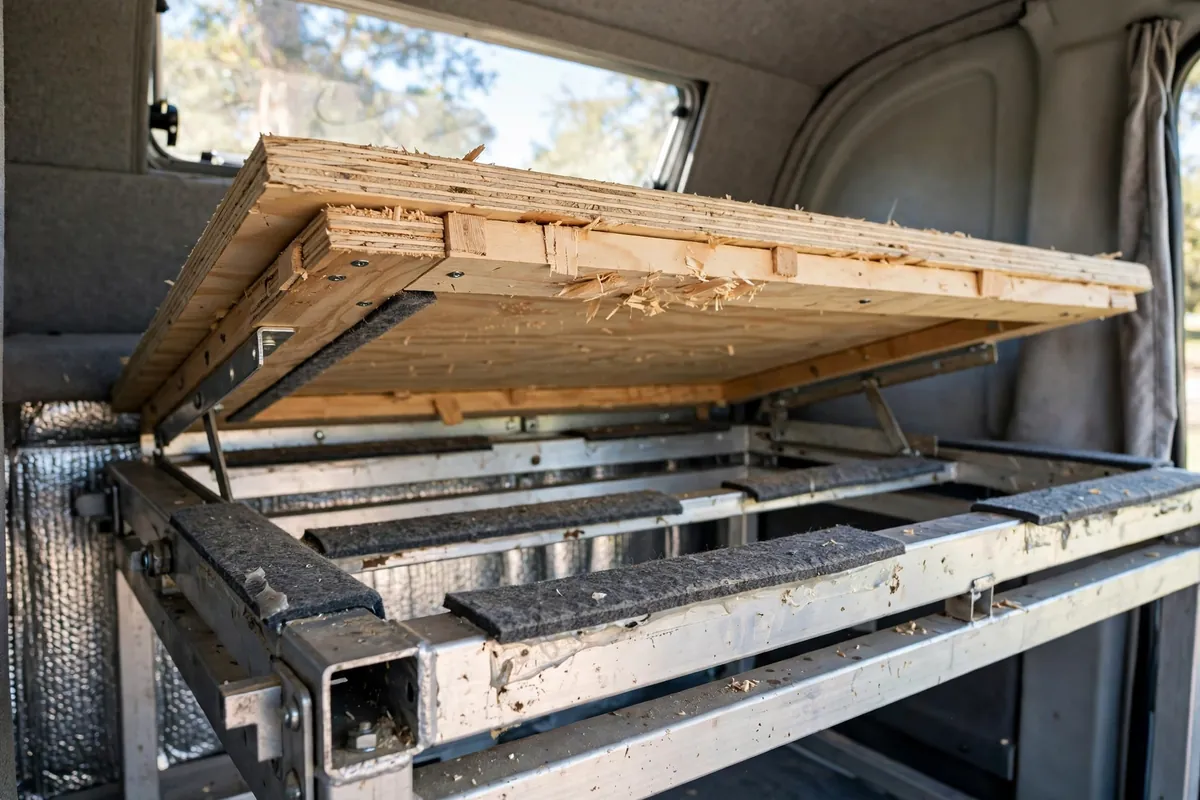
The classic cabover squeak is a rhythmic creak from above and just behind the cab, worst when the truck flexes — turning into a driveway or crossing a dip diagonally. Push up on the bunk platform and it stops; let go and it starts again. Owners on Forest River forums traced exactly this sound to the plywood bunk platform resting directly against its metal support frame, and fixed it by prying the plywood up just enough to slip strips of adhesive felt onto the metal framework. Once wood no longer rubbed bare metal, the squeak was gone for good. That felt-strip trick is my favourite fix here: it costs almost nothing and addresses the cause instead of masking the sound.
The floor squeak is its cousin. Owners on WanderTheWest describe a distinctive squeak underfoot, like an old house floor, sometimes from new, sometimes after a few months as the camper settles. The usual culprit is floor plywood rubbing against the truck bed or bedliner. First check the camper sits flat, not riding up on a wheel-well hump or a lump in the bed mat. Then a rubber bed mat between camper and bed — or, in one owner’s case, a sheet of heavy vinyl cut to fit under the camper — stopped it completely, because the floor finally had something soft and grippy to sit on. A rubber mat also acts as a vibration absorber and helps the camper stay put once turnbuckles are re-tightened. If only one spot squeaks, look underneath for rub marks and backed-out floor screws; if a hole is stripped, use a slightly larger screw into solid framing.
Cabinets, drawers, and everything inside them
An uncomfortable truth from the forums: most of the time, the cabinets are not rattling — what is inside them is. Owners on iRV2 who chased cabinet rattles for months found that once they lined shelves and separated dishes, the noise blamed on the doors mostly vanished. Start with contents, then the cabinet itself.
Line every shelf and drawer with non-slip mesh liner so plates, mugs, and cans stop sliding and clinking. Separate stacked pots with felt or liner, put silicone pads under stove grates, and fill dead space — a half-empty cabinet is a drum, so roll a hand towel into the gap. Pack the fridge sensibly too: bottles rattling in a door shelf are a classic mystery noise, heard from the cab and blamed on the rear of the camper.
Then fix the cabinet itself. Tighten every hinge and latch screw — vibration backs them out, and owners always find a couple loose. Stick adhesive felt pads where each door meets its frame: a few cents per door, and the sharp knock becomes a soft thud. If a door rattles by hand when latched, bend the catch, shim it, or fit a stronger catch. If the box itself moves a quarter to a half inch, add screws into solid framing. For shades that bang, stick foam where the shade rests, or wedge foam pipe insulation at each end.

Doors, windows, and seals: the squeak that sounds like everything
Door noises are great impersonators: a door seal squeak can sound like it comes from the roof or floor, because the seal runs around a large opening and sound carries through the wall. If it worsens in cold weather, changes when someone pulls inward on the handle, or stops when you press the door from inside, suspect the door first.
The usual cause is dry rubber gripping the frame as the body flexes. Owners on iRV2 fixed a door squeak loud enough to drown out the radio by cleaning the seal and frame — grit in rubber acts like sandpaper — then wiping the seal with silicone spray on a cloth, repeated every couple of months. Do not use petroleum-based products on rubber seals; they can degrade the rubber.
If silicone does not fix it, check the striker and latch. Wrapping the latch stud with a couple of turns of electrical tape is a good test: if the rattle stops, the latch was loose against its stud. Tape wears through in days, so treat it as a diagnosis, then adjust the striker inward so the door closes tightly, or replace a worn striker. One owner ground a small amount out of the striker bolt holes to move the bolt further inward, and the door finally closed tight and quiet. Check the frame bumpers too — a missing bumper leaves the door room to move — and raise any sunshade left down on a door window, which rattles in its track.
Windows deserve the same treatment on a smaller scale. A window that whistles at speed usually has a seal leak: look for dust tracks around the seal, clean and treat it, and check the latch pulls the window tight. A torn seal should be replaced, not patched with foam tape. If dust on dirt roads is your other enemy, see Truck Camper Dustproofing for Dirt Roads That Actually Works.
Wind and road noise: when it is not a rattle at all
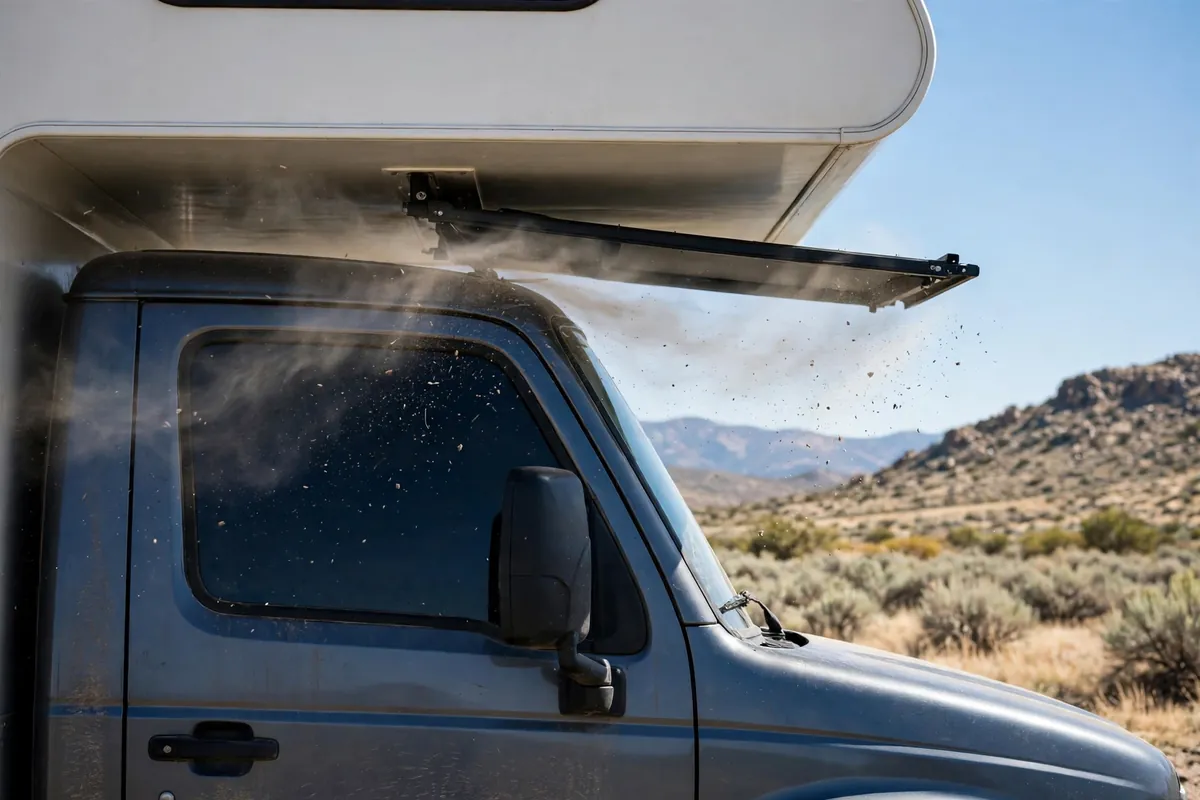
Some “rattles” are wind. The giveaway is speed: the noise appears above roughly 50 to 60 mph, stays steady rather than pulsing with bumps, and changes with headwinds. The most common source is the gap between cab and cabover, where trapped air buffets the flat front wall and makes it pop and roar.
Owners on WanderTheWest worked this out with a low-tech test: tape short telltales — strips of ribbon or yarn — around the cabover and cab, and watch them at speed. Where wind hits directly they stream steadily; where air tumbles in a wind shadow they flutter wildly. That tells you whether the noise comes from the front face, the sides past the cab, or the gap behind the cab.
The fix most owners land on is a wind deflector under the front of the cabover: a panel that smooths airflow into the gap instead of letting it slam into a flat wall. Owners featured in Truck Camper Magazine’s air dam roundup report one pop-up owner who could not pass 60 mph without roof popping, then drove comfortably at 75 to 80 mph after fitting a simple bumper valence for about $24 and three hours. Leave clearance for bed and cab flex, mount it to the camper not the truck roof — a flapping deflector is a new noise, worse than the old one.
For general road noise, do not add hundreds of pounds of sound deadening trying to match a car. A modest approach works better: butyl mat inside the cab doors and floor, where owners on Forest River forums report a noticeable drop, plus fresh door seals and tyre pressures matched to your loaded weight. Over-inflated tyres are an overlooked cause of a harsh ride. Weigh the rig loaded and follow your truck maker’s guidance. A vent lid not latched tight also flutters at speed, so keep any recent upgrade snug, as in my Truck Camper Roof Vent Fan Upgrade guide.
The noises that mean stop, not foam
Most of this guide is about comfort. The exceptions: stop and inspect for a sudden bang or clunk followed by a new rattle, a scraping or dragging sound, a clunk repeating once per wheel revolution, or the camper visibly shifting or leaning. Do not mask these with louder music. Pull over, check all four turnbuckles and jacks, look underneath for anything hanging, and if it looks structural, do not keep driving to “see if it gets worse.” The same applies parked: a camper shifting on its jacks overnight signals a load, ground, or hydraulics problem. See also Driving With a Truck Camper.
My quiet-rig checklist
Run this before every trip, and again after the first rough road — ten minutes that catches almost everything above. Before you leave: turnbuckles snug and even; jacks fully retracted, pins in, feet tight; cabinet doors latched, felt pads in place, contents lined; door seals treated, door closing tight; windows and vents latched; tyre pressures set for your loaded weight. After 200 miles and any long dirt stretch: re-check turnbuckles and jacks. Twice a season: tighten cabinet screws, treat seals, lubricate threads and pivots, and felt any new wood-on-metal contact.
That list will not make a truck camper silent — you are driving a small house down a highway. But it will take you from “cutlery drawer falling down stairs” to a low hum you stop noticing after the first hour. And when a new noise appears, you will know it is new, so you will know it deserves attention.
Frequently asked questions
Why does my truck camper rattle only on rough roads?
Because most camper noises need movement. On smooth pavement, slack parts stay quiet; on washboard, every tiny gap gets exercised dozens of times a second. It is usually looseness, not structural failure — but check tie-downs and jacks first anyway.
How tight should truck camper turnbuckles be?
Follow your maker’s instructions. Torklift’s widely published reference is 300 pounds per anchor point for spring-loaded turnbuckles — on a FastGun, the O-ring sits about a quarter inch below the body when correct. Re-check after 200 miles and again around 400 to 500 miles.
What causes a squeak in the cabover bunk area?
Usually the bunk platform rubbing its metal support frame as the truck flexes. Press up on the platform: if the squeak stops, that contact is the source. Thin adhesive felt strips between plywood and frame are the fix owners report as permanent.
Why does my camper door squeak, and will silicone spray fix it?
Usually dry rubber seals gripping the frame as the body flexes, worse in cold weather. Cleaning the seal and wiping it with silicone spray fixes most; owners repeat this every couple of months. If that fails, adjust the striker inward or replace a worn one.
Can I stop wind noise from the cabover gap?
Often, by a large amount. A deflector under the front of the cabover smooths airflow into the gap instead of letting it hit a flat wall; owners report going from unbearable popping at 60 mph to comfortable driving at 75 mph or more. First confirm it is wind — steady with speed, not pulsing with bumps.
When should I worry about a new rattle?
Stop and inspect when a noise starts suddenly, sounds metallic or like scraping, or comes with visible shifting or a jack or turnbuckle that looks wrong. Comfort rattles build up gradually; safety rattles announce themselves.