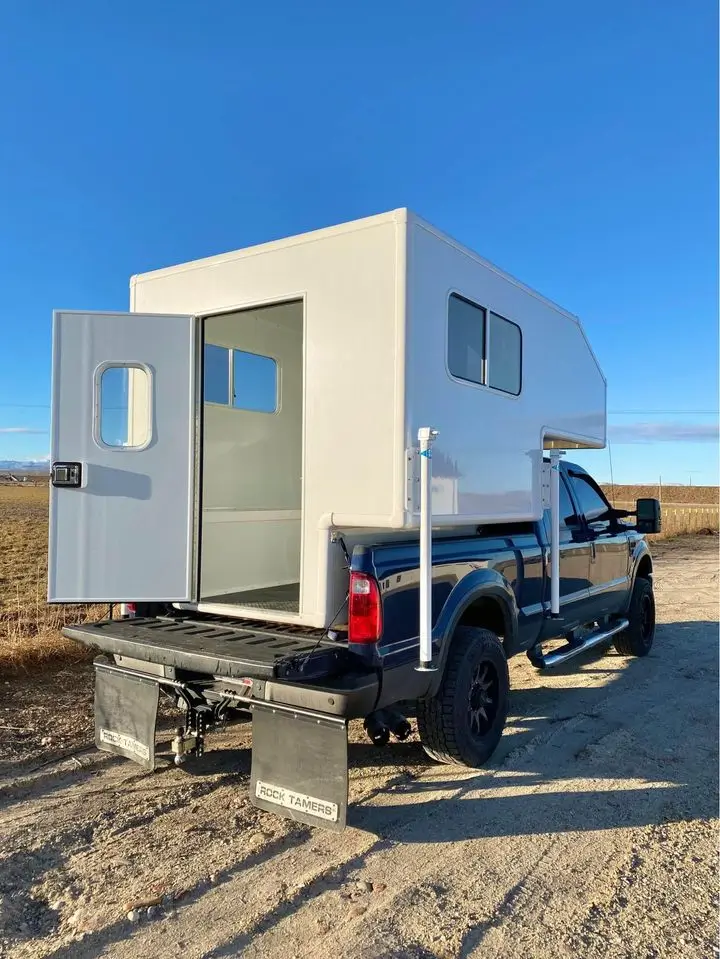

Truck Camper Electrical Troubleshooting: Dead Batteries, Bad Grounds, and Fixes That Work
On the second night of a trip that was supposed to be simple, my camper lights did the slow yellow fade I have come to dread. The fan slowed, the pump groaned, then everything quit. That night taught me the core lesson of truck camper electrical troubleshooting: most faults are not expensive parts. They are a fuse you did not test, a ground you did not clean, or a charger that quietly stopped charging.
First, split the problem in two. The 12-volt DC system runs off the camper battery and powers lights, fan, pump, furnace fan, fridge control board, and detectors. The 120-volt AC system only works on shore power, a generator, or through an inverter, and powers outlets, air conditioner, and microwave. Lights dead but outlets alive means a 12-volt fault; the reverse means a 120-volt fault.
Safety first. 120-volt shore power can seriously injure or kill you, and batteries can spark, short, and vent gas. Disconnect shore power before opening the breaker panel or converter, and disconnect the negative battery cable before working on 12-volt wiring. Never bypass a fuse or breaker or fit a higher-amp fuse than the circuit calls for. If you smell burning, see melted plastic, find a hot or swollen battery, or the fault involves the shore-power inlet, transfer switch, or a sealed charger or inverter, stop and call a qualified RV technician.
The test kit and the order that saves you money
You need a cheap digital multimeter, spare fuses in your panel’s sizes, a wire brush, dielectric grease, and a headlamp — fold these checks into our truck camper maintenance schedule. Without voltage numbers you are guessing, and guessing is how people replace a good converter and keep a bad battery.
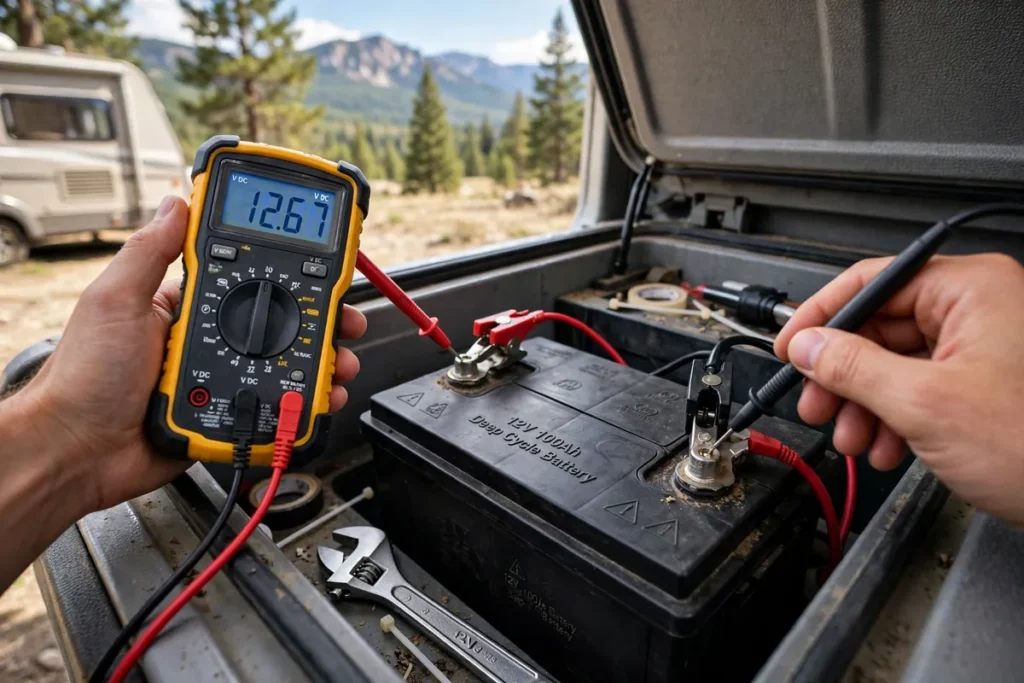
Work in this order, whatever the symptom. First, battery voltage at rest, charging disconnected and no load for a few hours if possible: a healthy lead-acid battery reads about 12.6–12.7 volts, roughly 12.2 volts is about half charge, and 12.0 volts or below is deeply discharged. A LiFePO4 battery rests around 13.4–13.6 volts when full, but its flat curve makes voltage a poor fuel gauge — follow your battery maker’s numbers. Second, voltage while charging: on shore power or with the truck running, a working converter should push a lead-acid battery into roughly 13.6–14.4 volts (lithium absorption is typically 14.2–14.6 volts). If the number barely moves, charging is not reaching the battery. Third, connections before components — corrosion under a cable lug can mimic a dead battery, converter, and pump all at once. Fourth, one change at a time: fix one thing, retest, write the number down. Dirt-road vibration loosens these connections first — see our truck camper dustproofing for dirt roads guide for what that shaking does elsewhere.
Dead battery: battery, charger, or drain?
A dead battery is a symptom, not a diagnosis — owners have bought a second new battery for a camper whose converter had quit, and replaced a converter when the battery itself was done.
Charge the battery fully from a known-good external charger, disconnect it, and measure again the next morning. If a lead-acid battery that read full last night sits at 12.2 volts or lower with nothing connected, the battery is done. If it holds voltage disconnected but dies fast once reconnected, you have a drain or load problem.
Then test the charger. On shore power, measure at the converter’s DC output if you can reach it safely, then at the battery. Converter output of 13.6 volts or more but a battery stuck at 12.3 volts means something between them is broken — a blown fuse, tripped breaker, corroded cable, or open disconnect switch. Owners on iRV2 report exactly this trap: a new battery dying again in under a day while plugged in, with a silent converter, almost always points back to the converter or its fuses rather than a second bad battery. Check the disconnect switch before buying anything — one that gets bumped, or whose relay fails, leaves everything 12-volt dead while the battery tests fine.

Truck camper electrical troubleshooting: converter problems
The converter has two jobs on shore power: run your 12-volt loads and charge the battery. When it fails, lights dim over a day or two, fans run slow, the fridge board acts up, then the battery — quietly carrying the whole camper because the converter stopped helping — goes flat.
Confirm its AC breaker is on by flipping it fully off and back on; a breaker can look on while tripped. Measure DC output at the converter, then at the battery — healthy charging is roughly 13.6–14.4 volts for lead-acid systems. Then check the reverse-polarity fuses: usually two large blade fuses (often 30 or 40 amps) on the converter itself, separate from the small circuit fuses. They blow instantly if a battery is ever connected backwards, and a blown pair looks exactly like a dead converter. Owners on RV forums call this the cheap fix that saves a converter replacement — but replace them only with the exact same amp rating, and only once you are sure the cables are on the right terminals. If output is present but low — lights stay on at 12 volts plugged in but the battery never climbs — the converter may be running but not charging, a partial failure that is easy to miss. A converter that hums loudly, smells hot, or has a dead fan and hot case should be taken out of service and checked professionally. Camping World’s guide covers the same checks: RV converter and inverter troubleshooting.
Inverter problems: flat battery or dead outlets?
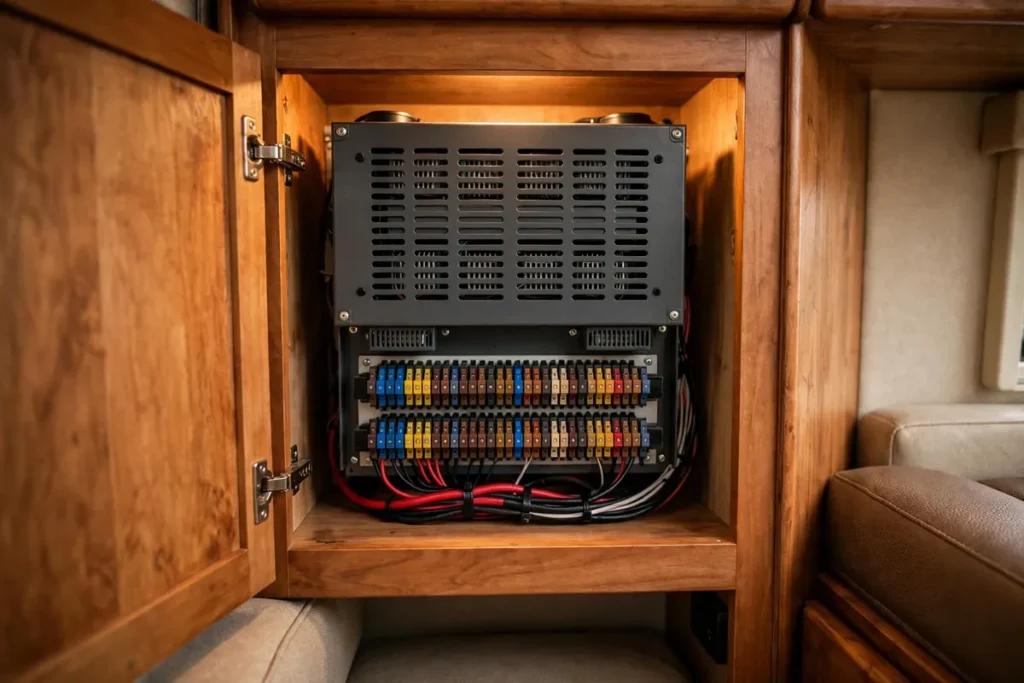
The inverter does the opposite job — battery DC into 120-volt AC — so its faults show up in two directions.
Inverter on, battery dies fast. This is usually math, not a fault. A 60-watt AC item draws about 5 amps from a 12-volt battery once conversion losses are counted, plus standby draw. Owners on RV forums report a small inverter pulling roughly 0.3–1 amp with nothing plugged in, and larger units more. Switch it off when you are not actively using it.
Inverter on, battery healthy, outlets dead. Measure AC voltage at an inverter-fed outlet with no load — expect roughly 110–125 volts. Nothing there with the battery at 12.5 volts or better points at the inverter, its own breaker or fuse, or the transfer switching between shore and inverter power. Check the resettable breaker and big DC fuse, often tucked away under a seat or sink. Also check the low-voltage cutoff: many inverters shut down around 10.0–10.5 volts, so a battery that reads fine at rest can still trip under load. Trips or alarms under load usually mean overload, a weak battery, or undersized DC cables — check battery health and cable size before buying a bigger inverter.
Blown fuses and tripped breakers
Fuses protect individual 12-volt circuits; breakers protect 120-volt circuits and big 12-volt feeds. When one light, pump, or bank of outlets dies while everything else works, start here. Pull the suspect fuse and test it — do not trust your eyes alone, as a fuse can crack without obvious blackening. If the new fuse blows immediately, you have a short or overloaded circuit: stop replacing fuses and look for pinched wiring, a wet connection, or a faulty appliance. A fuse that keeps blowing is doing its job; fitting a bigger one turns a cheap fix into a fire risk.
Breakers need a firm off-and-on reset, not a glance — push fully to off, then firmly to on, including at the campground pedestal. And check the GFCI outlet, usually in the kitchen or bathroom: one tripped GFCI can kill every downstream outlet while the breaker panel looks perfectly normal. That ten-second fix — press Test, then Reset firmly until it clicks — is the single most common “all my outlets are dead” answer in owner reports.
Bad grounds: the fault that pretends to be everything else
If one cause explains the weirdest camper stories — lights dimming when you hit the brakes, a fan surging, a fridge board throwing errors for no reason, a pump running slow only sometimes — it is a bad ground. Every 12-volt device needs a clean negative return path, usually through the frame. When that path corrodes or loosens, current finds strange alternate routes, voltage drops under load, and symptoms jump from one device to another.
Owners describe dim lights worsening under load, unrelated devices misbehaving at once, and faults that come and go with bumps — and note a bad ground stops charging more than it drains, which looks identical to a drain after short drives.
Find your grounds: battery negative to frame, converter and fuse-panel ground, and any frame ground bolts near the battery box. Undo them one at a time (battery disconnected first), clean to bright metal, and reassemble tight. Do not paint the contact surface — paint insulates. A thin coat of dielectric grease after assembly slows corrosion returning. Check broadly, not just one bolt — the same vibration shows up in a roof vent fan upgrade too.

Parasitic drain: the battery that dies while “everything is off”
Everything is off, the camper sits a week, and the battery is flat. Something is still drawing power — just nothing with a switch you flipped. The usual suspects, in the order owners on iRV2 and Airstream forums actually find them: an inverter left on (the biggest culprit, worth several amps on some units), the propane/CO detector (hard-wired and always on — never disable it to save battery), stereo memory, fridge board, and a lithium battery heater.
Find it with the fuse-pull method owners swear by. With everything off and unplugged, put the multimeter in DC amps mode in series with the battery negative cable (a DC clamp meter is easier and safer). Note the draw, then pull fuses one at a time. When the draw drops, you have found the circuit. Note: the factory disconnect does not disconnect everything — detectors and inverters wired direct to the battery bypass it by design — and you will never reach absolute zero. Get the draw low, then manage storage with a disconnect at the battery, a small solar maintainer, or trickle charging.
Battery not charging while driving
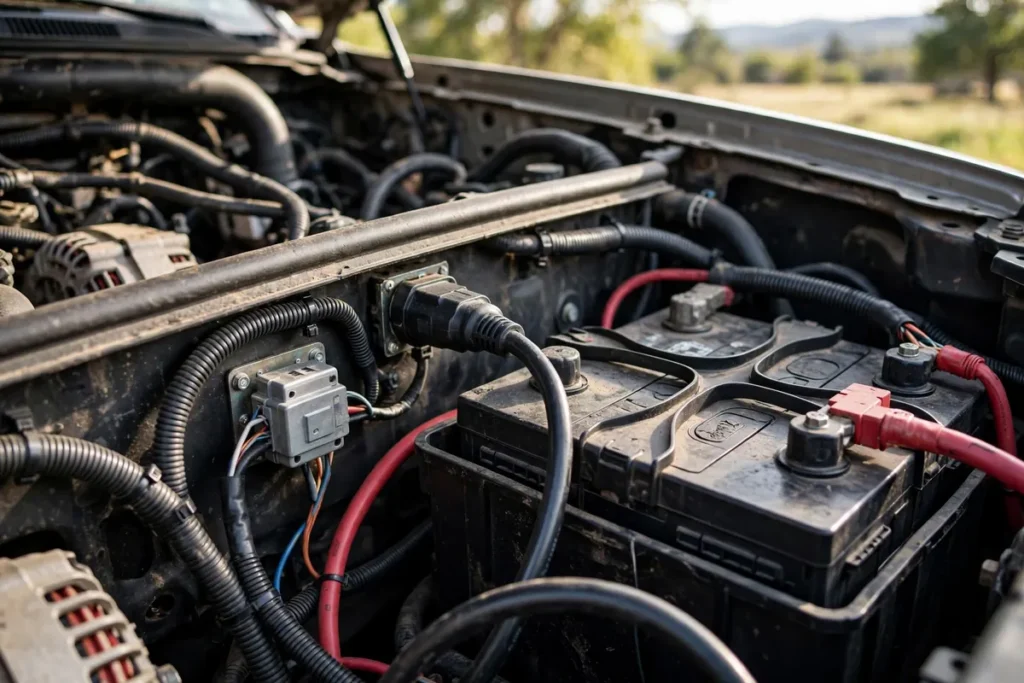
You drive four hours and the camper battery is barely higher than when you left, while the truck starts perfectly. Usually one of four things is wrong. First, the charge wire is too thin and too long: voltage drop along the factory 7-pin wire eats the charge. Owners on Wander The West report a camper battery that only ever reaches about 12.5 volts from the truck, no matter how long the drive, because the alternator regulates to the truck battery’s voltage, not the camper’s. Second, a stuck isolator or separator: it should connect the camper battery only while the engine runs. Owners there describe both failures — stuck closed, it lets the camper drain the truck battery overnight; stuck open, the camper battery never charges at all. Test it: engine off, the two batteries should read different voltages; engine running, the camper battery should climb toward charging voltage. Third, a blown charge-line fuse near the truck battery or corrosion in the 7-pin plug, a classic after winter or dusty travel. Fourth, a smart alternator that varies output to save fuel, or a lithium battery needing about 14.2–14.6 volts that a plain 7-pin feed rarely delivers. That is where a DC-DC charger earns its keep: mounted near the camper battery, it boosts sagging voltage, applies the right charge profile, and limits current. Owners consistently report it fixes the “drives all day, still not charged” problem that thicker wire alone only partly improves. If the truck battery goes flat overnight with the camper attached, unplug the link as a test — if it then holds charge, the fault is on the camper side or the isolator.
Shore-power issues: pedestal, cord, GFCI, transfer switch
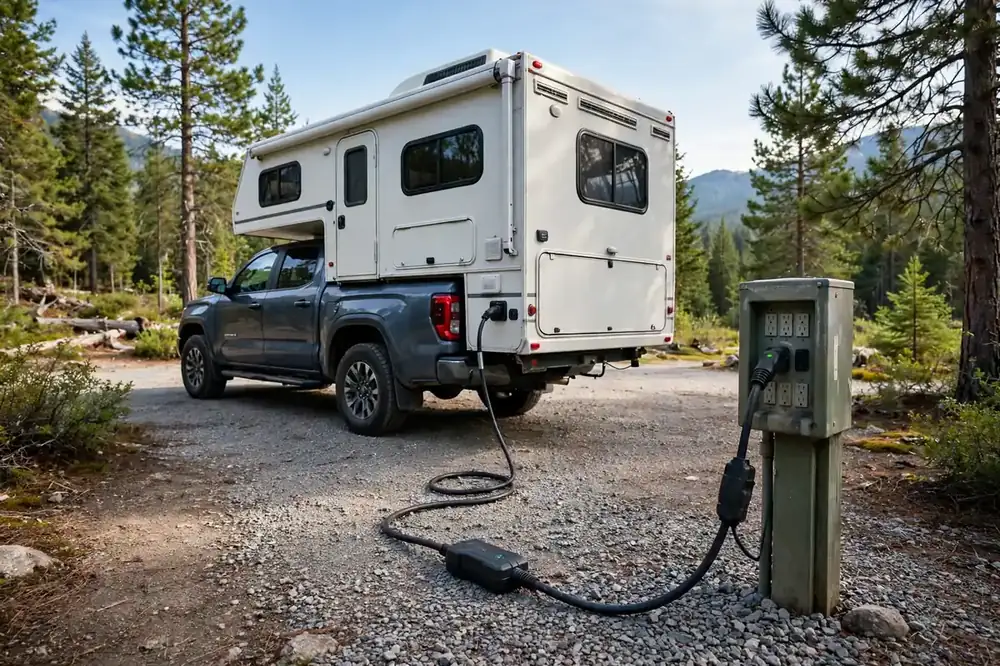
Work from the outside in, and keep your hands out of live panels. First, the pedestal: flip its breaker fully off and on. Check your surge protector or EMS for an error — many lock out on high voltage (often above about 132 volts), low voltage (often below about 104 volts), or an open ground, then wait 90–120 seconds before retrying. A persistent error code is the park wiring talking to you, not your camper failing. Next, cord and inlet: look for cuts, melted plastic at plug ends, and a plug that feels warm after a short time connected — warmth means a loose or corroded connection creating heat, so stop using that cord or inlet until repaired. Inside, flip the main AC breaker fully off and on, then reset the GFCI; one tripped GFCI can darken outlets in rooms that look unrelated. If your camper has a generator, a transfer switch stuck in the generator position blocks shore power — listen for its relay “clunk” after plugging in; no clunk, or a hot-smelling switch, is a technician job. Owners on Airstream forums flag one trap: two GFCIs in series can trip each other even when nothing is faulty. If your camper trips every GFCI pedestal but works on a standard outlet, an electrician should check neutral and ground bonding. Never defeat a ground or remove a GFCI to “fix” tripping. For realistic simultaneous loads, see our truck camper air conditioning guide.
Flickering and dim lights: fixture or supply?
One light flickers, the rest hold steady. That is almost never the converter or battery — it is that fixture: loose crimp, corroded socket, failing LED driver, or unseated bulb. Swap the bulb with a known-good one first. All lights dim together, especially when a pump or fan starts. That is supply: weak battery, converter output collapsing under load, corroded cable, or bad ground. Measure voltage with the load running — a sag of several tenths of a volt when the pump kicks in means the battery or its connections are struggling. Lights flicker only on shore power. Steady 13.6–14.4 volts with flickering lights points toward a loose connection or failing dimmer; jumping or sagging output points at the converter. Lights dim when you hit brakes or indicators. On trailer-style lighting, that screams ground fault at the connector or frame — running lights are powered by the tow vehicle, and a poor ground makes current back-feed
through other circuits. Clean the pins and frame ground first.

When to call a professional
Work the sections above top to bottom; do not skip a step because you are “sure” it is not that one.
Call a qualified RV technician if you find melted or scorched wiring, a swollen, leaking, cracked, or hot battery, any inlet or transfer-switch fault, a GFCI that will not reset, a burnt-smelling inverter or converter with a dead fan and hot case, or any fault you cannot trace to a fuse, breaker, connection, or single component. A technician’s hour is cheaper than a burnt harness.
Most truck camper electrical problems are not mysteries: a fuse untested, a ground uncleaned, an inverter left on, a converter fuse blown, or a charge wire too thin. Test in order and fix one thing at a time.
Frequently asked questions
Why does my truck camper battery keep dying overnight?
Most often an inverter left on, a stuck isolator, or parasitic loads on a battery never fully charged. Measure standby draw and pull fuses one at a time to find the circuit.
How do I know if my converter is bad?
On shore power, measure DC voltage at the converter output and at the battery: a working converter pushes roughly 13.6–14.4 volts for lead-acid systems. Check its reverse-polarity fuses first.
What voltage should my camper battery read?
Rested and fully charged, lead-acid reads about 12.6–12.7 volts; about 12.2 volts is roughly half charge, 12.0 volts or below is deeply discharged. While charging, expect roughly 13.6–14.4 volts. LiFePO4 rests around 13.4–13.6 volts full, charging at about 14.2–14.6 volts.
Why do my camper lights flicker or go dim?
One flickering light means that fixture. All lights dimming together means battery, terminals, ground, or converter output under load. Dimming with brakes or indicators usually means a connector or frame ground fault.
Why is my camper battery not charging while driving?
Usually the factory charge wire is too thin and long, the isolator is stuck, the charge-line fuse is blown, or the 7-pin connector is corroded. Smart alternators and lithium batteries may need a DC-DC charger. Measure voltage at the camper battery with the engine running.