Truck Camper Dump Station Guide: How to Dump Black and Grey Tanks Without the Mess
Nobody buys a truck camper dreaming about the day they’ll stand over a sewer drain in a gravel lot, gloves on, hoping nothing splashes. But if you camp for more than a weekend, the truck camper dump station becomes part of the routine — usually on checkout morning, usually with a line forming behind you. I learned the sequence the same way most owners do: by doing it wrong once, then never doing it that way again. Done right, the whole job takes about ten minutes.
What a Truck Camper Dump Station Is
A truck camper dump station, sometimes called a sani-dump, is a designated sewer inlet — usually a concrete pad with a round drain cover and a rinse-water spigot — where you empty your black and grey holding tanks. You’ll find them at campgrounds, state parks, truck stops, some highway rest areas, and a few city wastewater facilities.
The black tank holds toilet waste. The grey tank holds sink and shower water. Both go into the same drain, but the order matters more than anything else here: black first, grey second, so the soapy grey water scours the hose clean after the black water passes through. Truck camper tanks are small next to a motorhome’s — many slide-ins carry a black tank of 5 to 15 gallons and a grey tank not much bigger — so you’ll be dumping every few days, not once a week. Plan your route around it the way you plan fuel stops.
When to Dump Your Tanks
Don’t wait until a tank is completely full. The sweet spot is about two-thirds to three-quarters full: enough liquid volume to carry solids out, with margin left if the station you planned on is closed. For two people, that usually means dumping every three to five days, with the grey tank filling first. Watch your gauges, but don’t trust them blindly — sensors lie after a few seasons because waste coats the probes. If your gauge still reads full after a dump, the sensor is probably dirty, not the tank. I covered why truck camper tank gauges lie and how to fix them in a separate guide. Dump on travel days, on your way out of one campground or into the next, and never leave waste sitting in the tanks between trips.
Your Dump Station Kit
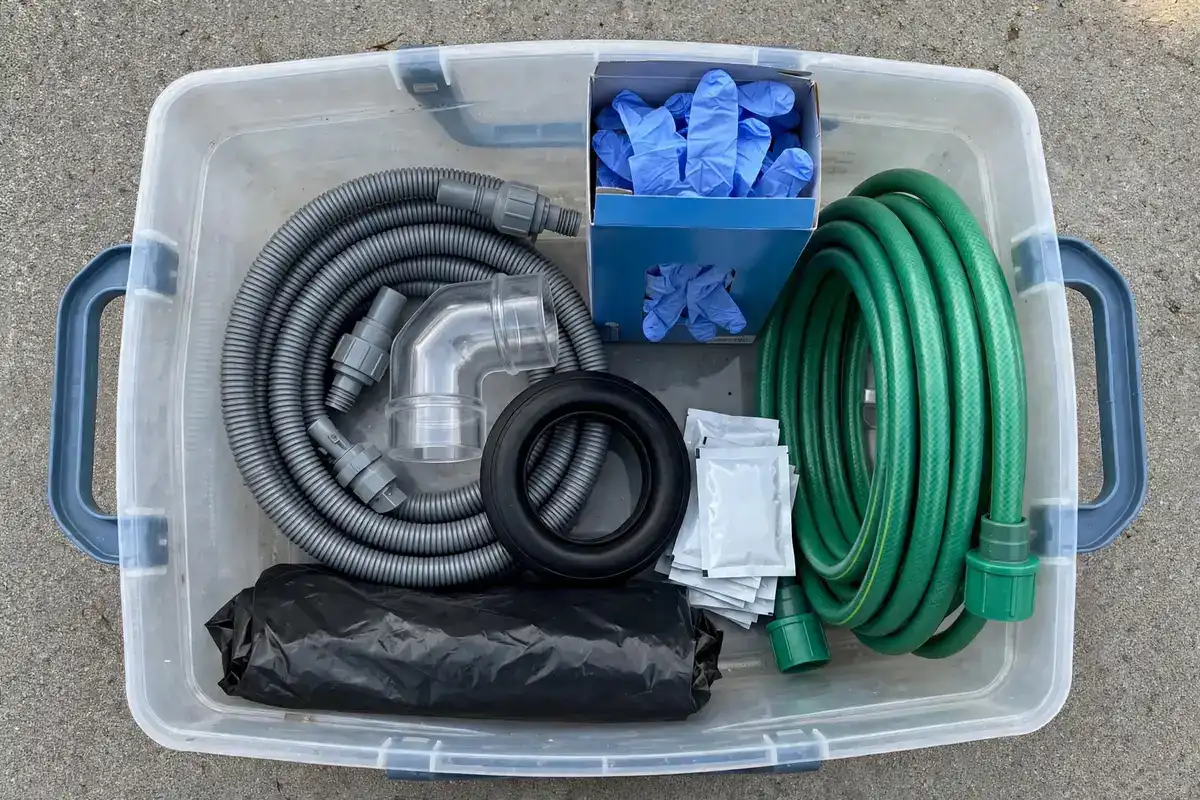
Everything fits in one plastic tote, kept separate from anything to do with drinking water. Buy it once, keep it together, and you’ll never be the person digging through three compartments while a line waits.
- Sewer hose, 15 to 20 feet, with bayonet fittings, plus a short backup hose. A 10-footer is fine at a well-designed station and useless at a badly placed one.
- Clear 45- or 90-degree elbow. It seats into the station inlet and lets you see when the flow runs clear — the best ten-dollar upgrade in truck camping.
- Rubber donut seal or threaded adapter. Inlets aren’t standardized; the elbow plus a donut or 4-in-1 adapter covers nearly all of them.
- Disposable nitrile gloves — a handful, not one pair — plus a small trash bag, hand sanitizer, and paper towels.
- A dedicated rinse hose, a different colour from your drinking-water hose. Never let the two swap jobs.
- Tank treatment to drop in after dumping, and closed-toe shoes you can hose off. Owners on RV forums keep retelling the same story: a loose fitting, a surge of black water, bare feet in sandals.
Before every trip, hold the sewer hose up to the light and look for pinholes, cracks, and crushed sections. Owners report hoses splitting mid-dump after a few seasons baking in the sun and freezing at night — usually in front of an audience. A hose you doubt is a hose you replace.
How to Dump at a Truck Camper Dump Station
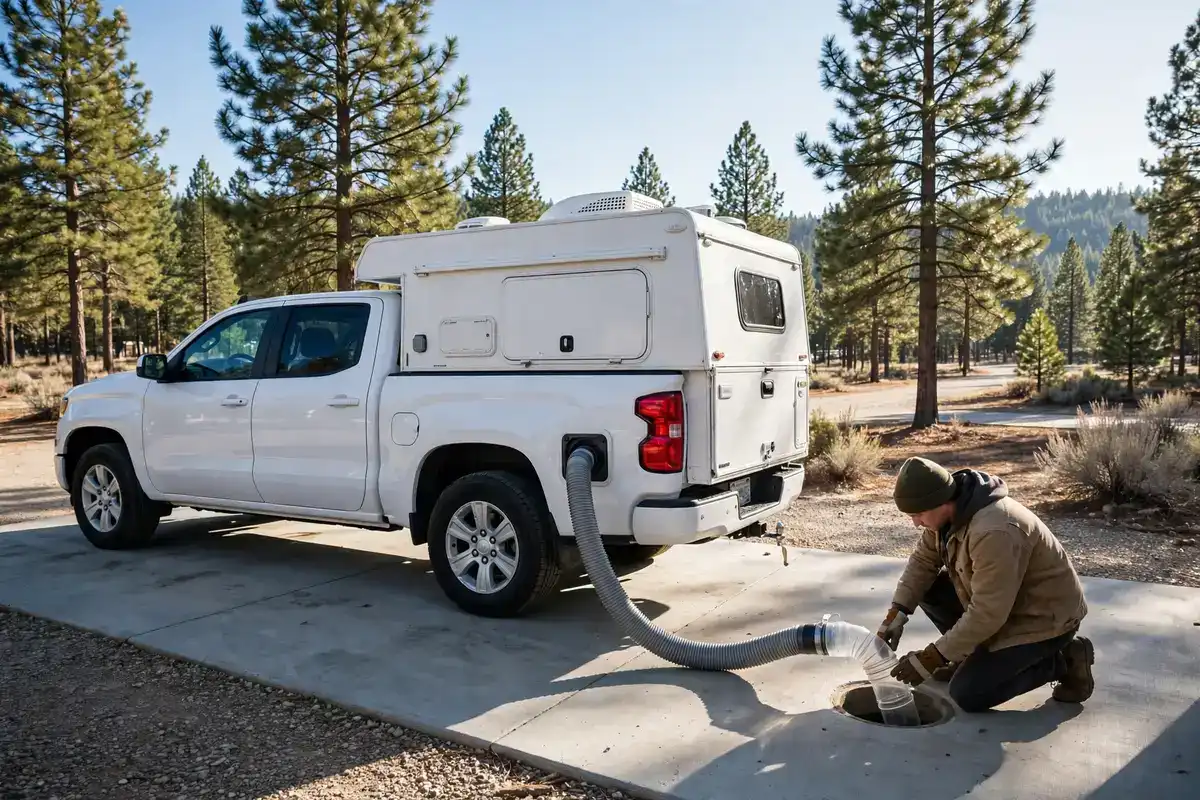
1. Position the truck. Pull up so your waste outlet — usually on the driver’s side, toward the rear — sits close to the inlet, slightly uphill of it. The hose should run downhill with no belly in the middle. Set the parking brake and chock a wheel on a slope.
2. Stage the kit while you wait in line. Lay out the hose, elbow, gloves, and rinse hose so you can grab them in order. Don’t unpack your storage compartment at the drain while four rigs wait.
3. Glove up and confirm the valves are closed. Push both handles fully in, then crack the bayonet cap off slowly, holding the hose end underneath to catch trapped drips. A valve that didn’t seat fully last time can leave wastewater sitting behind the cap.
4. Connect both ends before opening anything. Lock the hose onto the camper outlet with a firm quarter-turn and tug it. Seat the clear elbow into the inlet through the donut seal and weight it down with the inlet lid or a rock. A bare hose end will jump the moment flow starts. Connect first, open second — every messy-dump story starts with that order reversed. One owner on the Let’s RV blog describes exactly this failure: a fitting that wasn’t fully locked, the black valve opened, black water across his bare feet in sandals. Check the connection. It takes five seconds.
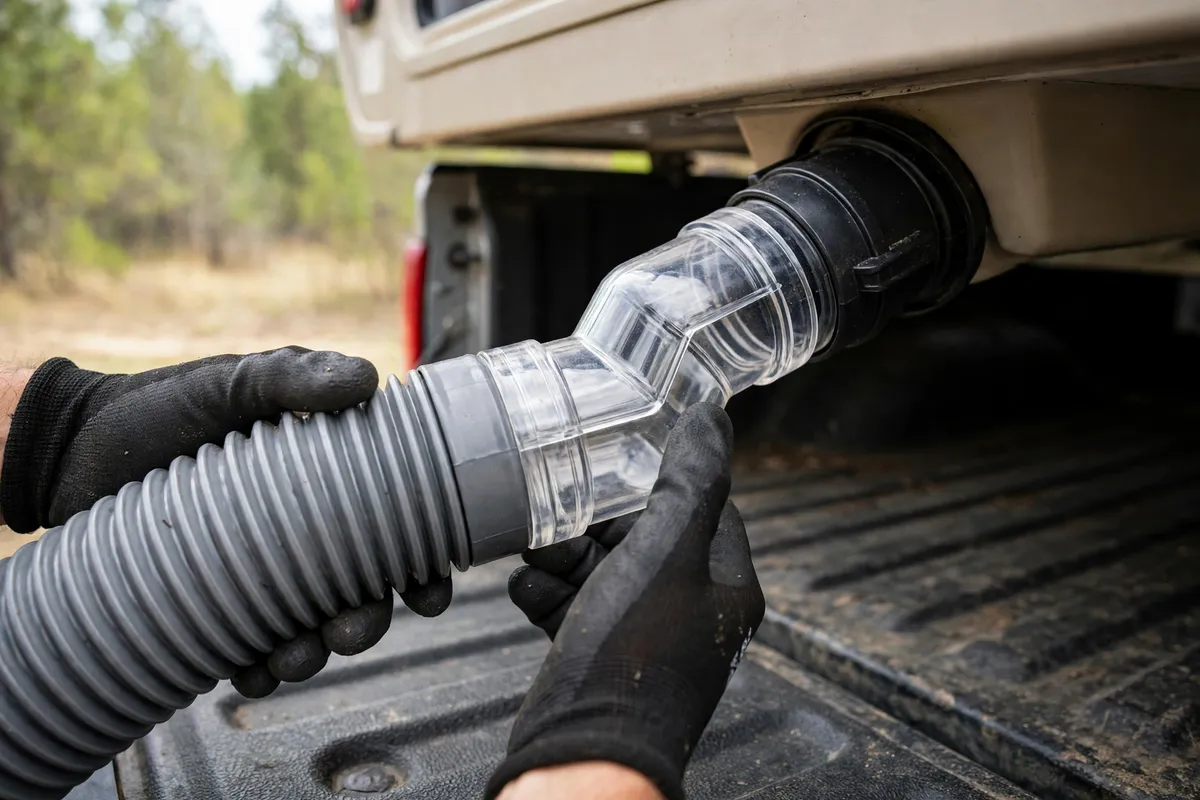
5. Open the black valve all the way, in one motion. Pull the larger 3-inch handle out fully. A half-open valve lets solids settle and clog; a full surge carries them out. Watch the flow through the clear elbow go from dark to thin and streaky, and wait until it stops completely — usually a minute or two for a truck camper tank.
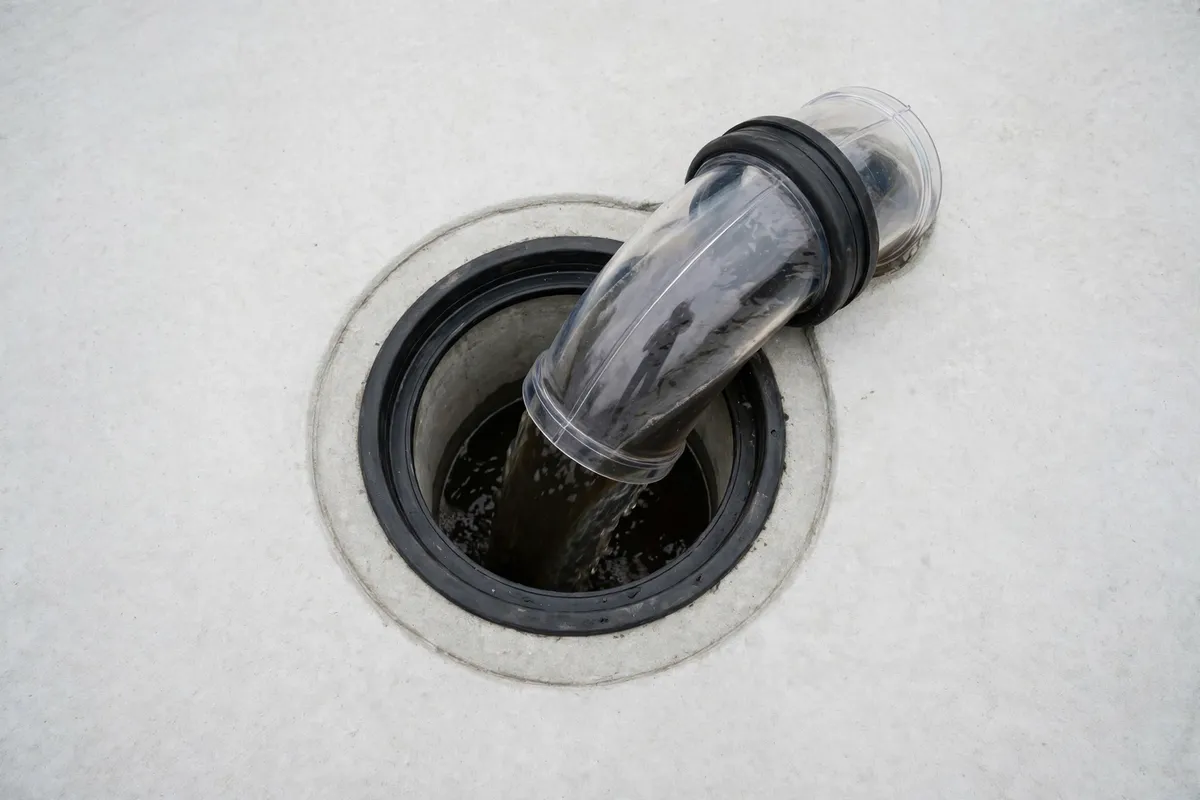
6. Flush the black tank if the station allows it. With a built-in flush inlet, connect your dedicated rinse hose — never your drinking-water hose — and run it two or three minutes with the black valve open, until the elbow runs clear. No built-in flush? Fill the toilet bowl a few times and flush. A caution from owners on the iRV2 forums: built-in flush spray nozzles clog. Owners report the nozzle holes crusting shut or the vacuum-breaker check valve sticking closed after seasons of disuse. The fixes that worked were soaking the line with a cleaner like CLR through a short hose, or removing the nozzle and cleaning or slightly enlarging its holes. That’s a job for home, not for the dump station with a line behind you.
7. Close the black valve, then open the grey. Let the soapy shower and sink water scour the hose. Wait until it stops.
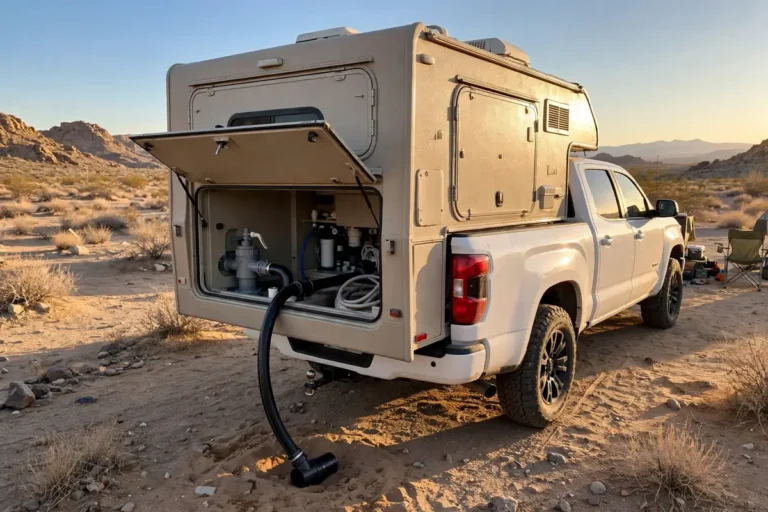
8. Disconnect, rinse, and stow. Close the grey valve. Disconnect from the station inlet first (the low end), then from the camper, lifting the hose section by section so the last water drains into the inlet. Rinse the outside of the hose with the station’s non-potable rinse hose, cap both ends, and stow it in its own bin, away from fresh-water gear. Refit the bayonet cap on the camper outlet.
9. Put water and treatment back in the black tank. A bone-dry tank smells worse than one with a few gallons of water and treatment, and dry solids bake onto the walls. Add three to five gallons through the toilet plus your treatment. If the tank keeps smelling between dumps, the cause is usually ventilation, a dried-out toilet seal, or buildup — I covered the permanent fixes in my guide to killing truck camper black tank smell.
10. Walk around before you drive off. One slow lap: hose disconnected and stowed, outlet cap on, valves closed, rinse hose back in its bin. Owners on RV forums swear by hanging the truck keys on the dump valve handle while they work, so they physically cannot drive off while still connected. People really do tear fittings off and drag hoses across the pad by pulling forward too soon.
Where to Find a Truck Camper Dump Station
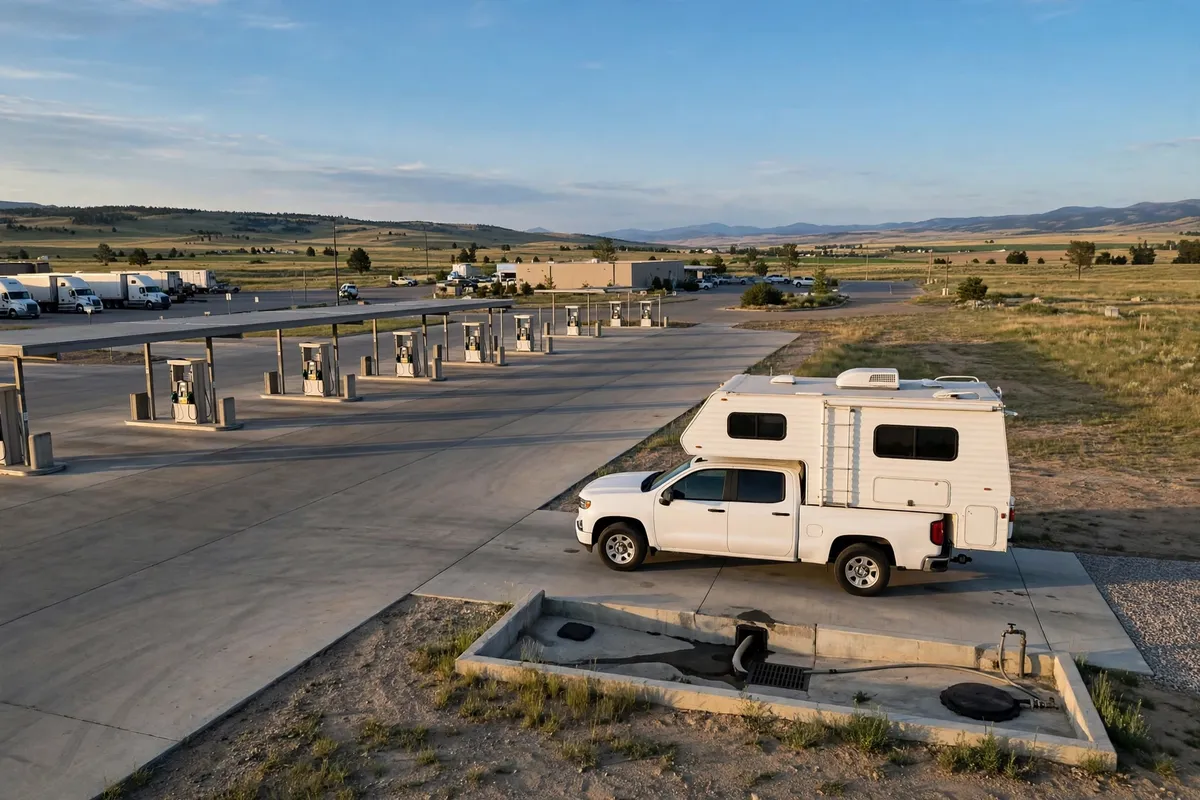
- Campgrounds and RV parks. Most let overnight guests dump free; many sell a dump-only visit for roughly $5 to $20. Call ahead — some restrict non-guests in peak season.
- State and national parks. Many have a dump station near the entrance or exit, included with a campsite or open to non-campers for a small fee.
- Truck stops and travel centres. Pilot, Flying J, Love’s, and TA locations often have an RV dump lane for around $10, paid at the fuel desk — the most reliable year-round, 24/7 option on an interstate route.
- Highway rest areas. A few states build dump stations into rest areas, usually free, but they can close in winter.
- City and county facilities. Many towns run a public dump at the wastewater plant or fairgrounds, often free.
- RV dealers and some outdoor stores. Some have a dump for customers, though many have removed theirs. Confirm before you drive there.
Don’t rely on a single source. Cross-check two directories, and call ahead when it matters. RVingLife — the directory that grew out of the original Sanidumps database, with more than 17,000 listings — is my first stop, because its recent reviews flag closures and fee changes faster than most apps update. RVDumpSites.net is a good second check: a map-based, community-driven directory with user reviews. Check the satellite view before committing to a tight station. Listings go stale — stations close for repairs, for winter, or because of misuse — so read reviews from the last month or two.
What a Dump Station Costs in 2026
Most paid dumps run $5 to $15, with $10 the typical price. A November 2026 survey of published prices by RV Dump Station Map found a median of $10 across 58 stations that publish a price, with half charging between $5 and $12, and 188 public stations listed as free. Save money by dumping before you check out of a campground where you stayed — it’s included in your site fee — and carry cash or small bills, since plenty of park and city stations still use a fee envelope box. Fees vary by state and operator, and some state parks have raised non-camper dump fees to $20, so treat any number here as a rough range.
Truck Camper Dump Station Etiquette
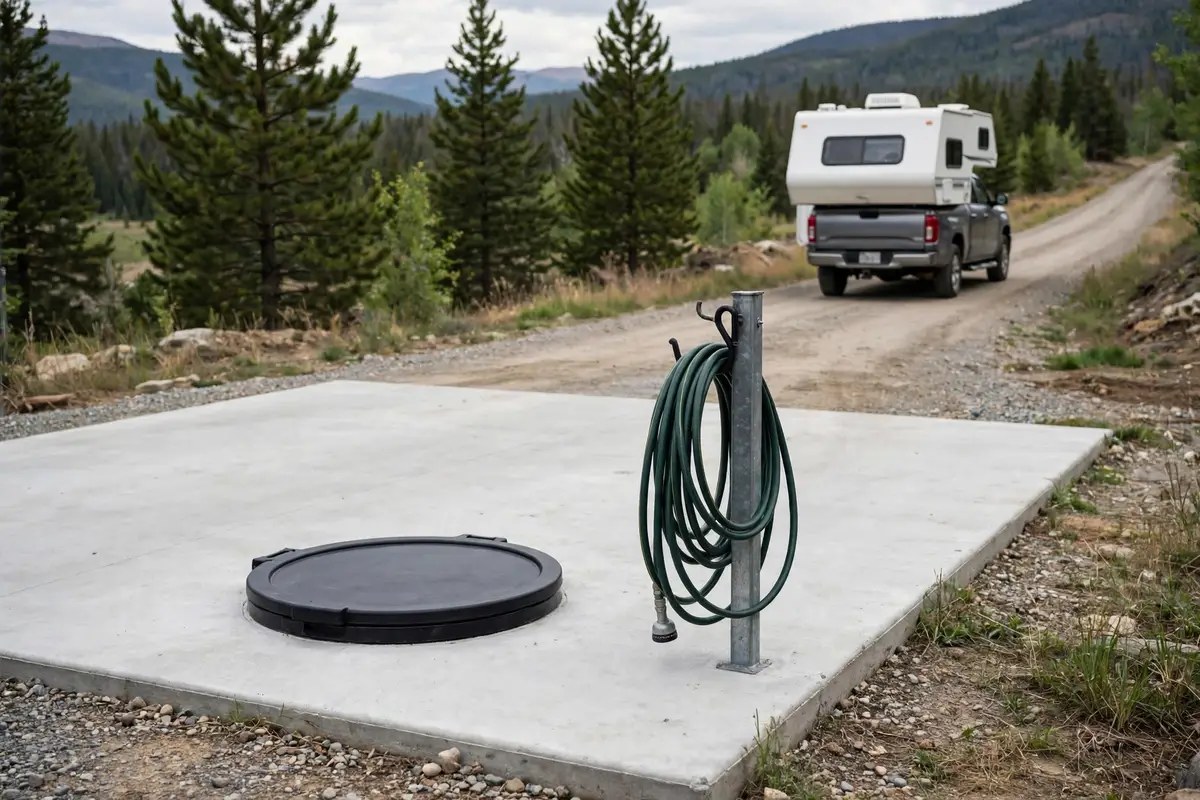
Be fast when there’s a line. This is the complaint that dominates owner forums. On Airstream and Keystone forums, owners describe Sunday-morning lines crawling because someone ahead is running a fifteen-minute tank-flushing ritual — multiple fill-and-dump cycles, a garden hose on the flush inlet — while half a dozen rigs wait to get home. The consensus is simple: when a line is forming, do a quick dump and one short rinse, then move on. Save the deep flush for a full-hookup site, or come back on a quiet weekday evening. Some owners even pay for an extra night at a state park so they can dump after checkout time when the station is clear.
Don’t fill your fresh water at the dump bay. Pull forward, clear of the drain, so the next person can start dumping while you fill. Never rinse your sewer hose at the fresh-water faucet — use the designated non-potable rinse spigot. Contaminating the drinking-water tap is the fastest way to get a station shut down.
Leave it cleaner than you found it. Rinse the pad if you spilled anything. Take your used gloves with you. Don’t put wipes, paper towels, grease, or trash down the inlet — only black and grey water belong in there.
Don’t dump anything on the ground. Ever. Black water never goes on the ground, full stop. Grey water isn’t harmless either, and dumping it is illegal on most public land — federal rules prohibit it in national parks and national forests. The Bureau of Land Management has a narrow exception for small amounts of wash water on some undeveloped public lands, but state laws can still prohibit it, and it never covers a full grey tank. My guide to truck camper grey water management covers the legal picture and the practical workarounds, and the boondocking guide covers planning tank capacity around dispersed sites.
Sanitize the spigot before and after you use it.
When There’s No Dump Station Nearby
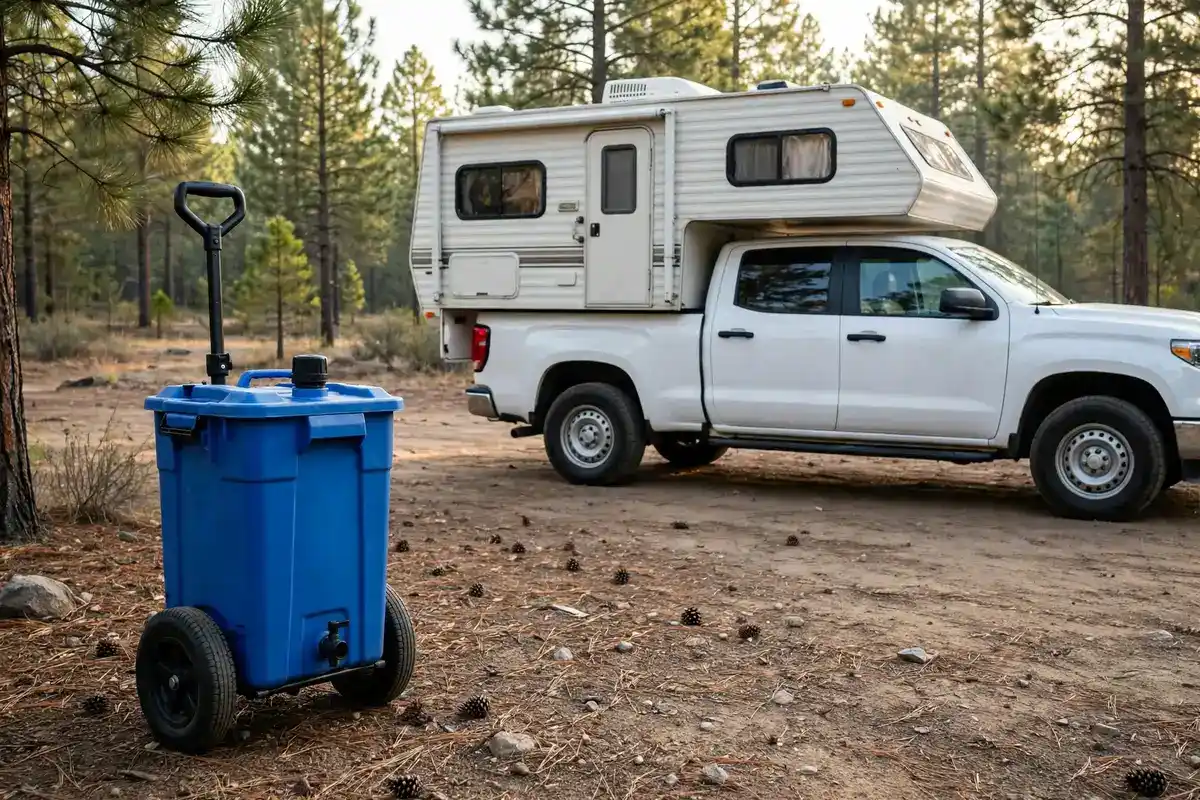
A portable waste tote — the blue “Blue Boy” style tank, typically 15 to 40 gallons — lets you drain into it and roll it to a distant dump without breaking camp. It’s the most useful backup for boondockers who can’t move the rig. A macerator pump grinds waste and pushes it through a garden-sized hose to a cleanout that’s uphill or far away. Staying with friends or family? You can dump into a proper sewer cleanout with the owner’s permission — never a septic system without their OK, and never a storm drain, which runs straight to waterways. If your camper runs a cassette instead of a fixed black tank, it lifts out and empties into any approved toilet or dump point; I weighed that trade-off in my cassette toilet guide for truck camper boondocking. Whatever you do, don’t improvise a roadside solution.
Troubleshooting at the Dump Station
Flow is slow or stops mid-dump. Usually a partial clog. Close the valve, add water through the toilet, wait ten minutes, and reopen. A full surge clears better than a trickle.
Sensors still read full after dumping. Almost always solids stuck on the probes. A real backflush at a station with rinse water fixes it more often than any chemical treatment.
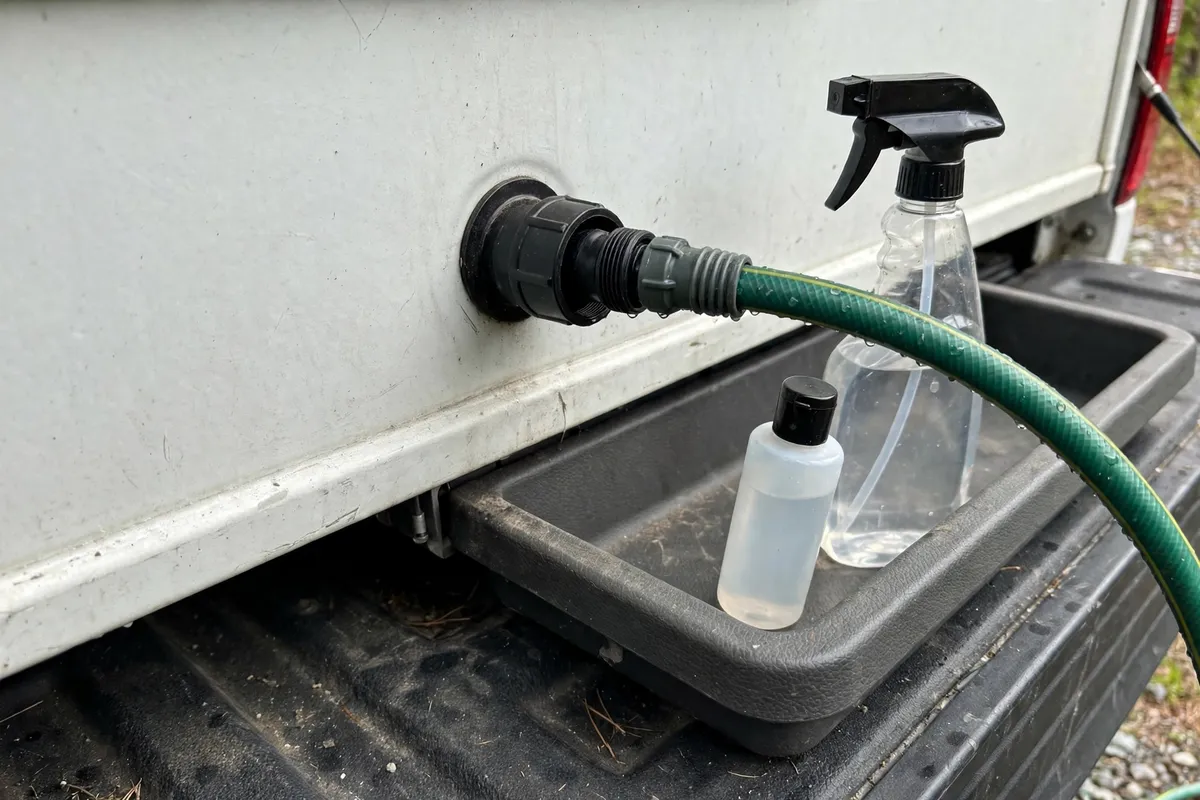
The station has no rinse water, or the rinse hose is missing. Owners report this constantly: a vandalised hose, a spigot with the fitting removed. That’s why the dedicated rinse hose lives in your tote. Dump, cap everything, and flush at the next station that has water. Don’t rinse with your drinking-water hose — that can contaminate your fresh water system. See my truck camper fresh water system guide for keeping the fresh side clean.
Winter closures. Many free dump stations in the northern US and Canada close from late October to early April to prevent freeze damage. In cold regions, favour truck stops and commercial stations, which rarely close for the season.
Frequently Asked Questions
How often should I dump my truck camper tanks?
For two people, every three to five days is normal, with the grey tank usually filling first. Dump at about two-thirds full for the best flow — not completely full, and not nearly empty, since low liquid volume won’t carry solids out.
Can I dump my truck camper at any gas station?
No. Only stations signed and equipped as dump stations. Many truck stops have one, but a regular gas station doesn’t. Use a dump-station directory and call ahead — and never dump into a storm drain, a roadside ditch, or a public toilet.
Is it OK to dump grey water on the ground while boondocking?
As a rule, no. It’s illegal on most public land, including national parks and national forests. The Bureau of Land Management allows small amounts of wash water on some undeveloped public lands, but state laws may still prohibit it, and it never covers a full grey tank. Use a dump station or a portable tote.
Disclaimer: dump-station rules, fees, hours, and grey-water laws vary by state, park, and land-management agency, and they change. This guide reflects conditions reported in 2026; always check the posted rules at the station and the current regulations for the land you’re camping on before you dump.
How much does it cost to use a dump station?
Usually free to $20. Campgrounds typically include dumping for overnight guests and charge non-guests $5 to $20. Truck stops charge around $10. A November 2026 survey of published prices found a median of $10.
What if the dump station is closed when I arrive?
Have a backup station in mind before you need one, and keep a portable waste tote as insurance on longer boondocking trips.
Can I use a dump station with a cassette toilet?
Yes. A cassette empties into the same drain — hold the pour spout over the inlet and empty it slowly. Many stations have a separate small rinse area for cassettes, and a cassette can also be emptied into an approved toilet where that’s permitted.
Dumping your tanks will never be the highlight of a truck camper trip. But done right, it’s ten unremarkable minutes — gloves on, black first, grey second, rinse, stow, walk around, drive on. Learn the sequence, keep the kit together, and the truck camper dump station becomes what it should be: the forgettable last stop before the next good campsite.