Best Lightweight Truck Campers (2026): 15 Picks That Won’t Overload Your Truck
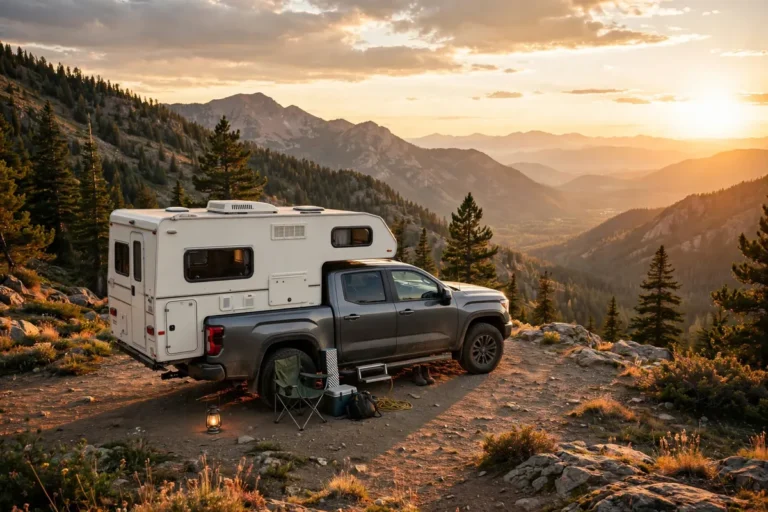
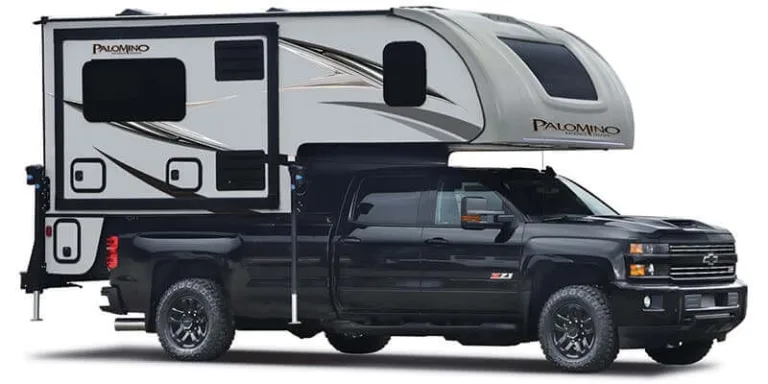
If you drive a midsize truck — a Tacoma, Gladiator, Colorado, Ranger, or Frontier — the best lightweight truck campers list is the only list that matters. A camper that looks perfect in photos can still land 400 pounds over your payload once you add water, propane, and your partner. Every price and weight below was verified for 2026, every pick sits under 1,400 pounds dry, and the popular models carry real owner-reported pros and cons. New here? Read our truck camping beginner guide first, then come back and pick your rig.
What “Lightweight” Means in 2026 (and Why It Matters)
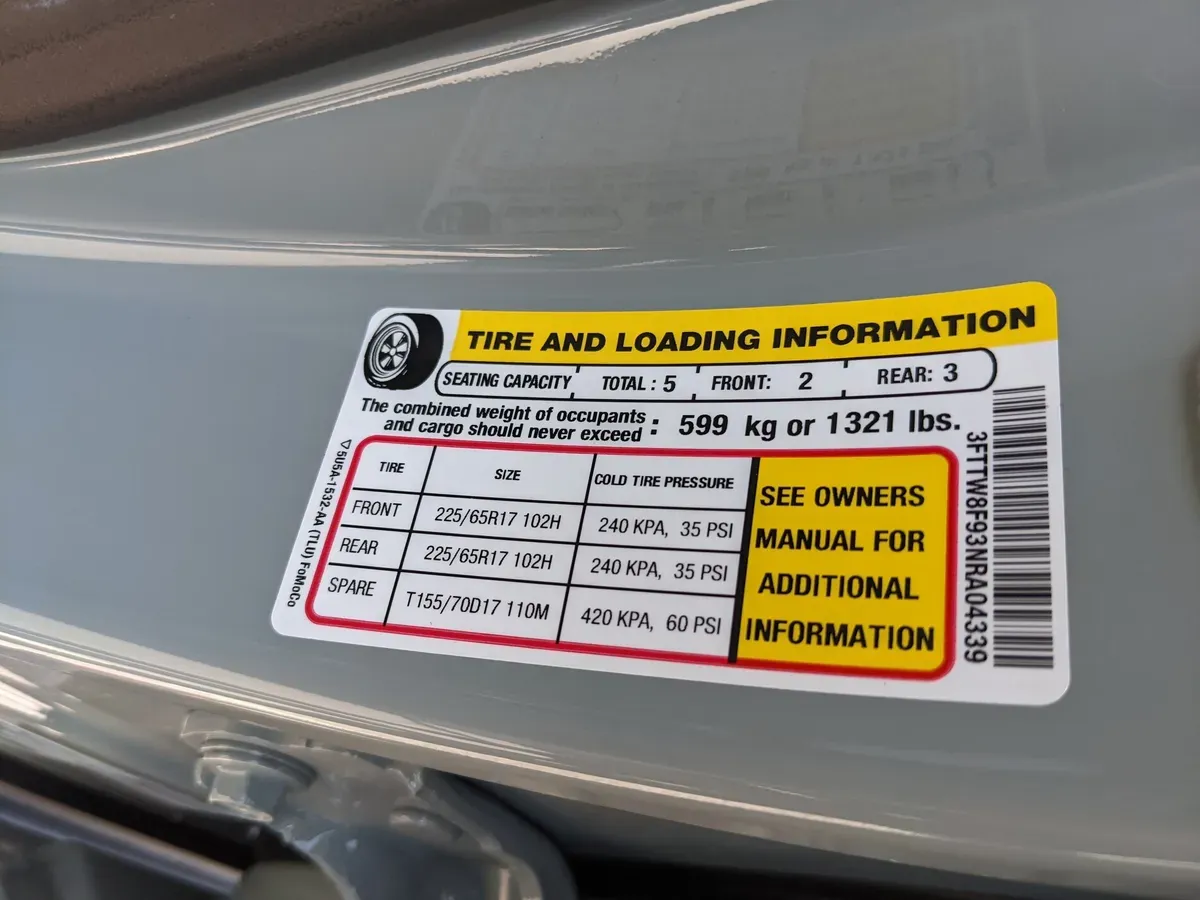
The definition that protects your truck: base dry weight under 1,400 pounds. A well-equipped half-ton typically offers 1,400–1,900 lbs of payload on the door sticker; a midsize more like 1,100–1,500. Once you subtract two adults, a full water tank (8.3 lbs per gallon), propane, batteries, and gear, a “1,200-lb camper” easily becomes 1,700 lbs of real load. Start under 1,400 and you have room for reality.
Weight also decides fuel economy (~1% per 100 lbs on the highway), handling on rough roads, and drivetrain happiness — one Expedition Portal seller sold his wedge because his lifted 4-cylinder Tacoma couldn’t handle it. Stay light and your truck usually stays a stock daily driver.
How We Picked the Best Lightweight Truck Campers for 2026
We narrowed 30+ campers to 15 across three designs — wedge toppers, pop-up slide-ins, hard-sides — and verified every figure in October 2026. Asterisked prices come from 2026 dealer or aggregator listings, not the factory — confirm before buying, since options swing these numbers fast.
Wedge & Canopy Campers
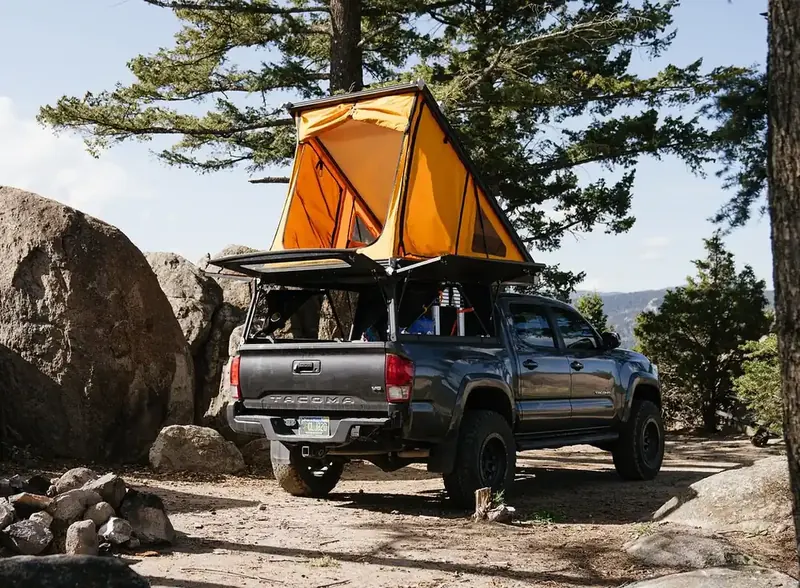
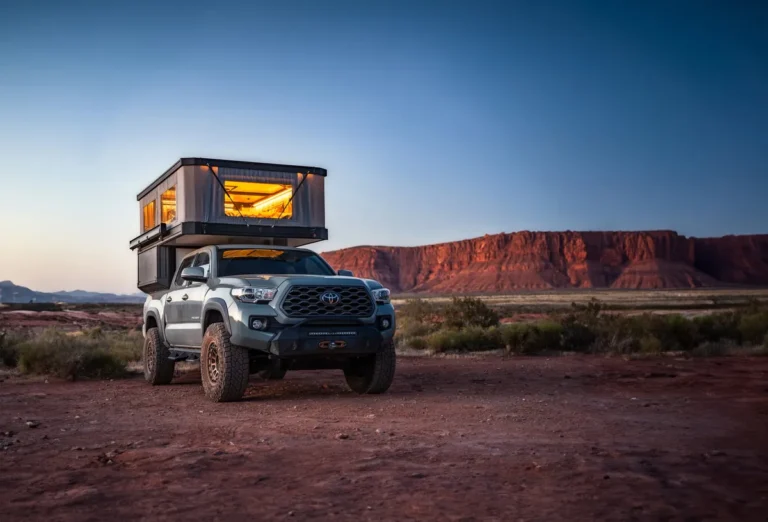
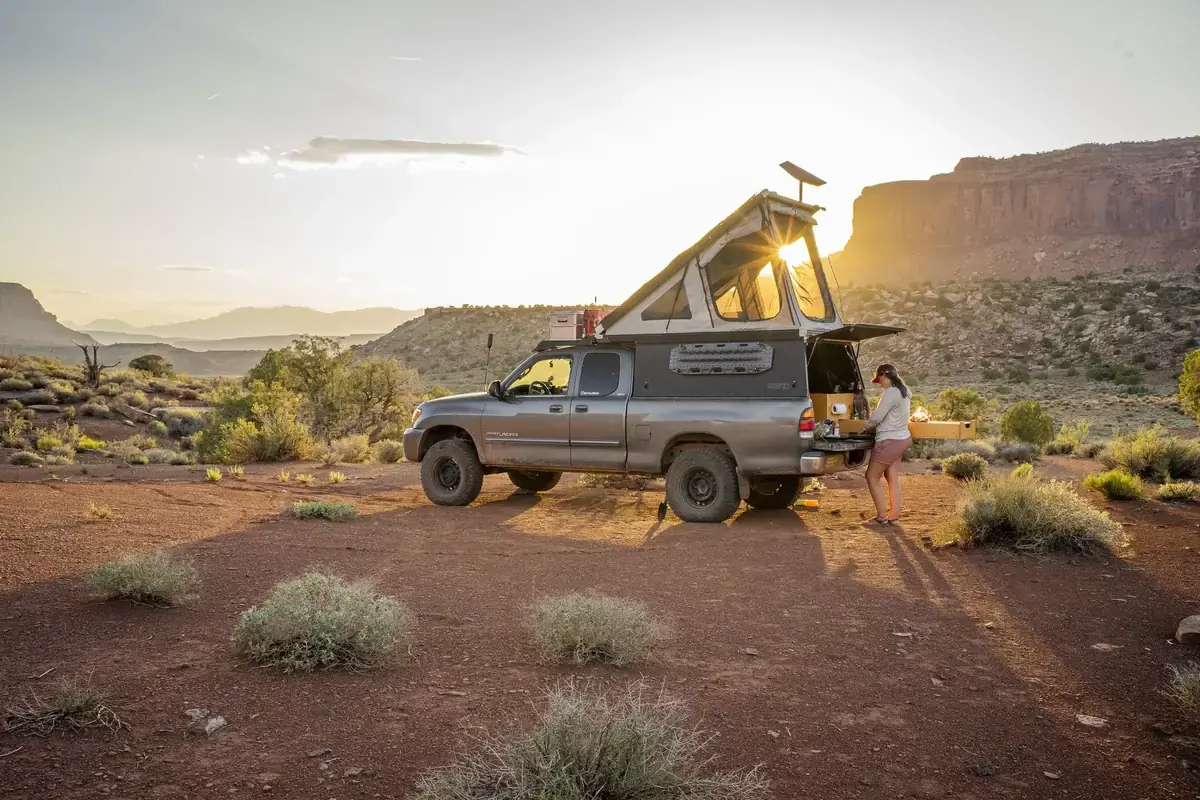
Wedges sit on your bed rails and pop up at an angle — the lightest category, bed still usable, minimal fuel-economy penalty. Our wedge camper roundup tracks them separately; these six make the short list.
Lone Peak Camper V2 — $7,000 | ~400 lbs
Lone Peak’s 2026 redesign adds a positive-pressure vent pushing air out through the tent — a direct answer to wedge camping’s two curses: 3 a.m. condensation drips and fine dust on dirt roads. You get a 4-inch dual-density mattress, blackout curtains, and real standing room. Tacoma-forum owners praise the value and fit-and-finish; just watch the options list climb past base price.
GFC Platform Camper V2 Pro — $8,000 | ~275 lbs
Go Fast Campers invented this category and the V2 Pro is still the weight benchmark: under 300 lbs on a midsize. The tubular aluminum spaceframe is field-repairable with hand tools, and the modular floor lets you stand inside with the bed half-deployed. Long-term Reddit owners report years of hard use. Gripes: the thin stock mattress (most add a topper) and long install-appointment waits.
OVRLND Custom Pop-Top — $8,700 | ~265 lbs
Flagstaff’s OVRLND builds the lightest pop-top here — the Bivy starts under 220 lbs, the cabover custom shell at 265 lbs for midsize trucks. The straight-wall vertical pop-up gives more usable volume than any wedge: 6’5″+ standing height, standard 60″ x 80″ queen. The DIY angle is the draw — straight aluminum walls take standard building materials. Industrial looks, and you’re buying direct from a small shop.
Tune M1L — $8,999 | ~350 lbs
The M1L is the streamlined Tune M1 sibling: same bolt-together aluminum build and full-length pop-top, smaller interior, about 350 lbs. It anchored the 2026 Overland Expo Ultimate Build on a Nissan Frontier — nearly seven feet of standing room with a north-south queen, the layout most couples prefer. Strong livability per pound; price is launch pricing, so confirm with Tune.
Tune M1 — $12,999 | ~400 lbs
The full M1 remains the space-to-weight champ: ~400 lbs for 269 cubic feet of midsize interior (323 for full-size), east-west queen over the cab, 6’4″+ headroom. Bolted panels are replaceable without welding; 440+ feet of T-track make it the easiest camper here to accessorize (official specs). Our Tune M1 review has the full story: owners love the airy feel and three-year warranty, but budget for the glass-wall option for real cold.
Super Pacific X1 — $13,495 | ~390 lbs
The X1 is the wedge for buyers who want it finished: Portland-built, aerospace-grade materials, Exped MegaMat standard, three locking canopy doors, marine-grade tent fabric for four-season use. “Living Room Mode” drops the bed platform for full standing height on rainy days. Priciest wedge here, no apology — owners say the quality justifies it.
Pop-Up Slide-In Campers
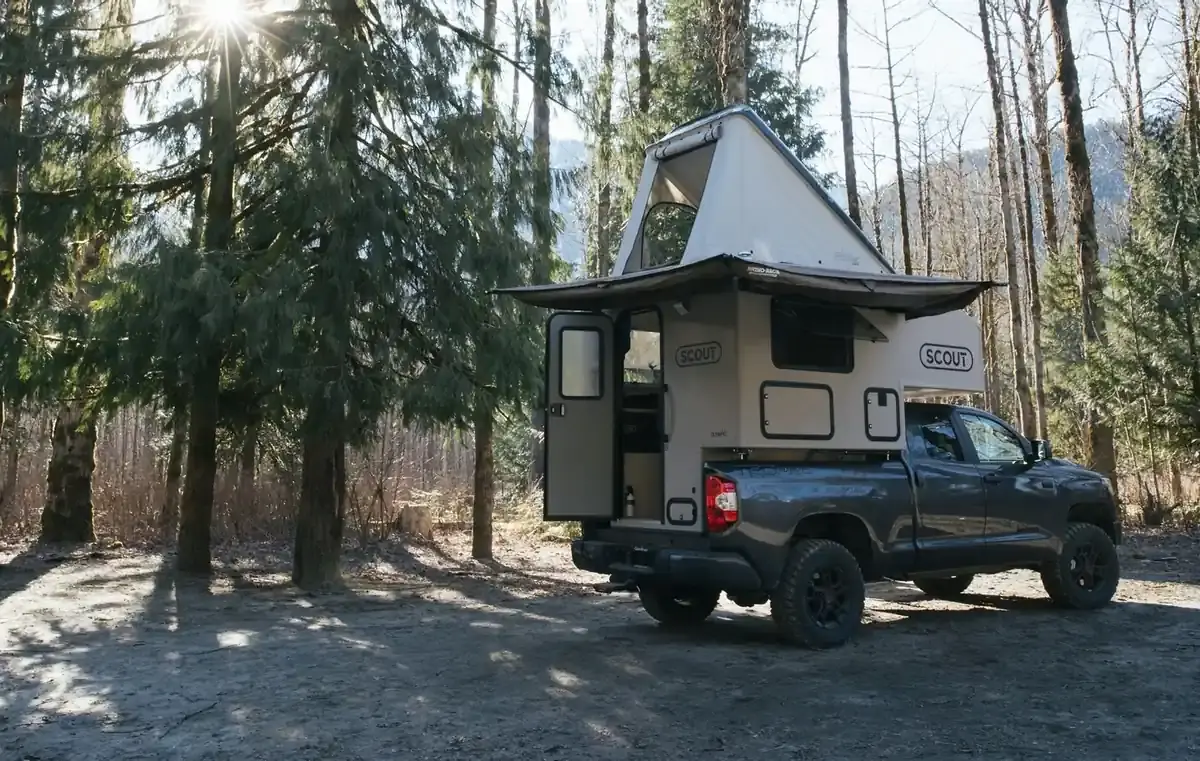
Slide-ins drop into the bed and come off on jacks, so the truck stays a truck on weekdays. Pop-up walls keep weight and profile down.
Four Wheel Campers Project M — $12,395 | ~360–470 lbs
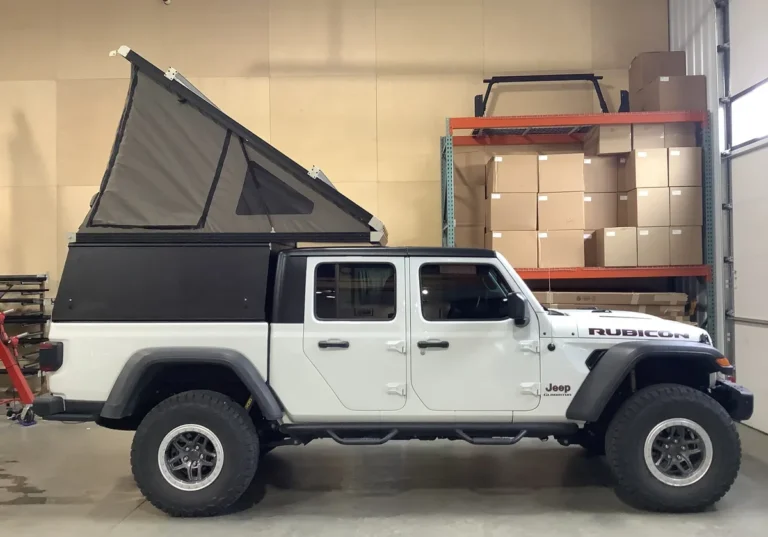
FWC’s topper-style pop-up bolts to your bed rails, keeps the factory bed and tailgate usable, and gives you a genuine FWC pop-top with an 81″ x 66–72″ cabover bed — from 358 lbs on a 5-foot midsize bed. The documented owner caveat: it seals against your factory bed, so dust enters through tailgate gaps and bedside openings on dirt roads. Owners on Wander the West report tailgate gasket kits, sealed bedside openings, and a small fan for positive pressure fix it. See our Fleet vs. Swift vs. Hawk guide for the full lineup.
Hiatus Camper — from ~$17,000 | 420–500 lbs
The only hard-wall pop-up topper here: aluminum and composite folding walls, up in under 15 seconds, fully insulated, genuinely four-season. No canvas flap, no soaked tent walls. Hiatus publishes no fixed prices — 2026 listings put base builds from ~$17,000, while a documented YouTube owner build on a Tacoma landed near $30,000 with options. Owners rave about winter comfort and the double rear doors; lead times have historically run long.
Four Wheel Campers CampOut — $25,995 | 860–1,030 lbs
FWC’s modular slide-in (860 lbs for the 5-foot midsize) lets you add galley, fridge, and seating modules over time — flat-packed for DIY install. It fits nearly every bed sold today. Heavier and pricier than the Project M, so be honest about whether you’ll use the modularity.
Scout Olympic — $29,990 | 1,072 lbs
Scout’s hard-wall flagship, verified on the factory site this month: 1,072 lbs dry, zero wood anywhere, aluminum exoskeleton over composite panels that can’t rot or delaminate. Sleeps 4–6, fits full-size half-tons, ships with 190W solar and the Unbound Power Tower lithium standard (factory specs). The minimalist philosophy means portable amenities, not fixed plumbing — great if you like modular, a dealbreaker if you want a built-in shower. Half-ton owners: do the payload math.
Scout Tuktut — ~$29,500 | 635 lbs
The lightest equipped slide-in here: 635-lb hard-side pop-up fitting everything from a Tacoma to a full-size. Shell-plus: buy it light, add Scout’s Basecamp package only if wanted. 2026 dealer listings cluster ~$29,500 as equipped. Owners love the tiny footprint and solo removal; the base shell is spartan, so budget for the options that make it a camper.
Scout Yoho — ~$34,600 | 904 lbs
Scout’s midsize sweet spot: 904 lbs dry for Tacoma, Ranger, and Frontier, with real headroom from the pop-up roof. 2026 dealer “Yoho Base” listings start ~$34,600. The most livable slide-in a midsize can responsibly carry — same wood-free build and standard solar/lithium as the Olympic. Pricey, but used Scouts hold value better than nearly anything in the category.
Lightweight Hard-Side Campers
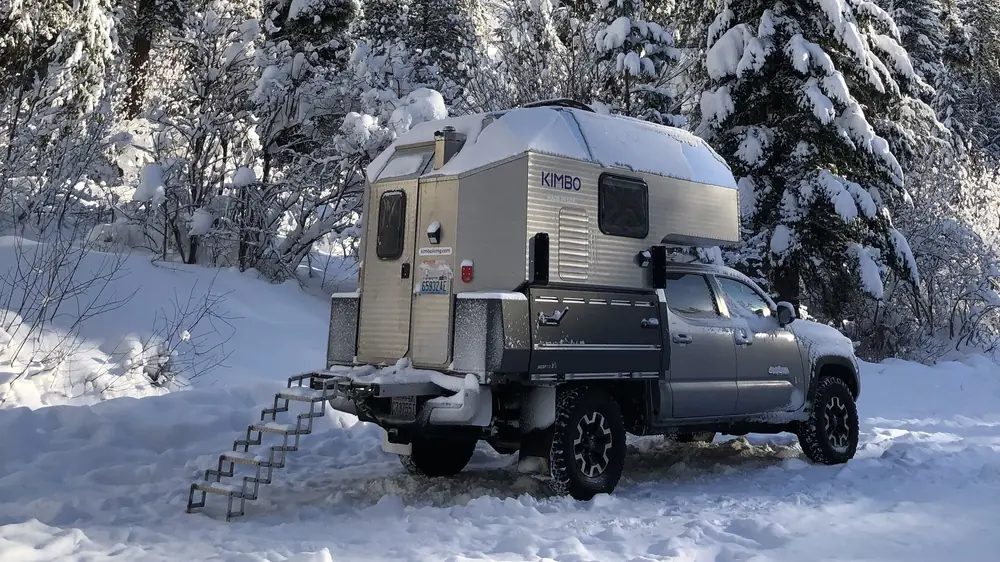
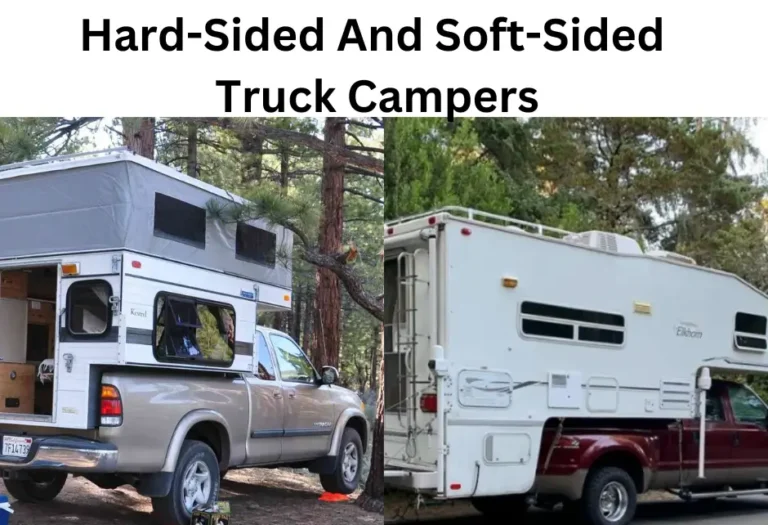
No canvas, no setup, no flapping — hard-sides cost weight but pay it back in insulation, security, and four-season comfort.
Capri Cowboy — $13,995 | 675 lbs
Hand-built in Texas for 55+ years, the 2026 Cowboy (mid-size) is $13,995 MSRP at just 675 lbs dry — the lightest hard-side here. Simple non-cab-over box: 100Ah AGM standard, vent fan, long options sheet (A/C, fridge, furnace, solar) so you build only what you’ll use. Owners praise the durability and that you can still tow with it on. Basic interior — a well-built shell with amenities, not a luxury camper.
Skinny Guy 6.5 Kit ‘N Kaboodle — ~$22,700 | ~800–1,050 lbs
Skinny Guy’s flip-top splits the difference: hard walls flipping open into a tent section, seating four with a slide-in footprint. 2026 dealer listings run from ~$22,700 equipped. The proprietary jack system keeps tailgate and hitch usable, and details like rainwater collection get mentioned unprompted by owners. Small company — confirm lead times; expect more setup than a fixed hard-side.
Kimbo 6 — $27,990 | 830 lbs
The industry’s only hand-riveted aluminum monocoque slide-in — no wood frame, no laminated walls, nothing to rot or delaminate. At 830 lbs dry (~1,200 loaded) it fits midsize and short-bed half-tons, sleeps two on a 54″ x 75″ cabover bed, and comes four-season ready with R5 insulation and a standard heater. Kimbo’s own comparison page lays out the trade: half the weight of a Lance 650, but no standard wet bath.
2026 Comparison Table: All 15 Picks
Here’s every one of the 15 best lightweight truck campers side by side, so you can compare dry weight, base price, and best use at a glance:
| Camper | Type | Dry Weight | Base Price | Best For |
|---|---|---|---|---|
| Lone Peak V2 | Wedge topper | ~400 lbs | $7,000 | Budget wedge with standing room |
| GFC Platform V2 Pro | Wedge topper | ~275 lbs | $8,000 | The lightest proven wedge |
| OVRLND Custom Pop-Top | Pop-top topper | ~265 lbs | $8,700 | DIY builders, max headroom |
| Tune M1L | Wedge topper | ~350 lbs | $8,999 | Ultra-light full stand-up topper |
| Tune M1 | Wedge topper | ~400 lbs | $12,999 | Space-to-weight, customization |
| Super Pacific X1 | Wedge topper | ~390 lbs | $13,495 | Premium fit and finish |
| FWC Project M | Pop-up topper | ~360–470 lbs | $12,395 | FWC quality, keep your truck bed |
| Hiatus Camper | Hard-wall pop-up topper | 420–500 lbs | ~$17,000* | Four-season hard-wall camping |
| FWC CampOut | Pop-up slide-in | 860–1,030 lbs | $25,995 | Modular, build-over-time interior |
| Scout Olympic | Hard-wall slide-in | 1,072 lbs | $29,990 | Full-size family basecamp |
| Scout Tuktut | Pop-up slide-in | 635 lbs | ~$29,500* | Lightest equipped slide-in |
| Scout Yoho | Pop-up slide-in | 904 lbs | ~$34,600* | Midsize slide-in comfort |
| Capri Cowboy | Hard-side slide-in | 675 lbs | $13,995 | Classic hard-side value |
| Skinny Guy 6.5 | Flip-top slide-in | ~800–1,050 lbs | ~$22,700* | Hard-wall + seats four |
| Kimbo 6 | Hard-side slide-in | 830 lbs | $27,990 | All-aluminum four-season tank |
2026 dealer/aggregator-listed prices — confirm with the builder or dealer before buying.
Payload Matching: The Math That Keeps You Legal (and Safe)
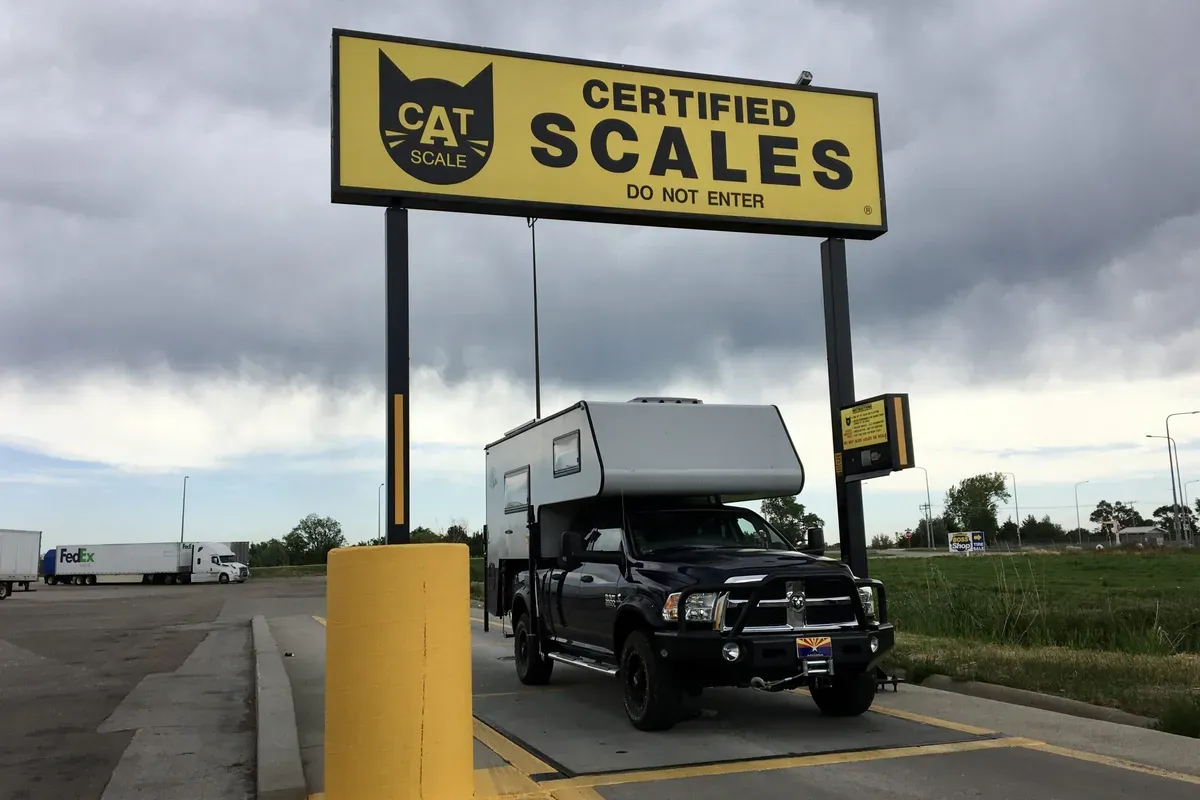
Do this before you fall in love with a camper.
1. Read your door-jamb sticker, not the brochure. Find the Tire and Loading Information placard on the driver’s door. “The combined weight of occupants and cargo should never exceed XXX lbs” is your real payload for your exact truck — a loaded 4×4 crew cab can show 400+ lbs less than the advertised max. Our payload calculator guide has the full worksheet.
2. Use the 10–30% buffer rule. Plan to run at 70–90% of the sticker number, never 100%. The margin covers the second battery, the bigger fridge, and the firewood — and keeps braking and emergency handling in the safe zone.
3. Dry weights lie — plan for it. Brochure weight means empty tanks, no batteries, no options, no gear. Reality: 10 gallons of water (83 lbs), a filled 20-lb propane tank (~38 lbs), a 100Ah lithium battery (~30 lbs), plus bedding, kitchen kit, tools, and options routinely add 300–500 lbs. Two adults add 300–350 more. Budget for 600–800 lbs over dry.
4. Airbags don’t create payload. Four Wheel Campers says it directly: airbags, SumoSprings, and upgraded shocks improve ride quality but don’t raise GVWR or payload. They’re the finishing touch on a matched rig, not a fix for an overloaded one. Same for the bumper, winch, and roof rack you already bolted on — all of it eats payload first.
Budget Picks vs. Premium Picks
Under $15,000, 2026 is the best the budget end has ever looked: Lone Peak V2 ($7,000), GFC V2 Pro ($8,000), OVRLND ($8,700), and Tune M1L ($8,999) are among the best lightweight truck campers for the money — they keep you light and leave thousands for power and accessories; the Capri Cowboy ($13,995) is the only true hard-side under the wire. Our budget truck camper guide goes deeper.
Over $25,000, you’re buying refinement and four-season capability: Scout’s wood-free construction with standard lithium/solar, the Kimbo 6’s riveted monocoque, the Hiatus’s insulated hard walls. The premium buys less maintenance, better cold-weather performance, and stronger resale — but not one extra pound of payload. The truck math doesn’t care what you paid.
The Best Picks for Midsize vs. Half-Ton Trucks
Midsize (Tacoma, Gladiator, Colorado, Ranger, Frontier): stay under ~900 lbs dry for a comfortable margin. The sweet spot: GFC V2 Pro, OVRLND, Tune M1L, Lone Peak V2, Super Pacific X1, or the Capri Cowboy for hard walls. The Scout Yoho (904 lbs) and Kimbo 6 (830 lbs) are the ceiling — only after checking your door sticker. The Project M even comes in a Gladiator-specific version.
Half-tons (F-150, Silverado/Sierra 1500, Ram 1500, Tundra): you can run anything here, but “can” isn’t “should.” A 1,072-lb Olympic plus water, gear, and family still pushes a modestly optioned half-ton toward its limit — a Tundra CrewMax can show as little as ~1,380 lbs of payload by trim. The Olympic, Tuktut, and CampOut are the best lightweight truck campers for turning that extra capacity into livability without demanding a 3/4-ton.
5 Buyer Mistakes We See Over and Over

1. Buying before weighing the truck. Load it the way you’ll travel — people, dog, gear, full fuel — and run it across a CAT scale. Subtract from GVWR: that’s your budget, not the brochure.
2. Ignoring condensation until the mattress is wet. The owner playbook: HyperVent mesh under the mattress so it dries from below, crack a window and run the roof fan low overnight, wipe the tent walls before closing up. Shoulder season? Owners line pop-up walls with Reflectix. Regular below-freezing camping is the argument for a hard-wall pick like the Hiatus or Kimbo.
3. Assuming the canvas is waterproof. The first hard rain reveals drips through stitch holes — owners report this constantly. Fix it in the driveway: silicone seam sealer along the stitching, then check window Velcro and corners after that first storm.
4. Forgetting the dust. Topper campers seal against your factory bed, and factory beds aren’t sealed. Dust pours through tailgate gaps and bedside openings — Project M owners document it extensively. Fixes: tailgate gasket kits, sealed bedside openings, a small fan for positive pressure. Do it before the first dusty trip.
5. Letting the camper walk. Slide-ins can shift in the bed on rough roads — one long-term FWC owner fixed his by shimming snugly against the wheel wells. Check tie-downs after the first few hundred dirt miles, then seasonally.
Frequently Asked Questions
What’s the lightest truck camper you can buy in 2026?
The OVRLND Bivy starts under 220 lbs and the GFC Platform Camper V2 Pro is ~275 lbs on a midsize — both toppers. For slide-ins, the Scout Tuktut at 635 lbs is the lightest equipped option. Lightest is only best if it fits how you camp.
Can a Toyota Tacoma carry a truck camper?
Yes, with a tighter margin than most expect: roughly 1,100–1,685 lbs of payload by trim. That fits any wedge here plus gear, and the Scout Yoho (904 lbs) or Kimbo 6 (830 lbs) if you pack light and skip the big water tank. Verify your door sticker — trim matters enormously.
Do I need airbags or suspension upgrades?
Usually not under ~500 lbs — most trucks handle toppers stock. Past ~800 lbs, many owners add airbags or springs for ride quality and leveling. They improve comfort, not your legal payload rating.
How much do water, propane, and gear really add?
Water is 8.34 lbs/gallon (a 10-gallon tank: 83 lbs plus the tank). A filled 20-lb propane tank is ~38 lbs; a 100Ah lithium battery ~30 lbs. Add bedding, kitchen kit, tools, and camper options, and 300–500 lbs over dry weight is normal — plus 300–350 for two adults. That’s the case for the payload buffer.
Wedge camper or slide-in — which is better for daily driving?
Wedges: lighter, lower profile, bed stays usable, minimal fuel-economy hit. Slide-ins: real headroom, better insulation options, removable on jacks. One vehicle + weekend camping? Start wedge. Long trips or winter camping? The slide-in’s comfort earns its weight.
How do I power a fridge, lights, and devices off-grid?
Size to the load: a 12V fridge draws ~30–50Ah/day, LEDs are negligible, a heater fan sips power. Most owners land on 100–200Ah of lithium plus ~200W of solar for week-long trips, with a DC-DC charger topping up while driving. The Scout line and Kimbo 6 ship lithium and solar standard.
All prices and weights verified October 2026. Manufacturers change pricing without notice — confirm current figures with the builder or dealer before you buy.